The Provisional Congress of the Confederate States is a congress of deputies and delegates called together from the Southern States which become the governing body of the Provisional Government of the Confederate States from February 4, 1861, to February 17, 1862. It sits in Montgomery until May 21, 1861, when it adjourns to meet in Richmond, Virginia, on July 20, 1861. It adds new members as other states secede from the Union and directs the election on November 6, 1861, at which a permanent government is elected.
The Second Session of the Provisional Congress is held at Montgomery from April 29, 1861, to May 21, 1861. It includes the members of the First Session with the additions of Virginia and Arkansas. John Tyler, the tenth president of the United States (1841–1845), serves as a delegate from Virginia in the Provisional Confederate States Congress until his death in 1862.
North Carolina and Tennessee join the Third Session of the Provisional Congress, which is held at Richmond from July 20, 1861, to August 31, 1861. Membership remains unchanged for the Fourth Session on September 3, 1861.
The Fifth Session of the Provisional Congress is held at Richmond from November 18, 1861, to February 17, 1862. All previous members are present with the additions of Missouri and Kentucky. One non-voting member is present from the Arizona Territory.
Doonican is the youngest of eight children of Agnes (née Kavanagh) and John Doonican. He is from a musical family and plays in his school band from the age of six. His father dies in 1941, so he has to leave De La Salle College Waterford to get factory jobs fabricating steel and making orange and grapefruit boxes. He begins to perform in his hometown, often with his friend Bruce Clarke, and they have their first professional engagement as a duo in 1947. He appears in a summer season at Courtown, County Wexford. He is soon featured on Irish radio, sometimes with Clarke, and appears in Waterford’s first-ever television broadcast.
In 1951 Doonican moves to England to join the Four Ramblers, who tour and perform on BBC Radio shows broadcast from factories, and on the Riders of the Range serials. He also begins performing at United States Air Force bases. The Ramblers support Anthony Newley on tour and, recognising Doonican’s talent and potential as a solo act, persuades him to leave the singing group and go solo. He is auditioned for radio as a solo act and appears on the radio show Variety Bandbox. Soon he has his own radio show and is performing in concerts and cabaret. In the late 1950s, he becomes one of the artists managed by Eve Taylor, the self-described “Queen Bee of Show Business,” who remains his manager until her death.
After seeing Doonican in cabaret in London in 1963, impresario Val Parnell books him to appear on Sunday Night at the Palladium. As a result of his performance, Bill Cotton, then Assistant Head of Light Entertainment at BBC Television, offers Doonican his own regular show. The TV shows are produced by Yvonne Littlewood and run for over 20 years. The shows feature his relaxed crooner style, sitting in a rocking chair wearing cardigans or jumpers, sometimes performing comedic Irish songs as well as easy listening and country material on which he accompanies himself on acoustic guitar. Being variety shows, his TV programmes give a number of other performers, such as Dave Allen, early exposure. Regular guests include Bernard Cribbins, Bob Todd, the Norman Maen Dancers, the Mike Sammes Singers, and the Kenny Woodman Orchestra. At its height The Val Doonican Show, which features both American and British acts, has 20 million viewers. In the United States, The Val Doonican Show airs on ABC on Saturday evenings from June 5 to August 14, 1971.
Behind the scenes, Doonican is described as “a perfectionist who knew his limitations but always aimed to be ‘the best Val Doonican possible.'” He is sometimes compared to American singer Perry Como, though he claims his main influence is Bing Crosby. He appears on Royal Variety Performance three times. On December 31, 1976, he performs his hit song “What Would I Be” on BBC One‘s A Jubilee of Music, celebrating British pop music for Queen Elizabeth II‘s impending Silver Jubilee.
Doonican wins the BBC Television Personality of the Year award in 1966. He is the subject of This Is Your Life in 1970. Eamonn Andrews meets him at the 18th green of the South Herts Golf Club as Doonican plays a round of golf. He writes two volumes of autobiography, The Special Years (1980) and Walking Tall (1985).
Doonican officially retires in 1990 but is still performing in 2009. He has a second home in Spain and is a keen golfer and a talented watercolour painter. Another hobby he enjoys is cooking. In June 2011, he is recognised by the Mayor of Waterford bestowing on him “The Freedom of the City.”
O’Brien is born on December 15, 1930, the youngest child of farmer Michael O’Brien and Lena Cleary at Tuamgraney, County Clare, a place she would later describe as “fervid” and “enclosed.” Her father inherits a “thousand acres or more” and “a fortune from rich uncles,” but is a “profligate” hard drinker who gambles away his inheritance, the land sold off or bartered to pay debts. From 1941 to 1946 she is educated by the Sisters of Mercy at the Convent of Mercy boarding school at Loughrea, County Galway – a circumstance that contributes to a “suffocating” childhood. In 1950, having studied at night at pharmaceutical college and worked in a Dublin pharmacy during the day, she is awarded a licence as a pharmacist. She reads such writers as Leo Tolstoy, William Makepeace Thackeray, and F. Scott Fitzgerald.
In Dublin, O’Brien purchases Introducing James Joyce, with an introduction written by T. S. Eliot, and says that when she learned that James Joyce‘s A Portrait of the Artist as a Young Man was autobiographical, it made her realise where she might turn, should she want to write herself. “Unhappy houses are a very good incubation for stories”, she says. In London she starts work as a reader for Hutchinson, a publishing firm, where on the basis of her reports she is commissioned, for £50, to write a novel. She publishes her first book, The Country Girls, in 1960. This is the first part of a trilogy of novels (later collected as The Country Girls Trilogy), which includes The Lonely Girl (1962) and Girls in Their Married Bliss (1964). Shortly after their publication, these books are banned and, in some cases, burned in her native country due to their frank portrayals of the sex lives of their characters. She is accused of “corrupting the minds of young women.” She later says, “I felt no fame. I was married. I had young children. All I could hear out of Ireland from my mother and anonymous letters was bile and odium and outrage.”
In the 1960s, O’Brien is a patient of R. D. Laing. “I thought he might be able to help me. He couldn’t do that – he was too mad himself – but he opened doors,” she later says. Her novel A Pagan Place (1970) is about her repressive childhood. Her parents were vehemently against all things related to literature. Her mother strongly disapproved of her daughter’s career as a writer. Once when her mother found a Seán O’Casey book in her daughter’s possession, she tried to burn it.
O’Brien is a panel member for the first edition of BBC One‘s Question Time in 1979. In 2017 she becomes the sole surviving member.
In addition to the Irish PEN Award, O’Brien’s awards include The Yorkshire Post Book Award in 1970 for A Pagan Place, and the Los Angeles Times Book Prize in 1990 for Lantern Slides. In 2006, she is appointed adjunct professor of English Literature at University College Dublin.
In 2019, O’Brien is awarded the David Cohen Prize for Literature at a ceremony in London. The £40,000 prize, awarded every two years in recognition of a living writer’s lifetime achievement in literature, has been described as the “UK and Ireland Nobel in literature.” Judge David Park says, “In winning the David Cohen Prize, Edna O’Brien adds her name to a literary roll call of honour.”
(Pictured: Edna O’Brien speaking at the 2016 Hay Festival, photo by Andrew Lih and licensed under the Creative Commons Attribution-Share Alike 3.0 Unported license)
The Duchies of Milan and Mantua are strategically important as the key to southern Austria. The French take possession of both in early 1701 but Emperor Leopold then sends Prince Eugene to recapture them. He is an extremely capable general who easily out manoeuvres his French counterparts, winning battles at Carpi and Chieri, after which his army takes up winter quarters in the pro-French Duchy of Mantua. Lack of funds and supplies from Vienna means Eugene has to improvise; since campaigning in the winter months is not usually done, he hopes to take the French by surprise.
Eugene has a contact inside Cremona, a priest named Cuzzoli. On the night of January 31, 1702, he admits a party of Imperial grenadiers by means of a hidden culvert and they seize control of the St. Margaret Gate. Once open, approximately 4,000 troops led by Prince Eugene in person take the French by surprise, many being killed as they emerge from their barracks, and François de Neufville captured in his quarters.
A second and larger force under Charles Thomas, Prince of Vaudémont intends to storm the Po gate and the Citadel but is late in arriving. This gives the garrison time to destroy a vital bridge and prepare, the assault being repulsed by two units of the Irish Brigade, the Régiment de Dillon and the Régiment de Bourke. The defenders now regroup and counterattack. With daylight and a French relief force arriving, Prince Eugene orders his troops to withdraw, the Austrians having suffered an estimated 1,600 casualties, the French around 1,100.
The two Irish units lose an estimated 350 out of 600 men engaged. Their commander, Major Daniel O’Mahoney, is later presented to Louis XIV and knighted by the Stuart exile James III. He goes on to have a distinguished career, fighting in Spain and Sicily. He ends as a Lieutenant-General and dies in Ocaña, Spain in 1714.
François de Neufville is soon released but his capture is commemorated in verse; Par la faveur de Bellone, et par un bonheur sans égal, nous avons conservé Crémone et perdu notre général (By the favour of Bellone, and a happiness without equal, we saved Crémone and lost our general).
The battle is also commemorated as a march entitled ‘The Battle of Cremona’ later used in the Irish Brigade.
The organization is set up to take over the work of the Irish National Land League after its leadership is imprisoned. They raise money for the Land League prisoners and their dependants. They encourage women to resist eviction from their cottages. If families are evicted, the Ladies’ Land League provides wooden huts to the evicted families.
The ladies find themselves with additional work late in 1881. The Land League has started its own paper, United Ireland, in August 1881, but towards the end of the year the government tries to close it down. William O’Brien, the editor, continues to smuggle out copy from Kilmainham Gaol, but it falls to the ladies to get it printed. This is done first in London and then for a while in Paris. Eventually the ladies print and circulate it themselves from an office at 32 Lower Abbey Street.
On Sunday, March 12, 1881, just more than a month after the formation of the league, a pastoral letter of Archbishop of DublinEdward McCabe is read out in all the churches of the diocese. It condemns the league in the strongest terms, deploring that “our Catholic daughters, be they matrons or virgins, are called forth, under the flimsy pretext of charity, to take their stand in the noisy street of life.” McCabe is not representative of all bishops, particularly Archbishop of CashelThomas Croke, a strong supporter of the original league. Croke publishes a letter in the Freeman’s Journal challenging the “monstrous imputations” in McCabe’s pastoral.
The dissension is revived somewhat in the summer of 1882. McCabe, now a Cardinal, and another bishop try to have a public condemnation of the Ladies’ Land League inserted into an address by the Catholic Bishops of Ireland in June. The other bishops resist on the basis that it would probably do more harm than good. They content themselves with expressing their hope that “the women of Ireland will continue to be the glory of their sex and the noble angels of stainless modesty.” When newspapers interpret this as a condemnation of the league, Croke writes again to the Freeman’s Journal to deny that this had been the intention of the bishops.
The order banning the Irish National Land League makes no direct reference to the Ladies’ Land League, but many police officers try to insist that the ban includes the women’s group. Eventually, on December 16, 1881, Inspector General Hillier of the Royal Irish Constabulary (RIC) orders the police to stop the women’s meetings. Anna Parnell defiantly issues a notice to all Ladies’ Land League branches in the country calling on them all to hold a meeting on January 1, 1882.
The prominent resident magistrate, Major Clifford Lloyd, claims that the huts built for evicted tenants are being used as posts from which the evicted tenants can intimidate anyone who attempts to take over their vacated holdings. In April 1882, he threatens that anyone attempting to erect huts will be imprisoned. That month, Anne Kirke is sent down from Dublin to Tulla, County Clare, to oversee the erection of huts for a large number of evicted tenants. Lloyd has her arrested and imprisoned for three months.
The government does not wish to be seen to use the Coercion Act to imprison women, but another stratagem is used. In December 1881 21-year-old Hannah Reynolds is imprisoned under an ancient statute from the reign of Edward III, the original purpose of which was to keep prostitutes off the streets. The statute empowers magistrates to imprison “persons not of good fame” if they do not post bail as a guarantee of their good behavior. Since Reynolds claims her behavior is good, she refuses to pay bail and spends a month in Cork gaol. In all, thirteen women serve jail sentences under this statute.
On May 3, 1882, Parnell and other leaders are released from jail after agreeing to the Kilmainham Treaty. This includes some improvement in the 1881 Land Act. He now wishes to turn his attention more to the Home Rule question. The Irish National Land League is replaced by the Irish National League. Parnell also wants to see an end to the Ladies’ Land League. There had been increased violence while he was in jail, and he sees Anna as too radical. The organization has an overdraft of £5,000 which Parnell agrees to clear from central funds only if the organization is dissolved. At a meeting of the Central Committee on August 10, 1882, the Ladies’ Land League votes to dissolve itself. Anna Parnell herself is not in attendance at that meeting having suffered a physical and mental collapse after the sudden death of her sister Fanny the previous month.
The records of the Ladies’ Land League are lost to history in 1916. Jennie Wyse Power, who had served on the Central Committee, had kept them in her house in Henry Street, Dublin. When fire spreads from Sackville Street during the 1916 Easter Rising, her house is destroyed, and the records perish in the blaze.
(Pictured: Lady Land Leaguers at work at the Dublin office)
Larkin is born to Irish parents in Liverpool, England, on January 21, 1876. He and his family later move to a small cottage in Burren, County Down. Growing up in poverty, he receives little formal education and begins working in a variety of jobs while still a child.
In 1905, Larkin is one of the few foremen to take part in a strike on the Liverpool docks. He is elected to the strike committee, and although he loses his foreman’s job as a result, his performance so impresses the National Union of Dock Labourers (NUDL) that he is appointed a temporary organiser.
Larkin moves to Belfast in 1907 to organise the city’s dock workers for the NUDL. He succeeds in unionising the workforce, and as employers refuse to meet the wage demands, he calls the dockers out on strike in June. Carters and coal men soon join in, the latter settling their dispute after a month.
In 1908, Larkin moves south and organises workers in Dublin, Cork, and Waterford, with considerable success. His involvement, against union instructions, in a dispute in Dublin results in his expulsion from the NUDL. The union later prosecutes him for diverting union funds to give strike pay to Cork workers engaged in an unofficial dispute. After trial and conviction for embezzlement in 1910, he is sentenced to prison for a year. This is widely regarded as unjust, and the Lord Lieutenant of Ireland, Lord Aberdeen, pardons him after he has served three months in prison.
After his expulsion from the NUDL, Larkin founds the Irish Transport and General Workers’ Union (ITGWU) at the end of December 1908. The organisation exists today as the Services Industrial Professional & Technical Union (SIPTU). In early 1909, Larkin moves to Dublin, which becomes the main base of the ITGWU and the focus of all his future union activity in Ireland.
In June 1911, Larkin establishes a newspaper, The Irish Worker and People’s Advocate, as a pro-labour alternative to the capitalist-owned press. In 1912, in partnership with James Connolly, Larkin helps form the Irish Labour Party.
In early 1913, Larkin achieves some successes in industrial disputes in Dublin. Two major employers, Guinness and the Dublin United Tramway Company, are the main targets of Larkin’s organising ambitions. The chairman of the Dublin United Tramway Company, industrialist and newspaper proprietor William Martin Murphy, is determined not to allow the ITGWU to unionise his workforce. On August 15, he dismisses 40 workers he suspects of ITGWU membership, followed by another 300 over the next week. On August 26, 1913, the tramway workers officially go on strike.
The resulting industrial dispute is the most severe in Ireland’s history. Employers in Dublin engage in a sympathetic lockout of their workers when the latter refuses to sign the pledge, employing blackleg labour from Britain and from elsewhere in Ireland. Guinness, the largest employer in Dublin, refuses the employers’ call to lock out its workers but it sacks 15 workers who struck in sympathy.
For seven months the lockout affects tens of thousands of Dublin workers and employers, with Larkin portrayed as the villain by Murphy’s three main newspapers, the Irish Independent, the Sunday Independent, and the Evening Herald, and by other bourgeois publications in Ireland. The lockout eventually concludes in early 1914 when calls by James Connolly and Larkin for a sympathetic strike in Britain are rejected by the British Trades Union Congress (TUC). Larkin’s attacks on the TUC leadership for this stance also lead to the cessation of financial aid to the ITGWU.
Some months after the lockout ends, Larkin leaves for the United States. He intends to recuperate from the strain of the lockout and raise funds for the union. Once there he becomes a member of the Socialist Party of America and is involved in the Industrial Workers of the World union (the Wobblies). He becomes an enthusiastic supporter of the Soviet Union and is expelled from the Socialist Party of America in 1919 along with numerous other sympathisers of the Bolsheviks during the Red Scare of that year.
Upon his return to Ireland in April 1923, Larkin receives a hero’s welcome and immediately sets about touring the country meeting trade union members and appealing for an end to the Irish Civil War. In September 1923, Larkin forms the Irish Worker League (IWL), which is soon afterwards recognised by the Communist International as the Irish section of the world communist movement.
James Larkin dies in his sleep on January 30, 1947, in the Meath Hospital in Dublin. Fr. Aloysius Travers, OFM, who had administered last rites to James Connolly in 1916, also administers extreme unction to Larkin. His funeral mass is celebrated by the Catholic Archbishop of Dublin, John Charles McQuaid, who had visited him in hospital before he died, and thousands line the streets of the city as the hearse passes through on the way to Glasnevin Cemetery.
Today a statue of “Big Jim” stands on O’Connell Street in Dublin, completed by Oisín Kelly and unveiled in 1979.
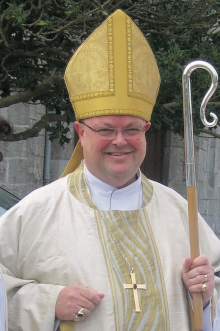
In 2013 Colton completes, and is conferred with, a PhD in Law also at Cardiff University. His academic areas of interest are church law, the law of the Church of Ireland, law within Anglicanism, the interface between the laws of religious communities and the laws of States (particularly in Ireland and Europe), human rights, education law, and charity law. In 2014 he is appointed as an honorary research fellow at the Cardiff School of Law and Politics of Cardiff University, and its Centre for Law and Religion.
Colton is married to Susan Colton, who is deputy principal of a primary school, and they have two adult sons. He is the first Church of Ireland bishop to openly support same-sex marriage. He is involved in education debates and in charity work. He chairs the board of directors of Saint Luke’s Charity, Cork, which focuses on the elderly and dementia sufferers. He is also chairman of the board of governors of Midleton College.
At the episcopal ordination of Bishop Fintan Gavin as Catholic bishop of Cork and Ross in June 2019, Colton presents the crosier at Bishop Gavin’s own request.
As of June 2020, Colton is the longest-serving bishop of Cork, Cloyne and Ross since bishop William Lyon in 1617 and also the longest serving bishop still in office in the Anglican churches of Ireland, England, Scotland and Wales. He is the author of almost a dozen book chapters, mostly in the area of the interface between religion and law.
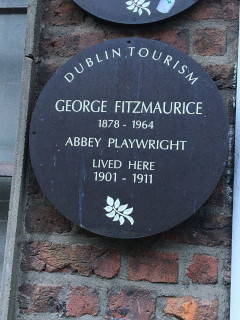
Fitzmaurice attends Duagh National School and later St. Michael’s College, Listowel. He is brought up in the Protestant faith as his father is a Protestant clergyman and is the vicar of St. John’s Church, Listowel. His father dies when he is fourteen years old and the family fortune declines. He takes a job in Dublin as a clerk in the Congested Districts Board for Ireland. In 1916 he enlists in the British Army and returns to Dublin after the war and is diagnosed with neurasthenia, rendering him fearful of crowds. On his return to Dublin, he takes up a position working for the Irish Land Commission.
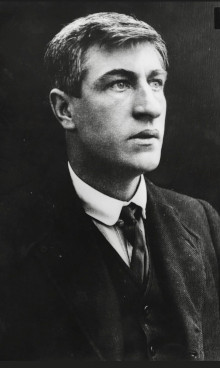
Fitzmaurice and his eleven siblings are the children of a mixed marriage. He and his brothers are brought up as Protestants and his sisters are brought up as Roman Catholics. His family home at Bedford, together with its extensive lands has to be given up as collateral in respect of a £60 debt owed to the local butcher. Neither Fitzmaurice nor any of his eleven siblings are to marry or have any offspring. He is the last Fitzmaurice of Duagh. There are no photographs of him other than a sketch of him in later life.
Fitzmaurice’s first success was in 1907, with an Abbey Theatre production of his comedy The Country Dressmaker which features one of his most famous characters, Luke Quilter, “The man from the mountain.” This character proves to be a favourite with the audience, to the surprise of William Butler Yeats. The play’s commercial success brings necessary income to the Abbey Theatre in 1907. The play is ultimately broadcast by the Radio Éireann Players.
Fitzmaurice’s second play is a dramatic fantasy called The Pie Dish. It is heavily rejected and slated by critics and considered blasphemous. This leads to the rejection of another of his plays called The Dandy Dolls which is now understood as another of his best plays. It is produced in the Abbey Theatre in 1969, six years after his death.
During Fitzmaurice’s lifetime, some of his dramatic works are produced by poet Austin Clarke in Lyric Theatre, Dublin. In 1923 his play Twixt by Giltinans and the Carmodys is also performed on Abbey and eight more of his plays are printed in the literary journey The Dublin Magazine from 1924 to 1925.
The effects of having fought in World War I lead to Fitzmaurice becoming increasingly reclusive over time. With a fear of travelling and people or crowds, he spends his later years following “monotonous routines in Dublin.” On May 12, 1963, he dies in poverty at his home at 3 Harcourt Street and is buried in Mount Jerome Cemetery. In his room there are no pictures of himself, few personal mementos, but he does have a copy of almost every play he had published, as well as some unpublished drafts. Besides his personal clothing, there is little else. He dies without leaving a will.
In 1965, RTÉ reports that “the works of George Fitzmaurice are now undergoing something of a revival.” A fellow Kerry playwright, John B. Keane, states at the time that Fitzmaurice is increasingly being recognised as the great dramatist he truly was. He also describes his work as having “practical clarity of speech coupled with a great conciseness, and a tightness in his writing and in his construction.” Michael Connor, the man who owns the Fitzmaurice property in Daugh, recounts that he often saw Fitzmaurice in the town after his retirement from the civil service but by that time the dramatist had completely lost interest in seeing his own plays on the stage.
In his native Daugh, The George Fitzmaurice Library is founded, and on October 14, 1995, a headstone that is sculpted by a local and commissioned by the Duagh Historical Society, is placed over Fitzmaurice’s grave.
Martin is born Marie Helena Martin in Glenageary, County Dublin, on April 24, 1892, the second of twelve children of Thomas Martin and Mary Moore. In 1904, while attending classes for her First Communion, she contracts rheumatic fever, which is to affect her heart permanently. Tragedy hits the family on St. Patrick’s Day 1907, as her father is killed in what is presumed to be an accidental shooting. Later her mother sends her to schools in Scotland, England and Germany, all of which she leaves as quickly as possible.
Upon the outbreak of World War I, Martin joins the Voluntary Aid Detachment, a division of the Red Cross. In October 1915, she is assigned to work in Malta. After learning that her brother had been killed in the campaign of Gallipoli, she returns to Ireland in April 1916. She is called to serve again a month later at Neufchâtel-Hardelot, France, in a field hospital near the front lines of the Battle of the Somme. This assignment lasts until December of that year, followed by a brief stint in Leeds, England. After the war, she is called upon help in nursing victims of the Spanish flu, which had begun to devastate populations around the world.
In 1917 a new curate comes to the parish which Martin attends, the Reverend Thomas Roynane, to whom she turns for guidance. Roynane inspires her with an interest in pursuing missionary work. She goes to England in January 1919 for further medical training. Her mother’s severe illness the following year interrupts her training, however, as she has to return home to care for her.
In April 1920, Roynane arranges for Martin to meet the new bishop, and she volunteers her services as a lay missionary to work in his jurisdiction in southern Nigeria. Agnes Ryan, a local schoolteacher now in her fourth year of medical training, advises her that she wishes to join her in the African mission.
In April 1921, Martin and Ryan leave Ireland for Nigeria. They set sail for Africa from Liverpool on May 25 and arrive in the port of Calabar on June 14. They arrive prepared to provide medical care, only to learn that they are expected to run a school which had been staffed by French Religious Sisters until two years prior. To give the parents and children of the school a sense of continuity, the two women are addressed as “Sisters” by the priests and treated as if they are already members of an established religious institute.
By October, Ryan contracts malaria and develops a heart condition, which require her return to Ireland. Forced to fill in as Acting Headmistress, Martin meets with the bishop in his headquarters at Onitsha and is advised that caution is needed in providing medical care to the people of her mission, so as not to provoke objections by other missionaries in the region. Upon her return to Calabar, she makes a 30-day retreat.
In April 1922 the bishop travels there and holds two weeks of consultations with Martin, Roynane and another missioner, during which the Rule and Constitutions of a new congregation are hammered out, with the understanding that Martin will be the foundress. Martin does not see the bishop again for two years. During this time, she learns that the bishop is working to establish the new congregation in Ireland, a direction she feels will focus the congregation on teaching rather than the medical care. An Irish Sister of Charity, Sister Magdalen Walker, is released from her congregation to help in this new work and arrives in Calabar in October 1923.
The following January Martin is directed by the bishop to return to Ireland to make a canonicalnovitiate. In March she starts her time of postulancy, prior to admission to the novitiate year. After 18 months, however, upon completion of the novitiate year she leaves the community, as the training provided by the Dominican Sisters has not been oriented toward medical care.
In this formal step of forming the new congregation, Martin encounters the prohibition in the new Code of Canon Law of 1917 of the Catholic Church against members of religious orders practicing medicine. Facing this barrier, she still feels a call to consecrated life and considers following the example of the recently canonizedCarmelite nun, Thérèse of Lisieux. In 1927 she applies to the community of that Order in Dublin, but her application is declined, solely on the decision of the prioress who feels that Martin is called to a different path in life. She then goes through a new period of confusion until she is requested to consider again serving the missions. She then forms a small group of women to provide the domestic service for the preparatory school run by the BenedictinemonksGlenstal Abbey.
In 1933, following a long period of illness, Martin approaches the new Apostolic Nuncio to Ireland, ArchbishopPaschal Robinson. He is supportive of her goals and encourages her continually over the next years. Finally, in February 1936, the Holy See lifts prohibition against Religious Sisters serving as doctors or midwives. She then seeks a diocese which will accept a new congregation, without success. In October of that same year, Antonio Riberi is named Apostolic Delegate in Africa, based in Kenya. He gives his support to having the congregation established in Calabar.
While still negotiating to purchase a house in Ireland as a local base, complicated by the fact that they are not yet a formal congregation, the small community sails for Nigeria at the end of 1936. Upon their arrival Martin suffers a heart attack and is hospitalized at Port Harcourt. It is there that she professes religious vows on April 4, 1937. With that the Medical Missionaries of Mary become established.
Martin’s health is always a source of concern, but she lives until 1975. Today the Medical Missionaries of Mary number some 400 women from 16 different nations, who serve in 14 different countries around the world.
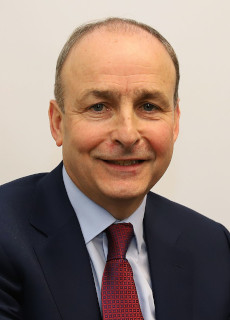
While Martin is Minister for Health and Children in 2004, he introduces a ban on tobacco smoking in all Irish workplaces and establishes the Health Service Executive (HSE). Ireland is the first country to introduce a full workplace smoking ban. As Foreign Minister, in 2009, he travels to Latin America for the first time and makes the first official visit to Cuba by an Irish Minister. That same year, he travels to Khartoum following the kidnapping of Sharon Commins and Hilda Kawuki. In 2010, he becomes the first Western foreign minister to visit Gaza since Hamas took control there in 2007.
In January 2011, Martin resigns as Minister for Foreign Affairs and is subsequently elected as the eighth leader of Fianna Fáil following Cowen’s resignation as party leader. In the 2011 Irish general election, he leads the party to its worst showing in its 85-year history, with a loss of 57 seats and a drop in its share of the popular vote to 17.4%. In the 2016 Irish general election, Fianna Fáil’s performance improves significantly, more than doubling their Dáil representation from 20 to 44 seats. In the 2020 Irish general election, Fianna Fáil becomes the largest party, attaining the most seats at 38, one seat ahead of Sinn Féin with 37 seats. He is appointed Taoiseach on June 27, 2020, leading a grand coalition with longtime rival Fine Gael and the Green Party as part of a historic deal. Under the terms of the agreement, Martin’s predecessor, Leo Varadkar, becomes Tánaiste, and will swap roles with Martin in December 2022.



 seamus dubhghaill