seamus dubhghaill

Promoting Irish Culture and History from Little Rock, Arkansas, USA


2 Comments

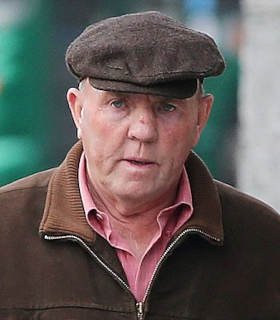
Birth of Irish Republican Thomas “Slab” Murphy

Thomas Murphy, Irish republican also known as “Slab” and believed to be a former Chief of Staff of the Provisional Irish Republican Army, is born on August 26, 1949. His farm straddles County Armagh and County Louth on the border between Northern Ireland and the Republic of Ireland. One of three brothers, he is a lifelong bachelor who lives on the Louth side of his farm prior to his imprisonment in February 2016 following a tax evasion conviction.

Murphy is allegedly involved with the South Armagh Brigade of the IRA before being elected Chief of Staff by the IRA Army Council. Toby Harnden, ex-correspondent for The Daily Telegraph, names him as planning the Warrenpoint ambush of 1979, in which 18 British soldiers are killed. He is also allegedly implicated in the Mullaghmore bombing the same day, which kills four people, including two children and Louis Mountbatten, 1st Earl Mountbatten of Burma. He is involved in smuggling huge stockpiles of weapons from Libya in the 1980s and is a member of the Army Council that decides to end its first ceasefire with the 1996 Docklands bombing in London that kills two men.

Accused by The Sunday Times of directing an IRA bombing campaign in Britain, in 1987 Murphy unsuccessfully sues the paper for libel in Dublin. The original verdict is overturned by the court of appeal because of omissions in the judge’s summing up and there is a retrial, which he also loses. At the retrial, both Sean O’Callaghan and Eamon Collins, former members of the Provisional Irish Republican Army, testify against Murphy, as do members of the Gardaí, Irish customs officials, British Army and local TD Brendan McGahon. Collins, who had also written a book about his experiences, Killing Rage, is beaten and killed by having a spike driven through his face near his home in Newry eight months later. In 1998, a Dublin court dismisses Murphy’s case after a high-profile trial, during which Murphy states that he has “never been a member of the IRA, no way” and claims not to know where the Maze prison is located. The jury rules, however, that he is an IRA commander and a smuggler.

The Sunday Times subsequently publishes statements given by Adrian Hopkins, the skipper who ferries weapons from Libya to the IRA, to the French authorities who intercept the fifth and final Eksund shipment. Hopkins details how Murphy met a named Libyan agent in Greece, paid for the weapons to be imported, and helped unload them when they arrived in Ireland. According to A Secret History of the IRA by Ed Moloney, Murphy has been the IRA Army Council’s chief of staff since 1997. Toby Harnden’s Bandit Country: The IRA & South Armagh also details Murphy’s IRA involvement.

On September 20, 2016, the BBC‘s Spotlight airs a programme in which an alleged British spy who had infiltrated the IRA claims that in 2006, Murphy had demanded the killing of Denis Donaldson, an IRA member and British informer, in order to maintain discipline. The BBC says it had tried to contact Murphy but had received no reply. He has yet to respond to the allegation. On September 23, 2016, the Donaldson family’s solicitor says that the allegation is “absolute nonsense.”

In October 2005, officers of the British Assets Recovery Agency and the Irish Criminal Assets Bureau carry out raids on a number of businesses in Manchester and Dundalk. It is extensively reported in the media that the investigation is aimed at damaging the suspected multi-million-pound empire of Murphy, who according to the BBC’s Underworld Rich List, has accumulated up to £40 million through smuggling oil, cigarettes, grain and pigs, as well as through silent or partial ownership in legitimate businesses and in property.

A large, purpose-built underground chamber that Gardaí believes the IRA used for interrogation is discovered close to Murphy’s home.

In his first-ever press release, issued on October 12, 2005, Murphy denies he owned any property and denies that he had any links with co-accused Cheshire businessman Dermot Craven. Furthermore, he claims that he had to sell property to cover his legal fees after his failed libel case against The Sunday Times, and that he made a living from farming.

On March 9, 2006, police, soldiers and customs officials from both sides of the Irish border launch a large dawn raid on Murphy’s house and several other buildings in the border region. Three persons are arrested by the Gardaí but are released three days later. A fleet of tankers, computers, documents, two shotguns, more than 30,000 cigarettes and the equivalent of 800,000 euros in sterling bank notes, euro bank notes and cheques are seized. Four diesel laundering facilities attached to a major network of storage tanks, some of which are underground, are also found. The Irish Criminal Assets Bureau later obtains seizure orders to take possession of euro cash and cheques and sterling cash and cheques, together worth around one million Euros.

Sinn Féin President Gerry Adams makes a public statement in support of Murphy following the March 2006 raids. Under political and media pressure over allegations of the IRA’s continued presence in South Armagh, Adams says, “Tom Murphy is not a criminal. He’s a good republican and I read his statement after the Manchester raids, and I believe what he says and also and very importantly he is a key supporter of Sinn Féin’s peace strategy and has been for a very long time.” He adds, “I want to deal with what is an effort to portray Tom Murphy as a criminal, as a bandit, as a gang boss, as someone who is exploiting the republican struggle for his own ends, as a multimillionaire. There is no evidence to support any of that.”

Commenting in Armagh on Murphy’s imprisonment for tax fraud, Arlene Foster, First Minister of Northern Ireland says, “Whilst some people refer to Murphy as a ‘good republican’ the people of this area know him to be a criminal.”

Murphy is arrested in Dundalk, County Louth, on November 7, 2007, by detectives from the Criminal Assets Bureau, on charges relating to alleged revenue offences. The following day, he is charged with tax evasion under the Tax Consolidation Act. He is later released on his own bail of €20,000 with an independent surety of €50,000.

On October 17, 2008, in an agreed legal settlement, Murphy and his brothers pay over £1 million in assets and cash to the authorities in Britain and the Republic in settlement of a global crime and fraud investigation relating to proceeds of crime associated with smuggling and money laundering. After an investigation involving the Irish Criminal Assets Bureau and the UK’s Serious Organised Crime Agency, more than 625,000 euros (£487, 000) in cash and cheques is confiscated by the Republic’s courts, while nine properties in North West England worth £445,000 are confiscated by British courts. Murphy is still fighting a claim in the Republic’s courts for tax evasion, relating to non-completion of tax returns for eight years from 1996. On April 26, 2010, he is further remanded on bail.

In 2011, there are claims that Murphy had become disillusioned with the Northern Ireland peace process and that he had fallen out with Sinn Féin. However, there is no evidence to support he is sympathetic to any dissident republican groups. In March 2013, the Garda and the Police Service of Northern Ireland (PSNI), along with members of the Irish Customs Authority and HM Revenue and Customs (HMRC), raid his farm on the Louth-Armagh border. The Sunday World reports that two hours prior to the raid, at approximately 4:00 a.m., fire is seen coming from Murphy’s yard. There are serious concerns within the Garda and PSNI that a mole may have tipped off Murphy about the raid hours earlier as laptops, computer disks and a large amount of documentation is destroyed in the fires. As a result, an internal Garda investigation takes place.

On December 17, 2015, Murphy is found guilty on nine charges of tax evasion by a three-judge, non-jury Special Criminal Court trial sitting in Dublin, lasting nine weeks. He is tried under anti-terrorist legislation due to the belief by the Director of Public Prosecutions (DPP) that there would not be a fair trial because of the potential of the intimidation of prosecution witnesses and jurors, and the security surrounding the trial.

Murphy is found guilty on all charges of failing to furnish tax returns on his income as a “cattle farmer” between 1996 and 2004. He is prosecuted following a 14-year-long Criminal Assets Bureau investigation, which during a raid of his property uncovers bags with more than €250,000 and more than £111,000 sterling in cash, along with documents, diaries and ledgers. He is remanded on bail until early 2016 for sentencing.

On February 26, 2016, Murphy is sentenced to 18 months in prison. None of the jail term is suspended. Following sentencing, he is immediately transferred from court to Ireland’s highest-security prison, Portlaoise Prison, reserved for terrorists, dissident republicans and serious gangland criminals, under a heavily armed Garda and Irish Army escort due to security concerns.

Murphy appeals the conviction in November 2016. His lawyer, John Kearney, claims that the tax Murphy had not paid had in fact been paid by his brother, Patrick. The Court of Appeal dismisses the appeal on all grounds in January 2017.

In January 2017, and scheduled for release in April 2018, Murphy is moved from Midlands Prison in Portlaoise to the Loughan House low-security prison in County Cavan.

Leave a comment

Death of Anew McMaster, Touring Shakespearean Actor & Manager

Anew McMaster, the last of the touring actor-managers who presents William Shakespeare’s plays throughout the United Kingdom, Ireland, Australia and the United States, dies in Dublin on August 24, 1962. For almost 35 years he tours as actor-manager of his own theatrical company performing the works of Shakespeare and other playwrights.

McMaster is born as Andrew McMaster on December 24, 1891, the son of Liverpool-born Andrew McMaster, a master stevedore, and Alice Maude (née Thompson). A number of sources make the erroneous claims, based on details supplied by McMaster himself, that he is born in 1893 or 1894 or even 1895 in County Monaghan in Ireland, but according to the Birth Register and the 1901 Census he is actually born in 1891 in Birkenhead, England. Like his future brother-in-law, Micheál Mac Liammóir, who is born in London as Alfred Willmore but who claims to have been born in Cork to Gaelic-speaking parents, McMaster reinvents himself as Irish and claims for himself the town of Monaghan as his birthplace, and Warrenpoint, County Down, as the scene of his earliest memories.

At the age of 19, McMaster gives up a career in banking to pursue one on the stage. He moves to Ireland and tours the country with the O’Brien-Ireland theatrical company from 1910 to 1914. Success quickly follows with his appearance as Jack O’Hara in Paddy the Next Best Thing at the Savoy Theatre in 1920. From 1921 he tours Australia in this and other plays, and in 1925 forms his own company, the McMaster Intimate Theatre Company, a “fit-up” company to tour in the works of Shakespeare, mainly in Ireland but also in Britain and Australia, touring with his theatrical company until 1959. One of the last actor-managers “of the old school – and an epitome of the type,” on occasions McMaster persuades a “big name” to act with his company as a draw for audiences, and Frank Benson (1928), Sara Allgood (1929) and Mrs. Patrick Campbell appear with him.

In 1933 at the Shakespeare Memorial Theatre in Stratford-upon-Avon McMaster appears as Hamlet opposite Esme Church as Gertrude, Coriolanus, Macduff in Macbeth, Leonato in Much Ado About Nothing, Prince Escalus in Romeo and Juliet, and Petruchio in The Taming of the Shrew. His greatest roles are as Othello and as Shylock in The Merchant of Venice, to which he adds King Lear in 1952. Just before World War II he and his company appear at the Chiswick Empire in a Shakespeare season. He tours the United States as James Tyrone in Eugene O’Neill‘s Long Day’s Journey into Night in 1956. Having “a great organ voice,” Harold Pinter, who acts in his company in Ireland from 1951 to 1953 and calls him “Perhaps the greatest actor-manager of his time,” later describes McMaster as “evasive, proud, affectionate, shrewd, merry.” In his brief biography Mac (1968), Pinter recalls, “Mac gave about a half dozen magnificent performances of Othello while I was with him… At his best he was the finest Othello I have seen. [He] stood dead in the centre of the role, and the great sweeping symphonic playing would begin, the rare tension and release within him, the arrest, the swoop, the savagery, the majesty and repose.”

McMaster’s only film role is an uncredited appearance as the Judge in Sword of Sherwood Forest (1960).

In 1924 McMaster marries the actress and designer Marjorie Willmore, the sister of Micheál Mac Liammóir. They have two children, the actors John Christopher McMaster and Mary-Rose McMaster.

McMaster dies at the age of 70 at his home in Dublin on August 24, 1962. He is buried with his wife in Dean’s Grange Cemetery in County Dublin.

McMaster trains a generation of actors who tour with his company and go on to achieve success as actors. These include Pauline Flanagan, Milo O’Shea, T. P. McKenna, Kenneth Haigh, Henry Woolf, Harold Pinter, Donal Donnelly and Patrick Magee. It is while they are touring with McMaster’s company that the actor and dramatist Micheál Mac Liammóir and the actor and producer Hilton Edwards first meet and begin their lifelong partnership.

McMaster’s biography, A Life Remembered: A Memoir of Anew McMaster, by his daughter Mary-Rose McMaster, is published in 2017. Harold Pinter also publishes a short biography, Mac, in 1968.


Leave a comment

The Electricity Supply Board (ESB) is Established

The Electricity Supply Board (ESB; Irish: Bord Soláthair an Leictreachais), a state-owned electricity company operating in the Republic of Ireland, is established on August 11, 1927, by the fledgling Irish Free State government under the Electricity (Supply) Act 1927, to manage Ireland’s electricity supply after the successful Shannon hydroelectric scheme at Ardnacrusha and take over all existing projects for the electrification of Ireland. While historically a monopoly, the ESB now operates as a commercial semi-state concern in a “liberalised” and competitive market. It is a statutory corporation whose members are appointed by the government of Ireland.

The Shannon hydroelectric scheme at Ardnacrusha is Ireland’s first large-scale electricity plant and, at the time, it provides 80% of the total energy demands of Ireland. To give an idea of the growth in demand, the output of Ardnacrusha is now approximately two per cent of national peak demand for power.

By 1937, plans are being finalised for the construction of several more hydroelectric plants. The plans called for stations at Poulaphouca, Golden Falls, Leixlip (all in Leinster), Clady, Cliff and Cathaleen’s Fall (between Belleek and Ballyshannon in County Donegal), Carrigadrohid and Inniscarra (in County Cork). All these new plants are completed by 1949 and together harness approximately 75% of Ireland’s inland waterpower potential. Many of these plants are still in operation, however, as can be expected with continuing growth in demand, their combined capacity falls far short of Ireland’s modern needs.

With Ireland’s towns and cities benefiting from electricity, the new government pushes the idea of Rural Electrification. Between 1946 and 1979, the ESB connects in excess of 420,000 customers in rural Ireland. The Rural Electrification Scheme is described as “the Quiet Revolution” because of the major socio-economic change it brings about. The process is greatly helped in 1955 by the Electricity Supply Amendment Act, 1955.

In 1947, the ESB, needing ever more generation capacity, builds the North Wall station on a 7.5-acre site in Dublin‘s industrial port area on the north side of the River Liffey on the site of an old oil refinery. The original station consists of one 12.5 MW steam turbine that is originally purchased for a power station at Portarlington but instead used at North Wall. Other power stations built around this time include the peat fired stations at Portarlington, County Laois, and Allenwood, County Kildare.

Because of the risks of becoming dependent on imported fuel sources and the potential for harvesting and utilising indigenous peat, the ESB – in partnership with Bord na Móna – establishes those stations and ESB also builds Lanesboro power station in 1958. Located in County Longford, the plant burns peat, cut by Bord na Móna in the bogs of the Irish midlands. In 1965, the Shannonbridge station, located in County Offaly, is commissioned. The two stations have been replaced by new peat-fired stations near the same locations, and peat is also used to power the independent Edenderry Power Station in County Offaly.

As in most countries, energy consumption is low at night and high during the day. Aware of the substantial waste of night-time capacity, the ESB commissions the Turlough Hill pumped-storage hydroelectric station in 1968. This station, located in County Wicklow, pumps water uphill at night with the excess energy created by other stations, and releases it downhill during the day to turn turbines. The plant can generate up to 292 MW of power, but output is limited in terms of hours because of the storage capacity of the reservoir.

The 1970s bring about a continued increase in Ireland’s industrialisation and with it, a greater demand for energy. This new demand is to be met by the construction of the country’s two largest power stations – Poolbeg Generating Station in 1971 and Moneypoint Power Station in 1979. The latter, in County Clare, remains Ireland’s only coal-burning plant and can produce 915 MW, just shy of the 1015 MW capacity of Poolbeg. In 2002 and 2003, new independent stations, Huntstown Power (north Dublin) and Dublin Bay Power (Ringsend, Dublin), are constructed.

In 1991, the ESB establishes the ESB Archive to store historical documents relating to the company and its impact on Irish life.

On September 8, 2003, two of the last remaining places in Ireland unconnected to the national grid – Turbot Island and Inishturk Island (off the coast of County Galway)- are finally connected to the main supply. Some islands are still powered by small diesel-run power stations.

Sixty wind farms are currently connected to the power system and have the capacity to generate 590 MW of power, depending on wind conditions. These wind farms are mainly owned by independent companies and landowners.

On March 16, 2005, the ESB announces that it is to sell its ShopElectric (ESB Retail) chain of shops, with the exception of the Dublin Fleet Street and Cork Academy Street outlets, to Bank of Scotland (Ireland), converting them into main street banks. Existing staff are offered positions as bank tellers.

On March 27, 2008, the ESB announces a €22bn capital investment programme in renewable energy technology, with the aim to halve its carbon emissions within 12 years and achieve carbon net-zero by 2035.


Leave a comment

Death of John Francis Larchet, Composer & Teacher

John Francis Larchet, Irish composer and teacher, dies in Dublin on August 10, 1967.

Larchet is born on July 13, 1884, at Sandymount, Dublin, the son of John Edward Larchet, manager of a wine business, and his wife Isabella Emily (née Farmar). Educated at the Catholic University School in Leeson Street, Dublin, he subsequently commences study under Michele Esposito at the Royal Irish Academy of Music (RIAM) in Dublin, winning many prizes for composition, theory, harmony, and counterpoint from 1903 to 1912. As a student at Trinity College Dublin (TCD), he obtains his Bachelor of Music in 1915 and Doctor of Music in 1917 and comes to dominate the music profession in Dublin over the next forty years, moulding the composers, teachers, and conductors of the next generation, while developing an Irish school of music based on folk tradition but writing in the modern idiom. A senior professor at the RIAM by 1920, the following year he is appointed professor of music at University College Dublin (UCD), where he remains until 1958, successfully establishing music as a serious discipline within the university. He is director of music examinations for Irish secondary schools (1907–34) and succeeds in raising standards of teaching, particularly with regard to rectifying weakness in the teaching of the theory of music.

Along with Aloys Fleischmann and composer Frederick May, Larchet keeps discourse on music in the public domain during the 1930s and 1940s, frequently addressing the need for a national school of music and a system of music education that would raise standards of musical appreciation and nurture a school of Irish composers.

Appointed music director at the Abbey Theatre in 1907, he is closely associated with Lady Gregory and W. B. Yeats, establishing a tradition of music at the theatre that delights critics. A popular myth at the time is that there are some who leave the theatre during the acts and return to enjoy Larchet’s music during the intervals. Appointed musical adviser to the army in 1923, he introduces a new philharmonic pitch, and serves as president of the Dublin Grand Opera Society for many years.

A fellow of the RIAM, Larchet also conducts the Dublin Amateur Orchestra Society, is choir master of the Jesuit church in Gardiner Street, Dublin, and organises annual orchestral concerts at the Royal Dublin Society (RDS). He is also involved in preparing a report for the commission on vocational organisation on behalf of the Musical Association of Ireland. The products of his own creative endeavour are mostly orchestral and choral works including An Ardglass Boat Song, Pádraic the Fiddler, and Diarmuid’s Lament.

Perhaps the main challenge facing Larchet in the 1920–50 period is the divide between “colonial” and “native” which has characterised the history of music in Ireland. A gentle-mannered, kindly man who is acutely aware of the lack of a national policy for music, he is a persuasive advocate of the European aesthetic and his main aim is said to have been “a reconciliation between the cultural chauvinism of Ireland as an emergent nation state and the central value (artistic as well as educational) of music as a vital dynamic in Irish cultural affairs.”

Although it can be argued that Larchet is not possessed of a uniquely original voice, with his authority coming rather from his enormous workload and his essential contribution as a teacher, it is no exaggeration to claim that the majority of Irish composers who emerge in the decades after the 1940s are influenced by his guidance, including Frank Llewellyn Harrison, Frederick May, Joan Trimble and Brian Boydell.

In addition to receiving an honorary Doctor of Music from the National University of Ireland (NUI) in 1953, Larchet is made a Commendatore of the Italian Republic.

Larchet dies in Dublin on August 10, 1967. He is survived by his wife, Madeleine Moore, a well-known musician, and their two daughters and son, also musicians. His daughter, Sheila Larchet Cuthbert, is an Irish harpist and author. She publishes The Irish Harp Book: A Tutor and Companion (Dublin, 1975).

(From: “Larchet, John Francis” by Diarmaid Ferriter, Dictionary of Irish Biography, http://www.dib.ie, October 2009)


Leave a comment

Death of Irish Writer Denis Johnston

Irish writer (William) Denis Johnston dies on August 8, 1984, at Ballybrack, County Dublin. He writes mostly plays, but also works of literary criticism, a book-length biographical essay of Jonathan Swift, a memoir and an eccentric work on cosmology and philosophy. He also works as a war correspondent and as both a radio and television producer for the BBC.

Johnston is born in Dublin on June 18, 1901, the only child of William John Johnston from Magherafelt, a barrister and later an Irish Supreme Court judge, and his wife Kathleen (née King), a teacher and singer from Belfast. They are Presbyterians and liberal home rulers. He sees the family home in Dublin occupied by rebels during the 1916 Easter Rising.

Johnston is educated at St. Andrew’s College, Dublin (1908–15, 1917–19), and Merchiston Castle School, Edinburgh (1915–16). In 1918, he attempts to join Sinn Féin, offering to supply the party with weapons taken from his Officers’ Training Corps. In 1922, while reading history and law at Christ’s College, Cambridge (1919–23) he tries to enlist in the civil war Free State army. He goes on to study at the Harvard Law School (1923–24) and enters King’s Inns in Dublin and the Inner Temple in London.

In London, developing his interest in the theatre, Johnston abandons plans for a legal and political career.

Johnston is a protégé of W. B. Yeats and George Bernard Shaw, and has a stormy friendship with Seán O’Casey. He is a pioneer of television and war reporting. He works as a lawyer in the 1920s and 1930s before joining the BBC as a writer and producer, first in radio and then in the fledgling television service. His broadcast dramatic work includes both original plays and adaptation of the work of many different writers.

Johnston’s first play, The Old Lady Says “No!”, helps establish the worldwide reputation of Dublin’s Gate Theatre. His second play, The Moon in the Yellow River, has been performed around the globe in numerous productions featuring such storied names as James Mason, Jack Hawkins, Claude Rains, Barry Fitzgerald, James Coco and Errol Flynn. Later plays deal with the life of Jonathan Swift, the 1916 Rebellion, the pursuit of justice, and the fear of death. He writes two opera libretti and a pageant.

“Passionate in his radical skepticism and loathing of what he saw as the pernicious influence of the Roman Catholic Church,” at the end of 1933, Johnston joins the trade unionist John Swift, the Dublin novelist Mary Manning, and fellow northerner, the libertarian socialist Jack White, in forming The Secular Society of Ireland. “Convinced that clerical domination in the community is harmful to advance,” the society seeks “to establish in this country complete freedom of thought, speech and publication, liberty for mind, in the widest toleration compatible with orderly progress and rational conduct.” Among other things it aims to terminate the clerically-dictated ban on divorce, the Censorship of Publications Act and the system of clerical management, and consequent sectarian teaching, in schools.

This is at a time of heightened clerical militancy and as soon the meeting place of the Society (from which it distributed the British journal The Freethinker) is exposed, it has to shift to private houses outside of Dublin. In 1936, Johnston and the other members disband the society and donate the proceeds to the government of the beleaguered Spanish Republic. He has become a recognised man of the left. In 1930 he joins the Irish Friends of Soviet Russia, and though never a party member, until as late as the 1950s he professes faith in a communist future.

During World War II he serves as a BBC war correspondent, reporting from El Alamein, through the Italian campaign, to Buchenwald and Adolf Hitler‘s Berghof. For this he is awarded an OBE, a mention in dispatches, and the Yugoslav Partisans Medal. He then becomes Director of Programmes for the television service.

Johnston later moves to the United States and teaches at Mount Holyoke College, Smith College and other universities. He keeps extensive diaries throughout his life, now deposited in the Library of Trinity College, Dublin, and these together with his many articles and essays give a distinctive picture of his times and the people he knew. Another archive of his work is held at the library of Ulster University at Coleraine. He receives honorary degrees from Ulster University and Mount Holyoke College and is a member of Aosdána.

Johnston and actress Shelah Richards are the parents of Jennifer Johnston, a respected novelist and playwright, and a son, Micheal. His second wife is the actress Betty Chancellor, with whom he has two sons, Jeremy and Rory.

Johnston dies on August 8, 1984, at Ballybrack, County Dublin, and is buried in St. Patrick’s Cathedral close. His epitaph is a quotation from The Old Lady Says “No!” – Emmet’s lines praising Dublin “the strumpet city.”

Johnston’s war memoir, Nine Rivers from Jordan, reaches The New York Times‘ Best Seller list and is cited in the World Book Encyclopedia‘s 1950s article on World War II under “Books to Read,” along with Winston Churchill, Dwight D. Eisenhower, et al. Joseph Ronsley cites an unnamed former CBS Vietnam War correspondent who called the book the “Bible,” carrying it with him constantly, “reading it over and over in the field during his tour of duty.” In a profile in The New Yorker in 1938, Clifford Odets is quoted as saying that the only playwrights he admires are John Howard Lawson, Sean O’Casey, and Denis Johnston.

The Denis Johnston Playwriting Prize is awarded annually by Smith College Department of Theatre for the best play, screenplay or musical written by an undergraduate at Smith College, Mount Holyoke College, Amherst College, Hampshire College and the University of Massachusetts Amherst. The prize is endowed by his former student at Smith, Carol Sobieski.


Leave a comment

Death of Annie Horniman, Theatre Patron & Manager

Annie Elizabeth Fredericka Horniman CH, English theatre patron and manager, dies on August 6, 1937, while visiting friends in Shere, Surrey, England. She establishes the Abbey Theatre in Dublin and founds the first regional repertory theatre company in Britain at the Gaiety Theatre in Manchester. She encourages the work of new writers and playwrights, including W. B. Yeats, George Bernard Shaw and members of what become known as the Manchester School of dramatists.

Horniman is born at Surrey Mount, Forest Hill, London, on October 3, 1860, the elder child of Frederick John Horniman and his first wife Rebekah (née Emslie). Her father is a tea merchant and the founder of the Horniman Museum. Her grandfather is John Horniman who founds the family tea business of Horniman and Company. She and her younger brother Emslie are educated privately at their home. Her father is opposed to the theatre, which he considers sinful, but their German governess takes her and Emslie secretly to a performance of The Merchant of Venice at The Crystal Palace when she is fourteen years old.

Horniman’s father allows her to enter the Slade School of Fine Art in 1882. Here she discovers that her talent in art is limited but she develops other interests, particularly in the theatre and opera. She takes great pleasure in Richard Wagner‘s Der Ring des Nibelungen and in Henrik Ibsen‘s plays. She cycles in London and twice over the Alps, smokes in public and explores alternative religions. The “lonely rich girl” has become “an independent-minded woman.” In 1890 she joins the occult society, the Hermetic Order of the Golden Dawn, where she remains a member until disagreements with its leaders lead to her resignation in 1903. During this time she meets and becomes a friend of W. B. Yeats, acting as his amanuensis for some years. Their friendship endures. Frank O’Connor recalls that on the day Yeats hears of her death, he spends the entire evening speaking of his memories of her.

Horniman’s first venture into the theatre is in 1894 and is made possible by a legacy from her grandfather. She anonymously supports her friend Florence Farr in a season of new plays at the Royal Avenue Theatre, London. This includes a new play by Yeats, The Land of Heart’s Desire, and the première of George Bernard Shaw’s play Arms and the Man. In 1903 Yeats persuades her to go to Dublin to back productions by the Irish National Theatre Society. Here she discovers her skill as a theatre administrator. She purchases a property and develops it into the Abbey Theatre, which opens in December 1904. Although she moves back to live in England, she continues to support the theatre financially until 1910. Meanwhile, in Manchester she purchases and renovates the Gaiety Theatre in 1908 and develops it into the first regional repertory theatre in Britain.

At the Gaiety, Horniman appoints Ben Iden Payne as the director and employs actors on 40-week contracts, alternating their work between large and small parts. The plays produced include classics such as Euripides and Shakespeare, and she introduces works by contemporary playwrights such as Ibsen and Shaw. She also encourages local writers who form what becomes known as the Manchester School of dramatists, the leading members of which are Harold Brighouse, Stanley Houghton and Allan Monkhouse. The Gaiety company undertakes tours of the United States and Canada in 1912 and 1913. Horniman becomes a well-known public figure in Manchester, lecturing on subjects which include women’s suffrage and her views about the theatre. In 1910 she is awarded the honorary degree of MA by the University of Manchester. During World War I the Gaiety continues to stage plays but financial difficulties lead to the disbandment of the permanent company in 1917, following which productions in the theatre are by visiting companies. In 1921 she sells the theatre to a cinema company.

As a result of her tea connection, Horniman is known as “Hornibags.” She holds court at the Midland Hotel, wearing exotic clothing and openly smoking cigarettes, which is considered scandalous at the time. She introduces Manchester to what is called at the time “the play of ideas.” The theatre critic James Agate notes that her high-minded theatrical ventures have “an air of gloomy strenuousness” about them.

Horniman moves to London where she keeps a flat in Portman Square. In 1933 she is made a Companion of Honour. She and Algernon Blackwood might be the only past or present members of an occult society to receive a United Kingdom honour.

Horniman dies, unmarried, on August 6, 1937, while visiting friends in Shere, Surrey. Her estate amounts to a little over £50,000. The Annie Horniman Papers are held in the John Rylands Research Institute and Library at the University of Manchester. Her portrait, painted by John Butler Yeats in 1904, hangs in the public area of the Abbey Theatre.


Leave a comment

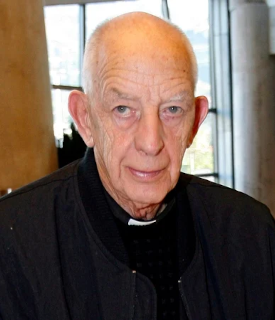
Birth of Fr. Alec Reid, Facilitator in the Northern Ireland Peace Process

Alexander Reid CSsR, Irish Catholic priest noted for his facilitator role in the Northern Ireland peace process, is born in Dublin on August 5, 1931. BBC journalist Peter Taylor subsequently describes Reid’s role as “absolutely critical” to the success of the peace process.

Reid is raised in Nenagh, County Tipperary, from the age of six following the death of his father. He studies English, history and philosophy at University College Galway.

Reid is professed as a Redemptorist in 1950 and ordained a priest seven years later. For the next four years, he gives Parish Missions in Limerick, Dundalk and Galway (Esker), before moving to Clonard Monastery in Belfast, where he spends almost the next forty years. The Redemptorist Monastery at Clonard stands on the interface between the Catholic nationalist Falls Road and the Protestant loyalist Shankill Road areas of west Belfast.

In the late 1980s, Reid facilitates a series of meetings between Gerry Adams and John Hume, in an effort to establish a “Pan-Nationalist front” to enable a move toward renouncing violence in favour of negotiation. Reid, himself a staunch nationalist who favours a united Ireland and the withdrawal of British forces from Northern Ireland, then acts as their contact person with the Irish Government in Dublin from a 1987 meeting with Charles Haughey up to the signing of the Good Friday Agreement in 1998. In this role, which is not public knowledge at the time, he holds meetings with various Taoisigh, and particularly with Martin Mansergh, advisor to various Fianna Fáil leaders. After the eventual success of the peace negotiations, Gerry Adams says, “there would not be a peace process at this time without [Father Reid’s] diligent doggedness and his refusal to give up.”

In 1988 in Belfast, Reid delivers the last rites to two British Army corporals, David Howes and Derek Wood of the Royal Corps of Signals, who are killed by the Provisional Irish Republican Army (IRA) – an event known as the corporals killings – after they drive into the funeral cortège of IRA member Kevin Brady, who had been killed in the Milltown Cemetery attack. A photograph of his involvement in that incident becomes one of the starkest and most enduring images of the Troubles. Unknown until years later, he is carrying a letter from Sinn Féin President Gerry Adams to Social Democratic and Labour Party (SDLP) leader John Hume outlining Adams’ suggestions for a political solution to the Troubles. Adams later tells the BBC in 2019 that Reid also advised U.S Ambassador to Ireland Jean Kennedy Smith during the peace process, stating “He was talking to her on the side and she was talking to her brother Teddy.”

After he moves to Dublin, Reid is involved in peace efforts in the Basque Country. In January 2003, he is awarded the Sabino Arana 2002 “World Mirror” prize, by the Sabino Arana Foundation in Bilbao, in recognition of his efforts at promoting peace and reconciliation. He and a Methodist minister, the Rev. Harold Good, announce that the IRA has decommissioned their arms at a news conference in September 2005.

Reid is involved in controversy in November 2005 when he makes comments during a meeting in Fitzroy Presbyterian Church concerning the Unionist community in Northern Ireland. When the loyalist activist Willie Frazer makes remarks that Catholics had butchered Protestants during the Troubles, Reid angrily responds, “You don’t want to hear the truth. The reality is that the nationalist community in Northern Ireland were treated almost like animals by the unionist community. They were not treated like human beings. They were treated like the Nazis treated the Jews.” Reid later apologises, saying his remarks had been made in the heat of the moment. In an interview with CNN, he says that “The IRA were, if you like, a violent response to the suppression of human rights.”

Reid dies in a Dublin hospital on November 22, 2013. He is survived by two sisters and an aunt, and is buried in Milltown Cemetery, Belfast.


Leave a comment

Birth of Gerry Cooney, Former Professional Boxer

Gerald Arthur Cooney, American former professional boxer who competes from 1977 to 1990, is born into a blue-collar Irish Catholic family on August 4, 1956, in Manhattan, New York City. He challenges twice for world heavyweight titles in 1982 and 1987. He is widely regarded as one of the hardest punchers in heavyweight history.

Cooney is encouraged to become a professional fighter by his father. His brother, Tommy Cooney, is also a boxer and reaches the finals of the New York Golden Gloves Sub-Novice Heavyweight division. His grandparents lived in Placentia, Newfoundland, in Canada.

Fighting as an amateur, Cooney wins international tournaments in England, Wales, and Scotland, as well as the New York Golden Gloves titles. He wins two New York Golden Gloves Championships, defeating Larry Derrick to win the 1973 160-lb Sub-Novice Championship and Earlous Tripp to win the 1976 Heavyweight Open Championship. In 1975 he reaches the finals of the 175-lb Open division, but is defeated by Johnny Davis. He trains at the Huntington Athletic Club in Long Island, New York, where his trainer is John Capobianco. His amateur record consists of 55 wins and 3 losses.

When Cooney turns professional, he signs with co-managers Mike Jones and Dennis Rappaport. He is trained by Victor Valle. Known for his big left-hook and his imposing size, he has his first paid fight on February 15, 1977, beating Billy Jackson by a knockout in one round. Nine wins follow and he gains attention as a future contender, although his opponents are carefully chosen. He moves up a weight class and fights future world cruiserweight champion S. T. Gordon in Las Vegas, winning by a fourth round disqualification. He has eleven more wins, spanning 1978 and 1979. Among those he defeats are Charlie Polite, former U.S. heavyweight champion Eddie Lopez, and Tom Prater. These are not rated contenders, however.

By 1980, Cooney is being featured on national television. Stepping up, he beats one-time title challengers Jimmy Young and Ron Lyle, both by knockout. The Young fight is stopped because of cuts sustained by Young. By then Cooney is ranked number 1 by the World Boxing Council (WBC) and eager for a match with champion Larry Holmes.

In 1981, Cooney defeats former world heavyweight champion Ken Norton by knockout just 54 seconds into the first round with a blisteringly powerful attack. This ties the record set in 1948 by Lee Savold for the quickest knockout in a main event in Madison Square Garden. Since his management team is unwilling to risk losing a big future pay day with Holmes by having him face another viable fighter, Cooney does not fight for 13 months after defeating Norton.

The following year, Holmes agrees to fight Cooney with the fight held on June 11, 1982. With a purse of ten million dollars for the challenger, it is the richest fight in boxing history to that time. The promotion of the fight takes on racial overtones that are exaggerated by the promoters, something Cooney does not agree with. He believes that skill, not race, should determine if a boxer is good. However, if he wins, he would become the first Caucasian world heavyweight champion since Swede Ingemar Johansson defeated Floyd Patterson 23 years earlier. Don King calls Cooney “The Great White Hope.” The bout draws attention worldwide, and Larry Holmes vs. Gerry Cooney is one of the biggest closed-circuit/pay-per-view productions in history, broadcast to over 150 countries.

Cooney fights bravely after he is knocked down briefly in the second round. He is fined three points for repeated low blows. After 12 rounds, the more skillful and experienced Holmes finally wears him down. In round 13, his trainer, Victor Valle, steps into the ring, forcing the referee to stop the fight. Two of the three judges would have had Cooney ahead after the 12th round if it were not for the point deductions. He and Holmes become friends after the fight, a relationship that endures for them. On December 14, 1982, he fights Harold Rice, the heavyweight champion of Connecticut, in a four-round bout. No winner is declared, so he tells the crowd following the bout, “This is only an exhibition. I’m sorry if I disappointed anybody. I’m trying to work myself back in shape so I can knock out Larry Holmes. Everything is OK. I felt a little rusty, but that is normal. It has been a while. I felt good in front of the people.”

After a long layoff, Cooney fights in September 1984, beating Phillip Brown by a 4th-round knockout in Anchorage, Alaska. He fights once more that year and wins, but personal problems keep him out of the ring.

Although Cooney fights only three official bouts in five years following his loss to Holmes, in 1987 he challenges former world heavyweight and world light heavyweight champion Michael Spinks in a title bout. He appears past his prime and Spinks, boxing carefully with constant sharp counters, knocks him out in the fifth round. His last fight is in 1990. He is knocked out in a match-up of power-punching veterans in two rounds by former world champion George Foreman. He does stagger Foreman in the first round, but he is over-matched, and Foreman knocks him out two minutes into the second round.

The losses to Holmes, Spinks, and Foreman exposes Cooney’s Achilles’ heel: his inability to clinch and tie up his opponent when hurt. In the Foreman fight, he rises from a second-round knockdown and stands in the center of the ring as Foreman delivers the coup de grâce.

Cooney compiles a professional record of 28 wins and 3 losses, with 24 knockouts. Not a single one of his fights ever goes the distance in a 12 or 15-round match. He is ranked number 53 on The Ring‘s list of “100 Greatest Punchers of All Time.”

Cooney founds the Fighters’ Initiative for Support and Training, an organization which helps retired boxers find jobs. He is deeply involved in J.A.B., the first union for boxers. He becomes a boxing promoter for title bouts featuring Roberto Durán, Héctor Camacho, and George Foreman. He is a supporter of the “hands are not for hitting” program, which tries to prevent domestic violence. He guides young fighters in the gym. In June 2010, he becomes the co-host of “Friday Night at the Fights” on Sirius XM radio.

Cooney resides in Fanwood, New Jersey, with his wife Jennifer and two of their three children, Jackson and Sarah. His son Chris resides in New York. He has been inducted into the Hall of Fame at Walt Whitman High School (New York), where he graduated.


Leave a comment

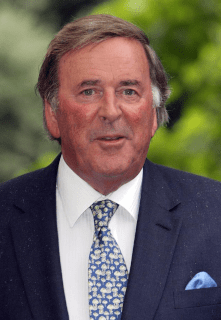
Birth of Terry Wogan, Irish-British Radio & Television Broadcaster

Sir Michael Terence Wogan KBE DL, Irish-British radio and television broadcaster who works for the BBC in the United Kingdom (UK) for most of his career, is born at Cleary’s Nursing Home, Elm Park, Limerick, County Limerick, on August 3, 1938. Between 1993 and his semi-retirement in December 2009, his BBC Radio 2 weekday breakfast programme Wake Up to Wogan regularly draws an estimated eight million listeners. He is believed at the time to be the most listened-to radio broadcaster in Europe.

Wogan is the elder of two children. He is the son of the manager of Leverett & Frye, a high-class grocery store in Limerick, and is educated at Crescent College, a Jesuit school, from the age of eight. He experiences a strongly religious upbringing, later commenting that he had been brainwashed into believing by the threat of going to hell. Despite this, he often expresses his fondness for the city of his birth, commenting on one occasion that “Limerick never left me, whatever it is, my identity is Limerick.”

At the age of 15, after his father is promoted to general manager, Wogan moves to Dublin with his family. While living there he attends Crescent College’s sister school, Belvedere College. He participates in amateur dramatics and discovers a love of rock and roll. After leaving Belvedere in 1956, he has a brief career in the banking profession, joining the Royal Bank of Ireland. Still in his twenties, he joins the national broadcaster of Ireland, Raidió Teilifís Éireann (RTÉ), as a newsreader and announcer, after seeing a newspaper advertisement inviting applicants.

Wogan conducts interviews and presents documentary features during his first two years at RTÉ, before moving to the light entertainment department as a disc jockey and host of TV quiz and variety shows such as Jackpot, a top-rated quiz show on RTÉ in the 1960s.

Wogan is a leading media personality in Ireland and Britain from the late 1960s, and is often referred to as a “national treasure.” In addition to his weekday radio show, he is known for his work on television, including the BBC One chat show Wogan, presenting Children in Need, the game show Blankety Blank and Come Dancing. He is the BBC’s commentator for the Eurovision Song Contest from 1971 to 2008 (radio in 1971, 1974–1977; television in 1973, 1978, 1980–2008) and the Contest’s host in 1998. From 2010 to 2015 he presents Weekend Wogan, a two-hour Sunday morning show on BBC Radio 2.

In 2005, Wogan acquires British citizenship in addition to his Irish nationality and is awarded a knighthood in the same year and is therefore entitled to use the title “Sir” in front of his name.

Wogan’s health declines after Christmas 2015. He does not present Children in Need in November 2015, citing back pain as the reason for his absence from the long-running annual show. One of his friends, Father Brian D’Arcy, visits him during January and notices he is seriously ill. He dies of cancer at the age of 77 on January 31, 2016 at his home.

British Prime Minister David Cameron says, “Britain has lost a huge talent.” President of Ireland Michael D. Higgins praises Wogan’s career and his frequent visits to his homeland. Taoiseach Enda Kenny and Tánaiste Joan Burton remember Wogan for his role in helping Anglo-Irish relations during the Troubles. D’Arcy speculates that a public funeral would be logistically difficult, as there would be too many people wanting to pay their respects.

After Wogan’s death and his private funeral a few weeks later, a public memorial service is held on September 27 the same year. This is held at Westminster Abbey and is opened by a recording of Wogan himself, and features a number of his celebrity friends making speeches, such as Chris Evans and Joanna Lumley. The service is broadcast live on BBC Radio 2.

On November 16, 2016, the BBC renames BBC Western House, home of BBC Radio 2, in his memory, to BBC Wogan House.


Leave a comment

Death of Joe Lynch, Comedy & Drama Actor

Joseph Laurence Lynch, Irish actor who has a long career in both comedy and drama, dies on August 1, 2001, in Alicante, Spain. He provides voice work for children’s animated series, in particular Chorlton and the Wheelies. He is also a singer and songwriter, performing in the film Johnny Nobody (1961). He also records work by other songwriters, including Leo Maguire‘s “The Whistling Gypsy” and Dick Farrelly‘s “Cottage by the Lee,” one of his biggest 1950s recordings.

Born in Mallow, County Cork, on July 16, 1925, Lynch attends the North Monastery Christian Brothers School. He has a number of other jobs before moving into acting and broadcasting full time.

Initially acting part-time with the Cork Shakespearean Company and at the Cork Opera House, by 1947 Lynch is acting full-time.

Lynch is a founding member of the Radio Éireann Players and appears in productions of Teresa Deevy plays among others. During the 1950s he is responsible for a Radio Éireann show Living with Lynch, broadcast on Sunday nights, the first comedy series on Radio Éireann. Between 1967–81, he acts onstage with the Abbey Theatre.

Lynch appears in the popular ABC/Thames Television sitcom Never Mind the Quality, Feel the Width (1968–70), and its spin-off feature film in 1973. Other notable film roles include The Siege of Sidney Street (1960), The Running Man (1963), Girl with Green Eyes (1964), The Face of Fu Manchu (1965), Ulysses (1967), Loot (1970), The Mackintosh Man (1973), The Outsider (1980), If You Go Down in the Woods Today (1981) and Eat the Peach (1986). In the 1970s, he makes regular guest appearances as Elsie Tanner‘s boyfriend in the long-running Granada Television soap Coronation Street.

In 1962, and again in 1977, Lynch wins a Jacob’s Award for his acting on RTÉ television.

By 1979, Lynch is back in Ireland, and makes his first appearances as Dinny Byrne in the RTÉ soap Bracken. Later the Byrne character would feature in the long-running RTÉ soap Glenroe.

Lynch quits Glenroe after he claims to have been “shamefully treated” and offered “small potatoes” when he asked for a pay rise. He is also upset that he is not to get a pension. RTÉ disputes those claims. He criticised RTÉ for preventing him from doing other acting work alongside Glenroe. “I was terrible restricted in RTÉ, they wouldn’t let me off for anything, even commercials.”

Lynch voices the main antagonist, Grundel the Toad, in the Don Bluth film Thumbelina, his final audio work before his death seven years later.

Lynch dies suddenly on August 1, 2001, in Alicante, Spain, where he had been living since leaving Glenroe.