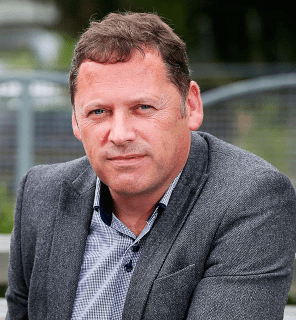
One of Ó Ceallaigh’s classmates in school is Sinéad O’Connor. He once tells an interviewer, “She told me she wanted to become famous and I tried to talk her out of it.”
Ó Ceallaigh graduates from University College Dublin (UCD) with a degree in philosophy. After receiving his degree, he travels the world, doing a variety of jobs, including waiter, newspaper editor, freelance journalist and volunteer for clinical trials. He moves to Bucharest, Romania, so that he can live cheaply and pursue his desire to write.
Ó Ceallaigh has spent much of his adult life in Eastern Europe, starting in Russia in the early 1990s. Since 1995 he has lived mostly in Bucharest, Romania. He has also lived for a while in the United States.
Ó Ceallaigh has published over 40 short stories, as well as essays and criticism. His work has appeared in Granta, The Irish Times and the Los Angeles Review of Books and has been translated into more than a dozen languages. In 2010, he edits Sharp Sticks, Driven Nails, an anthology of new short stories by twenty-two Irish and international writers, for The Stinging Fly Press. He translates Mihail Sebastian‘s autobiographical novel For Two Thousand Years. It tells the story of the author’s early years as a Jew in Romania during the 1920s. It is published in 2016.
Ó Ceallaigh has written an unpublished novel but reduces it to a long short story and believes “if you’ve got something to say and you can say it with less, that’s the way to go.”
The first story in Ó Ceallaigh’s third collection, Trouble, involves a security guard and the theft of sum of money from a gangster. He uses time he spent as a security guard in Dublin to form the basis of this fiction.
Ó Ceallaigh eschews the prevailing style of Irish short story writing in that his works are rarely set in Ireland, and instead are set in a variety of locations across the world, predominately in Romania. His stories generally feature solitary men, with women playing more incidental roles. He acknowledges being influenced in his writing style by Charles Bukowski, Anton Chekhov, Fyodor Dostoyevsky, Ernest Hemingway, Jack Kerouac, and Ivan Turgenev.
Ó Ceallaigh wins the Hennessy Award for his first published work in 1998. He wins the Rooney Prize for Irish Literature and the Glen Dimplex New Writers’ Award for his collection Notes from a Turkish Whorehouse in 2006. His second collection, The Pleasant Light of Day, is shortlisted for the Frank O’Connor International Short Story Award. He is the first Irish writer to receive this honour.
Sykes joined HM Foreign Service in 1947 and serves at the Foreign Office from 1947 to 1948. He then serves in Nanjing (1948–50), Peking (1950–52) and returns to the UK to serve at the Foreign Office (1952–56). His next overseas postings take him to Brussels (1956–59), Santiago (1959–62) and Athens (1963–66), before returning to the Foreign Office (1967–69).
Sykes’ first posting as an ambassador comes with a posting to Havana (1970–72) before moving to be a Minister at the British Embassy in Washington D.C. (1972–1975). From there he returns to the Foreign Office as Department Under-Secretary between 1975 and 1977. He is then appointed as Ambassador to the Netherlands in 1977.
Sykes is leaving his residence in The Hague at 9:00 a.m. on March 22, 1979, and is getting into his silver Rolls-Roycelimousine when he is shot. He is sitting next to Alyson Bailes. The car door is held by Karel Straub, a 19-year-old Dutch national who works at the embassy. Straub is also shot in the attack. The chauffeur, Jack Wilson, is uninjured and drives Sykes to Westeinde Hospital, where he dies two hours later. Straub is transported by ambulance to the same hospital, where he also dies.
Police report that the shots came from around 10 yards away by two assailants wearing business suits, who escaped on foot following the attack. Suspects for the assassination are Palestinians or Iraqis, although no evidence is ever put forward. It is ultimately confirmed that the IRA had carried out the killings.
The IRA claims responsibility for the assassination in February 1980. In a statement they say of Sykes, “[he was] not just a Brit propagandist, as are all British ambassadors, but because he had been engaged in intelligence operations against our organisation.”
The ‘intelligence operations’ mentioned in the statement relate to a government report written by Sykes following the assassination of Christopher Ewart-Biggs. Ewart-Biggs was the British Ambassador to the Republic of Ireland and was killed by the IRA in 1976. Sykes produces diplomatic security guidelines as part of his report.
Sykes’ position as Ambassador to the Netherlands had been strained due to certain Dutch groups, which were sympathetic to the IRA, and consequent arms smuggling activities.
There is a memorial plaque to Sykes in St. Michael’s Church, Wilsford, Wiltshire.
(Pictured: “Sir Richard Sykes” by Bassano Ltd., half-plate film negative, 20 January 1966, National Portrait Gallery, London)
Shawcross studies at Bolton College of Art from 1955 to 1958, and Lancaster College of Art from 1958 to 1960, before moving to Belfast in 1962 to take up a part-time lecturer’s post at the Belfast College of Art, becoming full-time in 1968. He continues to lecture there until his retirement in 2004.
Shawcross has exhibited nationally, with one-man shows in London, Manchester, Dublin and Belfast, and internationally in Hong Kong and the United States, and his work is found in many private and corporate collections.
Shawcross is elected an Associate of the Royal Ulster Academy of Art in 1975, and is made a full Academician in 1977. He wins the Academy’s Conor Award in 1975, its gold medal in 1978, 1982, 1987, 1994, 1997 and 2001, and its James Adam Prize in 1998. He is also a member of the Royal Hibernian Academy (RHA). He is awarded the Gallaher Portrait Prize in 1966.
In 2010, the Merrion Hotel, Dublin, hosts a private collection of the works of Shawcross. In 2015, he exhibits a collection of six foot tall book covers inspired by original Penguin paperbacks at the National Opera House in Wexford, County Wexford. In 2018, he donates to Belfast City Council a collection of 36 paintings dedicated to ‘Writers of Belfast’ in a show of appreciation to his adopted home city. A major retrospective of his works are exhibited at the F.E. McWilliam Gallery and Studio, Banbridge, County Down, in the same year.
Shawcross is a Patron of the charity YouthAction Northern Ireland. He lives in Hillsborough, County Down, Northern Ireland.
Hone’s most important works are probably the East Window, depicting the Crucifixion, for the Chapel at Eton College, Windsor (1949–1952) and My Four Green Fields, now located in Government Buildings, Dublin. This latter work, commissioned for the Irish Government’s Pavilion, wins first prize for stained glass in the 1939 New York World’s Fair. It graces CIÉ‘s Head Office in O’Connell Street from 1960 to about 1983. The window is then taken into storage by Abbey Glass in Kilmainham, Dublin at the request of the Office of Public Works.
The East Window of Eton College is commissioned following the destruction of the building after a bomb is dropped on the school in 1940 during World War II. She is commissioned to design the East Window in 1949, and the new window is inserted in 1952. This work is featured on an Irish postage stamp in 1969. From December 2005 to June 2006, an exhibition of her work is on display at the National Gallery of Ireland. Saint Mary’s church in Clonsilla also features her stained glass windows.
Hone is extremely devout. She spends time in an Anglican Convent in 1925 at Truro in Cornwall and converts to Catholicism in 1937. This may have influenced her decision to begin working in stained glass. Initially she works as a member of the An Túr Gloine stained glass co-operative before setting up a studio of her own in Rathfarnham.
Unmarried, Hone dies on March 13, 1955, while entering her parish church at Rathfarnham. She is survived by two of her sisters. Over 20,000 people visit a memorial exhibition of her work at University College Dublin (UCD), Earlsfort Terrace, Dublin, in 1958.
(Pictured: “My Four Green Fields” by Evie Hone, which depicts the four provinces of Ireland)
Briscoe is born in Dublin on September 25, 1894, the son of Abraham William Briscoe and Ida Yoedicke, both of whom are Lithuanian-Jewish immigrants. The original family name in Lithuania is believed to have been Cherrick or Chasen. His brother Wolfe Tone Briscoe is named after Theobald Wolfe Tone, one of the leaders of the Irish Rebellion of 1798. His father is the proprietor of Lawlor Briscoe, a furniture factory on Ormond Quay which makes, refurbishes, imports, exports and sells furniture, trading all over Ireland and abroad.
Briscoe is active in the Irish Republican Army (IRA) and Sinn Féin during the Irish War of Independence and accompanies Éamon de Valera to the United States. He speaks for the Sinn Féin cause at public meetings there and is adamant that being a “Hebrew” does not lessen his Irishness. He is sent by Michael Collins to Germany in 1919 to be the chief agent for procuring arms for the IRA. While in Germany in 1921 he purchases a small tugboat named Frieda to be used in transporting guns and ammunition to Ireland. On October 28, 1921, the Frieda slips out to sea with Charles McGuinness at the helm and a German crew with a cargo of 300 guns and 20,000 rounds of ammunition. Some sources cite this shipment as “the largest military shipment ever to reach the IRA” consisting of 1,500 rifles, 2,000 pistols and 1.7 million rounds of ammunition. On November 2, 1921, the Frieda successfully lands its cargo near Waterford Harbour.
In June 1922 during the Irish Civil War, Briscoe is involved in an incident with fellow anti-treaty IRA members who attack pro-treaty politician Darrell Figgis at his home. They enter the house and assault Figgis, cutting off his well-prized beard in the process. This traumatises Figgis’ wife Millie, who had been under the impression Briscoe and his fellow assistants had come to kill Figgis. In November 1924 Millie commits suicide, expressing in a suicide note that she was suffering from depression as a result of the 1922 attack. Figgis himself commits suicide in 1926.
In his biography, Briscoe recalls an incident of being recognised by a pro-Treaty opponent during the Civil War. He merely turns and walks away, confident that his enemy will not shoot him in the back.
Elected to the Dáil in the newly independent Ireland, Briscoe works with Patrick Little to bring through a law limiting the interest that can be charged by moneylenders and also, as he writes, “made it illegal for a married woman to borrow money without the knowledge and consent of her husband, for these foolish ones are always the easiest prey of the moneylenders.”
During World War II, Briscoe, at this time a member of Dáil Éireann, comes under close scrutiny from the Irish security services. His support for Zionism and his lobbying on behalf of refugees is considered potentially damaging to the interests of the state by officials from the Department of Justice. He is an admirer and friend of Ze’ev Jabotinsky and his campaign to liberate the Jews. Between 1939 and 1940, he along with John Henry Patterson, a former commander of both the Zion Mule Corps and later the 38th Battalion of the Royal Fusiliers, are involved in fund raising for the Irgun in the United States. Jabotinsky while head of Irgun visits Dublin to receive training in guerrilla warfare tactics against the British under the instruction of Briscoe. During the period Briscoe describes himself as the “Chair of Subversive Activity against England.” He wishes for Ireland to give asylum to Jews fleeing Nazi Germany but does so discreetly in order not to be accused of compromising the neutrality policy of the Fianna Fáil government.
After World War II Briscoe acts as a special advisor to Menachem Begin in the transformation of Irgun from a paramilitary group to a parliamentary political movement in the form of Herut in the new Israeli state. The party later becomes Likud. As he had already been a key figure in the formation in his own Fianna Fáil party out of the Anti-treaty IRA post Irish independence but not before a bitter Civil War, he prompts Begin to make the transition immediately after the Altalena Affair in order to avoid a similar civil conflict.
Briscoe serves in Dáil Éireann for 38 years and is elected 12 times in the Dublin South and from 1948, Dublin South-West constituencies. He retires at the 1965 Irish general election, being succeeded by his son, Ben, who serves for a further 37 years. In 1956, he becomes the first Jewish Lord Mayor of Dublin, although he is not the first Jewish Mayor in Ireland. That title belongs to William Annyas, who was elected Mayor of Youghal, County Cork in 1555. He serves a one-year term and is re-elected in 1961. His son Ben is also a Fianna Fáil TD, and he too serves as Lord Mayor of Dublin from 1988–1989.
Briscoe’s memoir, For the Life of Me, is published in 1958.
O’Sullivan is educated locally at Mount Carmel school. After completing a BA at University College Dublin (UCD), she then goes on to work as an English and History teacher and guidance counsellor in a secondary school in Baldoyle, a position she holds for thirty years.
O’Sullivan is a member of Tony Gregory‘s local political organisation in the 1970s, first canvassing for him and later serving as his election agent. She is co-opted onto Dublin City Council for the North Inner City local electoral area from September 2008 to June 2009, after the retirement of Mick Rafferty. After the death of Tony Gregory, she wins the resulting by-election which is held on the same day as the local elections where she also wins a seat on Dublin City Council, for the North Inner City local electoral area. Marie Metcalfe is co-opted to take the seat due to the dual mandate rule. Subsequently Anna Quigley replaces Metcalfe on Dublin City Council, who is in turn replaced by Mel MacGiobúin in March 2014. MacGiobúin fails to be elected at the local elections held in May.
O’Sullivan is re-elected to the Dáil at the 2011 Irish general election. She joins the Dáil technical group which gives independents and minor parties more speaking time in Dáil debates. She describes a proposal for political gender quota legislation as “tokenistic” and that women are able to get themselves nominated for election.
In December 2015, O’Sullivan and fellow independent TDs Clare Daly and Mick Wallace each put forward offers of a €5,000 surety for a 23-year-old man being prosecuted under terrorism legislation in the Special Criminal Court in Dublin charged with membership of an illegal dissident republican terrorist organisation.
After the 2016 Irish general election O’Sullivan unsuccessfully stands for election as Ceann Comhairle. She joins a technical group aligned with Independents 4 Change, while remaining outside the Independents 4 Change party. She is criticised by the brother of late TD Tony Gregory, over an allegedly false claim made in her election literature.
On January 16, 2020, O’Sullivan announces she will not be standing in the 2020 Irish general election in February.
Adrian Hardiman, Irish judge who serves as a Judge of the Supreme Court of Ireland from 2000 to 2016, dies in Portobello, Dublin, on March 7, 2016. He writes a number of important judgments while serving on the Court. He also presides, as does each Supreme Court judge on a rotating basis, over the Court of Criminal Appeal.
Hardiman joins Fianna Fáil while a student in University College Dublin and stands unsuccessfully for the party in the local elections in Dún Laoghaire in 1985. In 1985, he becomes a founder member of the Progressive Democrats but leaves the party when he is appointed to the Supreme Court. He remains very friendly with the former party leader and ex-Tánaiste, Michael McDowell, who is a close friend at college, a fellow founding member of the party, and best man at his wedding.
Hardiman is called to the Irish Bar in 1974 and receives the rare honour of being appointed directly from the Bar to Ireland’s highest court. Prior to his elevation to the Supreme Court in 2000, he has a successful practice as a barrister, focusing on criminal law and defamation.
Politically, Hardiman supports the liberal side in Ireland’s debates over abortion, being active in the “anti-amendment” campaign during the 1982 Abortion Referendum and later represents the Well Woman Centre in the early 1990s. After his death, he is described by Joan Burton as a liberal on social issues. But he could be an outspoken opponent of Political Correctness, such as when he rejects the Equality Authority‘s attempt to force Portmarnock Golf Club to accept women as full members. He also believes that certain decisions, such as those involving public spending, are better left to elected politicians rather than unelected judges, regardless of how unpopular that might sometimes be in the media (which he tends to hold in low esteem) and among what he describes as the “chattering classes.”
Hardiman’s concern for individual rights is not confined to Ireland. In February 2016, he criticizes what he describes as the radical undermining of the presumption of innocence, especially in sex cases, by the methods used in the UK‘s Operation Yewtree inquiry into historical sex allegations against celebrities, and he also criticizes “experienced lawyer” and then United States presidential candidate Hillary Clinton for allegedly declaring in January that “every accuser was to be believed, only to amend her view when asked if it applied to women who had made allegations against her husband”, former U.S. PresidentBill Clinton.
In a tribute following his death in 2016, PresidentMichael D. Higgins says Justice Hardiman “was one of the great legal minds of his generation”, who was “always committed to the ideals of public service.” He is described as a “colossus of the legal world” by Chief JusticeSusan Denham.
One commentator writes that “Hardiman’s greatest contribution …was the steadfast defence of civil liberties and individual rights” and that “He was a champion of defendants’ rights and a bulwark against any attempt by the Garda Síochána to abuse its powers.”
A party of eight Free State soldiers are sent to investigate a tip-off about an Irish Republican Army (IRA) arms dump. The tip-off is a ruse devised by the local IRA brigade to lure the enemy into a trap. At about 2:00 AM as they move stones to investigate the location where arms are allegedly buried, a mine explodes. Body parts are “strewn in all directions.” Paddy O’Connor, Michael Galvin, Laurence O’Connor, Michael Dunne and Edward Stapleton die instantly and a sixth is so badly injured, his legs are amputated. The IRA members who set the mine are hiding in a dugout about a mile away. The Knocknagoshel explosion represents the highest daily death toll among the Free State army in over six months.
Retaliation is swift and ferocious. Over the following two weeks, nineteen Republican prisoners die in County Kerry at the hands of the Free State. Knocknagoshel prompts an army statement that any future barricades or obstructions on the roads will be removed by republican prisoners. In his letter to officers in the Kerry Command, Brigadier Paddy O’Daly insists that “the taking out of prisoners is not to be regarded as a reprisal, but as the only alternative left us to prevent the wholesale slaughter of our men.” The implementation of O’Daly’s instructions is immediate and hugely repercussive.
On the night after the explosion, and in a move which reverberateds politically for generations, nine republican prisoners in Ballymullen Barracks in Tralee are taken to Ballyseedy on the Tralee to Killorglin road to clear a pile of rubble blocking the road. The nine, who had already been interrogated and abused in revenge for Knocknagoshel, are driven to the scene. It is suggested that one of the reasons these nine are selected from a wider group of prisoners is that they have no known links to the Catholic clergy or hierarchy so as not to antagonise the church which is actively and vocally supportive of the Free State and its leadership.
The army had planted a bomb in the rubble. They tie the prisoners by the wrists and their shoelaces and detonate the device. Eight of the nine are blown to pieces and killed instantly. The ninth, Stephen Fuller of Fahavane, Kilflynn, is thrown a considerable distance by the force of the explosion and, despite his injuries, manages to flee with the only eyewitness account of the incident.
When the dismembered remains of the eight dead men are placed in coffins and returned to their families at Ballymullen Barracks, there follows a “frenzy.” It is alleged that O’Daly orders the army band to play ragtime music as the bodies are handed over to the families at the gates of the barracks. The families react furiously, throwing stones at the soldiers and smashing the army coffins on the ground as they place the deceased in coffins they had brought themselves.
The funerals which follow prompted an outcry of condemnation of the actions of the Free State Army. As a result, it is decided that henceforth, prisoners who die in military custody in the Kerry Command areas will be buried by troops where they die rather than in their own parish. This is, as T. Ryle Dwyer argues, “tantamount to approving the barbarities that we being perpetrated and merely telling the soldiers to cover up their vile acts properly.”
Meanwhile, the police authorities move quickly to absolve themselves of any connections with the deaths at Ballyseedy on the basis that it was not reported to the Civic Guard in Kerry. The area is under an 11:00 PM curfew at the time and no patrols are undertaken after this hour. However, the superintendent Tralee notes, “In any event, in the Ballyseedy area at that time there were a considerable number of Irregulars, which rendered it unsafe for the Guards to patrol there.”
(From: “Body parts were ‘strewn in all directions’ – the bloody climax of the Civil War in Kerry” by Owen O’Shea, http://www.owenoshea.ie, March 7, 2021)
Bullock is born on May 17, 1865 at Inisherk, County Fermanagh just outside the County Cavan border near Belturbet, in what is now Northern Ireland. His father, Thomas Bullock, is a strict man who has eleven children and drives several to emigration because of his stern demeanour. Thomas Bullock works on the Crom Castle estate which runs along the Cavan/Fermanagh border and has both Catholic and Protestant workers. Protestant workers have the prime jobs and are employed as craftsmen and supervisors while Catholics work in the outer area of the estate at unskilled jobs. Folk memories of the Battle of Newtownbutler in 1689 remain long in the memory in the area where up to 1,500 Jacobite troops are hacked down or drowned in Upper Lough Erne when pursued by the Williamite cavalry. Many of the Williamite army is drawn from the local Protestant population.
Bullock is educated at Crom estate primary school run by the Church of Ireland and Farra School near Bunbrosna, County Westmeath. He fails the entrance exams at the University of Dublin. He tries his hand at farming but finds he is not suited. He moves to London in 1883 and becomes a Civil Service clerk. He takes to journalism to supplement his salary and publishes his first book of stories, The Awkward squads, in 1893. His stories are centered on Irish Catholic and Protestant small farmers and labourers and their struggles and tensions. He marries Emma Mitchell in 1899 and they have a son and daughter.
Bullock is well respected in literary circles but his books are never successful enough for him to become a full time writer. He says that the English are not interested in Irish stories and that there is no reading public in Ireland. He dislikes Orangesectarianism and is ambivalent to Irish nationalism. His novel The Red Leaguers looks at sectarianism conflict and Robert Thorne examines the lives of London clerks which is a popular theme at the time. His last and best novel The Loughsiders is published in 1924 and is the story of a conniving smallholder based on William Shakespeare’s Richard III.
Bullock’s wife dies in 1922. He spends the final years of his life in Sutton, Surrey and dies there on February 27, 1935.
Bullock’s daughter presents his literary papers, including two unpublished novels, two plays, numerous short stories and essays, and some correspondence to the Queen’s University Belfast library in the 1960s. A portrait of Bullock by Dermod O’Brien, RHA, is also at Queen’s University Belfast. His correspondence with Sir Horace Plunkett is in the archives of the Plunkett Foundation, Long Hanborough Business Park, Woodstock, Oxfordshire. Enniskillen public library has a collection of cuttings on Bullock, including some photocopied letters.
At the 1992 Irish general election, Upton stands again in Dublin South-Central, and in Labour’s “Spring Tide” surge at that election, he tops the poll with nearly 12,000 first-preference votes, a remarkable 1.48 quotas. He is re-elected at the 1997 Irish general election with a considerably reduced vote.
In the 28th Dáil Upton is appointed as Labour’s spokesperson on Justice, Equality and Law Reform. A leading critic of Labour’s 1999 merger with the Democratic Left, he nonetheless becomes the party’s spokesman on communications and sport after the merger.
Upton dies suddenly of a heart attack on February 22, 1999, at the UCD Veterinary College, where he is an occasional lecturer. He is taken to St. Vincent’s Hospital, and his death is officially confirmed. He is survived by his wife and their four children. Politicians of all parties pay glowing tributes to him for his outspoken but “erudite and incisive” contributions to politics and to Irish culture.
The by-election for Upton’s Dáil seat in Dublin South-Central is held on October 27, 1999, and won for the Labour Party by his sister Mary Upton.
Following Upton’s death, the University College Dublin branch of the Labour party is named in his honour due to his involvement with the college. It has since been renamed to honour the Spanish Civil War veteran Charlie Donnelly.