O’Halloran is the third son of Michael O’Halloran, a prosperous farmer, and his wife Mary McDonnell. He is named after Sylvester Lloyd, the titular Catholic bishop of Killaloe (1728–39). His mother’s cousin, Sean Claragh McDonnell, teaches him much at an early age, including some Greek and Latin. He goes on to a Limerick school run by Robert Cashin, a Protestantclergyman, which is unusual at the time as the O’Hallorans are Roman Catholics during the difficult time of the Penal Laws.
O’Halloran and his brothers engage successfully in areas of life that work around the restrictions of the Penal Laws. Joseph becomes a Jesuit and holds chairs in rhetoric, philosophy and divinity at the Jesuit College at Bordeaux in France. George becomes a jeweler and in time a property-owner. O’Halloran goes to London to learn medicine at the age of 17, particularly studying the methods of Richard Mead, as well as the oculists Taylor and Hillmer. After further study at Leiden, and in Paris under the anatomist and academician Antoine Ferrein, he sets up practice as a surgeon in Limerick in early 1749.
O’Halloran writes several learned treatises on medical matters, and his fame is acknowledged by his membership of the RIA in 1787. He is a founder of the County Limerick Infirmary that starts with four beds in 1761 before moving to larger premises at St. Francis’s Abbey in 1765. The foundation stone of the original infirmary is now preserved in the Sylvester O’Halloran Post Graduate Centre at the Mid-Western Regional Hospital, Limerick.
While in France, O’Halloran is very impressed with the Académie Royale de Chirurgie, which had been founded in Paris in 1731 during the reign of Louis XV. He is subsequently instrumental in founding the Royal College of Surgeons in Ireland (RCSI), by writing its blueprint, Proposals for the Advancement of Surgery in Ireland, in 1765. In 1780, he is made an honorary member of the new Dublin Society of Surgeons and, when the RCSI receives its charter in 1784, is again elected an honorary member, equivalent to a Fellowship today.
As well as his scientific knowledge, O’Halloran’s interest in the arts begins with his collection of Gaelic poetry manuscripts and this leads on to an interest in Irish history. Given his background, he argues to validate the pre-Norman history of Ireland which had often been dismissed as a period of barbarism.
In 1789, Charlotte Brooke publishes the first English-language compendium of Irish poetry, the seminal “Reliques of Irish Poetry”, giving full due to O’Halloran for lending her his manuscript collection and for having written the essential history underlying her anthology.
In 1752, O’Halloran marries Mary Casey of Ballycasey, County Limerick, and they have four sons and a daughter. Their homes are in Change Lane and then on Merchants’ Quay. One of their sons is Major-General Sir Joseph O’Halloran, the father of Thomas Shuldham O’Halloran, after whom the Adelaide, South Australia suburb of O’Halloran Hill is named. Mary dies in 1782.
After a stroke, O’Halloran is infirm and confined to his chair for some time before his death on August 11, 1807, at his home on Limerick’s Merchant Quay. His is buried at St. Munchin’s graveyard at Killeely, which is now a suburb of Limerick.
Though politically restricted in his life by the Penal Laws, O’Halloran helps establish the county Infirmary, is elected President of the city’s Free Debating Society in 1772 and is elected to a committee in 1783 that examines the River Shannon navigation. Appropriately, a Limerick bridge over the River Shannon has been named after him.
Three Irish regiments in the service of Spain fight in the Battle of Villaviciosa on December 10, 1710, during the War of the Spanish Succession. The regiments are commanded by Colonel Don Demetrio MacAuliffe, Colonel Don John de Comerford, and Colonel Don Reynaldo Mac Donnell. This last becomes known as the Hibernia Regiment.
The Battle of Villaviciosa is a battle between a Franco-Spanish army led by Louis Joseph, Duke of Vendôme, and Philip V of Spain and a Habsburg-allied army commanded by AustrianGuido Starhemberg. The battle takes place one day after a Franco-Spanish victory at Brihuega against a British army under James Stanhope, 1st Earl Stanhope. Both Philip V of Spain and the Archduke Charles of Austria claim victory, but the number of dead and wounded, the number of artillery and other weapons abandoned by the Allied army and the battle’s strategic consequences for the war confirm victory for Philip.
The battle is largely determined by the Spanish dragoons commanded by the Marquis of Valdecañas and the Count of Aguilar, which far exceeds the opposing forces. The Austrian forces retreat, pursued by Spanish cavalry, and the allied army is reduced to 6,000 or 7,000 men when it reaches Barcelona, one of the few places in Spain still recognizing Charles’ authority, on January 6.
After victories in the Battle of Almenar on July 27 and the Battle of Saragossa on August 20, the Habsburg allies supporting Archduke Charles capture Madrid for the second time and Charles enters Madrid on September 21. The 1710 invasion is a repetition of the one in 1706, and the 23,000-strong allied army is reduced at Almenara and Saragossa and in skirmishes with the Spanish-Bourbon militia. The allied troops are unable to maintain an occupation.
The allied position in Madrid is dangerous. On November 9, the city is evacuated and the retreat to Catalonia begins, pursued by Spanish cavalry led by the Marquis of Valdecañas. The archduke leaves the army with 2,000 cavalry and rushes back to Barcelona, while the rest of the army marches in two detachments. Austrian general Starhemberg and the main body of 12,000 men are a day’s march ahead of the 5,000 British troops under Lord Stanhope. The British force, surprised, is defeated at Brihuega on December 9, 1710. The British are taken prisoner, including Stanhope, who finally surrenders.
When General Starhemberg is informed of the attack on the British column, he moves his troops to help Stanhope’s army, unaware that the latter had capitulated. The next morning, December 10, the Franco-Spanish army is waiting on the plain of Villaviciosa. Compared to the Austrian general’s 14,000 troops, the Duke of Vendôme deploys about 20,000 men, including King Philip and other troops who had joined the duke that morning. The armies deploy in two lines on parallel ridges.
The battle begins during the afternoon, lasting until midnight. Each army has 23 pieces of artillery, deployed in three batteries. The artillery fire begins simultaneously, damaging both armies. The Marquis de Valdecañas, commanding the cavalry in the Bourbon right wing, begins the attack. Valdecañas sends his cavalry against the allied left wing, composed of German infantry and Portuguese and Spanish cavalry under Imperial General von Frankenberg. The German infantry and Portuguese cavalry try to stop the Bourbon charge before yielding, and the left wing is destroyed. The Spanish capture the artillery pieces, killing the Anglo-Dutch troops sent to aid the left wing. With the allied left wing defeated, the archduke’s infantry advances toward the Franco-Spanish center and drives back the Bourbon infantry. The Marquis of Toy tries to prevent losses in the center and avoid the division of the army, but most of his men are taken prisoner by the Portuguese.
Although the Bourbons in the center are in difficulty, the Count of Aguilar throws his cavalry against the archduke’s right wing, commanded by General Starhemberg and comprising the best grenadiers and cavalry squadrons of the allied army. The allies are unable to stop the Count of Aguilar’s cavalry. The archduke’s right wing is saved from disaster by support from the center, led by the Spanish general Antoni de Villarroel. Starhemberg regroups his forces, repulses the Count of Aguilar’s cavalry and charges the Bourbon left wing. After capturing the left-wing cannons, Starhemberg launches his army against the center.
The Bourbon center and left wing begin to retreat, and the right-wing cavalry pursues the allied left wing. The Count of Aguilar then attacks against the archduke’s right wing with his dragoons. Although the German and Portuguese cavalry, under Pedro Manuel de Ataíde, 5th Count of Atalaya, resist the first charge, Aguilar’s cavalry breaks the allied right wing. Valdecañas’ cavalry also deals a severe blow to the allied army, and Lt. Gen. Mahony and Field Marshal Amezaga’s troops charge from the right wing. Starhemberg in return launches three cavalry charges against them. During the fighting, Amezaga is wounded in the face. Starhemberg’s forces retreat to a nearby forest to escape the Franco-Spanish cavalry, and the allied forces begin their withdrawal under cover of night. The British regiments suffer heavy losses. Brigadier-General Lepell, the senior British officer, reports two regiments have been cut off while over 107 men are missing from his own and he has only two squadrons still available.
Although Philip V of Spain and the Archduke Charles both claim victory, the number of dead and wounded, the weapons abandoned by the allied army, and the strategic consequences in the war confirm French domination.
Starhemberg continues his retreat, harassed by Spanish cavalry. His army is reduced to 6,000 or 7,000 men by the time he reaches Barcelona. The Spanish throne is finally secured for Philip when Charles leaves Spain in April 1711 to become Holy Roman Emperor after the death of his older brother.
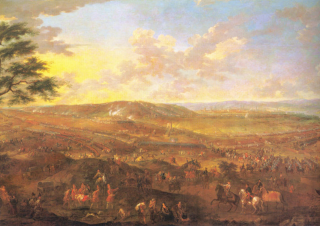
(Pictured: “Battle of Villaviciosa, December 10, 1710,” oil on canvas by Jean Alaux, Museum of the History of France)
Lady Isabella Anne Beresford (1776–1850), marries Sir John William Head Brydges, MP, of Wootton Court, second son of Edward Brydges), in 1812.
Lady Catharine Beresford (1777–1843)
Lady Anne Beresford (1779–1842)
Lady Elizabeth Louisa Beresford (1783–1856), who marries Maj. Gen. Sir Denis Pack in 1816. After his death in 1823, she marries Sir Thomas Reynell, 6th Baronet, in 1831.
In January and February 1689, Butler votes against the motion to put William of Orange and Mary on the throne and against the motion to declare that James II has abdicated it. Nevertheless, he subsequently joins the forces of William of Orange, by whom he is made colonel of the 2nd Troop of Horse Guards on April 20, 1689. He accompanies William in his Irish campaign, debarking with him in Carrickfergus on June 14, 1690, and commands this troop at the Battle of the Boyne in July 1690. In February 1691 he becomes Lord Lieutenant of Somerset.
Butler serves on the continent under William of Orange during the Nine Years’ War and, having been promoted to major general, he fights at the Battle of Steenkerque in August 1692 and the Battle of Landen in July 1693, where he is taken prisoner by the French and then exchanged for the Duke of Berwick, James II’s illegitimate son. He is promoted to lieutenant general in 1694.
Butler plays a dramatic role at the notorious meeting of the Privy Council on March 8, 1711, when Antoine de Guiscard, a French double agent who is being questioned about his treasonable activities, attempts to assassinate Robert Harley, 1st Earl of Oxford, against whom he has a personal grudge for drastically cutting his allowance, by stabbing him with a penknife. Harley is wounded, but not seriously, due largely to the fact that he is wearing a heavy gold brocade waistcoat in which the knife gets stuck. Several Councillors, including Butler, stab Guiscard in return. Guiscard implores Butler to finish the deed, but he replies that it is not for him to play the hangman. In any case, he has the sense to see that Guiscard must be kept alive at least long enough to be questioned, although as it turns out Guiscard’s wounds are fatal, and he dies a week later.
On April 23, 1712, Butler leaves Harwich for Rotterdam to lead the British troops taking part in the war. Once there he allows himself to be made the tool of the Tory ministry, whose policy is to carry on the war in the Netherlands while giving secret orders to him to take no active part in supporting their allies under Prince Eugene. In July 1712, he advises Prince Eugene that he can no longer support the siege of Le Quesnoy and that he is withdrawing the British troops from the action and instead intends to take possession of Dunkirk. The Dutch are so exasperated at the withdrawal of the British troops that they close the towns of Bouchain on Douai to British access, despite the fact that they have plenty of stores and medical facilities available. Butler takes possession of Ghent and Bruges as well as Dunkirk, in order to ensure his troops are adequately provided for. On April 15, 1713, he becomes Lord Lieutenant of Norfolk.
Ormonde’s position as Captain-General makes him a personage of much importance in the crisis brought about by the death of Queen Anne and, during the last years of Queen Anne, he almost certainly has Jacobite leanings and corresponds with the Jacobite Court including his cousin, Piers Butler, 3rd Viscount Galmoye, who keeps barrels of gunpowder at Kilkenny Castle. King George I, on his accession to the throne in August 1714, institutes extensive changes and excludes the Tories from royal favour. Butler is stripped of his posts as Captain-General, as colonel of the 1st Regiment of Foot Guards and as Commander in Chief of the Forces with the first two posts going to the Duke of Marlborough and the role of Commander-in-Chief going to John Dalrymple, 2nd Earl of Stair. On November 19, 1714, Butler is instead made a member of the reconstituted Privy Council of Ireland.
Accused of supporting the Jacobite rising of 1715, Butler is impeached for high treason by Lord Stanhope on June 21, 1715. He might avoid the impending storm of Parliamentary prosecution, if he remains in England and stands trial but instead, he chooses to flee to France in August 1715 and initially stays in Paris with Lord Bolingbroke. On August 20, 1715, he is attainted, his estate forfeited, and honours extinguished. The Earl Marshal is instructed to remove the names and armorial bearings of Butler and Bolingbroke from the list of peers and his banner as Knight of the Garter is taken down in St. George’s Chapel.
On June 20, 1716, the Parliament of Ireland passes an act extinguishing the regalities and liberties of the county palatine of Tipperary; for vesting Butler’s estate in the crown and for giving a reward of £10,000 for his apprehension, should he attempt to land in Ireland. But the same parliament passes an act on June 24, 1721, to enable his brother, Charles Butler, 1st Earl of Arran, to purchase his estate, which he does accordingly.
Butler subsequently moves to Spain where he holds discussions with Cardinal Giulio Alberoni. He later takes part in a Spanish and Jacobite plan to invade England and puts James Francis Edward Stuart on the British throne in 1719, but his fleet is disbanded by a storm in the Bay of Biscay. In 1732, he moves to Avignon, where he is seen in 1733 by the writer Lady Mary Wortley Montagu. He dies at Avignon in exile on November 16, 1745, but his body is returned to London and buried in Westminster Abbey on May 22, 1746.
On July 20, 1682, Butler, then called Lord Ossory, marries Lady Anne Hyde, daughter of Laurence Hyde, who is then Viscount Hyde of Kenilworth but becomes Earl of Rochester in November. The couple has a daughter, Mary, who dies young in 1688.
Following the death of his first wife in 1685, Butler plans to marry again in order to secure a male heir. He gains permission from the House of Lords for the arranging of a jointure for another marriage in May 1685, and in August of that year, he marries Lady Mary Somerset, daughter of the Duke of Beaufort and Mary Capel. The couple has a son, Thomas (1686–1689), and two daughters, Elizabeth (1689–1750) and Mary (1690–1713). His second wife is a Lady of the Bedchamber to Queen Anne. Their younger daughter, Mary, marries John Ashburnham, 1st Earl of Ashburnham.
(Pictured: Portrait of James Butler, 2nd Duke of Ormonde, by Michael Dahl, National Portrait Gallery)
Twysden is born in Kent, in the South East England region, on September 7, 1713, the third son of Sir William Twysden, 5th Baronet of Roydon Hall, East Peckham, Kent, by his wife (and distant cousin) Jane Twisden.
By his second wife, Twysden has two children: Mary, who dies in infancy, and a posthumous daughter named Frances (1753–1821). Frances, later Countess of Jersey, is one of the many mistresses of King George IV when he is Prince of Wales.
Twysden dies on November 2, 1752, at home in Jermyn Street, St. James’s, London. However, according to ecclesiastical historian and author Henry Cotton, he dies at Roydon Hall, East Peckham, his father’s country house. He is buried in the south chancel of St. Michael’s Church, East Peckham, under a plain stone with no inscription.
A story grows up that, having been made bankrupt, Twysden is shot while attempting to rob a stagecoach. The location of his alleged attempted career as a highwayman is either Hounslow Heath (west of London) or Wrotham Heath in Kent.
(Pictured: The Cathedral of St Eunan, Raphoe, the episcopal seat of the pre-Reformation and Church of Ireland bishops of Raphoe)
Beresford is educated at Trinity College, Dublin. From 1783, he serves as a storekeeper for the port of Dublin. He is subsequently appointed to a wealthy sinecure post of Inspector-General of Exports and Imports. He is returned by his father, Hon. John Beresford, for the family borough of Swords to the Irish House of Commons in 1790. In 1798 he is returned for Dublin City, helped by his position in the port, and as a partner in a leading Dublin bank and a member of Dublin Corporation.
During the Irish Rebellion of 1798, Beresford leads a yeoman battalion which fights against the rebels with a particular ferocity. He keeps a riding school in Dublin, which acquires an evil reputation as the chief scene of the floggings by which evidence is extorted from the United Irishmen. As such, he becomes identified as one of the leading opponents of the rebellion, and the rebels deliberately burn the banknotes issued by his bank. His reputation for persecuting political opponents survives throughout his political career.
Beresford takes a prominent part in the Irish House of Commons, where he unsuccessfully moves the reduction of the proposed Irish contribution to the imperial exchequer in the debates on the Act of Union. He is to the last an ardent opponent of the union, taking the opposite position to his father. He resigns his post at the port on January 25, 1799, so as not to be tainted by it or by the suggestion that his actions are motivated by a desire to retain it.
Under a provision of the Act of Union 1800 Beresford retains his seat in the 1st Parliament of the United Kingdom (1801–02) without a fresh election, and in the Union Parliament he is a supporter of William Pitt the Younger and later Henry Addington. He has to give up his Irish business interests to play a full part in Parliamentary business. He is re-elected at the 1802 United Kingdom general election, being top of the poll.
On June 3, 1803, Beresford is the only previous supporter of the government to desert them and support a censure motion moved by Peter Patten, making a speech in support which is regarded as “absurd” by the Chief Secretary to the Lord Lieutenant for Ireland. In March 1804, he is appointed to the Irish currency committee, and therefore resigns his seat by accepting the Escheatorship of Ulster, a sinecure office of profit under the Crown.
After the death of his father on November 5, 1805, Beresford returns to Parliament by winning the by-election to replace him as MP for County Waterford. Politically, he allies to a family faction of the Marquess of Waterford, under the leadership of Henry de La Poer Beresford. The faction aims at trying to stop the government from giving power in Ireland to the Ponsonby family. Beresford is the chief spokesman for his group in their meetings with Ministers.
Although expected to go into opposition in 1806, Beresford in fact supports the government, because a run on funds at his bank leaves him in need of government support for credit. His support leads to his re-election at the 1806 United Kingdom general election in a contested election. This is a controversial decision within the government, with the Duke of Bedford admitting that Beresford had been guilty of persecution but believing he is now loyal, while Lord Howick believes it unlikely that he can be relied upon.
Howick turns out to be correct. In 1807 Beresford does not support the government and becomes a supporter of the Duke of Portland before his accession to the premiership later that year. He is unopposed in the 1807 United Kingdom general election. However, he is erratic, and some of his speeches are reckoned as doing more harm than good to the government’s cause. He strongly supports government against the proposal that peace negotiations with France begin in 1809.
In January 1811, Beresford suffers a further severe financial crisis which prevents his attendance at Parliament for some months. In June he resigns his seat through appointment as Escheator of Munster, being succeeded by his kinsman, Major General Sir William Carr Beresford. The next year, he attempts to get a government appointment but is refused as he already has a good pension. He serves as Lord Mayor of Dublin in 1814–15, where he is known for his “princely hospitality,” but thereafter withdraws from public life.
Beresford dies on July 20, 1846, at his house at Glenmoyle, County Londonderry.
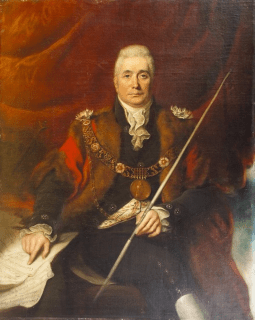
(Pictured: Portrait of John Claudius Beresford, seated and wearing the chain of office of the Lord Mayor of Dublin, by William Cuming, August 1814)
Hogan is the third child of John Hogan, a carpenter and builder of Cove Street, Cork, County Cork, and Frances Cos, the great-granddaughter of Sir Richard Cox, Lord Chancellor of Ireland from 1703 to 1707. As the family feels that she had married beneath her station, she is disinherited.
At the age of fourteen, Hogan is placed as clerk to an attorney, where he spends much of his time carving figures in wood. After two years, he chooses to be apprenticed to the architect Sir Thomas Deane, where his talents for drawing and carving are developed. He carves balusters, capitals, and ornamental figures for Deane’s buildings. At the completion of his apprenticeship in March 1820, Deane encourages him to consider taking up sculpture as a profession. For the next three years, he attends lectures on anatomy, copies casts of classic statuary in the Gallery of the Cork Society of Arts, and makes anatomical studies in wood of feet, hands, and legs. Among the first of his works to attract notice is a life-size figure of Minerva for an insurance building built by Deane.
In 1821, Hogan carves twenty-seven statues in wood for the North Chapel in Cork for the reredos behind the high altar. After subsequent cathedral renovations, these are now positioned in decorative plasterwork over the nave. He also does a bas-relief of the “Last Supper” for the altar. This work keeps him employed for about a year.
In 1823, the engraver William Paulet Carey visits Cork, and impressed with Hogan’s talent, begins to publicise his work in order to raise subscriptions for him to study in Italy. Hogan arrives in Rome, by way of Dublin and Liverpool, in 1824. He works in the galleries of the Vatican but cannot afford a studio. Additional subscriptions allow him to improve his situation, rent a studio, purchase marble, and hire models. Danish sculptor Bertel Thorvaldsen says to him, “My son, you are the best sculptor I leave after me in Rome.”
In 1829, Hogan visits Ireland, bringing several works with him. The Royal Arts Society provides a venue for an exhibition. The Royal Dublin Society awards him a gold medal.
Hogan’s best-known work and masterpiece are the three versions of the statue of The Dead Christ or The Redeemer in Death. Created in flawless Carrara marble, the first version (1829) is located in St. Therese’s Church, Dublin, the second (1833) in St. Finbarr’s (South) Church, Cork, and the third and final version (1854) is located in the Basilica of St. John the Baptist, Newfoundland. His other works include the Sleeping Shepherd and The Drunken Faun. He assures his international reputation in 1829 with The Dead Christ. Thereafter, his creations are snapped up by Irish bishops visiting his Rome studio.
In 1840, a monumental group in memory of Bishop James Warren Doyle, founder of the Cathedral of the Assumption in Carlow, is brought to Dublin and exhibited at the Royal Exchange. The statue of Bishop Doyle is in the Cathedral of the Assumption, as is a second Hogan work depicting the Holy Family.
Hogan marries Cornelia Bevignani in Rome in 1838. The figure of Hibernia, in Hogan’s work Hibernia with the Bust of Lord Cloncurry (1844), is reportedly modelled on his wife. A representation of this work is later used as the watermark on all Series A banknotes printed in Ireland from the 1920s to the 1970s. The couple has four sons and eight daughters.
With the revolutionary movement growing in Italy during the 1840s, and after spending twenty-four years in Rome, Hogan returns with his family to Ireland in 1848. At first, he finds little work in the aftermath of the Great Famine, but gradually commissions increase. He can be impatient with ignorance, intolerant of professional inferiority, and independent. He holds aloof from other artists and refuses to join the Royal Hibernian Academy.
Hogan has a stroke in 1855 and, though he recovers somewhat, his health begins to fail. By the year prior to his death, he can no longer work and his sons, John Valentine Hogan and James Cahill, assist at his studio and complete some of the work.
Hogan dies at his home at 14 Wentworth Place (later renamed Hogan Place), Dublin, on March 27, 1858. He is buried at Glasnevin Cemetery in Dublin.
(Pictured: Scan of a drawing depicting the Irish sculptor John Hogan with his sculpture The Drunken Faun in background, published in the Dublin University Magazine, January 1850)
Britain’s enemies in Continental Europe have long recognised Ireland as a weak point in Britain’s defences. Landing troops there is a popular strategic goal, not only because an invader can expect the support of a large proportion of the native population, but also because at least initially they will face fewer and less reliable troops than elsewhere in the British Isles. Additionally, embroiling the British Army in a protracted Irish campaign will reduce its availability for other theatres of war. Finally, French planners consider that a successful invasion of Ireland might act as the ideal platform for a subsequent invasion of Great Britain.
Unaware of Humbert’s surrender, the French despatch reinforcements under the command of CommodoreJean-Baptiste-François Bompart on September 16. Having missed one invasion force, the Royal Navy is more watchful. Roving frigate patrols cruise off the principal French ports and in the approaches to Ireland, while squadrons of battleships from the Channel Fleet sail nearby, ready to move against any new invasion force. In command of the squadron on the Irish station is Commodore Sir John Borlase Warren, a highly experienced officer (and politician) who has made a name for himself raiding the French coast early in the war.
The squadron carrying the reinforcements is soon spotted after leaving Brest. After a long chase, the French are brought to battle in a bay off the rugged County Donegal coast in the west of Ulster, very close to Tory Island. During the action the outnumbered French attempt to escape, but are run down and defeated piecemeal, with the British capturing four ships and scattering the survivors. Over the next fortnight, British frigate patrols scour the passage back to Brest, capturing three more ships. Of the ten ships in the original French squadron, only two frigates and a schooner reach safety. British losses in the campaign are minimal.
The battle marks the last attempt by the French Navy to launch an invasion of any part of the British Isles. It also ends the last hopes the United Irishmen have of obtaining outside support in their struggle against the British. After the action, Wolfe Tone is recognised aboard the captured French flagship and arrested. He is brought ashore by the British at Buncrana, on the Inishowen peninsula. He is later tried for treason, convicted, and commits suicide while in prison in Dublin, hours before he is to be hanged.
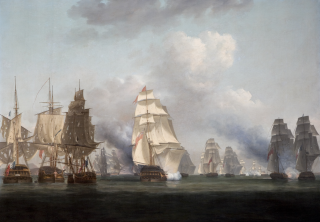
(Pictured: Attack of the French Squadron under Monsr. Bompart Chef d’Escadre, upon the Coast of Ireland, by a Detachment of His Majesty’s Ships under the Command of Sir J. B. Warren, October 12, 1798, by Nicholas Pocock, 1799)
A trained barrister, Pery becomes a member of the Irish House of Commons for the Wicklow constituency in 1751. On the dissolution of the house following the death of George II, he is elected for the constituency of Limerick City and serves from 1761 until 1785, becoming Speaker of the House in 1771. In 1783, he stands also for Dungannon, however chooses to sit for Limerick City. He is considered one of the most powerful politicians in Ireland in his time, leading a faction which includes his nephew, the future Earl of Limerick, and his relatives by marriage, the Hartstonges. Following his resignation, he is created Viscount Pery, of Newtown Pery, near the City of Limerick, in the Peerage of Ireland, entitling him to a seat in the Irish House of Lords. As he has no male heirs, his title becomes extinct on his death on February 24, 1806.
Pery is also noted for his part in the history of the architecture of Limerick. In 1765, he commissions the engineer Davis Ducart to design a town plan for land that he owns on the southern edge of the existing city. This leads to the construction of the Georgian area of the city later known as Newtown Pery. He is also commemorated in the naming of Pery Square.
The 1710 Spanish campaign opens on May 15 when the Spanish Bourbon army commanded by Philip V in person and Francisco Castillo Fajardo, Marquis of Villadarias, advance on the town of Balaguer. Guido Starhemberg, commander of the Allied forces in Catalonia, halts this attempt by preventing the Spanish from fording the Segre River, a success in which the officers of the British contingent have a leading role.
Having received reinforcements, in June Philip makes another attempt upon Balaguer with 20,000 infantry and 6,000 cavalry but is defeated at Almenar on July 27. The allied troops take up a strong defensive position and repel the Spanish attacks until the British commander, James Stanhope, leading their vanguard, breaks the Spanish lines. Philip is forced to withdraw to Zaragoza, capital of Aragon, while Villadarias is replaced by the French general Alexandre Maître, Marquis de Bay.
On August 9, the Spanish army reaches Zaragoza and de Bay positions his troops with the river Ebro on his left and the Torrero heights to the right. On August 15, an Allied cavalry attack is repulsed, followed by five days of minor skirmishes before the Allies cross the Ebro in force on August 19 and are allowed to deploy during the night.
The two forces are roughly equal in strength, the allies having thirty-seven battalions of infantry and forty-three squadrons opposed to the Spanish-Bourbon army of thirty-eight battalions and fifty-four squadrons. The Allied left, composed of Catalonian and Dutch troops, is led by Pedro Manuel de Ataíde, 5th Count of Atalaia, the right by Stanhope, made up of British, Portuguese and Austrian cavalry, with Starhemberg in charge of the centre, mainly German, Austrian and Spanish infantry.
On August 20 at 8:00 a.m., an artillery-duel starts which lasts four hours before Stanhope charges the Bourbon-Spanish left. At first the Spanish and Walloon troops of the Bourbon army seem to gain the advantage, having defeated a body of eight Portuguese squadrons, which they chased from the field. This opens a gap in the Bourbon lines, which opens a gap for Stanhope who scatters the disorganized Spanish soldiers, while at the centre and the right their attacks are repulsed.
The battle follows the same pattern as at Almenar, with the allies repulsing fierce Bourbon cavalry charges before counter-attacked with their infantry and pushing the Spanish back. In less than three hours, the Allies army wins a comprehensive victory, capturing the Bourbon artillery along with 73 standards. Between 5,000 and 6,000 Spanish soldiers are killed or wounded, and another 7,000 captured, with Allied losses estimated as 1,500 men dead or wounded.
Archduke Charles enters Zaragoza the next day. The defeat of the army of Philip V of Spain is severe, the way to Madrid is open. Philip V abandons Madrid on September 9 and goes to Valladolid. Archduke Charles enters a very hostile and almost empty Madrid on September 28. Charles comments, “This city is a desert!” In the winter of 1710, Archduke Charles and the allied troops have to abandon Madrid, due to the great opposition of the people of Madrid and the dangerous strategic situation. After this, the British army suffers a defeat at the Battle of Brihuega, and the rest of the allied army is defeated at the Battle of Villaviciosa.




 seamus dubhghaill