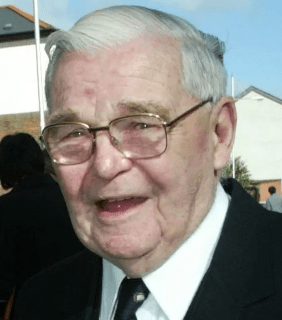
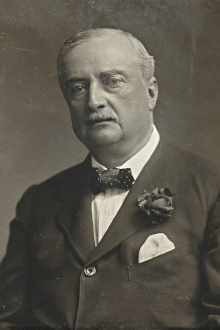
Known principally for his contribution to Ulster politics at local level, Armstrong serves as JP and is appointed High Sheriff of Armagh for 1875 and High Sheriff of Longford for 1894. He is a County Councillor for Armagh from 1899 to 1920, and a Member of the Irish Convention in 1917–18. Vice-Lieutenant of County Armagh in 1920, he is a Senator of Queen’s University Belfast from 1920 to 1937.
Armstrong is returned unopposed to the Imperial House of Commons for Mid-Armagh in the 1921 Mid Armagh by-election, at the advanced age of 76, becoming one of the oldest first-time MPs whose birth date is recorded. Certainly, he immediately becomes the oldest member of the current House of Commons. He is a Senator of Northern Ireland from 1921 to 1937, and Lord Lieutenant of Armagh from 1924 to 1939. For twenty-five years he is a member of the Representative Body of the Church of Ireland. He is Chairman of the County Armagh Education Committee from 1925 to 1931, and President of the Association of Education Committees of Northern Ireland. In 1932, he is made a Privy Councillor for Northern Ireland, and in 1938 he serves as a Justice for the Government of Northern Ireland in the absence of the Governor.
In his later years, Armstrong provides financial support for Jewish refugees fleeing Nazi-occupied Europe.
In 1883, Armstrong marries Margaret Leader, daughter of William Leader of Rosnalea, County Cork. They have five sons and three daughters, of whom C. W. Armstrong also becomes a politician.
Armstrong dies at his home in Dean’s Hill, Armagh, on December 4, 1943, at the age of 99 years.
Emmett is born in the Hammond’s Marsh area of Cork, County Cork, on April 24, 1764, the son of Dr. Robert Emmet from County Tipperary (later to become State Physician of Ireland) and Elizabeth Mason of County Kerry, both of whose portraits are today displayed at Cork’s Crawford Art Gallery. He is the elder brother of Robert Emmet, who is executed for leading the Irish Rebellion of 1803, becoming one of Ireland’s most famous republican martyrs. His sister, Mary Anne Holmes, holds similar political beliefs.
Emmet is a man of liberal political sympathies and becomes involved with a campaign to extend the democratic franchise for the Irish Parliament and to end discrimination against Catholics. He is called to the Irish bar in 1790 and quickly obtains a practice, principally as counsel for prisoners charged with political offenses. He also becomes the legal adviser of the Society of the United Irishmen.
When the Dublin Corporation issues a declaration of support of the Protestant Ascendancy in 1792, the response of the United Irishmen is their nonsectarian manifesto which is largely drawn up by Emmet. In 1795 he formally takes the oath of the United Irishmen, becoming secretary in the same year and a member of the executive in 1797. As by this time the United Irishmen had been declared illegal and driven underground, any efforts at peaceful reform of government and Catholic emancipation in Ireland are abandoned as futile, and their goal is now the creation of a non-sectarian Irish republic, independent from Britain and to be achieved by armed rebellion. Although Emmet supports this policy, he believes that the rebellion should not commence until French aid has arrived, differing from more radical members such as Lord Edward FitzGerald.
British intelligence infiltrates the United Irishmen and manages to arrest most of their leaders on the eve of the rebellion. Though not among those taken at the house of Oliver Bond on March 12, 1798, Emmet is arrested about the same time and is one of the leaders imprisoned initially at Kilmainham Gaol and later in Scotland at Fort George until 1802. Upon his release he goes to Brussels where he is visited by his brother Robert in October 1802 and is informed of the preparations for a fresh rising in Ireland in conjunction with French aid. However, at that stage France and Britain are briefly at peace, and the Emmets’ pleas for help are turned down by Napoleon.
Emmet receives news of the failure of his brother’s rising in July 1803 in Paris, where he is in communication with Napoleon. He then emigrates to the United States and joins the New York bar where he obtains a lucrative practice.
After the death of Matthias B. Hildreth, Emmet is appointed New York State Attorney General in August 1812 but is removed from office in February 1813 when the opposing Federalist Party obtains a majority in the Council of Appointment.
Sullivan, the second of six sons of Daniel Sullivan, house painter, and his wife, Catherine (née Baylor), a teacher, is born on May 15, 1829, in Bantry, County Cork. A popular date for Sullivan’s birth appears in many histories as 1830, but his gravestone reads 1829. He is educated in the local national school. One of his brothers is Timothy Daniel Sullivan, the Lord Mayor of Dublin from 1886 to 1888.
During the Great Famine of 1845 to 1847, Sullivan is employed as a clerk in connection with the relief works started by the government. Deeply influenced by the distress he witnesses, he afterward joins the Confederate Club formed in Bantry in support of the revolutionary movement of the Young Irelanders and is the organiser of the enthusiastic reception given by the town to William Smith O’Brien in July 1848 during the insurgent leader’s tour of the southern counties. Early in 1853, he goes to Dublin to seek employment as an artist. An exhibition of the arts and industries of Ireland is held in Dublin that year, and he is engaged to supply pencil sketches to the Dublin Expositor, a journal issued in connection with the exhibition. Subsequently, he obtains a post as a draughtsman in the Irish valuation office, and afterward as a reporter on the Liverpool Daily Post.
In 1855, Sullivan becomes assistant editor of The Nation, and subsequently editor and proprietor. From 1861 to 1884, in conjunction with his elder brother, T. D. Sullivan, he makes The Nation one of the most potent factors in the Irish Nationalist cause and also issues the Weekly News and Zozimus. Called to the Irish bar in 1876, he is a “special call” of the Inner Temple in 1877 and is made QC in 1881. He mainly practices at the English bar, though he acts in some political cases in Ireland.
As a member of the Dublin Corporation, Sullivan secures a magnificent site for the Grattan Monument, toward which he donates £400, the amount of a subscription by his admirers while he is undergoing imprisonment for a political offence in 1868. The monument is formally unveiled in January 1876. Between 1878 and 1882 he is engaged in many notable trials. His last great case is on November 30, 1883, when he is a colleague of Lord Russell in the defence of Patrick O’Donnell for the murder of James Carey, an informer.
Sullivan suffers another heart attack while on holiday in Bantry in September 1884 and spends his last days with William Martin Murphy at Dartry, County Dublin. Murphy regards him as a father figure, attributing his success to Sullivan’s early advice and journalistic training. Sullivan dies on October 17, 1884, at Dartry Lodge, Rathmines, Dublin. He is buried at Glasnevin Cemetery. With his wife, Frances Genevieve Donovan, whom he marries on April 27, 1861, and who outlives him by nearly forty years, he has a family of three sons and five daughters. His second son and namesake, Alexander Martin Sullivan, is the last to hold the rank of Serjeant-at-law (Ireland).
In addition to his labours, Sullivan is a great temperance reformer. He also writes two notable books, The Story of Ireland and New Ireland and contributes many sketches (including some verse) to Irish Penny Readings (1879–85). Some of his correspondence is located in the Isaac Butt papers in the National Library of Ireland.
Willes is born on February 13, 1814, in Cork, County Cork, the eldest among six children of James Willes, physician, and his wife, Elizabeth Aldworth, daughter of John Shaw, mayor of Cork in 1792. Educated at Dr. Porter’s school in Cork and Trinity College Dublin (TCD), he graduates BA in 1836, having entered the King’s Inns the previous year. In 1837, he goes to London and joins the Inner Temple as a pupil of the noted barrister Thomas Chitty (1802–78), in whose chambers he remains as a salaried assistant and special pleader before being called to the English bar on June 12, 1840. The Willes and Chitty families are connected, and James’s younger sister, Mary, later marries Thomas Chitty’s son.
Willes joins the home circuit, though his practice is chiefly in London in mercantile and maritime law. A leading junior in the Court of Exchequer, he holds the post of tubman from 1851, an honorary position in the gift of the Lord Chief Baron. Known for his erudition, he is persuaded to edit, with Sir Henry Singer Keating, the third and fourth editions of John William Smith‘s Leading Cases (1849, 1856). In 1850, his reputation is such that he is appointed one of the commissioners to draft the common law procedure bill (1854) and is credited with having effected most of the reform therein. On July 3, 1855, he is appointed judge of the Court of Common Pleas, though he has not yet taken silk and is only 41, the youngest lawyer but one to have been appointed to the bench since 1778.
A classical scholar and linguist who knows oriental as well as European languages, who travels widely, loves poetry, and frequents literary men, and whose judgments are clear and philosophical, Willes is accounted among the best common law judges of his day, and is celebrated for the simplicity and lucidity of his style. Notable judgments include Esposito v. Bowden (1857), which lays down that the force of a declaration of war is equal to that of an act of parliament prohibiting commercial transactions with the enemy. In the law of torts, he gives an oft-cited judgment in the case of Indermaur v. Dames (1866), which has been accepted almost as statutory, on the liability of the occupier of a building for the safety of a visitor. In 1868, as one of the first judges appointed to try election petitions, he lays down the rules of practice generally followed afterward. A strong British patriot, he serves in the Inns of Court Volunteers from 1859 until shortly before his death.
On November 3, 1871, Willes is sworn of the privy council. However, his health has deteriorated through overwork and an emotional temperament, and he has long suffered heart disease and gout. In August 1872, after a heavy assize at Liverpool, he returns to his house, Otterspool, Watford, Hertfordshire, and succumbs to a nervous breakdown, which leads to his shooting himself on October 2, 1872. He is buried on October 7 at Brompton Cemetery in London. He is survived fifteen years by his wife, Helen, daughter of Thomas Jennings of Cork, whom he married on May 17, 1856. There have no children.
A tall, reserved man, with a prominent nose and sad eyes, Willes has great affection for children and animals and is singularly emotional. He is known to return to his room and shed tears before passing sentence on a criminal. He never loses his Irish accent. His marriage is allegedly unhappy, as he had been forced into it after he had fallen out of love. Sir Frederick Pollock (1845–1937), author of the magisterial History of English Law before the Time of Edward I and sometime marshal to Willes, dedicates to him his first textbook on torts in 1879, writing that he was “one of those whose knowledge is radiant and kindles answering fire.” A century later, A. W. B. Simpson maintains that “his reputation as a jurist will last as long as the law reports of England are read.”
(From: “Willes, Sir James Shaw” by Bridget Hourican, Dictionary of Irish Biography, http://www.dib.ie, October 2009)
Following his exit from politics in 1957, having lost his Dáil seat, Finlay resumes practicing as a barrister. He successfully defends Captain James Kelly in the infamous 1970 arms trial.
In 1971, Finlay is tasked by the Fianna Fáil government with representing Ireland before the European Commission of Human Rights, when, in response to the ill treatment of detainees by security forces in Northern Ireland, they charge the British government with torture. Despite the notional recourse such prisoners would have within the British legal system, the Commission rules the complaint admissible.
During this period Finlay presides over a number of landmark cases, including Attorney General v X in 1992, when he overturns a High Court injunction preventing a pregnant teenage rape victim travelling to the UK for an abortion.
When, in the same year, Judge Liam Hamilton of the High Court, chair of the Beef Tribunal, seeks disclosure of the cabinet’s minutes for a particular meeting, Chief Justice Finlay along with the majority of the Supreme Court deny the request ruling that the concept of collective government responsibility in the Constitution takes precedence.
Finlay announces his resignation as Chief Justice of Ireland and retirement as a judge in 1994.
After his retirement, Finlay presides over a number of public inquiries.
In 1996, Finlay oversees the inquiry into the violence by English fans at the aborted 1995 friendly soccer match versus the Republic of Ireland at Lansdowne Road. His report to Bernard Allen, Minister for Sport, is critical of security arrangements on the night and recommends improvements to ticketing, seat-allocation, fan-vetting and policing arrangements. The Irish Government shares his report with the British Home Office.
After the collapse of The Irish Press group in 1995, the Minister for Enterprise and Employment, John Bruton, receives a damming report from the Competition Authority that Independent Newspapers has abused its dominant position and acted in an anti-competitive manner by purchasing a shareholding in The Irish Press. In September 1995, Bruton announces the Commission on the Newspaper Industry with an extremely wide remit to examine diversity and ownership, competitiveness, editorial freedom and standards of coverage in Irish newspapers as well as the impact of the sales of the British press in Ireland. Minister Bruton appoints 21 people to the commission and appoints Finlay chair. Due to the wide remit and huge number of submissions, the commission’s report is delayed but is eventually published at the end of July recommending widespread reforms.
Following the discovery of the BTSB anti-D scandal, in 1996, Finlay is appointed the chair and singular member of the Tribunal of Inquiry into the Blood Transfusion Service Board. The speed and efficiency with which his BTSB Tribunal conducts its business, restores confidence in the Tribunal as a mechanism of resolving great controversies in the public interest.
Finlay also sits on an Irish Rugby Football Union (IRFU) panel to adjudicate on the cases of Rugby players accused of using banned performance-enhancing substances.
Finlay is married to Alice Blayney, who predeceases him in 2012. They have five children, two of whom follow in his family’s legal tradition: his son John being a Senior Counsel and his daughter Mary Finlay Geoghegan a former judge of the High Court, Court of Appeal and Supreme Court. Whenever his work schedule allows, he escapes to County Mayo where he indulges his passion for fishing.
Thomas Finlay dies at the age of 95 in Irishtown, Dublin, on December 3, 2017.
Several of Redmond’s relatives are politicians. He takes over control of the minority IPP faction loyal to Charles Stewart Parnell after Parnell dies in 1891. He is a conciliatory politician who achieves the two main objectives of his political life: party unity and, in September 1914, the passing of the Irish Home Rule Act.
The Irish Home Rule Act grants limited self-government to Ireland, within the United Kingdom. However, implementation of Home Rule is suspended by the outbreak of the World War I. Redmond calls on the National Volunteers to join Irish regiments of the New British Army and support the British and Allied war effort to restore the “freedom of small nations” on the European continent, thereby to also ensure the implementation of Home Rule after a war that is expected to be of short duration. However, after the Easter Rising of 1916, Irish public opinion shifts in favour of militant republicanism and full Irish independence, resulting in his party losing its dominance in Irish politics.
In sharp contrast to Parnell, Redmond lacks charisma. He works well in small committees but has little success in arousing large audiences. Parnell had always chosen the nominees to Parliament. Now they are selected by the local party organisations, giving Redmond numerous weak MPs over whom he has little control. He is an excellent representative of the old Ireland but grows increasingly old-fashioned because he pays little attention to the new forces attracting younger Irishmen, such as Sinn Féin in politics, the Gaelic Athletic Association in sports, and the Gaelic League in cultural affairs.
Redmond never tries to understand the unionist forces emerging in Ulster. He is further weakened in 1914 by the formation of the Irish Volunteers by Sinn Féin members. His enthusiastic support for the British war effort alienates many Irish nationalists. His party has been increasingly hollowed out, and a major crisis, notably the Easter Rising, is enough to destroy it.
Redmond is increasingly eclipsed by ill-health after 1916. An operation in March 1918 to remove an intestinal obstruction appears to progress well initially, but he then suffers heart failure. He dies a few hours later at a Londonnursing home on March 6, 1918.
Condolences and expressions of sympathy are widely expressed. After a funeral service in Westminster Cathedral his remains are interred, as requested in a manner characteristic of the man, in the family vault at the old Knights Templars‘ chapel yard of Saint John’s Cemetery, Wexford, amongst his own people rather than in the traditional burial place for Irish statesmen and heroes in Glasnevin Cemetery. The small, neglected cemetery near the town centre is kept locked to the public. His vault, which has been in a dilapidated state, has been only partially restored by Wexford County Council.
In effect a special extension of the Defence of the Realm Acts, the aim of the Act is to increase convictions of nationalist rebels while averting the need to declare martial law. Under Section 3(6) of the Act, military authorities are empowered to jail any Irish person without charge or trial. Secret courts-martial are established, and lawyers (appointed by Crown agents) can be present only if the death penalty is involved. Inquests of military or police actions are banned.
By the middle of 1920, Ireland is in the throes of a full-fledged rebellion that is barely recognized by the British Government in Ireland headquartered in Dublin Castle. The Irish Republican Army (IRA), the military arm of the Dáil Éireann revolutionary government, is engaged in a guerilla campaign to destroy elements of British power, particularly burning down courthouses and attacking members of the Royal Irish Constabulary (RIC), Britain’s police force in the countryside.
The British response to the increase in violence and the assassination of police officers is twofold. To suppress the IRA “murderers,” Major GeneralHugh Tudor, commander of the RIC and self-styled “Chief of Police,” begins supplementing that body with the employment of World War I veterans known as the “Black and Tans” because of the colour of their surplus World War I uniforms, and an additional temporary force of Auxiliaries. With little discipline and utter indifference to the plight or moral indignation of the Irish population, these groups raid and burn villages, creameries, and farm buildings to intimidate supporters of the IRA.
The second measure is the enactment of the Restoration of Order in Ireland Act (ROIA). The Act is envisioned as a remedy to the problem perceived by Chief Secretary for Ireland Sir Hamar Greenwood that “throughout the greater part of Ireland criminal justice can no longer be administered by the ordinary constitutional process of trial by judge and jury.”
The genesis of the Act may be seen in a Cabinet discussion on May 31, 1920, in which the members focus on the violence in Ireland. Rather than addressing violence as the product of rebellion, Greenwood insists that, “The great task is to crush out murder and arson.” He asserts that the violence is perpetrated by handsomely paid thugs. Commenting on a pending Irish bill, Secretary of State for WarWinston Churchill states, “You should include in the Bill a special tribunal for trying murderers. It is monstrous that we have some 200 murders, and no one hung.” The prime minister agrees that convicted murderers should be hanged but questions whether convictions can be obtained from Catholics. The concern of all is that the civil courts are incapable of strictly administering justice to the revolutionaries because the juries largely consisted of Irish Catholics. The ensuing discussion of possibly imposing court-martial jurisdiction is inconclusive.
After the May 31 meeting, Greenwood investigates the feasibility of imposing martial law in Ireland and raises martial law as the specific subject of a July 23, 1920, conference committee meeting of the Cabinet led by Prime MinisterDavid Lloyd George to which the key members of the Dublin Castle administration are invited. William E. Wylie, the law advisor at Dublin Castle, notes that the RIC is disintegrating through resignations brought on by terrorist attacks, and that with “regard to the Civil Courts, the entire administration of the Imperial Government had ceased.” The civilian participants from Dublin Castle, especially Wylie, maintain that martial law is counter-productive, and will only antagonize the Irish people. As an alternative to martial law, General Tudor argues for the imposition of court-martial jurisdiction. Tudor argues forcefully that court-martial jurisdiction over all crimes will support the Black and Tans and Auxiliaries that he is recruiting. He declaims that “not a single criminal had been brought to justice for murder.” Lloyd George closes the discussion directing the Dublin Castle participants to provide final proposals for enforcement of the laws.
A draft bill to establish military criminal jurisdiction is considered by the Cabinet on July 26. The prime minister’s most telling contribution is his question as to whether a convicted man would be shot or hanged. It appears that he is comforted by the response that the defendant will be tried under the ordinary law which implies death by hanging. The resulting bill is completed by July 30, 1920, and is then quickly pushed through Parliament and receives royal assent on August 9, 1920. The ROIA provides that all crimes punishable under the laws in Ireland can be brought before a court-martial. The court-martial will have the power to impose any punishment authorized by statute or common law including the death penalty. The final step is taken on August 20, 1920, when the final regulations for implementation go into effect.
The combination of growing police and military pressure and recourse to the ROIA lead to increased internments of known or suspected IRA members and a steady increase in convictions to 50-60 per week. This makes it more difficult for IRA soldiers to continue openly working day jobs while carrying on part-time guerrilla activities. As a result, the IRA shifts its approach to guerrilla warfare in the rural counties. Volunteers from IRA units are organized into elite, full-time, mobile flying columns of around 25 men who live off the land and on the run. These flying columns prove to be more suited to ambushes of patrols and convoys and other targets of opportunity, rather than attacks on barracks which had become better defended.
On December 10, 1920, martial law is proclaimed in counties Cork, Kerry, Limerick, and Tipperary. In January 1921 martial law is extended to counties Clare and Waterford.
In a crucial judgement, R (Egan) v Macready, the Irish courts rule that the Act does not give power to impose the death penalty. This would no doubt have proved politically contentious had not hostilities ended the same day.
Despite its name, the courts are of the view that ROIA applies in England as well. Following the creation of the Irish Free State, when the Act is repealed by implication, it is still used to deport ex-members of the Irish Self-Determination League to Ireland.
Cox is the younger of two sons of Dr. Michael Cox, physician originally of Roscommon and Sligo, and Elizabeth Cox (née Nolan). Like his father, he supports the Irish Parliamentary Party (IPP) and maintains an interest in a wide range of subjects outside his chosen career throughout his life. He attends Belvedere College (1900-09), where he often obtains first place in his class and wins the Union prize for essay writing three years in a row (1905–07). He is the first auditor of the Belvedere Debating Society and is succeeded in the post by George O’Brien, who remains his lifelong friend. In 1909, he wins both a Royal University of Ireland (RUI) scholarship and an entrance exhibition to University College Dublin (UCD), a college of the new National University of Ireland (NUI).
Working for an arts degree at UCD, then housed at 86 St. Stephen’s Green, Cox overcomes an innate shyness to cultivate a reputation as a skillful and humorous orator in the Literary and Historical Society (L&H), where he befriends both Kevin O’Higgins and John A. Costello. He has immense respect for both men, and they remain firm friends. The respect is reciprocal, and during their subsequent careers O’Higgins and Costello often have occasion to seek Cox’s wise counsel. In 1912, Cox defeats Costello for the auditorship of the L&H by 112 votes to 63, and in the same year attains a first-class honours BA. His role as auditor means that he is involved with UCD for a further year. He attends lectures at the Incorporated Law Society while at the same time he pursues both the LL. B course, a one-year postgraduate law degree, and an MA at UCD. By the end of 1913 he has achieved first place in the LL. B and first-class honours in his MA. In addition, he has become auditor of the Solicitors’ Apprentices’ Debating Society.
After university Cox is apprenticed to a solicitor, Francis Joseph Scallan, who runs a firm in partnership with his brother, John Louis Scallan. On qualifying in 1915, he remains with the firm as an assistant solicitor until 1920, when he forms a partnership with another solicitor, John McAreavey. The firm is called Arthur Cox & Co. and has its offices at 5 St. Stephen’s Green. Initially the new firm’s clients are predominantly made up of those for whom he worked at his previous firm, and friends from his university days. Through George O’Brien he meets Sir Horace Plunkett, president of the Irish Agricultural Organisation Society (IAOS), a connection of enormous benefit, which sees the firm both become solicitor to the IAOS and gain a large number of clients through its membership.
Despite his relative youth, Cox is held in high esteem by those attempting to construct the apparatus of the newly independent Irish Free State in 1922. This is clear when he provides Hugh Kennedy, law officer to the provisional government and future Chief Justice of Ireland, with a lengthy opinion on the status of the Anglo–Irish Treaty, in the context of drafting a constitution for the new state. He is conscious of the need to counter claims that the treaty does not go far enough in acknowledging Irish nationhood; and he advises that the first article of the new constitution should explicitly state that the sovereignty of the new state derives from the Irish people. This is ultimately done in the preamble of the Constitution of the Irish Free State (1922).
In 1923, Cox is appointed solicitor to Siemens-Schuckert, the German engineering firm, and helps to negotiate the terms of an agreement with the Irish government for the construction of a hydro-electric station at Ardnacrusha, County Clare. In 1926, the Electricity (Supply) Act is passed, on which he advises. Although he experiences much success in these years, he is very much affected by the death of his friend Kevin O’Higgins, who is shot and dies from his injuries on July 10, 1927. He visits O’Higgins on his deathbed. Arthur Cox & Co. expands rapidly in its early years, and in 1926 Cox and McAreavey purchase new premises at 42–3 St. Stephen’s Green. Four years later he buys his partner out of the firm.
Given his friendships with various members of the original Free State administration, and the amount of work he receives from it, government work for Cox dries up when Fianna Fáil comes to power in 1932. However, the protectionist corporate policies and implementing legislation of the new administration bring new opportunities. The legislation places severe restrictions on foreign companies owning and operating enterprises in Ireland. He develops a reputation for assisting corporate clients to circumnavigate the restrictive laws. Along with his friend James Beddy, chief executive of the Industrial Credit Corporation, he realises that foreign investment is essential to the growth of the Irish economy. He introduces many clients to Beddy, and between them they find ways to assist the firms in investing in various enterprises without breaching the law. During this period, he cements his reputation as the foremost corporate lawyer in Ireland. This is evident when James Marmion Gilmor Carroll appoints him, as one of only two non-family members, to the board of the tobacco manufacturers P. J. Carroll & Co. He plays a key role in transforming the archaic practices of the firm by persuading Carroll to recruit Kevin McCourt as executive director. He and McCourt later convince Carroll to employ his nephew, Don Carroll, who plays a key role in the modernisation and diversification of the firm. In 1960 He and Carroll negotiate the sale of 40 per cent of the company to Rothmans International.
Despite his reputation as a corporate lawyer, Cox also represents non-corporate clients, some of whom include well-known personalities. In 1946, he agrees to assist Hungarian film-maker Gabriel Pascal in attempting to persuade the Irish government to establish an Irish film studio, with a view to filming the plays of George Bernard Shaw. He puts much time and energy into trying to convince the government to provide finance for the venture, but to no avail.
In 1942, Cox is elected to the council of the Incorporated Law Society and becomes president of the society for the 1951-52 term, presiding over the celebrations to commemorate the centenary of the society’s charter of incorporation. In 1951, he also becomes chairman of the company law reform committee, which produces its report, known as “the Cox report,” in 1958. Renowned for his eccentricities, he is almost as well known for his shabby mode of dress as he is for his incisive mind and immense capacity for work. His reputation is also based on a strict adherence to discretion and confidentiality. This is clear in 1948 when his old friend John A. Costello, having been offered the office of Taoiseach in the first inter-party government, turns to him for advice on whether he should accept the post. In 1954, Costello nominates him to the 8th Seanad.
In October 1953, the London firm of Nicholl Manisty & Co. retains him to represent British Prime Minister Sir Winston Churchill in a libel action brought by BrigadierEric Dorman O’Gowan, arising from comments in Churchill’s The Second World War: The Hinge of Fate. Churchill also relies on the advice of his friend Sir Hartley Shawcross, leader of the English bar, who makes several visits to Dublin to meet Cox and counsel (including John A. Costello). Cox and Shawcross believe it necessary to reach some form of settlement to avoid Churchill having to appear in court. The action is therefore withdrawn in return for an undertaking that certain corrections will be made.
On August 5, 1940, Cox marries Brigid O’Higgins (née Cole), widow of his friend Kevin O’Higgins. Prior to this he lives with his mother at 26 Merrion Square. He had purchased Carraig Breac in Howth in 1936 and moves there on his marriage. His commitment to his work means that he often works seven days a week and he therefore keeps a flat on Mespil Road, Dublin, from 1940. In 1959, he sells Carraig Breac and moves to 8 Shrewsbury Road, Dublin.
On February 14, 1961, Brigid Cox dies. Soon after, Cox decides to retire from his profession and study for the priesthood. He is intent on becoming a Jesuit and discusses his intentions with the Archbishop of Dublin, John Charles McQuaid, who agrees to ordain him after two years of private tuition at the Jesuit theologate at Milltown Park, Dublin. On being accepted by the Jesuits, he makes arrangements to settle his worldly affairs by selling his home on Shrewsbury Road and leaving his practice to the existing partners. He enters Milltown Park on October 15, 1961, and is ordained on December 15, 1963. His impact on Irish life over the previous forty years is evident by the presence at his ordination of John A. Costello, W. T. Cosgrave, Seán T. O’Kelly, and James Dillon, among others.
Following ordination Cox is appointed to serve at the Jesuit mission in Monze, Northern Rhodesia (Zambia). He arrives at Monze in August 1964 and is appointed extraordinary chaplain to the local convent and hospital. On June 8, 1965, he suffers head injuries in a car accident while traveling to Namwada in Zambia. Taken to Choma hospital, he initially appears to be relatively unscathed but collapses and dies on June 11, 1965. He is found to have suffered from a cerebral haemorrhage and a fractured skull. He is buried in the grounds of the Jesuit retreat house in Chikuni, Zambia.
Many of the Cox family papers are housed at the UCD archives.
(From: “Cox, Arthur Conor Joseph” by Shaun Boylan, Dictionary of Irish Biography, http://www.dib.ie, October 2009)
Born John Gerard Smyth, upon joining the Norbertine Roman Catholic religious order in 1945, he changes his name to Brendan. The Norbertines, also known as the “Premonstratensians,” are aware of Smyth’s crimes as early as the late 1970s, yet they do not report him to either the Garda Síochána or the Royal Ulster Constabulary (RUC). He is moved from parish to parish and between dioceses and countries whenever allegations are made. In some cases, the order does not inform the diocesan bishop that Smyth has a history of sexual abuse and should be kept away from children. He abuses children in parishes in Rhode Island and North Dakota and at one time works in Boston and is suspected of similar actions while on pastoral work in Wales and Italy. Norbertine Father Bruno Mulvihill makes several attempts to alert church authorities about the abuse committed by Smyth.
Smyth’s first conviction follows the reporting to police of his abuse of four siblings in Belfast’s Falls Road. After his arrest in 1991, he flees to the Republic of Ireland, where he spends the next three years on the run, staying mostly at Kilnacrott Abbey. This leads to the collapse of the Fianna Fáil–Labour Party coalition government in December 1994 when the poor handling of an extradition request from the RUC by the Irish Attorney General‘s office leads to a further delay of Smyth’s trial. An award-winning UTVCounterpoint programme on the scandal by journalist Chris Moore, followed by a book, accuses the head of the Norbertines and the Archbishop of Armagh of mishandling the case, and the Norbertines of negligence and a failure to tell others of Smyth’s crimes, enabling him to sexually abuse large numbers of children for 40 years.
Smyth dies in prison of a heart attack at the age of 70 on August 22, 1997, after collapsing in the exercise yard, one month into a 12-year prison sentence. The Norbertines hold his funeral before dawn and cover his grave with concrete to deter vandalism. He is buried in Kilnacrott Abbey, which is later put up for sale with 44 acres of land, including the grave.
On October 27, 2005, the title “Reverend” is removed from his gravestone following a campaign by one of Smyth’s victims.
Reviewers of the case differ as to whether there is a deliberate plot to conceal Smyth’s behaviour, incompetence by his superiors at Kilnacrott Abbey, or some combination of factors. Cahal Daly, both as Bishop of Down and Connor, a diocese where some of the abuse takes place, and later as Cardinal Archbishop of Armagh, is recorded as having been privately furious at the Norbertine “incompetence.” Smyth’s activities are investigated by the Northern Ireland Historical Institutional Abuse Inquiry, finding that: “…despite knowing his history of abusing children, the Norbertine religious order moved Smyth to different dioceses where he abused more children…”
In 2010, Daly’s successor as Roman Catholic Archbishop of Armagh, Cardinal Seán Brady, faces “huge pressure to resign” after he admits that in 1975, he witnessed two teenage boys sign oaths of silence after testifying in a Church inquiry against Smyth. Survivor groups see this as evidence of collusion, but Brady says he “did not have the authority” to turn Smyth in. On March 17, 2010, the Deputy First Minister of Northern Ireland, Martin McGuinness, calls for Brady to resign.
In 2013, some of Smyth’s alleged Rhode Island victims between 1965 and 1968, both male and female, call for the Diocese of Providence to investigate Smyth. As of 2019, he is among those listed by the Diocese of Providence as being “credibly accused” of committing sex abuse.
Module 6 of the 2014-2016 Northern Ireland Historical Institutional Abuse Inquiry is dedicated to Smyth’s crimes in Northern Ireland.
A two-part dramatisation of the Smyth case, Brendan Smyth: Betrayal of Trust, is broadcast by the BBC on March 13, 2011, with Ian Beattie in the title role and Richard Dormer as Chris Moore.
(Pictured: Father Brendan Smyth, Our Lady of Mercy, East Greenwich, Rhode Island, USA, c. 1965)
On February 21, 1910, Carson accepts the parliamentary leadership of the anti-Home Rule Irish Unionists and, forfeiting his chance to lead the British Conservative Party, devotes himself entirely to the Ulster cause. His dislike of southern Irish separatism is reinforced by his belief that the heavy industry of Belfast is necessary to the economic survival of Ireland. The Liberal government (1908–16) under H. H. Asquith, which in 1912 decides to prepare a Home Rule bill, cannot overcome the effect of his extra-parliamentary opposition. The Solemn League and Covenant of resistance to Home Rule, signed by Carson and other leaders in Belfast on September 28, 1912, and afterward by thousands of Ulstermen, is followed by his establishment of a provisional government in Belfast in September 1913. Early in that year he recruits a private Ulster army, the Ulster Volunteer Force, that openly drills for fighting in the event that the Home Rule Bill is enacted. In preparation for a full-scale civil war, he successfully organizes the landing of a large supply of weapons from Germany at Larne, County Antrim, on April 24, 1914. The British government, however, begins to make concessions to Ulster unionists, and on the outbreak of World War I he agrees to a compromise whereby the Home Rule Bill is enacted but its operation suspended until the end of the war on the understanding that Ulster’s exclusion will then be reconsidered.
Appointed Attorney General for England in Asquith’s wartime coalition ministry on May 25, 1915, Carson resigns on October 19 because of his dissatisfaction with the conduct of the war. In David Lloyd George’s coalition ministry (1916–22) he is First Lord of the Admiralty from December 10, 1916, to July 17, 1917, and then a member of the war cabinet as minister without portfolio until January 21, 1918.
Carson retires in October 1929. In July 1932, during his last visit to Northern Ireland, he witnesses the unveiling of a large statue of himself in front of Parliament Buildings at Stormont. The statue is sculpted by Leonard Stanford Merrifield, cast in bronze and placed upon a plinth. The inscription on the base reads “By the loyalists of Ulster as an expression of their love and admiration for its subject.” It is unveiled by James Craig, 1st Viscount Craigavon, in the presence of more than 40,000 people.
Carson lives at Cleve Court, a Queen Anne house near Minster-in-Thanet in the Isle of Thanet, Kent, bought in 1921. It is here that he dies peacefully on October 22, 1935. A warship brings his body to Belfast for the funeral. Thousands of shipworkers stop work and bow their heads as HMS Broke steams slowly up Belfast Lough, with his flag-draped coffin sitting on the quarterdeck. Britain gives him a state funeral on Saturday, October 26, 1935, which takes place in Belfast’s St. Anne’s Cathedral. He remains the only person to have been buried there. From a silver bowl, soil from each of the six counties of Northern Ireland is scattered onto his coffin, which had earlier been covered by the Union Jack. At his funeral service the choir sings his own favourite hymn, “I Vow to Thee, My Country.”