seamus dubhghaill

Promoting Irish Culture and History from Little Rock, Arkansas, USA


1 Comment

The 2006 Dublin Riots

A series of riots in Dublin on February 25, 2006, is precipitated by a proposed march down O’Connell Street of a unionist demonstration. The disturbances begin when members of the Garda Síochána attempt to disperse a group of counterdemonstrators blocking the route of the proposed march. The situation escalates as local youths join forces with the counterdemonstrators.

Love Ulster is a Unionist organisation dedicated to commemorating the Unionist victims of the Troubles in Northern Ireland. It is organised in part by Willie Frazer of Families Acting for Innocent Relatives (FAIR). It is a partisan group established to voice outrage at killings by the Republican paramilitary organisations, but is criticised for not doing the same for victims of loyalist paramilitary organisations.

The Love Ulster march in Dublin is to consist of a uniformed band, several hundred activists (including some from the Orange Order) and relatives of victims, all of whom are to march from Parnell Street north of the River Liffey, down O’Connell Street, past Trinity College Dublin (TCD) onto Nassau Street, Dawson Street and Molesworth Street, and eventually reaching Leinster House, the seat of the Oireachtas, on Kildare Street.

The march of this group in Dublin is viewed as provocative by some Irish nationalists and many Irish republicans, particularly in the context of an Orange Order march. The Orange Order is accused of being a sectarian organisation known for its anti-Catholicism. The right to march is supported by the main Irish political parties and the march is authorised by the Garda Síochána. Love Ulster had organised a similar rally in Belfast in October 2005.

At previous FAIR rallies, a picture of an Ulster Volunteer Force (UVF) member who was allegedly involved in the murder of 26 people in Dublin in the 1974 Dublin and Monaghan bombings, and who was himself killed by the Provisional Irish Republican Army in 1976, had been displayed. An organiser of the Love Ulster demonstration tells a republican newspaper that he cannot guarantee that images of the murder suspect will not be displayed during the demonstration.

Sinn Féin, an Irish republican political party, does not organise a protest and says that the march should be allowed to go ahead, calling for republicans to ignore the march. Republican Sinn Féin, a splinter political party no longer affiliated with Sinn Féin, has an organised presence.

Their protest blocks the northeastern junction of O’Connell Street and Parnell Street. The small Republican Sinn Féin group (and some activists from the Irish Republican Socialist Party) are joined by several hundred local youths. Before the violence breaks out, they chant republican chants. Several thousand bystanders are also on the scene but take no part in the subsequent rioting. When the marchers form up at the top of Parnell Square and their bands begin to play in anticipation of the start of the march, gardaí attempt to disperse the protest at around 12:45 p.m. At this point, scuffles break out between protesters and Gardaí.

After the failure of the initial garda effort to disperse the protesters, the violence escalates. The Garda Public Order Unit is deployed, and stones and metal railings are thrown at gardaí by protesters, as are fireworks, bricks, crude petrol bombs, and other missiles. As the rioting continues, the ranks of the rioters are swelled by many local teenagers who had not taken part in the initial protest. Several barricades are constructed from building materials on the street to impede the march and the Gardaí. The march is due to start at 12:30 p.m., but as the violence goes on the gardaí decide against trying to escort the marchers through O’Connell Street. At about 1:30 p.m. the assembled marchers return to the coaches that had brought them to Dublin from Northern Ireland. The three coaches are then driven to Leinster House, where a small parade is carried out, and a letter is handed to Irish Minister for Justice, Michael McDowell. They are then escorted out of the city. One of the coaches is attacked by stone throwers on the way home.

Violence continues sporadically on O’Connell Street for another hour or so. The Gardaí, advancing from the northern end of the street gradually push the rioters back southward. The most sustained violence takes place around the General Post Office building, where the rioters initially sit down in protest and then, after several of them have been batoned, regroup behind burning barricades and throw rocks, paving slabs and one or possibly two petrol bombs at Gardaí. Several Gardaí, protesters and a number of journalists from RTÉ and TV3 are injured.

While the standoff on O’Connell Street is still going on, several hundred rioters follow the Unionist coaches to the Nassau Street area where they set a number of cars on fire and damage several businesses. Further skirmishes break out around the River Liffey at O’Connell Bridge, Aston Quay, Fleet Street and Temple Bar, as the Gardaí retake O’Connell street, before the rioters disperse.

Having dispersed the rioters, the gardaí then closes O’Connell Street to facilitate a cleanup of the scene by building workers. Media reports estimate the cost of the cleanup job at €50,000, and Dublin Chamber of Commerce places loss of earnings for businesses in the city due to the riots at €10,000,000.

Estimates for the number of unionist marchers before the event are predicted to be over 1,000. However, only eight coach loads turn up in Dublin, indicating a far smaller number, possibly 300 to 400. Estimates for the number of counterdemonstrators vary between 300 and 7,000. The number is made much more difficult to determine by the presence of the several thousand bystanders at the scene who do not take part. Most of the rioters appear to be local youths, though some who brandished leaflets and other political literature are clearly political activists.

A total of 14 people, including six gardaí and a small number of journalists and photographers, are hospitalised as a result of the rioting. A further 41 people are arrested, according to RTÉ news. As of February 27, 2006, thirteen have been charged. Twenty-six people are convicted in January 2009 for their part in the disturbances and given sentences of up to five years. Two are described as “alcoholics.” One of them and a teenage boy are “homeless.” Three are not Irish – a Georgian, a Romanian and a Moldovan are convicted of looting shops on O’Connell Street. Two have travelled from County Offaly, one from County Galway and one from County Donegal for the riot. All the rest come from Dublin.

(Pictured: The Public Order Unit on O’Connell Street during the 2006 Dublin Riots)


Leave a comment

Death of Basil Stanlake Brooke, Third Prime Minister of Northern Ireland

Basil Stanlake Brooke, 1st Viscount Brookeborough, KG, CBE, MC, TD, PC (Ire), Ulster Unionist Party (UUP) politician who serves as the third Prime Minister of Northern Ireland from May 1943 until March 1963, dies on August 18, 1973, at Colebrooke Park, Brookeborough, County Fermanagh, Northern Ireland. He has been described as “perhaps the last Unionist leader to command respect, loyalty and affection across the social and political spectrum.” Equally well, he has also been described as one of the most hardline anti-Catholic leaders of the UUP, and his legacy involves founding his own paramilitary group, which feeds into the reactivation of the Ulster Volunteers.

Brooke is born on June 9, 1888, at Colebrooke Park, his family’s neo-Classical ancestral seat on what is then the several-thousand-acre Colebrooke Estate, just outside Brookeborough, a village near Lisnaskea in County Fermanagh. He is the eldest son of Sir Arthur Douglas Brooke, 4th Baronet, whom he succeeds as 5th Baronet when his father dies in 1907. His mother is Gertrude Isabella Batson. He is a nephew of Field Marshal Alan Brooke, 1st Viscount Alanbrooke, Chief of the Imperial General Staff (CIGS) during World War II, who is only five years his senior. His sister Sheelah marries Sir Henry Mulholland, Speaker of the Stormont House of Commons and son of Lord Dunleath. He is educated for five years at St. George’s School in Pau, France, and then at Winchester College (1901–05).

After graduating from the Royal Military College, Sandhurst, Brooke is commissioned into the Royal Fusiliers on September 26, 1908, as a second lieutenant. He transfers to the 10th Royal Hussars in 1911. He is awarded the Military Cross and Croix de guerre with palm for his service during World War I.

Brooke is a very active Ulster Unionist Party member and ally of Edward Carson. He founds his own paramilitary group, Brooke’s Fermanagh Vigilance, from men returning from the war front in 1918. Although the umbrella Ulster Volunteers had been quiescent during the war, it is not defunct. It re-emerges strongly in 1920, subsuming groups like Brooke’s.

In 1920, having reached the rank of captain, Brooke leaves the British Army to farm the Colebrooke Estate, the family estate in west Ulster, at which point he turns toward a career in politics.

Brooke has a very long political career. When he resigns the Premiership of Northern Ireland in March 1963, he is Northern Ireland’s longest-serving prime minister, having held office for two months short of 20 years. He also establishes a United Kingdom record by holding government office continuously for 33 years.

In 1921, Brooke is elected to the Senate of Northern Ireland, but he resigns the following year to become Commandant of the Ulster Special Constabulary (USC) in their fight against the Irish Republican Army (IRA). He is created a Commander of the Order of the British Empire in 1921.

In 1929 Brooke is elected to the House of Commons of Northern Ireland as Ulster Unionist Party MP for the Lisnaskea division of County Fermanagh. In the words of the Oxford Dictionary of National Biography, “his thin, wiry frame, with the inevitable cigarette in hand, and clipped, anglicised accent were to be a feature of Stormont for the next forty years.”

Brooke becomes Minister of Agriculture in 1933. By virtue of this appointment, he also acquires the rank of Privy Councilor of Northern Ireland. From 1941 to 1943 he is Minister of Commerce.

On May 2, 1943, Brooke succeeds John M. Andrews as Prime Minister of Northern Ireland. In 1952, while Prime Minister, was raised to the peerage as Viscount Brookeborough, the title taken from the village named after the Brookes. Although a peer, he retained his seat in the House of Commons at Stormont and remained Prime Minister for another decade.

As the Northern Ireland economy begins to de-industrialise in the mid-1950s, leading to high unemployment amongst the Protestant working classes, Brooke faces increasing disenchantment amongst UUP backbenchers for what is regarded as his indifferent and ineffectual approach to mounting economic problems. As this disenchantment grows, British civil servants and some members of the UUP combine to exert discreet and ultimately effective pressure on Brooke to resign to make way for Captain Terence O’Neill, who is Minister of Finance.

In 1963, his health having worsened, Brooke resigns as Prime Minister. However, he remains a member of the House of Commons of Northern Ireland until the 1969 Northern Ireland general election, becoming the Father of the House in 1965. During his last years in the Parliament of Northern Ireland he publicly opposes the liberal policies of his successor Terence O’Neill, who actively seeks to improve relationships with the Republic of Ireland, and who attempts to address some of the grievances of Catholics and grant many of the demands of the Northern Ireland Civil Rights Association (NICRA).

Brooke is noted for his casual style toward his ministerial duties. Terence O’Neill later writes of him, “he was good company and a good raconteur, and those who met him imagined that he was relaxing away from his desk. However, they did not realise that there was no desk.”

In his retirement Brooke develops commercial interests as chairman of Carreras (Northern Ireland), a director of Devenish Trade, and president of the Northern Ireland Institute of Directors. He is also made an honorary LL.D. of Queen’s University Belfast.

From 1970 to 1973, years in which the Stormont institution comes under its greatest strain and eventually crumbles, Brooke makes only occasional forays into political life. In 1972, he appears next to William Craig MP on the balcony of Parliament Buildings at Stormont, a diminutive figure beside the leader of the Vanguard Unionist Progressive Party (VUPP) who is rallying right-wing Unionists against the Government of Northern Ireland. He opposes the Westminster white paper on the future of Northern Ireland and causes some embarrassment to his son, Captain John Brooke, the UUP Chief Whip and an ally of Brian Faulkner, by speaking against the Faulkner ministry‘s proposals.

Brooke dies at his home, Colebrooke Park, on the Colebrooke Estate, on August 18, 1973. His remains are cremated at Roselawn Cemetery, East Belfast, three days later, and, in accordance with his wishes, his ashes are scattered on the demesne surrounding his beloved Colebrooke Park.


Leave a comment

Birth of Pauline Flanagan, Stage & Television Actress

Pauline Flanagan, Irish-born actress who has a long career on stage, is born in Sligo, County Sligo, on June 29, 1925. She is best known in the United States for her role as Annie Colleary, on the television soap opera Ryan’s Hope in 1979 and again in 1981. She later returns to the show as Sister Mary Joel.

Flanagan is born to Patrick and Elizabeth (née Mulligan) Flanagan, who are strongly nationalist and republican, and support the Republican Anti-Treaty during the Irish Civil War, both serving as Lord Mayor of Sligo. Her paternal family, originally from County Fermanagh, are driven out by anti‐Catholic pogroms and resettle in Sligo, where her parents manage a retail business. She is good friends with fellow Irish actresses Joan O’Hara and Paddy Croft. She spends much of the early 1950s touring with Anew McMaster, where she meets Harold Pinter at the Gate’s Pinter Festival.

Flanagan appears in many Broadway plays, making her debut in 1957 in the first Main Stem production of Dylan Thomas‘s Under Milk Wood. She stars as Mrs. Grose in the 1976 Broadway revival of the William Archibald play The Innocents. She also appears on Broadway in Brian Friel‘s play Philadelphia, Here I Come! in 1994.

Flanagan also acts in Off-Broadway productions on several occasions with the Irish Repertory Theatre, including Harold Prince‘s Grandchild of Kings (1992), Seán O’Casey‘s Juno and the Paycock (1995). and Hugh Leonard‘s A Life (2001). For her performance in Grandchild of Kings, she receives the 1992 Outer Critics Circle Awards nomination for Best Actress. Other Off-Broadway work includes Yeats! A Celebration by William Butler Yeats.

Flanagan appears as Myra White in Hugh Leonard’s play Summer (1974), both in the original production at the Olney Theatre Center in Olney, Maryland, and at the Olympia Theatre in the Dublin Theatre Festival.

Flanagan is nominated for the 1982 Drama Desk Award for Outstanding Featured Actress in a Play for Medea in which she performs on Broadway in 1982.

In 1997, Flanagan wins the Barclays Theatre Awards for Best Actress in a Supporting Role for her role in Jennifer Johnston‘s The Desert Lullaby: A Play in Two Acts, at the Lyric Theatre, Belfast. The Barclays Theatre Awards are for outstanding regional theatre (including opera and dance) in the United Kingdom.

In 2001, Flanagan wins a Laurence Olivier Award for Best Actress in a Supporting Role, for her performance in Frank McGuinness‘s Dolly West’s Kitchen at The Old Vic in Waterloo, London.

A resident of Glen Rock, New Jersey, Flanagan dies at The Valley Hospital in Ridgewood, New Jersey, on June 28, 2003, one day before her 78th birthday, of heart failure following a battle with lung cancer. She is survived by her husband, George Vogel (whom she married in 1958), a sister, Maura McNally, and her daughters Melissa Brown and Jane Holtzen.


Leave a comment

Death of John McKeague, Northern Irish Loyalist

John Dunlop McKeague, a Northern Irish loyalist and one of the founding members of the paramilitary group the Red Hand Commando (RHC) in 1970, is killed by the Irish National Liberation Army (INLA) in Belfast, Northern Ireland, on January 29, 1982.

McKeague is born in 1930 at Messines Cottage, Bushmills, County Antrim, Northern Ireland, one of six children of Thomas McKeague and his wife, Isabella. The family operates a guesthouse in Portrush before moving to Belfast, where they open a stationer’s shop on Albertbridge Road. It is inherited by McKeague and in the late 1970s it becomes a confectioner’s shop and café.

In the late 1960s, McKeague is active in Ian Paisley‘s Free Presbyterian Church of Ulster and the Willowfield branch of the Ulster Protestant Volunteers (UPV). He is linked to William McGrath and the revived Ulster Volunteer Force (UVF) of the mid-1960s, and he publicises the claims of Gusty Spence that the police had framed him for the murder of a Catholic barman. On November 30, 1968, he participates in a banned demonstration by supporters of Ian Paisley against a civil rights march in Armagh city. Throughout the late 1960s and early 1970s he publishes a magazine, Loyalist News, full of anti-Catholic rhetoric and gossip, sectarian rhymes, Protestant religious material, and illustrated lessons in the use of firearms. He takes part in the bombing campaign of 1969 which leads to the downfall of Prime Minister of Northern Ireland Terence O’Neill and stands unsuccessfully for Belfast Corporation in 1969 as a Protestant Unionist Party (PUP) candidate. McKeague, who never marries, is a promiscuous homosexual. His paramilitary recruitment of young men has homoerotic overtones, and his violence contains elements of sexual perversion.

In 1969, McKeague and his associates take over the nascent Shankill Defence Association (SDA), which had been formed to oppose a destructive redevelopment scheme. He becomes its chairman and, despite his outsider status and eccentricities, is given to strutting around wearing a helmet and brandishing a stick, often seen as offering communal defence against a perceived Catholic threat. The organisation acquires 1,000 members. In August 1969, he orchestrates mob attacks on Catholic enclaves in Belfast, including Bombay Street. He boasts of these activities, becoming a figure of hate for Catholics. In October 1969, he is arrested and charged with conspiracy to cause an explosion but is cleared in February 1970. The sentence is reduced to three months on appeal. He testifies before Justice Leslie Scarman‘s tribunal, appointed to inquire into the unrest. In the course of his evidence, he exults over the August 1969 riots and the tribunal’s report condemns him by name. He later further enrages Catholics by calling the events of Bloody Sunday in January 1972 “Good Sunday” in a television interview.

McKeague seeks publicity and power, but his eccentricity and unwillingness to participate where he cannot command dooms his political ambitions. In the 1970 United Kingdom general election he wins only 441 votes in Belfast North. He is expelled from the UPV after being prosecuted in February–March 1970 over the loyalist bombing campaign of 1969, even though he is acquitted. He and Ian Paisley exchange bitter invective and he subsequently supports William Craig‘s Vanguard movement. In 1971, he and two associates are prosecuted under the new Incitement to Hatred Act for publishing a Loyalist song book, which includes verses, probably composed by McKeague, reveling in the murder of Catholics. The defendants plead that the book is purely a historical record, and their acquittal vitiates the act. After he quarrels with the newly formed Ulster Defence Association (UDA), which is created by a federation of the SDA with other local vigilante groups, his elderly mother is burned alive when the UDA petrol-bombs the family shop on May 9, 1971.

Early in 1972 McKeague is expelled from the SDA. He founds the Red Hand Commandos (RHC), centered on east Belfast and north Down, which perpetrates numerous sectarian murders. As RHC leader, he allegedly participates in murders involving torture and mutilation. He aligns the RHC with the UVF in 1972 and in February 1973 he is one of the first loyalist internees. He is subsequently imprisoned for three years for armed robbery, although he always asserts his innocence of this charge. During his imprisonment he assumes a leadership role among loyalist prisoners, undertaking two short hunger strikes in protest against the Special Powers Act and prison conditions. Later, in December 1981, he acts as an intermediary during a loyalist prison protest. On his release in 1975, the RHC splits and thereafter he denies any connection with the organisation, threatening to sue newspapers that link him with it. Until his death he is co-chair of the Ulster Loyalist Central Co-ordinating Committee (ULCCC), a paramilitary umbrella group established in 1974. On October 6, 1975, a Catholic customer is killed and McKeague’s sister severely injured when his shop is bombed by the Irish Republican Army (IRA).

From the mid-1970s McKeague advocates negotiated independence for Northern Ireland, arguing that this can accommodate republican anti-British feeling and unionist fears of a united Ireland. “The days of the Orange card are gone forever,” he says (Sunday World, January 31, 1982). He is a founder and deputy leader of the minuscule Ulster Independence Association and suggests that the “Londonderry Air” become Ulster‘s national anthem. In talks with nationalists and republicans, he tells the Catholic priest Des Wilson that a united Ireland would be acceptable to Protestants, provided “we enter as a free people, even if we’re only independent for five minutes.” However, his record is an insuperable barrier to these initiatives.

In his last years, McKeague is chairman of the Frank Street–Cluan Place–Stormont Street Housing Association. He lobbies for a security wall to shield this Protestant district of Belfast from the Catholic Short Strand on which it borders. Construction of the wall begins just before his death. He is shot dead by the INLA at his shop on Albertbridge Road on January 29, 1982. Shortly before his death, he is linked to the rape and prostitution of teenage boys at Kincora Boys’ Home in east Belfast. He had apparently been an informer to the security forces, and it is sometimes suggested that his murder is part of an official cover-up. He is buried in Bushmills, with Church of Ireland rites.

McKeague exemplifies the social deviant who can gain prominence during political instability, projecting and legitimising his hatreds and obsessions through extremist politics. In his last years, he accepts that he will die violently. He says that if loyalists kill him, “I want . . . to be left in the Republican area so that they’re blamed” (Sunday World, January 31, 1972).

(From: “McKeague, John Dunlop” by Patrick Maume, Dictionary of Irish Biography, http://www.dib.ie, October 2009)


1 Comment

The Philadelphia Nativist Riots

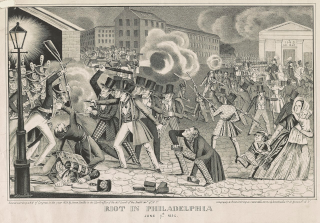
The Philadelphia nativist riots (also known as the Philadelphia Prayer Riots, the Bible Riots and the Native American Riots) are a series of riots that take place on May 6—8 and July 6—7, 1844, in Philadelphia, Pennsylvania, and the adjacent districts of Kensington and Southwark. The riots are a result of rising anti-Catholic sentiment at the growing population of Irish Catholic immigrants.

On July 3, Father John Patrick Dunn of the Church of St. Philip Neri in the Southwark District is warned that the church might be attacked during an upcoming parade held by the Native American Party. The Native American Party, a nativist political party, plans to hold a large parade the next day on Independence Day.

To prepare for violence, the church applies for an arsenal that a volunteer company could use in case the church is attacked. Pennsylvania Governor David R. Porter authorizes the formation of a company and the procurement of twenty-five muskets from the Frankford Arsenal. Major General Robert Patterson, commander of the Pennsylvania militia, puts the troops on alert in case of violence.

Five of the muskets placed in St. Philip Neri’s Church are discovered to be defective and are sent back to the Frankford Arsenal to be repaired. No violence occurs before or during the parade, but on July 5, a nativist mob numbering in the thousands gathers at the church after some observe five defective muskets being returned to the church. They then demand that the sheriff remove the weapons, while Father Dunn and volunteers rally to protect the church. Sheriff Morton McMichael and two aldermen search the church and remove twelve muskets. After leaving the church, the sheriff urges the crowd to disperse and leaves a volunteer posse to guard the church. The mob remains, and a man injured in the May riots makes a speech to the crowd, calling for a second search of the church. The sheriff, an alderman, and seventeen nativists enter the church and find three armed men, fifty-three muskets, ten pistols, a keg of gunpowder and ammunition. To avoid inciting the mob, the sheriff decides not to remove the armaments, and the search party stays in the church. Just after midnight, July 6, Major General Patterson orders a company of city guards to clear the streets. After the crowd disperses, the arms found within the church are removed.

By midday, the crowds return around St. Philip Neri’s Church. General George Cadwalader orders the crowds to disperse, but they do not. By the evening, the sheriff arrives with a 150-strong posse. Throughout the evening, the military presence grows, and three cannons are stationed on the streets. The soldiers clear the streets near the church, despite being pelted with rocks by the mob. Responding to the rock throwers, General Cadwalader orders a cannon to be fired at the crowd on Third Street. Former U.S. Congressman Charles Naylor begs the general not to fire. He and several others are arrested and held within the church. By the morning of July 7, most of the soldiers have left, but the crowds, led by an alderman and the sheriff, return and demand that the remaining guard release Naylor. Everyone except Naylor is released. The crowds grow, and a cannon is brought from a nearby wharf and used to threaten the church. After further negotiations, Naylor is released and carried home to cheers on people’s shoulders.

After Naylor is brought home, the mob attacks the church, damaging a wall with the cannon. A second cannon is brought from the wharfs and fired at the church, after which the mob pelts the building with rocks and break in through a side door. The soldiers fire on the men breaking into the church, who promptly retreat. After retreating, the nativists negotiate with the guard, who agrees to withdraw, allowing the nativists to guard the church. The crowd pelts the soldiers with rocks and some soldiers fire back, which only incites the mob further. The mob forces its way into the church, causing extensive damage to the interior. After about an hour, a group of twenty men organizes themselves to guard St. Philip Neri’s, and the mob leaves the church.

By the evening, a large number of soldiers arrive with orders to clear the streets, only to be stoned in the process. After a captain is attacked, the order is given to fire on the mob, which results in seven fatalities and nine injuries. Not long after, people with muskets and cannons arrive and fierce fighting breaks out between the soldiers and the mob. The fighting lasts for several hours, with the soldiers being fired upon from alleyways and the windows of nearby buildings. The soldiers bring in two cannons of their own and fire on the mob. The mob returns fire using their own cannons, armed with items such as nails, chains, knives and broken bottles. In an attempt to capture the mob’s cannons, soldiers charge one cannon’s position, only to be knocked off their horses by a rope tied across the street. The cannons are all eventually captured, and by early morning on July 8, the fighting has ended.

At least fifteen people, including rioters and soldiers, are killed in the riot, and at least fifty people are injured. Under Governor Porter’s orders, state troops continue to arrive in the city in the days afterward, but no further violence takes place. An estimated 5,000 militia are used to stop violence. Troops begin to withdraw from the city on July 10, and the church takes over responsibility from the district of Southwark of protecting the church on July 11. As with the May riots, a grand jury blames the Irish Catholics for the riots but supports the military’s response to the violence.

The riots gain national attention and condemnation. The riots are used as an issue in the 1844 U.S. Presidential election, the Democratic Party condemning the growing Native American Party and the Whig Party, which the Democrats accuse of involvement in the nativist movement. In Philadelphia, the Native American Party ends up making a strong showing in the city’s October election.

On July 11, 1844, Philadelphia passes an ordinance that gives the city a battalion of artillery, a regiment of infantry, and at least one full troop of cavalry to preserve peace within the city when necessary. The difficulty of quelling the riots and other crime leads the Pennsylvania General Assembly to pass an 1845 act that requires Philadelphia, the township of Moyamensing and the unincorporated districts of Spring Garden, Northern Liberties, and Penn to maintain a police force of one man per 150 taxable inhabitants. In 1850, another act is passed that establishes that the Philadelphia police force will police the city and seven surrounding districts. The inability to maintain order effectively in Philadelphia’s suburbs is an important argument for the consolidation of the city in 1854.

After the riots, Bishop Kenrick ends his efforts to influence the public education system and begins encouraging the creation of Catholic schools, with 17 being founded by 1860. The friars of the Church of St. Augustine sue the city of Philadelphia for not providing the church with adequate protection, claiming $80,000 in damages. The city argues that the friars cannot claim their civil rights were violated, as the Order of Saint Augustine is a foreign organization under the Pope. Furthermore, the city argues that the friars took a vow of poverty and cannot be property owners. The Augustinians end up proving the Order is incorporated in 1804 and is awarded $45,000. The church is rebuilt in 1848.

(Pictured: “Riot in Philadelphia,” lithograph by H. Bucholzer, 1844, Library of Congress)


Leave a comment

Birth of Peter Robinson, Northern Irish Politician

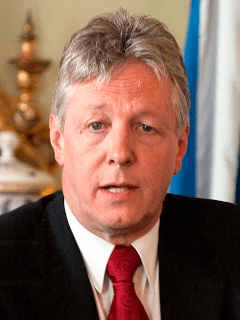
Peter David Robinson, retired Northern Irish politician, is born on December 29, 1948, in Belfast, Northern Ireland. He serves as First Minister of Northern Ireland from 2008 until 2016 and Leader of the Democratic Unionist Party (DUP) from 2008 until 2015. Until his retirement in 2016, he is involved in Northern Irish politics for over 40 years, being a founding member of the DUP along with Ian Paisley.

Robinson is the son of Sheila and David McCrea Robinson. He is educated at Annadale Grammar School and Castlereagh College, now part of the Belfast Metropolitan College. In 1966 he first hears Ian Paisley speak at a rally at Ulster Hall and shortly afterwards leaves school to devote himself to the Protestant fundamentalist cause. He considers joining the Royal Ulster Constabulary (RUC) but instead joins the Lagan Valley unit of the Ulster Protestant Volunteers (UPV), a paramilitary organisation tied to Ian Paisley’s Free Presbyterian Church of Ulster. He also joins the Ulster Constitution Defence Committee. As a young man he embraces a populist anti-Catholic fundamentalism. A former classmate alleges Robinson and a friend harassed a pair of Catholics nuns in the street in Portrush, County Antrim, yelling “Popehead, Popehead.” He initially gains employment as an estate agent for R.J. McConnell & Co. and later with Alex, Murdoch & Deane in Belfast.

Robinson serves in the role of General Secretary of the DUP from 1975, a position he holds until 1979 and which affords him the opportunity to exert unprecedented influence within the fledgeling party. In 1977, he is elected as a councillor for the Castlereagh Borough Council in Dundonald, County Down, and in 1979, he becomes one of the youngest Members of Parliament (MP) when he is narrowly elected for Belfast East. He holds this seat until his defeat by Naomi Long in 2010, making him the longest-serving Belfast MP since the Acts of Union 1800.

In 1980, Robinson is elected as the deputy leader of the DUP. Following the re-establishment of devolved government in Northern Ireland as a result of the Good Friday Agreement, he is elected in 1998 as the Member of the Legislative Assembly (MLA) for Belfast East. He subsequently serves as Minister for Regional Development and Minister of Finance and Personnel in the Northern Ireland Executive. He is elected unopposed to succeed Ian Paisley as leader of the DUP on April 15, 2008, and is subsequently confirmed as First Minister of Northern Ireland on June 5, 2008.

In January 2010, following a scandal involving his wife Iris (née Collins), Robinson temporarily hands over his duties as First Minister to Arlene Foster under the terms of the Northern Ireland Act 2006. Following a police investigation, which recommends that he should not be prosecuted following allegations made by the BBC in relation to the scandal, he resumes his duties as First Minister. The Official Assembly Commissioner’s Investigation and Report clears Robinson of any wrongdoing.

In September 2015, Robinson again stands aside to allow Arlene Foster to become acting First Minister after his bid to adjourn the assembly is rejected. His action is a response to a murder for which a member of Sinn Féin, a party in the Northern Ireland Executive, had been questioned. He resumes his duties on October 20, 2015. On November 19, 2015, he announces that he will be stepping down as First Minister and as leader of the DUP. He subsequently steps down as First Minister on January 11, 2016 and is now fully retired from frontline politics.

Robinson is the author of a number of books and pamphlets on local politics and history including: Capital Punishment for Capital Crime (1974), Savagery and Suffering (1975), Ulster the Facts (1981), Self-Inflicted (1981), A War to be Won (1983), It’s Londonderry (1984), Carson – Man of Action (1984), Ulster in Peril (1984), Their Cry was no Surrender (1986), Hands Off the UDR (1990), Sinn Féin – A Case for Proscription (1993), The Union Under Fire (1995), Give Me Liberty (no date), Ulster—the Prey (no date).


Leave a comment

Belfast Nationalists Vote Against Orange Parades

Nationalist residents of Belfast’s Lower Ormeau Road vote overwhelmingly on August 4, 2000, against allowing Orange Order parades through the flashpoint district. Results indicate that over 90% of those polled in a secret vote on the mainly nationalist lower Ormeau area of south Belfast want such parades rerouted.

The nationalist residents’ group, the Lower Ormeau Concerned Community (LOCC), which organised the ballot, says the majority of the 600 people who voted want the parades rerouted. In a statement it says it welcomes the result as “an overwhelming and democratic expression of our community’s desire to live free from sectarian harassment”.

LOCC spokesman Gerard Rice says, “We do not claim to speak for loyalist residents.” He adds that the loyal orders will now have to listen to the people of the area. “The whole point in this exercise was not to vindicate our position, but to set out clearly an informed position as to what exactly the opinion in our community is and has been for many years,” he tells BBC Radio Ulster.

“The Orange Order and other loyal institutions have said for many, many years that really people living on the Ormeau Road want parades. That they are actually a colourful event that people can enjoy. We have said that many people within our community would say parades by the loyal institutions were seen as sectarian, coat trailing exercises, the institutions were seen as anti-Catholic and sectarian organisations. Now we can actually say that 95.9% of our community believe that to be true.”

However, the Belfast County Grand Master of the Orange Order rejects the results of the poll. Dawson Baillie says the vote was unrepresentative because it did not include the staunchly loyalist Donegall Pass area and the Ballynafeigh district above the Ormeau Bridge. “We believe that it’s our right and everyone’s right to walk down a main thoroughfare. We’re not going into side streets on the right-hand side of that part of the Ormeau Road or the left-hand side. We go straight down the main thoroughfare. Our parade at any given point would take no more than three to four minutes to pass.”

Unionists question the validity of the poll as it excludes nearby loyalist areas. Dawn Purvis of the Progressive Unionist Party says the poll would not help to resolve the situation. “You don’t get people to enter into talks on the basis of no parade. You get people to enter into talks on the basis of an accommodation,” she says. “If that poll had been held to show what concerns the people of Lower Ormeau have over loyal order parades, that would have been better, that would have been a way forward, trying to address the concerns of the residents of the Lower Ormeau Road. LOCC have not been forthcoming with those concerns, so the talks haven’t moved forward.”

Reverend Martin Smyth, the Belfast South MP, says it had been “a stage-managed exercise” to show how well the group could conduct their business in that area and “to gather support from those who don’t want a procession down that road.”

However, Rice rejects the suggestions that it is unrepresentative because loyalist areas had been left out. Another LOCC representative, John Gormley, says they would welcome equivalent ballots from the loyalist part of the Ormeau area.

Local parish priest Father Anthony Curran says he is satisfied with the conduct of the vote. “A large number of people seem to have come out, a very broad section of the community, elderly young middle-aged, sick. They came free from fear and intimidation.”

A similar poll was last conducted in the Lower Ormeau area in 1995 by management consultants Coopers & Lybrand, when a large majority voted against allowing loyalist marches in the area.

The Northern Ireland Parades Commission has barred the Orange Order from marching through the Lower Ormeau area during its Twelfth of July demonstrations for the previous two years.

(From: “Poll ‘rejects’ loyal order parades” by BBC News (news.bbc.co.uk), August 4, 2000)


Leave a comment

The Broad Street Riot

The Broad Street Riot, a massive brawl between Irish Americans and Yankee firefighters, occurs in Boston, Massachusetts, on June 11, 1837. At the time of this particular riot, nearly all of Boston’s firefighters are volunteers.

Boston is a major center for immigration in the 19th century due to its large seaport. Nativist and anti-Catholic sentiment is strong, especially among working-class men whose jobs and wages are threatened by an influx of poor Irish immigrants. On Broad Street, it is common for groups of nativist Yankees to vandalize Irish homes and attack lone Irishmen.

At about 3:00 PM on Sunday, June 11, 1837, Fire Engine Company 20 returns to their station on East Street from a fire at the Boston Neck. Some of the men go straight home from there, however most stop at a nearby pub for drinks. The pub is apparently operating illegally as it is a Sunday and, in Massachusetts, blue laws are then in effect.

The men have just emerged from the pub “in a more or less bellicose mood,” when they collide with a crowd of about a hundred Irishmen who are on their way to join a large funeral procession on Sea Street. Nearly all of the firefighters pass through the crowd without incident, however, when 19-year-old George Fay, who has reportedly had too much to drink, insults or shoves several of the Irishmen, and a fight breaks out. Fay’s friends rush to his aid, but the firemen are outnumbered and are badly beaten. Their foreman, W.W. Miller, orders them back into the firehouse.

By some accounts, the Irishmen then take over the firehouse. According to others, the crowd had begun to disperse, and the matter might have ended there had the foreman not “lost his head completely.” In any case, Miller orders his men to sound the emergency alarm. First, they roll their wagon into the street, ringing the fire alarm bell. Then Miller sends men to ring the church bells, summoning all the fire engines in Boston. According to the Boston Transcript, Miller then runs to another firehouse, shouting, “The Irish have risen upon us, and are going to kill us!”

Company 9, responding to what they think is a legitimate fire alarm, arrives just as the funeral procession is turning onto New Broad Street. Their horse-drawn wagon veers into the crowd, scattering and knocking down the mourners. The Irish assume the assault is deliberate, and another brawl erupts. As more fire companies arrive, and Irishmen pour out of nearby houses into the street to help their friends and relatives, the fight escalates into a full-blown riot. Before long, an estimated 800 men are doing battle with sticks, stones, bricks, and cudgels while at least 10,000 more urged them on. Protestant workmen come running to the aid of the firefighters, while underfoot, injured and unconscious men lay sprawled on the pavement.

Outnumbered, the Irish are defeated and driven back to their homes. That is when the home invasions begin. A “gang of stout boys and loafers” raid nearby houses, breaking doors and windows, and in some cases beating the occupants. Furniture and other possessions are destroyed and thrown into the street. Some Irish families lose their homes altogether.

After raging for about three hours, the riot is quelled when Mayor Samuel Atkins Eliot calls in the National Lancers, a newly formed cavalry company, and some 800 other members of the state militia with fixed bayonets. Among them are the Montgomery Guards, a short-lived Irish American infantry company which is forced to disband the following year due to the extreme nativist and anti-Catholic sentiment in Boston.

No immediate deaths result from the violence. Many people suffer serious wounds, however, and there is no nearby hospital to care for them. Given the lack of hospital and police records, the number of people who eventually die of their injuries cannot be determined. Thousands of dollars in damage are done to property belonging to some of the city’s poorest inhabitants.

The militia, being composed nearly entirely of Yankees, arrest 34 Irishmen and 4 Yankees. A grand jury indicts 14 of the Irishmen and all four of the Yankees. At the municipal court trial, a Yankee jury acquits the four Yankees and convicts four Irishmen, three of whom are sentenced to several months of hard labor.

Three months later, in September, Mayor Eliot establishes a professional, paid fire department, with all new hires requiring the approval of the mayor and aldermen. The Boston Police Department is established the following year.