Stanford is born in Dublin into a well-off and highly musical family on September 30, 1852, the only son of John James Stanford, a prominent Dublin lawyer, Examiner to the Court of Chancery in Ireland and Clerk of the Crown for County Meath, and his second wife, Mary (née Henn). He is educated at the University of Cambridge before studying music in Leipzig and Berlin. He is instrumental in raising the status of the Cambridge University Musical Society, attracting international stars to perform with it.
While still an undergraduate, Stanford is appointed organist of Trinity College, Cambridge. In 1882, at the age of 29, he is one of the founding professors at the Royal College of Music, where he teaches composition for the rest of his life. From 1887 he is also Professor of Music at Cambridge. As a teacher, he is skeptical about modernism and bases his instruction chiefly on classical principles as exemplified in the music of Johannes Brahms. Among his pupils are rising composers whose fame go on to surpass his own, such as Gustav Holst and Ralph Vaughan Williams. As a conductor, he holds posts with the Bach Choir and the Leeds Triennial Music Festival.
Stanford composes a substantial number of concert works, including seven symphonies, but his best-remembered pieces are his choral works for church performance, chiefly composed in the Anglican tradition. He is a dedicated composer of opera, but none of his nine completed operas has endured in the general repertory. Some critics regard him, together with Hubert Parry and Alexander Mackenzie, as responsible for a renaissance in music from the British Isles. However, after his conspicuous success as a composer in the last two decades of the 19th century, his music is eclipsed in the 20th century by that of Edward Elgar as well as former pupils.
In September 1922, Stanford completes the sixth Irish Rhapsody, his final work. Two weeks later he celebrates his 70th birthday and thereafter his health declines. On March 17, 1924, he suffers a stroke and dies on March 29 at his home in London, survived by his wife and children. He is cremated at Golders Green Crematorium on April 2 and his ashes are buried in Westminster Abbey the following day.
Stanford’s last opera, The Travelling Companion, composed during World War I, is premiered by amateur performers at the David Lewis Theatre, Liverpool in 1925 with a reduced orchestra. The work is given complete at Bristol in 1928 and at Sadler’s Wells Theatre, London, in 1935.
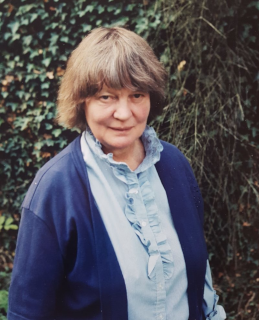
Murdoch is the daughter of Irene Alice (née Richardson) and Wills John Hughes Murdoch. Her father, a civil servant, comes from a mainly Presbyterian sheep farming family from Hillhall, County Down. In 1915, he enlists as a soldier in King Edward’s Horse and serves in France during World War I before being commissioned as a second lieutenant. Her mother trains as a singer before Iris is born and is from a middle-class Church of Ireland family in Dublin. Her parents first meet in Dublin when her father is on leave and are married in 1918. Iris is the couple’s only child. When she is a few weeks old the family moves to London, where her father had joined the Ministry of Health as a second-class clerk. She is a second cousin of the Irish mathematician Brian Murdoch.
From 1947 to 1948 Murdoch studies philosophy as a postgraduate at Newnham College, Cambridge. She meets Ludwig Wittgenstein at Cambridge but does not hear him lecture, as he had left his Trinity College professorship before she arrives. In 1948 she becomes a fellow of St. Anne’s College, Oxford, where she teaches philosophy until 1963. From 1963 to 1967 she teaches one day a week in the General Studies department at the Royal College of Art.
In 1956 Murdoch marries John Bayley, a literary critic, novelist, and from 1974 to 1992 Warton Professor of English at Oxford University, whom she had met in Oxford in 1954. The unusual romantic partnership lasts more than forty years until Murdoch’s death. Bayley thinks that sex is “inescapably ridiculous.” She in contrast has “multiple affairs with both men and women which, on discomposing occasions, Bayley witnesses for himself.”
Murdoch’s first novel, Under the Net, is published in 1954 and is selected in 1998 as one of Modern Library’s 100 best English-language novels of the 20th century. She had previously published essays on philosophy, and the first monograph about Jean-Paul Sartre published in English. She goes on to produce 25 more novels and additional works of philosophy, as well as poetry and drama.
Murdoch’s last novel, Jackson’s Dilemma, is published in 1995. She is diagnosed with Alzheimer’s disease in 1997 and dies on February 8, 1999, in Oxford, England. There is a bench dedicated to her in the grounds of Lady Margaret Hall, Oxford, where she enjoyed walking.
Drew’s parents are the Rev. Thomas Drew and Isabella (née Dalton) Drew. She is the third of the couple’s eight daughters and four sons, although most of her siblings die young. She spends her childhood in Belfast, where her father is the rector of Christ Church in Durham Street from 1833 to 1859. In 1866, she moves to 60 Upper Sackville Street, Dublin, to live with her brother, the architect Thomas Drew.
From here she appears to begin her journalist career, writing articles for the Irish Builder, going on to eventually become its assistant editor. She goes on to write for Belfast’s News Letter, and following advice from its proprietor James Alexander Henderson, she moves to London in 1871 becoming the paper’s London correspondent. She writes two columns, Metropolitan gossip and Ladies’ letter, which are among some of the earliest regular columns written specifically for women, providing society news for her readers in Belfast. Articles by her also appear in The Literary World, The British Architect and London Society.
Drew is one of the founding members of the Ladies’ Press Association, and campaigns for greater rights for women journalists. She becomes a prominent figure in the Institute of Journalists, representing the Institute at several international congresses. She is serving as the vice-president of the Institute at the time of her death. She also works on its Orphan Fund for many years, an initiative she originally suggests in 1891.
In 1894, Drew is one of the signatories of the Frances Power Cobbe memorial campaigning for greater recognition and rights for women journalists, alongside Millicent Fawcett and Jessie Boucherett. She writes a number of novels, including Harry Chalgraves’s Legacy (1876) and The Lutanistes of St. Jacobi’s (1881). In March 1885, she gives a lecture titled Dress, Economic and Technical at the Loan Exhibition of Women’s Industries in Bristol, which later appears as a pamphlet.
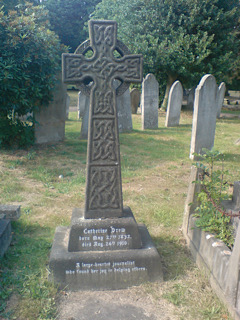
Drew dies at her home in Holland Street, Kensington, on August 26, 1910, and is buried at the Royal Borough of Kensington and Chelsea Cemetery, Hanwell. Lady Drew, her sister-in-law, erects a Celtic cross memorial there in her honour. She bequeaths a jewel-studded gold bracelet to the Institute of Journalists, which had been presented to her by the Institute to mark her retirement in 1908. It is worn by women presidents or the wives of male presidents, and is known as the “Drew Bracelet.”
Gwynn is born in Ramelton, County Donegal, on May 5, 1873. He is a member of a family well known in Dublin at the time for its academic and sporting achievements. He is the fourth son of the Very Rev. John Gwynn, Regius Professor of Divinity at Trinity College Dublin (TCD), and Lucy Josephine, daughter of the Irish patriot William Smith O’Brien. He and his three immediate younger brothers, Arthur, Robin and Jack, all in turn captain their school and university cricket teams and play the game at first class level. He is also a talented rugby player.
Gwynn’s academic career outshines even his sporting achievements. He enters Trinity College Dublin as a foundation Scholar and achieves a double first in his degree finals. In 1899 he is elected a Fellow of Trinity College and commences what promises to be a distinguished academic career.
At school Gwynn is mainly a bowler, his brother Arthur being the superior bat, though this inequality is ironed out at university. He is captain of the Dublin University Cricket Club XI for two seasons, 1894 and 1895, then plays under Arthur’s captaincy. The three brothers make up a formidable threesome in those years.
Primarily noted for his bowling prowess during early outings with the Dublin University XI, Gwynn takes 44 wickets at an average of 8.14 in Trinity’s annus mirabilis of 1893, a season which witnesses victories over Leicestershire, Oxford University, Warwickshire (dismissed for a paltry total of 15 runs) and a draw against Essex.
Gwynn, a right-handed batsman, who records the highest first-class average (56.87) among those batsmen who complete ten innings or more during the English season of 1895, enjoys another remarkably productive season in 1896, plundering over a thousand runs in Trinity flannels, a superlative effort complemented by a haul of 93 wickets at 9.37. His irrepressible form reputedly earns him an invitation to represent England against Australia in the second Ashes Test at Old Trafford in July 1896. However, concurrent university examinations render him unable to participate. Instead, English cricket is introduced to the wizardry of K. S. Ranjitsinhji, who takes Gwynn’s place.
Gwynn makes his debut for Ireland against I Zingari in July 1892 and goes on to play for Ireland 13 times, his last game coming in May 1902 against Marylebone. Two of his matches for Ireland have first-class status.
Gwynn also plays first-class cricket in two Gentlemen v Players matches, representing the gentlemen, and four matches for Dublin University in 1895, for whom he makes his top score of 153 not out against Leicestershire. In all, he amasses 3,195 runs and 311 wickets for Dublin University, in addition to 499 runs and 14 wickets for Ireland.
Remarkably, Gwynn also represents Ireland seven times at rugby union, debuting against Scotland at Belfast in February 1893. He features in all three legs of Ireland’s 1894 Triple Crown-winning campaign.
In 1901 Gwynn marries Katharine Rawlins of Bristol. He is already suffering from persistent symptoms of debility and fatigue. A few months later a Harley Street physician diagnoses tuberculosis. He is admitted to a sanatorium at Davos Platz in Switzerland, but the illness has progressed too far for any treatment to succeed. He dies on December 23, 1902, at the age of 29. The couple’s only child, a daughter named Rhoda, is born in September 1902, just three months before his death.
Janet McNeill, prolific Irish novelist and playwright, is born on September 14, 1907, in Dublin. Author of more than 20 children’s books, as well as adult novels, plays, and two opera libretti, she is best known for her children’s comic fantasy series My Friend Specs McCann.
McNeill is born to Rev. William McNeill, a minister at Adelaide Road Presbyterian Church, and Jeannie Patterson (Hogg) McNeill. In 1913, the family moves to Birkenhead, Merseyside, England, where her father becomes minister at Trinity Road Church. She attends public school in Birkenhead and studies classics at the University of St. Andrews in St. Andrews, Scotland, completing a MA degree in 1929. While at university, she is involved in writing and acting with the College Players. In 1924, the family returns to Ireland due to her father’s failing health, and Rev. McNeill becomes the minister of a village church in Rostrevor, County Down, Northern Ireland, while Janet joins the Belfast Telegraph as a secretary.
In 1933, McNeill marries Robert Alexander, the chief engineer in the Belfast city surveyor’s department, and the couple settles in Lisburn, where they raise their four sons. One son is the zoologist Professor Robert McNeill Alexander, CBE, FRS. Though she plans to write her first novel early on, she finds it impossible to write seriously until the children grow up, saying, “It was four years before I had a baby and twenty-five before I produced the book.”
In 1946, McNeill wins a prize in a BBC competition for her play Gospel Truth. She begins writing radio dramas, which are broadcast by the BBC. She suffers an intracerebral hemorrhage in 1953. During her recovery, she begins writing novels both for adults and children, producing a large body of work between 1955 and 1964. Her popular children’s character, Specs McCann, who debuts in a 1955 book and makes several reappearances, also inspires a newspaper cartoon strip by Rowel Friers, a Belfast artist and friend of hers.
Her 1944 novel The Maiden Dinosaur is her first to be published in the United States, twenty-two years later. She also has three writing credits on television with series and plays. Several of her plays are staged at the Ulster Group Theatre.
In 1964, McNeill’s husband retires, and the couple moves to Bristol, South West England. She writes one more novel after she leaves Northern Ireland but continues to write children’s books for another decade. During this time, she writes her only children’s play, published as Switch On, Switch Off, and other plays (1968), which presents different moral themes in scenes set in “domestic and workplace settings in contemporary England.” Her children’s book The Battle of St. George Without is televised by the BBC in 1969.
In her adult fiction, McNeill focuses on the lifestyle and social mores of Belfast and Ulster in the mid-twentieth century. Her characters are primarily “menopausal, middle-aged, middle-class Protestants.” She depicts the “dreary, Ulster religiosity” of ministers and laymen alike, and the class conventions and sexual repression of middle-aged, upper-middle-class women. The theme of suppressing self-identity and goals, both by wives in deference to their husbands and parents on behalf of their children, pervades her adult novels.
McNeill has a number of health problems and dies in Bristol in October 1994.
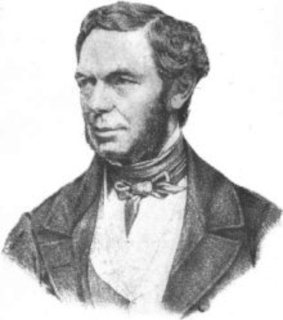
Doheny receives a rudimentary education from an itinerant scholar while labouring on his father’s holding, and in 1826 attends Maher’s classical academy near Emly for nine months. Educating himself in the late 1820s and early 1830s while teaching the children of local farmers, he determines on a career in law to help secure political redress for the disenfranchised poor. He is admitted to Gray’s Inn in November 1834, enters the King’s Inns, Dublin, in 1835 and is called to the Irish bar in 1838. Settling later that year in Cashel, County Tipperary, he first practises in the local courts and then on the southern circuit. Appointed legal assessor to the borough of Cashel under the Municipal Corporations (Ireland) Act 1840, he successfully prosecutes former borough officers for misappropriation of funds and fraudulent transfer of property, winning wider attention. He had supported the campaign for repeal in the early 1830s, and in 1841 joins Daniel O’Connell‘s Repeal Association, becoming active in forming temperance bands and setting up town meetings. By May 1841 he is on the association’s general committee. O’Connell finds him less tractable than most and is ruffled by his queries into the association’s financial management.
During 1842 Doheny begins to associate with the more militant members of the repeal movement such as Thomas Davis. There is a marked gap in age and class between Doheny and most of this group and some look down on his lack of refinement. Others, however, admire his zeal and sincerity, and an anonymous colleague describes him as “rough, generous, bold, a son of the soil, slovenly in dress, red-haired and red-featured, but a true personification of the hopes, passions, and traditions of the people.” Assisting in the launch of The Nation in October 1842, he is chagrined to find most of his articles rejected as unfit for publication, although fifteen are published between January 1843 and September 1844. He also publishes a competent History of the American Revolution (1846) for The Nation‘s “Library of Ireland” series. More impressive as a speaker than a writer, he contributes regularly to repeal meetings at Conciliation Hall, Burgh Quay, Dublin. He enthuses at the apparent martial potential of the immense, ordered crowds attending the “monster” repeal meetings of 1843, and is one of the main organisers of the Cashel meeting of May 31, 1843, at which he is loudly cheered. However, his later claim to have deliberately set up these meetings, with Davis and John Blake Dillon, on quasi-military lines in order to prepare the peasantry for a future war with Britain, is far-fetched. His opposition to O’Connell’s decision to submit to proclamation of the proposed meeting of October 8, 1843, at Clontarf again greatly irritates O’Connell.
An active member of the Repeal Association parliamentary committee from February 1844, in February and March 1845 Doheny chairs a sub-committee of five senior barristers investigating the legality of withdrawal from the House of Commons by the body of repeal MPs, coming “reluctantly” to the verdict that such an action is open to criminal prosecution. O’Connell’s gruff dismissal of his report testifies to their awkward relationship. He further vexes O’Connell by his advocacy of non-denominational university education during debates over the Maynooth College Act 1845. Irrevocable divisions between the Young Irelanders and O’Connell open up between April and July 1846 when Doheny leads calls for endorsement of the conduct of William Smith O’Brien – imprisoned for a month for refusal to serve on a parliamentary committee – and voices Young Ireland’s martial convictions in a speech at Liverpool. After the secession of the Young Irelanders from the Repeal Association in July 1846, he opposes attempts at reconciliation and is one of the founders of the Irish Confederation on January 13, 1847.
During the summer of 1847, Doheny begins setting up “Confederate Clubs” in east Tipperary and aids James Fintan Lalor in organising a failed tenant league meeting at Holycross, County Tipperary, on September 19. He is one of the few Young Irelanders attracted to Lalor’s revolutionary agrarian philosophy, but supports Smith O’Brien against John Mitchel in January 1848, deploring irresponsible demands for insurrection. However, after Mitchel’s conviction for treason felony in May, he supports armed action. Arrested for seditious speechmaking at Cashel on July 12, he is bailed on July 20. During the confused period of “rebellion” in late July, he attempts to organise the peasantry in Tipperary but is frustrated by O’Brien’s vacillation.
After the collapse of the armed adventure at Ballingarry on July 31, Doheny takes refuge near Slievenamon and, with James Stephens, eludes pursuit for nearly two months, until he finally escapes, disguised as a clergyman, on a cattle-ship from Cork to Bristol. Some days later he reaches Paris, where he stays for two months with Stephens and John O’Mahony before leaving for New York City. Practising law in New York, he dedicates himself to the development of an Irish Americanrepublican movement. Tensions between conservative and radical Young Ireland exiles, perhaps aggravated by social snobbery, surface by late 1849, when he is arrested for attempting to push Thomas D’Arcy McGee into an open cellar on a New York street, angered by accusations of boasting, drunkenness, and incompetence. Similar criticisms are made by John Blake Dillon and appear to have some foundation.
Doheny finds time to write The Felon’s Track (1849), a polemical account of the repeal agitation and the 1848 insurrection that is highly critical of O’Connell. Despite a rambling narrative, it becomes a popular work and is reprinted several times. He also gives several lectures on historical and literary subjects to Irish American societies and contributes a memoir on Geoffrey Keating to O’Mahony’s translation (1857) of Foras Feasa ar Éirinn.
Involved with the New York Irish militia from his arrival, he is elected lieutenant colonel of the 69th Infantry Regiment in November 1851, and in September 1852 becomes colonel of a new regiment, the Irish Republican Rifles. These formations are often wracked by dissension over strategy and leadership, and in February 1856 he and O’Mahony found the Emmet Monument Association, planning to mobilise an Irish American force to invade Ireland. Efforts to acquire Russian backing fails on the close of the Crimean War in March 1857.
In autumn 1857, Doheny and O’Mahony make overtures to James Stephens to reorganise the republican movement in Ireland, and in March 1858 they accept Stephens’s demands for undisputed authority there, though by the winter of 1858–59 Doheny shows increasing distrust of Stephens’s ambitions. Adopting the organisational structure set out by Stephens in establishing the IRB in 1858, he and O’Mahony found the American equivalent, the Fenian Brotherhood, in early 1859, although he plays a subordinate part. In July 1859, he founds and edits a short-lived newspaper in New York, The Phoenix, to promote Fenian ideals. Active in opposing the national petition for self-government of 1860–61, he argues that Britain will only yield to force. He assists in making preparations for the funeral of Terence Bellew MacManus in Ireland and acts as one of the pallbearers in New York. Travelling to Ireland in October 1861, he appears to argue for using the excitement engendered by the funeral to spark an insurrection in Dublin but is thwarted by Stephens.
Doheny dies suddenly on April 1, 1862, in New York and is buried in Calvary Cemetery in the city’s borough of Queens.
(From: “Doheny, Michael” by James Quinn and Desmond McCabe, Dictionary of Irish Biography, http://www.dib.ie, October 2009)
Henry II returns to England on April 17, 1172, having granted a charter to Dublin, the first granted to an Irish town.
Toward the end of 1171, Henry II, the first king of England to set foot on Irish soil, lands at Crook, County Waterford. His visit to Ireland serves two purposes. Firstly, it allows him to bring his adventurous English barons to heel and put the royal seal on their conquests in Ireland. Secondly, it means he can avoid meeting the cardinal legates who have been dispatched from Rome to investigate his complicity in the murder of the Archbishop of Canterbury, Thomas Becket, in 1170.
When the King of Leinster, Diarmait Mac Murchada, finds himself exiled in the late 1160s, he quickly finds help across the Irish Sea. He finds Henry II on the banks of the Loire in 1166 and is then pointed in the direction of south Wales by a Bristol merchant to find Richard FitzGilbert de Clare, more commonly known as Strongbow, who is then out of royal favour due to his prior support of Henry II’s competition for the kingship, Stephen of Blois.
Bolstered by English forces, Diarmait returns to Ireland and retakes his kingdom with Strongbow’s help, the latter earning the hand in marriage of Diarmait’s daughter, Aoife, in return. None of this has greatly concerned Henry II, until Diarmait dies, and Strongbow seizes the Kingdom of Leinster for himself in 1171. Leinster encompasses not only the counties of Carlow, Kilkenny, Wexford, Kildare, and parts of Wicklow, Laois, and Offaly, but the kings of Leinster are often the overlords of the flourishing Hiberno-Norse ports of Wexford and Dublin, both of which have considerable trading links with England and wider Europe.
Concerned with the growing power of Strongbow in Ireland, Henry II decides to head across the Irish Sea. He originally intends to arrive in Ireland in September 1171, but unfavourable winds on the coast of southwest Wales delay his journey for 17 days. He finally embarks from Pembroke on October 16 and arrives on the County Waterford coast the following day.
Naturally, Henry does not come alone and is at the head of an estimated 4,000 strong army comprised of 500 knights and their esquires and a large body of archers, all of which are carried, along with horses, in 400 ships. The undertaking is vast, and a large quantity of supplies are gathered to provision this considerable force. These ingredients include salted meats and fish, 1,000 lbs. of wax to ensure that Henry can seal charters and mandates, and, of course, the oil on which the medieval war machine runs, wine.
With the arrival of Henry II in Ireland, Strongbow surrenders the kingdom of Leinster and the Hiberno-Norse towns of Dublin, Wexford, and Waterford. Henry II regrants Leinster to Strongbow as a lordship, and later grants him Wexford. However, Waterford and Dublin become, and remain, royal ports.
Henry II then tours Ireland, showing the clergymen and native kings who their new lord is. He first visits Lismore and Cashel, then back to Waterford for a brief rest, before journeying by way of Kilkenny to Dublin, where he arrives around November 11. At all of his stop he collects the submissions of the Irish kings, with the probable exception of Ruaidrí Ua Conchobair (Rory O’Connor), who is the claimant to the high kingship of Ireland at the time.
Outside the city walls of Dublin, Henry II constructs a palace at the present-day southern side of Dame Street, where he celebrates the winter festivities until February 2. At this time, he also grants Dublin its first charter, on a piece of parchment measuring only 121 x 165 mm, which, extraordinarily, survives to this day. Henry’s charter to Dublin grants the right to live in the city to the men of Bristol, with whom the men of Dublin have enjoyed pre-existing economic relations.
About March 1, 1172, Henry II makes his way to Wexford, before finally departing for England on Easter Sunday, April 17, after celebrating Mass. It is probable that he had intended to stay in Ireland longer than he did, but events in England and Normandy divert his attention. In Normandy, Henry II’s son, Henry, has gone into rebellion against his father, while in England, the cardinal legates are threatening to interdict Henry’s lands unless he comes to meet with them regarding Becket’s murder.
The circumstances which lead to Henry II’s departure are more telling for Ireland’s future than any member of contemporary society could have realised. Now, Ireland has to compete with the other segments of a vast transnational realm, with lands stretching across England, Wales and France. Although Henry II is the first king of England to arrive in Ireland, his visit does not mean that royal visits would become a routine occurrence. Throughout the Middle Ages, the kings of England only directly visit Ireland in 1185, 1210, 1394–5, and 1399. As such, Henry’s visit and departure marks the beginning of absentee lordship over Ireland.
(From: “The royal visit: what did Henry II do in Ireland 850 years ago?” by John Marshall, PhD student in the Department of History at Trinity College Dublin, RTÉ, http://www.rte.ie | Pictured: Henry at Waterford, Ireland, October 18, 1172. Illustration by James E. Doyle (1864). Image: Historical Picture Archive/ Corbis via Getty Images)
Edgeworth Lysaght, later Edward Anthony Edgeworth Lysaght, and from 1920 Edward MacLysaght (Irish: Éamonn Mac Giolla Iasachta), a genealogist of twentieth century Ireland, is born on November 6, 1887, at Flax Bourton, Somerset, England. His numerous books on Irish surnames build upon the work of Rev. Patrick Woulfe’s Irish Names and Surnames (1923).
Lysaght is born to Sidney Royse Lysaght (1856-1941), of Irish origin, a director of the family iron and steel firm John Lysaght and Co. and a writer of novels and poetry, and Katherine (died 1953), daughter of Joseph Clarke, of Waddington, Lincolnshire. His grandfather, Thomas Royse Lysaght, is an architect, and his great-grandfather, William Lysaght, a small landowner distantly connected with the Barons Lisle. He is named “Edgeworth Lysaght” after his father’s friend, the economist Francis Ysidro Edgeworth. He loses the sight in one eye after a childhood accident.
Lysaght is educated at Nash House preparatory school, Bristol, and Rugby School at Rugby, Warwickshire, where he is unhappy, his parents’ frequent absence due to his father’s business responsibilities necessitating travel to South America, South Africa, and Australia contributing to this. He is a contemporary there of Rupert Brooke, whose father is Lysaght’s housemaster. Eighteen months after leaving Rugby, on the advice of Francis Edgeworth, he goes to Corpus Christi College, Oxford, to study law, but, having on his own account “had a wild time as part of the smart set” and anticipating rustication after a drunken incident, he leaves after three terms.
Lysaght takes up residence in a caravan at Lahinch, County Clare, where he had previously holidayed and become friendly with local people. His father, himself strongly connected to his Irish boyhood and wanting to establish himself as a “country gentleman,” recognizes his son’s enthusiasm for Ireland and in 1909 purchases a 600-acre estate at Tuamgraney, at which Lysaght farms until 1913, introducing an electrical generator and other forms of modernization including the development of a lime kiln, nursery, and school where young men of means can learn the basics of farming. This is the beginning of a metamorphosis for him. Although of English upbringing, he dislikes the local gentry, considering them “layabout rentiers,” and prefers to make friendships amongst employees and his neighbours. He seeks to replace his English accent with a Clare accent, eschews his lack of religion of a few years before in favour of Roman Catholicism, and becomes involved in the Gaelic League.
An integral factor in Lysaght’s reinvention is his relationship with Mabel (“Maureen”) Pattison. Five years his senior, they meet when he spends a period at a Dublin hospital. She is born and raised in South Africa, her father a civil servant there, but has Irish family including a local postmistress. His family seeks to avoid what they consider an unsuitable marriage, sending him and his brother Patrick on a world tour, but the couple are nevertheless married at the Brompton Oratory on September 4, 1913. Mabel introduces him to friends in the Arts Club, and he enters Dublin literary society. His father invests £300 in Maunsell’s publishers, who produces Lysaght’s book of poems, Irish Eclogues. As of the early 1930s, he serves on the General Committee of the Munster Agricultural Society.
By 1915, Lysaght’s command of the Irish language has improved dramatically, and in that year he founds the Nua-Ghaeltacht at Raheen, County Clare. He is an independent delegate to the 1917-18 Irish Convention in which he opposes John Redmond‘s compromise on Home Rule. By 1918 his involvement in all aspects of the Irish independence movement have deepened greatly. Although not known if he is actually a member of the Irish Republican Army (IRA), he is very active in the Irish War of Independence as a supporter, financially and otherwise, of the East Clare Brigade of the IRA and its legendary leaders, Michael and Conn Brennan.
In 1920, Lysaght, along with others of the name, changes his name to “MacLysaght,” “so as to emphasise its Gaelic origin.”
MacLysaght’s Raheen office serves as a meeting place for the Volunteers and guns, documents and ammunition are stored there. However, the war leads to a sharp decline in the fortunes of his farm. The execution of close friends such as Conor Clune of Quin in November 1920 and the subsequent devastating raids on his farm result in his playing a far more active role in Sinn Féin as a loyal supporter of the new TD for Clare, Éamon de Valera. For this he is imprisoned following his return from Britain as part of a Sinn Féin delegation which is publicising the Black and Tans atrocities.
Aer Lingus (Irish: Aer Loingeas) is founded by the Irish government as the national airline of the Republic of Ireland on April 15, 1936.
Aer Lingus is founded with a capital of £100,000. Its first chairman is Seán Ó hUadhaigh. Pending legislation for Government investment through a parent company, Aer Lingus is associated with Blackpool and West Coast Air Services which advances the money for the first aircraft and operates with Aer Lingus under the common title “Irish Sea Airways.” Aer Lingus Teoranta is registered as an airline on May 22, 1936. The name Aer Lingus is proposed by Richard F. O’Connor, who is County Cork Surveyor, as well as an aviation enthusiast.
Later that year, the airline acquires its second aircraft, a four-engined biplane de Havilland DH.86 Express named Éire, with a capacity of 14 passengers. This aircraft provides the first air link between Dublin and London by extending the Bristol service to Croydon. At the same time, the DH.84 Dragon is used to inaugurate an Aer Lingus service on the Dublin-Liverpool route.
Aer Lingus is established as the national carrier under the Air Navigation and Transport Act (1936). In 1937, the Irish government creates Aer Rianta, now called Dublin Airport Authority (DAA), a company to assume financial responsibility for the new airline and the entire country’s civil aviation infrastructure. In April 1937, Aer Lingus becomes wholly owned by the Irish government via Aer Rianta.
Aer Lingus is privatised between 2006 and 2015. It is a former member of the Oneworld airline alliance, which it leaves on March 31, 2007.
Ryanair owns over 29% of Aer Lingus stock and the Irish state owns over 25% before being bought out by International Airlines Group (IAG) in 2015. The state had previously held an 85% shareholding until the Government’s decision to float the company on the Dublin and London stock exchanges on October 2, 2006. The principal group companies include Aer Lingus Limited, Aer Lingus Beachey Limited, Aer Lingus (Ireland) Limited and Dirnan Insurance Company Limited, all of which are wholly owned.
On May 26, 2015, after months of negotiations on a possible IAG takeover, the Irish government agrees to sell its stake in Aer Lingus. Ryanair retains a 30% stake in the company which it agrees to sell to IAG on July 10, 2015, for €2.55 per share. In August 2015, Aer Lingus’ shareholders officially accept IAG’s takeover offer. IAG subsequently assumed control of Aer Lingus on September 2, 2015.
After the takeover by IAG, it is expected that Aer Lingus would re-enter Oneworld, however, at a press briefing on November 15, 2017, the airline’s then CEO Stephen Kavanagh states that the airline has “no plans to join Oneworld.” The airline is now a wholly owned subsidiary of IAG.
Potter is born in Belfast on September 22, 1918, to a Presbyterian family who, oddly, lives on the Falls Road, a republican (Catholic) stronghold. His father is a church organist and piano tuner who has been blind since childhood. His mother is, in Potter’s own words, “a raging alcoholic.” He escapes a rather grim childhood when he goes to live with an aunt in Kent, England.
Potter had already started composing chamber and vocal music before the war. Now, established in Dublin, he chooses the orchestra as his principal means of expression. His early pieces, such as Rhapsody under a High Sky and Overture to a Kitchen Comedy, show that he has absorbed Vaughan Williams’ pastoral style and his love of folk music. In 1952, both pieces are awarded Radio Éireann‘s “Carolan Prize” for orchestral composition by the adjudicatorArnold Bax. A year later Potter repeats this success when his Concerto da Chiesa, a concerto for piano and orchestra, also wins the Carolan Prize.
In 1955 Potter is appointed Professor of Composition at the Royal Irish Academy of Music, where he becomes an effective administrator and inspiring teacher.
In the 1960s, Potter turns to ballet, writing four orchestral scores for the Cork Ballet company. The first of these, Careless Love, becomes the composer’s own favourite of all his compositions. Several years later, following a successful battle with alcoholism, he writes what some regard as his magnum opus, Sinfonia “de Profundis” (1969). The première is given at the Gaiety Theatre, Dublin on March 23, 1969, in a performance by the RTÉ Symphony Orchestra under the baton of Albert Rosen. The Irish Times refers to the concert as a “major national event.” In December 1969, he receives a Jacob’s Award for the composition.
Potter’s last substantial work, an opera entitled The Wedding, receives its first public performance in Dublin in 1981, almost a year after his death.
Potter dies suddenly at his home in Greystones, County Wicklow on July 5, 1980, at the age of 61. He is buried in the nearby Redford cemetery.






 seamus dubhghaill