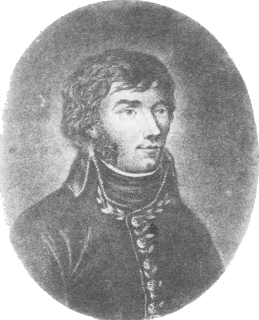
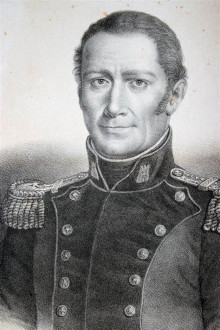
Humbert is the eldest of six children of Jean-Joseph Humbert, a farmer and trader, and Catherine (née Privat), who dies when he is three years old. From a modest rural background, he works briefly as a hatter and rabbit hunter before entering the military in July 1789 amid the early stages of the French Revolution.
In 1796, Humbert is assigned to prepare for an expedition to Ireland. In the ill-fated Expédition d’Irlande, his ship Droits de l’Homme is wrecked off the Bay of Audierne in January 1797, but he survives. In 1798, he leads about 1,000 French troops to Ireland, landing at Killala. His forces fight and win at Ballina and the Races of Castlebar, proclaiming a Republic of Connacht before being defeated and captured at the Battle of Ballinamuck. He is exchanged for British prisoners.
In 1810, Humbert emigrates to New Orleans, where he becomes acquainted with French pirate Jean Lafitte. He joins the Buenos Aires rebellion in 1814 before returning home. In 1815, he fights the British at the Battle of New Orleans in the War of 1812, earning thanks from General Andrew Jackson. He later lives as a schoolteacher in New Orleans until his death on January 3, 1823.
Humbert’s career spans revolutionary France, Napoleonic campaigns, and post-Napoleonic adventures, making him a notable figure in late 18th- and early 19th-century military history.
A 1966 review by Howard Klein in The New York Times of Greevy’s recording of Handel arias states: “The voice has the firm, compact resonance of a true contralto. She has endless breath and can move her voice with agility and precision.”
Greevy has a special affinity with Mahler, in particular his orchestral song cycles. In 1966, she performs Kindertotenlieder in London with the then RTÉ National Symphony Orchestra. The Times praises the 26-year-old Greevy’s “full, glowing voice, rich and firm at the bottom, radiant at the top, and gloriously expressive phrasing.” Later, in the 1990s, she performs all Mahler’s vocal works with orchestra over a four-year period in the Teatro Colón, Buenos Aires, Argentina.
Greevy chooses to live in her native Dublin throughout her career rather than be based in one of the world’s major music centres. She maintains confidently that “if you’re good enough you can live where you like.” Nevertheless, this decision undoubtedly curtails her opportunities in the recording studio and on the concert stage.
Greevy dies at the age of 68 on September 26, 2008, following a short illness. She is married to Peter Tattan, who predeceases her in 1983. They have one son, Hugh.
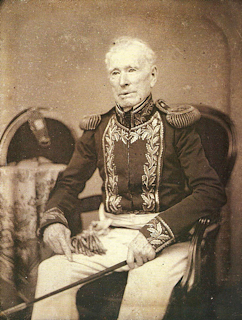
Comparatively little is known of his early life, and it has been suggested that he was illegitimate and took his mother’s surname and that his father’s surname was actually Gannon. He emigrates with his father to Baltimore, Maryland, in 1793, eventually settling in Philadelphia, Pennsylvania. A short time after their arrival, the friend who had invited them and offered them food and hospitality dies of yellow fever. Several days later, his father also succumbs to the same disease.
One morning, while Brown is wandering along the banks of the Delaware River, he meets the captain of a ship then moored in port. The captain inquires if he wants employment and Brown agrees. The captain engages him as a cabin boy, thereby setting him on the naval promotion ladder, where he works his way to the captaincy of a merchant ship. After ten years at sea, where he develops his skills as a sailor and reaches the rank of captain, Brown is press-ganged into a Royal Navy warship. British impressment of American sailors is one of the primary issues leading to the War of 1812.
During the Napoleonic Wars, Brown escapes the ship he is serving on, a galley, and scuttles the vessel. However, the French do not believe he had assisted them and imprison him in Lorient. On being transferred to Metz, he escapes, disguised in a French officer’s uniform. However, he is recaptured and is imprisoned in the fortress of Verdun. In 1809, he escapes from there in the company of a British Army officer named Clutchwell, and eventually reaches German territory.
Returning to England, Brown renounces his maritime career and on July 29, 1809, he marries Elizabeth Chitty, daughter of an English shipping magnate, in Kent. As he is a Catholic and she a Protestant, they agree to raise their sons as Catholics and their daughters as Protestants. Despite lengthy periods of enforced separation, they have nine children. He leaves the same year for the Río de la Plata on board Belmond and sets himself up as a merchant in Montevideo, Uruguay.
Late in 1811 Brown settles in Buenos Aires just as a criollo rebellion against Spanish colonial rule in Argentina is gaining strength. By April 1812, he is developing a coastal shipping business in fruit and hides. As the Spanish naval blockade of 1812–14 begins to choke trade, he is first commissioned by the patriot government as a privateer licensed to raid Spanish merchantmen, and then, on March 1, 1814, invited to take charge of a small rebel naval squadron to contest Spanish control of the Río de la Plata estuary. Leading a fleet of nineteen ships, he fixes with great speed on a set of wartime naval routines and signaling methods, and organises a system of discipline, founding the navy on principles that pay exceptional attention to the welfare of ordinary seamen.
In early March 1814, Brown shows personal courage and incisive skill in outwitting and defeating a more powerful Spanish force near Martín García Island, thereby dividing the Spanish blockade. A Spanish attempt in May 1814 to break his blockade of Montevideo is decisively crushed by him and his makeshift navy, and the Spanish strongholds on the Atlantic coast collapse, ending open war. In 1815 and 1816, however, he carries out skirmishing raids on military and commercial targets belonging to Spanish South American possessions, until detained by a British colonial governor in Barbados in July 1816 for alleged infringements of international rules of trade.
Illness, and a tortuous but ultimately successful appeal process, take up most of 1817–18, but when Brown returns to Argentina in October 1818, political enemies set in motion a prosecution for alleged disobedience of orders. Cashiered in August 1819, then restored in rank but forced to retire, he attempts suicide the following month. Convalescence and resumption of his trading concern occupies him for several years.
A repentant government renews Brown’s command of the navy in December 1825, when war breaks out with Brazil. Though vastly outnumbered by the Brazilian fleet, he shows audacity and great finesse in a number of successful engagements in the Plate estuary in 1826, roving up the Brazilian coast on occasion to create great confusion. In February 1827, he triumphs in a series of actions known as the Battle of Juncal. After another year of commercial privateering against the Brazilian merchant fleet, he is one of two delegates selected to sign peace terms with Brazil in October 1828.
Retiring from active service that month, Brown tries to remain neutral as civil war erupts in Argentina, but reluctantly accepts the post of governor of Buenos Aires under General Juan Lavalle from December 1828 to May 1829, when he resigns in disgust at government excesses. During 1829–37 he holds aloof from the despotic government of Juan Manuel de Rosas. After French and British encroachments on the region in the later 1830s, he offers to take charge of the navy again to protect national independence and is available to defend Argentine interests when war breaks out with a French-backed Uruguay in early 1841. Though exasperated by a long and “stupid war,” he blockades the Uruguayan navy effectively until French and British fleets intervene in July 1845 with overwhelming force to capture his squadron and bring the war to an end.
Idolised by the Argentinian population for his high-principled and humane advocacy of independent democracy, Brown passes his last years trading and farming a country estate. In late 1847, he journeys to Ireland, hoping to find relations in Mayo, and is shocked by the hunger and destitution of the Great Famine.
Brown dies on March 3, 1857, at his home in Buenos Aires and is buried with full military honours. The Argentine government issues a comuniqué: “With a life of permanent service to the national wars that our homeland has fought since its independence, William Brown symbolized the naval glory of the Argentine Republic.” During his burial, General Bartolomé Mitre famously says: “Brown in his lifetime, standing on the quarterdeck of his ship, was worth a fleet to us.” His grave is currently located in the La Recoleta Cemetery in Buenos Aires.
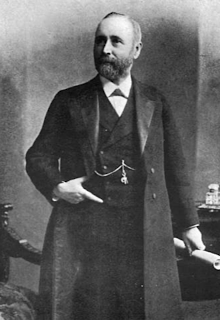
Pirrie is educated at the Royal Belfast Academical Institution before entering Harland & Wolff shipyard as a gentleman apprentice in 1862. Twelve years later he is made a partner in the firm, and on the death of Sir Edward Harland in 1895, he becomes its chairman, a position he holds until his death. As well as overseeing the world’s largest shipyard, he is elected Lord Mayor of Belfast in 1896, and is re-elected to the office as well as made an Irish Privy Counsellor the following year. He becomes Belfast’s first honorary freeman in 1898, and serves in the same year as High Sheriff of Antrim and subsequently of County Down. In February 1900, he is elected President of the UK Chamber of Shipping, where he had been vice-president the previous year. He helps finance the Liberals in Ulster in the 1906 United Kingdom general election, and that same year, at the height of Harland & Wolff’s success, he is raised to the peerage as Baron Pirrie, of the City of Belfast.
In February 1912, after chairing a famous meeting of the Ulster Liberal Association at which Winston Churchill defends the government’s policy of Home Rule for Ireland, Pirrie is jeered on the streets of Belfast, and assaulted as he boards a steamer in Larne: pelted with rotten eggs, herrings, and bags of flour. In 1910, the Ulster Liberal Association, an overwhelmingly Protestant body, with a weekly newspaper, and branch network throughout Ulster, adopts (in opposition to the Ulster Liberal Unionist Association) an explicitly pro-home rule position.
In the months leading up to the 1912 sinking of the RMS Titanic, Pirrie is questioned about the number of life boats aboard the Olympic-classocean liners. He responds that the great ships are unsinkable and the rafts are to save others. This haunts him for the rest of his life. In April 1912, Pirrie is to travel aboard RMS Titanic, but illness prevents him.
During the war Pirrie is a member of the War Office Supply Board, and in 1918 becomes Comptroller-General of Merchant Shipbuilding, organising British production of merchant ships.
In 1921, Pirrie is elected to the Senate of Northern Ireland, and that same year is created ViscountPirrie of the City of Belfast, in the honours for the opening of the Parliament of Northern Ireland in July 1921, for his war work and charity work. In Belfast he is, on other grounds, already a controversial figure: a Protestant employer associated as a leading Liberal with a policy of Home Rule for Ireland.
Pirrie dies at sea off Cuba on June 7, 1924. His body is embalmed. On June 13, Ebro reaches Pier 42 on the North River in New York City, where Pirrie’s friend Andrew Weir, 1st Baron Inverforth and his wife meet Viscountess Pirrie and her sister. UK ships in the port of New York lower their flags to half-mast, and Pirrie’s body is transferred to Pier 59, where it is embarked on White Star Line‘s RMS Olympic, one of the largest ships Pirrie ever built, to be repatriated to the UK. He is buried in Belfast City Cemetery. The barony and viscountcy die with him. Lady Pirrie dies on June 19, 1935. A memorial to Pirrie in the grounds of Belfast City Hall is unveiled in 2006.
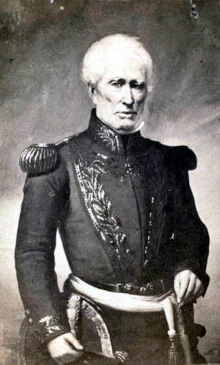
Brown is born on June 22, 1777, in Foxford, County Mayo. Comparatively little is known of his early life, and it has been suggested that he was illegitimate and took his mother’s surname and that his father’s surname was actually Gannon. He emigrates with his father to Baltimore, Maryland, in 1793, eventually settling in Philadelphia, Pennsylvania. A short time after their arrival, the friend who had invited them and offered them food and hospitality dies of yellow fever. Several days later, his father also succumbs to the same disease.
One morning, while Brown is wandering along the banks of the Delaware River, he meets the captain of a ship then moored in port. The captain inquires if he wants employment and Brown agrees. The captain engages him as a cabin boy, thereby setting him on the naval promotion ladder, where he works his way to the captaincy of a merchant ship. After ten years at sea, where he develops his skills as a sailor and reaches the rank of captain, Brown is press-ganged into a Royal Navy warship. British impressment of American sailors is one of the primary issues leading to the War of 1812.
During the Napoleonic Wars, Brown escapes the ship he is serving on, a galley, and scuttles the vessel. However, the French do not believe he had assisted them and imprison him in Lorient. On being transferred to Metz, he escapes, disguised in a French officer’s uniform. However, he is recaptured and is imprisoned in the fortress of Verdun. In 1809, he escapes from there in the company of a British Army officer named Clutchwell, and eventually reaches German territory.
Returning to England, Brown renounces his maritime career and on July 29, 1809, he marries Elizabeth Chitty, daughter of an English shipping magnate, in Kent. As he is a Catholic and she a Protestant, they agree to raise their sons as Catholics and their daughters as Protestants. Despite lengthy periods of enforced separation, they have nine children. He leaves the same year for the Río de la Plata on board Belmond and sets himself up as a merchant in Montevideo, Uruguay.
Late in 1811 Brown settles in Buenos Aires just as a criollo rebellion against Spanish colonial rule in Argentina is gaining strength. By April 1812, he is developing a coastal shipping business in fruit and hides. As the Spanish naval blockade of 1812–14 begins to choke trade, he is first commissioned by the patriot government as a privateer licensed to raid Spanish merchantmen, and then, on March 1, 1814, invited to take charge of a small rebel naval squadron to contest Spanish control of the Río de la Plata estuary. Leading a fleet of nineteen ships, he fixes with great speed on a set of wartime naval routines and signaling methods, and organises a system of discipline, founding the navy on principles that pay exceptional attention to the welfare of ordinary seamen.
In early March 1814, Brown shows personal courage and incisive skill in outwitting and defeating a more powerful Spanish force near Martín García Island, thereby dividing the Spanish blockade. A Spanish attempt in May 1814 to break his blockade of Montevideo is decisively crushed by him and his makeshift navy, and the Spanish strongholds on the Atlantic coast collapse, ending open war. In 1815 and 1816, however, he carries out skirmishing raids on military and commercial targets belonging to Spanish South American possessions, until detained by a British colonial governor in Barbados in July 1816 for alleged infringements of international rules of trade.
Illness, and a tortuous but ultimately successful appeal process, take up most of 1817–18, but when Brown returns to Argentina in October 1818, political enemies set in motion a prosecution for alleged disobedience of orders. Cashiered in August 1819, then restored in rank but forced to retire, he attempts suicide the following month. Convalescence and resumption of his trading concern occupies him for several years.
A repentant government renews Brown’s command of the navy in December 1825, when war breaks out with Brazil. Though vastly outnumbered by the Brazilian fleet, he shows audacity and great finesse in a number of successful engagements in the Plate estuary in 1826, roving up the Brazilian coast on occasion to create great confusion. In February 1827, he triumphs in a series of actions known as the Battle of Juncal. After another year of commercial privateering against the Brazilian merchant fleet, he is one of two delegates selected to sign peace terms with Brazil in October 1828.
Retiring from active service that month, Brown tries to remain neutral as civil war erupts in Argentina, but reluctantly accepts the post of governor of Buenos Aires under General Juan Lavalle from December 1828 to May 1829, when he resigns in disgust at government excesses. During 1829–37 he holds aloof from the despotic government of Juan Manuel de Rosas. After French and British encroachments on the region in the later 1830s, he offers to take charge of the navy again to protect national independence and is available to defend Argentine interests when war breaks out with a French-backed Uruguay in early 1841. Though exasperated by a long and “stupid war,” he blockades the Uruguayan navy effectively until French and British fleets intervene in July 1845 with overwhelming force to capture his squadron and bring the war to an end.
Idolised by the Argentinian population for his high-principled and humane advocacy of independent democracy, Brown passes his last years trading and farming a country estate. In late 1847, he journeys to Ireland, hoping to find relations in Mayo, and is shocked by the hunger and destitution of the Great Famine.
Brown dies on March 3, 1857, at his home in Buenos Aires and is buried with full military honours. The Argentine government issues a comuniqué: “With a life of permanent service to the national wars that our homeland has fought since its independence, William Brown symbolized the naval glory of the Argentine Republic.” During his burial, General Bartolomé Mitre famously says: “Brown in his lifetime, standing on the quarterdeck of his ship, was worth a fleet to us.” His grave is currently located in the La Recoleta Cemetery in Buenos Aires.
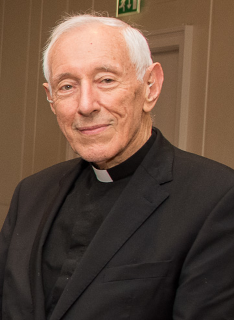
In September 1966, Coveney goes to work in the English-language section of the Secretariat of State in the Vatican. This sometimes involves acting as interpreter at audiences of Pope Paul VI, as when the Pope receives the three astronauts of the Apollo 11 mission that first lands human beings on the Moon.
Coveney serves with the rank of Secretary in the Apostolic Nunciature in Buenos Aires from 1972 to 1976, returning then to the Secretariat of State in the Vatican. He is counselor of the nunciatures in New Delhi (1982–1984) and Khartoum (1984–1985).
On January 25, 1990, Coveney is appointed Nuncio to Ethiopia and also becomes Apostolic Delegate to Djibouti on March 26, 1992, and Nuncio to Eritrea on September 30, 1995.
Coveney becomes Apostolic Nuncio to New Zealand, Tonga, the Marshall Islands, and Samoa, and Apostolic Delegate for Oceania on hpril 27, 1996. His remit is expanded to include Apostolic Nuncio to Fiji, Kiribati, the Federated States of Micronesia, and Vanuatu on October 15, 1996, and Apostolic Nuncio to Nauru on December 7, 1996. He is also named Apostolic Nuncio to the Cook Islands and Palau on July 14, 2001. As the longest-serving resident diplomatic representative to New Zealand, Archbishop Coveney serves for a time as Dean of the Diplomatic Corps. While based in Wellington, he also represents the Holy See at the inauguration of Chen Shui-bian as president of the Republic of China (Taiwan) on May 18, 2004.
Coveney’s last diplomatic appointment is as Apostolic Nuncio to Greece on January 25, 2005. On November 5, 2008, he officiates at the presentation to the Acropolis Museum in Athens of a fragment of the Parthenon Frieze on loan from the Vatican Museums. He resides in Athens until his retirement in 2009.
Coveney returns to the Diocese of Cork and Ross to reside in Crosshaven Parish. He assists in Crosshaven parish and celebrates the Sacrament of Confirmation in many parishes throughout the Diocese of Cork and Ross. He dies at the age of 88 on October 22, 2022.
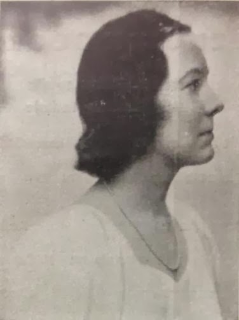
Married in 1893, Hinkson’s parents initially settle in England, where he studies law and is called to the Inner Temple in 1902. After suffering the loss of their first two sons in infancy, they have two more sons in addition to their daughter, Pamela. During this time her mother earns the main family income, and it is likely that she determines their return to Ireland in 1911. The Hinksons initially settle in Dalkey, County Dublin, before moving to a house called Clarebeg in Shankill. When Henry Hinkson is appointed resident magistrate for south Mayo (Castlebar) in October 1914, the family moves to Claremorris, County Mayo.
Hinkson is educated privately in England and on the Continent, and in Ireland attends a local convent day-school. She is exposed to her mother’s literary milieu which includes prominent writers of the Irish revival, including George William Russell, James Stephens, and Padraic Colum. Her mother’s memoir, The Years of the Shadow (1919), recalls Pamela’s developing talent for writing poetry and her predilection for war themes, as evidenced by The Blind Soldier, one of her first published poems. By the time she turns her hand to short stories, her earnings from writing enable her to buy the latest fashions.
Two key events that consumed Hinkson’s life and later spark her creativity are World War I and the Easter Rising. H. G. Wells describes in the foreword to his war novel Mr. Britling Sees It Through (1916) a conversation he had with her when she was 12, recalling how she had boldly set him straight on the “Irish question.” Her parents send her away to boarding school in County Wicklow in the hope that she will be distracted from her gloomy preoccupations, which are accentuated by the absence of her brothers, serving in the British Army. After the war she is deeply concerned by the redundancy experienced by demobilised and often maimed soldiers and contributes to the welfare work of the Irish servicemen’s Shamrock Club in London. These issues inform two early novels, The Victors (1925) and Harvest (1926), both written in the guise of an ex-serviceman under the pseudonym “Peter Deane.” By masking her identity, she avoids the possibility of her works being discredited because of her gender and lack of first-hand experience of war. Subsequently she writes under her own name for thirty years.
In contrast to her close relationship with her mother, Hinkson deeply dislikes her father. With the exception of her beloved brother Giles A. Hinckson, a correspondent for The Times in Buenos Aires and Santiago, she never meets a man who matches her high ideals. Though briefly engaged to be married, she is ultimately disillusioned by all men, dismissing them as she had her father. After his death early in 1919, she and her mother are left in financial difficulties, and have to resort to friends and boarding houses for accommodation. Without the financial means to embark on a university degree, she remains at her mother’s side. Though she continues to write, she leads a somewhat stifled life. From 1922 onwards they spend several years on the Continent.
Hinkson’s first novel, The End of All Dreams (1923), addresses the decline of the “big house” amid the revolutionary upheavals of recent Irish history, a theme to which she returns in later works, such as The Deeply Rooted (1935) and her last book, The Lonely Bride (1951). During the 1920s she writes much girls’ school fiction, while her novel Wind from the West (1930) is informed by a period spent in France, where she works as a governess. Her transcription of the memoirs of Lady Fingall (Elizabeth Burke-Plunkett), published under the title Seventy Years Young (1937), illustrates the decline of the Anglo-Irish ascendancy. Informed by war and the Irish troubles, her novels characteristically are solemn, and reflect her ambivalent relationship with Ireland. Inspired by the Irish landscape, but never an ardent supporter of Irish independence, she maintains an abiding attachment to England.
The death of Hinkson’s mother in 1931 is a devastating blow that triggers her most forceful and first truly successful novel, The Ladies’ Road (1932). Documenting the lives of the Irish and English ascendancies before, during, and after World War I, this novel, without being explicitly autobiographical, contains many motifs that resonate with her own life story. When published in the United States in 1946 it proves a massive success, selling 100,000 copies in the Penguin Books edition, a rare feat for a World War I novel appearing immediately after World War II. Other notable works are The Light on Ireland (1935) and her sketches of Irish life, Irish Gold (1939), written while she lodges with friends near Lough Derg, County Tipperary.
Hinkson’s visit to India in the late 1930s as a guest of the viceroy, which she recounts in Indian Harvest (1941), results in her appointment to the Ministry of Information in London (1939–45). She lectures on India in the United States during World War II, and also lectures to British troops and local audiences in Germany (1946–47), broadcasts on radio, and contributes to The Observer, The Spectator, New Statesman, The Manchester Guardian, and Time and Tide. Her novel Golden Rose (1944), written in London during The Blitz, romanticises the British colonial presence in India. Forthright in the expression of her numerous strongly held opinions, she argues ardently and controversially for women’s rights, animal welfare, and retention of Northern Ireland in the UK. Devout in her Catholicism, she is none the less critical of certain Catholic precepts.
Hinkson returns to Ireland in 1959 where she suffers poor health for twenty years until her death in Dublin on May 26, 1982.
(From: “Hinkson, Pamela” by Jessica March, Dictionary of Irish Biography, http://www.dib.ie)
He is born John MacKenna, the son of William MacKenna of Willville House near Monaghan and Eleanora O’Reilly and, on his mother’s side, a nephew to CountAlejandro O’Reilly. Count O’Reilly takes an interest in the young Mackenna and takes him to Spain where he studies at the Royal School of Mathematics in Barcelona. He also trains in the Royal Military Academy as a Military Engineer between 1785 and 1791.
In 1787 Mackenna is accepted into the Irish Brigade of the Spanish Army, and joins the army fighting in Ceuta in northern Africa, under Lieutenant Colonel Luis Urbina, and is promoted to Second Lieutenant. In 1791 he resumes his studies in Barcelona and acts as liaison with mercenaries recruited in Europe. The following year he is promoted to Lieutenant in the Royal Regiment of Engineers. In the War of the Pyrenees against the French, he fights in Rosselló under General Ricardos and there meets the future liberator of Argentina, José de San Martín. For his exploits in defence of the Plaza de Rozas, he is promoted to captain in 1795.
For the purpose of a new assignment, in October 1796, Mackenna leaves Spain for South America. He arrives in Buenos Aires and then travels to Mendoza and to Chile across the Andes and then to Peru. Once in Lima, he contacts Ambrosio O’Higgins, another Irishman, at that time Viceroy of Perú, who names him Governor of Osorno and puts him in charge of the reconstruction works for the southern Chilean town.
In this capacity, Mackenna convinces the families of Castro, on Chiloé Island, to move to Osorno to found a colony there. He builds the storehouse and two mills, as well as the road between Osorno and present-day Puerto Montt. His successful administration provokes jealousy from Chile’s captain-general Gabriel de Avilés, who fears that Mackenna and Ambrosio O’Higgins will create an Irish colony in Osorno. Both Irishmen are loyal to the Spanish crown, though Mackenna has good relations with O’Higgins’ son Bernardo, the future emancipator of Chile, and is also connected with the VenezuelanFrancisco de Miranda and his group of supporters of South American independence. When Ambrosio O’Higgins dies in 1801, Avilés is appointed viceroy of Peru. It takes him eight years to remove Mackenna, O’Higgins’s protégé, from Osorno.
In 1809 Mackenna marries Josefina Vicuña y Larraín, an eighteen-year-old Chilean woman from a family with revolutionary connections, with whom he has three children. After the Declaration of Chilean Independence in 1810, he adheres to the Patriot side and is commissioned by the first Chilean government to prepare a plan for the defense of the country and oversees the equipment of the new Chilean Army. At this juncture he trains the first military engineers for the new army.
The following year Mackenna is called to the defence committee of the new Republic of Chile, and in 1811 is appointed governor of Valparaíso. Owing to political feuds with José Miguel Carrera and his brothers, he is dismissed from the post and taken prisoner. He is a firm ally of Bernardo O’Higgins, who appoints him as one of the key officers to fight the Spanish army of General José Antonio Pareja. His major military honour is attained in 1814 at the Battle of Membrillar, in which the general assures a temporary collapse of the royal forces.
As a reward for his victory, Mackenna is appointed commandant-general by Bernardo O’Higgins, but after a coup d’état led by Luis Carrera he is exiled to Argentina in 1814, when Carrera comes to power. Mackenna dies in Buenos Aires on November 21, 1814, following a duel with Carrera.
A bust of General Mackenna is publicly presented to Monaghan County Museum on August 5, 2004 by his direct descendant, Luis Valentín Ferrada. At the presentation ceremony, MacKenna, the man “unreservedly regarded as the greatest of County Monaghan’s exiles” is commemorated in speeches by Most Rev. Dr. Joseph Duffy, Bishop of Clogher and by his descendant Senor Ferrada who declares, “In this city of Monaghan, very near to Willville House, the tombs of my ancestors are in the old cemetery. There, my own blood is interred in the sacred earth.”
In 1794, after serving in the Army of the Coasts of Brest, Humbert serves under Louis Lazare Hoche in the Army of the Rhin-et-Moselle. Charged to prepare for an expedition against Ireland, he takes command of the Légion des Francs under Hoche, sailing in the ill-fated Expédition d’Irlande against Bantry Bay in 1796, and is engaged in actions at sea against the Royal Navy. Contrary weather and enemy action force this expedition to withdraw. The trip home ends in a naval battle, the Action of 13 January 1797, during which Humbert, on the French ship Droits de l’Homme (1794), narrowly escapes death. As the ship is destroyed and sinks, hundreds of men perish, but Humbert is among the last to escape.
On his return to France, Humbert serves in the Army of the Sambre-et-Meuse, before being appointed to command the troops in another attempt to support a rising in Ireland in 1798. His command chiefly consists of infantry of the 70th demi-brigade with a few artillerymen and some cavalry of the 3rd Hussars, however by the time he arrives off the Irish coast the United Irish rising has already suffered defeat. The expedition is able to land in Ireland at Killala on Thursday August 23, 1798, meeting with initial success in the Battle of Castlebar where he routs the Irish Militia. Humbert subsequently declares a Republic of Connacht, with hopes of taking Dublin. However, Humbert’s small force is defeated at the Battle of Ballinamuck by the Irish Royal Army, and he is taken as a prisoner of war by the authorities. The British send the French officers home in two frigates and then massacre their Irish supporters. Humbert makes no attempt to save the Irish who bravely supported him.
Humbert is shortly repatriated in a prisoner exchange and appointed in succession to the Armies of Mayence, Danube and Helvetia, with which he serves at the Second Battle of Zurich. He then embarks for Santo Domingo and participates in several Caribbean campaigns for Napoleon Bonaparte before being accused of plundering by General Brunet. It is also rumored that he engages in an affair with Pauline Bonaparte, the wife of his commanding officer Charles Leclerc. He is returned to France by order of General Leclerc in October 1802, for “prevarications, and liaison relationships with organisers of the inhabitants and with leaders of brigands.” A committed Republican, his displeasure at Napoleon’s Imperial pretensions lead to him being dismissed in 1803 and he retires to Morbihan in Brittany.
In 1810, after brief service in the Army of the North, Humbert emigrates to New Orleans, where he makes his acquaintance with French pirate Jean Lafitte. In 1813, Humbert joins the revolutionary Juan Bautista Mariano Picornell y Gomila in an unsuccessful attempt to foment rebellion in Spanish Mexico, but the effort fails. In 1814, Humbert again leaves New Orleans and joins the rebelling forces of Buenos Aires, briefly commanding a corps, before returning home. Humbert last fights the British at the Battle of New Orleans, as a volunteer private soldier in U.S. ranks, in the War of 1812, wearing his Napoleonic uniform. General Andrew Jackson thanks him for his assistance there after the American victory in January 1815. Thereafter Humbert lives peacefully as a schoolteacher until his death on January 3, 1823.
A monument to General Humbert depicting Mother Ireland stands on Humbert Street, Ballina, County Mayo. In 1989, sculptor Carmel Gallagher unveils a bust of General Humbert in Killala, Ireland, to mark the upcoming bicentennial of the Irish Rebellion of 1798.
From 1932, Alexander teaches mathematics in Winchester and marries Enid Constance Crichton Neate on December 22, 1934. In 1938 he leaves teaching and becomes head of research at the John Lewis Partnership.
In February 1940 Alexander arrives at Bletchley Park, the British codebreaking centre during the World War II. He joins Hut 6, the section tasked with breaking German Army and Air Force Enigma messages. In 1941, he transfers to Hut 8, the corresponding hut working on Naval Enigma. He becomes deputy head of Hut 8 under Alan Turing and formally becomes the head of Hut 8 in November 1942. In October 1944, Alexander is transferred to work on the Japanese JN-25 code.
In mid-1946, Alexander joins GCHQ, which is the post-war successor organisation to the Government Code and Cypher School (GC&CS) at Bletchley Park. By 1949, he has been promoted to the head of “Section H” (cryptanalysis), a post he retains until his retirement in 1971.
Alexander is twice a winner of the British Chess Championship, in 1938 and 1956. He represents England in the Chess Olympiad six times, in 1933, 1935, 1937, 1939, 1954 and 1958. At the 1939 Olympiad in Buenos Aires, Argentina, Alexander has to leave part-way through the event, along with the rest of the English team, due to the declaration of World War II, as he is required at home for codebreaking duties. He is also the non-playing captain of England from 1964 to 1970. He is awarded the International Master title in 1950 and the International Master for Correspondence Chess title in 1970. He wins the Hastings International Chess Congress 1946/47 with the score 7½/9, a point ahead of Savielly Tartakower. His best tournament result may have been first equal Hastings 1953/54, where he goes undefeated and beats Soviet grandmasters David Bronstein and Alexander Tolush in individual games. He is also the chess columnist of The Sunday Times in the 1960s and 1970s.
Many knowledgeable chess people believe that Alexander had Grandmaster potential, had he been able to develop his chess abilities further. Many top players peak in their late twenties and early thirties, but for Alexander this stretch coincided with World War II, when high-level competitive opportunities were unavailable. After this, his professional responsibilities as a senior cryptanalyst limited his top-class appearances. He defeats Mikhail Botvinnik in one game of a team radio match against the Soviet Union in 1946, at a time when Botvinnik is probably the world’s top player. Alexander makes important theoretical contributions to the Dutch Defence and Petrov’s Defence.