A serious interest in poetry and literature begins to manifest itself during his years at TCD. In 1900, he makes the acquaintance of W. B. Yeats and George Moore and begins to frequent Dublin literary circles. In 1904 and 1905 he publishes several short poems in the London publication The Venture and in John Eglinton‘s journal Dana. His name also appears in print as the renegade priest Fr. Oliver Gogarty in George Moore’s 1905 novel The Lake.
In 1905, Gogarty becomes one of the founding members of Arthur Griffith‘s Sinn Féin, a non-violent political movement with a plan for Irish autonomy modeled after the Austro-Hungarian dual monarchy.
In July 1907, his first son, Oliver Duane Odysseus Gogarty, is born, and in autumn of that year he leaves for Vienna to finish the practical phase of his medical training. Returning to Dublin in 1908, he secures a post at Richmond Hospital, and shortly afterward purchases a house in Ely Place opposite George Moore. Three years later, he joins the staff of the Meath Hospital and remains there for the remainder of his medical career.
Gogarty maintains close friendships with many of the Dublin literati and continues to write poetry in the midst of his political and professional duties. He also tries his hand at playwriting, producing a slum drama in 1917 under the pseudonym “Alpha and Omega,” and two comedies in 1919 under the pseudonym “Gideon Ouseley,” all three of which are performed at the Abbey Theatre. He devotes less energy to his medical practice and more to his writing during the twenties and thirties.
With the onset of World War II, Gogarty attempts to enlist in the Royal Air Force (RAF) and the Royal Army Medical Corps (RAMC) as a doctor. He is denied on grounds of age. He then departs in September 1939 for an extended lecture tour in the United States, leaving his wife to manage Renvyle House, which has since been rebuilt as a hotel. When his return to Ireland is delayed by the war, he applies for American citizenship and eventually decides to reside permanently in the United States. Though he regularly sends letters, funds, and care-packages to his family and returns home for occasional holiday visits, he never again lives in Ireland for any extended length of time.
Gogarty suffers from heart complaints during the last few years of his life, and in September 1957 he collapses in the street on his way to dinner. He dies on September 22, 1957. His body is flown home to Ireland and buried in Cartron Church, Moyard, near Renvyle, County Galway.
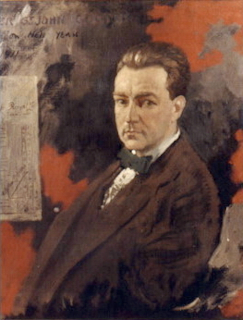
(Pictured: 1911 portrait of Oliver St. John Gogarty painted by Sir William Orpen, currently housed at the Royal College of Surgeons in Ireland)
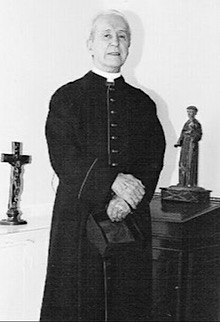
Martin is born on July 23, 1921, in Ballylongford, County Kerry, to a middle-class family in which the children are raised speaking Irish at the dinner table. His parents, Conor and Katherine Fitzmaurice Martin, have five sons and five daughters. Four of the five sons become priests, including his younger brother, Francis Xavier Martin.
Martin participates in the research on the Dead Sea Scrolls and publishes 24 articles on Semitic palaeography. He does archaeological research and works extensively on the Byblos syllabary in Byblos, in Tyre, and in the Sinai Peninsula. He assists in his first exorcism while working in Egypt for archaeological research. In 1958, he publishes a work in two volumes, The Scribal Character of the Dead Sea Scrolls.
In 1964, Martin requests a release from his vows and from the Jesuit Order. He receives a provisional release in May 1965 and a dispensation from his vows of poverty and obedience on June 30, 1965. Even if dispensed from his religious vow of chastity, he remains under the obligation of chastity if still an ordained secular priest. He maintains that he remains a priest, saying that he had received a dispensation from Paul VI to that effect.
Martin moves to New York City in 1966, working as a dishwasher, a waiter, and taxi driver, while continuing to write. He co-founds an antiques firm and is active in communications and media for the rest of his life.
In 1967, Martin receives his first Guggenheim Fellowship. In 1970, he publishes the book The Encounter: Religion in Crisis, winning the Choice Book Award of the American Library Association. He then publishes Three Popes and the Cardinal: The Church of Pius, John and Paul in its Encounter with Human History (1972) and Jesus Now (1973). In 1970, he becomes a naturalizedU.S. citizen.
In 1969, Martin receives a second Guggenheim Fellowship, allowing him to write his first of four bestsellers, Hostage to the Devil: The Possession and Exorcism of Five Living Americans (1976). In the book, he calls himself an exorcist, claiming he assisted in several exorcisms. According to McManus Darraugh, William Peter Blatty “wrote a tirade against Malachi, saying his 1976 book was a fantasy, and he was just trying to cash in.” Darraugh also says that Martin became “an iconic person in the paranormal world.”
Martin is a periodic guest on Art Bell‘s radio program, Coast to Coast AM, between 1996 and 1998. The show continues to play tapes of his interviews on Halloween.
The Vatican restores Martin’s faculty to celebrate Mass in 1989, at his request. He is strongly supported by some Traditionalist Catholic sources and severely criticized by other sources, such as the National Catholic Reporter. He serves as a guest commentator for CNN during the live coverage of the visit of Pope John Paul II to the United States in October 1995.
On July 27, 1999, Martin dies in Manhattan of an intracerebral haemorrhage, four days after his 78th birthday. It is caused by a fall in his Manhattan apartment. The documentary Hostage to the Devil claims that Martin says he was pushed from a stool by a demonic force.
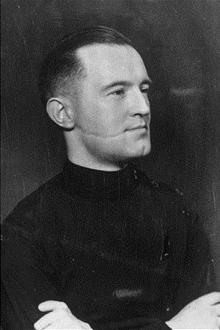
Joyce is the eldest of three sons of Michael Joyce, an Irish Catholic from a family of tenant farmers in Ballinrobe, County Mayo, and his wife, Gertrude (née Brooke), who although born in Shaw and Crompton, Lancashire, is from a well-off AnglicanAnglo-Irish family of physicians associated with County Roscommon. The Joyces return to Ireland in 1909. William, a precocious child, attends Coláiste Iognáid SJ, a Jesuit school in County Galway, from 1915 to 1921. At the age of fourteen, he abandons Catholicism for Anglicanism, apparently after being told that all non-Catholics, including his mother, would be damned. In adult life he is nominally anglican, though his adherence to Christianity is tenuous.
The Joyces are unionists and teach their children fervent imperialism. During the Irish War of Independence, Joyce openly associates with the Black and Tans and acts as a scout for them. An acquaintance claims that his views are so extreme even loyalists dislike him. On December 9, 1921, he flees to England to join the Worcestershire Regiment and is followed to England in 1923 by the rest of the family. When he enlists, he claims to be eighteen, but after he contracts rheumatic fever, his age is discovered, and he is discharged in March 1922. For a time, he studies mathematics and chemistry at Battersea Polytechnic Institute as a pre-medical student (1922–23), but he leaves of his own accord, with a reputation for laziness and violent political views. His studies in English and history at Birkbeck College are more successful. He is a brilliant linguist and mathematician and graduates BA with first-class honours in 1927. He publishes an academic article on philology and considers progressing to an MA. He later falsely claims that his research had been plagiarised by a Jewish academic. In 1932, he enrolls at King’s College, London, for a Ph.D. in educational psychology.
Joyce is disturbed by the difference between depressed post-war Britain and the imperial ideal that he had imbibed in Galway and is mocked for his outspoken patriotism and obvious Irishness. He identifies strongly with Thomas Carlyle, an earlier angry anti-liberal from the provinces. His life is marked by repeated episodes of hero worship, followed by disillusion and bitter denunciation. In 1923, he joins the British Fascists, an organisation that has a significant Irish loyalist membership, and in 1924 he allies himself with a militant splinter group, the National Fascists. Most British fascists see themselves as Tory auxiliaries, and they often provide a security presence at conservative meetings. On October 22, 1924, while stewarding a meeting addressed by a Jewish conservative candidate, he has his face slashed and is left with a prominent scar across his right cheek. He joins the Conservative Party in 1928 and is active in the Chelsea constituency until 1930, when he is forced out because of his eccentricities and sexual misbehaviour. On April 30, 1927, he marries Hazel Kathleen Barr. They have two daughters but separate in 1935, largely because of his infidelities, heavy drinking, and temper. The marriage is dissolved in 1937.
In November 1933, Joyce abandons his Ph.D. studies to work for Sir Oswald Mosley‘s British Union of Fascists (BUF). By early 1934 he has become its paid publicity director, traveling throughout Britain to organise meetings. He is a powerful, rabble-rousing speaker, driven by an instinctive awareness that vitriolic verbal abuse gives speaker and audience a sense of power and solidarity. MI5 sees him as a compelling, though deranged, personality. On February 8, 1937, he marries Margaret Cairns White, a BUF activist from Lancashire, with whom he had cohabited since 1936.
Joyce leads a BUF faction that favours a recruitment strategy based on uncompromising ideological assertion. This is challenged by populists who prioritise marches and displays and hold that indoctrination should follow membership. In February 1937, he is BUF candidate for the London County Council in Shoreditch. The party wins 14 percent of the vote. In March 1937, he, along with many full-time BUF staff, are sacked when the BUF cuts expenses. But his dismissal also reflects Mosley’s awareness that his obsessive rhetoric repels “respectable” recruits and that he is no longer a biddable, slavish admirer of “the Leader.” He later falsely claims near-exclusive credit for the BUF’s escalating antisemitism, a view that Mosley eventually finds it convenient to adopt in order to evade his own responsibility.
In April 1937, Joyce founds the National Socialist League, helped by a wealthy patron. He supports himself as a private tutor, refusing to take Jewish pupils. He is active in various antisemitic and pro-Nazi groups such as the Right Club and engages in “peace” campaigns based on the view that British interests lay with Germany against Russia. Political marginalisation intensifies his admiration for Nazi Germany and hero worship of Adolf Hitler. By the time of the Munich crisis in 1938, he has decided that if war comes, he will go to Germany, though he also considers moving to Ireland. He renews his British passport for one-year terms in August 1938 and August 1939.
On August 26, 1939, Joyce and his wife leave London for Berlin. He is allegedly tipped off about his impending arrest and internment by an MI5 officer, to whom he had supplied information on communists. His siblings, whom he recruited into his fascist organisations, are variously penalised for his activities. At a loose end in Berlin, he is persuaded by a British associate to become a radio announcer with the English-language service of the Reichs-Rundfunk-Gesellschaft (RRG). He makes his first broadcast on September 6, 1939, and receives a contract in October. He finds in radio an outlet for his forceful style and delight in saying the unsayable, and in the early years of the war takes an exultant pride in recounting Nazi victories. His performances are admired by Joseph Goebbels, whom Joyce, to his regret, never meets. On September 26, 1940, he acquires German citizenship.
The novel experience of hearing the enemy in one’s own living room attracts wide audiences in Britain. Joyce’s practice of naming newly captured prisoners of war in his broadcasts is also a compelling motive for listening. In fact, he tries to recruit British prisoners of war as collaborators. The name “Lord Haw-Haw,” invented by the Daily Express radio critic in September 1939, initially applies to several English-language broadcasters but in time becomes associated with Joyce. He is initially a figure of fun, imitated by comedians, but there are sinister undercurrents of terrifying omnipotence, intensified by his sneering, gloating delivery and his delighted deployment of the “big lie” technique. It is widely believed that British-based fifth columnists supply him with information, that he predicts air raids, and shows minute local knowledge. In time, fear and his growing notoriety feed popular hatred of him in Britain, though his anti-British taunts allegedly win appreciative Irish audiences. He exults that he is daily committing treason and rendering himself liable to the death penalty.
In 1940, Joyce publishes a commissioned self-justifying propaganda work, Twilight over England. His representation of himself echoes that of Hitler in Mein Kampf – the provincial patriot, whose martial sacrifices are betrayed by corrupt elites, learning through poverty the hollowness of bourgeois patriotism and the need to synthesise socialism with nationalism. He shares with his hero a paranoid belief in his own ability to create an alternative reality through language and obstinacy. He dreams of becoming the English Führer.
In Berlin, the Joyces’ marriage comes under increasing strain, marked by drunken rows, domestic violence, and infidelity on both sides, though they retain a fierce mutual fascination. They divorce on August 12, 1941, but remarry on February 11, 1942, while continuing their previous behaviour. As the Axis powers begin to fail, his broadcasts become more defensive, focusing on the Soviet threat. On October 14, 1944, he is awarded the German War Merit Cross, first class. On October 22, he is sworn into the Volkssturm (territorial army) and begins drilling. The Joyces are evacuated from Berlin in March 1945, initially to Apen near the Dutch border and then to Hamburg, where he makes a last, drunken, defiant broadcast on April 30, 1945, the day of Hitler’s death. After an unsuccessful attempt to escape to Sweden, the Joyces hide at Flensburg near the Danish border. On May 28, 1945, he is shot and captured while gathering firewood.
Joyce is brought back to Britain on June 16 after Parliament passed legislation simplifying treason trial procedures. At his September 17-20 trial, he proves his American citizenship, but the court holds that his illegally acquired British passport incurred duties of allegiance. His appeals are rejected by the Court of Appeal and the House of Lords. His fate is influenced by British public opinion, and possibly by a desire to avoid antagonising the Soviet Union. In his death cell he blames the defeat of national socialism on German limitations. He also fantasises that he could have saved Hitler from his incompetent subordinates.
Joyce is hanged by Albert Pierrepoint at Wandsworth Prison on January 3, 1946. Unlike most of his fellow Nazis, he proclaims to the end his allegiance to national socialism and hatred of Jews. He corresponds cheerfully with Margaret, joking evasively about the death camps and expressing a belief that his spirit will survive, watch over her, and continue his work. To neo-Nazis he becomes a martyr. Even among those to whom his activities had been repellent, a significant body of opinion holds he should not have been condemned on a questionable and innovative technicality. The historian A. J. P. Taylor maintains that Joyce was executed for making a false declaration to obtain a passport, a misdemeanour that normally incurs a £2 fine.
In 1976, Joyce is reinterred in Galway as it is feared that a grave in England might become a fascist shrine. Thomas Kilroy‘s play Double Cross (1986) juxtaposes Joyce and Brendan Bracken as Irishmen who reinvented themselves through fantasies of Britishness. The BBC Sound Archive has recordings of some of Joyce’s broadcasts and transcripts of others, collected during the war as evidence for a future treason trial.
(From: “Joyce, William Brooke (‘Lord Haw-Haw’)” by Patrick Maume, Dictionary of Irish Biography, http://www.dib.ie, October 2009)
The band is briefly named the Fast, but as there is already a group of that name, they change it to Stiff Little Fingers, taken from the song of the same name that had appeared on Pure Mania, the 1977 album by the Vibrators. Apart from a five-year gap from 1983 to 1987, Stiff Little Fingers has been active since 1977 to the present day and have released ten studio albums.
In 1981, Burns makes his acting debut in an episode of the BBC‘s Play for Today series entitled Iris in the Traffic, Ruby in the Rain, written by Belfast-born poet and playwrightStewart Parker, which also features the rest of Stiff Little Fingers effectively playing themselves as “The Band.”
After the breakup of Stiff Little Fingers in 1983, Burns forms Jake Burns and the Big Wheel. The band consists of Burns on vocals and guitar, Steve Grantley on drums, Sean Martin on bass guitar, and Pete Saunders on keyboards. Big Wheel records a total of three singles, “On Fortune Street,” “She Grew Up” and “Breathless.” A compilation album, also called On Fortune Street, is released in 2002 after the band’s demise.
In 1987, Burns disbands Big Wheel, and Stiff Little Fingers reforms, because they are “skint and wanted to make a bit of cash to get back to Ireland for Christmas.”
From about 2001 to 2005, Burns is involved in a side project with Pauline Black of the Selecter, called 3 Men and Black. This involves Black touring with three male artists from the late 1970s and early 1980s doing acoustic versions of songs they are famous for and talking a little about how they came to write the songs. The lineup for the concerts is fairly fluid, and includes such people as Bruce Foxton, Jean-Jacques Burnel, Eric Faulkner and Nick Welsh.
On March 27, 2006, Burns releases a solo album titled Drinkin’ Again.
Burns lives in London for over ten years from 1978 after Stiff Little Fingers relocates there. His first wife lives in Newcastle upon Tyne, and after their marriage, he moves to Newcastle, where he lives for 16 years, becoming a supporter of Newcastle United F.C. He is also an avid supporter of the Northern Ireland national football team.
Burns’s second wife, Shirley, is American and they have lived in Chicago since 2004. Burns eventually becomes a U.S. citizen, partially so he can help vote out Donald Trump.
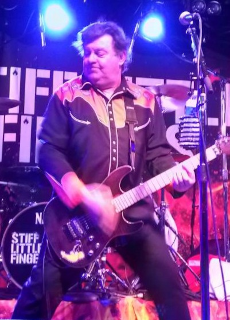
(Pictured: Jake Burns, performing with Stiff Little Fingers in 2019)
Patrick J. Killoran, Irish traditional fiddle player, bandleader and recording artist is born on September 21, 1903, in Emlaghgissan (also spelled “Emlagation”), a townland in the civil parish of Emlaghfad near the town of Ballymote, County Sligo. He is regarded, along with James Morrison and Michael Coleman, as one of the finest exponents of the south Sligo fiddle style in the “golden age” of the ethnic recording industry of the 1920s and 1930s.
Killoran’s father Patrick plays the flute and his mother Mary the concertina, but he is also influenced by local fiddle master Philip O’Beirne, who had earlier tutored Michael Coleman. As a teenager, he is a volunteer with the Ballymote-based 3rd Battalion of the south Sligo Brigade of the Irish Republican Army (IRA) during the Irish War of Independence.
In 1925, Killoran emigrates to New York City, arriving on May 19 on the Cunard liner Scythia. Within a few months, he officially declares his intention to become a citizen of the United States, listing his address as 227 East 126th Street in east Harlem and his occupation as “laborer.” He later lodges with fellow Sligo fiddler James Morrison in a Columbus Avenue apartment on Manhattan‘s Upper West Side. A 1927 newspaper ad for “Morrison’s Orchestra” offers “Irish music by P. Killoran and J. Morrison, celebrated violinists,” giving 507 West 133d Street in west Harlem as the contact address. He soon launches his own career as a soloist and bandleader. A publicity photo of his quartet c. 1928 includes button accordionist D. Casey, tenor banjo player Richard Curran and second fiddler Denis Murphy. By the next year, he is performing on a weekly radio program sponsored by the Pride of Erin Ballrooms, located at the corner of Bedford and Atlantic Avenues in Brooklyn. He also tries another side occupation as his 1931 naturalization petition lists his occupation as “Music store owner.”
At the Pride of Erin, and later at the Sligo Ballroom at 125th Street and St. Nicholas Avenue in Harlem, Killoran’s “Irish Orchestra” provides music for Irish dancing, while Jack Healy, another Ballymote native, leads a group for “American” dancing. Healy, as a singer and tenor saxophone player, also performs and records with Killoran’s group, the membership of which over the course of the 1930s includes fiddler Paddy Sweeney, another Sligo native, fiddle and clarinet player Paul Ryan, Ryan’s brother Jim on the C Melody saxophone, pianists Eileen O’Shea, Edmund Tucker and Jim McGinn, drummer Mickey Murphy, button accordionists Tommy Flanagan and William McElligott and tenor banjo/tenor guitar player Michael “Whitey” Andrews.
Killoran’s band is variously billed as his “Pride of Erin Orchestra,” “Radio Dance Orchestra,” “Sligo Ballroom Orchestra,” “Lakes of Sligo Orchestra” and “Irish Barn Dance Boys.” The group is a popular choice for county association functions, particularly those of Sligo and Roscommon. In 1932, he leads a band that accompanies CardinalWilliam Henry O’Connell of Boston to the Eucharistic Congress in Ireland and briefly bills his group as the “Pride of Erin Eucharistic Congress Orchestra.” He regularly performs at Irish beach resorts on the Rockaway peninsula and in East Durham in the Catskill Mountains.
Uniquely among the major New York Irish musicians of the pre-World War II era, Killoran continues his musical career through the 1950s. He issues new recordings, including duets with flute player Mike Flynn and some fiddle-and-viola sides with Paul Ryan, and leads an active dance band. Age and illness eventually force him to retire, and in 1962 he turns over leadership of the band, a fixture at the City Center Ballroom, to button accordionist Joe Madden, father of Cherish the Ladies flute player Joanie Madden.
In 1956, Killoran is a co-founder of the Dublin Recording Company, later better known simply as Dublin Records, which is organized to record new Irish discs in New York.
Killoran is a founding member of the Emerald Irish Musicians Benevolent Society, a group that stages “Night of Shamrocks” concerts to raise money for the benefit of sick and deceased Irish musicians in New York. He is also a member of the Irish Musicians Association of America, and a New York branch of that organization, which later merges with Comhaltas Ceoltóirí Eireann, is named for him.
In addition to the 1932 trip to the Eucharistic Congress, Killoran returns to Ireland at least twice. In 1949, he plays on a Radio Éireann program hosted by piper and folklorist Séamus Ennis. Some selections from that broadcast are recorded on a private disc and are later released on CD. On a 1960 visit, he visits Sligo and Clare and performs at a concert in County Longford.
Killoran is married twice. His first wife, Anna Gorman, a native of County Roscommon, dies in 1935. His second wife is Betty (Bridget) Hayes, an immigrant from Shanaway West, County Clare, who survives him. He dies in New York City on April 24, 1965.
A “Paddy Killoran Traditional Festival” is celebrated in the third week of June in Ballymote, where a monument in Killoran’s honor is erected in 2012.
O’Byrne is the son of James Burns, a farmer, and his wife Isabella (née Arnett). His biographer states that his parents came from County Wicklow, which would imply that their name had been anglicised from the form “O’Byrne,” which their son readopts. He never marries and spends most of his life living with his unmarried sister Teresa. He has other siblings, as he is survived by four nieces and two nephews.
O’Byrne’s childhood is spent in the Balmoral district of south Belfast in a comfortable but slightly precarious middle-class Catholic environment. Although sparse in direct autobiographical references, his writings contain references to excursions around the Malone and Stranmillis areas, with particular reference to the Botanic Gardens. He is educated at St. Malachy’s College. After leaving school, he manages a spirit grocery on the Beersbridge Road in east Belfast and is active in the Sexton Debating Society, named after Thomas Sexton, then home rule MP for Belfast West, and led by Joseph Devlin, who remains a lifelong friend despite their later political differences. He also studiess music with Carl Hardebeck, acquiring an extensive knowledge of Irish folk music and becoming an accomplished singer of Irish tunes in Hardebeck’s arrangements.
O’Byrne subsequently joins the Belfast Gaelic League, becoming a leading member, though he never masters the Irish language. He moves in the literary and antiquarian circles around Francis Joseph Bigger, whose friendship becomes central to his career and self-definition. He is a regular participant in Bigger’s soirées and establishes friendships with many prominent political and cultural figures, among them Roger Casement and Alice Milligan. Although he is usually seen as a specifically northern writer, he draws extensively on a wider Irish tradition of defensively self-glorifying Catholic-nationalist antiquarianism, including the works of W. H. Grattan Flood and Archbishop of Tuam, John Healy, a major source for his later pamphlet on Saint Patrick and for the descriptions of Ulster monasteries in As I Roved Out: A Book of the North (1946).
In 1900, O’Byrne publishes a collection of verses, A Jug of Punch, of which no copies are known to survive, and in 1905 collaborates with Cahir Healy on another collection, The Lane of the Thrushes, which applies Celtic revival imagery to rural Ulster. He publishes another collection, The Grey Feet of the Wind, in 1917. The manuscript of his unpublished Collected Poems (1951) is in the Public Record Office of Northern Ireland.
In 1902, O’Byrne gives up the spirit grocery to work full time as a journalist, singer, and storyteller. He appears at a wide variety of concerts, where he cuts a striking figure in Gaelic dress with saffron kilt. He provides musical interludes at productions by the Ulster Literary Theatre, and his recitation of Eleanor Alexander’s humorous piece on the battle of Scarva inspires Harry Morrow’s celebrated satirical play Thompson in Tir-na-nOg (1912). In 1913, he founds and manages the Celtic Players, a theatre company which stages some plays of his own composition, including The Dream of Bredyeen Dara, possibly a nativity story incorporating Saint Brigid of Kildare.
During World War I O’Byrne achieves immense cross-community success with a weekly dialect column in the Unionist paper Ireland’s Saturday Night, describing the domestic activities of “Mrs. Twigglety” and her working-class friends. At the same time, he has abandoned his earlier support for Devlin’s home rule politics to embrace physical-force republicanism under the influence of Denis McCullough. During Casement’s imprisonment and trial, he carries on an intense correspondence with him, comforting him, urging him to convert to Catholicism, and sending him religious icons. Some commentators have detected homoerotic undertones in their exchanges, though this is a matter of opinion.
After the Easter Rising of 1916, O’Byrne is active in the reconstituted Irish Republican Army (IRA), and in 1919–20 he smuggles arms from Belfast to Dublin. In August 1920, he emigrates to the United States, where he goes on a six-month lecture tour to raise funds for victims of the Belfast pogroms. He allegedly raises $100,000 and funds the construction of Amcomri Street in west Belfast. He spends the next eight years in the United States as a speaker and entertainer, contributing to American Catholic publications. He develops an abiding fondness for Chicago and considers applying for American citizenship. At one point he corresponds with the film star Rudolph Valentino, who admires his verses on Italian themes.
O’Byrne returns to Belfast in September 1928 with the intention of opening a bookshop in Dublin, but this has to be abandoned after the loss of his savings in the Wall Street crash of October 1929. He settles into respectable semi-poverty in Cavendish Street, off the Falls Road, and remains a presence on the fringes of Belfast literary life. In 1930, he founds the Cathal O’Byrne Comedy Company, which performs plays of his own composition, notably the slight comedies The Returned Swank and The Burden, drawing on The Drone, by Samuel Waddell. In 1932, he sings at a concert in the Dublin Mansion House held to mark the Eucharistic Congress. He writes extensively for Catholic publications in Ireland and elsewhere, in particular the Capuchin Annual, Irish Monthly, and Irish Rosary, and publishes several pamphlets with the Catholic Truth Society (CTS). The sensibility displayed in these writings has much in common with that of Brian O’Higgins, Aodh de Blácam, Daniel Corkery and Gearoid Ó Cuinneagáin.
O’Byrne also publishes The Gaelic Source of the Brontë Genius (1932), Pilgrim in Italy (1930), and the story collection From Far Green Hills (1935), which retells gospel episodes in the style of an Irish storyteller with elements of Wildean orientalist exoticism. Pilgrim in Italy is published by the Three Candles Press of Colm Ó Lochlainn, an old friend through the Bigger circle, as is his last story collection, Ashes on the Hearth (1948), a series of slight reveries in which the narrator, wandering the back streets of Dublin, relives such resonant moments as the last days of James Clarence Mangan.
O’Byrne is best remembered, however, for As I Roved Out (1946), a collection of 128 articles on Belfast history originally published from the late 1930s in the Belfast Irish News. It displays considerable knowledge of Belfast history, drawn from lifelong reading and from conversations with Bigger, and can be seen as at once the summation of and a lament for the northern branch of the Irish revival associated with such figures as Bigger and Alice Milligan. The pieces, moving out from central Belfast to surrounding rural districts are held together by the storyteller surveying the landscape. Surveys of Belfast by journalistic flâneurs are not unprecedented, O’Byrne dismisses the mercantile and unionist establishment of Belfast as hopelessly materialistic and oppressive, casting himself and, by implication, his Catholic/nationalist readers as internal exiles forced into the side streets of history, treasuring a martyred religious faith and gazing back wistfully to the bright and fleeting hope represented by the Society of United Irishmen and the cultural revival. The book is punctuated by expressions of anger against the whole heritage of the Ulster plantation. The economic success of the planters is attributed solely to their plunder of the natives. The textile industry is discussed solely in terms of exploitation and starvation wages. Shipbuilding is dismissed with a remark that ships were built in Ulster long before the planters arrived. Finally, the history of Belfast is summed up in the confrontation between the Belfast merchant, ancestor of the unionist “establishment,” and would-be slave-trader Waddell Cunningham and the United Irishman and self-declared “Irish slave” William Putnam McCabe.
There are numerous contemptuous references to the Sabbatarianism and respectable dullness of late Victorian Belfast, contrasted with the lively artistic activities of the volunteer period. The book is reprinted three times in O’Byrne’s lifetime and is seen by nationalists as an underground classic. Its image of Belfast layered with fragmentary and hidden memories has been drawn on by authors as diverse as Ciaran Carson and Gerry Adams, and in the early twenty-first century O’Byrne is commemorated as one of the city’s significant writers. A plaque is placed on his Cavendish Street house in 2004. It is ironic that his reputation should rest on his memorialisation of Belfast, for he denounced it as “interminable miles of mean streets . . . one of the ugliest cities in the world.”
O’Byrne is believed by some, though not all, of his acquaintances to be homosexual. This view is supported by references to the descriptions of male beauty (based on Gaelic saga models) which recur in his writings and by the expressions of longing which permeate his work (which might also reflect a wider sense of loneliness or cultural displacement). His last years, 1954–57, are spent in the Nazareth Nursing Home in Ormeau Road, Belfast, where he dies on August 1, 1957, a month after suffering a stroke. His funeral is crowded, and his gravestone describes him as “singer, poet and writer who brought joy into the lives of others.”
(From: “O’Byrne, Cathal” by Patrick Maume, Dictionary of Irish Biography, http://www.dib.ie, October 2009)
Dowling is born in Kimmage, Dublin, on September 7, 1929, the sixth of four sons and three daughters of William Dowling, a ship’s captain, and his wife Mary (née Kelly). His father is violent toward the family and leaves when he is a toddler. Helped by money provided by a priest, the Dowlings move in 1934 from the basement of his maternal uncle’s flat in Merrion Square, Dublin, to a house in Mount Merrion, County Dublin. In 1942, financial necessity forces the family’s move to a smaller residence in Marlborough Road, Donnybrook, Dublin.
Dowling is educated at St. Mary’s College in Rathmines, Dublin, having previously attended KilmacudNational School and CBS Dún Laoghaire, both in County Dublin. He is a bright student, but with his fees in arrears, the dean of studies induces him to leave school early in September 1945 for a clerkship with the Standard Life Assurance Company. A few years later, he finds his vocation when he accompanies a girlfriend to the academy of acting run by Brendan Smith. He signs up in 1948 for a two-year course during which he performs in and stage-manages academy plays and stage-manages for Smith’s professional company. Upon quitting Standard Life in June 1950, he spends a year touring Ireland with Smith’s company, both as an actor and the touring group’s manager.
Dowling comes to prominence in the 1950s for his role as Christy Kennedy in the long-running radio soap opera, The Kennedys of Castleross, and as a member of the Abbey Theatre company. He returns to the Abbey as artistic director from 1987 to 1990.
Following two months in the United States in 1969 lecturing and directing at Loyola University Chicago, he spends periods during 1972–74 directing for the Missouri Repertory Theatre and lecturing and directing at the University of Missouri – Kansas City. On extended leave from the Abbey, he directs in various American theatres throughout 1975, the year he married Olwen O’Herlihy, daughter of the Irish actor Dan O’Herlihy. After his request for six months leave each year is refused, he quits the Abbey in 1976, having done over a hundred major roles for the company.
Dowling marries actress Brenda Doyle in 1952. They have four daughters, including actress Bairbre Dowling, before divorcing in 1975. In 1975, he marries Olwen O’Herlihy, with whom he has a son.
Politician Richard Boyd Barrett is the biological son of Dowling and recording artist and actress Sinéad Cusack from a 1966 relationship while both are at the Abbey Theatre. Boyd Barrett is adopted as an infant. Dowling contacts Boyd Barrett after his connection with Cusack is publicly revealed in 2007. Their relationship is made known after his death.
Dowling dies on May 10, 2013, in Massachusetts General Hospital due to complications arising from surgery. Following a funeral service at the First Congregational Church of Chester, his remains are interred in the nearby cemetery.
Dowling receives honorary doctorates from Westfield State University in Massachusetts, and from Kent State University, John Carroll University and the College of Wooster, all in Ohio. His papers, from 1976 onward, are housed at the Kent State University and John Carroll University libraries.
Joyce is born on April 24, 1906, in Brooklyn, New York, the eldest of three sons of Michael Joyce, an Irish Catholic from a family of tenant farmers in Ballinrobe, County Mayo, and his wife, Gertrude (née Brooke), who although born in Shaw and Crompton, Lancashire, is from a well-off AnglicanAnglo-Irish family of physicians associated with County Roscommon. The Joyces return to Ireland in 1909. William, a precocious child, attends Coláiste Iognáid SJ, a Jesuit school in County Galway, from 1915 to 1921. At the age of fourteen, he abandons Catholicism for Anglicanism, apparently after being told that all non-Catholics, including his mother, would be damned. In adult life he is nominally anglican, though his adherence to Christianity is tenuous.
The Joyces are unionists and teach their children fervent imperialism. During the Irish War of Independence, Joyce openly associates with the Black and Tans and acts as a scout for them. An acquaintance claims that his views are so extreme even loyalists dislike him. On December 9, 1921, he flees to England to join the Worcestershire Regiment and is followed to England in 1923 by the rest of the family. When he enlists, he claims to be eighteen, but after he contracts rheumatic fever, his age is discovered, and he is discharged in March 1922. For a time, he studies mathematics and chemistry at Battersea Polytechnic Institute as a pre-medical student (1922–23), but he leaves of his own accord, with a reputation for laziness and violent political views. His studies in English and history at Birkbeck College are more successful. He is a brilliant linguist and mathematician and graduates BA with first-class honours in 1927. He publishes an academic article on philology and considers progressing to an MA. He later falsely claims that his research had been plagiarised by a Jewish academic. In 1932, he enrolls at King’s College, London, for a Ph.D. in educational psychology.
Joyce is disturbed by the difference between depressed post-war Britain and the imperial ideal that he had imbibed in Galway and is mocked for his outspoken patriotism and obvious Irishness. He identifies strongly with Thomas Carlyle, an earlier angry anti-liberal from the provinces. His life is marked by repeated episodes of hero worship, followed by disillusion and bitter denunciation. In 1923, he joins the British Fascists, an organisation that has a significant Irish loyalist membership, and in 1924 he allies himself with a militant splinter group, the National Fascists. Most British fascists see themselves as Tory auxiliaries, and they often provide a security presence at conservative meetings. On October 22, 1924, while stewarding a meeting addressed by a Jewish conservative candidate, he has his face slashed and is left with a prominent scar across his right cheek. He joins the Conservative Party in 1928 and is active in the Chelsea constituency until 1930, when he is forced out because of his eccentricities and sexual misbehaviour. On April 30, 1927, he marries Hazel Kathleen Barr. They have two daughters but separate in 1935, largely because of his infidelities, heavy drinking, and temper. The marriage is dissolved in 1937.
In November 1933, Joyce abandons his Ph.D. studies to work for Sir Oswald Mosley‘s British Union of Fascists (BUF). By early 1934 he has become its paid publicity director, traveling throughout Britain to organise meetings. He is a powerful, rabble-rousing speaker, driven by an instinctive awareness that vitriolic verbal abuse gives speaker and audience a sense of power and solidarity. MI5 sees him as a compelling, though deranged, personality. On February 8, 1937, he marries Margaret Cairns White, a BUF activist from Lancashire, with whom he had cohabited since 1936.
Joyce leads a BUF faction that favours a recruitment strategy based on uncompromising ideological assertion. This is challenged by populists who prioritise marches and displays and hold that indoctrination should follow membership. In February 1937, he is BUF candidate for the London County Council in Shoreditch. The party wins 14 per cent of the vote. In March 1937, he, along with many full-time BUF staff, are sacked when the BUF cuts expenses. But his dismissal also reflects Mosley’s awareness that his obsessive rhetoric repels “respectable” recruits and that he is no longer a biddable, slavish admirer of “the Leader.” He later falsely claims near-exclusive credit for the BUF’s escalating antisemitism, a view that Mosley eventually finds it convenient to adopt in order to evade his own responsibility.
In April 1937, Joyce founds the National Socialist League, helped by a wealthy patron. He supports himself as a private tutor, refusing to take Jewish pupils. He is active in various antisemitic and pro-Nazi groups such as the Right Club and engages in “peace” campaigns based on the view that British interests lay with Germany against Russia. Political marginalisation intensifies his admiration for Nazi Germany and hero worship of Adolf Hitler. By the time of the Munich crisis in 1938, he has decided that if war comes, he will go to Germany, though he also considers moving to Ireland. He renews his British passport for one-year terms in August 1938 and August 1939.
On August 26, 1939, Joyce and his wife leave London for Berlin. He is allegedly tipped off about his impending arrest and internment by an MI5 officer, to whom he had supplied information on communists. His siblings, whom he recruited into his fascist organisations, are variously penalised for his activities. At a loose end in Berlin, he is persuaded by a British associate to become a radio announcer with the English-language service of the Reichs-Rundfunk-Gesellschaft (RRG). He makes his first broadcast on September 6, 1939, and receives a contract in October. He finds in radio an outlet for his forceful style and delight in saying the unsayable, and in the early years of the war takes an exultant pride in recounting Nazi victories. His performances are admired by Joseph Goebbels, whom Joyce, to his regret, never meets. On September 26, 1940, he acquires German citizenship.
The novel experience of hearing the enemy in one’s own living room attracts wide audiences in Britain. Joyce’s practice of naming newly captured prisoners of war in his broadcasts is also a compelling motive for listening. In fact, he tries to recruit British prisoners of war as collaborators. The name “Lord Haw-Haw,” invented by the Daily Express radio critic in September 1939, initially applies to several English-language broadcasters but in time becomes associated with Joyce. He is initially a figure of fun, imitated by comedians, but there are sinister undercurrents of terrifying omnipotence, intensified by his sneering, gloating delivery and his delighted deployment of the “big lie” technique. It is widely believed that British-based fifth columnists supply him with information, that he predicts air raids, and shows minute local knowledge. In time, fear and his growing notoriety feed popular hatred of him in Britain, though his anti-British taunts allegedly win appreciative Irish audiences. He exults that he is daily committing treason and rendering himself liable to the death penalty.
In 1940, Joyce publishes a commissioned self-justifying propaganda work, Twilight over England. His representation of himself echoes that of Hitler in Mein Kampf – the provincial patriot, whose martial sacrifices are betrayed by corrupt elites, learning through poverty the hollowness of bourgeois patriotism and the need to synthesise socialism with nationalism. He shares with his hero a paranoid belief in his own ability to create an alternative reality through language and obstinacy. He dreams of becoming the English Führer.
In Berlin, the Joyces’ marriage comes under increasing strain, marked by drunken rows, domestic violence, and infidelity on both sides, though they retain a fierce mutual fascination. They divorce on August 12, 1941, but remarry on February 11, 1942, while continuing their previous behaviour. As the Axis powers begin to fail, his broadcasts become more defensive, focusing on the Soviet threat. On October 14, 1944, he is awarded the German War Merit Cross, first class. On October 22, he is sworn into the Volkssturm (territorial army) and begins drilling. The Joyces are evacuated from Berlin in March 1945, initially to Apen near the Dutch border and then to Hamburg, where he makes a last, drunken, defiant broadcast on April 30, 1945, the day of Hitler’s death. After an unsuccessful attempt to escape to Sweden, the Joyces hide at Flensburg near the Danish border. On May 28, 1945, he is shot and captured while gathering firewood.
Joyce is brought back to Britain on June 16 after Parliament passed legislation simplifying treason trial procedures. At his September 17-20 trial, he proves his American citizenship, but the court holds that his illegally acquired British passport incurred duties of allegiance. His appeals are rejected by the Court of Appeal and the House of Lords. His fate is influenced by British public opinion, and possibly by a desire to avoid antagonising the Soviet Union. In his death cell he blames the defeat of national socialism on German limitations. He also fantasises that he could have saved Hitler from his incompetent subordinates.
Joyce is hanged at Wandsworth Prison on January 3, 1946. Unlike most of his fellow Nazis, he proclaims to the end his allegiance to national socialism and hatred of Jews. He corresponds cheerfully with Margaret, joking evasively about the death camps and expressing a belief that his spirit will survive, watch over her, and continue his work. To neo-Nazis he becomes a martyr. Even among those to whom his activities had been repellent, a significant body of opinion holds he should not have been condemned on a questionable and innovative technicality. The historian A. J. P. Taylor maintains that Joyce was executed for making a false declaration to obtain a passport, a misdemeanour that normally incurs a £2 fine.
In 1976, Joyce is reinterred in Galway as it is feared that a grave in England might become a fascist shrine. Thomas Kilroy‘s play Double Cross (1986) juxtaposes Joyce and Brendan Bracken as Irishmen who reinvented themselves through fantasies of Britishness. The BBC Sound Archive has recordings of some of Joyce’s broadcasts and transcripts of others, collected during the war as evidence for a future treason trial.
(From: “Joyce, William Brooke (‘Lord Haw-Haw’)” by Patrick Maume, Dictionary of Irish Biography, http://www.dib.ie, October 2009)
In June 1919, de Valera arrives in the United States for what is to be an 18-month visit. He has recently escaped from Lincoln Gaol in England in sensational fashion, after a duplicate key is smuggled into the jail in a cake and he escapes dressed as a woman. A few months later he is a stowaway aboard the SS Lapland from Liverpool bound for America.
De Valera’s plan is to secure recognition for the emerging Irish nation, tap into the huge Irish American community for funds, and to pressurize the U.S. government to take a stance on Irish independence. Playing on his mind is the upcoming Versailles conference where the nascent League of Nations is preparing to guarantee “existing international borders” – a provision that will imply Ireland remaining within the United Kingdom.
De Valera also has a challenge in winning over PresidentWoodrow Wilson, who is less than sympathetic to Ireland’s cause.
De Valera’s interest in America is of course personal. He is born in New York City on October 14, 1882, and his U.S. citizenship is one of the reasons he is spared execution after the 1916 Easter Rising.
At first de Valera keeps a low profile in America. Though he is greeted by Harry Boland and others when he docks in New York City, he first goes to Philadelphia and stays with Joseph McGarrity, the County Tyrone-born leader of Clan na Gael and a well-known figure in Irish America. He also quietly pays a visit to his mother in Rochester, New York.
De Valera’s first major engagement is on June 23, 1919, when he is unveiled to the American public at a press conference in the Waldorf-Astoria hotel in New York City. Crowds throng the streets around the hotel, and de Valera proclaims, “I am in America as the official head of the Republic established by the will of the Irish people in accordance with the principle of self-determination.”
De Valera then embarks upon a tour across America. Vast crowds turn out to see the self-proclaimed “president of the Irish republic.” In Boston an estimated crowd of 70,000 people hear him talk in Fenway Park. In San Francisco he unveils a statute of Irish revolutionary hero Robert Emmet in Golden Gate Park.
Later in the year, de Valera holds a huge rally in Philadelphia, where he is welcomed by the mayor at Independence Hall. He also visits smaller towns and cities across the United States, and his trip garners huge press coverage – an invaluable boon for his campaign to heighten awareness of the Irish issue in America.
But difficulties soon emerged during de Valera’s visit. He becomes embroiled in a bitter split among Irish Americans. He finds himself at odds with Judge Daniel Cohalan and John Devoy, central figures in the Friends of Irish Freedom (FOIF) association. Part of the dispute centers around money. De Valera had settled on an idea for a bond sale as a way of raising money for the cause – investors would be given bond certificates that would be exchangeable for bonds of the Irish Republic once it gets international recognition. But Cohalan and Devoy, who have already raised thousands through the Friends of Irish Freedom, are opposed, concerned about the scheme’s legality for one.
De Valera’s claim in an interview that Irish-British relations can be analogous to the relationship between Cuba and America also enrages the Cohalan-Devoy camp, who accuse him of surrendering the idea of full Irish sovereignty.
De Valera’s increasingly acrimonious relationship with Cohalan and Devoy spills over into the 1920 Republican and Democratic conventions. Against the advice of Cohalan and Devoy, he advances a resolution about Irish independence which is rejected 12-1 at the Republican convention in June of that year. A rival resolution by Cohalan squeezes through but ultimately is overturned. Similarly, he fails to secure the inclusion of the Irish issue in the Democratic Party’s policy platform during the Democrats’ convention in San Francisco.
De Valera leaves the United States in December 1920 with mixed results. Though he has raised millions of dollars through the bond sale, he has made little progress in co-opting official America to Ireland’s cause. Much as division is to characterise the next chapter of his political career in Ireland, de Valera’s sojourn in America leaves Irish America more divided than it has ever been.
(From: “Éamon de Valera’s US trip that left Irish America divided” by Suzanne Lynch, The Irish Times, http://www.irishtimes.com, June 1, 2019 | Pictured: Éamon de Valera (center) in New York with Friends of Irish Freedom’s Judge Daniel Cohalan and John Devoy in July 1919, Topical Press Agency/Getty)
Dirrane is born in Oatquarter in the townland of Kilmurvey on Inishmore, Aran Islands, County Galway on November 15, 1894. She is the youngest child of Joseph Gillan and Maggie (née Walsh). Her father is a weaver of flannel cloth and has a small farm. She has four brothers and three sisters. Her oldest brother is a fisherman, who dies at age 21 in 1901, and her father dies before 1911. Despite this hardship, all of the children go to school, with one of her brothers becoming an Irish teacher, and later an Irish inspector. The family speaks Irish at home, but they are all bilingual with English. She is schooled at the national school in Oatquarter until the age of 14. She leaves to work in local homes, looking after children. When she writes her memoirs late in life, she claims to have met Joseph Plunkett, Éamonn Ceannt, Thomas MacDonagh, Thomas Ashe and Patrick Pearse when they visited the island, visiting a house where she looked after the children, discussing politics and plans for the Easter Rising with them. She is a republican, becoming a member of Cumann na mBan in 1918 while she is working for Fr. Matthew Ryan as a housekeeper. She is involved in drilling and assisting fugitives from the authorities. Because of their known republican sympathies, the Black and Tans raid the Gillan family homes.
Dirrane moves to Dublin in 1919 to train in Saint Ultan’s Children’s Hospital as a nurse. She is still under surveillance, being arrested alongside her employer, Claude Chavasse, when she is working as a nurse in his house. She is held in Dublin’s Bridewell Garda Station for two days before being transferred to Mountjoy Prison. In the time of her imprisonment, she is not charged or put on trial. Her refusal to speak English angers the guards, culminating in her going on hunger strike for a number of days in 1920 until she is released. She takes part in the Cumann na mBan vigil outside of Mountjoy Prison in November 1920, when Kevin Barry is hanged.
Dirrane works in Richard Mulcahy‘s house for two years, before emigrating to the United States in 1927 to continue her career as a nurse. She works in Boston where she is an active member of the Irish emigrant community alongside former neighbours from the Aran Islands and some relatives. She works in a hotel for a time but returns to nursing after her marriage to Edward ‘Ned’ Dirrane in November 1932 in the Jamaica Plain section of Boston. Ned, a labourer in Boston and also from Inishmore, dies from heart failure in 1940. Dirrane continues her career nursing in hospitals and as a district nurse. On May 13, 1940, she naturalises as U.S. citizen. During World War II, she works as a nurse in a munitions factory, and at a U.S. Army Air Forcesbomber base in Mississippi. She canvases for John F. Kennedy in the Irish community in South Boston when he runs for president in 1960. Jean Kennedy Smith visits Dirrane in 1997 in Galway to acknowledge her contribution. She also meets Senator Edward Kennedy.
Following her retirement, Dirrane lives with her nephew, but she returns to the Aran Islands in 1966 at age 72. There she lives with her brother-in-law, Pat Dirrane, a widower with three grown sons. They marry in a private ceremony on April 27, 1966. She continues to live on the island after Pat’s death on February 28, 1990, living with her stepson. She eventually moves into a nursing home in Newcastle in the suburbs of Galway. When she celebrates her 100th birthday, she funds a statue of Our Lady Mary at a holy well in Corough on Inishmore. At age 103, the matron of her nursing home arranges for a local writer, Jack Mahon, to record her memories and collate the information into a book. The book, A Woman of Aran, is published in 1997 and is a bestseller for several weeks. She is awarded an honorary degree, an MA honoris causa, from NUI Galway in May 1998, the oldest person to ever receive one.
Dirrane dies at age 109 on December 31, 2003, in Galway. She is buried on Inishmore.



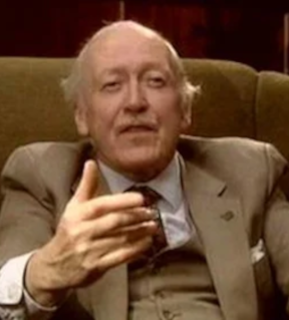


 seamus dubhghaill