John James Bernard (J. B.) Malone, an Irish hillwalking enthusiast who popularises the pastime through his television programmes and books, is born on December 13, 1913, in Leeds, West Yorkshire, England. He is responsible for the establishment of the Wicklow Way as a recognised walking trail, having first proposed it in 1966.
Malone is born to James Bernard Malone and his wife, Agnes (née Kenny), both from Dublin. He is raised mainly in England and completes his secondary education at the Marist Brothers College, Grove Ferry, Kent.
Malone moves to Ireland in 1931 where he finds employment in a builders’ providers firm and an insurance company before joining the Irish Army in 1940. There he becomes a cartographer in the intelligence section. In 1947, having left the army, he goes to work at the Department of Posts and Telegraphs as a draughtsman. He remains employed in the Irish civil service until his retirement in 1979. Also in 1947, he marries Margaret Garry, and they have three children.
Malone starts hillwalking in 1931 when he climbs Montpelier Hill to visit the ruins of the Hell Fire Club. Later, while on leave during his military career, he develops a detailed knowledge of walking routes throughout the hills of County Wicklow. He sits on the Board of An Taisce in Ireland from 1970 to 1974.
Following his retirement from the civil service, Malone is appointed as a field officer with the Long-Distance Walking Routes Committee of Cospóir, the Irish Sports Council. There, he negotiates rights of way with landowners to enable his vision of the Wicklow Way to become a reality. He first proposes a guided walking route through the Wicklow hills in 1966, although he had first raised the idea as early as 1942.
From 1938 to 1975 Malone contributes a regular column to the Evening Herald entitled Over the Hills. Between 1967 and 1968 he writes the column Know your Dublin, illustrated by Liam C. Martin. The column features information on a Dublin landmark and is later compiled into a book published in 1969.
During the 1960s, Malone presents a television documentary series on RTÉ entitled Mountain and Meadow, in which, accompanied by a cameraman, he introduces viewers to a variety of hill walks in Wicklow and surrounding counties. In 1980, he presents a one-hour TV programme on the newly opened Wicklow Way.
From 1950 to 1988, Malone writes several books on hillwalking in the Dublin Mountains and the Wicklow Mountains.
In 1980, Malone is made an honorary life member of An Óige, the Irish Youth Hostel Association (IYHA), in recognition of his contribution to promoting the Irish countryside.
Following his death in 1989, Malone’s contribution to hillwalking in Ireland is marked by the erection of the J.B. Malone Memorial Stone plaque in his honour on a section of the Wicklow Way overlooking Lough Tay.
In October 2014, on the 25th anniversary of Malone’s death, the South Dublin Libraries hold an exhibition on his life and work.
(Pictured: The John James Bernard Malone memorial, on the Wicklow Way overlooking Lough Tay and Luggala)
He serves in the American Revolutionary War (1775–81), first seeing action at the Battles of Lexington and Concord and the Battle of Bunker Hill. He is rewarded with an English peerage in 1783. He succeeds his father as Earl of Moira in 1793. When the Whigs come to power in 1806, he is appointed Master-General of the Ordnance, a post he resigns on the fall of his party in 1807. Taking an active part in the business of the House of Lords, he belongs to the circle of the Prince of Wales (later George IV), through whose influence he is appointed Governor-General of India, on November 11, 1812. He lands at Calcutta (Kolkata) and assumes office in October 1813. Facing an empty treasury, he raises a loan in Lucknow from the nawab-vizier there and defeats the Gurkhas of Nepal in 1816. They abandon disputed districts, cede some territory to the British, and agree to receive a British resident (administrator). For this success, in 1817 he is raised to the rank of Marquess of Hastings together with the subsidiary titles Viscount Loudoun and Earl of Rawdon.
He then has to deal with a combination of Maratha powers in western India whose Pindaris, bands of horsemen attached to the Maratha chiefs, are ravaging British territory in the Northern Sarkars, in east-central India. In 1817, he offers the Marathas the choice of cooperation with the British against the Pindaris or war. The Peshwa, the Prime Minister of the Maratha Confederacy, the raja of Nagpur, and the army under Holkar II, ruler of Indore, chose war and are defeated. The Pindari bands are broken up, and, in a settlement, the Peshwa’s territories are annexed, and the Rajput princes accept British supremacy. By 1818 these developments establish British sovereignty over the whole of India east of the Sutlej River and Sindh. Rawdon-Hastings also suppresses pirate activities off the west coast of India and in the Persian Gulf and the Red Sea. In 1819, Sir Stamford Raffles, under his authority, obtains the cession by purchase of the strategic island of Singapore.
In internal affairs, Rawdon-Hastings begins the repair of the Mughal canal system and brings the pure water of the Yamuna River (Jumna) into Delhi, encourages education in Bengal, begins a process of Indianization by raising the status and powers of subordinate Indian judges, and takes the first measures for the revenue settlement of the extensive “conquered and ceded” provinces of the northwest.
Rawdon-Hastings’s competent administration, however, ends under a cloud because of his indulgence to a banking house. Though he is cleared of any corrupt motive, the home authorities censure him. He resigns and returns to England in 1823, receiving the comparatively minor post of Governor of Malta in 1824. He dies at sea off Naples on November 28, 1826, aboard HMS Revenge, while attempting to return home with his wife. She returns his body to Malta, and following his earlier directions, cuts off his right hand and preserves it, to be buried with her when she dies. His body is then laid to rest in a large marble sarcophagus in Hastings Gardens, Valletta. His hand is eventually interred, clasped with hers, in the family vault at Loudoun Kirk.
In 1828, two years after Rawdon-Hastings’s death, members of the India House, to make some amends for their vote of censure, give £20,000 to trustees for the benefit of Hastings’s son.
(Pictured: “Portrait of Francis Rawdon, 2nd Earl of Moira, later 1st Marquess of Hastings (1754 – 1826)” possibly by Martin Archer Shee, oil on canvas, National Gallery of Ireland)
Known principally for his contribution to Ulster politics at local level, Armstrong serves as JP and is appointed High Sheriff of Armagh for 1875 and High Sheriff of Longford for 1894. He is a County Councillor for Armagh from 1899 to 1920, and a Member of the Irish Convention in 1917–18. Vice-Lieutenant of County Armagh in 1920, he is a Senator of Queen’s University Belfast from 1920 to 1937.
Armstrong is returned unopposed to the Imperial House of Commons for Mid-Armagh in the 1921 Mid Armagh by-election, at the advanced age of 76, becoming one of the oldest first-time MPs whose birth date is recorded. Certainly, he immediately becomes the oldest member of the current House of Commons. He is a Senator of Northern Ireland from 1921 to 1937, and Lord Lieutenant of Armagh from 1924 to 1939. For twenty-five years he is a member of the Representative Body of the Church of Ireland. He is Chairman of the County Armagh Education Committee from 1925 to 1931, and President of the Association of Education Committees of Northern Ireland. In 1932, he is made a Privy Councillor for Northern Ireland, and in 1938 he serves as a Justice for the Government of Northern Ireland in the absence of the Governor.
In his later years, Armstrong provides financial support for Jewish refugees fleeing Nazi-occupied Europe.
In 1883, Armstrong marries Margaret Leader, daughter of William Leader of Rosnalea, County Cork. They have five sons and three daughters, of whom C. W. Armstrong also becomes a politician.
Armstrong dies at his home in Dean’s Hill, Armagh, on December 4, 1943, at the age of 99 years.
Ware is born on November 16, 1594, in Castle Street, Dublin, eldest surviving son among ten children of Sir James Ware, auditor general, and his wife Mary Bryden, sister of Sir Ambrose Briden of Maidstone, Kent, England, whose house provides Ware’s base in England. His father, a Yorkshireman, comes to Ireland in the train of Lord Deputy of Ireland Sir William FitzWilliam in 1588 and builds up a substantial landed estate. He enters Trinity College Dublin (TCD), where his father is the college auditor, as a fellow commoner in 1605 and is presented a silver standing bowl in 1609. His association with the college continues, as he particularly remembers the philosophy lectures of Anthony Martin, who becomes a fellow in 1611. He takes his MA on January 8, 1628, but by then he has already launched on his future course. His father procures him the reversion of his office in 1613, and by 1620 he already owns the Annals of Ulster and is taking notes from the Black Book of Christ Church. In 1621, he marries Elizabeth Newman, daughter of Jacob Newman, one of the six clerks in chancery. Newman becomes clerk of the rolls in 1629, which apparently facilitates Ware’s assiduous research in the Irish public records.
From Ware’s numerous surviving notebooks, it is possible to follow his scholarly tracks over the rest of his life. He is particularly concerned to trace the succession of the Irish bishops. The first fruits appear in print in 1626, Archiepiscoporum Cassiliensium et Tuamensium . . . adjicitur historia coenobiorum Cisterciensium Hiberniae, followed in 1628 by De presulibus Lageniae . . ., the whole to be rounded off in 1665 with De presulibus Hiberniae. . . . However, he has wide interests in Irish history and in 1633 edits Edmund Spenser‘s A View of the Present State of Irelande and the Irish histories of Edmund Campion, Meredith Hanmer, and Henry of Marlborough. The first Irish biographical dictionary follows in 1639, De scriptoribus Hiberniae. Both publications are dedicated to the viceroy, Thomas Wentworth. In public life he is a supporter, first of Wentworth, later of James Butler, 1st Duke of Ormond, rather than a leader, and always a stout royalist. He is knighted in 1630 and following his father’s death in 1632 he succeeds as auditor general. He is elected member of parliament for Dublin University in 1634, 1640, and 1661, but is not admitted to the Privy Council of Ireland until 1640.
Shortly after the outbreak of rebellion in October 1641, Ware is in England, and in London at the time of the passing of the Adventurers’ Act 1640, presumably on the council’s business. During Ormond’s prolonged negotiations with the confederates, he is sent to advise the king at Oxford in November 1645. While there he works in the Bodleian Library and is incorporated into the university as a Doctor of Civil Law. On his way back to Ireland in January 1646, he is captured at sea by a parliament ship and held prisoner in the Tower of London until October 1646.
When Ormond is arranging the surrender of Dublin to the parliament in the summer of 1647, Ware is sent to London as one of the hostages for his performance of the terms. Back in Dublin he has been replaced as auditor general but is able to carry on his work on the public records. In 1648 he publishes the catalogue of his manuscript library. As a leading royalist he is unwelcome to those governing the city for the parliament and is sent into exile in France on April 7, 1649, with his eldest son, also James, who already holds the reversion of the auditor generalship and eventually succeeds his father. He is allowed to live in London from October 1650, and from 1653, when hostilities end in Ireland, he is allowed brief visits there, perhaps taking up residence again in 1658.
Ware’s years in London are spent in the library of Archbishop of ArmaghJames Ussher, then in Lincoln’s Inn, and in the Royal, Cotton, Carew, and Dodsworth libraries. He publishes his De Hibernia et antiquitatibus ejus disquisitiones in 1654, lamenting the inaccessibility of his notes, then in Dublin. The second edition, published in 1658, also includes the annals of Henry VII. His Opuscula Sancto Patricio . . . adscripta . . . appears in 1656. In it he remarks that his knowledge of the Irish language is not expert enough for an edition of the ‘Lorica’. According to Roderick O’Flaherty, Ware can read and understand but not speak Irish. For the older language he employs Irish scholars, Dubhaltach Mac Fhirbhisigh being the last and most learned. The 1660 Stuart Restoration sees him back as auditor general and one of the commissioners for the Irish land settlement. He publishes annals of Henry VIII in 1662, and in 1664 annals for 1485–1558.
Ware dies in his house in Castle Street on December 1, 1666, and is buried in the family vault in St. Werburgh’s Church, Dublin. He has numerous friends among the scholars of the day, including Irish Franciscans, across the sectarian divide. While clergy lists are still partly dependent on his work, his notebooks and manuscripts remain of first importance for the study of medieval Ireland. Of his ten children, two boys and two girls survive him. His wife dies on June 9, 1651. The engraving by George Vertue prefixed to Harris’ edition of Ware’s Works is claimed to be based on a portrait in the possession of the family.
(From: “Ware, Sir James” by William O’Sullivan, Dictionary of Irish Biography, http://www.dib.ie, October 2009)
When the war breaks out, one of the Boers’ early targets is the diamond-mining centre of Kimberley, which stands not far from the point where the borders of the Boer republics of the Transvaal and the Orange Free State, and the British-controlled Cape Colony meet. Although their forces surround the town, they do not press home any immediate assault. Nor do they attempt to cross the Orange River on this front to invade Cape Colony.
Meanwhile, British reinforcements are on their way to South Africa. Their commander, General Sir Redvers Buller, detaches the 1st Division under Lieutenant General Lord Methuen to relieve the Siege of Kimberley. This decision is made partly for reasons of prestige, as the capture of Kimberley, which contains the famous Imperialist and former Prime Minister of Cape Colony, Cecil Rhodes, would be a major propaganda victory for the British.
During November, Methuen’s force advances north along the Western Cape Railway. They fight and win two engagements against Boers from the Orange Free State under General Prinsloo at the Battle of Belmont and at the Battle of Graspan. At least one American, Lance Corporal Hollon Bush of the 7th Company, First Battalion Coldstream Guards is present and wounded at the Battle of Modder River. His journey to enlist from departure in New Orleans to England is not without many pitfalls before beginning service at the Tower of London, then on to Gibraltar and South Africa.
Methuen’s force consists of two infantry brigades, the Guards Brigade under Major-General Sir Henry Edward Colville and the 9th Brigade under Major-General Reginald Pole-Carew, two mounted regiments, three batteries of field artillery (18th, 62nd and 75th) and four guns of the Naval Brigade. Further reinforcements are arriving up the railway.
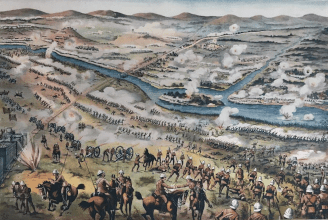
The British cavalry (the 9th Queen’s Royal Lancers and a unit recruited in Cape Town, Rimington’s Guides) make some attempts to scout the ground ahead of the army but fail entirely to detect General Koos de la Rey‘s trenches and other preparations. For example, the Boers had whitewashed stones on the veld or had placed biscuit tins as range markers. At 4:30 a.m. on November 28, Methuen’s force rouses itself, deploys into line and begins advancing toward the Modder River, with no plans other than to cross the river before having breakfast on the far side.
As the British troops come within 1,200 yards of the river, Methuen remarks to Colville, “They’re not here.” Colville replies, “They’re sitting uncommonly tight if they are.” At this point the Boers open fire. Most of the British troops are forced to throw themselves flat. Some try to advance in short rushes but can find no cover on the veld. Few British troops get closer than 1,000 yards to the Boers. The Guards try to outflank the Boer left but are unable to ford the Riet River. The British guns pound the buildings near Modder River Station and the line of poplar trees which mark the north bank of the Modder River, and entirely miss the enemy trenches on the south bank. Meanwhile, the Boer guns maintain a galling fire and are kept in action by repeatedly moving their positions.
The battle becomes a day-long stalemate. Most of the British infantry lay prone on the veld, tortured by heat and thirst, but safe from enemy fire unless they move. Many stoically smoke pipes or even sleep. Methuen gallops about the field trying to renew the advance and is himself wounded. At midday, some of Pole-Carew’s 9th Brigade find the open Boer right flank at Rosmead drift (ford) downstream. British infantry infiltrates across the ford and at about 1:00 p.m. drives the Boers out of Rosmead. The attack is disjointed and suffers casualties when a British field artillery battery which had just arrived on the field shells them by mistake. By nightfall, De la Rey has driven them back into a small insecure bridgehead.
Nevertheless, the Boers fear that they are now vulnerable to being outflanked and withdraw during the night.
Methuen reports that the battle had been “one of the hardest and most trying fights in the annals of the British army.” Although casualties are not cripplingly heavy (between 450 and 480), mainly because the Boers opened fire prematurely, it is clear that any simple frontal attack by infantry only against an enemy using bolt action rifles, is effectively impossible. The British are forced to pause for ten days, to evacuate their casualties, receive further reinforcements and repair their lines of communications. The delay allows the Boers to construct the entrenchments which they are to defend in the Battle of Magersfontein.
On the Boer side, there are about 80 casualties, including, Adriaan, the eldest son of Koos de la Rey, mortally wounded by a shell.
(Pictured: An illustration of the Battle of Modder River during the Second Boer War. This illustration is more dramatic than the actual battle, and is meant to amplify the British side of the war, Bacon’s South Africa War Prints, G. W. Bacon & Co. London)
Orpen is the fourth and youngest son of Arthur Herbert Orpen (1830–1926), a solicitor, and his wife, Anne Caulfield (1834–1912), the eldest daughter of the Right Rev. Charles Caulfield (1804–1862), the Bishop of Nassau. Both his parents are amateur painters, and his eldest brother, Richard Caulfield Orpen, becomes a notable architect. His nieces are Bea Orpen and Kathleen Delap. The historian Goddard Henry Orpen is his second cousin. The family lives at “Oriel,” a large house with extensive grounds containing stables and a tennis court. He appears to have a happy childhood there.
Orpen is a naturally talented painter, and six weeks before his thirteenth birthday is enrolled at the Dublin Metropolitan School of Art. During his six years at the college, he wins every major prize there, plus the British Isles gold medal for life drawing, before leaving to study at the Slade School of Fine Art in London between 1897 and 1899. At the Slade he masters oil painting and begins to experiment with different painting techniques and effects.
While at the Slade, Orpen becomes engaged to Emily Scobel, a model and the subject of his painting The Mirror (1900). She ends their relationship in 1901, and he marries Grace Knewstub, the sister-in-law of Sir William Rothenstein. He and Knewstub have three daughters together, but the marriage is not a happy one. By 1908, he has begun a long-running affair with Evelyn Saint-George, a well-connected American millionairess based in London, with whom he also has a child.
Orpen first exhibits at the New English Art Club (NEAC) in 1899, becoming a member in 1900. In 1901, he holds a solo exhibition at the Carfax Gallery in central London. His portraits, which establish his reputation, show the influence of the Realist artist Édouard Manet. He also becomes known as a painter of group portraits such as Homage to Manet (1909), in which he portrays members of the contemporary English art world sitting in conversation beneath a famous portrait by that artist.
At the start of World War I, a number of Irish people living in England return to Ireland to avoid conscription. Among them is Orpen’s studio assistant and former pupil, Seán Keating. Keating encourages him to do likewise, but he refuses and commits himself to supporting the British war effort. In December 1915, he is commissioned into the Royal Army Service Corps and reports for clerical duty at London’s Kensington Barracks in March 1916. Throughout 1916 he continues painting portraits, most notably one of a despondent Winston Churchill, but soon starts using both his own contacts and those of Evelyn Saint-George, to secure a war artist posting.
He is the official painter of the Paris Peace Conference after World War I. Throughout 1919 he paints individual portraits of the delegates to the Conference and these form the basis of his two large paintings, A Peace Conference at the Quai d’Orsay and The Signing of Peace in the Hall of Mirrors. In both pictures, the architecture overwhelms the gathered politicians and statesmen who’s political wranglings and vainglory diminish them in Orpen’s eyes.
Orpen becomes seriously ill in May 1931, and, after suffering periods of memory loss, dies at the age of 52 on September 29, 1931, in South Kensington, London, of liver and heart failure. He is buried at Putney Vale Cemetery in southwest London. A stone tablet in the Island of Ireland Peace Park Memorial at Mesen, Belgium, commemorates him. He is posthumously regarded as a facile and prolific, but somewhat superficial, artist who nevertheless achieves great popularity in his day.
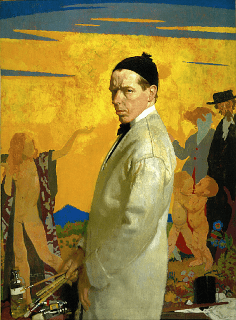
(Pictured: “Self-portrait” (1913), oil on canvas by William Orpen, Saint Louis Art Museum)
O’Kelly is born on August 25, 1882, on Capel Street in the north inner-city of Dublin. He joins the National Library of Ireland in 1898 as a junior assistant. That same year, he joins the Gaelic League, becoming a member of the governing body in 1910 and General Secretary in 1915.
In 1905 O’Kelly joins Sinn Féin who, at the time, supports a dual monarchy. He is an honorary secretary of the party from 1908 until 1925. In 1906 he is elected to Dublin Corporation, which is Dublin’s city council. He retains the seat for the Inns Quay Ward until 1924.
O’Kelly is elected Sinn Féin MP for Dublin College Green in the 1918 Irish general election. Along with other Sinn Féin MPs he refuses to take his seat in the British House of Commons. Instead, they set up an Irish parliament, called Dáil Éireann, in Dublin. O’Kelly is Ceann Comhairle (Chairman) of the First Dáil. He is the Irish Republic’s envoy to the post-World War I peace treaty negotiations at the Palace of Versailles, but the other countries refuse to allow him to speak as they do not recognise the Irish Republic.
O’Kelly is a close friend of Éamon de Valera, and both he and de Valera oppose the Anglo-Irish Treaty of December 1921. When de Valera resigns as President of the Irish Republic on January 6, 1922, O’Kelly returns from Paris to try to persuade de Valera to return to the presidency but de Valera orders him to return to Paris.
During the Irish Civil War, O’Kelly is jailed until December 1923. Afterwards he spends the next two years as a Sinn Féin envoy to the United States.
In 1926 when de Valera leaves Sinn Féin to found his own republican party, Fianna Fáil, O’Kelly follows him, becoming one of the party’s founding members. In 1932, when de Valera is appointed President of the Executive Council of the Irish Free State, he makes O’Kelly the Minister for Local Government and Public Health. He often tries to publicly humiliate the Governor-General of the Irish Free State, James McNeill, which damages O’Kelly’s reputation and image, particularly when the campaign backfires.
In 1938, many believe that de Valera wants to make O’Kelly the Fianna Fáil choice to become President of Ireland, under the new Irish constitution, Bunreacht na hÉireann. When Lord Mayor of Dublin, Alfie Byrne, says he wants to be president there is an all-party agreement to nominate Douglas Hyde, a Protestant Irish Senator, Irish language enthusiast and founder of the Gaelic League. They believe Hyde to be the only person who might win an election against Alfie Byrne. O’Kelly is instead appointed Minister of Finance and helps create Central Bank in 1942.
O’Kelly leaves the cabinet when he is elected President of Ireland on June 18, 1945, in a popular vote of the people, defeating two other candidates. He is re-elected unopposed in 1952. During his second term he visits many nations in Europe and speaks before the United States Congress in 1959. He retires at the end of his second term in 1959, to be replaced by his old friend, Éamon de Valera. Following his retirement, he is described as a model president by the normally hostile newspaper, The Irish Times. Though controversial, he is widely seen as genuine and honest, but tactless.
O’Kelly’s strong Roman Catholic beliefs sometimes cause problems. Éamon de Valera often thinks that O’Kelly either deliberately or accidentally leaks information to the Knights of Saint Columbanus and the Church leaders. He ensures that his first state visit, following the creation of the Republic of Ireland in 1949, is to the Vatican City to meet Pope Pius XII. He accidentally reveals the Pope’s private views on communism. This angers the Pope and Joseph Stalin and is why he is not given the papal Supreme Order of Christ which is given to many Catholic heads of state.
On his retirement O’Kelly gives a series of radio talks about his early life and the independence movement. These form the basis of an account serialised in TheIrish Press (July 3 to August 9, 1961) and subsequently translated into Irish and published as Seán T. (1963), echoing the nickname by which he is commonly known. The book relies heavily on memory and its accuracy on points of detail has been questioned by scholars such as F. X. Martin. In retirement he lived at his home, Roundwood Park in County Wicklow.
O’Kelly dies at the Mater Private Nursing Home in Dublin on November 23, 1966, at the age of 84, fifty years after the Easter Rising that first brought him to prominence. He is buried in Glasnevin Cemetery, Glasnevin, Dublin. His perceived unctuousness and his opportunistic tendencies in his later career should not efface his significance as a separatist organiser and an effective populist politician, who played a major role in the establishment of Fianna Fáil political hegemony.
Needham then holds a staff appointment in Ireland, and during the Irish Rebellion of 1798 commands the crown forces at the Battle of Arklow on June 9, 1798. He places his approximately 1,600 troops in strong positions at the eastern and western ends of the town, where they can sweep the Arklow Rock Road and the Coolgreany Road with fire if the rebels approach along them. Ultimately, this is what the United Irish force, estimated at 5,000–9,000 strong, does, repeatedly attacking Needham’s right flank, which is in fact his strongest position. Estimates of the United Irish dead range from 200 to 1,000, and the failure of the attack ensures that the rebels lose the military initiative. He is also present at the Battle of Vinegar Hill on June 21, 1798, but his force arrives late, leaving a gap in the British line through which many rebels escape. This is later christened “Needham’s gap,” earning him the nickname of “the late General Needham” among his fellow officers.
Promoted to lieutenant-general in 1802, Needham is made colonel of the 5th Royal Veteran Battalion in 1804, entering House of Commons as MP for Newry in 1806. He is made full general in 1812, and, following the death of his two older brothers, succeeds as 12th Viscount Kilmorey in November 1818, resigning his parliamentary seat. On January 12, 1822, he is created 1st Earl of Kilmorey (Queen’s County) and Viscount Newry and Mourne. He dies on November 21, 1832, at the family seat, Shavington Hall, Shropshire, and is buried in St. Peter’s Church, Adderley.
Needham marries Anne Fisher, daughter of Thomas Fisher of Acton, Middlesex, on February 20, 1787. They have two sons, Francis Jack Needham, who succeeds as 2nd Earl, and the Hon. Francis Henry William Needham, lieutenant-colonel in the Grenadier Guards, and seven daughters. There are Needham letters in the Public Record Office (PRO), Kew, and in the Rebellion Papers in the National Archives of Ireland in Dublin.
Thompson is the youngest child of the social historians and peace activists E. P. Thompson and Dorothy Towers. She has lived in Ireland since 1981 and many of her books are set there. She trains racehorses in the UK and United States and travels extensively in India before settling in 1984 in Inagh, County Clare, in the west of Ireland with her partner Conor Minogue. They have two daughters, Cliodhna and Dearbhla. She is an accomplished fiddler with an interest in Irish traditional music, which is reflected in The New Policeman (2005).
MacHale is born in Tubbernavine, near Lahardane, County Mayo on March 6, 1791, to Patrick and Mary Mulkieran MacHale. He is so feeble at birth that he is baptised at home by Father Andrew Conroy. By the time he is five years of age, he begins attending a hedge school. Three important events happen during his childhood: the Irish Rebellion of 1798, the landing at Killala of French troops, whom the boy, hidden in a stacked sheaf of flax, watches marching through a mountain pass to Castlebar, and a few months later the brutal hanging of Father Conroy on a false charge of high treason.
With his friend and ally, Daniel O’Connell, MacHale takes a prominent part in the important question of Catholic emancipation, impeaching in unmeasured terms the severities of the former penal code, which had branded Catholics with the stamp of inferiority. During 1826 his zeal is omnipresent. He calls on the Government to remember how the Act of Union in 1800 was carried by William Pitt the Younger on the distinct assurance and implied promise that Catholic emancipation, which had been denied by the Irish Parliament, should be granted by the Parliament of the Empire.
Oliver Kelly, Archbishop of Tuam, dies in 1834, and the clergy selects MacHale as one of three candidates, to the annoyance of the Government who despatches agents to induce Pope Gregory XVI not to nominate him to the vacant see. Disregarding their request, the pope appoints MacHale Archbishop of Tuam. He is the first prelate since the Reformation who has received his entire education in Ireland. The corrupt practices of general parliamentary elections and the Tithe War cause frequent rioting and bloodshed and are the subjects of denunciation by the new archbishop, until the passing of a Tithes bill in 1838. He also leads the opposition to the ProtestantSecond Reformation, which is being pursued by evangelical clergy in the Church of Ireland, including the Bishop of Tuam, Killala and Achonry, Thomas Plunket.
The repeal of the Acts of Union 1800, advocated by O’Connell, enlists MacHale’s ardent sympathy and he assists the Liberator in many ways, and remits subscriptions from his priests for this purpose. In his zeal for the cause of the Catholic religion and of Ireland, so long downtrodden, but not in the 1830s, he frequently incurs from his opponents the charge of intemperate language, something not altogether undeserved. In his anxiety to reform abuses and to secure the welfare of Ireland, by an uncompromising and impetuous zeal, he makes many bitter and unrelenting enemies, particularly British ministers and their supporters.
The Great Famine of 1846–47 affects his diocese more than any. In the first year he announces in a sermon that the famine is a divine punishment on his flock for their sins. Then by 1846 he warns the Government as to the state of Ireland, reproaches them for their dilatoriness, and holds up the uselessness of relief works. From England as well as other parts of the world, cargoes of food are sent to the starving Irish. Bread and soup are distributed from the archbishop’s kitchen. Donations sent to him are acknowledged, accounted for, and disbursed by his clergy among the victims.
The death of O’Connell in 1847 is a setback to MacHale as are the subsequent disagreements within the Repeal Association. He strongly advises against the violence of Young Ireland. Over the next 30 years he becomes involved in political matters, particularly those involving the church. Toward the end of his life, he becomes less active in politics.
MacHale attends the First Vatican Council in 1869. He believes that the favourable moment has not arrived for an immediate definition of the dogma of papal infallibility. Better to leave it a matter of faith, not written down, and consequently he speaks and votes in the council against its promulgation. Once the dogma had been defined, he declares the dogma of infallibility “to be true Catholic doctrine, which he believed as he believed the Apostles’ Creed“. In 1877, to the disappointment of the archbishop who desires that his nephew should be his co-adjutor, Dr. John McEvilly, Bishop of Galway, is elected by the clergy of the archdiocese, and is commanded by Pope Leo XIII after some delay, to assume his post. He had opposed this election as far as possible but submits to the papal order.
Every Sunday MacHale preaches a sermon in Irish at the cathedral, and during his diocesan visitations he always addresses the people in their native tongue, which is still largely used in his diocese. On journeys he usually converses in Irish with his attendant chaplain and has to use it to address people of Tuam or the beggars who greet him whenever he goes out. He preaches his last Irish sermon after his Sunday Mass, April 1881. He dies in Tuam seven months later, on November 7, 1881, and is buried in the cathedral at Tuam on November 15.




 seamus dubhghaill