seamus dubhghaill

Promoting Irish Culture and History from Little Rock, Arkansas, USA


Leave a comment

Death of David Sheehy, Irish Nationalist Politician

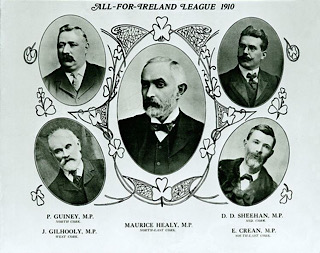
David SheehyIrish nationalist politician, dies in Dublin on December 17, 1932. He is a member of parliament (MP) from 1885 to 1900 and from 1903 to 1918, taking his seat as a member of the Irish Parliamentary Party (IPP) in the House of Commons of the United Kingdom of Great Britain and Ireland.

Born in Limerick in 1844, Sheehy is the son of Richard Sheehy and Johanna Shea, and is the brother of Mary Sheehy and Fr. Eugene Sheehy. He is a student for the priesthood at the Irish College in Paris, but leaves due to a cholera epidemic and later marries Bessie McCoy. In his youth he is a member of the Irish Republican Brotherhood (IRB) and is active in the Irish National Land League. He is imprisoned on six occasions for his part in the Land War.

At the 1885 United Kingdom general election in Ireland, Sheehy is elected unopposed as MP for South Galway and holds that seat until the 1900 United Kingdom general election in Ireland. His re-election in Galway is unopposed in 1886 and 1895. When the Irish Party splits over the leadership of Charles Stewart Parnell, he joins the anti-Parnellite Irish National Federation majority. At the 1892 United Kingdom general election in Ireland, he is opposed by a Parnellite Irish National League candidate, whom he defeats with a majority of nearly two to one. In the same election he stands in Waterford City, but fails to unseat the Parnellite John Redmond.

The two factions of the Irish Parliamentary Party reunite for the general election in 1900, but Sheehy does not stand again and is out of parliament for the next three years. After the death in August 1903 of James Laurence Carew, the Independent Nationalist MP for South Meath, he is selected as the Irish Parliamentary Party candidate in the resulting by-election in October 1903. Carew had allegedly been elected in 1900 as a result of a series of errors in nominations, and his predecessor John Howard Parnell stands again, this time as an Independent Nationalist. Sheehy wins with a majority of more than two to one, and holds the seat until he stands down at the 1918 United Kingdom general election in Ireland.

Sheehy and his wife, Bessie, have seven children, of whom six survive to adulthood. One of his daughters, Mary (born 1884), marries the MP Tom Kettle and has one daughter, Betty (1913–1996). Hanna (born 1877), becomes a teacher and marries the writer Francis Skeffington. They have one son, Owen, who is seven years old when his father is murdered by the Captain Bowen-Colthurst in Portobello BarracksRathmines, during the 1916 Easter Rising. Kathleen marries Freeman’s Journal and Irish Independent journalist Frank Cruise O’Brien. The contrarian politician and writer Conor Cruise O’Brien is their son. Margaret (born 1879), an elocutionist, actress and playwright, marries solicitor Frank Culhane. They have four children. After his death she marries her godson, the poet Michael Casey. Sheehy’s two sons, Richard and Eugene, are barristers.

The writer James Joyce, who lives nearby as a youth, often visits the family home, 2 Belvedere Place, where musical evenings and theatricals take place every Sunday evening. Joyce entertains the family with Italian songs. In 1900, Margaret writes a play in which the Sheehys and their friends, including Joyce, act. Joyce takes a particular liking to Eugene and has a long-lasting but unrequited crush on Mary. Joyce’s novel Ulysses wittily describes an encounter between Sheehy’s wife, Bessie, and Father John Conmee, SJ, rector of Clongowes Wood College. Their daughter Mary is the spéirbhean longingly pursued by the protagonist in the story “Araby” in Joyce’s collection Dubliners. Another daughter, Kathleen, is possibly the model for the mockingly nationalist Miss Ivors in the story “The Dead“, which concludes Dubliners.

When Sheehy dies at the age of 88 in Dublin on December 17, 1932, it is reported that he has been the oldest surviving member of the Irish Parliamentary Party.


Leave a comment

Death of Sir William Moore, Member of Parliament & Judge

Sir William Moore, 1st BaronetPC (NI)DL, a Unionist member of the British House of Commons from Ireland and a Judge of Ireland, and subsequently of Northern Ireland, dies in Ballymoney, County Antrim, Northern Ireland, on November 28, 1944. He is created a Baronet of Moore Lodge, Ballymoney, in 1932.

Moore is the eldest son of Queen Victoria‘s honorary physician in Ireland, Dr. William Moore of Rosnashane, Ballymoney, and Sidney Blanche Fuller. His ancestors came to Ulster during the Plantation of Ulster, settling at Ballymoney, at which time they were Quakers. The Moore Lodge estate is inherited from a relative. The family owns several other houses: Moore’s Grove and Moore’s Fort. He goes on to become a Deputy Lieutenant for County Antrim and a Justice of the Peace.

Moore is schooled at Marlborough College, then attends Trinity College Dublin (TCD), where he is president of the University Philosophical Society. He marries Helen Gertrude Wilson, the daughter of a Deputy Lieutenant of County Armagh, in 1888. The marriage produces three children. His eldest son, William, inherits his title on his father’s death.

Moore is called to the Irish Bar in 1887, to the English bar in 1899, and becomes an Irish Queen’s Counsel the same year.

In 1903, Moore is one of the first landowners of Ireland to sell off their estates under the land acts. By the early 1920s he owns a Belfast pied-à-terre called “Glassnabreedon,” in the village of Whitehouse, four miles north of Belfast. This house is once owned by the son of Nicholas Grimshaw, Ireland’s first cotton pioneer.

Moore becomes a member of the General Synod of the Church of Ireland and is a founder member of the Ulster Council. He is a passionate Orangeman: his vehemence in defending Ulster’s right to oppose Irish Home Rule is said to alarm even those who share his views. Speaking in England on March 10, 1913, he makes his feelings clear on the possibility of Irish Home Rule: “I have no doubt, if Home Rule is carried, its baptism in Ireland will be a baptism in blood.” He shows little respect for English politicians, and has nothing but contempt for Southern Unionists. The eventual political settlement in 1921 meets with his approval.

Moore is a Member of Parliament, representing North Antrim from 1899 to 1906. From 1903 to 1904, he is an unpaid secretary to the Chief Secretary for Ireland. Having lost his Parliamentary seat in the 1906 United Kingdom general election, he is elected for North Armagh at the 1906 North Armagh by-election in November. He sits for this seat until he is appointed a judge of Ireland’s High Court.

Moore is a Justice of the High Court from 1917 to 1921. He is sworn of the Privy Council of Ireland in the 1921 Birthday Honours, entitling him to the style “The Right .” Following the partition of Ireland, he becomes a Lord Justice of Appeal in the Northern Irish Court of Appeal (1921–25). He is sworn of the Privy Council of Northern Ireland in 1922 and becomes the Lord Chief Justice of Northern Ireland, succeeding Sir Denis Henry. He holds the position until he retires in 1937.

Moore dies at his home, Moore Lodge, in Ballymoney on November 28, 1944, less than a week after his 80th birthday. He is buried in the family burial ground, “Lamb’s Fold,” two days later.


Leave a comment

Birth of Reginald Greville-Nugent, Politician

The Honourable Reginald James Macartney Greville-Nugent, an Irish politician, is born on November 27, 1848.

Greville-Nugent is the youngest of five sons born to the former Lady Rosa Nugent and Fulke Greville-Nugent, 1st Baron Greville. His brothers are Hon. Algernon Greville-Nugent (who marries Lady Beatrice Violet Graham, a daughter of James Graham, 4th Duke of Montrose), Hon. George Greville-Nugent MP (who marries Cecil Aitcheson Hankey, a daughter of Lt. Gen. Henry Aitchison Hankey), Hon. Robert Southwell Greville-Nugent (who dies unmarried), and Hon. Patrick Greville-Nugent, of Clonyn Castle, the High Sheriff of Westmeath (who marries Ermengarde Ogilvy). His sister is Hon. Mildred Charlotte Greville-Nugent, who marries Alexis Huchet, Marquis de la Bedoyére.

Greville-Nugent’s mother is the only daughter and heir of George Nugent, 1st Marquess of Westmeath and, his first wife, Lady Emily Cecil (second daughter of James Cecil, 1st Marquess of Salisbury). His paternal grandparents are Algernon Greville, of North Lodge in Hertford and the former Caroline Graham (daughter of Sir Bellingham Graham, 6th Baronet).

Greville-Nugent holds the Irish parliamentary seat of Longford, vacated by his father on his elevation to the peerage, from December 31, 1869, defeating John Martin. He has to relinquish the seat in May 1870 due to Judge Fitzgerald overturning the election result on the grounds of voting irregularities.

On October 21, 1871, Greville-Nugent is married to Louisa Maud Yarde-Buller, sister of John Yarde-Buller, 1st Baron Churston, and daughter of Sir Francis Buller-Yarde-Buller, 2nd Baronet.

Greville-Nugent is killed on February 28, 1878, after a fall in a steeplechase at Sandown Park Racecourse.

Greville-Nugent’s illegitimate son, Reginald Charles Fulke Greville, born August 19, 1866, is better known after changing his surname to Maugham (following a close friendship with the writer W. Somerset Maugham‘s great-aunt Julia) as the author of numerous books about Africa, and his most well-known work, Jersey under the Jack Boot.


Leave a comment

Birth of Sir Anthony Babington, Barrister, Judge & Politician

Sir Anthony Brutus Babington PC (NI)Anglo-Irish barristerjudge and politician, is born on November 24, 1877, at Creevagh House, County Londonderry, to Hume Babington JP, son of Rev. Hume Babington and a landowner of 1,540 acres, and Hester (née Watt), sister of Andrew Alexander Watt.

Babington is born into the Anglo-Irish Babington family that arrives in Ireland in 1610 when Brutus Babington is appointed Bishop of Derry. Notable relations include Robert BabingtonWilliam BabingtonBenjamin Guy Babington and James Melville Babington and author Anthony Babington.

Babington is educated at Glenalmond SchoolPerthshire, and Trinity College, Dublin, where he wins the Gold Medal for Oratory of the College Historical Society in 1899.

Babington is called to the Irish Bar in 1900. He briefly lectures in Equity at King’s Inns, and it is during this time, in 1910, that he re-arranges and re-writes R.E. Osborne’s Jurisdiction and Practice of County Courts in Ireland in Equity and Probate Matters. He takes silk in 1917.

Babington moves to the newly established Northern Ireland in 1921 and practises as a barrister until his election to the House of Commons of Northern Ireland as the Ulster Unionist Party member for Belfast South in the 1925 Northern Ireland general election and subsequent appointment as Attorney General for Northern Ireland the same year in the cabinet of James Craig, 1st Viscount Craigavon. His appointment to the Privy Council of Northern Ireland in 1926 entitles him to the style “The Right Honourable.” From 1929 he is the MP for Belfast Cromac, the Belfast South constituency having been abolished. He is made an honorary bencher of the Middle Temple in 1930.

Babington resigns from politics in 1937 upon his appointment as a Lord Justice of Appeal and is knighted in the 1937 Coronation Honours.

In 1947, Babington chairs the Babington Agricultural Enquiry Committee, named in his honour, which is established in 1943 to examine agriculture in Northern Ireland. The committee’s first recommendation under Babington’s leadership is that Northern Ireland should direct all its energies to the production of livestock and livestock products and to their efficient processing and marketing.

Babington retires from the judiciary in 1949, taking up the chairmanship of the Northern Ireland Transport Tribunal, which exists until 1967, established under the Ulster Transport Act – promoting a car-centred transport policy – and which is largely responsible for the closure of the Belfast and County Down Railway. He endorses the closure on financial grounds and is at cross purposes with his co-chair, Dr. James Beddy, who advises against the closure, citing the disruption of life in the border region between the north and the south as his primary reason in addition to financial grounds.

Babington also chairs a government inquiry into the licensing of clubs, the proceeds of which results in new regulatory legislation at Stormont. While Attorney General, he is a proponent of renaming Northern Ireland as “Ulster.”

Babington is critical of the newly proposed Irish constitution, in which the name of the Irish state is changed to “Ireland,” laying claim to jurisdiction over Northern Ireland.

Michael McDunphy, Secretary to the President of Ireland, then Douglas Hyde, recalls Ernest Alton‘s correspondence with Babington on the question of Irish unity, in which Alton and Babington are revealed to be at cross purposes. The discussion is used as an example by Brian Murphy, in Forgotten Patriot: Douglas Hyde and the Foundation of the Irish Presidency, as an example of the office of the Irish President becoming embroiled in an initiative involving Trinity College Dublin and a senior Northern Ireland legal figure, namely Babington. 

Babington writes to Alton, then Provost of Trinity College, Dublin, expressing his view that, as Murphy summarises, “… Severance between the two parts of Ireland could not continue, that it was the duty of all Irishmen to work for early unification and that in his opinion Trinity College was a very appropriate place in which the first move should be made.” When Alton arrives to meet with Hyde, it emerges, after conversing with Hyde’s secretary McDunphy, that he and Babington are at cross purposes. “It soon became clear that the united Ireland contemplated by Mr. [sic] Justice Babington of the Northern Ireland Judiciary was one within the framework of the British Commonwealth of Nations, involving recognition of the King of England as the Supreme Head, or as Dr. Alton put it, the symbol of unity of the whole system,” writes McDunphy.

On September 5, 1907, Babington marries Ethel Vaughan Hart, daughter of George Vaughan Hart of Howth, County Dublin (the son of Sir Andrew Searle Hart) and his wife Mary Elizabeth Hone, a scion of the Hone family. They have three children.

Babington is a member of the Apprentice Boys of Derry. From 1926 to 1952, he is a member of the board of governors of the Belfast Royal Academy. He serves as warden (chairman) of the board from 1941 to 1943. Through his efforts the school acquires the Castle Grounds from Anthony Ashley-Cooper, 9th Earl of Shaftesbury in 1934.

Babington is a keen golfer. He is an international golfer from 1903 to 1913, during which he is runner-up in the Irish Amateur Golf Championships in 1909 and one of the Irish representatives at an international match in 1913. The Babington Room in the Royal Portrush Golf Club is named after him, as is the 18th hole on the course as a result of the key role he plays in shaping its history.

Babington dies at the age of 94 on April 10, 1972 at his home, Creevagh, Portrush, County Antrim.


Leave a comment

Death of Rory Maguire, Politician & Soldier

Colonel Rory Maguire, Irish politician and soldier, is killed while leading an attack on a fortress at Jamestown, County Leitrim, on November 13, 1648. He is a leading instigator of the Irish Rebellion of 1641 and subsequently participates in the Irish Confederate Wars as a senior Confederate commander.

Maguire is the second son of Bryan Maguire, 1st Baron of Enniskillen and Rose, daughter of Art MacBaron O’Neill. In 1639, he is elected as the Member of Parliament for County Fermanagh in the Irish House of Commons. He receives a commission in Charles I of England‘s Irish army in 1640. In May 1640, he marries Deborah, widow of Sir Leonard Blennerhassett and daughter of Sir Henry Mervyn. Their son is the Jacobite politician, Roger Maguire, who later claims the title Baron Maguire. Through his marriage to Deborah, Maguire becomes the owner of Crevenish Castle.

Alongside his older brother, Connor Maguire, Maguire is a prime mover in the conspiracy which leads to the outbreak of rebellion in Ireland on October 23, 1641. He is tasked with securing County Fermanagh for the rebels, but is only partially successful, with several key fortresses in the county, including Enniskillen Castle, remaining under Protestant settler control. His attempt to murder Sir William Cole immediately prior to the rising fails, but the landowner Arthur Champion is killed in one of the first actions of the rebellion. In November 1641, he joins Felim O’Neill of Kinard at Newry to issue a proclamation in which the rebels claim they are acting in defence of King Charles and Catholicism. In December 1641, the Fermanagh army under Maguire slaughters many of the garrison and refugees in Tully Castle, apparently in retaliation for the killing of the garrison of a Maguire castle which had been taken by assault some days previously. He also destroys Castle Archdale and its neighbouring settler village, and kills eight Protestant settlers at Monea Castle. In early 1642, he is expelled from the Irish Parliament and in the summer of the same year he is made a colonel in Owen Roe O’Neill‘s army in Ulster.

Maguire is appointed Governor of Fermanagh by the authorities of the newly established Confederate Ireland. He commands the rebel reserve in the Battle of Benburb in June 1646. He leads raids into Protestant-held areas in east Ulster, before joining O’Neill in his campaigns in Leinster in the autumn of 1646. Later that year, he raids lands in Connacht controlled by the Royalist commander, Ulick Burke, 1st Marquess of Clanricarde. In August 1647, O’Neill and Maguire move the army to Leinster, where Maguire quarrels so vigorously with O’Neill over the payment of troops that the general orders his arrest and court-martials him. After the court-martial, Maguire and his supporters, about five or six regiments, draw up their forces and threaten to desert. The mutiny soon dissipates and Maguire remains allied to O’Neill.

In 1648, Maguire joins O’Neill in opposing the truce between the Confederates and Royalists. He plays a prominent role in the skirmishes and evasive manoeuvrings that occur between the two sides in central Ireland. In the winter of 1648, Maguire withdraws north and on November 13 he is killed while leading an attack on a fortress near Jamestown, County Leitrim.


Leave a comment

Death of William FitzGerald, 2nd Duke of Leinster

William Robert FitzGerald, 2nd Duke of LeinsterKPPC (Ire), an Irish liberal politician and landowner, dies at Carton House in Maynooth, County Kildare, on October 20, 1804.

FitzGerald is born on March 13, 1749, in Arlington Place, Piccadilly, London, the second son of nine sons and ten daughters of James Fitzgerald, 20th Earl of Kildare and later 1st Duke of Leinster, and his wife, Lady Emily Lennox. He is educated at Eton College (1758–63). He is the elder brother of the 1790s revolutionary Lord Edward FitzGerald, and is a first cousin of the English liberal politician Charles James Fox.

FitzGerald makes his Grand Tour between 1768 and 1769. During the same time, he is also a Member of Parliament (MP) for Kildare Borough. He then sits in the Irish House of Commons for Dublin City until 1773, when he inherits his father’s title and estates. He is appointed High Sheriff of Kildare for 1772. Politically he is a liberal supporter of Henry Grattan‘s Irish Patriot Party and he co-founds the Irish Whig Club in 1789. He controls about six Kildare members of the Irish House of Commons. In 1779, he is elected colonel of the Dublin Regiment of the Irish Volunteers.

In November 1775, FitzGerald marries Emilia Olivia Usher, daughter of the 1st Baron Saint George and Elizabeth Dominick and sole grand daughter of Sir Christopher Dominick. They have three sons and six daughters.

In 1770, FitzGerald is chosen Grandmaster of the masonic Grand Lodge of Ireland, a post he holds for two years. He is re-elected for another year in 1777. In 1783, he is among the first knights in the newly created Order of St. Patrick.

In 1788–89, FitzGerald is Master of the Rolls in Ireland. In theory a senior judicial office, it is then largely a sinecure, but so blatant a choice of a man who is wholly unqualified for it gives rise to unfavourable comment, and a few years later it becomes the rule that the Master must be a lawyer of repute.

FitzGerald is a supporter of Catholic emancipation and helps to found the Royal College of St. Patrick at Maynooth on land he donates, in 1795. Withdrawing from Parliament with Grattan in 1797, he moves to England to be with his sick wife and remains there during the Irish Rebellion of 1798.

FitzGerald’s homes are at Carton and Kilkea Castle in County Kildare, and at Leinster House in Dublin (now the home of the Oireachtas). He is a founder member of the Order of St. Patrick in 1783 and of the Royal Irish Academy in 1785, and is a large investor in the Royal Canal company launched in 1790. His family’s estates of 60,000 acres (25,000 Ha) in Kildare are in three main parts, around Maynooth, Rathangan and Athy. He rebuilds the main bridge in Athy over the River Barrow.

FitzGerald dies of strangury, a urinary tract disorder, at Carton House on October 20, 1804. He is buried in Kildare Abbey. His funeral is so well attended that the mourners reach across The Curragh. He is succeeded by his second, but eldest surviving, son, Augustus Frederick Fitzgerald, as 3rd Duke of Leinster.


Leave a comment

Birth of Sir Arthur Rawdon, Soldier & Horticulturist

Sir Arthur Rawdon, 2nd Baronet, soldier, and horticulturalist, is born on October 17, 1662. He builds a large part of Moira, County Down in the seventeenth century. Known as the “Father of Irish Gardening” and “The Cock of the North,” he is a keen botanist, and brings over 400 different species of plants to Moira from Jamaica.

Rawdon plays an active role in the Williamite War in Ireland. Following the Glorious Revolution he is involved in the raising of the Army of the North, a Protestant force opposed to the Jacobite Irish Army.

Rawdon’s father is Sir George Rawdon, 1st Baronet. His mother is George’s second wife, Dorothy, daughter of Edward Conway, 2nd Viscount Conway. He is a Member of Parliament for County Down, and a general in the army of King William III of England. Besieged at Derry, he falls ill, but manages to escape, though his military career is at an end.

Rawdon marries Ellen Graham, daughter of Sir James Graham of Congleton in Cheshire. They have at least two children, John and Isabella.

Rawdon inherits the lands at Moira after his father dies. He rebuilds a mansion, surrounded by trees, sheep and huge gardens. On this estate, he builds the first hothouse in Europe.

Rawdon is a botanist and imports 400 plant species from Jamaica, earning the name “Father of Irish Gardening.” His garden has a labyrinth, ponds, and canals. The trees include the “Locust of Virginia” which is 30 feet high and has a trunk of at least a foot and a half in diameter. For two generations the garden is maintained.

Rawdon dies on October 17, 1695, his thirty-third birthday, and John succeeds to the baronetcy and estate as a minor. The plant collections, perhaps inevitably, decline after his death, though his wife and sisters share his interest in natural history. Some of his plant specimens are still preserved in Hans Sloane‘s herbarium in the Natural History Museum, London.

Today in Moira many places are named after Sir Arthur Rawdon, including Rawdon Court, off Main Street. Off Meeting Street there is Rawdon Place which is a housing street. Parts of the remains of his mansion are still visible.


Leave a comment

Death of Ulick O’Connor, Writer, Historian & Critic

Ulick O’Connor, Irish writer, historian and critic, dies on October 7, 2019, in Rathgar, County Dublin.

Born in Rathgar on October 12, 1928, to Matthew O’Connor, the Dean of the Royal College of Surgeons, O’Connor attends Garbally CollegeBallinasloeSt. Mary’s College, Rathmines, and later University College Dublin (UCD), where he studies law and philosophy, becoming known as a keen sporting participant, especially in boxingrugby and cricket, as well as a distinguished debater. During his time at UCD he is an active member of the Literary and Historical Society. He subsequently studies at Loyola University, New Orleans. He was called to the bar in 1951.

After practising at the Irish Bar in Dublin, O’Connor spends time as a critic before turning to writing. His work spans areas such as biographypoetryIrish historydrama, diary, and literary criticism. He is a sports correspondent for The Observer from 1955 to 1961.

O’Connor is a well-known intellectual figure in contemporary Irish affairs and expresses strong opinions against censorship and the war on drugs. He contributes a regular poetry column to the Irish daily, the Evening Herald, also writes a column for the Sunday Mirror and a sporting column for The Sunday Times, as well as broadcasting on RTÉ.

O’Connor’s best-known writing is his biographies of Oliver St. John GogartyBrendan Behan, his studies of the early 20th-century Irish troubles and the Irish Literary Revival.

O’Connor is also known for the autobiographical The Ulick O’Connor Diaries 1970-1981: A Cavalier Irishman (2001), which details his encounters with well-known Irish and international figures, ranging from political (Jack Lynch and Paddy Devlin) to the artistic (Christy Brown and Peter Sellers). It also documents the progress of the Northern Ireland peace process during the same time, and the progress of the Northern Ireland Assembly. Although he travels extensively, he lives in his parental home in Dublin’s Rathgar. He is a member of Aosdána.

O’Connor’s great-grandfather is Matthew HarrisLand LeaguerFenian, and Irish Parliamentary Party (IPP) Member of Parliament. He is related to American actor Carroll O’Connor. He dies in Rathgar on October 7, 2019, five days short of his 91st birthday. He is buried at Dean’s Grange Cemetery, Deansgrange, County Dublin.


Leave a comment

Birth of Lord Henry FitzGerald, Diplomat & Soldier

Lord Henry FitzGeraldPC (Ire), diplomat, soldier, and younger brother of revolutionary Lord Edward FitzGerald, is born on July 30, 1761. He is the fourth son among nine sons and ten daughters of James FitzGerald, 1st Duke of Leinster, and Emily FitzGerald, Duchess of Leinster (née Lady Emily Lennox).

FitzGerald joins the British Army and becomes a lieutenant in the 66th (Berkshire) Regiment of Foot in 1788, transferring as a captain in 1779 to the newly raised 85th Regiment of Foot (Westminster Volunteers), which is posted to garrison duty in Jamaica for the duration of the American Revolutionary War. He is there promoted to major in 1781 and lieutenant colonel in 1783, taking over command of the regiment from General Charles Stanhope, 3rd Earl of Harrington. After the 85th is disbanded in 1783 he becomes a captain and lieutenant colonel in the 2nd Foot Guards in 1789 and retires from active service in 1792.

FitzGerald is a Member of Parliament (MP) for Kildare Borough between 1783 and 1790 and represents Athy between 1790 and 1791. From 1790 to 1798, he sits in the Irish House of Commons for Dublin City. On July 8, 1806, he is appointed to the Privy Council of Ireland, and from 1807 until 1814, he serves in the Parliament of the United Kingdom for Kildare. He also holds the position of one of the joint Postmasters General of Ireland from April 1806 until May 1807.

FitzGerald is a member of the Kildare Street Club in Dublin. He dies at Boyle FarmThames Ditton, Surrey, England, on July 9, 1829. He is buried at St. Mary’s Paddington Green Churchyard, PaddingtonCity of WestminsterGreater London, England

FitzGerald marries Charlotte Boyle Walsingham in London on August 3, 1791. Together they live at Boyle Farm, Thames Ditton. In 1806, his wife succeeds to the Baron de Ros, the premier baron in the Peerage of England, as 20th Baroness de Ros. The family then takes the surname FitzGerald-de Ros. The couple has 13 children in 21 years, of which nine survive to adulthood.


Leave a comment

Birth of James Kilfedder, Northern Ireland Unionist Politician

Sir James Alexander Kilfedder, Northern Irish unionist politician usually known as Sir Jim Kilfedder, is born on July 16, 1928, in KinloughCounty Leitrim, in what is then the Irish Free State. He is the last unionist to represent Belfast West in the House of Commons.

Kilfedder’s family later moves to Enniskillen in neighbouring County Fermanagh in Northern Ireland, where he is raised. He is educated at Portora Royal School in Enniskillen and at Trinity College, Dublin (TCD). During his time at TCD, he acts as Auditor of the College Historical Society (CHS), one of the oldest undergraduate debating societies in the world. He becomes a barrister, called to the Irish Bar at King’s Inns, Dublin, in 1952 and to the English Bar at Gray’s Inn in 1958. He practises law in London.

At the 1964 United Kingdom general election, Kilfedder is elected as an Ulster Unionist Party (UUP) Member of Parliament for Belfast West. During the campaign, there are riots in Divis Street when the Royal Ulster Constabulary(RUC) remove an Irish flag from the Sinn Féin offices of Billy McMillen. This follows a complaint by Kilfedder in the form of a telegram to the Minister of Home Affairs, Brian McConnell. It reads, “Remove tricolour in Divis Street which is aimed to provoke and insult loyalists of Belfast.” Kilfedder loses his seat at the 1966 United Kingdom general election to Gerry Fitt. He is elected again in the 1970 United Kingdom general election for North Down, and holds the seat until his death in 1995.

Kilfedder is elected for North Down in the 1973 Northern Ireland Assembly election, signing Brian Faulkner‘s pledge to support the White Paper which eventually establishes the Sunningdale Agreement, but becoming an anti-White Paper Unionist after the election. In 1975, he stands for the same constituency in the Northern Ireland Constitutional Convention election, polling over three quotas as a UUP member of the United Ulster Unionist Council (UUUC) although he refuses to sign the UUUC’s pledge of conduct.

Kilfedder leaves the UUP in 1977 in opposition to the party’s policies tending to integrationism, preferring to advocate the restoration of the Stormont administration. For a time he sits as an “Independent Ulster Unionist.” He contests the 1979 European Parliament election under that label, finishing fourth in the count for the three seats, having overtaken the UUP leader Harry West on transfers.

In 1980, Kilfedder forms the Ulster Popular Unionist Party (UPUP) and is re-elected under that label in all subsequent elections. He again tops the poll in the 1982 Northern Ireland Assembly election and is elected as Speaker of the Assembly, serving in the position until 1986. He generally takes the Conservative whip at Westminster. While Speaker, he is paid more than the Prime Minister.

On March 20, 1995, while traveling by train into London from Gatwick Airport, Kilfedder dies of a heart attack. This is the same day that the Belfast Telegraph carries a front-page story saying that an Ulster MP has been targeted as one of twenty MPs invited by the LGBT rights organisation OutRage! in a letter to come out. He dies unmarried and is survived by two sisters.

Kilfedder is described by Democratic Unionist Party MLA Peter Weir as “the best MP North Down ever had.”

The UPUP does not outlive Kilfedder, and the by-election for his Commons seat is won by Robert McCartney, standing for the UK Unionist Party (UKUP). McCartney had fought the seat in the 1987 United Kingdom general election as a “Real Unionist” with the backing of the Campaign for Equal Citizenship. At the 1987 election count, in his victory speech, Kilfedder “attacked his rival’s supporters as ‘a rag tag collection of people who shame the name of civil rights.’ He said they included communists, Protestant paramilitaries and Gay Rights supporters and he promised to expose more in future.” McCartney loses North Down in 2001 to Sylvia Hermon of the UUP.

Kilfedder’s personal and political papers (including constituency affairs) are held at the Public Record Office of Northern Ireland, reference D4127.

Kilfedder is buried in Roselawn Cemetery in East Belfast.