seamus dubhghaill

Promoting Irish Culture and History from Little Rock, Arkansas, USA


Leave a comment

IRA Assassination of MP Robert Bradford

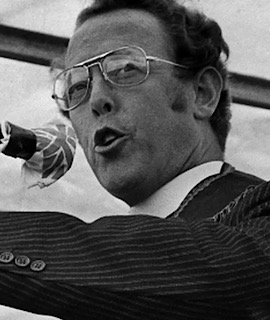
The Rev. Robert J. Bradford, an Ulster Unionist Member of Parliament (MP) for the Belfast South constituency in Northern Ireland, is killed by Provisional Irish Republican Army gunmen on the morning of November 14, 1981, as he sits talking with constituents in a Belfast community center.

The gunmen, who are wearing workmen’s overalls, escape in a car afterward, killing Ken Campbell, a caretaker, as they leave. The people with whom Bradford had been meeting, most of them elderly, dive under tables for cover, and dozens of teenagers dancing nearby break into hysterical tears, but there are no injuries.

The killing is part of an escalation of IRA violence, both in London and in Northern Ireland, after the collapse of the prison hunger strike the previous month. The previous night an IRA bomb damages the London home of Britain’s Attorney General for Northern Ireland, Michael Havers. The home is empty and no one is seriously injured.

Bradford, a 40-year-old Methodist minister who is married and has a 6-year-old daughter, is shot several times, according to witnesses, and he dies almost immediately. His brother, Roy, who lives near the scene of the killing, in South Belfast, is at his side within moments. “But he was unconscious when I reached him, and he only lived for about a minute,” Roy Bradford says. News of the killing arouses fears of a Protestant reaction that could lead to serious civil unrest in Northern Ireland.

John “Jack” Hermon, the Chief Constable of the Royal Ulster Constabulary, issues an appeal to both the Protestant majority and the Roman Catholics to show “good sense and restraint.” He says security is being tightened in the province as a precautionary measure. He orders a wide-ranging search for the gunmen, who number at least three and possibly four, a point upon which the witnesses differ.

Bradford, who has been in Parliament since 1974, is an outspoken critic of the Irish nationalist guerrillas. He repeatedly calls for the reimposition of capital punishment in the province and for other strong deterrent measures.

With the Rev. Ian Paisley, another hard-line Member of Parliament, Bradford had planned to visit the United States In early 1982 to counteract the publicity of the IRA, which depends heavily on the money it receives from its American sympathizers. “There is a need for Americans to recognize that Ulster is not an occupied country,” Bradford says the previous month, “and that our political history is one of which we can be proud.”

The IRA, in a statement claiming responsibility for the killing, calls Bradford “one of the key people responsible for winding up the loyalist paramilitary sectarian machine in the North.” All twelve of Northern Ireland’s Members of Parliament – ten Protestants and two Catholics – are considered likely targets in the sectarian struggle that has claimed 2,100 lives in the province since 1969.

In a statement expressing shock and sympathy, Prime Minister of the United Kingdom Margaret Thatcher says, “We shall pursue with utmost vigor those who committed this wicked act.”

(From: “I.R.A. Gunmen Slay a Protestant M.P.” by William Borders, The New York Times, http://www.nytimes.com, November 15, 1981)


Leave a comment

Death of Wilhelmina Geddes, Stained Glass Artist

Wilhelmina Geddes, Irish stained glass artist who is an important figure within the Irish Arts and Crafts movement and also the twentieth-century British stained glass revival, dies in London, England, on August 10, 1955. Her notable works include windows at St. Bartholomew’s Anglican Church (Ottawa, Canada), St. Peter’s Church (LampeterWales), and the King Albert Memorial Window, St. Martin’s Cathedral (Ypres, Belgium).

Geddes is born on her maternal grandparent’s farm at Drumreilly Cottage in Leitrim, County Leitrim, on May 25, 1887. She is the eldest of four children, three girls and a boy, of William Geddes and his wife Eliza Jane Stafford. The family, who migrates to Ireland from Scotland, has mainly been farmers. Her father, a Methodist, who is born near his father’s farm at TandrageeCounty Armagh, emigrates to the United States as a young man, working as a labourer for the railway construction business. This serves a useful purpose as he had worked as a site engineer at the Cavan, Leitrim and Roscommon Railway Company. When she is still an infant her parents move to their native home in Belfast, so her father can set up in business as a building contractor.

Geddes begins drawing subjects from life and nature from the age of four. She learns first how to draw from the school mistress in Ayrshire, where her father occasionally goes shooting. She begins her studies at Methodist College Belfast along with her three younger sisters. She later moves to the Belfast School of Art. She is encouraged by Rosamond Praeger, a sculptor from County Down, to continue with her studies. She is accepted as a student to study at the Belfast School of ArtUlster University. This is where she adapts and improves her style and is introduced to a professional standard of art work.

While still studying at the Belfast School of Art, Geddes takes part in the Arts and Crafts Society of Ireland‘s fourth exhibition. For this exhibition, she contributes a glowingly coloured illustration of the book Cinderella Dressing the Ugly Sister (Dublin City Gallery), which she had created. It is at this exhibition that her work is spotted by Sarah Purser, a well established painter seeking newly trained students to introduce to stained glass artistry. Purser, who goes on to be her lifelong mentor, invites the young Geddes to join her in Dublin, working under the established stained glass artist William Orpen.

Geddes contributes a watercolour illustration of a Ballad Seller with the Belfast Art Society in 1907. She is elected as an Associate of the Belfast Art Society’s successor, the Ulster Academy of Arts, in 1933 before promotion to Honorary Academician in 1935. She shows five illustrations in the 1911 Oireachtas Exhibition. It is some twenty-one years before she returns to the Oireachtas when she exhibits three cartoons and three sketches for stained glass in 1932.

Geddes joins Purser at the acclaimed stained glass workshop called An Túr Gloine in 1910. The workshop is held in Dublin’s Metropolitan School of Art. It is here that she discovers her passion for the craftsmanship of stained glass artistry and creates her most important works.

During her early years at An Túr Gloine, Geddes’s originality shines, and important commissions come from St. Ann’s Church, Dawson Street, Dublin and the Presbyterian church in Rathgar. Dogged by illness, she returns to Belfast before 1916 and lives between there and Dublin until moving in 1925, as she has long wanted, to work in London at The Glass House, Fulham. While working at The Glass House, she instructs the Irish painter and stained glass artist Evie Hone.

Geddes’s work is considered pioneering and represents a rejection of the Late Victorian approach. She creates a new view of men in stained glass windows, portraying them with close-shaven crew cuts. The muscularity and tension of her portraiture is matched by the radical design of her constructions. Ambitious large-scale projects, as at the cathedral in Ypres, are equalled by the drama of smaller-scale work at Wallasey (Lancashire) and Wallsend (Northumberland), or war memorial windows in obscure country churches.

Despite the hardships of living in London during World War II, poverty, and ill health, Geddes designs seventeen full-scale stained glass masterpieces, sixteen of which she completes.

Geddes dies on August 10, 1955 in London of a pulmonary embolism. She is buried in Carnmoney Cemetery, County Antrim, along with her mother and sister Ethel. Even after moving to London, she claims that her native identity never wavered as she says she was always “a Belfast woman.”


Leave a comment

Death of John Harty, Catholic Archbishop of Cashel

John Harty, Catholic Archbishop of Cashel, dies in Thurles, County Tipperary, on September 11, 1946.

Harty is born on August 11, 1867, in Knocknagurteeny, Murroe, County Limerick, the son of Francis Harty and his wife, Johana (née Ryan). He is educated locally and at the JesuitsCrescent College, Limerick. In 1884, he goes to St. Patrick’s College, Thurles, and two years later proceeds to Maynooth College, where he trains for the priesthood. After ordination at Clonliffe College, Dublin, on May 20, 1894, he returns to Maynooth. The following year he is appointed to the chair of philosophy and theology there. However, he defers this for a year while he attends lectures at the Ecclesiastical university in Rome, as one of two professors who has been granted the new privilege of leave of absence on full salary to study abroad.

Back at Maynooth Harty is a prominent member of staff. In 1906, he co-founds the Irish Theological Quarterly, of which he is for many years editor, and is also editor for a time of the Irish Ecclesiastical Record. His contributions to these and other periodicals are numerous and include an essay on the “Sacredness of fetal life” for the Irish Theological Quarterly in 1906. As a founder member of the Maynooth manuscripts publication committee, which runs from 1906 to 1915, he helps oversee the publication of the edition of the Black Book of Limerick (1907) by his colleague James MacCaffrey and of some impressive student publications, including Gadaidhe Géar na Geamh-oidche (1915), a volume of tales from the Fenian cycle from manuscripts in the library. He is appointed senior professor of moral theology but ceases teaching after he is consecrated Archbishop of Cashel on January 18, 1914.

Harty is early involved with the Gaelic Athletic Association – he had been a hurler in his youth – and is a strong supporter of the Irish Parliamentary Party (IPP). In late 1915 he furnishes John Redmond with a letter of support, and a few months later is denouncing the Easter Rising and congratulating the people of Cashel for abstaining from insurrection. Later that year he is involved in a French propaganda drive to boost the war effort in Ireland. As one of the four bishop delegates to the 1917 Irish Convention, he speaks against a Methodist delegate’s call for mixed education. Criticising the Protestant educational system in Belfast, he claims the Catholic church has a right to teach its own children, and effectively closes down the discussion. By April 1918 he has moved toward tacit acceptance of Sinn Féin and is at the forefront of the anti-conscription campaign. In a speech he calls conscription unjust and hypocritical and calls for “every man with a drop of Irish blood in his veins” to sign the protest against it.

On the establishment of the Free State, Harty preaches support for Cumann na nGaedheal, but by the 1930s is closer to Éamon de Valera, and is a strong advocate of protectionism, which he feels will ensure a self-sufficient Ireland of traditional values. In 1933, he applauds the tax set on imported daily papers, as he believes English papers are corrupting the young. At the golden jubilee of the GAA the following year he makes a speech in Cashel calling for Irish industries, Irish music, and Irish dances. As president of the congress committee, he is a key organiser of the massive Eucharistic Congress of 1932. His other great concerns are the foreign missions and the promotion of Catholic literature – he is president of the Catholic Truth Society of Ireland. His practical work for his diocese includes heading a deputation to the minister for agriculture in October 1932 to press Thurles’s claims for the new sugar beet factory. It opens there in December 1934.

Although tall, athletic, and fond of open air, Harty is for many years in poor health and from about 1933 petitions the Holy See for a coadjutor-archbishop. This finally comes about in 1942 when Bishop Jeremiah Kissane of Waterford comes to Cashel as his dean and coadjutor. Four years later Harty dies at his residence in Thurles on September 11, 1946, and is buried at the Cathedral of the Assumption, Thurles. He is survived by a brother and a sister. The GAA ground in his native Murroe is named after him.

(From: “Harty, John” by Bridget Hourican, Dictionary of Irish Biography, www. dib.ie, October 2009)


Leave a comment

Birth of Fr. Alec Reid, Facilitator in the Northern Ireland Peace Process

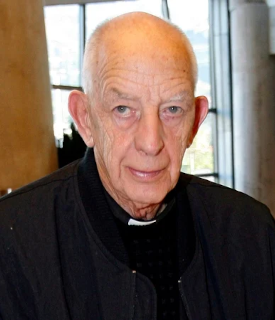
Alexander Reid CSsR, Irish Catholic priest noted for his facilitator role in the Northern Ireland peace process, is born in Dublin on August 5, 1931. BBC journalist Peter Taylor subsequently describes Reid’s role as “absolutely critical” to the success of the peace process.

Reid is raised in Nenagh, County Tipperary, from the age of six following the death of his father. He studies English, history and philosophy at University College Galway.

Reid is professed as a Redemptorist in 1950 and ordained a priest seven years later. For the next four years, he gives Parish Missions in Limerick, Dundalk and Galway (Esker), before moving to Clonard Monastery in Belfast, where he spends almost the next forty years. The Redemptorist Monastery at Clonard stands on the interface between the Catholic nationalist Falls Road and the Protestant loyalist Shankill Road areas of west Belfast.

In the late 1980s, Reid facilitates a series of meetings between Gerry Adams and John Hume, in an effort to establish a “Pan-Nationalist front” to enable a move toward renouncing violence in favour of negotiation. Reid, himself a staunch nationalist who favours a united Ireland and the withdrawal of British forces from Northern Ireland, then acts as their contact person with the Irish Government in Dublin from a 1987 meeting with Charles Haughey up to the signing of the Good Friday Agreement in 1998. In this role, which is not public knowledge at the time, he holds meetings with various Taoisigh, and particularly with Martin Mansergh, advisor to various Fianna Fáil leaders. After the eventual success of the peace negotiations, Gerry Adams says, “there would not be a peace process at this time without [Father Reid’s] diligent doggedness and his refusal to give up.”

In 1988 in Belfast, Reid delivers the last rites to two British Army corporals, David Howes and Derek Wood of the Royal Corps of Signals, who are killed by the Provisional Irish Republican Army (IRA) – an event known as the corporals killings – after they drive into the funeral cortège of IRA member Kevin Brady, who had been killed in the Milltown Cemetery attack. A photograph of his involvement in that incident becomes one of the starkest and most enduring images of the Troubles. Unknown until years later, he is carrying a letter from Sinn Féin President Gerry Adams to Social Democratic and Labour Party (SDLP) leader John Hume outlining Adams’ suggestions for a political solution to the Troubles. Adams later tells the BBC in 2019 that Reid also advised U.S Ambassador to Ireland Jean Kennedy Smith during the peace process, stating “He was talking to her on the side and she was talking to her brother Teddy.”

After he moves to Dublin, Reid is involved in peace efforts in the Basque Country. In January 2003, he is awarded the Sabino Arana 2002 “World Mirror” prize, by the Sabino Arana Foundation in Bilbao, in recognition of his efforts at promoting peace and reconciliation. He and a Methodist minister, the Rev. Harold Good, announce that the IRA has decommissioned their arms at a news conference in September 2005.

Reid is involved in controversy in November 2005 when he makes comments during a meeting in Fitzroy Presbyterian Church concerning the Unionist community in Northern Ireland. When the loyalist activist Willie Frazer makes remarks that Catholics had butchered Protestants during the Troubles, Reid angrily responds, “You don’t want to hear the truth. The reality is that the nationalist community in Northern Ireland were treated almost like animals by the unionist community. They were not treated like human beings. They were treated like the Nazis treated the Jews.” Reid later apologises, saying his remarks had been made in the heat of the moment. In an interview with CNN, he says that “The IRA were, if you like, a violent response to the suppression of human rights.”

Reid dies in a Dublin hospital on November 22, 2013. He is survived by two sisters and an aunt, and is buried in Milltown Cemetery, Belfast.


Leave a comment

Birth of Robin Eames, Primate of All Ireland & Archbishop of Armagh

Robert Henry Alexander “Robin” Eames, Anglican Primate of All Ireland and Archbishop of Armagh from 1986 to 2006, is born in Belfast on April 27, 1936, the son of a Methodist minister.

Eames spends his early years in Larne, with the family later moving to Belfast. He is educated at the city’s Belfast Royal Academy and Methodist College Belfast before going on to study at Queen’s University Belfast, graduating LL.B. (Upper Second Class Honours) in 1960 and earning a Ph.D. degree in canon law and history in 1963. During his undergraduate course at Queen’s, one of his philosophy lecturers is his future Roman Catholic counterpart, Cahal Daly.

Turning his back on legal studies for ordination in the Church of Ireland, Eames embarks on a three-year course at the divinity school of Trinity College, Dublin in 1960, but finds the course “intellectually unsatisfying.” In 1963 he is appointed curate assistant at Bangor Parish Church, becoming rector of St. Dorothea’s in Belfast in 1966, the same year he marries Christine Daly.

During his time at St. Dorothea’s, in the Braniel and Tullycarnet area of east Belfast, Eames develops a “coffee bar ministry” among young people but is interrupted by the Troubles. He turns down the opportunity to become dean of Cork and in 1974 is appointed rector of St. Mark’s in Dundela in east Belfast, a church with strong family links to C. S. Lewis.

On May 9, 1975, at the age of 38, Eames is elected bishop of the cross-border Diocese of Derry and Raphoe. Five years later, on May 30, 1980, he is translated to the Diocese of Down and Dromore. He is elected to Down and Dromore on April 23 and that election is confirmed on May 20, 1980. In 1986, he becomes the 14th Archbishop of Armagh and Primate of All Ireland since the Church of Ireland’s break with Rome. It is an appointment that causes some level of astonishment among other church leaders.

Drumcree Church, a rural parish near Portadown, becomes the site of a major political incident in 1996, when the annual Orangemen‘s march is banned by the Chief Constable of the Royal Ulster Constabulary from returning to the centre of Portadown via the nationalist Garvaghy Road after attending worship at Drumcree Church. Public unrest and violence escalate over the next three summers as other parades come under first police and later commission sanction.

Eames, as diocesan bishop and civil leader finds himself immersed in the search for a resolution to the issue. Within the wider Church of Ireland there is unease as it is a broad church in theology and politics including within its congregations nationalists in the south and unionists in the north. Eames, along with the rector of Drumcree, has to navigate this political and social controversy and seeks political assistance to diffuse tension. Some bishops in the Republic of Ireland call for Eames to close the parish church, including Bishop John Neill who later becomes Archbishop of Dublin. He refuses to do so, believing this action could precipitate greater unrest and possible bloodshed.

Eames is, for many years, a significant figure within the general Anglican Communion. In 2003, the self-styled ‘divine optimist’ is appointed Chairman of the Lambeth Commission on Communion, which examines significant challenges to unity in the Anglican Communion. The Commission publishes its report, the Windsor Report, on October 18, 2004.

At the Church of Ireland General Synod in 2006 Eames announces his intention to retire on December 31, 2006. Church law permits him to continue as primate until the age of 75 but he resigns, in good health, at the age of 69. On January 10, 2007, the eleven serving bishops of the Church of Ireland meet at St. Patrick’s Cathedral in Dublin and elect Alan Harper, Bishop of Connor, as Eames’s successor.


Leave a comment

Death of Risteárd Ó Glaisne, Irish Language Writer & Teacher

Risteárd Ó Glaisne, teacher and writer with a lifelong commitment to the Irish language, dies in Dublin on November 6, 2003. He is the author of biographies of two former Presidents, Douglas Hyde (pictured) and Cearbhall Ó Dálaigh.

Risteárd Earnán Ó Glaisne is born on September 2, 1927, near Bandon, County Cork, the third of four children of George William Giles and his wife, Sara Jane (née Vickery). Educated at Bandon Grammar School and Trinity College Dublin, he graduates with a BA in 1949 and obtains a master’s degree in 1959. At TCD he is greatly influenced by Daithí Ó hUaithne.

Ó Glaisne first becomes interested in the Irish language at school in Bandon. His headmaster gives him a copy of Liam Ó Rinn‘s Peann agus Pár, along with a book of poems by Ivan Turgenev translated into Irish by Ó Rinn. “I suddenly found myself breaking into a world vastly larger than my own world in Irish,” he recalls. “The quality of mind I encountered made me realise I could never again connect Irish only with poteen and potatoes.”

Ó Glaisne further explores the language by making contact with the few native Irish speakers left in the Bandon area. He gradually comes to the conclusion that he is a member of a nation that has an extremely old and in many ways distinguished culture, of which Irish has been historically an integral part. Deciding that Irish best reflects the society in which he grew up and reflects him as an individual, he adopts it as his first language.

On graduating from TCD Ó Glaisne teaches Irish at Avoca School, Blackrock. He later teaches in St. Andrew’s College, Dublin, and at St. Patrick’s Cathedral Grammar School, where he ends his teaching career in 1989. He took a career break in the mid-1960s to study the French educational system and to travel on the Continent.

To perfect his Irish Ó Glaisne holidays on the Great Blasket Island, where he immerses himself in the rich oral culture. He makes many friends among the islanders, and the friendships continue after they are resettled on the mainland in Dún Chaoin. He regularly visits Corca Dhuibhne to meet friends like Muiris Mhaidhc Léan Ó Guithín, one of the last surviving islanders, and to enjoy the annual Ceiliúradh an Bhlascaoid.

Ó Glaisne holds that Protestants have enjoyed a long association with Irish, pointing to 18th-century followers of John Wesley such as Charles Graham, Gideon Ousley and Tomás Breathnach, who evangelised in Irish. He firmly believes that Protestants can be “every whit as Irish” as Roman Catholics. He urges his co-religionists to identify fully with Ireland.

Ó Glaisne is the founder and editor of Focus (1958-66), a monthly magazine that aims to help Protestants “come to an understanding of their cultural heritage.” He is a regular contributor to programmes on RTÉ and RTÉ Raidió na Gaeltachta, and writes for Comhar, Inniú, An tUltach and The Irish Times.

Ó Glaisne is the author of over 20 books and pamphlets in Irish. These include biographies of Conor Cruise O’Brien, Ian Paisley, Tomás Ó Fiaich and Dúbhglas de hÍde. Other works include a history of Methodism in Ireland, a book of essays on early revivalist writers and a manual for beginners in journalism. He also writes Saoirse na mBan (1973), Gaeilge i gColáiste na Trionóide 1592-1992 (1992) and Coláiste Moibhí (2002), a history of the preparatory college for Protestant teachers.

Generous with his time and knowledge, Ó Glaisne makes a point of encouraging young writers.

(From: “Worked to make Protestants aware of Irish culture heritage,” The Irish Times, Saturday, November 15, 2003)


Leave a comment

Birth of Alice Milligan, Nationalist Poet & Writer

alice-milligan

Alice Letitia Milligan, Irish nationalist poet and writer, is born in Gortmore, near Omagh, County Tyrone on September 4, 1865. She is also active in the Gaelic League.

Milligan is brought up as a Methodist, the daughter of the writer Seaton Milligan, antiquarian and member of the Royal Irish Academy (RIA). She is one of eleven children, including music collector Charlotte Milligan Fox, and from 1877 to 1887 attends Methodist College Belfast (MCB), after which she completes a teacher-training course. Together with her father she writes a political travelogue of the north of Ireland in 1888, Glimpses of Erin. She writes her first novel, A Royal Democrat, in 1890.

After the death of Charles Stewart Parnell, Milligan becomes an ardent nationalist. In 1894 with Jenny Armour, she founds branches of the Irish Women’s Association in Belfast and other places and becomes its first president. With Ethna Carbery she founds two nationalist publications in the 1890s, The Northern Patriot, and later The Shan Van Vocht, a monthly literary magazine published in Belfast from 1896 to 1899.

Milligan is a figure of the Irish Literary Revival, and a close associate of Douglas Hyde. She is also “on first-name terms” with William Butler Yeats, James Connolly and Roger Casement. Thomas MacDonagh, writing in the Irish Review in September 1914, describes her as “the best Irish poet of his generation.”

Milligan is awarded an honorary doctorate by the National University of Ireland in 1941. She is also honored during the last decade of her life by the Literary Department of Queen’s University Belfast for her poetry.

Alice Milligan dies in Omagh in April 1953 and is buried in Blackford Municipal Cemetery, County Tyrone. On her headstone is inscribed “She loved no other place than Ireland.”

During 2010/2011 the Ulster History Circle mounts plaques for famous Ulster figures. Charlotte Milligan Fox and Alice Milligan have a plaque mounted on Omagh Library, 1 Spillar’s Place, Omagh, County Tyrone.


Leave a comment

Death of Nathaniel Hone The Elder

nathaniel-hone-the-elder

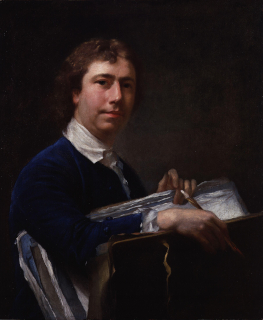
Nathaniel Hone the Elder, Irish-born portrait and miniature painter, and one of the founder members of the Royal Academy of Arts in 1768, dies in London on August 14, 1784.

Hone is born in Dublin on April 24, 1718, the son of a Dublin-based Dutch merchant. He moves to England as a young man and, after marrying Molly Earle, daughter of the John Campbell, 4th Duke of Argyll, in 1742, eventually settles in London, by which time he has acquired a reputation as a portrait painter. While his paintings are popular, his reputation is particularly enhanced by his skill at producing miniatures and enamels. He interrupts his time in London by spending two years (1750–52) studying in Italy.

As a portrait painter, several of Hone’s works are now held at the National Portrait Gallery in London. His sitters include magistrate Sir John Fielding and Methodist preacher John Wesley, and General Richard Wilford and Sir Levett Hanson in a double portrait. He often uses his son John Camillus Hone (1745-1836) in some of his works, including his unique portrait of “The Spartan Boy,” painted in 1774.

Hone courts controversy in 1775 when his satirical picture The Conjurer (National Gallery of Ireland, Dublin) is seen to attack the fashion for Italian Renaissance art and to ridicule Sir Joshua Reynolds, leading the Royal Academy to reject the painting. It also originally includes a nude caricature of fellow Academician Angelica Kauffman in the top left corner, which is painted out by Hone after Kauffman complains to the academy. The combination of a little girl and an old man has also been seen as symbolic of Kauffman and Reynolds’s closeness, age difference, and rumoured affair. To show that his reputation is undamaged, Hone organises a one-man retrospective in London, the first such solo exhibition of an artist’s work.

The Hone family is related to the old Dutch landed family the van Vianens, who hold the hereditary title of Vrijheer. His great-grand-nephew shares the same name and is also a notable Irish painter, known as Nathaniel Hone the Younger (1831–1917). He is also a relation to painter Evie Hone.

Nathaniel Hone the Elder dies in London at the age of 66 on August 14, 1784.

(Pictured: Oil on canvas self-portrait by Nathaniel Hone, circa 1760)


Leave a comment

Birth of Charlotte Milligan Fox, Composer & Music Collector

charlotte-milligan-fox

Charlotte Milligan Fox, Irish composer and music collector, is born on March 17, 1864 in Omagh, County Tyrone in what is now Northern Ireland.

Milligan is the eldest of eleven children born to Methodist parents Seaton Milligan (1837–1916) and Charlotte Burns (1842–1916), with nine surviving including Alice Milligan and Edith Wheeler. All nine children enroll at Methodist College Belfast which provides a privileged and exceptional education. She studies classical piano and composition at the Royal College of Music in London and the Conservatoires of Frankfurt and Milan. Following her marriage to Charles Eliot Fox in 1892, she settles in London.

In 1904 Fox co-founds with Alfred Perceval Graves the Irish Folk Song Society, an offshoot of the Folk-Song Society formed in 1898. Its aim is to collect and publish Irish airs and ballads, in addition to holding lectures and concerts on the subject. She acts as the society’s honorary secretary. The rules of the Society are collected in volume 4 of the Journal of the Irish Folk Song Society. The subscription is 5 shillings payable every January and committee meetings are held at the Rooms of the Irish Literary Society in London.

Fox is a musician in her own right and tours Ireland collecting folk songs and airs. She undertakes a series of tours of County Antrim between 1909 and 1910 with her sisters Edith Wheeler and Alice Milligan. The sisters record and transcribe songs by Irish singers, then publish articles and musical scores in The Journal of Irish Folk Song.

In 1910 Fox visits the east coast of the United States where the New York branch of the Irish Folk Song Society is formed. “The Bardic Recital” is produced on March 16 at the National Theatre in Washington, D.C. She collects and arranges the music for the play.

Fox rediscovers Edward Bunting‘s papers, and under the provision of her will they come to Queen’s University Belfast in 1916. From these papers she writes The Annals of the Irish Harpers. The publication of The Annals of the Irish Harpers stimulates a revival of interest in both the Irish harp and Edward Bunting. Alice Milligan nurses her sister prior to Fox’s death in London on March 25, 1916. An obituary of Charlotte Milligan Fox is in The Irish Booklover (1916). The Journal of the Irish Folk Song Society (1917) has a poem in remembrance of Charlotte Milligan Fox. The same issue has a memoir of Fox by Alice Milligan and an appreciation of Fox by Alfred Perceval Graves.

During 2010 and 2011, the Ulster History Circle mounts plaques for famous Ulster figures. Charlotte Milligan Fox and Alice Milligan have a plaque mounted on Omagh Library, 1 Spillar’s Place, Omagh, County Tyrone.


Leave a comment

The Allihies Copper Mine Museum

engine-house-allihies

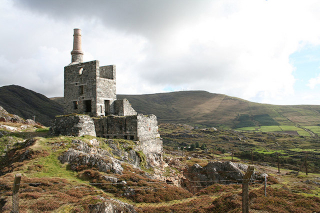
On January 7, 2000, experts underline the important heritage value of a 19th Century relic that stands on the site of a disused copper mine. A conservation appeal is launched to safeguard a unique engine house at a mountain mine in the Beara peninsula. A rare surviving symbol of Cornish type mining technology, the structure is the primary surviving embodiment of a once thriving copper mining industry in Allihies, County Cork.

The industrial mines in Allihies date back to 1812, when they are first opened by John Puxley. Mining activity reaches its peak there in 1845, when the mines employ around 1,600 people, after which the mines suffer with the local area during the Great Famine. The mines are operational until 1962, when they are finally closed. Large Cornish engine houses are constructed around the mining site, ruins of which survive today. These are used to pump out water to allow for deeper mining, and to transport miners and equipment down shafts that go below sea level. The site still contains a number of engine houses, mining shafts and a church. These are constructed by and for the Cornish miners who are brought to the area in the 1800s to mine copper ore. Once the mine becomes unprofitable, many of the miners emigrate to Butte, Montana.

The Allihies Copper Mine Museum (ACMM) is housed in a renovated Methodist church dating from 1845. It is officially opened by President Mary McAleese on September 13, 2007, after ten years of work by the Allihies Mines Co-op, a group that is formed to preserve the history of the area and mining heritage in the Allihies area, supported by the Mining Heritage Trust of Ireland.

The exhibitions cover all aspects of the history of copper mining in the area, from prehistoric times all the way up to the nineteenth century and the Industrial Revolution. The displays also cover the local geology and the social history of the mining heritage. The collections contain examples of mining equipment and tools from the various eras of activity. The exhibition space is also used to display artworks, with local artists such as Charles Tyrrell, Cormac Boydell, Rachel Parry and Tim Goulding exhibiting there.

(Pictured: Engine House, Allihies by John Gibson, view of the 1862 house for the 36″-cylinder beam engine that powered the man-engine and winder on Mountain Mine)