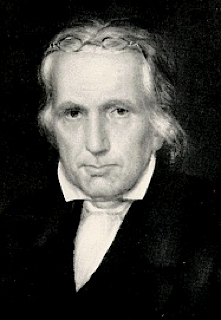
Campbell is born on February 1, 1763, in County Down, Ireland (now Northern Ireland), and is raised as an Anglican. He is ordained a minister in the Scottish Seceder Presbyterian Church sometime after graduating from the University of Glasgow in 1786. He leaves Ireland for the United States in April 1807. This move is prompted by the advice of his physician. Once in America, disagreement arises between him and other Presbyterians over certain points related to Calvinist doctrine and the administration of the Eucharist.
When their study of the New Testament leads the reformers to begin to practice baptism by immersion, the nearby Redstone Baptist Association invites Brush Run Church to join with them for the purpose of fellowship. The reformers agree, provided that they will be “allowed to preach and to teach whatever they learned from the Scriptures.”
Thomas and his son, Alexander, work within the Redstone Baptist Association during the period 1815 through 1824. While both the Campbells and the Baptists share practices of baptism by immersion and congregational polity, it is soon clear that the Campbells and their associates are not traditional Baptists. Within the Redstone Baptist Association, some of the Baptist leaders consider the differences intolerable when Alexander Campbell begins publishing a journal, Christian Baptist, which promotes reform. The Campbells anticipated the conflict and move their membership to a congregation of the Mahoning Baptist Association in 1824.
Campbell is a student of the Enlightenment philosopher John Locke. While he does not explicitly use the term “essentials,” in the Declaration and Address, Campbell proposes the same solution to religious division as had been advanced earlier by Herbert and Locke: “[R]educe religion to a set of essentials upon which all reasonable persons might agree.” The essentials he identifies are those practices for which the Bible provides “a ‘Thus saith the Lord,’ either in express terms or by approved precedent.” Unlike Locke, who sees the earlier efforts by Puritans as inherently divisive, he argues for “a complete restoration of apostolic Christianity.” He believes that creeds serve to divide Christians. He also believes that the Bible is clear enough that anyone can understand it and, thus, creeds are unnecessary.
Campbell combines the Enlightenment approach to unity with the Reformed and Puritan traditions of restoration. The Enlightenment affects the Campbell movement in two ways. First, it provides the idea that Christian unity can be achieved by finding a set of essentials that all reasonable people can agree on. The second is the concept of a rational faith that is formulated and defended on the basis of a set of facts derived from the Bible.
Thomas dies on January 4, 1854, in Bethany, West Virginia, and is buried next to his wife in the Campbell family cemetery.
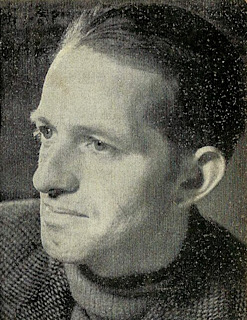
Ó Cuinneagáin Is the third child of Sean Cunningham and his wife Caitlín. He is educated in Belfast, at St. Brigid’s school, Malone Road, and the St. Patrick’s Christian Brothers school on Donegall Street. His political views are permanently influenced by memories of the sectarian violence of 1920–22. In 1927, he enters the Irish civil service as a tax clerk, stationed first at Athlone and then at Castlebar. He is promoted to junior executive officer in the Department of Defence, but resigns in July 1932 after his superiors refuse to allow him six months unpaid leave to study the Irish language in the Donegal Gaeltacht. He turns down a promotion to the Department of Finance, a decision partly motivated by disillusion with Fianna Fáil. He subsequently works as an accountant and lives in the south Dublin suburbs. In 1934, he establishes his own publishing company, Nuachtáin Teoranta, which he boasts is the first company to be registered in the Irish language, and he also contributes to an Irish language socialist paper, An t-Éireannach, under the pen name “Bruinneal gan Smal.”
In 1940–41, Ó Cuinneagáin is active in the Friends of Germany, a pro-Nazi organisation which disintegrates after some of its leading members are interned. On September 26, 1940, he founds Craobh na h-Aiséirighe, a branch of the Gaelic League aimed at attracting dynamic young enthusiasts frustrated by the older activists who dominate established branches. It makes a point of using modern publicity methods to get its message across, a trait which is carried over into Ailtirí na hAiséirghe (Architects of Resurrection), a political movement made up of branch members, which Ó Cuinneagáin founds in 1942. This move leads to the expulsion of Craobh na h-Aiséirighe from the Gaelic League and the establishment of Glún na Buaidhe by branch members who disapprove of his political ambitions and wish to concentrate on the promotion of the Irish language.
Members of Ailtirí wear an informal uniform of a green shirt, tweed suit, and báinín jacket. In private Ó Cuinneagáin reveals that the organisation is modeled on the Hitler Youth. His own title of “ceannaire” (leader) equates with “Führer” and “duce.” Features of the movement copied from Nazism include an emphasis on propaganda based on a few simple concepts and phrases. The claim that party politics allow statesmen to evade individual responsibility, whereas a single leader is necessarily more responsive to public opinion; and the belief that all difficulties can be overcome through willpower.
Ó Cuinneagáin takes to extremes contemporary Catholic advocacy of a corporate state based on vocational principles as the solution to the problems of modernity. While venerating António de Oliveira Salazar‘s Portugal as a role model, he believes that Ireland can surpass it and create a Catholic social model that will redeem the whole world. He takes a quasi-racial view of Irishness and comes close to saying that the only true Irish Catholics are of Gaelic race. When Seán Ó’Faoláin comments acidly in The Bell on the paradox of “Celtophiles” who bear such Celtic names as Blackham and Cunningham, Ó Cuinneagáin protests that he can prove his pure Gaelic descent. The Ailtirí state forces all male citizens to undertake a year’s compulsory military service, which is also used as a means of Gaelicisation, and the resulting citizen army of 250,000 would mount a lightning invasion of Northern Ireland, modeled on the blitzkrieg, with a favourite slogan being “Six Counties, Six Divisions, Sixty Minutes.” In 1943, the Stormont government excludes Ó Cuinneagáin from Northern Ireland.
Ailtirí attracts considerable attention. Its leaders address numerous meetings around the country, attracting large crowds to demonstrations at Dublin and Cork. Ó Cuinneagáin, who is by no means unintelligent, is capable of shrewd observations on the restrictions imposed on most Irish-language bodies by government subsidies, and the impact of the snobbery shown toward the poor by their middle class co-religionists. Several of his lieutenants are academics or engineers. In the 1970s he praises modernist architecture as breaking with the hated Georgian past, and denounces conservationists who oppose plans to build an oil refinery in Dublin Bay. Bilingual pamphlets produced by the group sell thousands of copies. Ó Cuinneagáin is the author of several, including Ireland’s twentieth century destiny (1942), Aiséirí says . . .(1943), Partition: a positive policy (1945), and Aiséirí for the worker (1947). Hus attempts to launch a party paper are stifled until the end of the war. Some of the interest attracted by the group is derived from curiosity or amusement. It also functions to some extent as a front organisation for the banned Irish Republican Army (IRA), with Ó Cuinneagáin declaring that Jews and freemasons should be locked up instead of IRA men. Aiséirí members are involved in the bombing of the Gough memorial in Phoenix Park in July 1957, with the stolen head concealed for a time in the party’s offices.
The party runs four candidates, including Ó Cuinneagáin in Dublin North-West, in the 1943 Irish general election and seven in 1944, but all lose their deposits. Ó Cuinneagáin does not actually vote for himself. Throughout his life he demands Irish language ballot papers. When given English language ones he tears them up, claiming that they disenfranchise him and that this invalidates the election. In 1946, Ailtirí na h-Aiséirí elects eight members to local bodies in counties Louth and Cork. This helps to bring about the decline of the party, as the Cork activists rebell against the rigid Führerprinzip upheld by the electorally unsuccessful ceannaire and his Dublin acolytes. Most of the party’s local support is absorbed by Clann na Poblachta. Ó Cuinneagáin retains a small group of followers centred on his newspaper Aiséirighe.
Ó Cuinneagáin keeps himself in the public gaze by driving around the country in a van painted with slogans, and by regularly appearing in court for refusing to respond to official documents (rates demands, car insurance, court summonses) unless they are supplied in Irish. He enjoys some success in securing the provision of Irish language versions of such documents, and he contrasts the state’s niggardliness on this point with its professed commitment to the revival of Irish. In 1954, he founds an Irish language women’s artistic and social paper, Deirdre, which operates successfully for over a decade without government subsidy.
Ó Cuinneagáin continues to write sympathetically about IRA activities, at one point offering a £1,000 reward for the capture of the Prime Minister of Northern Ireland, Basil Brooke. He maintains surprisingly extensive international neo-fascist contacts. He regularly reprints in Aiséirighe material by the American antisemite and racial segregationistGerald L. K. Smith. He cites praise for Aiséirighe from Der Stahlhelm, a far-right German veterans’ paper, and notes Oswald Mosley‘s support for Irish reunification. He denounces Hugh Trevor-Roper‘s Last days of Hitler as typical British slander of a fallen enemy. He compares the sacrificial ideology of the Hungarian Nazi collaborator Ferenc Szálasi to that of Patrick Pearse. He praises Juan Perón as a model whom Ireland should imitate and he follows the electoral fortunes of Italian neo-fascism with interest. He also maintains contacts with the radical right-wing fringes of Breton, Scottish, and Welsh nationalism. He declares that Ireland’s grievance is against England alone and bemoans the Dublin government’s failure to encourage the break-up of the United Kingdom.
Ó Cuinneagáin denounces the Soviet Union and United States alike as controlled by Zionists and freemasons. He points to illegitimacy and divorce rates in the United States as proof of the folly of those who regard “progressive” American education as superior to the sound Irish teaching methods embodied by the Christian Brothers, and bemoans the increasing flow of “immoral” American comics and paperback books into Ireland. While noting with pride that he has been described as “Ireland’s foremost Jew-baiter,” He claims that his frequent diatribes against Robert Briscoe and the state of Israel are merely anti-Zionist, and that he has nothing against Jews, whom he defines as ultra-Orthodox anti-Zionists. He hopes that a Europe united on national–Christian principles might fend off the influence of the super powers. He echoes Mosleyite calls for European unity and is an early and determined advocate of Irish membership of the European Community. However, he dissents from the Mosleyite view that such a union should be based on African empire. He is generally anti-imperialist, though somewhat more lenient toward Portuguese than British imperialism, and from 1956 the President of Egypt, Gamal Abdel Nasser, becomes one of his heroes. While supporting European unity as a defensive strategy, he also warns that unless Ireland adopts mass conscription the country might be conquered by a regiment of Russian paratroopers landing on Dollymount Strand. Throughout the 1950s and 1960s he regularly calls for the Irish Army to mount a military coup, hinting that it should install him as leader in the same way that the Portuguese army had installed Salazar.
Ó Cuinneagáin gives up contesting elections but regularly cites those who do not vote in elections as indicating the extent of political support for Ailtirí na hAiséirghe. He regularly laments that the safety valve of emigration had taken the steam out of radical politics. In his later years he notes the growth of anti-clericalism and the beginnings of a permissive society in Dublin. He attributes this to the church’s failure to implement its own social teaching and its encouragement of West British snobbery at the expense of the truly Catholic traditions of the Gael.
On April 4, 1945, Ó Cuinneagáin marries Sile Ní Chochláin. They have four sons and two daughters, some of whom become active in left-wing politics. He dies on June 13, 1991. He tends to be remembered as a figure of fun, but this view demands some qualification. He possesses genuine abilities and dedication. His fantasies are an extreme development of the official ideology of the state, and part of his appeal stems from his ability to point out the hypocrisy involved in paying it lip service while failing to push it to its logical conclusion. The blindness and cruelty involved in imposing his world view at a personal level has their counterparts in the institutions of official Ireland. Ailtirí na hAiséirghe may have been a marginal millennial cult, but in Europe during the 1940s such groups were often raised to power by circumstances. Had the World War II taken a different direction after 1940, he might be remembered not as a parody of Pearse but as an Irish Szálasi.
(From: “ÓCuinneagáin, Gearóid Seán Caoimhín” by Patrick Maume, Dictionary of Irish Biography, http://www.dib.e, October 2009)
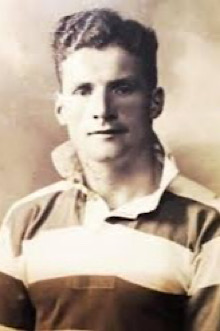
In 1934, aged 16, McAlinden is playing for Glentoran Reserves, when after a game against their reserves, he is offered a professional contract by Belfast Celtic. Together with Jackie Vernon, Tommy Breen, Billy McMillan and Charlie Tully, he subsequently becomes a prominent member of the Celtic team managed by Elisha Scott. This team dominates the Irish League in the era before and during World War II. Among his most notable contributions is scoring in the 2–1 win against Bangor in the 1938 Irish Cup final.
In December 1938, McAlinden signs for Portsmouth for a fee of £7.500. He makes his debut for the club against Chelsea and goes on to become a regular in the side. Within six months of his arrival at the club, he helps them win the 1939 FA Cup final, beating Wolverhampton Wanderers 4–1. After the outbreak of World War II, he plays three times for Portsmouth in wartime regional leagues, but his first spell with the club ends when he then returns to Belfast Celtic in 1939. He returns to Portsmouth for a second stint in 1946. In September 1947, he leaves Portsmouth once again and joins Stoke City for a fee of £7,000.
Following the end of his second stint with Belfast Celtic and before he rejoins Portsmouth, McAlinden signs for Shamrock Rovers in September 1945. He makes his debut against Shelbourne at Glenmalure Park on September 16. While playing for Rovers his teammates include Paddy Coad, Peter Farrell and Tommy Eglington. During his one season with Rovers, he helps the club reach the 1946 FAI Cup final. However Rovers lose 3–1 to Drumcondra.
McAlinden joins Stoke City in September 1947 for a then club record fee of £7,000. He becomes regular inside forward under manager Bob McGrory in 1947–48, playing in 33 matches scoring just twice against Aston Villa and Huddersfield Town. His lack of goals sees him fall out of favour at the Victoria Ground and he is sold to Third Division South side Southend United in October 1948.
In 1948, Southend United signs McAlinden from Stoke City for a fee of £8,000. He continues to play for United until 1954 and during his time with the club he serves as club captain. He also becomes something of a cult hero among the club’s fans and is remembered as being possibly the best player ever to play for the club. In 1950, he is caught up in controversy after it is alleged that he received illegal payments during his second spell with Portsmouth. As a result, he is suspended for the first two months of the 1950–51 season. In April 1954, he makes his last home appearance for United in a 4–1 win over Queens Park Rangers.
When McAlinden begins his international career in 1937 there are in effect, two Ireland teams, chosen by two rival associations. Both associations, the Northern Ireland–based Irish Football Association (IFA) and the Irish Free State–based Football Association of Ireland (FAI), claim jurisdiction over the whole of Ireland and select players from the whole island. As a result, several notable Irish players from this era, including McAlinden play for both teams.
Between 1937 and 1948, McAlinden makes five appearances for the IFA XI, making his international debut in a 1–1 draw with Scotland at Pittodrie Stadium on November 10, 1937. His IFA XI appearances also include the 8–4 defeat against a Combined Services XI at Windsor Park on September 9, 1944. This team is basically a Great Britain XI and features, among others, Matt Busby, Stanley Matthews, Tommy Lawton and Stan Mortensen. He also plays against England in 7–2 defeat at Windsor Park on September 9, 1946. He makes his last appearance for the IFA XI on October 10, 1948, in a 6–2 defeat to England at Windsor Park. He makes his first three appearances for the IFA XI while with Belfast Celtic, his fourth while at Portsmouth and his fifth while at Southend United.
In 1946, while with Portsmouth, McAlinden also makes two appearances for the FAI XI. He is one of several players born in Northern Ireland who benefits from the FAI’s attempts to establish their all-Ireland influence. In June 1946, when the FAI organises an Iberian tour, he, together with Jackie Vernon, Billy McMillan and Paddy Sloan, is one of four Northern Irish players called up. He subsequently plays in both the 3–1 defeat to Portugal on June 16 and then helps Ireland gain a surprise 1–0 victory against Spain on June 23, 1946.
In 1955, McAlinden becomes player/manager of Glenavon. He continues playing for an additional year before finally retiring as a player to concentrate on management. During a thirteen-year stint with Glenavon, he guides them two Irish League titles, three Irish Cup victories and one Gold Cup. After leaving Glenavon, works as a full-time scout for Coventry City before taking charge at Lisburn Distillery in 1969. He subsequently guides a Distillery team that includes a young Martin O’Neill to a win in the 1971 Irish Cup. Later in his first season with Drogheda United, he guides them to the 1976 FAI Cup final, only to lose 1–0 to Bohemian.
McAlinden dies at the age of 75 on November 15, 1993.
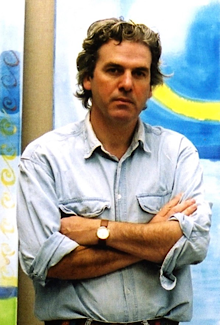
Henderson is born to James Douglas Alexander Henderson, who manages the family business of Henderson & Eadie, and Doris Josephine (née Watson). He attends Portora Royal School in Enniskillen, where the art master, Angus Bryson, spots him as an exceptional student.
From 1972 to 1973 Henderson studies an Arts Foundation course at Ulster University. From 1973 to 1976 he studies Fine Art at Kingston University, London, achieving a Bachelor of Artsfirst class honours degree under the tutelage of Terry Jones, returning in 1977 as Artist-in-Residence. In the same year he becomes the first recipient of the Stanley Picker Fellowship Award in Painting. Between 1978 and 1979 he completes a MA postgraduate in Fine Art at Chelsea School of Art under the tutelage of the artist John Hoyland.
In 1980, Henderson starts his professional artistic journey, developing abstract techniques, creating large canvases with complex layers of overlaid and inter-worked paint. He lives and paints in London for twenty years before relocating back to Ireland. In the mid-1980s he works in a studio adjacent to the house he shares with his partner, Jenni Stone, with whom he has a daughter named Emerald.
During the mid-1980s Henderson’s work becomes recognised by private and public collectors, including Bono, leader of the Irish rock band U2. During this period he sells his first work to the National Art Collection (1986). Cuilcagh Under A Renaissance Sky is purchased for Fermanagh County Museum with a grant from the Arts Council of Northern Ireland during his first solo exhibition “Around a Border” in Ireland. This is followed by three more acquisitions via the Arts Council during the 1980s, who continue to support his work into the new millennium acquiring If Hobbema had Seen Ireland (1989) in 2004 via Art Fund with support from the Esmée Fairbairn Foundation. His work is exhibited by Arts Council England.
In 1990 Henderson moves to the Cooperage Studio, Brick Lane, London, sharing the top floor with sculptor David Fusco and artist Bryan Benge, a friend from Kingston University. Benge says “Every summer the studios in the East End became part of the open studios programme. . . . . He was an intelligent and incredibly accomplished Painter.” It is here, separated from his partner and virtually penniless, he devotes himself entirely to his work, living in a tent, donated by Benge’s parents, inside the studio.
Henderson begins Palinurus in Soho in 1991, a series of twelve paintings depicting night time rooftop scenes across London, painted from an attic in Kingly Street. Exhibited at the Anna Bornholt Gallery in 1992, ten of the series are acquired by a single private collector.
Around 2000, Henderson becomes more influenced by Greek and Irish symbolism, in particular White Island, the Book of Kells and Sheela na gig, reflected in much of the art produced from this time onward. In 2001, he creates a set of enamel manuscripts for The Clinton Centre in Enniskillen, inaugurated by U.S. PresidentBill Clinton in 2002, in commemoration of the Remembrance Day bombing of 1987. He is interested in enameling because of the possibilities that it offers to him as a colourist and in the behaviour of gestural mark-making. The process is made possible when he is introduced to Andrew Morley, the authority on enamel sign making.
Henderson’s artistic influences include Hans Hofmann, Barnett Newman, Mark Rothko, and John Hoyland. Frequently associated with Samuel Beckett and Jack Butler Yeats, he is influenced by his homeland; his early environment, growing up around weaving, yarns and dyeing, the regions political turmoil, symbolism, and in later life his chronic illness, expressed in his more sombre paintings.
John Hutchinson, critic and director of the Douglas Hyde Gallery writes in the Sunday Independent that Henderson’s paintings “demonstrate the fruitfulness of the no man’s land between abstraction and representation,” and “His images deliberately evoke the picturesque and romantic landscape conventions that originated in the late 18th century…..as well as the expressionist subjectivity of painters such as Jack B. Yeats.” Due to Henderson’s disinterest in the commercialisation of his work, he is sometimes referred to as Ireland’s Invisible Genius.
Henderson describes the evolution of his work, after returning to Ireland in 1993, saying, “Since returning to Ireland my work has become less concerned with resting landscape painting in a cultural context more appropriate to our times, but has come full circle towards an internalised organic abstraction which characterised my more intuitive approach until the early eighties.”
Henderson is married once, in 1995 to the actress Patricia Martinelli with whom he subsequently has a daughter in 1997, Bella-Lucia. He remains married, living in the remote village of Boho, County Fermanagh, Northern Ireland, until his death, brought on by a brain tumour, on April 28, 2009. He remains a prolific artist throughout his life.
Ireland formally applies for European Economic Committee (EEC) membership in July 1961. Ó Móráin, as Minister for Lands and the Gaeltacht, delivers a widely reported address to the Castlebar Chamber of Commerce in 1962. In the speech, he argues that Ireland is “ready to subscribe to the political aims of the EEC” and that Ireland does not want to be seen as “committed” to its policy of neutrality. In the ensuing controversy, he and Lemass deny that there is any suggestion Ireland might or should abandon neutrality. Outside the country, foreign governments see this episode as a deliberately provoked debate to evaluate the government’s domestic room for manoeuvre on neutrality.
Ó Móráin is appointed Minister for Justice by Taoiseach Jack Lynch in 1968. It is in this role that he is most remembered. While he is still Minister, the Arms Crisis in Ireland erupts in 1970. This political scandal sees Government ministers Charles Haughey and Neil Blaney dismissed by the Taoiseach for alleged involvement in a conspiracy to smuggle arms to the Irish Republican Army (IRA) in Northern Ireland. Ó Móráin continually suffers from ill health, which is accentuated by his alcoholism. When the Arms Crisis erupts, Lynch comes to see him in a hospital in Galway and asks for his resignation. Ó Móráin is a witness at the subsequent Arms Trial. He testifies that he had passed on Garda intelligence reports about the involvement of ministers with the IRA to the Taoiseach before the arms were seized at Dublin Airport. Hus evidence at the trial has been described as “erratic.”
Ó Móráin loses his Dáil seat at the 1973 Irish general election and retires from politics. He dies at his home in Sutton, Dublin, in on May 6, 1983. With a Fianna Fáil guard of honour, he is buried in Castlebar. With his wife, Madge, he has one daughter, Sorcha, and two sons, John, and Michael, who dies in a road accident in 1972.
Since the Troubles began, the South Armagh area—especially around Crossmaglen and other similar republican strongholds—is one of the most dangerous places for the British security forces, and the IRA’s South Armagh brigade carries out numerous ambushes on the British Army and Royal Ulster Constabulary (RUC). This includes the 1975 Drummuckavall ambush and the 1978 downing of a British Army Gazelle helicopter which leads to the death of one British soldier and four others being seriously injured.
A number of British security force members are killed in Crossmaglen during 1978. On March 4, British soldier Nicholas Smith (20), 7 Platoon, B Company, 2nd Royal Green Jackets, is killed by an IRA booby trap bomb while attempting to remove an Irish flag from a telegraph pole in Crossmaglen. On June 17, William Turbitt (42) and Hugh McConnell (32), both Protestant RUC officers, are shot by the IRA while on mobile patrol near Crossmaglen. McConnell is killed at the scene, but Turbitt is kidnapped. The next day, a Catholic priest, Fr. Hugh Murphy, is kidnapped in retaliation but later released after appeals from Protestant clergy. The body of Turbitt is found on July 10, 1978.
On December 21, 1978, when the patrol is near Rio’s Bar coming around a bend, a red Royal Mail-type van is spotted by the patrols commander Sergeant Richard Garmory. The van is fitted with armor plating and is facing away from the patrol. Garmory believes the van is in a suspicious place on the other side of the street. He notes what appear to be boxes in the back of the van, which actually provide cover for the IRA Volunteers. IRA members open fire from the back of the van with an M60 machine gun which is fitted down onto the floor in the back of the van. Three other IRA volunteers armed with AR-15-style rifles and another Volunteer with an AK-47 open up on the patrol. The British soldiers on patrol return fire but do not claim any hits. A handful of Christmas shoppers scramble for cover. Three soldiers at the front of the patrol are fatally wounded. They are treated by staff at a nearby health center and then taken to Musgrave Park Hospital but are declared dead on arrival. The soldiers killed are Graham Duggan (22), Kevin Johnson (20) and Glen Ling (18). All are members of the British Armies Grenadier Guards regiment. The patrol commander, Richard Garmory, says of the ambush:
On coming round the bend near the Rio Bar, I saw 40 yards away what looked like a British Rail parcel delivery van parked partly on the pavement on the left facing away from us. It had an 18-inch tailboard with a roll shutter that could be pulled down. The van immediately struck me as highly suspicious because I saw what looked like cardboard boxes piled to the top in the back, all flush with the tailboard so they would fall out if the van moved off fast. I instantaneously put my magnifying sight to my to my eye and saw four firing slits, two above the other two, among the boxes. I immediately opened fire.
Four months later the South Armagh brigade strikes again at British security forces, this time near Bessbrook which is several miles from Crossmaglen. Four RUC officers are killed in the 1979 Bessbrook bombing, when a 1,000 lb. land mine is detonated when the RUC patrol is passing by the bomb, killing all the officers outright.
(Pictured: South Armagh Brigade, Provisional Irish Republican Army, manning a temporary checkpoint close to Crossmaglen, 1978)
The attacks are linked to the Glenanne gang, a group of loyalist militants who are either members of the UVF, the Ulster Defence Regiment (UDR), the Royal Ulster Constabulary (RUC) and the closely linked UVF paramilitary the Red Hand Commando (RHC). Some of the Glenanne gang are members of two of these organisations at the same time, such as gang leaders Billy Hanna, who is in both the UVF and the UDR and who fights for the British Army during the Korean War, and John Weir from County Monaghan, who is in the UVF and is a sergeant in the RUC. At least 25 UDR men and police officers are named as members of the gang. The Red Hand Commando claim to have carried out both attacks.
The attacks are planned at the Glenanne farm of RUC reserve officer James Mitchell which is where most terrorist acts are planned by the gang and the farm also acts as a UVF arms dump and bomb-making site. After the attacks are finished everyone involved in both attacks is to meet at Mitchell’s farm. Then if there is any heat, Mitchell can claim the bombers and shooters were with him when the attacks happened.
The first phase of the plan starts at around 6:15 p.m. along Crowe Street in Dundalk when a 100-pound no-warning bomb explodes in a Ford sports car just outside Kay’s Tavern. The blast kills Hugh Watters, who is a tailor and has just dropped into the pub to deliver some clothes he has altered for the pub’s owner, almost instantly. Jack Rooney, who is walking past the town hall on the opposite side of the street, is struck in the head by flying shrapnel and dies three days later. A further 20 people are injured in the explosion, several of them very seriously. The car bomb is fitted with fake southern registration plates and placed in one of the busiest streets in Dundalk in the hope of causing maximum death and injury. According to Joe Tiernan, UVF commander Robin Jackson plants the bomb and along with other members of his unit escapes across the border in a blue Hillman Hunter around the time the bomb goes off.
At around 9:00 p.m., about three hours after the Dundalk bombing, the second phase of the coordinated plan begins. It is led by McConnell and takes place at Donnelly’s Bar & Filling Station in the small Armagh village Silverbridge, close to Crossmaglen.
The unit arrives in two cars and come unusually fast toward the pub. The publican’s son, Michael Donnelly (14), is serving petrol to a customer. He notices the strange speed of the cars. He tries to run toward the pub, but McConnell jumps out of one of the cars and shoots the teenage boy dead with a Sten gun. McConnell then shoots the man Michael Donnelly had been serving petrol to in the head. Although the man survives the shooting, he is maimed for life.
Then a second gunman, believed to be Billy McCaughey, a UVF volunteer and member of the RUC Special Patrol Group, shoots dead a second person, local man Patrick Donnelly (no relation to the pub owner’s family) who has been waiting for petrol. McConnell then goes inside the pub and sprays the bar with his Sten SMG, killing a third man, Trevor Bracknell, and seriously injuring three more people.
As McConnell withdraws to his car, two other members of the unit carry a 25-pound cylinder bomb inside the pub. As McConnell’s unit flees back to Mitchell’s farm, the bomb detonates inside the pub. However, by this time most of the people have already fled.
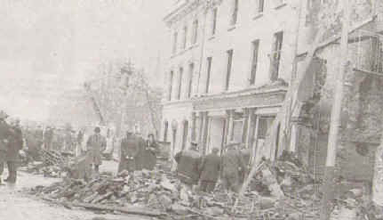
(Pictured: Photograph of the destruction at Kay’s Tavern after the loyalist car bomb explosion on December 19, 1975. Members of the Garda and Dundalk fire service are seen in the foreground. Also present are a number of visiting government ministers from Dublin.)
Cruise O’Brien follows his cousin Owen into Sandford Park School, which has a predominantly Protestant ethos despite objections from Catholic clergy. He subsequently attends Trinity College Dublin (TCD) before joining the Irish diplomatic corps.
Although he is a fierce advocate of his homeland, Cruise O’Brien is a strong critic of Irish Republican Army (IRA) violence and of what he considers the romanticized desire for reunification with Northern Ireland. His collection of essays Maria Cross: Imaginative Patterns in a Group of Modern Catholic Writers (1952; written under the pseudonym Donat O’Donnell) impresses UN Secretary-GeneralDag Hammarskjöld, who in 1961 appoints him UN special representative in the Congo, later the Democratic Republic of the Congo. He orders UN peacekeeping forces into the breakaway Katanga province, and the resulting scandal forces him out of office. Despite UN objections, he writes To Katanga and Back (1963) to explain his actions.
After serving as vice-chancellor of the University of Ghana (1962–65) and Albert Schweitzer Professor of Humanities at New York University (1965–69), Cruise O’Brien enters Irish politics. He holds a Labour Party seat in Dáil Éireann from 1969 to 1977 and then in the Senate from 1977 to 1979, representing Trinity College, of which he is pro-chancellor (1973–2008).
In 1979, Cruise O’Brien is named editor in chief of the British Sunday newspaper The Observer, but he leaves after three tumultuous years. He remains an active newspaper columnist, especially for the Irish Independent until 2007. His books include States of Ireland (1972) and On the Eve of the Millennium (1995), as well as perceptive studies of Charles Stewart Parnell, Edmund Burke, and Thomas Jefferson.
In early July 1996, in the period of Cruise O’Brien’s involvement as a UK Unionist Party (UKUP) representative in talks at Stormont, he suffers a mild stroke. He recovers well, but is left with anxiety about his recall of names. His last public appearance is on September 7, 2006, to deliver an address on the ninetieth anniversary of the death of Tom Kettle, in the old House of Lords chamber of the Bank of Ireland on College Green.
Since the beginning of its campaign in 1970, the Provisional IRA has carried out many improvised land mine and roadside bomb attacks on British forces in the region. In September 1972, three British soldiers are killed when their armoured vehicle is blown up by an IRA land mine at Sanaghanroe, near Dungannon. In March 1974, two IRA members are killed on the Aughnacloy Road near Dungannon when a land mine they are planting explodes prematurely.
The Dungannon attack occurs just months after the Warrenpoint ambush on August 27, 1979, where the IRA kills eighteen British soldiers with roadside bombs in south County Down — the deadliest single attack on British forces during The Troubles.
On December 16, 1979, two armoured British Army Land Rovers are driving along Ballygawley Road, about two miles outside Dungannon. A unit of the IRA had planted a 600–1,000-pound (270–450 kg) improvised land mine in a culvert under the road at Glenadush. When the second vehicle reaches the culvert, the land mine is detonated by remote control from a concealed location, showcasing their evolving tactics in guerrilla warfare and ambush strategy. The blast is powerful enough to launch the armoured Land Rover into the air and killing four soldiers from the Royal Regiment of Artillery outright: William Beck (23), Keith Richards (22), Simon Evans (19), and Allan Ayrton (23).
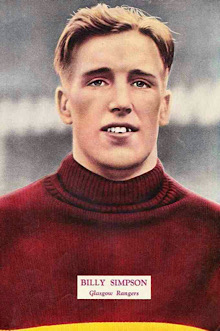
Simpson signs for Rangers from Linfield for a sum of £11,500 in 1950. He spends nine years (1950–59) at Rangers making 239 appearances and scoring 163 goals. He wins three championship medals and a Scottish Cup winners medal with Rangers to add to the two Northern Ireland Football League and two Irish Cups he wins with Linfield. He leaves Ibrox Stadium in 1959 and spends the last couple of years of his career with Stirling Albion, Partick Thistle and (then non-league) Oxford United.
As an illustration of his popularity, in the fictional song “A Trip to Ibrox,” Simpson is credited with scoring twice in a “Ne’erday” Old Firm Derby at Ibrox. Whereby Rangers are 1-0 down at halftime, and Simpson inspires his team to a second half comeback after Willie Waddell has scored an equaliser.
In recognition of his service to that club, Simpson is made a member of the Rangers F.C. Hall of Fame.
Simpson makes his debut for Northern Ireland in 1951 against Wales, scoring in the process. He represents his country twelve times in total between 1951 and 1958, scoring five goals. He is selected in Northern Ireland’s squad for the 1958 FIFA World Cup in Sweden but a late injury ensures he does not play at all during the finals.
In April 2015, the feature-length documentarySpirit of ’58 is screened as part of the Belfast Film Festival. It features Simpson prominently alongside the other surviving players (Billy Bingham, Peter McParland, Jimmy McIlroy and Harry Gregg) as it tells the story of Northern Ireland’s journey throughout the 1950s under the managership of Peter Doherty, culminating in the 1958 World Cup.


 seamus dubhghaill