seamus dubhghaill

Promoting Irish Culture and History from Little Rock, Arkansas, USA


2 Comments

Birth of James Patrick Mahon, Journalist, Barrister & Parliamentarian

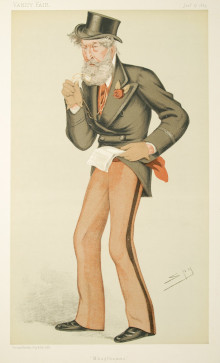
James Patrick Mahon, Irish nationalist journalist, barrister, parliamentarian and international mercenary, is born into a prominent Roman Catholic family in Ennis, County Clare, on March 17, 1803.

Mahon, the eldest of four children, is the son of Patrick Mahon of New Park, who took part in the Irish Rebellion of 1798, and Barbara, a considerable heiress and the only daughter of James O’Gorman of Ennis. He studies at Clongowes Wood College, where he is one of the earliest pupils, and at Trinity College Dublin, where he takes his BA in 1822 and his MA in law in 1832. Following his father’s death in 1821, he inherits half the family property and becomes a magistrate for Clare.

In 1830, Mahon marries Christina, the daughter of John O’Brien of Dublin. She is an heiress and has property valued at £60,000 in her own right, which gives him the resources to seek election to parliament. The couple spends little time together, and she dies apart from him in Paris in 1877. They have one son who dies in 1883.

In 1826, Mahon joins the newly formed Catholic Association. He encourages fellow member Daniel O’Connell to stand for election at the 1828 Clare by-election. O’Connell’s election, in which Mahon plays a large role, persuades the British Government to pass the Roman Catholic Relief Act 1829, which finalises the process of Catholic Emancipation and permitted Roman Catholics to sit in the British Parliament.

As a result, when Mahon is elected for Clare at the 1830 United Kingdom general election, he is entitled to take his seat. However, during the election campaign he quarrels with O’Connell, and after his election he is unseated for bribery. He is subsequently acquitted and stands again at the 1831 United Kingdom general election, but is defeated by two O’Connell-backed candidates, one of whom is his old schoolfriend Maurice O’Connell, Daniel O’Connell’s son. He gives up on politics, becomes deputy lieutenant of Clare, and captain of the local militia.

Mahon becomes a barrister in 1834, but the following year, he leaves for Paris. There he associates with Charles Maurice de Talleyrand-Périgord, becoming a favourite at Louis Philippe‘s court and working as a journalist. He travels the world, spending time in both Africa, where he befriends Ferdinand de Lesseps, engineer of the Suez Canal, and South America, before returning to Ireland in 1846.

At the 1847 United Kingdom general election, Mahon is elected for Ennis and declares himself a Whig in favour of Irish Repeal. However, he opposes the Young Irelanders and narrowly loses his seat at the 1852 United Kingdom general election.

Following his defeat in the 1852 election, Mahon returns to Paris, then travels on to Saint Petersburg, where he serves in the Imperial Bodyguard. During this period, he journeys through lands from Finland to Siberia. He then travels across China, India and Arabia. His finances largely exhausted, he serves as a mercenary in the Ottoman and Austrian armies before returning to England in 1858. Late that year, he leaves for South America, where he attempts to finance the construction of a canal through Central America.

After exploits abroad Mahon returns to Ireland in 1871 and is a founding member of the Home Rule League. Nearly ruined by his ventures, he even ends up at the Old Bailey as a consequence of his dealings but is acquitted. He is defeated in Ennis at the 1874 United Kingdom general election, and also at the 1877 Clare by-election. Finally, he wins the 1879 Clare by-election and holds the seat at the 1880 United Kingdom general election.

Mahon is a close associate of Charles Stewart Parnell, who he successfully nominates for the leadership of the League in 1880 but is dropped in 1885 as a party candidate because of his age and his tendency to vote with the Liberal Party in Parliament. He is also embroiled in a court case disputing the will of his son.

Parnell personally ensures Mahon is a candidate at the 1887 County Carlow by-election, which he wins at the age of 87 as a Liberal. By this point, he is the oldest MP in the House of Commons of the United Kingdom. He dies at his home in South Kensington, London on June 15, 1891, while still in office.

Mahon had served alongside William O’Shea as an MP, and the two were close friends. He introduced him and Katharine O’Shea, his wife, to Parnell. After Parnell is named in the O’Sheas’ divorce case in 1890, Mahon splits with Parnell, siding with the Irish National Federation. However, Parnell attends Mahon’s funeral in Glasnevin Cemetery a few months later.

(Pictured: Caricature of James Patrick Mahon by Sir Leslie Matthew Ward under the pseudonym “Spy” published in Vanity Fair in 1885)


Leave a comment

Birth of Sir Peter O’Sullevan, Horse Racing Commentator

Sir Peter O’Sullevan, Irish-British horse racing commentator for the BBC, and a correspondent for the Press Association, the Daily Express, and Today, is born Newcastle, County Down on March 3, 1918. He is the BBC’s leading horse racing commentator from 1947 to 1997, during which time he describes some of the greatest moments in the history of the Grand National.

O’Sullevan is the son of Colonel John Joseph O’Sullevan DSO, resident magistrate at Killarney, and Vera (née Henry). As an infant, the family returns to his parents’ home at Kenmare, County Kerry and he is raised in Surrey, England. He is educated at Hawtreys Preparatory School, Charterhouse School, and later at Collège Alpin International Beau Soleil in Switzerland.

In the late 1940s O’Sullevan is involved in some of the earliest television commentaries on any sport and makes many radio commentaries in his earlier years (including the Grand National before it is televised for the first time in 1960). On television, he commentates on many of the major events of the racing year, including the Cheltenham Festival until 1994, The Derby until 1979, and the Grand National, Royal Ascot and Glorious Goodwood until he retires in 1997. During his career, he commentates on around 30 runnings of the Prix de l’Arc de Triomphe in Paris and racing from the United States and Ireland as well as trotting from Rome during the 1960s.

During his 50 years of commentating on the Grand National, O’Sullevan commentates on numerous historic victories. These include Bob Champion‘s run on Aldaniti in 1981 after recovering from cancer, 100/1 outsider Foinavon‘s win in 1967, and the three-times winner Red Rum in 1973, 1974 and 1977. He also commentates on the 1993 Grand National, which is declared void after 30 of the 39 runners fail to realise there had been a false start, and seven go on to complete the course. As the runners approach the second-last fence in the so-called “race that never was,” O’Sullevan declares it “the greatest disaster in the history of the Grand National.”

O’Sullevan becomes known as the “Voice of Racing.” In a television interview before his 50th and last Grand National in 1997, he reveals that his commentary binoculars came from a German submarine. He is knighted the same year – the only sports broadcaster at the time to have been bestowed that honour. He is also a racehorse owner, including of Be Friendly, who wins the King’s Stand Stakes at Ascot, and Prix de l’Abbaye de Longchamp. He is twice successful in the Haydock Sprint Cup (then Vernons Sprint) in 1966 and 1967. Another horse he owns is Attivo, whose victory in the 1974 Triumph Hurdle at the Cheltenham Festival is described by O’Sullevan as the most difficult race to call.

Attivo also wins the Chester Cup and the Northumberland Plate during the 1970s. O’Sullevan’s final race commentary comes at Newbury Racecourse for the 1997 Hennessy Gold Cup, and he visits the winners’ enclosure as a winning owner in the race which follows courtesy of Sounds Fyne’s victory in the Fulke Walwyn Chase. He is succeeded as the BBC’s lead commentator by Jim McGrath.

After his retirement, O’Sullevan is actively involved in charity work, fundraising for causes which revolve around the protection of horses and farm animals, including the International League for the Protection of Horses (ILPH), the Thoroughbred Rehabilitation Centre and Compassion in World Farming. The National Hunt Challenge Chase Cup (run at the Cheltenham Festival) is named after him in 2008 to celebrate his 90th birthday. In 2010, Aintree Racecourse names O’Sullevan as one of the eight inaugural “Grand National Legends.” His name is inscribed on a commemorative plaque at the course, alongside the likes of Ginger McCain and Captain Martin Becher.

O’Sullevan meets his wife Patricia, daughter of Frank Duckworth of Manitoba, Canada, at a ball in Manchester in 1947. She dies of Alzheimer’s disease in 2010.

O’Sullevan dies of cancer at his home in London on July 29, 2015.


Leave a comment

Birth of Mary Swanzy, Landscape & Genre Artist

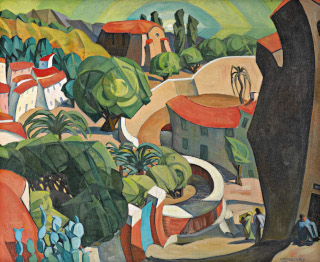
Mary Swanzy, Irish landscape and genre artist, is born in Dublin on February 15, 1882. Noted for her eclectic style, she paints in many styles including cubism, futurism, fauvism, and orphism, she is one of Ireland’s first abstract painters.

Swanzy is the second of three daughters of Sir Henry Rosborough Swanzy, an eye surgeon, and his wife Mary (née Denham). She attends Alexandra College, Earlsfort Terrace, a finishing school at the Lycée in Versailles, France, and a day school in Freiburg, Germany. This education means that she is fluent in French and German. She goes on to take art classes at Mary Manning‘s studio, under the direction of John Butler Yeats. Manning encourages her to study modelling with John Hughes at the Dublin Metropolitan School of Art.

Living within walking distance of the National Gallery of Ireland, she spends a lot of time studying and copying the great masters. Her first exhibition is with the Royal Hibernian Academy (RHA) in 1905 with Portrait of a child, continuing to exhibit portraits every year until 1910. In 1905 she goes to Paris and works at the Académie Delécluse, an atelier-style art school. She goes on to attend the studio of Antonio de La Gándara in 1906 and takes classes at Académie de la Grande Chaumière and Académie Colarossi. While in Paris she is exposed to the works of Gauguin, Matisse, and Picasso, which make a lasting impression on her.

On her return to Dublin, Swanzy paints portraits and genre scenes and holds her first show at Mill’s Hall, Merrion Row in 1913. She holds another show there in 1919, where she exhibits nearly 50 pieces. This exhibition is reviewed by Sarah Purser who notes the lack of melancholy and light optimism in Swanzy’s Irish landscapes. Swanzy paints in a number of styles, often reflecting the major art developments in Paris.

After the deaths of her parents, she is financially independent and can travel, spending her time between Dublin and Saint-Tropez during World War I while continuing to paint. She also exhibits with the Société des Artistes Indépendants in 1914 and 1916, being elected to the committee in 1920. While visiting her sister who is involved with the Protestant relief mission in Yugoslavia and Czechoslovakia, she paints landscapes, village life, and peasant scenes. These works are shown in the autumn of 1921 in the Dublin Painters’ Gallery with six other artists including Jack Butler Yeats, Paul Henry, and Clare Marsh with whom she shares a studio.

Swanzy begins to travel to more exotic countries from the 1920s, Honolulu around 1923, and later Samoa. As a result, she paints local tropical flowers, trees, and native women, with a palette and style similar to that of Fauvism. She stays for a time in Santa Barbara, California, working in a local studio and exhibiting some of her Samoan work at the Santa Barbara Arts Club Gallery. She returns to Ireland in February 1925 and exhibits three of her Samoan paints at the RHA, and 14 at her one-woman show in the Galerie Bernheim-Jeune, Paris in October 1925. Gertrude Stein writes her to congratulate her on her Paris exhibition.

In the mid 1920s Swanzy settles in Blackheath, London, making regular trips to Dublin and abroad. In 1932 Purser holds an exhibition of Swanzy’s work for invited guests in her house. At this time her painting is influenced by orphism and is reviewed positively. Her work becomes more allegorical in later years, with The message in the Hugh Lane Gallery demonstrating this. During World War II she stays with her sister in Coolock for three years. In 1943, she holds a one-woman show at the Dublin Painters’ Gallery, and is also featured at the first Irish Exhibition of Living Art. She is exhibited at St. George’s Gallery, London in 1946 along with Henry Moore, Marc Chagall, and William Scott.

Swanzy is made an honorary member of the RHA in 1949, showing with them in 1950 and 1951. She does not exhibit in Ireland for a number of years, but the Hugh Lane Gallery holds a major retrospective of her work in 1968. Following this she holds two one-woman shows at the Dawson Gallery in 1974 and 1976. In 1975 she is featured at the Cork ROSC art exhibition and resumes showing with the RHA. She continues to paint until her death at her home in London on July 7, 1978.

In 1982 the Taylor Galleries holds an exhibition to mark the centenary of Swanzy’s birth. More recently she is featured in the Irish Museum of Modern Art (IMMA) 2013 exhibition Analysing Cubism. From October 2018-February 2019, also in IMMA, she is the subject of the solo exhibition Mary Swanzy Voyages.

(Pictured: Sunlit Landscape, oil-on-canvas, by Mary Swanzy)


Leave a comment

Oscar Wilde’s “Salomé” Opens in Paris

Oscar Wilde languishes in jail as his play Salomé opens in Paris on February 11, 1896. Salomé is a one act play based on the biblical tale of Salomé, stepdaughter of the tetrarch Herod Antipas, who asks for the head of Jokanaan (John the Baptist) on a platter as a reward for dancing the Dance of the Seven Veils. The original 1891 version of the play is in French. Three years later an English translation, with illustrations by Aubrey Beardsley, is published.

Rehearsals for the play’s debut on the London stage, for inclusion in Sarah Bernhardt‘s London season, begin in 1892, but are halted when the Lord Chamberlain‘s licensor of plays bans Salomé on the basis that it is illegal to depict Biblical characters on the stage. The play eventually premiers on February 11, 1896, while Wilde is in prison, in Paris at the Théâtre de la Comédie-Parisienne in a staging by Lugné-Poe‘s theatre group, the Théâtre de l’Œuvre.

In The Pall Mall Gazette of June 29, 1892 Wilde explains why he had written Salomé in French:

“I have one instrument that I know I can command, and that is the English language. There was another instrument to which I had listened all my life, and I wanted once to touch this new instrument to see whether I could make any beautiful thing out of it. […] Of course, there are modes of expression that a Frenchman of letters would not have used, but they give a certain relief or colour to the play. A great deal of the curious effect that Maeterlinck produces comes from the fact that he, a Flamand by grace, writes in an alien language. The same thing is true of Rossetti, who, though he wrote in English, was essentially Latin in temperament.”

A performance of the play is arranged by the New Stage Club at the Bijou Theatre in Archer Street, London, on May 10 and 13, 1905, starring Millicent Murby as Salomé and directed by Florence Farr. In June 1906 the play is presented privately with A Florentine Tragedy by the Literary Theatre Society at King’s Hall, Covent Garden. The Lord Chamberlain’s ban is not lifted for almost forty years. The first public performance of Salomé in England is produced by Nancy Price at the Savoy Theatre on October 5, 1931. She takes the role of Herodias herself and casts her daughter, Joan Maude, as Salomé.

In 1992 the play is performed on Broadway at the Circle in the Square Theatre, under the direction of Robert Allan Ackerman. Sheryl Lee stars as the title role alongside Al Pacino. The play costars Suzanne Bertish, Esai Morales and Arnold Vosloo.

Al Pacino says in an interview that a new production of the play where he will star as King Herod is to open in London’s West End in 2016.

In 2018 a production by Lazarus Theatre is performed at Greenwich Theatre. Directed by Ricky Dukes, the performance portrays Salomé as male.


Leave a comment

Founding of the Ladies’ Land League

Anna Parnell, younger sister of Irish Nationalist leader Charles Stewart Parnell, founds the Committee of the Ladies’ Land League, an auxiliary of the Irish National Land League, in Dublin on January 31, 1881. The organisation grows rapidly. By May 1881 there are 321 branches in Ireland, with branches also in Britain, the United States, Canada, Australia and New Zealand.

The organization is set up to take over the work of the Irish National Land League after its leadership is imprisoned. They raise money for the Land League prisoners and their dependants. They encourage women to resist eviction from their cottages. If families are evicted, the Ladies’ Land League provides wooden huts to the evicted families.

The ladies find themselves with additional work late in 1881. The Land League has started its own paper, United Ireland, in August 1881, but towards the end of the year the government tries to close it down. William O’Brien, the editor, continues to smuggle out copy from Kilmainham Gaol, but it falls to the ladies to get it printed. This is done first in London and then for a while in Paris. Eventually the ladies print and circulate it themselves from an office at 32 Lower Abbey Street.

On Sunday, March 12, 1881, just more than a month after the formation of the league, a pastoral letter of Archbishop of Dublin Edward McCabe is read out in all the churches of the diocese. It condemns the league in the strongest terms, deploring that “our Catholic daughters, be they matrons or virgins, are called forth, under the flimsy pretext of charity, to take their stand in the noisy street of life.” McCabe is not representative of all bishops, particularly Archbishop of Cashel Thomas Croke, a strong supporter of the original league. Croke publishes a letter in the Freeman’s Journal challenging the “monstrous imputations” in McCabe’s pastoral.

The dissension is revived somewhat in the summer of 1882. McCabe, now a Cardinal, and another bishop try to have a public condemnation of the Ladies’ Land League inserted into an address by the Catholic Bishops of Ireland in June. The other bishops resist on the basis that it would probably do more harm than good. They content themselves with expressing their hope that “the women of Ireland will continue to be the glory of their sex and the noble angels of stainless modesty.” When newspapers interpret this as a condemnation of the league, Croke writes again to the Freeman’s Journal to deny that this had been the intention of the bishops.

The order banning the Irish National Land League makes no direct reference to the Ladies’ Land League, but many police officers try to insist that the ban includes the women’s group. Eventually, on December 16, 1881, Inspector General Hillier of the Royal Irish Constabulary (RIC) orders the police to stop the women’s meetings. Anna Parnell defiantly issues a notice to all Ladies’ Land League branches in the country calling on them all to hold a meeting on January 1, 1882.

The prominent resident magistrate, Major Clifford Lloyd, claims that the huts built for evicted tenants are being used as posts from which the evicted tenants can intimidate anyone who attempts to take over their vacated holdings. In April 1882, he threatens that anyone attempting to erect huts will be imprisoned. That month, Anne Kirke is sent down from Dublin to Tulla, County Clare, to oversee the erection of huts for a large number of evicted tenants. Lloyd has her arrested and imprisoned for three months.

The government does not wish to be seen to use the Coercion Act to imprison women, but another stratagem is used. In December 1881 21-year-old Hannah Reynolds is imprisoned under an ancient statute from the reign of Edward III, the original purpose of which was to keep prostitutes off the streets. The statute empowers magistrates to imprison “persons not of good fame” if they do not post bail as a guarantee of their good behavior. Since Reynolds claims her behavior is good, she refuses to pay bail and spends a month in Cork gaol. In all, thirteen women serve jail sentences under this statute.

On May 3, 1882, Parnell and other leaders are released from jail after agreeing to the Kilmainham Treaty. This includes some improvement in the 1881 Land Act. He now wishes to turn his attention more to the Home Rule question. The Irish National Land League is replaced by the Irish National League. Parnell also wants to see an end to the Ladies’ Land League. There had been increased violence while he was in jail, and he sees Anna as too radical. The organization has an overdraft of £5,000 which Parnell agrees to clear from central funds only if the organization is dissolved. At a meeting of the Central Committee on August 10, 1882, the Ladies’ Land League votes to dissolve itself. Anna Parnell herself is not in attendance at that meeting having suffered a physical and mental collapse after the sudden death of her sister Fanny the previous month.

The records of the Ladies’ Land League are lost to history in 1916. Jennie Wyse Power, who had served on the Central Committee, had kept them in her house in Henry Street, Dublin. When fire spreads from Sackville Street during the 1916 Easter Rising, her house is destroyed, and the records perish in the blaze.

(Pictured: Lady Land Leaguers at work at the Dublin office)


Leave a comment

Death of Seán MacBride, Politician & Chief of Staff of the IRA

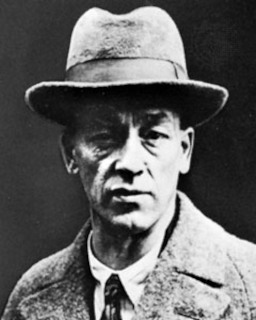
Seán MacBride, Irish government minister, prominent international politician, and a former Chief of Staff of the Irish Republican Army (IRA), dies in Dublin at the age of 83 on January 15, 1988.

MacBride is born in Paris on January 26, 1904. He is the son of Major John MacBride and Maud Gonne. After his father’s execution for his participation in the Easter Rising of 1916, MacBride is sent to school at Mount St. Benedict’s, Gorey, County Wexford in Ireland. In 1919, at the age of 15, he joins the Irish Volunteers, which fights as part of the Irish Republican Army, and takes part in the Irish War of Independence. He is imprisoned by the Irish Free State but is released in 1924 and resumes his IRA activities. He returns to Dublin in 1927 and becomes the Director of Intelligence of the IRA.

Toward the end of the 1920s, after many supporters have left the IRA to join Fianna Fáil, some members start pushing for a more left-wing agenda. After the IRA Army Council votes down the idea, MacBride launches a new movement, Saor Éire (“Free Ireland”), in 1931. Although it is a non-military organisation, Saor Éire is declared unlawful along with the IRA, Cumann na mBan, and nine other organizations.

In 1936, MacBride becomes Chief of Staff of the IRA after Moss Twomey is sent to prison for three years. At the time, the movement is in a state of disarray, with conflicts between several factions and personalities. In 1937, he is called to the bar and then resigns from the IRA when the Constitution of Ireland is enacted later that year. As a barrister, he frequently defends IRA political prisoners, but is not unsuccessful in stopping the execution of Charlie Kerins in 1944 who is convicted of killing Garda Detective Dennis O’Brien in 1942. In 1946, during the inquest into the death of Seán McCaughey, he embarrasses the authorities by forcing them to admit that the conditions in Portlaoise Prison are inhumane.

In 1946, MacBride founds the republican/socialist party Clann na Poblachta, hoping it would replace Fianna Fáil as Ireland’s major political party. In October 1947, he wins a seat in Dáil Éireann at a by-election in the Dublin County constituency. However, at the 1948 Irish general election Clann na Poblachta wins only ten seats.

MacBride is serving as Minister of External Affairs when the Council of Europe drafts the European Convention on Human Rights. He serves as President of the Committee of Ministers of the Council of Europe from 1949 to 1950 and is credited with being a key force in securing the acceptance of this convention, which is finally signed in Rome on November 4, 1950. He is instrumental in the implementation of the repeal of the External Relations Act and the passing of the Republic of Ireland Act 1948 which comes into force in 1949.

Clann na Poblachta is reduced to only two seats after the 1951 Irish general election. MacBride keeps his seat and is re-elected again at the 1954 Irish general election. Opposing the internment of IRA suspects during the Border Campaign (1956–62), he contests both the 1957 and 1961 Irish general elections but fails to be elected both times. He then retires from politics but continues practicing as a barrister. He expresses interest in running as an independent candidate in the 1983 Irish presidential election, but does not receive sufficient backing and ultimately does not enter the contest.

Throughout the 1950s, 1960s, and 1970s, MacBride works tirelessly for human rights worldwide. He is a founding member of Amnesty International and serves as its International chairman from 1961 until 1975. During the 1980s, he initiates the Appeal by Lawyers against Nuclear War which is jointly sponsored by the International Peace Bureau and the International Progress Organization.

MacBride is awarded the Nobel Peace Prize in 1974 as a man who “mobilised the conscience of the world in the fight against injustice.” He later receives the Lenin Peace Prize (1975–76) and the UNESCO Silver Medal for Service (1980).

In his later years, MacBride lives in his mother’s home, Roebuck House, that served as a meeting place for many years for Irish nationalists, as well as in the Parisian arrondissement where he grew up with his mother, and enjoyed strolling along boyhood paths. In 1978, he receives the Golden Plate Award of the American Academy of Achievement.

MacBride dies in Dublin on January 15, 1988, just eleven days shy of his 84th birthday. He is buried in a simple grave in Glasnevin Cemetery, Dublin, with his mother, and wife who died in 1976.


Leave a comment

Death of James Stephens, Novelist & Poet

James Stephens, Irish novelist and poet, dies in London, England on December 26, 1950, Saint Stephen’s Day.

Stephens’ birth is somewhat shrouded in mystery. He claims to have been born on the same day and same year as James Joyce, February 2, 1882, whereas he is in fact probably the same James Stephens who is on record as being born at the Rotunda Hospital in Dublin, on February 9, 1880, the son of Francis Stephens of 5 Thomas’s Court, Dublin, a vanman and a messenger for a stationer’s office, and his wife, Charlotte Collins. His father dies when he is two years old and, when he was six years old, his mother remarries. He is committed to the Meath Protestant Industrial School for boys in Blackrock for begging on the streets, where he spends much of the rest of his childhood. He attends school with his adoptive brothers Thomas and Richard Collins before graduating as a solicitor‘s clerk. They compete and win several athletic competitions despite James’ tiny 4’10” stature. He is known affectionately as “Tiny Tim.” He is much enthralled by the tales of military valour of his adoptive family and would have become a soldier except for his height.

By the early 1900s Stephens is increasingly inclined to socialism and the Irish language and by 1912 is a dedicated Irish Republican. He is a close friend of the 1916 leader Thomas MacDonagh, who is then editor of The Irish Review and deputy headmaster in St. Enda’s School, the radical bilingual Montessori school run by Patrick Pearse and later manager of the Irish Theatre. He spends much time with MacDonagh in 1911. His growing nationalism brings a schism with his adoptive family, but probably wins him his job as registrar in the National Gallery of Ireland, where he works between 1915 and 1925, having previously had an ill-paid job with the Mecredy firm of solicitors.

Stephens produces many retellings of Irish myths. His retellings are marked by a rare combination of humour and lyricism, with Deirdre and Irish Fairy Tales especially often praised. He also writes several original novels, including The Crock of Gold, Etched in Moonlight and Demi-Gods, based loosely on Irish wonder tales. The Crock of Gold in particular has achieved enduring popularity and has often been reprinted.

Stephens begins his career as a poet under the tutelage of poet and painter Æ (George William Russell). His first book of poems, Insurrections, is published in 1909. His last book, Kings and the Moon (1938), is also a volume of verse. His influential account of the 1916 Easter Rising, Insurrection in Dublin, describes the effect of the deaths by execution of his friend Thomas MacDonagh and others as being “like watching blood oozing from under a door.”

Stephens later lives between Paris, London and Dublin. During the 1930s he is a friend of James Joyce, and they wrongly believe that they share a birthday. Joyce, who is concerned about his ability to finish what later becomes Finnegans Wake, proposes that Stephens assist him, with the authorship credited to JJ & S (for “Jameses Joyce & Stephens”, but also a pun on the popular Jameson Irish Whiskey, made by John Jameson & Sons). The plan is never implemented, as Joyce is able to complete the work on his own.

During the last decade of his life Stephens finds a new audience through a series of broadcasts on the BBC.


Leave a comment

Death of Marie-Louise O’Murphy, Mistress of Louis XV

Marie-Louise O’Murphy, one of the lesser mistresses of King Louis XV of France and possibly the model for the famous painting by François Boucher, dies in Paris on December 11, 1814.

O’Murphy is born in Rouen, France on October 21, 1737 as the youngest of twelve children of Daniel Morfi and Marguerite Iquy, a family of Irish origin. Her parents have well-known criminal histories. Her father was involved in a case of espionage and blackmail while her mother was accused of prostitution and theft. She and her sisters are also known for being involved in prostitution.

Contemporary and modern historiography believe O’Murphy is the very young model who posed for the Jeune Fille allongée (Reclining Girl), of François Boucher, a painting famous for its undisguised eroticism, dating from 1752. Two versions of this painting have survived, both conserved in Germany, one in the Alte Pinakothek at Munich and the other in the Wallraf-Richartz Museum at Cologne.

The term petite maîtresse (little mistress) is given to Louis XV’s mistresses that are not formally presented at court, and unlike the official mistress (maîtresse-en-titre) do not have an apartment in Palace of Versailles. Generally recruited by the King’s valets in Paris surroundings, if their affair lasts more than a single night, they are placed in a group of houses in the district of Parc-aux-Cerfs in Versailles, or close to other royal residences. O’Murphy resides there for two years, from 1753 to 1755.

After a miscarriage in mid-1753 which almost kills her, O’Murphy gives birth to Louis XV’s illegitimate daughter, Agathe-Louise de Saint-Antoine de Saint-André, born in Paris on June 20, 1754. The King, who does not want to recognize the offspring born from petites maîtresses and brief affairs, orders that the newborn must be immediately placed in care of a wet nurse. Subsequently, Agathe-Louise is sent to the Couvent de la Présentation, where she is raised.

After serving as a mistress to the King for almost two years, O’Murphy makes a mistake that is common for many courtesans, that of trying to replace the official mistress. She unwisely tries to unseat the longtime royal favorite, Madame de Pompadour. This ill-judged move quickly results in her downfall at court. In November 1755 she is expelled at night from her home at Parc-aux-Cerfs, repudiated by the King, and sent far away from Versailles.

O’Murphy hastily marries Jacques Pelet de Beaufranchet, Seigneur d’Ayat on November 25, 1755. Soon after she becomes pregnant. Her first child, a daughter named Louise Charlotte Antoinette Françoise Pelet de Beaufranchet, is born on October 30, 1756 (she dies at the age of two). Thirteen months later, on November 5, 1757, her husband is killed in action at the Battle of Rossbach. Seventeen days after his death she gives birth a second child, a son, Louis Charles Antoine de Beaufranchet, the later Comte de Beaufranchet and General under the Republic.

On February 19, 1759, O’Murphy marries François Nicolas Le Normant, Comte de Flaghac and Receiver General of Finance in Riom, a divorcee with three children. From this marriage, she gives birth to a daughter, Marguerite Victoire Le Normant de Flaghac on January 5, 1768, who, according to one theory, could be another illegitimate daughter of Louis XV. François Le Normant dies on April 24, 1783.

During the Reign of Terror O’Murphy is imprisoned as a “suspect,” under the name of O’Murphy, at Sainte-Pélagie Prison and later at the English Benedictine convent in Paris. After her release she marries Louis Philippe Dumont, a moderate MP for Calvados in the National Convention and twenty-eight years her junior, on June 19, 1795. This union quickly fails, and after almost three years, they divorce on March 16, 1798. She never marries again.

Marie-Louise O’Murphy dies in Paris on December 11, 1814 aged 77, at the home of her daughter Marguerite Le Normant.


Leave a comment

Birth of James Butler, 1st Duke of Ormond

James Butler, 12th Earl and 1st Duke of Ormond, is born at Clerkenwell, London on October 19, 1610. An Anglo-Irish Protestant, he is the leading agent of English royal authority in Ireland during much of the period from the beginning of the English Civil War (1642–1651) to the Glorious Revolution (1688–1689).

Butler is born into the prominent Butler family, the eldest child of Thomas Butler and his wife Elizabeth Poyntz. He grows up in England and succeeds to the earldom of Ormonde in 1633. That same year he begins his active career in Ireland by offering his services to Lord Deputy of Ireland Thomas Wentworth, later Earl of Strafford. Upon the outbreak of the Irish Rebellion of 1641 in Ireland, he is appointed a lieutenant general in the English army. He defeats the rebels of the Catholic confederacy at Kilrush, Munster on April 15, 1642, and at New Ross, Leinster on March 18, 1643. Those triumphs, however, do not prevent the confederates from overrunning most of the country.

Butlers’s attempts to conclude a peace are blocked by a Catholic faction that advocates complete independence for Ireland. The situation deteriorates further, and, in July 1647, he departs from Ireland, leaving the Protestant cause in the hands of the parliamentarians, who had defeated King Charles I in the first English Civil War (1642–1646).

Returning to Ireland in September 1648, Butler concludes a peace with the confederacy in January 1649. He then rallies Protestant royalists and Catholic confederates in support of Charles II, son and successor of Charles I. For several months most of Ireland is under his control. But the parliamentarian general Oliver Cromwell lands at Dublin in August 1649 and swiftly conquers the country for Parliament. Butler flees to France and becomes one of Charles II’s closest advisers at his court-in-exile in Paris.

When Charles II returns to England in the Restoration of 1660, Butler, who had urged constitutional rather than military rule, is made commissioner for the treasury and the navy. Appointed Lord Lieutenant of Ireland in 1662, he makes vigorous attempts to encourage Irish commerce and industry. Nevertheless, his enemies at court persuade Charles to dismiss him in 1669. He is restored to royal favour in 1677 and is again appointed Lord Lieutenant of Ireland. Although he is created a duke in the English peerage in 1682, he is recalled from Ireland in 1684 as a result of new intrigues at Charles’s court and because of the determination of James, Duke of York, to strengthen his supporters in Ireland.

Butler dies on July 21, 1688, at Kingston Lacy estate, Dorset. He is buried in Westminster Abbey on August 4, 1688. His eldest son, Thomas, 6th Earl of Ossory, predeceases him, but Ossory’s eldest son James succeeds as 2nd Duke of Ormonde (1665–1745).

(Pictured: “James Butler, 1st Duke of Ormond,” oil on canvas by William Wissing, National Portrait Gallery)


Leave a comment

Birth of Irish Tenor Frank Patterson

Frank Patterson, internationally renowned Irish tenor following in the tradition of singers such as Count John McCormack and Josef Locke, is born on October 5, 1938, in Clonmel, County Tipperary. He is known as “Ireland’s Golden Tenor.”

As a boy Patterson performs with his local parish choir and is involved in maintaining the annual tradition of singing with the “Wrenboys.” He sings in the local St. Mary’s Choral Society and at a production of The Pirates of Penzance performed with both his parents. His interests extend beyond music and as a boy he represents Marlfield GAA hurling club, plays tennis at Hillview and golf at the Mountain Road course. He quits school at an early stage to work in the printing business of his mother’s family. He moves to Dublin in 1961 to enroll at the National Academy of Theatre and Allied Arts where he studies acting while at the same time receiving vocal training from Hans Waldemar Rosen. In 1964, he enters the Feis Ceoil, a nationwide music competition, in which he wins several sections including oratorio, lieder and the German Gold Cup.

Patterson gives classical recitals around Ireland and wins scholarships to study in London, Paris and in the Netherlands. While in Paris, he signs a contract with Philips Records and releases his first record, My Dear Native Land. He works with conductors and some of the most prestigious orchestras in Europe including the London Symphony Orchestra and Orchestre de Paris. He also gains a reputation as a singer of Handel, Mozart, and Bach oratorios and German, Italian and French song. He has a long-running programme on RTÉ titled For Your Pleasure.

In the early 1980s Patterson moves to the United States, making his home in rural Westchester County, New York. A resurgence of interest in Irish culture encourages him to turn towards a more traditional Irish repertoire. He adds hymns, ballads, and traditional as well as more popular tunes to his catalogue. In March 1988 he is featured host in a St. Patrick’s Day celebration of music and dance at New York City‘s famous Radio City Music Hall. He also gives an outdoor performance before an audience of 60,000 on the steps of the United States Capitol in Washington, D.C. with the National Symphony Orchestra.

Patterson is equally at home in more intimate settings. His singing in the role of the Evangelist in Bach’s St. John Passion is given fine reviews. Further recordings follow, of Beethoven arrangements, Irish songs, Berlioz songs, Purcell songs and others, all on the Philips label.

Patterson performs sold-out concerts from London’s Royal Albert Hall to New York’s Carnegie Hall, and with his family he presents two concerts at the White House, for presidents Ronald Reagan in 1982 and Bill Clinton in 1995. He records over thirty albums in six languages, wins silver, gold and platinum discs and is the first Irish singer to host his own show in Radio City Music Hall in New York.

Rising to greater prominence with the new popularity of Celtic music in the 1990s, Patterson sees many of his past recordings reissued for American audiences, and in 1998 he stars in the PBS special Ireland in Song. His last album outsells Pavarotti.

In recognition of his musical achievements, he is awarded an honorary doctorate from Salve Regina University in Newport, Rhode Island in 1990, an honorary doctorate in fine arts from Manhattan College in 1996 and the Gold Medal of the Éire Society of Boston in 1998.

In 1999, Patterson learns he has a brain tumour. He has several operations in the following year and his condition appears to stabilise. He is diagnosed with a recurrence of his illness on May 7, 2000. He briefly recuperates and resumes performing. His last performance is on June 4, 2000, at Regis College in the Boston suburb of Weston, Massachusetts. Shortly thereafter he is admitted to the Memorial Sloan Kettering Cancer Center in New York where he lapses into a coma and dies on June 10, 2000, at the age of 61.

At his death accolades and tributes came from, among others, President of Ireland Mary McAleese, Taoiseach Bertie Ahern and Opposition leader John Bruton who said he had “the purest voice of his generation.”