seamus dubhghaill

Promoting Irish Culture and History from Little Rock, Arkansas, USA


Leave a comment

Death of Sir William Moore, Member of Parliament & Judge

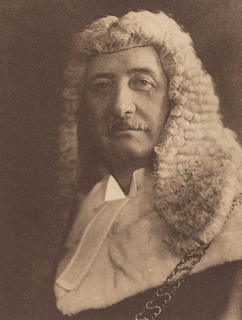
Sir William Moore, 1st BaronetPC (NI)DL, a Unionist member of the British House of Commons from Ireland and a Judge of Ireland, and subsequently of Northern Ireland, dies in Ballymoney, County Antrim, Northern Ireland, on November 28, 1944. He is created a Baronet of Moore Lodge, Ballymoney, in 1932.

Moore is the eldest son of Queen Victoria‘s honorary physician in Ireland, Dr. William Moore of Rosnashane, Ballymoney, and Sidney Blanche Fuller. His ancestors came to Ulster during the Plantation of Ulster, settling at Ballymoney, at which time they were Quakers. The Moore Lodge estate is inherited from a relative. The family owns several other houses: Moore’s Grove and Moore’s Fort. He goes on to become a Deputy Lieutenant for County Antrim and a Justice of the Peace.

Moore is schooled at Marlborough College, then attends Trinity College Dublin (TCD), where he is president of the University Philosophical Society. He marries Helen Gertrude Wilson, the daughter of a Deputy Lieutenant of County Armagh, in 1888. The marriage produces three children. His eldest son, William, inherits his title on his father’s death.

Moore is called to the Irish Bar in 1887, to the English bar in 1899, and becomes an Irish Queen’s Counsel the same year.

In 1903, Moore is one of the first landowners of Ireland to sell off their estates under the land acts. By the early 1920s he owns a Belfast pied-à-terre called “Glassnabreedon,” in the village of Whitehouse, four miles north of Belfast. This house is once owned by the son of Nicholas Grimshaw, Ireland’s first cotton pioneer.

Moore becomes a member of the General Synod of the Church of Ireland and is a founder member of the Ulster Council. He is a passionate Orangeman: his vehemence in defending Ulster’s right to oppose Irish Home Rule is said to alarm even those who share his views. Speaking in England on March 10, 1913, he makes his feelings clear on the possibility of Irish Home Rule: “I have no doubt, if Home Rule is carried, its baptism in Ireland will be a baptism in blood.” He shows little respect for English politicians, and has nothing but contempt for Southern Unionists. The eventual political settlement in 1921 meets with his approval.

Moore is a Member of Parliament, representing North Antrim from 1899 to 1906. From 1903 to 1904, he is an unpaid secretary to the Chief Secretary for Ireland. Having lost his Parliamentary seat in the 1906 United Kingdom general election, he is elected for North Armagh at the 1906 North Armagh by-election in November. He sits for this seat until he is appointed a judge of Ireland’s High Court.

Moore is a Justice of the High Court from 1917 to 1921. He is sworn of the Privy Council of Ireland in the 1921 Birthday Honours, entitling him to the style “The Right .” Following the partition of Ireland, he becomes a Lord Justice of Appeal in the Northern Irish Court of Appeal (1921–25). He is sworn of the Privy Council of Northern Ireland in 1922 and becomes the Lord Chief Justice of Northern Ireland, succeeding Sir Denis Henry. He holds the position until he retires in 1937.

Moore dies at his home, Moore Lodge, in Ballymoney on November 28, 1944, less than a week after his 80th birthday. He is buried in the family burial ground, “Lamb’s Fold,” two days later.


2 Comments

Birth of Charles Kickham, Novelist, Poet, Journalist & Revolutionary

Charles Joseph Kickham, Irish revolutionary, novelist, poet, journalist and one of the most prominent members of the Irish Republican Brotherhood (IRB), is born at Mullinahone, County Tipperary, on May 9, 1828.

Kickham’s father, John Kickham, is the proprietor of the principal drapery in the locality and is held in high esteem for his patriotic spirit. His mother, Anne O’Mahony, is related to the Fenian leader John O’Mahony. He grows up largely deaf and almost blind, the result of an explosion with a powder flask when he is thirteen. He is educated locally, where it is intended that he study for the medical profession. During his boyhood the campaign for a repeal of the Acts of Union 1800 between Great Britain and Ireland is at its height, and he soon becomes versed in its arguments and is inspired by its principles. He often hears the issues discussed in his father’s shop and at home amongst all his friends and acquaintances.

From a young age Kickham is imbued with these patriotic ideals. He becomes acquainted with the teaching of the Young Irelanders through their newspaper The Nation from its foundation in October 1842. His father read the paper aloud every week for the family. Like all the young people of the time, and a great many of the old ones, his sympathies are with the Young Irelanders on their secession from the Repeal Association.

When he is 22 years old, Kickham contributes The Harvest Moon sung to the air of “The Young May Moon,” to The Nation on August 17, 1850. Other verses are to follow, but the finest of his poems according to A. M. O’Sullivan, appear in other journals. Rory of the Hill, The Irish Peasant Girl, and Home Longings, better known as Slievenamon, are published in the Celt. The First Felon appears in the Irishman. Patrick Sheehan, the story of an old soldier, is published in the Kilkenny Journal, and becomes very popular as an anti-recruiting song.

Kickham begins to write for a number of papers, including The Nation, but also the Celt, the Irishman, the Shamrock, and becomes one of the leading writers of The Irish People, the Fenian newspaper, in which many of his poems appear. His writings are signed using his initials, his full name, or the pseudonyms, “Slievenamon” and “Momonia.”

Kickham is the leading member of the Confederation Club in Mullinahone, which he is instrumental in founding. When the revolutionary spirit begins to grip the people in 1848, he turns out with a freshly made pike to join William Smith O’Brien and John Blake Dillon when they arrive in Mullinahone in July 1848. On hearing of the progress of O’Brien through the country, he sets to work manufacturing pikes and is in the forge when news reaches him that the leaders are looking for him. It is here that he meets James Stephens for the first time. At O’Brien’s request, he rings the chapel bell to summon the people and before midnight a Brigade has answered the summons. He later writes a detailed account about this period which brings his connection with the attempted Rising of 1848 to a close.

After the failed 1848 uprising at Ballingarry, Kickham has to hide for some time, as a result of the part he had played in rousing the people of his native village to action. When the excitement has subsided, he returns to his father’s house and resumes his interests in the sports of fishing and fowling and spends much of his time in literary pursuits. Some of the authors in which he is well versed are Alfred Tennyson and Charles Dickens and he greatly admires George Eliot, and after William Shakespeare, is Robert Burns.

In the autumn of 1857, a messenger arrives from New York with a message for James Stephens from members of the Emmet Monument Association, calling on him to get up an organization in Ireland. On December 23, Stephens dispatches Joseph Denieffe to the United States with his reply and outlines his conditions and his requirements from the organisation in America. Denieffe returnd on March 17, 1858, with the acceptance of Stephens’ terms and £80. That evening the Irish Republican Brotherhood commences. Those present in Langan’s, lathe-maker and timber merchant, 16 Lombard Street, for that first meeting are Stephens, Kickham, Thomas Clarke Luby, Peter Langan, Denieffe and Garrett O’Shaughnessy. Later it includes members of the Phoenix National and Literary Society, which is formed in 1856 by Jeremiah O’Donovan Rossa in Skibbereen, County Cork.

In mid-1863, Stephens informs his colleagues that he wishes to start a newspaper, with financial aid from O’Mahony and the Fenian Brotherhood in America. The offices are established at 12 Parliament Street, almost at the gates of Dublin Castle. The first issue of The Irish People appears on November 28, 1863. The staff of the paper along with Kickham are Luby and Denis Dowling Mulcahy as the editorial staff, O’Donovan Rossa and James O’Connor in charge of the business office, with John Haltigan being the printer. John O’Leary is brought from London to take charge in the role of Editor. Shortly after the establishment of the paper, Stephens departs on an America tour, and to attend to organizational matters. Before leaving, he entrusts to Luby a document containing secret resolutions on the Committee of Organization or Executive of the IRB. Though Luby intimates its existence to O’Leary, he does not inform Kickham as there seems no necessity. This document later forms the basis of the prosecution against the staff of The Irish People.

Kickham’s first contribution to The Irish People, entitled Leaves from a Journal, appears in the third issue and is based on a journal he kept on his way to America in 1863. This article leaves no doubt as to his literary capacity according to O’Leary. It falls to Kickham, as a good Catholic, to tackle the priests, though not exclusively with articles such as “Two Sets of Principles,” a rebuff to the doctrines laid down by Lord Carlisle, and “A Retrospect,” dealing with the tenant-right movement chiefly but also the events of the recent past and their bearing on the present. Kickham articulates the attitude held by the IRB in relation to priests, or more particularly in politics.

On July 15, 1865, American-made plans for a rising in Ireland are discovered when the emissary loses them at Kingstown railway station. They find their way to Dublin Castle and to Superintendent Daniel Ryan, head of G Division. Ryan has an informer within the offices of The Irish People named Pierce Nagle. He supplies Ryan with an “action this year” message on its way to the IRB unit in Tipperary. With this information, Ryan raids the offices of The Irish People on September 15, followed by the arrests of O’Leary, Luby, and O’Donovan Rossa. Kickham is caught after a month on the run. Stephens is also caught but with the support of Fenian prison warders John J. Breslin and Daniel Byrne is less than a fortnight in Richmond Bridewell when he vanishes and escapes to France. The last issue of The Irish People is dated September 16, 1865.

On November 11, 1865, Kickham is convicted of treason. Judge William Keogh, with many expressions of sympathy for the prisoner, and many compliments in reference to his intellectual attainments, sentences him to fourteen years’ penal servitude. The prisoners’ refusal to disown their opposition to British rule in any way, even when facing charges of life-imprisonment, earn them the nickname of “the bold Fenian men.” Kickham spends time from 1866 until his release in the Woking Convict Invalid Prison.

Kickham is given a free pardon from Queen Victoria on February 24, 1869, because of ill-health, and upon his release he is made Chairman of the Supreme Council of the IRB and the unchallenged leader of the reorganized movement. He is an effective orator and chairman of meetings despite his physical handicaps. He wears an ear trumpet and can only read when he holds books or papers within a few inches of his eyes. For many years he carries on conversations by means of the deaf and dumb alphabet.

Kickham is the author of three well-known stories, dealing sympathetically with Irish life and manners and the simple faith, the joys and sorrows, the quaint customs and the insuppressible humour of the peasantry. Knocknagow is deemed one of the finest tales of peasant life ever written. Sally Cavanagh is a touching story illustrating the evils of landlordism and emigration. For the Old Land deals with the fortunes of a small farmer’s family.

Kickham dies on August 22, 1882, at the house of James O’Connor, a former member of the IRB and afterward MP for West Wicklow, 2 Montpelier Place, Blackrock, Dublin, where he had been living for many years, and had been cared for by the poet Rose Kavanagh. He is buried in Mullinahone, County Tipperary.


Leave a comment

Birth of Captain Otway Cuffe

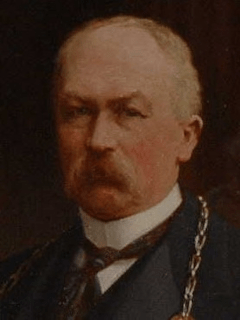
Captain Otway Cuffe, benefactor, Gaelic revivalist, twice mayor of Kilkenny and a founder of businesses and organisations to profit the local people, is born in London on January 11, 1853.

Cuffe is born the Honourable Otway Frederick Seymour Cuffe to John Cuffe, 3rd Earl of Desart, and Lady Elizabeth Lucy Campbell. He has an older sister and two older brothers. After the death of his eldest brother William Ulick, 4th Earl of Desart, his seecond eldest brother, Hamilton, becomes the 5th Earl of Desart. As the 5th Earl has no male heirs himself, Cuffe is nominally his heir. However, as he also dies without heirs, the line becomes extinct upon the death of the 5th Earl.

Cuffe marries Elizabeth St. Aubyn on July 22, 1891. She is the daughter of John St. Aubyn, 1st Baron St. Levan of St. Michael’s Mount, Cornwall, England, and Lady Elizabeth Clementina Townshend. When he becomes the heir to the Kilkenny-based title he moves to Ireland and lives nearby the main house, in Sheestown Lodge, Kilkenny, County Kilkenny. He has been in the British Army, serving as aide-de-camp to Prince Arthur, Duke of Connaught and Strathearn, in 1880–81. He is Groom of the Privy Chamber to Queen Victoria from 1893 until her death in 1901 and Gentleman Usher to both King Edward VII from 1901 until his death in 1910 and King George V until 1911. His rank in the army is Captain in the Rifle Brigade.

Dedicated to ensuring a strong Irish identity in the area, Cuffe works with his sister-in-law, Ellen Cuffe, Countess of Desart. He joins Conradh na Gaeilge soon after his arrival in Kilkenny. He is elected president of its Kilkenny branch in 1904 and remains so until his death. He is replaced by Lady Desart. Together they open the theatre in Kilkenny in 1902 and he is the first President of the Kilkenny Drama Club. He also performs on stage.

Cuffe is first elected Mayor of Kilkenny in 1907 and again in 1908. With Lady Desart, he builds the Kilkenny Woollen Mills, Desart Hall, the Talbot’s Inch model village and the Kilkenny Woodworkers factory. He lays the foundation stone for Kilkenny’s Carnegie library. He is also President of the Irish Industrial Association.

Cuffe is a friend of William Morris whom he had met on a trip to Iceland. He believes in the Arts and Crafts movement and tries to implement it in the projects which he drives. He is also a friend and supporter of Standish James O’Grady and helps him found the weekly radical conservative paper The All-Ireland Review and runs it between 1900 and 1906.

In 1911, Cuffe becomes ill and is forced to move to warmer climates until he recovers. He decides to go to the south of Europe but then a visit to Australia seems appropriate. However, on the journey there he contracts pneumonia and dies at Fremantle in Western Australia on January 3, 1912. He is buried at Perth, carried to his grave by Kilkenny hurlers. The Kilkenny Moderator calls his death “a thunderbolt to the people of Kilkenny.” He is remembered as a visionary who made a permanent impact on the physical landscape of Kilkenny.


Leave a comment

“The Siege of Rochelle” First Performed at Drury Lane Theatre

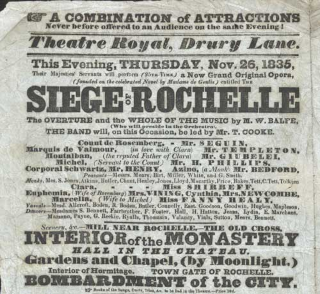
Irish composer Michael William Balfe‘s opera The Siege of Rochelle is first performed at the Drury Lane Theatre in London on October 29, 1835.

The opera is originally prepared for the English Opera House but for some reason the theatrical manager, Samuel James Arnold, does not want it. Instead, Alfred Bunn, the manager of Drury Lane Theatre, seizes the opportunity and begins what is a very fruitful collaboration with Balfe that lasts a decade. Balfe is to become the mainstay of English Opera for almost the next 30 years with a succession of popular operas.

The opera runs for 70 nights on its initial run and is revived in the following three seasons with Balfe singing the role of Michel. Queen Victoria sees the opera on November 15, 1837, her first state visit to a theatre during her reign. In 1836, the opera is reported as staged in Leeds, York, Sheffield, Manchester, Liverpool, Bath and Dublin with Abigail Betts as Clara. John Wilson, who sings in the initial run of the opera, also sings in, at least, some of these. Madame Balfe chooses the opera for her benefit in 1841, and Bunn opens his 1843 season with it on September 30. Emma Romer uses it to open her 1853 season at the Surrey Theatre, although it is being described by then as “somewhat hacknied.”

October 1875 sees a revival of the opera by the Carl Rosa Opera Company at the Princess’s Theatre, and it is then included in the company’s repertoire that tours to Manchester in 1875, Liverpool in 1876, Birmingham in 1877 and Dublin in 1879. The Turner Company tours it in 1893. This is possibly the opera’s last performance until the Wexford Festival Opera performances in 1963. The overture and songs from the opera, such as “When I beheld the anchor weigh’d” continue to retain a place in the concert hall and the home into the 20th century.

In 1838, the opera is performed by the Caradori-Allan troupe at the Park Theatre in New York but fails although it appears to be retained in the repertory. In 1839, it is performed again in Dublin with Balfe as Michel and in Sydney in 1848.

The opera’s production sparks an acrimonious argument between a correspondent in The Examiner accusing Balfe of plagiarism from Luigi Ricci‘s 1832 opera, Chiara di Rosemberg, and, in defence, Frederick Beale, from Balfe’s publishers, and Balfe. The matter seems to be settled in Balfe’s favour when the score of Chiara di Rosemberg is displayed at music publisher Cramer, Beale and Co. so that people can compare the two for themselves. While Edward Fitzball probably uses Ricci’s libretto as the basis for his, it does not seem to have been a straight translation, as some allege, but similarities would help to feed the accusations of plagiarism, bolstered by the Italian training and approach of both composers and the fact that Balfe had sung in Chiara di Rosemberg in Italy in 1834.

Balfe is said to have been paid £5 a night by Bunn and 400 guineas for the score by the publishers Cramer, Beale and Co. In 1871, the Bury and Norwich Post (April 11, 1871) report that the copyright has sold for £156 and just over ten years later the Aberdeen Evening Express (May 8, 1883) notes that the copyright has been sold again for approximately £20, adding “So much for Balfe’s ‘popularity.”


Leave a comment

Birth of Thomas Cleeve, Businessman & High Sheriff of Limerick City

Sir Thomas Henry Cleeve, a Canadian-born businessman, domiciled in Ireland, is born in Cleveland, Quebec, Canada, on June 5, 1844. He is elected High Sheriff of Limerick City on three occasions.

Cleeve is the eldest son of Edward Elmes Cleeve, an English immigrant, and Sophia Journeaux, whose family came from Ireland.

In 1860, Cleeve travels to Ireland to stay with his mother’s relatives who run an agricultural machinery business in Limerick known as J.P. Evans & Company. He decides to remain in Ireland and eventually assumes control of the business.

Cleeve marries Phoebe Agnes Dann in 1874 and they have five children. The author and broadcaster Brian Cleeve is his grand nephew.

In 1883, Cleeve starts a new enterprise, the Condensed Milk Company of Ireland, in conjunction with two local businessmen. The company manufactures dairy products, such as condensed milk, butter, cheese and confectionery. Its headquarters are located in Limerick city, on the northern bank of the River Shannon. The business expands over the next 20 years to become the largest of its type in the United Kingdom.

Cleeve is also senior partner in the Cleeve Canning and Cold Storage Company based in British Columbia. He is also the President of Limerick Chamber in 1908-09.

In 1899, Cleeve is voted onto the Limerick City Council. That same year, his fellow councillors elect him as High Sheriff of Limerick City, the Queen’s representative in the city. He holds the position again in 1907 and 1908.

In 1900, following a visit to Ireland by Queen Victoria, Cleeve receives a knighthood from the Lord Lieutenant.

In December 1908, Cleeve is taken ill at a public function. Despite undergoing surgery, he dies of peritonitis on December 19, 1908, at the age of 64. According to contemporary newspaper reports his funeral is one of the largest seen in Limerick city, with crowds lining the streets up to an hour before the cortège passes. He is buried in the churchyard of St. Mary’s Cathedral in the city.


Leave a comment

The Execution of Fenian Michael Barrett

Michael Barrett, Irish activist and a member of the Fenians, is executed on May 26, 1868, for his part in the Clerkenwell Gaol explosion in December 1867. From all the evidence, it is likely he is not guilty. He is the last man to be publicly hanged in England.

Barrett is born in 1841 in Drumnagreshial in the Ederney area of County Fermanagh. As a young man and in search of work, he moves to Glasgow where, at the age of 27, he joins the Irish Republican Brotherhood (IRB), often referred to as Fenians. In the 1860s, the IRB is a political movement that dominates Irish Republican politics and defies the Catholic Church, middle-class nationalists who advocate milder approaches and Irish Unionists. Tens of thousands of Irishmen in both Ireland and Great Britain are recruited into its ranks.

The Clerkenwell bombing is the most infamous action carried out by the Fenians in mainland Britain. It results in a long-lived backlash that foments much hostility against the Irish community in Britain.

The events that lead up to the bombing start with the arrest in November 1867 of Ricard O’Sullivan Burke, a senior Fenian arms agent who planned the “prison-van escape” in Manchester a few months earlier. O’Sullivan-Burke is subsequently imprisoned on remand in the Middlesex House of Detention, Clerkenwell. On December 13, an attempt to rescue him is made by blowing a hole in the prison wall. The explosion is seriously misjudged. It demolishes not only a large section of the wall, but also a number of tenement houses opposite in Corporation Lane (now Corporation Row), killing 12 people and wounding up to 120 more.

The bombing has a traumatic effect on British working-class opinion. The radical, Charles Bradlaugh, condemns the incident in his newspaper, the National Reformer, as an act “calculated to destroy all sympathy, and to evoke the opposition of all classes.”

The day before the explosion, Prime Minister Benjamin Disraeli bans all political demonstrations in London in an attempt to put a stop to the weekly meetings and marches that are being held in support of the Fenians. He fears that the ban might be challenged, but the explosion has the effect of turning public opinion in his favour.

Months earlier, Barrett had been arrested in Glasgow for illegally discharging a firearm and allegedly false evidence is used to implicate him in the Clerkenwell Prison explosion. In court, he produces witnesses who testify that he had been in Scotland on the date of the incident. The main case against him rests on the evidence of Patrick Mullany, a Dubliner known to have given false testimony before and whose price is a free passage to Australia, who tells the court that Barrett had informed him that he had carried out the explosion with an accomplice by the name of Murphy. After two hours of deliberation the jury pronounces Barrett guilty. On being asked if he has anything to say before sentence is passed, he delivers an emotional speech from the dock.

Many people, including a number of radical MPs, press for clemency. In Fermanagh, Barrett’s aged mother walks several miles in the snow to appeal to the local Irish Conservative Party MP, Captain Mervyn Edward Archdale, a staunch Orangeman, who rejects her.

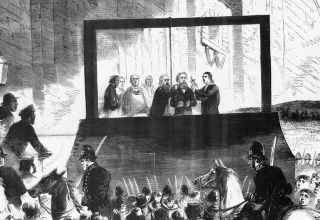
Barrett is executed outside the walls of Newgate Prison on May 26, 1868, before a crowd of two thousand who boo, jeer and sing “Rule, Britannia!” and “Champagne Charlie” as his body drops. His execution is the last public hanging to take place in England. The hangman is William Calcraft.

Until their transfer to the City of London Cemetery, Barrett’s remains lay for 35 years in a lime grave inside the walls of Newgate Prison. When the prison is demolished in 1903 his remains are taken to their present resting place. Today the grave is a place of Fenian pilgrimage and is marked by a small plaque.

After the explosion, the Prime Minister Disraeli advocates the suspension of the Habeas Corpus Act 1862 in Great Britain, as is already the case in Ireland. Greater security measures are quickly introduced. Thousands of special constables are enrolled to aid the police and at Scotland Yard a special secret service department is established to meet the Fenian threat. Although a number of people are arrested and brought to trial, Barrett is the only one to receive the death sentence.

Within days of the explosion, the Liberal Party leader, William Ewart Gladstone, then in opposition, announces his concern about Irish Nationalist grievances and says that it is the duty of the British people to remove them. Later, he says that it is the Fenian action at Clerkenwell that turned his mind towards Home Rule. When Gladstone discovers at Hawarden later that year that Queen Victoria had invited him to form a government, he famously states, “my mission is to pacify Ireland.”


Leave a comment

Death of William Wilde, Surgeon, Author & Father of Oscar Wilde

Sir William Robert Wills Wilde, Irish otoophthalmologic surgeon and the author of significant works on medicine, archaeology and folklore, particularly concerning his native Ireland dies on April 19, 1876. He is the father of poet and playwright Oscar Wilde.

Wilde is born in March 1815 at Kilkeevin, near Castlerea, County Roscommon, the youngest of the three sons and two daughters of a prominent local medical practitioner, Thomas Wills Wilde, and his wife, Amelia Flynne. His family are members of the Church of Ireland, and he is descended from a Dutchman, Colonel de Wilde, who came to Ireland with King William of Orange‘s invading army in 1690, and numerous Anglo-Irish ancestors. He receives his initial education at the Elphin Diocesan School in Elphin, County Roscommon. In 1832, he is bound as an apprentice to Abraham Colles, the pre-eminent Irish surgeon of the day, at Dr. Steevens’ Hospital in Dublin. He is also taught by the surgeons James Cusack and Sir Philip Crampton and the physician Sir Henry Marsh. He also studies at the private and highly respected school of anatomy, medicine, and surgery in Park Street (later Lincoln Place), Dublin. In 1837, he earns his medical degree from the Royal College of Surgeons in Ireland. In the same year, he embarks on an eight-month-cruise to the Holy Land with a recovering patient, visiting various cities and islands throughout the Mediterranean. Porpoises are flung on board the ship, Crusader, and Wilde dissects them. Taking notes, he eventually composes a two-volume book on the nursing habits of the creatures. Among the places he visits on this tour is Egypt. In a tomb he finds the mummified remains of a dwarf and salvages the torso to bring back to Ireland. He also collects embalmed ibises.

Once back in Ireland, Wilde publishes an article in the Dublin University Magazine suggesting that one of the “Cleopatra’s Needles” be transported to England. In 1878, one of the Needles is transported to London, and in 1880 the other one is brought to New York City‘s Central Park. In 1873 he is awarded the Cunningham Gold Medal by the Royal Irish Academy.

Wilde runs his own hospital, St. Mark’s Ophthalmic Hospital for Diseases of the Eye and Ear, in Dublin and is appointed to serve as Oculist-in-ordinary to Queen Victoria. At one point, he performs surgery on the father of another famous Irish dramatist, George Bernard Shaw.

Wilde had a very successful medical practice and is assisted in it by his natural son, Henry Wilson, who had been trained in Dublin, Vienna, Heidelberg, Berlin, and Paris. Wilson’s presence enables him to travel, and he visits Scandinavia, where he receives an honorary degree from Uppsala University, and is welcomed in Stockholm by Anders Retzius, among others. King Charles XV of Sweden confers on him the Nordstjärneorden (Order of the Polar Star). In 1853, he is appointed Surgeon Occulist in Ordinary to the Queen in Ireland, the first position of its kind, probably created for him.

Wilde is awarded a knighthood in a ceremony at Dublin Castle on January 28, 1864, more for his involvement with the Irish census than for his medical contributions, although he had been appointed medical commissioner to the Irish census in 1841. In 1845, he becomes editor of the Dublin Journal of Medical & Chemical Science, to which he contributes many articles.

Wilde marries the poet Jane Francesca Agnes Elgee on November 12, 1851, who writes and publishes under the pen name of Speranza. The couple has two sons, William (Willie) and Oscar, and a daughter, Isola Francesca, who dies in childhood.

In addition to his children with his wife, Wilde is the father of three children born out of wedlock before his marriage: Henry Wilson, born in 1838, and Emily and Mary Wilde, born in 1847 and 1849, respectively, of different parentage to Henry. He acknowledges paternity of his illegitimate children and provides for their education, but they are reared by his relatives rather than with his wife and legitimate children. Emily and Mary both die in 1871 following a Halloween party at which their dresses accidentally catch fire.

From 1855 until his death in 1876, Wilde lives at 1 Merrion Square, now the headquarters of American College Dublin. The building is named Oscar Wilde House after William Wilde’s son, who also lives at the address from 1855 until 1878. There is a plaque at 1 Merrion Square dedicated to him.

Wilde’s reputation suffers when Mary Travers, a long-term patient of his and the daughter of a colleague, claims that he had seduced her two years earlier. She writes a pamphlet crudely parodying Wilde and Lady Wilde as Dr. and Mrs. Quilp, and portraying Dr. Quilp as the rapist of a female patient anaesthetised under chloroform. She distributes the pamphlets outside the building where Wilde is about to give a public lecture. Lady Wilde complains to Mary’s father, Robert Travers, which results in Mary bringing a libel case against her. Mary Travers wins her case but is awarded a mere farthing in damages by the jury. Legal costs of £2,000 are awarded against Lady Wilde. The case is the talk of all Dublin, and Wilde’s refusal to enter the witness box during the trial is widely held against him as ungentlemanly behaviour.

From this time onwards, Wilde begins to withdraw from Dublin to the west of Ireland, where he had started in 1864 to build what becomes Moytura, his house overlooking Lough Corrib in Connemara, County Galway. His health deteriorates in 1875. He dies, likely of cancer, at the age of 61 on April 19, 1876. He is buried in Mount Jerome Cemetery in Dublin.

(Pictured: Sketch of William Wilde by J.H. Maguire, 1847)


Leave a comment

Birth of Justin McCarthy, Historian, Novelist & Politician

Justin McCarthy, Irish nationalist and Liberal historian, novelist and politician, is born in Cork, County Cork on November 22, 1830. He is a Member of Parliament (MP) from 1879 to 1900, taking his seat in the House of Commons of the United Kingdom of Great Britain and Ireland.

McCarthy is educated in Cork. He begins his career as a journalist at the age of 18 in Cork. From 1853 to 1859 he is in Liverpool, on the staff of the Northern Daily Times. In March 1855, he marries Charlotte Ailman. In 1860 he moves to London, as parliamentary reporter to the Morning Star, of which he becomes editor in 1864. He gives up his post in 1868 and, following a lecturing tour in the United States, joins the staff of The Daily News as leader-writer in 1870. In this capacity he becomes one of the most useful and respected upholders of the liberal politics of the time. He lectures again in America in 1870–71 and in 1886–87.

McCarthy is first elected to Parliament at a by-election on April 4, 1879, when he is returned unopposed as a Home Rule League MP for Longford. He is re-elected unopposed as a Parnellite Home Ruler in 1880, and when the two-seat Longford constituency is split into two divisions under the Redistribution of Seats Act 1885, he is elected as an Irish Parliamentary Party member for the new single-seat North Longford constituency. His sole opponent, James Mackay Wilson of the Irish Conservative Party, wins only 6% of the votes.

At the 1886 United Kingdom general election, McCarthy is returned unopposed in North Longford, but also stands in Londonderry City, where he is declared the loser to the Irish Unionist Alliance candidate by the narrow margin of 1778 votes to 1781. However, the result is later overturned on petition and McCarthy opts to sit for Londonderry City. During the divorce controversy surrounding Charles Stewart Parnell in November 1890, the British Prime Minister William Ewart Gladstone expresses a warning, given to McCarthy as intermediary, that if Parnell retains leadership of the Irish Parliamentary Party, it will mean the loss of the next election, the end of their alliance and Home Rule. When the annual party leadership election meeting is called later that month, the threat is somehow not conveyed to the members, who re-elect Parnell leader of the Party.

After a further historical meeting of the Irish Party MPs in early December, Parnell refuses to retire and the Party divides. McCarthy becomes chairman of the Anti-Parnellite group, the Irish National Federation, for a year in 1891–92. His nationalism is of a temperate and orderly kind, and though his personal distinction singles him out for the chairmanship during the party dissensions of this period, he is in no active sense the political leader.

At the 1892 United Kingdom general election, McCarthy again stands both in North Longford and in Londonderry City. In each seat there is a two-way contest between the Anti-Parnellite McCarthy and a Unionist candidate, but the narrow Unionist victory in Londonderry is not overturned, and McCarthy sits for North Longford, where he wins over 93% of the votes. He is returned unopposed for North Longford in 1895 United Kingdom general election in Ireland and stands down from Parliament at the 1900 United Kingdom general election In Ireland.

It is claimed that McCarthy’s true vocation is literature. His earliest publications are novels, some of which, such as A Fair Saxon (1873), Dear Lady Disdain (1875), Miss Misanthrope (1878), and Donna Quixote (1879), attain considerable popularity. His most important work is his History of Our Own Times, which treats of the period between Queen Victoria‘s accession and her Diamond Jubilee. He begins a History of the Four Georges (1884–1901) and the latter half is written by his son, Justin Huntly McCarthy.

Justin McCarthy dies at the age of 81 in Folkestone, Kent, England on April 24, 1912.

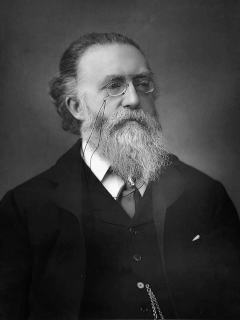
(Pictured: Portrait style photograph of Irish politician Justin McCarthy, taken in 1891 by Herbert Rose Barraud)


Leave a comment

The Irish Church Act 1869 Receives Royal Assent

The Irish Church Act 1869 receives British royal assent on July 26, 1869. The Act is an act of the Parliament of the United Kingdom which separates the Church of Ireland from the Church of England and disestablishes the former, a body that commands the adherence of a small minority of the population of Ireland. The Act is passed during the first ministry of William Ewart Gladstone and comes into force on January 1, 1871. It is strongly opposed by Conservatives in both houses of Parliament.

The Act means the Church of Ireland is no longer entitled to collect tithes from the people of Ireland. It also ceases to send representative bishops as Lords Spiritual to the House of Lords in Westminster. Existing clergy of the church receive a life annuity in lieu of the revenues to which they are no longer entitled: tithes, rentcharge, ministers’ money, stipends and augmentations, and certain marriage and burial fees.

The passage of the Bill through Parliament causes acrimony between the House of Commons and the House of Lords. Queen Victoria personally intervenes to mediate. While the Lords extort from the Commons more compensation to alleviate the disestablished churchmen, in the end, the will of the Commons prevail.

The Irish Church Act is a key move in dismantling the Protestant Ascendancy which had dominated Ireland for several centuries previously.


Leave a comment

Birth of Mary Ward, Astronomer, Microscopist, Author & Artist

Mary Ward (née King), Irish naturalist, astronomer, microscopist, author, and artist, is born in Ballylin near present-day Ferbane, County Offaly, on April 27, 1827. She is killed in 1869 when she falls under the wheels of an experimental steam car built by her cousins, thereby becoming the first person known to be killed by a motor vehicle.

King is the youngest child of the Reverend Henry King and his wife Harriette. She and her sisters are educated at home, as are most girls at the time. However, her education is slightly different from the norm because she is of a renowned scientific family. She is interested in nature from an early age, and by the time she is three years old she is collecting insects.

King is a keen amateur astronomer, sharing this interest with her cousin, William Parsons, 3rd Earl of Rosse, who builds the Leviathan of Parsonstown, a reflecting telescope with a six-foot mirror which remains the world’s largest until 1917. She is a frequent visitor to Birr Castle, producing sketches of each stage of the process. Along with photographs made by Parson’s wife, Mary Rosse, her sketches are used to aid in the restoration of the telescope.

King also draws insects, and the astronomer James South observes her doing so one day. She is using a magnifying glass to see the tiny details, and her drawing so impresses him that he immediately persuades her father to buy her a microscope. A compound microscope made by Andrew Ross is purchased for £48 12s 8d. This is the beginning of a lifelong passion. She begins to read everything she can find about microscopy, and teaches herself until she has an expert knowledge. She makes her own slides from slivers of ivory, as glass is difficult to obtain, and prepares her own specimens. The physicist David Brewster asks her to make his microscope specimens, and uses her drawings in many of his books and articles.

Universities and most societies do not accept women at the time, but King obtains information any way she can. She writes frequently to scientists, asking them about papers they had published. During 1848, Parsons is made president of the Royal Society, and visits to his London home allows her to meet many scientists.

King is one of only three women on the mailing list for the Royal Astronomical Society. The others are Queen Victoria and Mary Somerville, a scientist for whom Somerville College at the University of Oxford is named.

On December 6, 1854, King marries Henry Ward of Castle Ward, County Down, who in 1881 succeeds to the title of Viscount Bangor. They have three sons and five daughters, including Maxwell Ward, 6th Viscount Bangor. Her best-known descendants are her grandson, Edward Ward, the foreign correspondent and seventh viscount, and his daughter, the Doctor Who actress Lalla Ward.

When Ward writes her first book, Sketches with the microscope (privately printed in 1857), she apparently believes that no one will print it because of her gender or lack of academic credentials. She publishes 250 copies of it privately, and several hundred handbills are distributed to advertise it. The printing sells during the next few weeks, which prompts a London publisher to take the risk and contract for future publication. The book is reprinted eight times between 1858 and 1880 as A World of Wonders Revealed by the Microscope. A new full-colour facsimile edition at €20 is published in September 2019 by the Offaly Historical and Archaeological Society, with accompanying essays.

Her books are A Windfall for the Microscope (1856), A World of Wonders, Revealed by the Microscope (1857), Entomology in Sport, and Entomology in Earnest (1857, with Lady Jane Mahon), Microscope Teachings (1864), Telescope Teachings (1859). She illustrates her books and articles herself, as well as many books and papers by other scientists.

Ward is the first known automobile fatality. William Parsons’ sons had built a steam-powered car and on August 31, 1869, she and her husband are traveling in it with the Parsons boys, Richard Clere Parsons and the future steam turbine pioneer Charles Algernon Parsons, and their tutor, Richard Biggs. She is thrown from the car on a bend in the road at Parsonstown (present-day Birr, County Offaly). She falls under its wheel and dies almost instantly. A doctor who lives near the scene arrives within moments, and finds her cut, bruised, and bleeding from the ears. The fatal injury is a broken neck. It is believed that the grieving family destroys the car after the crash.

Ward’s microscope, accessories, slides and books are on display in her husband’s home, Castle Ward, County Down. William Parsons’ home at Birr Castle, County Offaly, is also open to the public.