seamus dubhghaill

Promoting Irish Culture and History from Little Rock, Arkansas, USA


Leave a comment

Death of Playwright George Shiels

George Shiels, playwright, dies following a lengthy illness in Carnlough, County Antrim, Northern Ireland, on September 19, 1949.

Shiels is born on June 24, 1881, in Milltown, Ballybrakes, near Ballymoney, County Antrim, one of seven sons of Robert Shiels, a railway worker, and Eliza Shiels (née Sweeney), who also has one daughter. The family soon moves to Castle Street, Ballymoney, where he attends the local Roman Catholic national school. His elder brothers emigrate to the United States when young. With there being no chance of further schooling even if he wanted it, he leaves Ireland when he is 19 years old. He works as a casual labourer in many places in western North America: as a farmworker and miner in Idaho and Montana, and as a lumber camp worker in British Columbia, Canada. In 1904 he is employed by the Canadian Pacific Railway to supervise a gang of workers who are building a stretch of railway in Saskatchewan. In a serious accident, he is badly injured. Despite surgery on his back, he is never able to walk again, and he receives a disability pension from the railway company.

After a long convalescence in Canada, Shiels returns to his mother’s house in Ballymoney around 1908. He sets up in business in Main Street as a shipping agent and as an agent for the Canadian Pacific Railway, taking bookings from intending emigrants. He is encouraged by his parish priest, Fr. John Hasson, by a local solicitor, Jack Pinkerton, and by James Pettigrew, a teacher, to write short stories. To try to preserve anonymity in a small community, he at first uses the pseudonym “George Morshiel,” and is successful with Western stories and other short fiction. His friends urge him to try writing dramas, and in 1918 Away from the Moss is produced by the Ulster Literary Theatre in Belfast.

After further success there with two short plays in which Shiels is learning his craft, the Abbey Theatre in Dublin accepts a one-act play, Bedmates, which is performed in January 1921. With great regularity for the next twenty years, he writes twenty-two plays for the Abbey Theatre. His work forms the basis of the repertoire in the 1920s and 1930s and attracts large audiences. Plays such as The New Gossoon (1930) provide Dublin theatregoers with entertainment, but also help form the style of acting and production which for many years characterises the Abbey and its actors. Three of his plays, Paul Twyning (1922), Professor Tim (1925) and The New Gossoon, are later performed in theatres in London and are also published in a 1945 volume, which is twice reprinted. Professor Tim, produced by the touring Abbey Theatre, receives enthusiastic reviews in Philadelphia, and The New Gossoon appears successfully on Broadway in New York City in 1932, 1934, and 1937.

Shiels’s earlier work is perhaps easiest for audiences to enjoy. Comedies such as Moodie in Manitoba (1918) portray characters so realistic that north Antrim people believe with some alarm that it might be possible to identify who Shiels had in mind when he created them, and he is at first somewhat less than popular in Ballymoney. He superbly reproduces local language and thoroughly understands the local way of life. Plays he writes late in his career are first performed by the Group Theatre in Belfast, and in these productions (and in the radio versions broadcast by the BBC) his work becomes widely known, almost beloved, in the north of Ireland. During the first half of the twentieth century amateur drama groups throughout Ireland are much more important in local life than they have been since the advent of television. Probably all such societies have at some time staged a Shiels play, and this tradition continues. His plays contain amusing dialogue, carefully crafted plots, and usually more or less happy endings.

However, Shiels’s later works, notably The Passing Day (1936), first broadcast as a radio play, and The Rugged Path (1940), which breaks all records at the Abbey Theatre in a run of three months, tackle darker subject matter and feature characters still less sympathetic even than the rogues and hypocrites of the earlier work. In The Rugged Path and its sequel, The Summit (1941), he explores the moral crisis facing Ireland after the political changes of the 1920s. One critic sees in it an allegory for the contemporary struggle against Adolf Hitler. His view of life in the small towns and farms of Ireland is never in the slightest rosy-tinted, but in the symbolism of The Passing Day, he achieves “bitter intensity” (The Irish Times review, quoted by Casey).

Shiels’s modesty leads him to refuse an honorary doctorate from Queen’s University Belfast (QUB), in 1931. He is reticent about his experiences and beliefs and does little to foster his own reputation. In one early interview he expresses the belief that Ulster theatre needs dramatic material that reflects the psychology and setting of the region. His own work, at its best, achieves this and more. The very qualities which make his work popular in the north of Ireland permit some metropolitan literary critics to dismiss his plays as “kitchen comedies.” However, with the passage of time, his importance as a chronicler of a vanishing way of life can be set alongside the recognition due to him as a prolific and gifted dramatist.

Shiels suffers from a lengthy illness, and though he undergoes an operation in Ballymoney in 1949, dies soon afterwards at his house, New Lodge, in Carnlough, County Antrim, on September 19, 1949. He is buried in the graveyard of Our Lady and St. Patrick in Ballymoney. In the month that he dies, the Group Theatre and Garvagh Young Farmers’ Club are both rehearsing Shiels plays, and there have since been many productions of his plays in the north and elsewhere. Ballymoney Drama Festival presents a portrait of Shiels to the Abbey Theatre, and a new production of The Passing Day is staged there to celebrate his centenary in 1981.


Leave a comment

Death of Thomas McDowell, Former CEO of “The Irish Times”

Thomas Bleakley McDowell, often called T. B. McDowell or simply “the Major,” dies on September 9, 2009. He is a British Army officer and subsequently chief executive of The Irish Times for nearly 40 years.

Born in Belfast, Northern Ireland, on May 18, 1923, the only child of a Protestant and unionist couple, McDowell finishes school at the Royal Belfast Academical Institution in 1941 as World War II is under way. He is dissuaded from enlisting immediately in the British Army by his parents as his father, also named Thomas, had been gassed in World War I and suffers serious lung problems which lead to his early death in 1944. He goes instead to Queen’s University Belfast to study commerce but, a year later and still uncertain about his long-term plans, he joins the Royal Inniskilling Fusiliers, being commissioned in 1943. He goes on to join the Royal Ulster Rifles.

A knee injury during a night training exercise in Omagh makes McDowell ineligible for active military service and he becomes a weapons instructor. The accident also leads to him meeting his future wife, Margaret Telfer, the physiotherapist who treats him in hospital in Bangor, County Down.

McDowell rises to the rank of major and is part of the Allied forces in occupied Austria following the end of the war, taking part in joint patrols in Vienna with Russian, American and French officers. In the post-war period, he is given two years to finish his college course and spends a summer studying law with a tutor before passing the English bar and returning to the British Army.

After a further military posting to Edinburgh, McDowell’s legal qualification brings him to the army legal service in the War Office in London. With little prospect of further promotion and every chance of being posted abroad without his young family, he decides to leave the army. He is offered a job as legal adviser in London to James North Ltd, a company which makes protective clothing. With no experience of industry, he asks to be given a managerial role at first. The company suggests a managing position in its operations in Dublin. He slots easily into the city’s old business establishment, joining the Kildare Street Club, becoming a director of Pim’s department store, and setting his career firmly on a commercial rather than a legal path.

McDowell’s involvement with newspapers comes about through the recognition of his business acumen. He is asked by some acquaintances to take a look at the financial troubles of the Evening Mail, which is bought subsequently by The Irish Times, adding to the latter’s own financial difficulties.

McDowell is asked later by The Irish Times to see if Roy Thomson, the Canadian-born British press baron whom he had met while they both looked separately at the Evening Mail, might be interested in taking it over. Thomson passes and the company then asks McDowell himself to take charge as chief executive in 1962. Among his first actions are to close the Evening Mail and the Sunday Review, a short-lived tabloid that is ahead of its time. A year later, another problem is resolved when Douglas Gageby, who had been hired as managing director of The Irish Times shortly before McDowell’s arrival, takes over as editor.

Thus, what had begun as a slightly awkward relationship, turns into a highly successful partnership as Gageby sets about broadening the newspaper’s editorial appeal and McDowell sets it on a successful commercial course. McDowell always credits Gageby and his successors as editor with the success of the newspaper. Although he has a close relationship with editors, especially Gageby, he does not interfere in the editorial running of the newspaper.

By the early 1970s, the circulation of The Irish Times has almost doubled in a decade to 60,000 and it is making money. Some of the directors indicate an interest in selling the company. McDowell proposes instead that it be turned into a trust. It is a period when several newspapers in Ireland and Britain have changed hands or are seen as being vulnerable to takeovers. His aims are to protect the newspaper’s independence, make it as difficult as possible for anyone to take over, and formalise its aims in a guiding trust.

McDowell works on the trust document for many months, going through 28 drafts before he is satisfied with the result. The five directors of the company, including McDowell and Gageby, transfer their shares in the company to a solicitor in the autumn of 1973 in anticipation of announcing the trust at the end of that year. Further delays in finalising the trust terms result in its announcement in April 1974, on the eve of the introduction of capital gains tax. The timing gives rise to suggestions that the directors are taking their cash (£325,000 each) out of the company before the new tax takes effect. McDowell always denies that this is the case, maintaining that the timing is coincidental. He is also adamant that the motivation behind the formation of the trust itself is altruistic.

The formation of the trust leaves the newspaper with a large bank debt, used to buy out the directors/shareholders, at what turns out to be a difficult economic period after the first oil crisis hits the western world in the autumn of 1974. McDowell successfully guides The Irish Times‘ financial fortunes through the subsequent recession and into further periods of growth throughout the 1980s and 1990s.

McDowell stands down as chief executive of the company in 1997 and retires from the chairmanship of The Irish Times Trust in 2001. He is given the title President for Life in recognition of his huge contribution to the newspaper.

McDowell is a private person and never seeks or exploits the public status or limelight that goes with being a newspaper publisher. During his visit to the new The Irish Times offices on Tara Street in June 2008 for the unveiling of a portrait of him by Andrew Festing, he describes the newspaper and his family as the two loves of his life.

McDowell dies unexpectedly at the age of 87 on September 9, 2009. His funeral takes place in Whitechurch Parish Church, Rathfarnham, followed by burial in the adjoining churchyard.


Leave a comment

Birth of Henry Armstrong, Northern Irish Barrister & Politician

Henry Bruce Wright Armstrong, Northern Irish barrister and politician, Ulster Unionist Party Member of Parliament (MP) for Mid Armagh from June 1921 until 1922, is born on July 27, 1844, at Hull House in Sholden, a small village adjacent to the seaside town of Deal, Kent, South East England.

Armstrong is the second surviving son of William Jones Wright Armstrong of County Armagh and Frances Elizabeth, widow of Sir Michael McCreagh, and daughter of Major Christopher Wilson. He is educated at The Royal School, Armagh and Trinity College, Cambridge, gaining a BA (2nd Class Law Tripos) in 1867 and an MA in 1870. Admitted at the Inner Temple in 1866, he is called to the Bar in 1868.

In 1883, Armstrong marries Margaret Leader, daughter of William Leader of Rosnalea, County Cork. They have five sons and three daughters, of whom C. W. Armstrong also becomes a politician.

Armstrong is appointed High Sheriff of Armagh for 1875 and High Sheriff of Longford for 1894. He is a County Councillor for Armagh from 1899 to 1920, and a Member of the Irish Convention in 1917–18. Vice-Lieutenant of County Armagh in 1920, he is a Senator of Queen’s University Belfast from 1920 to 1937.

Armstrong is returned unopposed to the House of Commons of the United Kingdom for Mid Armagh in a by-election in 1921, at the advanced age of 76, becoming one of the oldest first-time MPs whose birth date is recorded. Certainly, he immediately becomes the oldest member of the current House of Commons. He is a Senator of Northern Ireland from 1921 to 1937, and Lord Lieutenant of Armagh from 1924 to 1939. For 25 years he is a member of the Representative Body of the Church of Ireland. He is Chairman of the County Armagh Education Committee from 1925 to 1931, and President of the Association of Education Committees of Northern Ireland. In 1932 he is made a Privy Councillor for Northern Ireland, and in 1938 he serves as a Justice for the Government of Northern Ireland in the absence of the Governor.

Armstrong dies at the age of 99 on December 4, 1943, at his home in Dean’s Hill, County Armagh.


Leave a comment

Birth of Anthony McIntyre, Former IRA Volunteer, Writer & Historian

Anthony McIntyre, a former Provisional Irish Republican Army volunteer, writer and historian, is born on June 27, 1957.

McIntyre is imprisoned for murder for 18 years in Long Kesh Detention Centre, spending four of those years on the dirty protest. Following his release from prison in 1992, he completes a PhD in political science at Queen’s University Belfast and leaves the republican movement in 1998 to work as a journalist and researcher. A collection of his journalism is published as a book in 2008, Good Friday: The Death of Irish Republicanism.

McIntyre is involved with the Boston College oral history project on the Troubles entitled the Belfast Project, conducting interviews with former Provisional IRA members who, like himself, had become disillusioned with the direction the republican movement had taken, such as Brendan Hughes and Dolours Price, and former Ulster loyalist paramilitaries such as David Ervine. The interviews are the basis for the book Voices from the Grave: Two Men’s War in Ireland by Ed Moloney.

In 2011, McIntyre becomes embroiled in controversy when transcripts of the interviews, held by Boston College, are subpoenaed by the Police Service of Northern Ireland (PSNI) in relation to an investigation of the 1972 abduction and killing of Jean McConville. In March 2014, the PSNI announces that it is seeking to question McIntyre over newly released Belfast Project recordings, specifically in reference to the alleged role of Gerry Adams in the kidnapping and murder of Jean McConville.

McIntyre is a prominent critic of modern-day Sinn Féin and its leadership. He has spoken at Republican Sinn Féin party events. He is a co-founder of The Blanket, a journal which casts a critical eye on the Northern Ireland peace process.


Leave a comment

Birth of F. E. McWilliam, Surrealist Sculptor

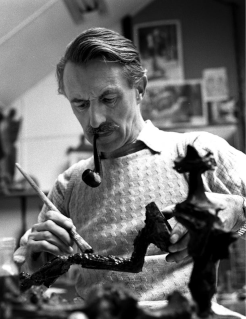
Frederick Edward McWilliam CBE RA, Northern Irish surrealist sculptor, is born in Banbridge, County Down, on April 30, 1909. He works chiefly in stone, wood and bronze. His style of work consists of sculptures of the human form contorted into strange positions, often described as modern and surreal.

McWilliam is the son of Dr. William McWilliam, a local general practitioner. Growing up in Banbridge has a great influence on his work. He makes references to furniture makers such as Carson the Cooper and Proctors in his letters to his friend, Marjorie Burnett.

McWilliam attends Campbell College in Belfast and later attends Belfast College of Art from 1926. After 1928, he continues to study at the Slade School of Fine Art in London. He originally intends to become a painter, but influenced by Alfred Horace Gerrard, head of the sculpture department at the Slade, and by Henry Moore whom he meets there, he turns to sculpture. He receives the Robert Ross Leaving Scholarship which enables him and his wife, Beth (née Crowther), to travel to Paris where he visits the studio of Constantin Brâncuși.

During the first year of World War II, he joins the Royal Air Force and is stationed in England for four years where he is engaged in interpreting aerial reconnaissance photographs. He is then posted to India. While there he teaches art in the Hindu Art School in New Delhi.

After his return from India, McWilliam teaches for a year at the Chelsea School of Art. He is then invited by A. H. Gerrard to teach sculpture at the Slade. He continues in this post until 1968.

The 1950s see McWilliam receive many commissions including the Four Seasons Group for the Festival of Britain exhibition in 1951. A major commission in 1957 is Princess Macha for Altnagelvin Area Hospital in Waterside, Derry.

During the Northern Ireland Troubles McWilliam produces a series of bronzes in 1972 and 1973 known as Women of Belfast in response to the bombing at the Abercorn Tea-Rooms.

In 1964 McWilliam is awarded an Honorary Doctor of Letters from Queen’s University Belfast. In 1966 he is appointed CBE and in 1971 he wins the Oireachtas Gold Medal. He is represented in many public collections, including the Museum of Modern Art in New York City and Tate Britain in London. In 1984 the National Self-Portrait Gallery purchases a McWilliam self-portrait amongst acquisitions from fellow Northerners Brian Ballard, Brian Ferran and T. P. Flanagan.

The Arts Council of Northern Ireland organises a retrospective of his work in 1981 and a second retrospective is shown at the Tate Gallery in 1989 for his 80th birthday.

McWilliam continues carving up to his death. He dies of cancer in London on May 13, 1992.

In September 2009 Banbridge District Council opens a gallery and studio dedicated to the work of and named after McWilliam.


Leave a comment

Birth of Dawson Stelfox, Architect & Mountaineer

James Dawson Stelfox MBE, architect and mountaineer well known for the first Irish ascent of Mount Everest in 1993, is born in Belfast, Northern Ireland, on March 24, 1958. He is the former chairman of Consarc Design Group and in May 2008, is elected President of the Royal Society of Ulster Architects.

Stelfox attends Rosetta Primary school, then continues his education at the Royal Belfast Academical Institution. In 1976 he begins to study architecture at Queen’s University Belfast (QUB). His first job is with the conservation architects, Consarc Design Group, which after a brief period of self-employment he rejoins in 1995. He becomes Chairman in 2002.

Among the many projects on which Stelfox has worked are the Parliament Buildings, often referred to as Stormont, Belfast’s Christ Church, the Odyssey Arena and the Ormeau Gas Works. Several of these projects have been premiated by the Royal Institute of British Architects (RIBA) and the Belfast Civic Trust.

In 1993 Stelfox leads the Irish Everest expedition which contains climbers from both jurisdictions on the island and is supported by both Sports Council as well as private companies. When he reaches the peak of Everest via the North Ridge on May 27, 1993, he becomes the first person from Ireland to do so.

Stelfox is past Chair and current board member of Mountaineering Ireland. He also is the current Chair of Outdoor Recreation Northern Ireland, a Belfast not-for-profit organisation who make it easier for people to responsibly enjoy the outdoors.


Leave a comment

The Murder of IRA Volunteer Eamon Collins

Eamon Collins, member of the Provisional Irish Republican Army (IRA) in the late 1970s and early 1980s, is beaten and stabbed to death by an unidentified assailant(s) in the early morning hours of January 27, 1999, in Newry, County Down, Northern Ireland.

Collins is born in 1954 in Camlough, County Armagh, Northern Ireland, the son of Brian Collins, a farmer, livestock trader, and cattle smuggler, and Kathleen Collins (née Cumiskey). His extended family has no history of political involvement, though his upbringing is fervently Catholic and nationalist. He leaves secondary school at age 16 and briefly works as a clerk in the Ministry of Defence in London. He returns home for family reasons and resumes his education in 1971 through a scholarship to St. Colman’s College, Newry, County Down. In 1973 he goes to Queen’s University Belfast (QUB) to study law.

Collins develops ultra-leftist political beliefs in his late teens and supports the Northern Ireland civil rights movement but retains reservations about the use of violence. He is further radicalised by being beaten up by soldiers searching his family’s farm at Easter 1974 and by the downfall of the power sharing executive. He loses interest in his studies, leaves QUB in 1976 without completing his degree, and drifts for two years, joining an anarchist collective in Belfast. He comes back into contact with the republican movement through the blanket protest by Long Kesh inmates; he had known hunger striker Raymond McCreesh as a teenager. In 1978 he joins the customs service in Newry and begins to pass information to the IRA, which he joins in 1979. He is central to IRA recruitment and intelligence in Newry and south Down. Without firing a shot himself he facilitates at least five murders, including that of a customs colleague.

In 1982 Collins marries and the couple has four children. By 1984 he has developed doubts about his activities. He antagonises the Belfast leadership, which is moving towards political engagement and away from the all-out revolutionary violence that he favours, and while he admires the hardline South Armagh IRA for its military professionalism, he regards its members as political primitives. On February 28, 1985, he is arrested after an IRA mortar attack in which nine Royal Ulster Constabulary (RUC) members are killed. He breaks down after six days of interrogation and is recruited as a “supergrass,” but retracts his evidence a fortnight later and is held on remand on the basis of his confessions.

In January–February 1987 Collins is tried for murder but acquitted after the judge rules his statements inadmissible. He completes an Open University degree while awaiting trial. After his release he is ostracised and is interrogated by the IRA, which in July 1987 orders him to leave Northern Ireland. He engages in youth work in Dublin from 1987 to 1990, taking a diploma in community work at Maynooth. His wife and children remain in Newry and he visits them regularly in defiance of the expulsion order. In 1990 he returns to live in Newry and teaches at the Ulster People’s College in Belfast. From 1992–94 he is a community worker in Edinburgh. His wife and children continue to live on the Barcroft Park estate in Newry.

In 1994 Collins returns permanently to Northern Ireland after securing a job at a youth club in Armagh. In April 1995 he describes his career in a television documentary, admitting the murders for which he had been tried. In 1997 he publishes a memoir, Killing Rage, a powerful account of life as a paramilitary, although it is not entirely reliable. After the 1995 documentary he experiences verbal and physical harassment. This intensifies after May 1998 when he testifies for The Sunday Times in a libel action by Thomas Murphy, whom the paper accuses of being a leading IRA member. Four months after Murphy loses the case, the family farmhouse in Camlough, which Collins is renovating, is burned down. After the Omagh bombing he publishes several articles denouncing the Real IRA, several of whose activists he had recruited into the IRA from the Irish National Liberation Army (INLA) in the early 1980s. Graffiti regularly appears outside his home in Newry denouncing him as a British agent.

Early in the morning of January 27, 1999, Collins paints out the latest graffiti, and is walking his dogs near the Barcroft Park Estate in Newry along a quiet stretch of country lane at Doran’s Hill, just within sight of Sliabh gCuircin (Camlough Mountain). His body also bears marks of having been struck by a car moving at speed. The subsequent police investigation and Coroner’s Inquest comments upon the extremity of weaponed violence to Collins’ head and face used during the attack.

Rumoured reasons behind the murder are that Collins had returned to Northern Ireland in breach of the IRA’s banning order, and further he had detailed IRA activities and publicly criticized in the media a multiplicity of Irish Republican paramilitary splinter groups that had appeared after the Provisional IRA’s 1994 ceasefire, and that he had testified in court against Murphy. Gerry Adams states the murder was “regrettable,” but adds that Collins had “many enemies in many places.”

After a traditional Irish wake, with a closed coffin necessitated due to the damage to his face, and a funeral service at St. Catherine’s Dominican Church in Newry, Collins’ body is buried at the city’s Monkshill Cemetery, not far from the grave of Albert White, a Catholic former Royal Ulster Constabulary Inspector, whose assassination he helped to organise in 1982.

In January 2014 the Police Service of Northern Ireland (PSNI) releases a statement that a re-examination of the evidence from the scene of the 1999 murder had revealed new DNA material of a potential perpetrator’s presence, and makes a public appeal for information, detailing the involvement of a specific car model, a white coloured Hyundai Pony, and a compass pommel that had broken off a hunting knife during the attack and had been left behind at the scene. In February 2014 detectives from the Serious Crime Branch arrest a 59-year-old man at an address in Newry in relation to the murder, but he is subsequently released without charge. In September 2014 the police arrest three men, aged 56, 55 and 42, in County Armagh in relation to inquiries into the murder, all of whom are subsequently released without charges after questioning. In January 2019 the police release a statement regarding the murder that one of the assailants had been seriously injured by an accidentally sustained knife wound during the attack, and had left traces of his own blood at the scene, and that recent scientific advances in DNA evidence had increased the possibility of his identification. In May 2019, three men aged 60 to 62 are arrested and questioned, but then released unconditionally.


Leave a comment

Birth of George Henry Perrott Buchanan, Poet, Novelist & Journalist

George Henry Perrott Buchanan, poet, novelist, and journalist is born on January 9, 1904, in Kilwaughter, County Antrim, in what is now Northern Ireland.

Buchanan is the second child and younger of two sons and one daughter of the Rev. Charles Henry Leslie Buchanan (1863–1939) and Florence Buchanan (née Moore). He is educated at Larne Grammar School in Larne, County Antrim, Campbell College, Belfast, and Queen’s University Belfast (QUB). He works for the Northern Whig (1921) and is a founder member of the Northern Drama League, Belfast (1923). After moving to London, he joins The Daily Graphic, becomes a reviewer (1928–40) for The Times Literary Supplement, sub-editor (1930–35) of The Times, and columnist and drama critic (1935–38) for the News Chronicle.

During World War II, Buchanan serves as an operations officer in RAF Coastal Command (1940–45). His service includes a period in Sierra Leone, operational liaison with Free France in French Equatorial Africa, and night attacks on U-boats in the Bay of Biscay. After the war, he lives in Limavady, County Londonderry, Northern Ireland, for nearly ten years, which he later describes as a period of regeneration. During this time, he broadcasts for BBC Radio and becomes chairman of the NI town and country development committee (1949–53) and a member (from 1954) of the executive council of the European Society of Culture (Venice), and later president of its London centre.

A versatile writer with wide-ranging concerns, Buchanan publishes his first journal, Passage Through the Present, in 1932. It is followed by six novels, including A London Story (1935) and Naked Reason (1971). His plays include A Trip to the Castle (1960) and War Song (1965). The Politics of Culture (1977) is one of several collections of essays, and Green Seacoast (1959) and Morning Papers (1965) are autobiographical. His writing has been noted for its integrity and for the diversity of its ideas. Recurrent themes are the importance of common experience, living sensitively in the present, and the impoverishment of urban life. He believes in the power of ideas and the creative nature of journalism in the modern world. Despite his prosaic style, he writes poetry from his teenage years. It “was always the base from which everything else was motivated. . . [it] affected, and perhaps energised, everything I did. Its pressure led me to special attitudes in journalism, in the theatre, in the novel.” He publishes his first collection, Bodily Responses, in 1958. Other collections include Annotations (1970) and Inside Traffic (1976). In order to bring the variety of his work to a wider audience, Frank Ormsby devotes a supplement in the Honest Ulsterman (1978) to Buchanan, whom he believes is almost forgotten in Ireland and has been unjustly neglected.

Buchanan lives at 18A Courtnell Street, London W2. He marries four times, first to Winifred Mary Corn (1938-45), secondly to Noel Pulleyne Ritter (1949-51), thirdly to the Hon. Janet Hampden Margesson (1952-68), with whom he had two daughters, and fourthly to Sandra Gail McCloy (1974-89). He dies on June 28, 1989, in Richmond, London, and is cremated at Mortlake Crematorium, Richmond.

(From: “Buchanan, George Henry Perrott” by Helen Andrews, Dictionary of Irish Biography, http://www.dib.ie, October 2009 | Pictured: George Henry Perrott Buchanan by Howard Coster, 10 x 8 inch film negative, 1935, transferred from Central Office of Information, 1974)


Leave a comment

Birth of Neil Hannon, Northern Irish Singer & Songwriter

Edward Neil Anthony Hannon, Northern Irish singer and songwriter, is born in Derry, County Londonderry, on November 7, 1970. He is the creator and front man of the chamber pop group The Divine Comedy, and is the band’s sole constant member. He is the writer of the theme tunes for the television sitcoms Father Ted and The IT Crowd.

Hannon is the son of Brian Hannon, a Church of Ireland minister in the Diocese of Derry and Raphoe and later Bishop of Clogher. He spends some of his youth in Fivemiletown, County Tyrone, before moving with his family to Enniskillen, County Fermanagh, in 1982. While there he attends Portora Royal School.

Hannon enjoys synthesizer-based music as a youngster. He identifies The Human League and Orchestral Manoeuvres in the Dark (OMD) as “the first music that really excited [him].” In the late 1980s he develops a fondness of the electric guitar, becoming an “indie kid.”

Hannon is founder and mainstay of The Divine Comedy, a band which achieves their biggest commercial success in the last half of the 1990s with the albums Casanova (1996), A Short Album About Love (1997), and Fin de Siècle (1998). He continues to release albums under The Divine Comedy name, the most recent being Office Politics (2019). In 2000 he and Joby Talbot contribute four tracks for Ute Lemper‘s collaboration album, Punishing Kiss.

In 2004 Hannon plays alongside the Ulster Orchestra for the opening event of the Belfast Festival at Queen’s University Belfast. In 2005, he contributes vocals to his long-time collaborator Joby Talbot’s soundtrack for the movie version of The Hitchhiker’s Guide to the Galaxy.

In 2006 it is announced that Hannon is to lend his vocal ability to the Doctor Who soundtrack CD release, recording two songs – “Love Don’t Roam” for the 2006 Christmas special, “The Runaway Bride“, and a new version of “Song For Ten”, originally used in 2005’s “The Christmas Invasion.” On January 12, 2007, The Guardian website’s “Media Monkey” diary column reports that Doctor Who fans from the discussion forum on the fan website Outpost Gallifrey are attempting to organise mass downloads of the Hannon-sung “Love Don’t Roam,” which is available as a single release on the UK iTunes Store. This is in order to attempt to exploit the new UK Singles Chart download rules, and get the song featured in the Top 40 releases.

The same year Hannon adds his writing and vocal talents to the Air album Pocket Symphony, released in the United States on March 6, 2007. He is featured on the track “Somewhere Between Waking and Sleeping,” for which he writes the lyrics. This song had been originally written for and sung by Charlotte Gainsbourg on her album, 5:55. Though it is not included in its 2006 European release, it is added as a bonus track for its American release on April 24, 2007.

Hannon wins the 2007 Choice Music Prize for his 2006 album, Victory for the Comic Muse. He wins the 2015 Legend Award from the Oh Yeah organisation in Belfast.

Hannon is credited with composing the theme music for the sitcoms Father Ted and The IT Crowd, the former theme composed for the show and later reworked into “Songs of Love,” a track on The Divine Comedy’s breakthrough album Casanova. Both shows are created or co-created by Graham Linehan. A new Divine Comedy album, Bang Goes the Knighthood, is released in May 2010.

Hannon has collaborated with Thomas Walsh, from the Irish band Pugwash, to create a cricket-themed pop album under the name The Duckworth Lewis Method. The first single, “The Age of Revolution,” is released in June 2009, and a full-length album is released the following week. The group’s second album, Sticky Wickets, comes out in 2013.

Hannon contributes to a musical version of Swallows and Amazons, writing the music while Helen Edmundson writes the book and lyrics, which premiers in December 2010 at the Bristol Old Vic.

In April 2012 Hannon’s first opera commission, Sevastopol, is performed by the Royal Opera House. It is part of a program called OperaShots, which invites musicians not typically working within the opera medium to create an opera. Sevastopol is based upon Leo Tolstoy‘s Sevastopol Sketches. Hannon’s second opera for which he writes music, In May, premiers in May 2013 in Lancaster and is shown in 2014 with overwhelming success.

The world premiere of “To Our Fathers in Distress,” a piece for organ, is performed on March 22, 2014, in London, at the Royal Festival Hall. It is inspired by Hannon’s father, Rt. Revz. Brian Hannon, who suffers from Alzheimer’s disease.

Hannon’s partner is Irish musician Cathy Davey. The couple live in the Dublin area. He is previously married to Orla Little, with whom he has a daughter, Willow Hannon. With Davey, Hannon is a patron of the Irish animal charity My Lovely Horse Rescue, named after the Father Ted Eurovision song for which he wrote the music.

Politically, Hannon describes himself as being “a thoroughly leftie, Guardian-reading chap, but of the champagne socialist variety.”


Leave a comment

Birth of George McWhirter, Writer, Teacher & Vancouver’s First Poet Laureate

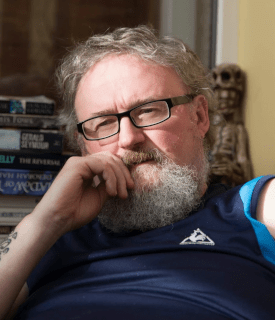
George McWhirter, Irish-Canadian writer, translator, editor, teacher and Vancouver‘s first Poet Laureate, is born in Belfast, Northern Ireland, on September 26, 1939.

The son of a shipyard worker, McWhirter is raised in a large extended family on the Shankill Road in Belfast. He and his extended family spend the war years and then weekends and the summers at their seaside bungalow in Carnalea, now a suburb of Bangor, County Down. In 1957 he begins a “combined scholarship” studying English and Spanish at Queen’s University Belfast, and education at Stranmillis University College, Belfast. His tutor at Queen’s is the poet Laurence Lerner, and he is a classmate with the future literary critic Robert Dunbar and the poets Seamus Heaney and Seamus Deane.

After graduating, McWhirter teaches in Kilkeel and Bangor, County Down, and in Barcelona, Spain, before moving to Port Alberni, British Columbia, Canada. After receiving his M.A. from the University of British Columbia (UBC), where he studies under Michael Bullock and J. Michael Yates, he stays on to become a full professor in 1982 and head of the Creative Writing Department from 1983 to 1993. He retires as a Professor Emeritus in 2005.

McWhirter is associated with PRISM International magazine from 1968 to 2005. He is the author and editor of numerous books and the recipient of many awards. His first book of poetry, Catalan Poems, is a joint winner of the first Commonwealth Poetry Prize with Chinua Achebe‘s Beware, Soul Brother. He is made a life member of the League of Canadian Poets in 2005 and is also a member of the Writers’ Union of Canada and PEN International. In March 2007, he is named Vancouver’s inaugural Poet Laureate for a two-year term.

McWhirter currently writes full-time and lives in Vancouver with his wife. They have two children and three grandchildren.