MacManus begins writing while still teaching, first publishing a trilogy set in Penal times and concerning the life of the Gaelic poet Donncha Rua Mac Conmara comprising the novels Stand and Give Challenge (1934), Candle for the Proud (1936) and Men Withering (1939). A second trilogy follows which turns its attention to contemporary Ireland: This House Was Mine (1937), Flow On, Lovely River (1941), and Watergate (1942). The location is the fictional “Dombridge,” based on Kilkenny, and deals with established themes of Irish rural life including obsessions with land, sexual frustration, and the trials of emigration and return. Other major works include the novel The Greatest of These (1943), concerning religious conflict in nineteenth-century Kilkenny, and the biographies Boccaccio (1947) and Saint Columban (1963). In his last two novels, he descends into the depths of theological debate: The Fire in the Dust (1950) is followed by American Son (1959), a remarkable dialogue between conflicting modes of belief which reveals the strong influence of Roman Catholicism on the author.
Francis MacManus dies of a heart attack at the age of 56 in Dublin on November 27, 1965.
The RTÉ Francis MacManus Short Story Award is established in his memory in 1985. The competition is run by RTÉ, Ireland’s national broadcaster, and is open to entries written in Irish or English from authors born or resident in Ireland. The total prize fund is €6000, out of which the winning author receives €3,000. Sums of €2,000 and €1,000 are awarded to the second and third prize winners.
Michael “Mick” Lally, Irish stage, film and television actor, is born in the Gaeltacht village of Toormakeady, County Mayo, on November 10, 1945. He departs from a teaching career for acting during the 1970s. Though best known in Ireland for his role as Miley Byrne in the television soap Glenroe, his stage career spans several decades, and he is involved in feature films such as Alexander and the Academy Award-nominated The Secret of Kells. Many reports cite him as one of Ireland’s finest and most recognisable actors.
Lally begins his acting career with Taibhdhearc na Gaillimhe, Ireland’s national Irish language theatre, and is a founding member of the Druid Theatre Company. He receives an Irish Times/ESB Theatre Award Nomination for Best Actor for his role in Druid’s production of The Dead School. He also becomes a member of the Field Day Theatre Company, and stars in the company’s 1980 premiere of Brian Friel‘s play Translations. He first plays at the Abbey Theatre in 1977 in a production of Wild Oats and goes on to perform in many other Abbey productions.
In 1982, Lally stars in the TV series The Ballroom of Romance alongside Brenda Fricker. From 1983 he plays the role of Miley Byrne in the RTÉ soap Glenroe, reprising the character that he played earlier in Bracken in 1978. In 1979, he wins a Jacob’s Award for his performance as Miley in Bracken. He also has some musical success when “The By-road to Glenroe” goes to the top of the Irish charts in 1990. He is also involved in voice-over work, including a noted advertisement for Kilmeaden Cheese during the 1990s. Other TV appearances include roles in Tales of Kinvarna, The Year of the French and Ballykissangel.
In 1994, Lally plays the character Hugh in The Secret of Roan Inish, and in 1995 portrays Dan Hogan in the film adaptation of Maeve Binchy‘s Circle of Friends. Other film roles included Poitín, Our Boys, The Outcasts, A Man of No Importance and others. In later years, he provides the voice of Brother Aidan in the Academy Award-nominated The Secret of Kells, an animated film directed by Tomm Moore.
Lally appears in several TV advertisements encouraging elderly people to “release the equity tied up in their homes” during the Celtic Tiger.
Mick Lally dies in Dublin on the morning of August 31, 2010, after a short stay in the hospital. The cause of death is reported as heart failure, arising from an underlying emphysema condition. His funeral takes place in Dublin on September 2, 2010. The Irish Examiner comments that the “nation has lost one of its favourite uncles.” Personalities from TV, film, theatre and politics attend, while President of IrelandMary McAleese sends a letter and Lally receives a standing ovation at the end.
Wallace is born into a family of twelve children. He graduates from University College Dublin (UCD) with a teaching qualification. He marries Mary Murphy from Duncormick, County Wexford, in 1979. The couple has two sons, but the marriage ends when the children are young. He has two more children from another relationship in the 1990s.
Prior to entering politics, Wallace owns a property development and construction company completing developments such as the Italian Quarter in the Ormond Quay area of the Dublin quays. The company later collapses into liquidation, with him finally being declared bankrupt on December 19, 2016.
On December 15, 2011, Wallace helps to launch a nationwide campaign against the household charge which is introduced as part of the 2012 Budget.
Wallace is the listed officer of the Independents 4 Change, which is registered to stand for elections in March 2014 and, along with Clare Daly, is one of two MEPs which represent the party in the European parliament. During their time in the Dáil, Wallace and Daly, the Dublin North TD, become friends and political allies, and work together on many campaigns, including opposition to austerity and highlighting revelations of alleged Garda malpractices, including harassment, improper cancellation of penalty points and involvement of officers in the drug trade. They are partially active in protesting the Garda whistleblower scandal, which eventually leads to the resignation of Minister for JusticeFrances Fitzgerald, although she is later cleared of wrongdoing by the Charleton Tribunal.
In July 2014, Wallace and Daly are arrested at Shannon Airport while trying to board a U.S. military aircraft. He says the airport is being used as a U.S. military base and that the government should be searching the planes to ensure that they are not involved in military operations or that there are no weapons on board. He is fined €2,000 for being in an airside area without permission and chooses not to pay. He is sentenced to 30 days in prison in default, and in December 2015 is arrested for non-payment of the fine.
In December 2015, Wallace and independent TDs Clare Daly and Maureen O’Sullivan each put forward offers of a €5,000 surety for a man charged with membership of an unlawful organisation and with possession of a component part of an improvised explosive device.
At the 2016 Irish general election, Wallace stands as an Independents 4 Change candidate and is re-elected, finishing third on the first-preference count with 7,917 votes.
In 2017, Wallace calls on Ireland to join the Boycott, Divestment and Sanctions movement against Israel and “condemn the illegal expansion of Israeli settlements on Palestinian lands as well as the ongoing human rights abuses against Palestinians.”
Wallace is criticised for supporting Venezuela, Ecuador, China, Russia, Belarus and Syria during his period as an MEP. In November 2020, he refers to Belarusian opposition presidential candidate Svetlana Tikhanovskaya as a “pawn of western neoliberalism.” In February 2021, he is reprimanded for using a swear word during a session of the European Parliament. He has referred to Venezuelan opposition leader Juan Guaidó as being an “unelected gobshite.”
In April 2021, Wallace and Daly are called “embarrassments to Ireland” by Fianna Fáil‘s Malcolm Byrne after the two MEPs had travelled to Iraq and visited the headquarters of the Popular Mobilization Forces, an Iraqi militia supported by Iran.
Wallace questions the director general of the Organisation for the Prohibition of Chemical Weapons (OPCW), Fernando Arias, in the European Parliament in April 2021. He accuses the OPCW of falsely blaming the government of Bashar al-Assad for the 2018 Douma chemical attack. He says that, while he does not know what had happened in Douma, the White Helmets were “paid for by the U.S. and UK to carry out regime change in Syria.” Fianna Fáil’s Barry Andrews calls his accusation against the White Helmets a conspiracy theory and disinformation. French MEP Nathalie Loiseau describes his comments as “fake news” and apologises on his behalf to NGO groups in Syria.
In June 2021, Wallace and Daly are among the MEPs censured by the European Parliament’s Democracy Support and Election Coordination Group for acting as unofficial election-monitors in the December 2020 Venezuelan parliamentary election and April 2021 Ecuadorian general election without a mandate or permission from the EU. They are barred from making any election missions until the end of 2021. They are warned that any further such action may result in their ejection from the European parliament under the end of their terms in 2024.
Wallace has stated his opposition to vaccination certificates. He says, “I’m not anti-vax but we’re going down a dangerous path with COVID pass” and expresses concerns about civil liberties. Both Wallace and Daly have refused to present vaccination certs upon entering the European Parliament, resulting in them being reprimanded by the European Parliament.
In April 2022, Wallace and Daly initiate defamation proceedings against RTÉ.
In November 2022, Wallace criticises protests in Iran following the death of Mahsa Amini, accusing some protestors of violence and destruction and saying it “would not be tolerated anywhere.”
In February 2023, Wallace claims on social media that he has “three wine bars in Dublin.” This arouses alarm from his European parliamentary group, as no such assets were listed on his mandatory declaration of financial interests. After the chair of his parliamentary group calls any omission from the declaration “unacceptable” and not “worthy of our political group,” he amends his declaration to state that he is an “advisor” to the three wine bars and receives up to €500 a month in income for this role.
Greacen is the only child of Henry Greacen and his wife Elizabeth (née McCrea). His father comes from a Presbyterian farming background in County Monaghan and, at one time, holds a position as a creamery manager, but is a heavy drinker and fails in several businesses. Most of his childhood is spent with his maternal grandmother and aunts when his parents temporarily separate. He briefly attends two local primary schools in Belfast, but when his father receives insurance compensation after his Belfast business burned down, he takes his family to the Castleblayney area in County Monaghan and for a short time goes back to farming. He goes to a national school there, but after another fire destroys the farmhouse, the Greacens return to Belfast to run the Kenilworth, a tobacconist’s shop on the Newtownards Road. He attends Templemore primary school and then enters Methodist College Belfast in 1933.
Greacen mostly enjoys school, though he is too short-sighted to participate with success in any sport, and sometimes, because of his background, feels out of his depth among middle-class children. He is always ashamed of his father’s drunken outbursts and is terrified of the violent temper which accompanies them. Literature provides both a temporary escape and the promise of future success. His first poems are published in school magazines, and he decides at a young age to try to make a career as a writer. He fails examinations and interviews for positions in a bank and an insurance company and instead starts studying history and English at Queen’s University Belfast.
At Queen’s, as earlier at Methodist College, the interests which characterise Greacen’s later career are apparent. Largely thanks to meeting John Boyd, he develops sympathies with left-wing political ideas, as well as a deepened commitment to poetry. His youthful 1930s enthusiasm for Marxism disappears after the Molotov-Ribbentrop Pact of 1939 between the Soviet Union and Nazi Germany, but up to his later years he describes himself as a socialist. The formation of enduring friendships and mutually supportive coteries, a phenomenon particularly characteristic of the Ulster literary scene of the period, continues to be of great importance throughout his life. He makes friends with almost all the significant figures in Belfast, especially Roy McFadden, John Hewitt and Sam Hanna Bell. At Queen’s, he and a friend take over in 1940 the editing of a student magazine, The Northman. They try with short-lived, limited success to make it a literary journal for the whole region, so as to enable aspiring poets to get work into print. His own early poems appear in The Bell, and he writes some pieces for the left-wing Irish Democrat newspaper. His poem The Bird (1941) is well reviewed and later appears in anthologies. In 1942 he publishes Poems from Ulster, a small anthology including work by his friends.
For several months, Greacen worships from afar a fellow student named Irene. When he fails to form a relationship with her, he stops going to lectures so that he does not have to see her and does not finish his degree. His McCrea relatives pay for him to go to Trinity College Dublin in 1943 to take a diploma in social work. He is glad to get away from wartime Belfast and never lives there again. At first, he enjoys Dublin, and again makes many friends, among them Brendan and Beatrice Behan, Blanaid Salkeld, Cecil ffrench Salkeld, Joseph and Mary O’Neill, Douglas Gageby, Arland Ussher and Hubert Butler. He and Patrick Kavanagh live in the same boarding house on Raglan Road for several months in 1945, but Kavanagh takes offence at a review in Horizon by Greacen of his poem The Great Hunger and calls him a “Protestant bastard.” Greacen is upset, as he had thought the review favourable, and is disappointed but not surprised when Kavanagh refuses to allow any of his poems to appear in the prestigious Faber and Faber book Contemporary Irish Poetry, edited by Greacen and Valentin Iremonger in 1949.
The collaborative compilation of anthologies of poetry is Greacen’s characteristic way of working. In 1942, he and Alex Comfort edit Lyra: An Anthology of New Lyric. With Roy McFadden, he edits Ulster Voices in 1943. He is sole editor of Northern Harvest in 1944 and, in the same year, he, Bruce Williamson and Valentin Iremonger publish their own work in On the Barricades. His own first solo collection, One Recent Evening, is also a 1944 imprint. In 1946, with support from Maurice Fridberg, a Jewish Dublin and London bookseller, his publishing company, New Frontiers Press, produces Irish Harvest, which, though designed on more ambitious lines, still consists chiefly of poems by his friends. He feels much more affinity with the modernism and social protest that he finds in contemporary English poetry, especially in the “new apocalypse” movement associated with Herbert Read, and later the “new romantics,” than with what he regards as the outmoded Celtic nationalism of W. B. Yeats and his followers. Like others of his contemporaries, he comes to resent the unquestioned shibboleths of life in Ireland, and particularly objects to the censorship of literature and film.
Consequently, when Greacen’s second small volume of poems, The Undying Day (1948), sells badly, and other avenues seem unpromising, he and his wife give up on Dublin and move to London. He finds a job with the United Nations Association, which suits his outlook and ideals. However, when he is made redundant, he has to take various jobs in adult education, in creative-writing courses, and in teaching English as a foreign language, in the City of London College, the City Literary Institute, and West London College. He retires in 1986. His involvement with the London literary world continues throughout his career, as he gets to know many of the leading figures, including Stephen Spender and T. S. Eliot, and he organises poetry readings and other projects, though he himself writes no poetry for more than twenty years. At one time he considers taking up journalism and continues to produce book reviews and articles in journals, as well as many letters to newspapers. He writes several, well-received short works of criticism, in particular, The Art of Noël Coward (1953) and The World of C. P. Snow (1962). After returning to Dublin in 1986, he writes an interesting memoir about his many friends and acquaintances, Brief Encounters: Literary Dublin and Belfast in the 1940s (1991) and Rooted in Ulster: Nine Northern Writers (2000).
Greacen marries Patricia Hutchins in Fisherwick Presbyterian Church in Belfast on April 10, 1946. She is from a Protestant family who has a small estate at Ardnagashel, near Bantry, County Cork, and is related to the botanist Ellen Hutchins. They have one daughter, Arethusa, but, after four years of separation, the marriage ends in divorce in 1966. He resents his wife’s conversion to vegetarianism and seems also to disapprove of her desire to achieve her own career goals. Probably also the depression he experiences throughout the 1950s contributes to the breakdown of the marriage, but he feels that twelve experiences in the early 1960s with the hallucinogenic drug LSD, under the guidance of a psychiatrist, had cured him. After the LSD treatments he feels that he is ready to begin working on an autobiography, Even Without Irene, published several years later in 1969. This comes out again in an enlarged version in 1995, and, still further augmented, as The Sash My Father Wore (1997).
Greacen begins to publish poetry again in his fifties, in A Garland for Captain Fox (1975). Poems about the career and friends of an imaginary, sophisticated adventurer do not always strike the exactly right note but are popular and mark a new beginning for him, who increasingly writes elegiacally about personalities, real and fictional, in more restrained diction and with careful irony. In interviews, he denies that Captain Fox is his own alter ego, but the interplay between the character of Fox and elements of his creator’s own life suggests a metaphor for the poet’s creative process, as well as reminding the reader of the poet friends whose support means much to his writing in real life. At the very least, Captain Fox becomes what could be called a character of virtual reality for his creator.
Greacen’s later poetry collections include Young Mr. Gibbon (1979), A Bright Mask (1985), Carnival at the River (1990), Collected Poems 1944–1994 (1995; awarded The Irish Times Literature Prize for Poetry in that year), Protestant Without a Horse (1997), Captain Fox: A Life (2000), Lunch at the Ivy (2002), Shelley Plain (2002), and Selected and New Poems (2006).
On his return to Dublin in 1986, Greacen for a time shares a flat on Anglesea Road with Beatrice Behan, until he finds her dead in her bed in 1993. In later years he lives in a flat in Sandymount. He is elected to membership of Aosdána in 1986, and during his later years in Dublin enjoys the status of a senior figure in the world of literature. He gives readings in the United States, appears often on RTÉ radio programmes, and has poems republished in anthologies. There was even one poem displayed on the Dublin Dart suburban rail network, St. Andrew’s Day: An Elegy for Patricia Hutchins, perhaps his best work. Perhaps only a few of his poems have been lodged in the public memory, but it is appropriate, given the themes of his career, that his work will be read with most attention by poets and by scholars, and that his reputation in the future may largely be based on his friendships with other poets.
Among the thousands paying their respects are 4,000 serving and retired gardaí, over 2,000 in uniform. Garda Golden is remembered as a happy man, proud to serve, a role model for the community – and by his brother Patrick as a “big gentle giant.”
In his homily, chief celebrant parish priest Father Pádraig Keenan tells the congregation that the killing of Garda Golden was “cold-blooded murder.” He reminds the mourners that Garda Golden is the 88th garda to die in the line of duty. He says, “It is 88 members too many. He like all the others is mourned by the entire nation.”
“His murder brings to mind once again all the families and communities that have been affected on our island.”
Fr. Keenan says, “Garda Tony’s death once again reflects how north Louth and the Cooley Peninsula have been affected by the tragic history of the Troubles on the island of Ireland, and especially the murder of Detective Garda Adrian Donohoe, three years ago at Lordship Credit Union in Bellurgan.”
He says that too many hearts have been broken, and too many lives shattered. There is no place for violence in our society, violence is wrong, always wrong. He refers to Garda Golden as one of life’s gentlemen.
Fr. Keenan begins the funeral mass by saying that Garda Golden quietly let “his light shine in so many ways through his life in a very humble way. Amidst our sadness may we be thankful for the charisma of his beautiful but too short life.”
The stillness of the water across from the churchyard in Dundalk Bay mirrors the silence and sadness that has unfolded on everyone since the weekend, he tells the congregation.
“Tony was so proud to serve the community of Omeath,” he says. “As one person from Omeath put it to me in recent days, he was ‘our garda’, and to a person amongst his family and colleagues, all are immensely proud of Garda Tony and his selfless nature. Proud of everything he lived for, worked for and stood for. Tony Golden was a much-loved role model in our community.”
Symbols including a family photograph are taken to the altar in memory of Garda Golden. A club jersey and hurley from the Stephenites GAA club in his native Ballina, County Mayo, represent his roots and love of sport. A television remote control, a soft drink, a bar of chocolate and packet of crisps were offered to recall his cherished “time out.”
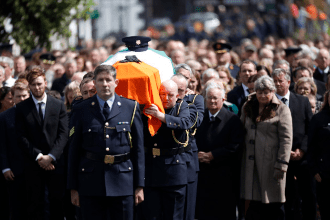
Garda Golden’s final journey begins at the home in the village of Blackrock he shared with his wife Nicola and their three young children, Lucy, Alex and Andrew. The funeral cortège is led by the Garda Commissioner, while thousands of gardaí escort their colleague into his parish church, St. Oliver Plunkett’s, for the funeral mass at noon.
Fr. Keenan is joined on the altar by the vicar general of the Armagh diocese Dean Colum Curry, who represents the Primate of All Ireland, Bishop Eamon Martin. As well as the chaplains to the Garda and the Defence Forces, Bishop John Fleming and Father Gerard O Hora travel to the funeral from Golden’s home county of Mayo.
Screens are erected in the grounds and the village to relay the service to those outside.
Businesses shut down along the route as a mark of respect during the funeral. Roads around the village are sealed off for several hours. Garda Golden is laid to rest at St. Paul’s Cemetery Heynestown.
Golden is killed as he is bringing Siobhan Phillips to her home to retrieve her personal possessions. Phillips is also shot in the incident and is in a critical condition in hospital with her family at her bedside at the time of Garda Golden’s funeral.
President of the Garda Representative Association, Dermot O’Brien, says members of the gardaí from all corners of Ireland traveled to County Louth to pay their respects to their colleague. He says they are grief-stricken and numb.
O’Brien says everyone will reflect in their own way and that the realisation has struck that Garda Golden was murdered doing “a bread-and-butter type call.”
“They are going to ask themselves, those that attended the same type of call on Sunday that it could have been them. These are very similar calls that a lot of members did on Sunday, and they will sit back and reflect on what happened to Tony as they responded to a similar call.”
O’Brien says he had spoken to Garda Golden’s unit in the days leading to the funeral and, while they are coping, they are not well. “They are angry, grieving and disillusioned because today they have to bury a second friend, a murdered friend, a second murdered colleague.”
Father Michael Cusack also speaks of the pain and anger expressed by members of the garda force he met following Garda Golden’s death. Speaking on RTÉ‘s Today with Sean O’Rourke, Fr. Cusack says it is a very difficult day and week for gardaí. He says a lot of care needs to be offered to the members of the force and that there needs to be appropriate follow-up care given.
(From: “Garda Tony Golden ‘mourned by entire nation’,” RTÉ News, http://www.rte.ie, October 15, 2015)
George Bernard Francis Clarke, Irish barrister who is Chief Justice of Ireland from July 2017 to October 2021, is born on October 10, 1951, in Walkinstown, Dublin. He has a successful career as a barrister for many years, with a broad practice in commercial law and public law. He is the chair of the Bar Council of Ireland between 1993 and 1995. He is appointed to the High Court in 2004 and becomes a judge of the Supreme Court of Ireland in February 2012. Following his retirement from the bench, he returns to work as a barrister. Across his career as a barrister and a judge, he is involved in many seminal cases in Irish legal history.
Clarke is the son of a customs officer who dies when he is aged eleven. His mother is a secretary. He is educated at Drimnagh Castle Secondary School, a Christian Brotherssecondary school in Dublin. He wins the Dublin Junior High Jump Championship in 1969. He studies Economics and Maths at undergraduate level at University College Dublin (UCD), while concurrently studying to become a barrister at King’s Inns. He is the first of his family to attend third level education and is able to attend university by receiving grants. While attending UCD, he loses an election to Adrian Hardiman to become auditor of the Literary and Historical Society (L&H).
Clarke is called to the Bar in 1973 and to the Inner Bar in 1985. He has a practice in commercial, constitutional and family law. Two years after commencing practice he appears as junior counsel for the applicant in State (Healy) v Donoghue before the Supreme Court, which establishes a constitutional right to legal aid in criminal cases.
Clarke represents Michael McGimpsey and his brother Christopher in a challenge against the constitutionality of the Anglo-Irish Agreement, which is ultimately unsuccessful in the Supreme Court in 1988.
Clarke appears for the plaintiff with Michael McDowell and Gerard Hogan in Cox v Ireland in 1990, where the Supreme Court first introduces proportionality into Irish constitutional law and discovers the right to earn a livelihood. He represents Seán Ardagh and the Oireachtas Subcommittee formed after the death of John Carthy in a constitutional case which limits the powers of investigation of the Oireachtas, which leads to the unsuccessful Thirtieth Amendment of the Constitution. In an action taken by tobacco companies to challenge the legality of bans on tobacco advertising, he appears for the State.
Clarke is Chairman of the Bar Council of Ireland from 1993 to 1995. Between 1999 and 2004, he acts as chair of Council of King’s Inns. He is a professor at the Kings’s Inns between 1978 and 1985 and is appointed an adjunct professor at University College Cork (UCC) in 2014. He also serves as an adjunct professor at Trinity College Dublin (TCD).
Clarke acts as a chair of the Employment Appeals Tribunal while still in practice. He is also a steward of the Turf Club and the chairman of Leopardstown Racecourse. He was due to take over as senior steward of the Turf Club but does not do so due to his appointment to the High Court.
Clarke is appointed as a High Court judge in 2004. He is chairman of the Referendum Commission for the second Lisbon Treaty referendum in 2009. As a High Court judge he gives a ruling on the Leas Cross nursing home case against RTÉ, that the public interest justifies the broadcasting of material that otherwise would have been protected by the right to privacy. He frequently presides over the Commercial Court during his time at the High Court. He is involved in the establishment of two High Court lists in Cork, Chancery and a Non-Jury List.
Clarke is appointed to the Supreme Court on February 9, 2012, and serves as Chief Justice from October 2017 until his retirement on October 10, 2021, required by law on his 70th birthday. In March 2021, the Cabinet begins the process of identifying his successor. Donal O’Donnell is selected to replace him. His final day in court is October 8, 2021, where judges, lawyers and civil servants make a large number of tributes to him. Mary Carolan of The Irish Times says that under his leadership the Supreme Court is “perhaps the most collegial it had been in some time.”
Following his retirement from the judiciary, Clarke resumes his practice as a barrister and rejoins the Bar of Ireland. Under the rules of the Bar of Ireland, he cannot appear before a court of equal or lesser jurisdiction to that on which he sat as a judge. Given that he was the most senior judge in Ireland, he cannot appear in any court in Ireland. He can appear in the European Union (EU) courts. However, he indicates his intention to focus on mediation and arbitration work.
Clarke has been married to Dr. Jacqueline Hayden since 1977. They have a son and a daughter. He is interested in rugby and horse racing, at one point owning several horses.
Rosenstock’s father, George, is a doctor and writer from Schleswig-Holstein, Germany, who serves as a medical officer with the Wehrmacht in World War II. His mother is a nurse from County Galway. He is the third of six children and the first born in Ireland. He is educated locally in Kilfinane, then in Mount Sackville, County Dublin.
Rosenstock works for some time on the television series Anois is Arís on RTÉ, then on the weekly newspaper Anois. Until his retirement he works with An Gúm, the publications branch of Foras na Gaeilge, the North-South body which promotes the Irish language.
Although he has worked in prose, drama and translation, Rosenstock is primarily known as a poet. He has written or translated over 180 books.
Rosenstock also writes for children, in prose and verse. Haiku Más É Do Thoil É! (An Gúm) wins the Children’s Books Judges’ Special Prize in 2015.
Rosenstock appears in the anthology Best European Fiction 2012, edited by Aleksandar Hemon, with a preface by Nicole Krauss (Dalkey Archive Press). He gives the keynote address to Haiku Canada in 2015.
Rosenstock has worked with American photographer Ron Rosenstock, Indian Photographer Debiprasad Mukherjee, Greek photographer Kon Markogiannis, Dublin photographer Jason Symes, French photographer Jean-Pierre Favreau and many more to create the new guise of a photo-haiku (or a haiga) – the interplay of visual aesthetic and literature.
Born in Newry, County Down, on February 24, 1921, Hall receives little more than a primary education as he leaves school at the age of twelve to work in a local shop. He later works as a waiter in London before moving to Dublin. On his return he joins the art department of the Irish Independent. He subsequently works with the Evening Herald where he writes a column on dance bands.
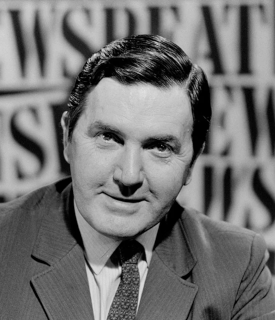
After that, Hall moves to RTÉ where he works in the newsroom. From 1964 to 1971 he presents Newsbeat, a regional news programme. He also presents The Late Late Show for the opening of the 1964 season, but his lack of success in that seat leads to the return of the previous presenter, Gay Byrne. When Newsbeat ends, he starts writing and presenting Hall’s Pictorial Weekly, a political satire show that runs for over 250 episodes until 1980. A successor show, Hall and Company, runs from 1980 until his retirement from television in 1986. He serves as spokesperson for the Irish jury in the Eurovision Song Contest 1965 and 1966.
Hall wins two Jacob’s Awards, in 1966 and 1975, for his work on Newsbeat and Hall’s Pictorial Weekly respectively.
In 1978, Hall is appointed Ireland’s national film censor. During his period as censor, he is known for his strict application of Irish censorship and his defence of family values. Among the films banned by him is Monty Python’s Life of Brian, which he describes as “offensive to Christians and to Jews as well, because it made them appear a terrible load of gobshites.”
Hall has a long running affair with a young colleague from RTÉ, though married to Aideen Kearney at the time. It is also widely accepted that he has a daughter in 1956 with RTÉ presenter Frankie Byrne, although this is disputed at the time by his family members. His relationship with Frankie Byrne is placed in the public domain in a Mint Productions programme, Dear Frankie, screened on RTÉ in January 2006. In 2010, a play written by Niamh Gleeson, also entitled Dear Frankie, opens in the Liberty Hall theatre. Later in 2012, it opens again in the Gaiety Theatre, going on to play in theatres across the country.
Hall dies of a heart attack in Dublin on September 21, 1995. He is buried in Dardistown Cemetery in Northside, Dublin.
Mac Thomáis comes from a staunch Republican family. He is born Edward Patrick Thomas in the Dublin suburb of Rathmines on January 13, 1927. His father, a fire-brigade officer, dies when he is five years old and his family moves to Goldenbridge, Inchicore. He leaves school at thirteen to work as delivery boy for White Heather Laundry, learning Dublin neighbourhoods with great thoroughness. He says he found work to help his mother pay the rent. He later works as a clerk and is appointed credit controller for an engineering firm.
At the November 1959 Ardfheis Mac Thomáis is elected to the Ardchomhairle of Sinn Féin and edits and contributes to the Sinn Féin newspaper United Irishman. He is a close friend of Tomás Mac Giolla and is deeply affected by the 1970 split in Sinn Féin. He takes the Provisional side, opposing Mac Giolla.
Mac Thomáis takes over as editor of An Phoblacht in 1972. In July 1973, he is arrested and charged with IRA membership at the Special Criminal Court in Dublin. He refuses to recognise the court, but he gives a lengthy address from the dock. The following month he is sentenced to 15-months imprisonment. Within two months of completing his sentence he is again before the court on the same charge and again receives a 15-month sentence. Editors of six left-wing and Irish-language journals call for his release, as do a number of writers, and hundreds attend protest meetings – to no avail. He serves his full sentence.
Tim Pat Coogan, editor of The Irish Press, claims the charges against Mac Thomáis are politically motivated to a large degree as his activities are confined strictly to the newspaper An Phoblacht. Under Section 31 of the Broadcasting Act, due to his membership in Sinn Féin in the 1970s he is removed from his position in making some of the RTÉ historical programmes. As a historian he makes numerous contributions to various historical publications such as the Dublin Historical Review.
From 1974 Mac Thomáis writes a number of books on old Dublin. They sell well and remain in print for over 20 years. He also starts a number of walking tours of Dublin, which prove very popular.
After finishing his schooling at fifteen, O’Herlihy follows his grandfather into journalism and secures a job in the reading room of The Cork Examiner. He is only seventeen years-old when he subsequently becomes sub-editor of the Evening Echo, a position he holds for five years. He also graduates to the positions of news, features and sports reporter.
In the early 1960s O’Herlihy begins his broadcasting career when he starts to do local association football reports from Cork for Radio Éireann. In 1965, he makes his first television broadcast in a programme commemorating the sinking of the RMS Lusitania off the Cork coast. After three years O’Herlihy is asked to join RTÉ’s current affairs programme 7 Days to add the required field-reporting skills to the studio-based interviews. The programme has a reputation for its hard-hitting investigative reporting, and he reports on many varying stories from illegal fishing in Cork to the outbreak of the crisis in Northern Ireland. In November 1970, the 7 Days programme comes into controversy when O’Herlihy reports a story on illegal money lending. The report is unconventional as it is one of the first television pieces to use hidden cameras, it claims the government is not responding to illegal moneylending. A tribunal of inquiry follows, and O’Herlihy is forced to move away from current affairs.
Following this controversy, while O’Herlihy is not sacked as he has fifteen months left on his contract with RTÉ, he is moved to the RTÉ Sports department. There he works under Michael O’Hehir, who dislikes him and his broadcasting style. In spite of this O’Herlihy fronts RTÉ’s television coverage of the Olympic Games that year. He also becomes involved in the production of various sports programmes.
O’Herlihy is not long in the RTÉ Sports department when he becomes a regular presenter for such programmes as Sunday Sport and Sports Stadium. In 1978 he becomes RTÉ Soccer host alongside Eamon Dunphy and, in 1984, Johnny Giles joins the panel and Liam Brady follows in 1998. Since 1974 O’Herlihy becomes RTÉ’s chief sports presenter for such events as all Olympic Games until 2012, FIFA World Cups until 2014, UEFA European Football Championships until 2012 and European and World Track and Field Championships. He hosts RTÉ highlights of the Ryder Cup in 2006 when it is at the K Club in County Kildare and continues to present coverage of Ireland’s soccer internationals for RTÉ, along with Dunphy, Giles and Brady.
O’Herlihy hosts RTÉ’s coverage of rugby union in the 1980s and early 1990s. However, when RTÉ attains the rights to cover the English Premier League in 1992, Tom McGurk takes over as host of RTÉ’s coverage of rugby union. O’Herlihy covers the Premier League, Irish Internationals and The Champions League before dropping the Premier League in 2008. He continues to cover the Olympic Games and International Athletic Championships such as the European and World Athletics. He presents the first Rugby World Cup on RTÉ television in 1987 and, with Jim Carney, co-presents the first edition of The Sunday Game in 1979.
In 2012, while covering Chloe Magee‘s progress at the 2012 Summer Olympics O’Herlihy remarks that badminton was once considered “a mainly Protestant sport.” RTÉ subsequently receives a number of complaints, and while Magee criticises the remarks, the argument is made that the incident inadvertently reflected a complex historical reality.
O’Herlihy presents RTÉ Sport‘s coverage of the 2010 FIFA World Cup, his ninth FIFA World Cup. He fronts 18 European Championships and FIFA World Cups for RTÉ, the last of which comes in 2014. This proves to be the final tournament with O’Herlihy at the helm. He retires at its conclusion and dies the following year.
O’Herlihy attends the 12th Irish Film & Television Awards on Sunday, May 24, 2015. He dies peacefully in his sleep at his home the following day at the age of 76 nearly a year after his retirement. He is survived by wife Hillary and daughters Jill and Sally. Giles, Brady and Dunphy appear on The Late Late Show in tribute later that week. At the time of his death O’Herlihy is working on a sports version of Reeling in the Years, which RTÉ immediately cancels.