seamus dubhghaill

Promoting Irish Culture and History from Little Rock, Arkansas, USA


Leave a comment

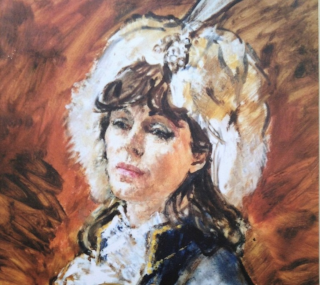
Birth of Mariga Guinness, Co-founder of the Irish Georgian Society

Mariga Guinness, architectural conservationist and socialite, and co-founder of the Irish Georgian Society, is born in London on September 21, 1932.

Guinness is born Hermione Maria-Gabrielle von Urach, the only child of the marriage of Albrecht von Urach, from Lichtenstein Castle, a member of the royal house of Wurtemberg, and Rosemary Blackadder (1901–1975) from Berwickshire in Scotland, a journalist and artist, who are married in Oslo, Norway in 1931. For the first few months of her life, she is very ill. In 1934, her parents, both working as journalists, move the family to Venice. They later move again to Japan. Her mother develops depression, and in 1937 tries to gain uninvited access to Emperor Hirohito‘s palace with her daughter. This results in her mother being arrested, sedated, and deported, which is the beginning of a decline in her mental health which culminates in a lobotomy in 1941 and spending the rest of her life in private mental institutions. Urach is returned to Europe, where she is raised by her godmother, Hermione Ramsden, in Surrey and Norway. She is educated by as many as seventeen governesses, with brief spells in boarding schools. Until the age of eighteen she is known as Gabrielle.

Urach meets Desmond Guinness in 1951, when she is nineteen, and they are married in Oxford in 1954. They have two children, Patrick (born 1956) and Marina (born 1957).

The couple moves to Ireland in 1955 where they rent Carton House, County Kildare. They share a love of Georgian architecture which results in them buying Leixlip Castle in 1958 and establishing the Irish Georgian Society on February 21 of the same year. Through the society they campaign for the restoration and protection of architectural sites such as Mountjoy Square, the gateway to the Dromana estate in County Waterford, the Tailors’ Hall in Dublin, and Conolly’s Folly in County Kildare. In 1967 they purchase Castletown House, also in County Kildare, with a plan to restore it, and make it a base for the Irish Georgian Society.

During the 1960s Leixlip Castle is a hub for those interested in architecture and conservation, and the Guinnesses work hands-on on a range of projects. By 1969, their marriage is in difficulties and Guinness moves to London. She later moves to Glenarm, County Antrim to live with Hugh O’Neill, and when that relationship ends, she returns to Leixlip Castle, but a divorce is finalised in 1981. Having lived in Dublin for a time, she rents Tullynisk House, the dower house of Birr Castle in County Offaly in 1983. Guinness becomes isolated and develops a problem with alcohol. While returning to Ireland from Wales on a car ferry on May 8, 1989, she has a massive heart attack which is compounded by a reaction to an injection of penicillin. She is buried at Conolly’s Folly.

Through Patrick, Guiness becomes grandmother of the fashion model Jasmine Guinness. Her daughter Marina is a patron of the arts and of Irish musicians including Glen Hansard, Damien Rice, and the band Kíla. Marina has three children of her own: Patrick (by Stewart Copeland of The Police), Violet (by photographer Perry Ogden), and Finbar (by record producer Denny Cordell).

In 2020, a new film on Guinness’s life and work, entitled Memory of Mariga, receives its United States premiere as part of the Elizabethtown Film Festival on Saturday, September 19, at the Crowne Pointe Theatre in Elizabethtown, Kentucky. In 2021, the same film receives its Irish premiere at the Fastnet Film Festival.

Leave a comment

Birth of Ken Doherty, Snooker World Champion

Ken Doherty, Irish professional snooker player, sports commentator and radio presenter, is born in Ranelagh, County Dublin, on September 17, 1969.

As an amateur, Doherty wins the Irish Amateur Championship twice (1987 and 1989), the IBSF World Under-21 Snooker Championship (1989) and the IBSF World Amateur Snooker Championship (1989). Having turned professional in 1990, Doherty wins a total of six ranking tournaments, including the 1997 World Snooker Championship in which he defeats Stephen Hendry of Scotland 18-12, inflicting Hendry’s first loss in a world final. This makes him the first and only player in the history of the game to be the world amateur, world under–21 and the world professional champion.

The following year, Doherty comes very close to breaking the Crucible curse, which refers to the fact that every first-time snooker world champion has failed to retain the title the following year. He reaches the final of the 1998 World Snooker Championship where he loses out to John Higgins of Scotland. He reaches his third final at the 2003 World Snooker Championship but is narrowly defeated by Mark Williams of Wales. In other Triple Crown events, he is a three-time UK Championship runner-up (1994, 2001, 2002) and a two-time Masters runner-up (1999, 2000).

An intelligent tactician and prolific break-builder, Doherty has compiled more than 300 century breaks in professional competition. Since 2009, he has combined his playing career with commentating and punditry work.

Doherty currently represents an Irish poker site, appearing on radio commercials, and regularly playing in tournaments, where the players on the site receive a bonus for knocking him out.

In partnership with Sean Francis O’Donoghue and Karl Leon Paul, Doherty set up an online cue sports equipment-marketing company.

Doherty has been a World Professional Billiards and Snooker Association (WPBSA) player director since 2012.


Leave a comment

Birth of Niall Ó Dónaill, Irish Language Lexicographer

Niall Ó Dónaill, Irish language lexicographer, is born in Ailt an Eidhinn, Loughanure, County Donegal, on August 27, 1908.

Ó Dónaill is the olderst of the six children of Tarlach Ó Dónaill and Éilis Nic Ruairí from Grial, Loughanure. They own a little land and a few cows. His father spends June to November working in Scotland and dies when he is 13 years old. He himself spends summers working in the tunnels in Scotland.

Ó Dónaill receives his education at Scoil Loch an Iúir in Loughanure before gaining a scholarship to St. Eunan’s College in Letterkenny. Another scholarship takes him to University College Dublin to study Irish, English and History. During his time in university Ó Dónaill spends his summers teaching at Coláiste Bhríde in Rann na Feirste, County Donegal.

Ó Dónaill writes the book Bruigheann Féile which is based on stories of pastimes in the Gaeltacht town Loughanure and its surrounding area. His book Na Glúnta Rosannacha is first published in 1952.

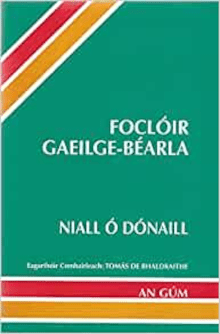
Ó Dónaill is most famous for his work as editor of the 1977 Irish-English dictionary Foclóir Gaeilge-Béarla, which is still widely used today.

In June 1982 Ó Dónaill is awarded a Doctor of Letters (D.Litt) by Trinity College Dublin. He is awarded Gradam an Oireachtais at Oireachtas na Gaeilge in 1980.

Ó Dónaill dies in Dublin on February 10, 1995.


Leave a comment

Birth of Cara Dillon, Irish Folk Singer

Cara Elizabeth Dillon, Irish folk singer, is born in Dungiven, County Londonderry, Northern Ireland on July 21, 1975.

Dillon comes from an area steeped in Irish traditional music. Since she was a schoolgirl she has sung and performed. She learns local folk songs from teachers and workshops held in the town. She can also play the fiddle and whistles. At the age of 14 she wins the All-Ireland Singing Trophy at Fleadh Cheoil.

In 1991 Dillon forms a band called Óige (an Irish word meaning ‘youth’) with school friends Murrough and Ruadhrai O’Kane, bringing her take on Irish traditional songs to Ireland, Scotland and further afield. During this time she also performs with big names such as De Dannan and Phil Coulter. Óige records two albums with Dillon, a studio and a live album. Inspiration is recorded in 1992 to sell at concerts in Europe. The live album, simply called Live, is recorded at a concert in Glasgow on August 15, 1993.

Dillon leaves Óige in 1995 and joins the folk supergroup Equation, replacing Kate Rusby, and signs a record deal with Warner Music Group. She leaves Equation with original band member Sam Lakeman because of musical differences and together they immediately signed a separate deal with the same label as a duo named Polar Star. In 2001, she releases her first solo album, Cara Dillon, which features traditional songs and two original Dillon/Lakeman compositions. The album is an unexpected hit in the folk world, with Dillon receiving four nominations at the 2002 BBC Radio 2 Folk Awards. Lakeman and Dillon marry in December 2002.

Dillon’s second album, Sweet Liberty (2003), enters the Irish Albums Chart and UK Independent Albums Chart. In 2004, she receives the Meteor Irish Music Award for Best Irish Female. Her third album, After the Morning, is released in 2006. The album’s opening track “Never in a Million Years” gains BBC Radio 2 airplay, while other tracks feature the Czech Philharmonic orchestra and Paul Brady. Also in 2006, she sings at the opening of the Ryder Cup in Ireland.

In 2009, Dillon releases her fourth album, the award-winning Hill of Thieves. The record marks a return to Dillon’s traditional roots with a purer production and arrangement style. The titular track “Hill of Thieves,” a Dillon\Lakeman original, is voted by BBC listeners as one of the “Top 10” original songs to have come out of Northern Ireland. In 2012, she performs two concerts with the Ulster Orchestra.

Dillon’s fifth solo album, A Thousand Hearts, is released in 2014. Prior to the album’s release, she discovers that her music enjoys a dedicated following in China, where her first album is featured in English curriculums. She has since embarked on several popular Chinese tours. As of 2017, she continues to tour regularly and work with her husband, who backs her on piano and guitar. Her most recent release is the album, Wanderer (2017).

Dillon is the sister of fellow folk singer Mary Dillon, formerly of Déanta. Dillon and Lakeman live in Frome, Somerset, England with their three children, twin sons born in 2006 and a daughter born in 2010.


Leave a comment

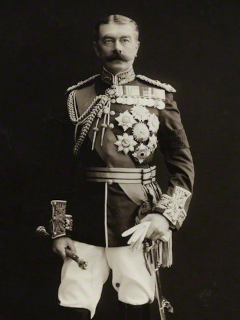
Death of Horatio Herbert Kitchener, 1st Earl Kitchener

Horatio Herbert Kitchener, 1st Earl Kitchener, Irish-born senior British Army officer and colonial administrator, drowns in the sinking of the HMS Hampshire west of Orkney, Scotland, on June 5, 1916. He wins notoriety for his imperial campaigns, especially his scorched earth policy against the Boers, his expansion of Lord Robertsinternment camps during the Second Boer War and his central role in the early part of World War I.

Kitchener is born in Ballylongford near Listowel, County Kerry, son of army officer Henry Horatio Kitchener and Frances Anne Chevallier, daughter of John Chevallier, a priest, of Aspall Hall, and his third wife, Elizabeth. The family moves to Switzerland when he is young, where he is educated at Montreux, then at the Royal Military Academy, Woolwich. He joins a French field ambulance unit in the Franco-Prussian War but is returned to England after he comes down with pneumonia.

Kitchener is credited in 1898 for winning the Battle of Omdurman and securing control of the Sudan for which he is made Baron Kitchener of Khartoum. As Chief of Staff (1900–1902) in the Second Boer War he plays a key role in Lord Roberts’ conquest of the Boer Republics, then succeeds Roberts as commander-in-chief, by which time Boer forces have taken to guerrilla warfare and British forces imprison Boer civilians in concentration camps. His term as Commander-in-Chief (1902–09) of the Army in India sees him quarrel with another eminent proconsul, the Viceroy Lord Curzon, who eventually resigns. He then returns to Egypt as British Agent and Consul General.

In 1914, at the start of World War I, Kitchener becomes Secretary of State for War, a Cabinet Minister. One of the few to foresee a long war, lasting for at least three years, and with the authority to act effectively on that perception, he organises the largest volunteer army that Britain had ever seen, and oversees a significant expansion of materials production to fight on the Western Front. Despite having warned of the difficulty of provisioning for a long war, he is blamed for the shortage of shells in the spring of 1915, one of the events leading to the formation of a coalition government and is stripped of his control over munitions and strategy.

On June 5, 1916, Kitchener is making his way to Russia on HMS Hampshire to attend negotiations with Tsar Nicholas II. At the last minute, Admiral Sir John Jellicoe changes the HMS Hampshire‘s route on the basis of a misreading of the weather forecast and ignoring (or not being aware of) recent intelligence and sightings of German U-boat activity in the vicinity of the amended route. Shortly before 7:30 PM the same day, steaming for the Russian port of Arkhangelsk during a Force 9 gale, HMS Hampshire strikes a mine laid by the newly launched German U-boat U-75 and sinks 1.5 miles west of the Orkney. Only twelve men survive. Amongst the dead are Kitchener and all ten members of his entourage. He is seen standing on the quarterdeck during the approximately twenty minutes that it takes the ship to sink. His body is never recovered.


Leave a comment

Execution of Thomas Wentworth, 1st Earl of Stafford

Thomas Wentworth, 1st Earl of Stafford and Lord Deputy of Ireland, is beheaded on Tower Hill near the Tower of London on May 12, 1641.

Wentworth is born in London on April 13, 1593, the eldest surviving son of Sir William Wentworth, a Yorkshire landowner. Educated at St. John’s College, Cambridge, and at the Inner Temple, he is knighted by James I in 1611. His marriage to Lady Margaret Clifford, daughter of the impoverished Francis Clifford, 4th Earl of Cumberland, establishes a link with an ancient and noble family still influential in the north.

Wentworth represents Yorkshire in the parliaments of 1614 and 1621 and Pontefract in 1624. His wife dies childless in 1622, and in February 1625 he marries Arabella Holles, daughter of John Holles, 1st Earl of Clare, a peer out of favour at court who brings Wentworth into touch with the critics of the King’s expensive and inefficient policy of war against Spain and, from 1627, against France. Along with other critics of the court he is prevented from sitting in the Parliament of 1626, and later in the year he refuses to subscribe to the forced loan imposed to pay for the war and is for some time under arrest. Despite his record of opposition to the King’s policy, he is approached by the crown — anxious to strengthen its position in the north — with the offer of a barony in 1628. He is appointed lord president of the Council of the North and in 1629 is given a seat on the Privy Council of the United Kingdom.

Wentworth’s return to the service of the court, coming so soon after his vehement opposition to it in Parliament, startles even some of his closest friends. His conduct is no doubt partly inspired by personal ambition, though he has logical reasons for his change of front since in the summer of 1628 the King gradually abandons his war policy.

On the Privy Council Wentworth seems to advocate the paternalist government that distinguishes the early years of the King’s personal rule. As President of the Council of the North he quells all defiance of his authority and makes many enemies by his insistence on the honour due to him as the King’s representative, but his administration is on the whole just and efficient. In 1631 he is deeply distressed by the death of his much-loved wife, though he provokes scandalous rumours not long afterward by secretly marrying Elizabeth Rodes, the young daughter of a neighbouring squire, in October 1632.

The King meanwhile has appointed Wentworth Lord Deputy of Ireland. Taking up his office in the summer of 1633, he immediately sets himself to consolidate the royal authority, break the power of the dominant clique of “new English” landowners, extend English settlement, improve methods of agriculture, increase the productivity of the land, and stimulate industry and trade. His ultimate goal is to assimilate Irish law and customs to the English system and to make a prosperous Protestant Ireland into a source of revenue to the English crown.

Wentworth continues his effective and firm-handed administration of Ireland until 1639, when he is recalled to England by King Charles I. The King needs advice and support in handling a Scottish revolt precipitated by an ill-conceived attempt to enforce episcopacy on the Scots. He is created Earl of Strafford in 1640 and is expected to resolve the crisis. But his policy of making war on Scotland proves disastrous for both him and the King. The English Parliament, called especially to vote money for the war, prove recalcitrant, and Strafford, in command of the English army, fails to prevent the Scots from overrunning the northern counties. The King, unable to pay his own troops or to buy off the Scots, is compelled by joint English and Scottish action to call a new Parliament in November 1640.

Wentworth is the chief target of attack from both nations. He is advised to leave the country, but the King relies on his help and assures him that he should not suffer in life or fortune. Detained by illness, he reaches Westminster on November 10 with the intention of impeaching the King’s opponents in Parliament for treasonable correspondence with the Scots. The leader of the House of Commons, John Pym, acts first by impeaching Wentworth before he can take his seat in the House of Lords.

Wentworth’s trial begins in March 1641. The basic accusation is that of subverting the laws and is supported by a charge that he had offered to bring over the Irish army to subdue the King’s opponents in England. More detailed charges rest on his administration in Ireland and the north. He conducts his defense with great skill, and it looks at one point as though he might be acquitted. Pym therefore introduces a bill of attainder. The Commons passes it by a large majority. The Lords, intimidated by popular rioting, pass it as well, but by a much smaller majority.

While an angry mob surges around Whitehall, Wentworth writes to the King releasing him from his promise of protection, and Charles, afraid for the safety of the Queen, gives his consent to the bill. He is executed before a crowd estimated, probably with some exaggeration, at 300,000 on May 12, 1641 (as this number is roughly the population of London at the time, the crowd is likely to have been a good deal smaller). In his last speech he once more professes his faith in “the joint and individual prosperity of the king and his people,” for which, in his view, he has always worked.

Wentworth remains an enigmatic figure in English history: ambitious, greedy for power and wealth, ruthless, and sometimes dishonest, but with a vision of benevolent authoritarian government and efficient administration to which he often gave persuasive expression. He made innumerable enemies, but his few close friends were deeply attached to him. In the last weeks of his life his dignity, eloquence, and loyalty to the King made a deep impression even on some of his enemies.


Leave a comment

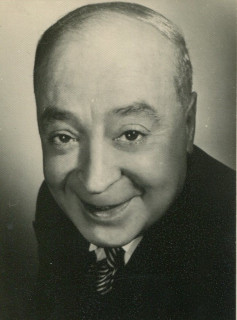
Birth of Jimmy O’Dea, Actor & Comedian

Jimmy O’Dea, Irish actor and comedian, is born at 11 Lower Bridge Street, Dublin, on April 26, 1899.

O’Dea, born James Augustine O’Dea, is one of eleven children of James O’Dea, an ironmonger, and Martha O’Gorman, who keeps a small toy shop. His father has a shop in Capel Street. He is educated at the Irish Christian Brothers O’Connell School in North Richmond Street, Dublin, where a classmate is future Taoiseach Seán Lemass, by the Holy Ghost Fathers at Blackrock College, and by the Jesuits at Belvedere College. From a young age he is interested in taking to the stage. He co-founds an amateur acting group, the Kilronan Players, in 1917, but his father will not hear of it. He is apprenticed to an optician in Edinburgh, Scotland, where he qualifies as an optician.

O’Dea returns to Dublin where, at age 21, he sets up his own business which he eventually gives to his sister, Rita. In his spare time he takes part in amateur productions of Henrik Ibsen and Anton Chekhov. From 1920 he is in the Irish theatre in Hardwicke Street working with actor-producer John MacDonagh. In 1922 he makes a series of comedy films for Norman Whitten. After working in plays by George Bernard Shaw for a few years he rejoins MacDonagh in revues, the first of which, Dublin To-Night, is produced at the Queen’s Theatre, Dublin in 1924. In 1927 he takes to the stage full-time. In 1928, the company’s first production Here We Are wins international acclaim, and in December of the same year it produces its first Christmas Pantomime, Sinbad the Sailor.

O’Dea forms a partnership with Harry O’Donovan whom he first meets in a production of You Never Can Tell in 1924. Their first show is Look Who’s Here at Queen’s Theatre. For more than two decades beginning in 1929 the duo produces two shows a year in Dublin, first in the Olympia Theatre, then in the Gaiety Theatre. They create O’Dea’s most famous character, Mrs. Biddy Mulligan. The role draws on O’Dea’s previous manifestations as “Dames” in Variety performances and pantomimes. Biddy Mulligan is the representation (caricature, parody and stereotype) of a Dublin street-seller, with all the working-class repartee, wisdom and failings implicit. He makes a number of recordings of sketches starring Mrs. Mulligan. Biddy Mulligan is referenced in many Dublin music hall songs such as “Biddy Mulligan the Pride of the Coombe,” “Daffy the Belle of the Coombe” and “The Charladies’ Ball.”

O’Dea makes some film appearances, such as Darby O’Gill and the Little People (1959) in which he plays King Brian of the little people and Johnny Nobody (1961). He also has a successful career in pantomime and tours Ireland and England many times, and is much associated with actress Maureen Potter, with whom he often partners.

O’Dea is also a prolific songwriter in his day. Many of his songs are still well known to this day, some of them having been sung and recorded by Dublin singer Frank Harte.

O’Dea marries Ursula Doyle, a theatrical impresario, in September 1959 with Seán Lemass standing in as best man and Maureen Potter as the bridesmaid. O’Dea had been best man at Lemass’s wedding in 1924.

Jimmy O’Dea dies at Dr. Steevens’ Hospital, Dublin, at age 65, on January 7, 1965. Seán Lemass, at the time Taoiseach, gives the valedictory oration at his funeral. He is buried in Glasnevin Cemetery, Dublin.


Leave a comment

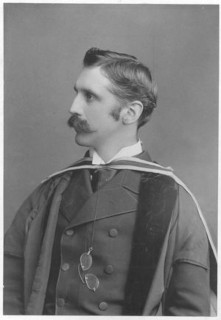
Birth of Samuel Henry Butcher, Scholar & Politician

Samuel Henry Butcher, Anglo-Irish classical scholar and politician, is born in Dublin on April 16, 1850.

Butcher is the son of Samuel Butcher, Bishop of Meath, and Mary Leahy. John Butcher, 1st Baron Danesfort, is his younger brother. He is educated at Marlborough College in Wiltshire and then receives a place at Trinity College, Cambridge, attending between 1869 and 1873 where he is Senior Classic and Chancellor’s medalist. He is elected fellow of Trinity in 1874.

Butcher leaves Trinity on his marriage, in 1876, to Rose Julia Trench (1840-1902), the daughter of Archbishop Richard Chenevix Trench. The marriage produces no children.

From 1876 to 1882 Butcher is a fellow of University College, Oxford, and tutors there. From 1882 to 1903 he is Professor of Greek at the University of Edinburgh succeeding Prof. John Stuart Blackie. During this period, he lives at 27 Palmerston Place in Edinburgh‘s West End. He is succeeded at the University of Edinburgh by Prof. Alexander William Mair.

Butcher is one of the two Members of Parliament for Cambridge University, between 1906 and his death, representing the Liberal Unionist Party. He is President of the British Academy from 1909 to 1910.

Butcher dies in London on December 29, 1910, and his body is returned to Scotland and interred at the Dean Cemetery in Edinburgh with his wife. His grave has a pale granite Celtic cross and is located near the northern path of the north section in the original cemetery.

Butcher’s many publications include, in collaboration with Andrew Lang, a prose translation of Homer‘s Odyssey which appears in 1879 and the OCT edition of Demosthenes, Orationes, vol. I (Or. 1-19, Oxford, 1903), II.i (Or. 20–26, Oxford, 1907).


Leave a comment

Death of Charles Leslie, Jacobite Propagandist & Non-Juror

Charles Leslie, former Church of Ireland priest who becomes a leading Jacobite propagandist after the 1688 Glorious Revolution, dies in Glaslough, County Monaghan on April 13, 1722. One of a small number of Irish Protestants to actively support the Stuarts after 1688, he is best remembered today for his role in publicising the 1692 Massacre of Glencoe.

Leslie is born on July 27, 1650, in Dublin, the sixth son and one of eight surviving children of John Leslie (1571-1671) and Katherine Conyngham (or Cunningham), daughter of Dr. Alexander Cunningham, Dean of Raphoe. He is allegedly named after the executed Charles I and educated at Enniskillen school and Trinity College, Dublin. After his father dies in 1671, he studies law in London before changing career and being ordained as an Anglican priest in 1681. Shortly afterwards, he returns to the family estate at Glaslough in County Monaghan and marries Jane Griffith. They have a daughter, Vinigar Jane, who appears to have died young and two sons, Robert (1683-1744) and Henry who are also Jacobites and spend time in exile.

Leslie is appointed assistant curate for the Church of Ireland parish of Donagh but as most of his parish is Roman Catholic or Presbyterian, he has few duties. His father had been chaplain to Charles I and a key supporter of Caroline religious reforms, first in Scotland, then in Ireland as Bishop of Raphoe in 1633, while the estate at Glaslough was granted by Charles II in 1660 as a reward for his service. With this background, Leslie is a firm supporter of the Stuart dynasty, although deeply hostile to Catholicism and soon becomes involved in political and theological disputes.

When the Catholic James II becomes King in 1685, his brother-in-law Henry Hyde, 2nd Earl of Clarendon, is appointed Lord Lieutenant of Ireland. In July 1686, Leslie’s legal training results in Clarendon making him chancellor of Connor cathedral and later Justice of the Peace. Clarendon’s authority is overshadowed by his Catholic deputy Richard Talbot, 1st Earl of Tyrconnell, who begins undermining legal restrictions on Catholics embodied in the Test Act. Clarendon employs Leslie’s polemical skills to oppose the appointment of Catholics to public office, but he is recalled in 1687. When James is deposed by the Glorious Revolution in December 1688, Leslie is in the Isle of Wight.

Shortly afterwards, Leslie becomes Clarendon’s personal chaplain and like his patron refuses to take the oath of allegiance to William III and Mary II. Like other non-jurors, he is deprived of his Church offices and becomes instead one of the most prominent Jacobite and Tory propagandists. This includes a long dispute with his Trinity College contemporary William King, who supports the Revolution. Gilbert Burnet, Bishop of Salisbury, later names him ‘the violentest Jacobite’ active in England during these years.

Much of Leslie’s early writing focuses on Scotland, where the 1690 Settlement ends Episcopacy and restores a Presbyterian kirk. He uses this to inspire concern about William’s intentions towards the Church of England. Ironically, his modern fame now rests primarily on a pamphlet written in 1695, called Gallienus Redivivus, or Murther will out, &c. Being a true Account of the De Witting of Glencoe, Gaffney. The focus of this is William’s alleged complicity in the 1672 death of Dutch Republican leader Johan de Witt, with other crimes including Glencoe included as secondary charges. During the Jacobite rising of 1745, Charles Stuart orders Leslie’s pamphlet and the 1695 Parliamentary minutes of the investigation to be reprinted in the Edinburgh Caledonian Mercury.

During the 1690s, Leslie serves as a messenger between James’ court in exile at Château de Saint-Germain-en-Laye and the Non-Juror community in England, including the non-juror bishops Jeremy Collier, Thomas Ken and George Hickes. He defends Collier and two other non-juror priests when they become involved in a furor over the execution of Sir John Friend and Sir William Parkyns for their role in the 1696 Jacobite plot to assassinate William. Immediately prior to the execution, the clergymen declare the two absolved of their sins, effectively declaring the correctness of their actions, while also performing a rite not recognised by the Church of England.

In 1702, the accession of Queen Anne, the last Stuart monarch, causes a resurgence in Jacobite activity and in 1704, Leslie begins a weekly periodical initially called The Observator, later The Rehearsal of Observator and finally The Rehearsal. Although his Tory readership shares his High Church principles, he is primarily a Jacobite and violently opposes the common practice of ‘occasional conformity.’ The Rehearsal is forced to close in 1709 and he falls out with his former allies, including Henry Sacheverell whose trial helped the Tories win a landslide victory in the 1710 British general election.

Despite his Tory allies now being in government, a warrant is issued for Leslie’s arrest for his tract The Good Old Cause, or, Lying in Truth. In 1711 he escapes to Paris, where James Francis Edward Stuart has succeeded his father as the Stuart heir in 1701. He continues to write polemics and act as a Jacobite agent. However, after the failed Jacobite rising of 1715, France withdraws support for the Stuarts who are forced to leave France, eventually being invited to settle in Rome by Pope Benedict XIV. The Spanish-sponsored 1719 Rising in Scotland is judged to have done more damage to the Jacobite cause than otherwise, one of its leaders concluding “it bid fair to ruin the King’s Interest and faithful subjects in these parts.”

Despite these failures, Leslie remains a dedicated Jacobite but his lifelong antipathy towards Catholicism makes living in Rome as a Papal pensionary difficult, while hopes of converting James to Anglicanism fades due to his devout personal Catholicism. He returns to Paris in 1717 and in 1719 publishes a two folio-volume edition of his Theological Works. It is later claimed these placed him ‘very high in the list of controversial authors, the ingenuity of the arguments being equalled only by the keenest and pertinacity with which they are pursued.’ He invites friends and supporters to subscribe to these and by 1721, over 500 members of the House of Lords and House of Commons have pledged a total of £750. Charles Spencer, 3rd Earl of Sunderland finally allows him to return home, with the stipulation he cease his political activities.

Charles Leslie dies at Glaslough on April 13, 1722. His grandchildren include Charles Leslie MP, whose son in turn is John Leslie, Bishop of Kilmore, Elphin and Ardagh.

(Pictured: Charles Leslie, mezzotint by Unknown artist, National Portrait Gallery, NPG D5066)


Leave a comment

Birth of Irish Novelist John Banim

John Banim, Irish novelist, short story writer, playwright, poet and essayist, sometimes called the “Scott of Ireland,” is born in Kilkenny, County Kilkenny on April 3, 1798. He also studied art, working as a painter of miniatures and portraits, and as a drawing teacher, before dedicating himself to literature.

At age four, Banim’s parents send him to a local school where he learns the basics of reading and grammar. At age five, he is sent to the English Academy at Kilkenny where his older brother Michael (1796–1874) is a student. After five years at the English Academy, he is sent to a seminary run by a Reverent Magrath, considered to be the finest Roman Catholic school in Ireland. After a year at the seminary, he transfers to another academy run by a teacher named Terence Doyle. Throughout his school years, he reads avidly and writes his own stories and poems. When he is ten, he visits the poet Thomas Moore, bringing along some of his own poetry in manuscript. Moore encourages him to continue writing and gives him a season ticket to his private theatre in Kilkenny.

At the age of 13, Banim enters Kilkenny College and devotes himself specially to drawing and miniature painting. He pursues his artistic education for two years in the schools of the Royal Dublin Society, and afterwards teaches drawing in Kilkenny, where he falls in love with one of his pupils, a 17-year-old girl named Anne. His affection is returned, but her parents disapprove of their relationship and send her out of town. Anne dies two months later of tuberculosis. Her death makes a deep impression on him and his health suffers severely and permanently.

In 1820 Banim goes to Dublin and settles finally to the work of literature. He publishes a poem, The Celt’s Paradise, and his play Damon and Pythias is performed at Covent Garden in 1821. During a short visit to Kilkenny he marries, and in 1822, in conjunction with Michael, plans a series of tales illustrative of Irish life, which should be for Ireland what the Waverley Novels are for Scotland. The influence of his model is distinctly traceable in his writings.

Banim then sets out for London, and supports himself by writing for magazines and for the stage. A volume of miscellaneous essays is published anonymously in 1824, called Revelations of the Dead Alive. The first series of Tales of the O’Hara Family appears in April 1825, which achieves immediate and decided success. One of the most powerful of them, Crohoore of the Bill Hook, is by Michael Banim.

In 1826, a second series is published, containing the Irish novel, The Nowlans. Banim’s health has given way, and the next effort of the “O’Hara family” is almost entirely the production of his brother Michael. The Croppy, a Tale of 1798 (1828), a novel of the Irish Rebellion of 1798, is hardly equal to the earlier tales, though it contains some wonderfully vigorous passages.

The Mayor of Windgap, and The Ghost Hunter (both by Michael Banim), The Denounced (1830) and The Smuggler (1831) follow in quick succession, and are received with considerable favour. Most of these deal with the darker and more painful phases of life, but the feeling shown in his last, Father Connell, is brighter and tenderer. Banim, meanwhile, suffers from illness and consequent poverty. In 1829, he goes to France, and while he is abroad a movement to relieve his wants is set on foot by the English press, headed by John Sterling in The Times. A sufficient sum is obtained to remove him from any danger of actual want.

Banim returns to Ireland in 1835, taking up residence in Dublin. On meeting him again in August, Michael Banim finds his brother’s condition to be that of a complete invalid. He is often in pain and has to use opiates to sleep, but during the short intervals between the attacks of his illness, he is able to enjoy conversation and the company of his brother and friends. In September he returns to Kilkenny and is received with an address from the citizens of Kilkenny showing their appreciation of him, and a subscription from them of £85. After a short stay in his childhood home, he settles in Windgap Cottage, then a short distance from Kilkenny. He passes the remainder of his life there, dying on August 13, 1842.

Michael Banim acquires a considerable fortune which he loses in 1840 through the bankruptcy of a firm with which he had business relations. After this disaster he writes Father Connell (1842), Clough Fionn (1852), and The Town of the Cascades (1862). He dies at Booterstown.

An assessment in the Encyclopædia Britannica Eleventh Edition (1911) reads:

“The true place of the Banims in literature is to be estimated from the merits of the O’Hara Tales; their later works, though of considerable ability, are sometimes prolix and are marked by too evident an imitation of the Waverley Novels. The Tales, however, are masterpieces of faithful delineation. The strong passions, the lights and shadows of Irish peasant character, have rarely been so ably and truly depicted. The incidents are striking, sometimes even horrible, and the authors have been accused of straining after melodramatic effect. The lighter, more joyous side of Irish character, which appears so strongly in Samuel Lover, receives little attention from the Banims.”