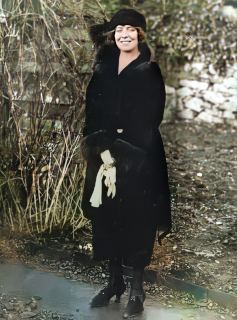
Josephine McNeill, Irish diplomat, is born on March 31, 1895, in Fermoy, County Cork. She is the first Irish female diplomat appointed to represent Ireland abroad in a ministerial capacity.
McNeill is born Josephine Ahearne, the daughter of shopkeeper and hotelier, James Ahearne, and his wife Ellen Ahearne (née O’Brien). She attends the Loretto Convent, Fermoy, and goes on to graduate from University College Dublin (UCD) with a BA, H.Dip.Ed. in French and German. With this she begins a teaching career, at St. Louis’ Convent, Kiltimagh, at the Ursuline Convent, Thurles, and at Scoil Íde. Scoil Íde, the female counterpart to St. Enda’s School, had been established by her friend, Louise Gavan Duffy. She is fluent in the Irish language and takes an active part in the cultural elements of the Irish independence movement, such as literature and music. She is a member of Cumann na mBan, serving as a member of the executive committee in 1921.
After the death of her husband in 1938, McNeill becomes the honorary secretary of the council of the Friends of the National Collections, as well as serving as chair of the executive committee of the Irish Countrywomen’s Association until 1950. As a member of the Department of External Affairs advisory committee on cultural relations, she writes on economic, social and cultural issues. She represents Ireland at the UNESCO general assembly in Paris in 1949.
McNeill is an active member of Clann na Poblachta from its foundation in 1946. She is appointed the minister to the Netherlands in 1950 by Seán MacBride, making her the first Irish female diplomat to represent the Republic of Ireland abroad in a ministerial capacity. This appointment is not well received by diplomats in the Department of External Affairs. Her reports from The Hague focus on the issues the Netherlands faces with decolonisation. In 1955, she becomes the minister to Sweden, going on to hold the joint appointment to Austria and Switzerland from 1956 to 1960, after which she retires. While serving in Switzerland she puts aside the resentment she feels towards Éamon de Valera based on how he had treated her husband, to sit with him during a convalescence while de Valera recovers from an eye operation.
McNeill is an amateur pianist and collects paintings and porcelains. In 1933, she publishes the Irish language book, Finnsgéalta ó India.
Rice is born to Johnny Rice and his wife Nell (née Hayes). Her mother can sing, and her father is a master mason. Her mother’s singing brings in extra money after her father is posted overseas during World War II. She goes to Methodist College Belfast and by the age of fourteen is living in the family home with lodgers as her parents are in Africa where her father is working. She is not academic and takes only a passing interest in becoming a secretary. A school friend says that all she wants to do is draw.
The artist Gerard Dillon comes from Belfast. He helps Rice after they are introduced to each other by her piano teacher in 1951. He is friends with the painter George Campbell. They both share “an interest in bohemian characters.” She regards both Dillon and Campbell as her mentors for decades and her work is of a similar surrealistic and primitive style.
In 1956, Rice completes her first solo exhibition at the British Council in Hong Kong. She had been there since 1954 doing typing and practicing her painting. Her father is working there, and she stays in Hong Kong until the following year. When she returns, she earns money working night shifts in the BBC newsroom.
Gerard Dillon and his sister, Mollie, have a property on London‘s Abbey Road in 1958. They rent part of the house to artist Arthur Armstrong, and they rent a flat to Rice and her brother. Dillon and Rice would tour junk yards to find objects like leather and string that they include in their artwork. The house is known for its ex-pat Irish artists which also include Aidan Higgins and Gerry Keenan.
In 1963, Rice goes to the United States to exhibit, and she has to be persuaded to find time to meet President Kennedy. This is three weeks before he is killed in Dallas. In 1967, she is in Paris learning lithography and marries the German contemporary artist Haim Kern. Their child Tristran is born, and the marriage soon ends, and she leaves for Switzerland.
Rice marries again after she returns to Ireland to live in County Fermanagh. They have a daughter who is named Trasna. She exhibits twice in Belfast. In 1997, a large collaboration with Felix Anaut results in images of Adam and Eve which is prepared for a Spanish arts festival near Zaragoza. Another large commission is to decorate the shutters of Pushkin House at Baronscourt for Alexandra Hamilton, Duchess of Abercorn, in 2005.
Rice dies in County Monaghan on March 23, 2015, where she had lived for twenty years. She completes her last exhibition in 2009, over fifty years after her first in Hong Kong. She has exhibited and had her work in notable collections including the United Nations. She is noted for only creating art when she wanted to, she had never conformed, Aeneas Bonner says in her obituary “Normality was a not a close acquaintance.”
Clarke is born in Dublin on March 17, 1889, the younger son and third child of Joshua Clarke and Brigid Clarke (née MacGonigal). Church decorator Joshua Clarke moves to Dublin from Leeds, West Yorkshire, England, in 1877 and starts a decorating business, Joshua Clarke & Sons, which later incorporates a stained-glass division. Through his work with his father, Clarke is exposed to many schools of art but Art Nouveau in particular.
Clarke is educated at the Model School in Marlborough Street, Dublin, and Belvedere College, which he leaves in 1905. After his mother’s death in 1903, he is apprenticed into his father’s studio and attends evening classes in the Metropolitan College of Art and Design. His The Consecration of St. Mel, Bishop of Longford, by St. Patrick wins the gold medal for stained-glass work in the 1910 Board of Education National Competition. At the art school in Dublin, he meets fellow artist and teacher Margaret Crilley. They marry on October 31, 1914.
Clarke moves to London to seek work as a book illustrator. Picked up by London publisher George G. Harrap and Co., he starts with two commissions which are never completed. Difficulties with these projects makes Fairy Tales by Hans Christian Andersen his first printed work, in 1916. It includes 16 colour plates and more than 24 halftone illustrations. This is followed by illustrations for an edition of Edgar Allan Poe‘s Tales of Mystery and Imagination, the second version of which, published in 1923, makes his reputation as a book illustrator. His work can be compared to that of Aubrey Beardsley, Kay Nielsen, and Edmund Dulac. His final book, Selected Poems of Algernon Charles Swinburne, is published in 1928.
Clarke also continues to work in stained-glass, producing more than 130 windows. His glass is distinguished by the finesse of its drawing and his use of rich colours. He is especially fond of deep blues. His use of heavy lines in his black-and-white book illustrations echoes his glass techniques.
Clarke is plagued with ill health, in particular respiratory problems. He is diagnosed with tuberculosis in 1929 and goes to a sanatorium in Davos, Switzerland. Fearing that he will die abroad, he begins his journey back to Dublin in 1931, but dies on this journey on January 6, 1931, in Chur where he is buried. A headstone is erected but local law requires that the family pledge to maintain the grave 15 years after the death. This is not explained to the Clarke family and Harry Clarke’s remains are disinterred in 1946 and reburied in a communal grave.
O’Reilly is born on May 14, 1929, in Granard, County Longford, one of six children of James P. O’Reilly, shopkeeper and musician, and Catherine O’Reilly (née Donegan). The family moves to Dublin when he is nine years old. He is educated at the Christian Brothers school in James’s Street, where he excels at Gaelic football and develops an interest in drama and music. Toward the end of his schooldays, he begins to participate in athletics, particularly the high jump, and is coached by Jack Sweeney, a leading athletics coach.
Always a man of many talents and interests, after leaving school O’Reilly combines working in the insurance business with an athletics career with Donore Harriers and evening drama classes. He wins several Irish titles, including the high jump, javelin, and decathlon, and sets a national record in the high jump. In 1954 he wins the British AAA Championships high jump title, beating the Commonwealth champion into second place, and setting a championship record of 6 ft. 5 in. (1.96 m). As a result, he secures a United States athletics scholarship to the University of Michigan, Ann Arbor, where he takes a degree in liberal arts, majoring in speech and drama. While at Michigan he improves his Irish record to 6 ft. 7 in. (2.007 m). His athletic career, however, is dogged with bad luck. He is selected to compete in the high jump at the European Athletics Championships in Bern, Switzerland, in 1954 but fractures an ankle in practice and fails to advance beyond the qualifying round. Although he competes at international level for ten years (1952–62), he is unlucky to never take part in the Olympic Games. A victim of sporting politics in 1952, as an NCAA athlete he is not entitled to compete. He is selected for the 1956 Summer Olympics in Melbourne but is unable to attend when, at the last minute, his club cannot provide the finance for him to attend. Earlier that year he wins the Big Ten Conference high jump title.
On leaving Michigan O’Reilly moves to New York City, where he embarks on an acting career with the Irish Players, but he returns to Dublin in 1959, where, after brief spells working as a teacher and for an advertising agency, he applies to Ireland’s new television station for a position. He is looking for an acting job but ends up being offered a position as a presenter, joining Teilifís Éireann in 1961 as an announcer/interviewer. His relaxed and unobtrusive style appeals to viewers and his light entertainment show, The Life of O’Reilly, is the most popular programme on Irish television in the day, eclipsing even a fledgling The Late Late Show. It is as a sports presenter and commentator, however, that O’Reilly is primarily remembered, as he becomes the face of sport on RTÉ Television for many years. He attends five Olympic Games as a broadcaster, from Mexico in 1968 to Los Angeles in 1984, commentating on athletics and gymnastics. The first presenter of RTÉ’s flagship Saturday afternoon sports programme Sports Stadium in 1984, he continues to present it over its fourteen-year life, co-presenting the final programme in December 1997. He also is the regular presenter of RTÉ’s Wimbledon Championships tennis coverage for many years, the sports results on news broadcasts on TV and radio, and Sunday Sport on RTÉ Radio, as well as commentating on individual sports such as ice-skating.
Although sports presenting is a natural progression for an athlete with his talents, O’Reilly’s real love is the arts. He continues to act, playing the part of Detective Inspector Michael Roarke in the classic children’s film Flight of the Doves (1971) with Ron Moody and Willie Rushton. He is also an accomplished singer and songwriter, and writes and performs his own one-man show, Across the Spectrum, comprising his own poems and songs in 1992. As well as a book of poems, The Great Explosion (1977), he releases a number of albums and tops the charts with his own song, “The Ballad of Michael Collins,” in 1981. He has a great admiration for Michael Collins, and this leads to his becoming the first non-political figure to give the oration at the annual Collins commemoration at Béal na Bláth, County Cork, in 1981. He also writes the song “Let the Nations Play” (1985), inspired by the boycotts of the Olympic games of 1980 and 1984, and the song is adopted as an anthem of the international Olympic movement.
Tall and slim in build, O’Relly is affable, modest, and self-deprecating in character. His relaxed style is no mere public affectation. He often exasperates colleagues by turning up just in time for broadcasts, and his ability to ad-lib is important in a live television environment. He once describes himself as “a champion high jumper who could enunciate properly and keep my hair neatly combed” (The Irish Times, April 7, 2001). Despite the disappointments in his sporting career, he maintains that his other interests more than compensated. In relation to the Olympics he is quoted as saying, “If you asked me whether I’d have preferred to win a medal or have written the song, I’d honestly say I would have preferred to have written the song” (Longford Leader, April 6, 2001).
O’Reilly lives in Ranelagh, Dublin, and is married twice. He meets his first wife Linda Herbst (née Kuhl) in New York in the late 1950s. His second marriage is to Johanna Lowry. He has four children. After a lenghty illness, he dies on April 1, 2001, in St. Vincent’s Hospital, Fairview, Dublin. He is buried at Mount Venus cemetery, Rathfarnham.
(From: “O’Reilly, Brendan” by Jim Shanahan, Dictionary of Irish Biography, http://www.dib.ie, October 2009)
Bardwell is born to Irish parents William Hone and Mary Collise and moves to Ireland at the age of two. Her father’s family are of the Anglo-IrishHone family. She has a difficult childhood growing up in Leixlip, County Kildare. She is educated at Alexandra College and briefly studies in Switzerland. She works in a variety of jobs in Ireland and later Scotland, where, in 1948, she meets poet Michael Bardwell. The couple has two children and later separate.
Bardwell becomes a part of the literary scene of Soho in London, where she socialises with fellow writers, including Anthony Cronin, Francis Bacon, Patrick Kavanagh and Anthony Burgess. In the 1950s, she meets Fintan McLachlan, with whom she has three children, including the composer, John McLachlan. The family moves back to Dublin, where she works as a reviewer for Hibernia magazine and as a poetry editor.
From 1970 onward, Bardwell’s work is published regularly, starting with her first volume of poetry, The Mad Cyclist, which is later followed by her first novel, Girl on a Bicycle. She writes a number of plays and short stories, such as Outpatients, and her works are produced for RTÉ and the BBC. In 1984, she writes a musical play, No Regrets, based on the life of Édith Piaf. It opens at the Gaiety Theatre starring Anne Bushnell, and later tours across Ireland.
Bardwell’s work is heavily influenced by her difficult upbringing and her experiences in London and Dublin. In her memoir, A Restless Life, she describes her life as “a crescendo of madness.” She is considered an important poet by her contemporaries, who include Patrick Kavanagh, John Jordan, Paul Durcan, Macdara Woods and Michael Hartnett. On the publication of her fourth collection of poetry, The White Beach, Eilean Ni Chuilleanain states “it is good to see her work of the decades collected – it has inspired many Irish poets, male and female, and should be much more widely known,” adding that her work is “witty, full of sharp intimate honesty, full of truth and surprises.”
In 1975, Bardwell co-founds the long running literary magazine Cyphers with Eiléan Ní Chuilleanáin and Macdara Woods, and acts as a co-editor until 2012. She is the recipient of the Marten Toonder Award in 1993, and the Dede Korkut Short Story Award from Turkish PEN in 2010.
In later life, Bardwell moves to Annamakarraig in County Monaghan and later to Cloonagh in County Sligo, where in 1993 she co-founds the Scríobh Literary Festival. She is a member of the Irish artists’ association Aosdána and acts as one of Patrick Kavanagh’s literary executors.
Bardwell dies at the age of 94 in Sligo, County Sligo, on June 28, 2016.
Beere joins the Civil Service of the Republic of Ireland in 1924 and works initially in the Statistics Branch. In 1925, she wins a Rockefeller Foundation scholarship and travels extensively in the United States before resuming her Civil Service career. From 1939, she works in the Department of Industry and Commerce where during The Emergency, as World War II is known in Ireland, she works in the area of supply with Minister Seán Lemass. She becomes Assistant Secretary of that Department in 1953. She is the first woman to achieve the rank of Department Secretary, the highest-ranking post in a government department, doing so at the Department of Transport and Power in 1959. PresidentMary McAleese calls her the “ultimate civil servant.”
Trinity College Dublin confers an honorary doctorate of Doctor of Laws upon her in 1960. After her retirement in 1967 she is active in public life, serving as a governor of Alexandra College and as a director of The Irish Times. She is requested by the Government to chair the Commission on the Status of Women in 1970, and the Beere Report is presented to the Minister for Finance in December 1972. The report provides a model for change in equal pay, the Civil Service marriage bar (which requires female civil servants to resign from their position upon marriage) and the widow’s pension. Her name is mentioned as a possible candidate for the Irish presidency in 1976.
Beere has a lifelong interest in the proceedings of the Statistical and Social Inquiry Society of Ireland and serves as its President. She is a Governor of The Irish Times Trust and chairwoman of the International Labour Organization office in Geneva, Switzerland. She is a member of the organising committee, which on May 7, 1931, sets up An Óige (the Irish Youth Hostel Association), of which she is President from 1968 to 1974. She also has an extensive interest in the arts, in particular the paintings of Cecil King.
Beere dies on February 19, 1991, in Killiney, County Dublin. She never marries but has a 40-year companionship with businessman JJ O’Leary.
Kiernan is born to Peter Kiernan and Bridget (née Dawson). She is educated at Loreto Convent, County Wicklow. Hers is a very comfortably off merchant family with five sisters and one brother. Her parents enjoy a happy marriage, and life in the Kiernan home is joyous until Kitty reaches her teens. On November 27, 1907, her sister, Elizabeth Mary (a twin), dies at the age of eighteen of pulmonary tuberculosis, while Elizabeth’s twin sister, Rose, apparently dies the same year in Davos, Switzerland, which would also indicate tuberculosis as a cause of death. Her mother dies on November 29, 1908, of apoplexy, while her father dies almost exactly a year later, on November 9, 1909, of pneumonia. The Kiernan family owns the Greville Arms Hotel in the town, as well as a grocery shop, a hardware store, a timber and undertaking business and also a bar. Around the corner from the hotel, they operate a bakery which supplies the town and most of the surrounding countryside. All the family works in one capacity or another.
Michael Collins, one of the principal founders of the independent Irish state, is introduced to the vivacious Kiernan sisters by his cousin Gearóid O’Sullivan, who is already dating Maud Kiernan. Collins initially falls for the captivating Helen Kiernan, but she is already engaged to someone else. He then turns his interests to Kitty, who has already captured the interest of Collins’ friend Harry Boland. However, it is Collins to whom Kitty becomes engaged, with plans to marry Collins in a November 1922 double ceremony to include the nuptials of Maud and Gearóid. Collins’ assassination four months earlier, on August 22, 1922, near Béal na Bláth, County Cork, results in a single wedding taking place.
On June 10, 1925, Kiernan marries Felix Cronin, who is Quartermaster General in the Irish Army. They have two sons, Felix Jnr. and Michael Collins Cronin. Felix Jnr. and his son Rex are interred with his parents in Glasnevin Cemetery.
Kiernan dies, aged 52, of a cerebral hemorrhage on July 24, 1945, and her grave is close to that of Collins. Felix Cronin dies suddenly on October 22, 1961, while playing golf at Woodbrook Golf Club and is also buried in Glasnevin.
Kiernan and Michael Collins keep up a lengthy correspondence and while Collins is in London during the Anglo-Irish Treaty negotiations, he writes to her every day. The bulk of these letters are written between 1919 and 1922, and through their almost daily contact emerges a picture of the dreams and aspirations of the man often called Ireland’s “lost leader” and the woman with whom he wanted to share a “normal” life. These letters are the subject of a book written by Leon Ó Broin entitled In Great Haste. In 2000, some of the 300 letters sent by Kiernan and Collins to each other go on permanent display at the Cork Public Museum. These letters give a great insight into her attitude to life and into the political events of this time.
Former Fine Gael minister Peter Barry donates his collection of historic letters to the Lord Mayor of Cork, on behalf of the municipal museum. The collection, purchased from the Cronin family in 1995, is conserved at the Delmas bindery at Marsh’s Library in Dublin. The letters are also catalogued and then returned to the Cork Public Museum. The Peter Barry collection also contains letters from Harry Boland, a friend of Collins and former suitor of Kiernan.
In the 1996 film Michael Collins, Kiernan is played by American actress Julia Roberts though some reviewers are critical of the character’s development.
Scallon is born Rosemary Brown, the fifth of seven children of a King’s Cross railway station porter and trumpet player originally from Derry, Northern Ireland. When she is five, the family moves back to Derry where she grows up in the Creggan housing estate and Bogside. She attends St. Eugene’s Primary School and then enrolls at Thornhill College. A singing talent from childhood, she wins several local contests while also participating in local choirs and taking piano, violin and ballet lessons.
In the early 1960s Scallon forms a trio with two of her sisters, often performing at charity concerts organized by their father. When one sister leaves, the remaining duo lands a summer-long booking at the Palladium and a recording contract with Decca Records. Her other sister, however, leaves to join her new husband, a United States airman, in America. Stricken with stage fright, Scallon the solo singer manages to win a folk competition at the Embassy Ballroom with her eyes shut. The contest’s sponsor, teacher and music promoter Tony Johnston, helps her complete her equivalency degree and records a demo that convinces Decca Records to sign her on as a solo artist. She releases a single in 1967 that brings some attention from local TV and radio.
Performing under her school nickname “Dana,” Scallon becomes a fixture in Dublin‘s cabaret and folk clubs. She is crowned “Queen of Cabaret” and feted with a parade and a reception at Clontarf Castle on the Saturday before Easter 1968.
At the suggestion of Decca Record’s local agent, Phil Mitton, Scallon auditions for the Irish National Song Contest, a preliminary for the 1969 Eurovision competition. She reaches the finals in Dublin but comes in second.
RTÉ Television chief Tom McGrath invites Scallon back to compete the following year. She accepts even though she is preparing to retire from active performing to pursue teaching. The song, “All Kinds of Everything” by Derry Lindsay and Jackie Smith, is picked for her by McGrath and propels her to victory. She goes on to represent Ireland in the 1970 Eurovision contest, held in Amsterdam. She performs perched on a stool on stage and defeats England’s Mary Hopkin and Spain‘s Julio Iglesias to secure Ireland’s victory.
Scallon is given a hero’s welcome upon her return to Ireland, especially in Northern Ireland. “All Kinds of Everything” shoots to #1 on the Irish Singles Chart, as well as the UK Singles Chart. It is also successful in Australia, Austria, Germany, Israel, Malaysia, the Netherlands, New Zealand, Singapore, South Africa, Switzerland and Yugoslavia, on its way to passing 1 million sales. She quickly records an album, with orchestral accompaniment. Her follow-up single, “I Will Follow You,” fails to make much of a splash. Given the choice of giving up, she decides to fight for her recording career, and succeeds with Paul Ryan‘s “Who Put the Lights Out,” which spends eleven weeks on the UK charts.
In 1974 Scallon switches to GTO Records. Her first single on that label, “Please Tell Him That I Said Hello,” returns her to the top 10. Her 1975 holiday single “It’s Gonna be a Cold Cold Christmas” by Roger Greenaway and Geoff Stephens, reaches #4 and remains a classic. Now an established Irish singing star she appears in films and festivals and sells out a week of concerts at the London Palladium. She also maintains her “Queen of the Cabaret” reputation with regular appearances in top London clubs. The BBC gives her two shows of her own: a series called A Day with Dana in 1974 and four-part series of Wake Up Sunday in 1979. BBC Radio follows suit with a series of I Believe in Music in 1977.
Meanwhile, Scallon begins performing stage pantomime in a blockbuster production of Cinderella in Oxford. In September 1976, however, she is hospitalized with a non-malignant growth on her left vocal cord, requiring surgery. The single “Fairytale” is sustained in the charts with the publicity from her dire medical prognosis. The experience strengthens her religious faith. On October 5, 1978, she marries Damien Scallon, a hotel-owner from Newry, at St. Eugene’s Cathedral in Derry.
In 1979, recovered from her surgery, Scallon records a new album entitled The Girl is Back, which has modest success. Pope John Paul II‘s visit to Ireland that year inspires her to write a song based on his personal motto, “Totus Tuus,” which tops the Irish charts. Long associated with Christian causes and Sunday-morning programs, she and her husband look for opportunities to reach a broader market for Christian music and find one in the United States. They attend the National Religious Broadcasters conference in Washington, D.C. in 1980 and secure a contract with Word Records.
Scallon’s first album of Christian songs, Totally Yours, is released on Word Records in 1981. She continues to record pop music, including the 1982 album Magic and the official 1982 FIFA World Cup song for the Northern Ireland team, “Yer Man.” She also continues her stage career, starring in Snow White and the Seven Dwarfs at Hull and later in London’s West End and Wolverhampton. She tours the United States in 1984, including appearances at Billy Graham‘s Boston crusades. She pens an autobiography in 1985. She performs “Totus Tuus” before a packed Superdome crowd during John Paul II’s visit to New Orleans in 1987.
Also in 1987, after one of her husband’s hotels is damaged for the seventh time by a terrorist bomb, he takes a job managing retreats for EWTN and moves the family to Alabama. They rent a house in the Cherokee Bend area of Mountain Brook and enroll their children at Saint Rose Academy. Scallon is welcomed to the network as well, hosting the Say Yes and We Are One Body programs. She leaves Word Records and signs with Heart Beat Records for her later Catholic albums. In 1993 she again performs for the Pope at a World Youth Day event in Denver, Colorado.
Scallon is naturalized as a dual citizen of the United States and Northern Ireland in 1997 and moves back there a year later because she has been drafted as an independent candidate for President of Ireland. She garners 15% of the popular vote, finishing third in the race won by Mary McAleese, ahead of the Labour Party candidate. Most of her votes come from rural districts where conservative values are more strongly held.
In 1999 Scallon wins a seat on the European Parliament, representing Connacht-Ulster on a family values and anti-abortion platform. During her five-year term she opposes the development of a European constitution. She also speaks out against a 2001 proposal to amend the Irish constitution to legalize the “morning-after pill” and intrauterine contraceptive devices. With the support of the mainstream parties, the amendment is put to a popular referendum, which fails in 2002. That same year she is defeated in a campaign to represent Galway West in the Dáil Éireann, the lower house of the Irish parliament. In 2004 she fails to hold her seat in the European Parliament and also does not secure a nomination for President.
Leaving politics behind, Scallon joins a weight-loss challenge on RTÉ’s The Afternoon Show in 2005. In 2006 she competes with Ronan McCormack on Celebrity Jigs ‘n’ Reels, finishing second on the popular dance contest.
That same year, Scallon and her husband launch their own music label, DS Music Productions, and release a compilation of songs deidcated to John Paul II’s memory. That is followed by Good Morning Jesus: Prayers and Songs for Children of All Ages, which is featured in a special series on EWTN. Heart Beat Records files a lawsuit against DS Music Productions for alleged copyright violations.
In 2007 Scallon appears as a guest judge for Young Star Search, a Belfast CityBeat radio contest. In 2009 she is brought on as a judge for The All Ireland Talent Show. That same year she returns to EWTN as host of Dana and Friends.
O’Neill is born Mary Devenport, the daughter of Royal Irish Constabulary (RIC) sub-constable, John Devenport, and his wife Bridget (née Burke). She attends the Dominican convent, Eccles Street, Dublin before enrolling in the Metropolitan School of Art from 1898 to 1903. In 1900 she wins the year’s prize in the School of Art. She apparently considers teaching as a career, as she is listed on the college register as a teacher in training from 1901 to 1903. It is while an art student that she starts to correspond with the writer she admires, Joseph O’Neill. Their relationship develops, and the couple marries on June 19, 1908, settling in Kenilworth Square, Dublin.
Many of O’Neill’s husband’s friends disapprove of her modern and unconventional ideas, but she is popular with “the Rathgar Group” who attends George Russell’s Sunday salons. After a few years, she establishes her own salon referred to as “Thursdays at home,” attended by Russell, Padraic Colum, W. B. Yeats, Richard Irvine Best, Frank O’Connor, Francis Stuart and Iseult Gonne. She becomes particularly close to Yeats, who she confides in. Yeats records their weekly consultations in his diary while working on A Vision (1925). In his Oxford anthology of English verse from 1936, he includes one of O’Neill’s poems. In 1917, she contributes lyrics to her husband’s play The Kingdom Maker. She publishes her only book in 1929, Prometheus and other poems. After this she occasionally contributes primarily modernist plays and poetry to The Dublin Magazine, The Irish Times and The Bell. She collaborates with Austin Clarke from the Lyric Theatre Company on her plays Bluebeard (1933) and Cain (1945).
O’Neill suffers with poor health, which sees her and her husband spending extended periods in the south of France and Switzerland. They sell their home in Dublin in August 1950 and move to Nice, with the intention of settling there. However, due to rapidly depleting finances they are forced to return to Ireland in April 1951. They rent a cottage in Wicklow from their friend Con Curran. When her husband dies in 1953, she goes to live with relatives in Dublin. She dies there in 1967.
Hone’s most important works are probably the East Window, depicting the Crucifixion, for the Chapel at Eton College, Windsor (1949–1952) and My Four Green Fields, now located in Government Buildings, Dublin. This latter work, commissioned for the Irish Government’s Pavilion, wins first prize for stained glass in the 1939 New York World’s Fair. It graces CIÉ‘s Head Office in O’Connell Street from 1960 to about 1983. The window is then taken into storage by Abbey Glass in Kilmainham, Dublin at the request of the Office of Public Works.
The East Window of Eton College is commissioned following the destruction of the building after a bomb is dropped on the school in 1940 during World War II. She is commissioned to design the East Window in 1949, and the new window is inserted in 1952. This work is featured on an Irish postage stamp in 1969. From December 2005 to June 2006, an exhibition of her work is on display at the National Gallery of Ireland. Saint Mary’s church in Clonsilla also features her stained glass windows.
Hone is extremely devout. She spends time in an Anglican Convent in 1925 at Truro in Cornwall and converts to Catholicism in 1937. This may have influenced her decision to begin working in stained glass. Initially she works as a member of the An Túr Gloine stained glass co-operative before setting up a studio of her own in Rathfarnham.
Unmarried, Hone dies on March 13, 1955, while entering her parish church at Rathfarnham. She is survived by two of her sisters. Over 20,000 people visit a memorial exhibition of her work at University College Dublin (UCD), Earlsfort Terrace, Dublin, in 1958.
(Pictured: “My Four Green Fields” by Evie Hone, which depicts the four provinces of Ireland)




 seamus dubhghaill