seamus dubhghaill

Promoting Irish Culture and History from Little Rock, Arkansas, USA


Leave a comment

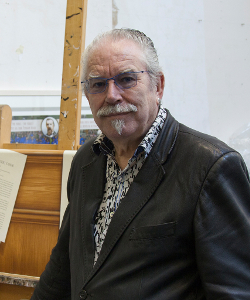
Birth of Robert Ballagh, Artist, Painter & Designer

Robert “Bobby” Ballagh, artist, painter and designer, is born in Dublin on September 22, 1943. His painting style is strongly influenced by pop art. He is particularly well known for his hyperealistic renderings of well-known Irish literary, historical or establishment figures.

Ballagh grows up in a ground-floor flat on Elgin Road in Ballsbridge, the only child of a Presbyterian father and a Catholic mother. He studies at Bolton Street College of Technology and becomes an atheist while attending Blackrock College. Before turning to art as a profession, he is a professional musician with the Irish showband Chessmen. He meets artist Michael Farrell during this period, and Farrell recruits him to assist with a large mural commission, which is painted at Ardmore Studios.

Ballagh represents Ireland at the 1969 Biennale de Paris. Among the theatre sets he has designed are sets for Riverdance, I’ll Go On, Gate Theatre (1985), Samuel Beckett‘s Endgame (1991) and Oscar Wilde‘s Salomé (1998). He also designs over 70 Irish postage stamps and the last series of Irish banknotes, “Series C,” before the introduction of the euro. He is a member of Aosdána and his paintings are held in several public collections of Irish painting including the National Gallery of Ireland, the Hugh Lane Gallery, the Ulster Museum, Trinity College, Dublin, and Nuremberg‘s Albrecht Dürer House.

In 1991, he co-ordinates the 75th anniversary commemoration of the 1916 Easter Rising, during which he claims he is harassed by the Special Branch of the Garda Síochána.

He is the president of the Ireland Institute for Historical and Cultural Studies, which promotes international republicanism. It is based at the new Pearse centre at 27 Pearse Street, Dublin, which is the birthplace of Pádraig Pearse in 1879.

In July 2011 it is reported that he might consider running for the 2011 Irish Presidential election with the backing of Sinn Féin and the United Left Alliance. A Sinn Féin source confirms there has been “very informal discussions” and that Ballagh’s nomination is “a possibility” but “very loose at this stage.” However, on July 25 Ballagh rules out running in the election, saying that he has never considered being a candidate. His discussions with the parties had been about the election “in general” and he has no ambitions to run for political office.

That same month, Ballagh breaks ranks with his colleagues in the travelling production of Riverdance in their decision to perform in Israel. He is an active member of the Ireland Palestine Solidarity Campaign, which insists that artists and academics participate in boycotts of Israeli businesses and cultural institutions.

In July 2012, Ballagh says he is “ashamed and profoundly depressed” at the en masse closure of Irish galleries and museums. He cites an example of some Americans and Canadians on holiday in Ireland. “They described most of the National Gallery as being closed along with several rooms in the Hugh Lane Gallery. I’m glad they didn’t bother going out to the Museum of Modern Art in Kilmainham because that’s closed too. At the point I met them, they were returning from Galway where they had found the Nora Barnacle Museum closed too.” He condemns the hypocrisy of political leaders, saying, “I know arts funding is not a big issue for people struggling to put food on the table, but we are talking about the soul of the nation.”

Leave a comment

Birth of Artist Thomas James Carr

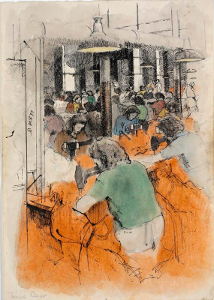
Thomas James Carr, British artist who is associated with the Euston Road School in the 1930s and has a long career as a painter of domestic scenes and landscapes, is born in Belfast to a well-to-do family on September 21, 1909.

Carr attends Oundle School where his art masters include E.M.O’R. Dickey and Christopher Perkins. In 1927 Carr moves to London where he studies at the Slade School of Fine Art. After two years at the Slade, he moves to Italy and spends six months in Florence. Upon returning to London, he establishes himself as a well-regarded painter of domestic scenes.

Although essentially a realist painter, Carr is included in the 1934 Objective Abstractionists exhibition at Zwemmer’s Gallery. In 1937, he shares an exhibition with Victor Pasmore and Claude Rogers at the Storran Gallery and subsequently becomes associated with the representational style of the Euston Road School. Starting in 1940, at Georges Wildenstein‘s gallery, he holds a series of one-man exhibitions at various galleries including at the Leicester Galleries, The Redfern Gallery and also at Thomas Agnew & Sons.

In 1939, Carr returns to Northern Ireland and settles in Newcastle, County Down. During the World War II, he receives a small number of commissions from the War Artists’ Advisory Committee to depict parachute manufacture and the Short Sunderland flying boats being built at the Short Brothers factory in Belfast.

After the war, Carr teaches at the Belfast College of Art and moves to Belfast in 1955. After the death of his wife in 1995, he moves to Norfolk, England to be nearer one of his three daughters and her family. He continues to paint into old age and tends to concentrate on landscape painting.

Carr is a regular exhibitor at the Royal Academy of Arts and is a member of the Royal Ulster Academy, the New English Art Club, the Royal Watercolour Society and is an honorary member of the Royal Hibernian Academy. Queen’s University awards him an honorary doctorate in 1991. For his services to art in Northern Ireland, he is awarded the MBE in 1974 and receives an OBE in 1993.

Thomas Carr dies at the age of 89 in Norwich, England on February 17, 1999.

(Pictured: “Making Coloured Parachutes” by Thomas James Carr (http://www.iwm.org.uk/collections/item/object/4674) [Public domain], via Wikimedia Commons)


Leave a comment

Execution of Robert Emmet, Irish Nationalist & Republican

Robert Emmet, Irish nationalist and Republican, orator and rebel leader, is hung, drawn, and quartered in Dublin on September 20, 1803, following his conviction for high treason.

Emmet is born at 109 St. Stephen’s Green, in Dublin on March 4, 1778, the youngest son of Dr. Robert Emmet, a court physician, and his wife, Elizabeth Mason. He attends Oswald’s school, in Dopping’s-court, off Golden-lane and enters Trinity College, Dublin in October 1793, at the age of fifteen. He becomes secretary of a secret United Irish Committee in college and is expelled in April 1798 as a result. That same year he flees to France to avoid the many British arrests of nationalists that are taking place in Ireland.

After the 1798 rising, Emmet is involved in reorganising the defeated Society of United Irishmen. In April 1799 a warrant is issued for his arrest. He escapes and soon after travels to the continent in the hope of securing French military aid. His efforts are unsuccessful, as Napoleon is concentrating his efforts on invading England.

Emmet returns to Ireland in October 1802 and, along with fellow revolutionaries Thomas Russell and James Hope, begins preparations for another uprising in March of the following year. A premature explosion at one of Emmet’s arms depots forces him to advance the date of the rising before the authorities’ suspicions are aroused.

Emmet is unable to secure the help of Michael Dwyer‘s Wicklow rebels. Many rebels from Kildare turn back due to the scarcity of firearms they had been promised, but the rising proceeds in Dublin on the evening of July 23, 1803. Failing to seize Dublin Castle, which is lightly defended, the rising amounts to a large-scale disturbance in the Thomas Street area. He sees a dragoon pulled from his horse and piked to death, the sight of which prompts him to call off the rising to avoid further bloodshed, but he has no control over of his followers. Sporadic clashes continue into the night until finally quelled by British military forces.

Emmet flees into hiding but is captured on August 25 and taken to Dublin Castle, then removed to Kilmainham Gaol. He is tried for treason on September 19. The Crown repairs the weaknesses in its case by secretly buying the assistance of Emmet’s defence attorney, Leonard McNally, for £200 and a pension. McNally’s assistant Peter Burrowes cannot be bought, and he pleads the case as best he can. Emmet is found guilty of high treason.

Chief Justice John Toler, 1st Earl of Norbury sentences Emmet to be hanged, drawn and quartered, as is customary for conviction of treason. The following day, September 20, Emmet is executed in Thomas Street near St. Catherine’s Church. He is hanged and beheaded once dead. As family members and friends of Emmet had also been arrested, including some who had nothing to do with the rebellion, no one comes forward to claim his remains out of fear of arrest.

Emmet’s remains are first delivered to Newgate Prison and then back to Kilmainham Gaol, where the jailer is under instructions that if no one claims them, they are to be buried in a nearby hospital’s burial grounds. A later search there finds no remains. It is speculated that Emmet’s remains were secretly removed from the site and reinterred in St. Michan’s Church, a Dublin church with strong United Irish associations, though it is never confirmed. It is later suspected that they are buried secretly in the vault of a Dublin Anglican church. When the vault is inspected in the 1950s a headless corpse was found, suspected of being Emmet’s, but cannot be identified. Widely accepted is the theory that Emmet’s remains were transferred to St. Peter’s Church in Aungier St. under cover of the burial of his sister, Mary Anne Holmes, in 1804. In the 1980s the church is deconsecrated, and all the coffins are removed from the vaults. The church has since been demolished.


Leave a comment

Charles Stewart Parnell’s Famous Speech at Ennis

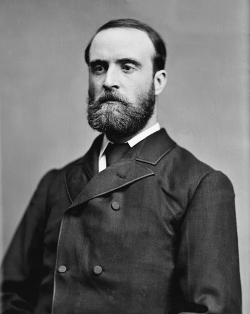
Charles Stewart Parnell delivers his famous speech at Ennis, County Clare, on September 19, 1880, in which he introduces the term for non-violent protest – boycotting.

Parnell is elected president of Michael Davitt‘s newly founded Irish National Land League in Dublin on October 21, 1879, signing a militant Land League address campaigning for land reform. During the summer of 1880, the Land League, goes into decline but its fortunes are transformed when the House of Lords rejects a moderate measure of land reform. The movement is transformed into a national movement as it spreads into Munster and Leinster. As the movement spreads, crime increases especially in the West. Parnell, who had been elected leader of the Irish Parliamentary Party in May, is very worried about this violence and hopes that the Land League can deflect tenants away from the traditional violence associated with land agitation. He advocates a policy of “moral force” where tenants are to deny all social or commercial contact with anyone who is believed to oppose the aims of the League.

During his speech at Ennis, Parnell asks his audience, “What are you to do with a tenant who bids for a farm from which another has been evicted?” Several voices reply “Shoot him!” and “Kill him!” Parnell responds, “I wish to point out to you a very much better way, a more Christian and charitable way, which will give the lost man an opportunity of repenting. When a man takes a farm from which another has been evicted, you must shun him on the roadside when you meet him, you must shun him in the streets of the town, you must shun him in the shop, you must shun him on the fair green and in the market place, and even in the place of worship, by leaving him alone, by putting him in moral Coventry, by isolating him from the rest of the country, as if he were the leper of old – you must show him your detestation of the crime he committed.”

This type of “moral Coventry” is used in the cast of Captain Charles Cunningham Boycott, a County Mayo land agent, who is isolated by the local people until his nerve breaks. This leads to a new word entering into the English language – boycotting.


Leave a comment

Birth of Sir Frederick Matthew Darley, Chief Justice of New South Wales

Sir Frederick Matthew Darley, the sixth Chief Justice of New South Wales, an eminent barrister, a member of the Parliament of New South Wales, Lieutenant-Governor of New South Wales, and a member of the Privy Council of the United Kingdom, is born in Bray, County Wicklow, on September 18, 1830.

Darley is educated at Dungannon College in County Tyrone. His uncle, the Reverend John Darley, is headmaster of the college. In July 1847 he commences studying at Trinity College, Dublin, and he graduates in July 1851 with a Bachelor of Arts (BA). He is called to the English bar at the King’s Inn in January 1853 but returns to Ireland and practises there for about nine years on the Munster circuit. He meets Sir Alfred Stephen when Stephen is on a visit to Europe and is told that there are good prospects for him in Australia.

Darley marries Lucy Forest Browne at Hunsdon, Hertfordshire, on December 13, 1860. Lucy is the sister of novelist Rolf Boldrewood (Thomas Alexander Browne) who is best known for the book Robbery Under Arms. They have two sons and four daughters.

Darley decides to emigrate to Australia and arrives in Sydney in 1862. He is admitted to the NSW Bar on June 2, 1862, and is later appointed a Queens Counsel (QC) in 1878. In September 1868 he is nominated to the New South Wales Legislative Council. In November 1881 he becomes vice-president of the executive council in the third Henry Parkes ministry. In November 1886 Darley is offered the position of Chief Justice of New South Wales in succession to Sir James Martin. He does not desire the office and to accept it would mean a considerable monetary sacrifice. As a barrister, he is likely earning more than twice the amount of the salary offered. He declines the position, and it is accepted by Julian Salomons who subsequently resigns a few days later.

Darley is again approached and this time he accepts the position. He is sworn in on December 7, 1886. He carries out his duties with great distinction, although he is not an exceptional jurist. On the retirement of Sir Alfred Stephen in November 1891, Darley is appointed Lieutenant-Governor of New South Wales, and he administers the government seven times in that capacity. When the position of Governor of New South Wales becomes vacant in 1901, there are many suggestions that Darley should be given the post, but it is given to Sir Harry Rawson.

Darley’s longest period administering the government is from November 1, 1900, to May 27, 1902, a significant period in Australia’s political history with the lead up to and the aftermath of federation of the then Australian colonies. But his anxiety for New South Wales’s supremacy possibly contributes to the “Hopetoun Blunder.” Darley’s private assessment in 1902 is that “Australian Federation is so far a pronounced failure.”

Darley is knighted in 1887, created a Knight Commander of the Order of St. Michael and St. George (KCMG) in 1897, and receives the Knight Grand Cross of the Order of St. Michael and St. George (GCMG) on May 15, 1901, in preparation of the forthcoming royal visit of the Duke and Duchess of Cornwall and York (later King George V and Queen Mary).

Darley visits England in 1902 and is appointed a member of the royal commission on the South African war. He is also appointed a member of the privy council in 1905. He dies in London on January 4, 1910.


Leave a comment

Birth of Irish Writer Frank O’Connor

Frank O’Connor, Irish writer of over 150 works and best known for his short stories and memoirs, is born Michael Francis O’Donovan in Cork, County Cork, on September 17, 1903. The Frank O’Connor International Short Story Award is named in his honour.

Raised in Cork, the only child of Minnie (née O’Connor) and Michael O’Donovan, O’Connor attends Saint Patrick’s School on Gardiner’s Hill and North Monastery CBS. His early life is marked by his father’s alcoholism, debt, and ill-treatment of his mother. His childhood is shaped in part by his mother, who supplies much of the family’s income by cleaning houses, because his father is unable to keep steady employment due to his drunkenness. He adores his mother and is bitterly resentful of his father. In his memoirs, he recalls his childhood as “those terrible years,” and admits that he has never been able to forgive his father for his abuse of himself and his mother. When his mother is seventy, O’Connor is horrified to learn from his own doctor that she has suffered for years from chronic appendicitis, which she has endured with great stoicism, as she has never had the time nor the money to see a doctor.

In 1918 O’Connor joins the First Brigade of the Irish Republican Army and serves in combat during the Irish War of Independence. He opposes the Anglo-Irish Treaty of 1921 and joins the Anti-Treaty IRA during the Irish Civil War, working in a small propaganda unit in Cork City. He is one of twelve thousand Anti-Treaty combatants who are interned by the government of the new Irish Free State. Between 1922 and 1923 he is imprisoned in Cork City Gaol and in Gormanston, County Meath.

Following his release, O’Connor takes various positions including that of teacher of Irish, theatre director, and librarian. He begins to move in literary circles and is befriended by George William Russell (Æ), through whom he comes to know most of the well-known Irish writers of the day, including William Butler Yeats, Lennox Robinson, F. R. Higgins and Lady Gregory. In his memoirs, he pays tribute to both Yeats and Russell for the help and encouragement they gave him.

In 1935, O’Connor becomes a member of the board of directors of the Abbey Theatre in Dublin, founded by Yeats and other members of the Irish National Theatre Society. In 1937, he becomes managing director of the Abbey. Following Yeats’s death in 1939, O’Connor’s long-standing conflict with other board members comes to a head and he leaves the Abbey later that year. In 1950, he accepts invitations to teach in the United States, where many of his short stories have been published in The New Yorker and have won great acclaim. He spends much of the 1950s in the United States, although it is always his intention to return eventually to Ireland.

From the 1930s to the 1960s O’Connor is a prolific writer of short stories, poems, plays, and novellas. His work as an Irish teacher complements his plethora of translations into English of Irish poetry, including his initially banned translation of Brian Merriman‘s Cúirt an Mheán Oíche (The Midnight Court). Many of O’Connor’s writings are based on his own life experiences – notably his well-known The Man of the House in which he reveals childhood details concerning his early life in County Cork. The Sullivan family in this short story, like his own boyhood family, is lacking a proper father figure.

O’Connor’s early years are recounted in An Only Child, a memoir published in 1961 which has the immediacy of a precocious diary. He continues his autobiography through his time with the Abbey Theatre in Dublin in his book My Father’s Son, which is published posthumously in 1968. It contains valuable character sketches of many of the leading Irish literary figures of the 1930s, in particular Yeats and Æ.

Frank O’Connor has a stroke while teaching at Stanford University in 1961, and he later dies from a heart attack in Dublin on March 10, 1966. He is buried in Deans Grange Cemetery two days later.


Leave a comment

Birth of Ronnie Drew, Singer & Folk Musician

Joseph Ronald “Ronnie” Drew, singer, folk musician and actor who achieves international fame during a fifty-year career recording with The Dubliners, is born in Dún Laoghaire, County Dublin, on September 16, 1934. He is most recognised for his lead vocals on the single “Seven Drunken Nights” and “The Irish Rover” both charting in the U.K. top 10. He is recognisable for his long beard and his voice, which is once described by Nathan Joseph as being “like the sound of coal being crushed under a door.”

Drew is educated at CBS Eblana. Despite his aversion to education, he is considered the most intelligent in his class by schoolfriend and future Irish film censor, Sheamus Smith. Drew also sings as a boy soprano before his voice breaks.

In the 1950s, Drew moves to Spain to teach English and learn Spanish and flamenco guitar. His interest in folk music begins at the age of nineteen. When he returns to Ireland, he performs in the Gate Theatre with John Molloy and soon goes into the music business full-time, after holding a number of short-term jobs.

In 1962, he founds the Ronnie Drew Group with Luke Kelly, Barney McKenna and Ciarán Bourke. They soon change their name to The Dubliners, with John Sheahan joining shortly afterwards to form the definitive line-up and quickly become one of the best-known Irish folk groups. They play at first in O’Donoghue’s Pub in Merrion Row, Dublin where they are often accompanied by Mary Jordan on the spoons and vocalist Ann Mulqueen, a friend of McKenna’s. Mary Jordan’s mother, Peggy Jordan, introduces them to the Abbey Tavern in Howth, which becomes a regular Monday night venue for the emerging group. They also play across the road in the Royal Hotel, at all-night parties in Peggy’s large house in Kenilworth Square in Rathgar, and in John Molloy’s flat at Ely Place.

Drew leaves the Dubliners in 1974, goes to Norway in 1978 and records two songs with the Norwegian group Bergeners. He rejoins The Dubliners in 1979 and leaves for good in 1995, though he does reunite with the group in 2002 for a 40th anniversary celebration. He makes several television appearances with the group between 2002 and 2005.

From 1995 onwards, Drew pursues a solo career. He records with many artists, including Christy Moore, The Pogues, Antonio Breschi, Dropkick Murphys, Eleanor Shanley and others. He does a number of “one-man shows” consisting of stories about people such as Brendan Behan, Patrick Kavanagh and Seán O’Casey, as well as Drew singing their songs.

He fronts a campaign to encourage the use of Dublin’s light-rail infrastructure and, before that, the “My Dublin” ads for radio stations 98FM and FM104. He narrates a retelling of the great Irish Myths and Legends over a six CD set in 2006. He also narrates the stories of Oscar Wilde in his distinctive voice for a series released on CD by the News of the World newspaper. Both were re-released as CD box sets in 2010.

On August 22, 2006, Drew is honoured in a ceremony where his handprints are added to the “Walk of Fame” outside Dublin‘s Gaiety Theatre.

In September 2006, Drew is reported to be in ill-health after being admitted to St. Vincent’s Hospital, Dublin, to undergo tests for suspected throat cancer. On October 25, 2007, Drew, now bald and beardless, appears on Ryan Confidential on RTÉ 1 to give an interview about his role in The Dubliners, his life since leaving the band and being diagnosed with throat cancer. Later in 2007, he appears on The Late Late Show, where he speaks about the death of his wife and his ongoing treatment for cancer.

Ronnie Drew dies in St. Vincent’s Hospital, Dublin, on August 16, 2008, following his long illness. He is buried three days later in Redford Cemetery in Greystones.


Leave a comment

Police Raid & Shut Down “The Irish People”

Police raid and close the offices of the Fenian newspaper The Irish People on September 15, 1865. Jeremiah O’Donovan Rossa, Thomas Clarke Luby, and John O’Leary are arrested.

In mid-1863, James Stephens informs his colleagues he wishes to start a newspaper, with financial aid from John O’Mahony and the Fenian Brotherhood in America. The offices are established at 12 Parliament Street, almost at the gates of Dublin Castle. The first edition of The Irish People appears on November 28, 1863. The staff of the paper along with Charles Kickham are Thomas Clarke Luby and Denis Dowling Mulcahy as the editorial staff. Jeremiah O’Donovan Rossa and James O’Connor are in charge of the business office, with John Haltigan being the printer. John O’Leary is brought from London to take charge in the role of Editor. Shortly after the establishment of the paper, James Stephens departs on an American tour, and to attend to organisational matters.

American Fenians make plans for a rising in Ireland, but the plans are discovered on July 15, 1865 when an emissary loses them at Kingstown railway station. They find their way to Dublin Castle and to Superintendent Daniel Ryan head of G Division. Ryan has an informer within the offices of The Irish People named Pierce Nagle, who supplies Ryan with an “action this year” message on its way to the Irish Republican Brotherhood unit in Tipperary. With this information, Ryan raids the offices of The Irish People on September 15, followed by the arrests of John O’Leary, Thomas Clarke Luby and Jeremiah O’Donovan Rossa. The last edition of the paper is dated September 16, 1865.

Before leaving for America, Stephens entrusts to Luby a document containing secret resolutions on the Committee of Organization or Executive of the IRB. Though Luby intimates its existence to O’Leary, he does not inform Kickham as there seems no necessity. This document later forms the basis of the prosecution against the staff of The Irish People. The document reads:

EXECUTIVE

I hereby appoint Thomas Clarke Luby, John O’Leary and Charles J. Kickham, a Committee of Organisation or Executive, with the same supreme control over the Home Organisation (Ireland, England, Scotland, etc.) I have exercised myself. I further empower them to appoint a Committee of Military Inspection, and a Committee of Appeal and Judgment, the functions of which Committee will be made known to each member of them by the Executive. Trusting to the patriotism and ability of the Executive, I fully endorse their action beforehand, and call on every man in our ranks to support and be guided by them in all that concerns our military brotherhood.

9 March 1864, Dublin
J. STEPHENS

Charles Kickham is caught after a month on the run and James Stephens is also eventually caught but with the support of Fenian prison warders John J. Breslin and Daniel Byrne is less than a fortnight in Richmond Bridewell Prison when he vanishes and escapes to France.

(From Stair na hÉireann, https://stairnaheireann.net/2015/09/15/1865-police-raid-and-close-the-irish-people-offices-odonovan-rossa-luby-and-oleary-are-arrested/)


Leave a comment

Death of Arthur Wellesley, 1st Duke of Wellington

Field Marshal Arthur Wellesley, 1st Duke of Wellington, Anglo-Irish soldier and statesman who was one of the leading military and political figures of 19th-century Britain, dies on September 14, 1852. His defeat of Napoleon at the Battle of Waterloo in 1815 puts him in the first rank of Britain’s military heroes.

Wellesley is born in Dublin, into the Protestant Ascendancy in Ireland. He is commissioned as an ensign in the British Army in 1787, serving in Ireland as aide-de-camp to two successive Lords Lieutenant of Ireland. He is also elected as a Member of Parliament in the Irish House of Commons. He is a colonel by 1796, and sees action in the Netherlands and in India, where he fights in the Fourth Anglo-Mysore War at the Siege of Seringapatam. He is appointed governor of Seringapatam and Mysore in 1799 and, as a newly appointed major-general, wins a decisive victory over the Maratha Confederacy at the Battle of Assaye in 1803.

Wellesley rises to prominence as a general during the Peninsular War of the Napoleonic Wars and is promoted to the rank of field marshal after leading the allied forces to victory against the First French Empire at the Battle of Vitoria in 1813. Following Napoleon’s exile in 1814, he serves as the ambassador to France and is granted a dukedom. During the Hundred Days in 1815, he commands the allied army which, together with a Prussian army under Gebhard Leberecht von Blücher, defeats Napoleon at Waterloo. Wellesley’s battle record is exemplary, and he ultimately participates in some 60 battles during the course of his military career.

Wellesley is famous for his adaptive defensive style of warfare, resulting in several victories against numerically superior forces while minimising his own losses. He is regarded as one of the greatest defensive commanders of all time, and many of his tactics and battle plans are still studied in military academies around the world.

After the end of his active military career, Wellesley returns to politics. He is British prime minister as part of the Tory party from 1828 to 1830, and for a little less than a month in 1834. He oversees the passage of the Roman Catholic Relief Act 1829 but opposes the Reform Act 1832. He continues as one of the leading figures in the House of Lords until his retirement and remains Commander-in-Chief of the British Army until his death.

Wellesley dies at Walmer Castle in Deal, Kent, his residence as Lord Warden of the Cinque Ports, on September 14, 1852. He is found to be unwell on that morning and is aided from his military campaign bed, the same one he used throughout his historic military career and seated in his chair where he dies. His death is recorded as being due to the aftereffects of a stroke culminating in a series of seizures.

Although in life Wellesley hates travelling by rail, his body is taken by train to London, where he is given a state funeral, one of only a handful of British subjects to be honoured in that way, and the last heraldic state funeral to be held in Britain. The funeral takes place on November 18, 1852. He is buried in a sarcophagus of luxulyanite in St. Paul’s Cathedral next to Horatio Nelson, 1st Viscount Nelson.


Leave a comment

Death of John Barry, Father of the American Navy

John Barry, an officer in the Continental Navy during the American Revolutionary War and later in the United States Navy, dies on September 13, 1803 in present day Philadelphia, Pennsylvania. He comes to be widely credited as “The Father of the American Navy,” a moniker he shares with John Paul Jones and John Adams, and is appointed a captain in the Continental Navy on December 7, 1775. He is the first captain placed in command of a U.S. warship commissioned for service under the Continental flag.

After the war, Barry becomes the first commissioned U.S. naval officer, at the rank of commodore, receiving his commission from President George Washington in 1797.

Barry is born on March 25, 1745, in Tacumshane, County Wexford. When his family is evicted from their home by their British landlord, they move to Rosslare on the coast, where his uncle works a fishing skiff. As a young man, Barry determines upon a life as a seaman and he starts out as a ship’s cabin boy.

Barry receives his first captain’s commission in the Continental Navy on March 14, 1776, signed by John Hancock, president of the Continental Congress. Barry is a religious man and begins each day at sea with a reading from the Bible. He has great regard for his crew and their well being and always makes sure they are properly provisioned while at sea. During his naval career Barry commands the USS Delaware, USS Lexington, USS Raleigh, and USS Alliance.

On February 22, 1797, he is issued Commission Number 1 by President George Washington, backdated to June 4, 1794. His title is thereafter “commodore.” He is recognized as not only the first American commissioned naval officer but also as its first flag officer.

Appointed senior captain upon the establishment of the U.S. Navy, he commands the frigate USS United States in the Quasi-War with the French Republic. This ship transports commissioners William Richardson Davie and Oliver Ellsworth to France to negotiate a new Franco-American alliance.

Barry’s last day of active duty is March 6, 1801, when he brings USS United States into port, but he remains head of the Navy until his death.

Barry dies of asthma on September 13, 1803, at Strawberry Hill, in present-day Philadelphia, and is buried in the graveyard of Old St. Mary’s Roman Catholic Church in Center City, Philadelphia.

(Pictured: Portrait of Commodore John Barry, US Navy, by V. Zveg, 1972, from the 1801 portrait by Gilbert Stuart.)