seamus dubhghaill

Promoting Irish Culture and History from Little Rock, Arkansas, USA


1 Comment

“Typhoid Mary” Placed in Quarantine

typhoid-mary

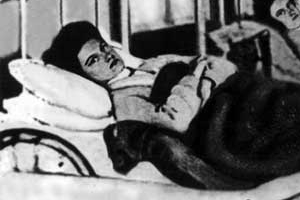
Mary Mallon, better known as Typhoid Mary, the first person in the United States identified as an asymptomatic carrier of the pathogen associated with typhoid fever, is placed in quarantine on March 27, 1869, where she remains for the rest of her life.

Mallon is presumed to have infected 51 people, three of whom die, over the course of her career as a cook. She is twice forcibly isolated by public health authorities and dies after a total of nearly three decades in isolation.

Mallon is born on September 23, 1869, in Cookstown, County Tyrone in what is now Northern Ireland. She immigrates to the United States in 1883 at the age of fifteen and lives with her aunt and uncle.

From 1900 to 1907, Mallon works as a cook in the New York City area for seven families. In 1900, she works in Mamaroneck, New York, where, within two weeks of her employment, residents develop typhoid fever. In 1901, she moves to Manhattan, where members of the family for whom she works develop fevers and diarrhea, and the laundress dies. Mallon then goes to work for a lawyer but leaves after seven of the eight people in that household become ill.

In 1906, Mallon takes a position in Oyster Bay, Long Island, and within two weeks ten of the eleven family members are hospitalized with typhoid. She changes jobs again and similar occurrences happen in three more households. She works as a cook for the family of a wealthy New York banker, Charles Henry Warren. When the Warrens rent a house in Oyster Bay for the summer of 1906, Mallon goes along as well. From August 27 to September 3, six of the eleven people in the family come down with typhoid fever. The disease at that time is “unusual” in Oyster Bay, according to three medical doctors who practice there. Mallon is subsequently hired by other families and outbreaks follow her.

In late 1906, one family hires a typhoid researcher named George Soper to investigate. Soper publishes the results on June 15, 1907, in the Journal of the American Medical Association. He believes Mallon might be the source of the outbreak, but she repeatedly turns him away.

The New York City Health Department sends physician Sara Josephine Baker to talk to Mallon. A few days later, Baker arrives at Mallon’s workplace with several police officers, who take her into custody.

Mallon attracts so much media attention that she is called “Typhoid Mary” in a 1908 issue of the Journal of the American Medical Association. Later, in a textbook that defines typhoid fever, she is again called “Typhoid Mary.”

The New York City Health Inspector determines her to be a carrier. Under sections 1169 and 1170 of the Greater New York Charter, Mallon is held in isolation for three years at a clinic located on North Brother Island.

Upon her release, Mallon is given a job as a laundress. In 1915, Mallon starts another major outbreak, this time at Sloane Hospital for Women in New York City. Twenty-five people are infected and two die. She again leaves, but the police are able to locate and arrest her when she brings food to a friend on Long Island. After arresting her, public health authorities return her to quarantine on North Brother Island on March 27, 1915.

Mallon spends the rest of her life in quarantine at the Riverside Hospital. Six years before her death, she is paralyzed by a stroke. She dies in North Brother Island, East River, New York, on November 11, 1938, of pneumonia. An autopsy finds evidence of live typhoid bacteria in her gallbladder. Mallon’s body is cremated, and her ashes are buried at Saint Raymond’s Cemetery in the Bronx.

Leave a comment

Birth of William Massey, New Zealand Prime Minister

william-ferguson-massey

William Ferguson Massey, New Zealand statesman, Prime Minister from 1912 to 1925, and founder of the Reform Party, is born in Limavady, County Derry in what is now Northern Ireland on March 26, 1856. He is a lifelong spokesman for agrarian interests and opponent of left-wing movements. His Reform Party ministries include leadership of the country during World War I.

The Massey family arrives in New Zealand on October 21, 1862, on board the Indian Empire as Nonconformist settlers, although William remains in Ireland for an additional eight years to complete his education. After arriving on December 10, 1870, on the City of Auckland, he works as a farmhand for some years before acquiring his own farm in Mangere, south Auckland, in 1876.

While managing his own farm, Massey assumes leadership in farmers’ organizations. He enters Parliament in 1894 as a conservative and from 1894 to 1912 is a leader of the conservative opposition to the Liberal ministries. He becomes prime minister in 1912 and promptly signs legislation enabling freeholders to buy their land at its original value. The first years of his ministry see labour strikes by miners in Waihi in 1912 and wharf workers in Wellington in 1913. His harsh repression of them give impetus to the formation of the Labour Party in 1916. He also improves federal administration by putting civil service positions under a nonpolitical commission.

A coalition with the Liberal Party led by Sir Joseph Ward enables Massey to continue his ministry in 1915. He participates in the Imperial War Cabinet (1917–18) and signs the Treaty of Versailles at the Paris Peace Conference of 1919, making New Zealand a founding member of the League of Nations. He opposes separate sovereign status for dominions within the British Commonwealth.

Following the war, farmers are troubled by depressed prices resulting from the sharply reduced British demand for their products, and they also face inflation in land prices, aggravated by increased demand for land by returning servicemen. Massey responds to these problems by establishing the Meat Control Board (1922) and the Dairy Export Control Board (1923), but rural and urban unrest resulting from rising prices continue to mount in the final years of his ministry.

In 1924 cancer forced Massey to relinquish many of his official duties, and he dies on May 10, 1925, at Wellington, New Zealand. The Massey Memorial is erected as his mausoleum in Wellington, paid for mostly by public subscription. Massey University is named after him, the name chosen because the university had a focus on agricultural science, matching Massey’s own farming background.


Leave a comment

Birth of Robert Gibbings, Wood Engraver & Sculptor

LEAD Technologies Inc. V1.01

Robert John Gibbings, Irish artist and author most noted for his work as a wood engraver and sculptor, and for his books on travel and natural history, is born into a middle-class family in Cork, County Cork on March 23, 1889. Along with Noel Rooke he is one of the founder members of the Society of Wood Engravers in 1920 and is a major influence in the revival of wood engraving in the twentieth century.

Gibbings’ father, the Reverend Edward Gibbings, is a Church of Ireland minister. His mother, Caroline, is the daughter of Robert Day, Fellow of the Royal Society of Antiquaries of Ireland and president of The Cork Historical and Archaeological Society. He grows up in the town of Kinsale where his father is the rector of St. Multose Church.

Gibbings studies medicine for three years at University College Cork before deciding to persuade his parents to allow him to take up art. He studies under the painter Harry Scully in Cork and later at the Slade School of Fine Art and the Central School of Art and Design.

During World War I Gibbings serves in the Royal Munster Fusiliers and is wounded at Gallipoli before eventually being invalided out of the army in 1918. He then resumes his studies in London.

Gibbings is very much at the centre of developments in wood engraving. He is a founder member and leading light of the Society of Wood Engravers, which he sets up with Noel Rooke in 1920. In 1922 he contributes two wood engravings, “Clear Waters” and “Hamrun,” to Contemporary English Woodcuts, an anthology of wood engravings produced by Thomas Balston, a director at Gerald Duckworth & Company and an enthusiast for the new style of wood engravings. In 1923 he receives a commission for a set of wood engravings for The Lives of Gallant Ladies for the Golden Cockerel Press, his most important commission to date at 100 guineas.

Gibbings is working on the wood engravings The Lives of Gallant Ladies when Hal Taylor, the owner of the press, becomes very ill with tuberculosis and has to put it up for sale. He seeks a loan from a friend, Hubert Pike, a director of Bentley Motors, to buy the press. He takes over in February 1924 and owns and runs the press until 1933.

Gibbings illustrates numerous books on travel and natural history, including Charles Darwin’s The Voyage of the Beagle, and writes a series of bestselling river books, notably Sweet Thames Run Softly. He does a huge amount to popularise the subject of natural history, travelling extensively through Polynesia, Bermuda and the Red Sea to gather inspiration for his work.

Gibbings is the first man to draw underwater, the illustrations filling his Penguin classic Blue Angels and Whales. He is one of the first natural history presenters on the BBC.

In September 1955 Gibbings and his wife, Patience, purchase Footbridge Cottage, a tiny beehive of a cottage in Gibbings’s words, in Long Wittenham on the banks of the River Thames. Life there suits him, and he has a period of tranquility that he had not known previously. They live there until he dies of cancer in an Oxford hospital on January 19, 1958. He is buried in the churchyard at Long Wittenham. The grave is marked by a simple headstone featuring his device of a crossed quill and graver, carved by Michael Black, a young sculptor who is a friend of Gibbings.


Leave a comment

Birth of Charlotte Milligan Fox, Composer & Music Collector

charlotte-milligan-fox

Charlotte Milligan Fox, Irish composer and music collector, is born on March 17, 1864 in Omagh, County Tyrone in what is now Northern Ireland.

Milligan is the eldest of eleven children born to Methodist parents Seaton Milligan (1837–1916) and Charlotte Burns (1842–1916), with nine surviving including Alice Milligan and Edith Wheeler. All nine children enroll at Methodist College Belfast which provides a privileged and exceptional education. She studies classical piano and composition at the Royal College of Music in London and the Conservatoires of Frankfurt and Milan. Following her marriage to Charles Eliot Fox in 1892, she settles in London.

In 1904 Fox co-founds with Alfred Perceval Graves the Irish Folk Song Society, an offshoot of the Folk-Song Society formed in 1898. Its aim is to collect and publish Irish airs and ballads, in addition to holding lectures and concerts on the subject. She acts as the society’s honorary secretary. The rules of the Society are collected in volume 4 of the Journal of the Irish Folk Song Society. The subscription is 5 shillings payable every January and committee meetings are held at the Rooms of the Irish Literary Society in London.

Fox is a musician in her own right and tours Ireland collecting folk songs and airs. She undertakes a series of tours of County Antrim between 1909 and 1910 with her sisters Edith Wheeler and Alice Milligan. The sisters record and transcribe songs by Irish singers, then publish articles and musical scores in The Journal of Irish Folk Song.

In 1910 Fox visits the east coast of the United States where the New York branch of the Irish Folk Song Society is formed. “The Bardic Recital” is produced on March 16 at the National Theatre in Washington, D.C. She collects and arranges the music for the play.

Fox rediscovers Edward Bunting‘s papers, and under the provision of her will they come to Queen’s University Belfast in 1916. From these papers she writes The Annals of the Irish Harpers. The publication of The Annals of the Irish Harpers stimulates a revival of interest in both the Irish harp and Edward Bunting. Alice Milligan nurses her sister prior to Fox’s death in London on March 25, 1916. An obituary of Charlotte Milligan Fox is in The Irish Booklover (1916). The Journal of the Irish Folk Song Society (1917) has a poem in remembrance of Charlotte Milligan Fox. The same issue has a memoir of Fox by Alice Milligan and an appreciation of Fox by Alfred Perceval Graves.

During 2010 and 2011, the Ulster History Circle mounts plaques for famous Ulster figures. Charlotte Milligan Fox and Alice Milligan have a plaque mounted on Omagh Library, 1 Spillar’s Place, Omagh, County Tyrone.


Leave a comment

Birth of Robert McCarrison, Physician & Nutritionist

robert-mccarrison

Major General Sir Robert McCarrison, physician and nutritionist in the Indian Medical Service, is born in Portadown, County Armagh in what is now Northern Ireland on March 15, 1878.

McCarrison is credited with being the first to experimentally demonstrate the effect of deficient dietaries upon animal tissues and organs. He also carries out human experiments aimed at identifying the cause of goitre, and includes himself as one of the experimental subjects. Much of his work is pioneering. His 1921 book Studies in Deficiency Disease is considered notable at the time, being published at a time when knowledge of vitamins and their role in nutrition is crystallizing.

McCarrison qualifies in Medicine at Queen’s College, Belfast in 1900. At age 23, he goes to India, where he spends 30 years on nutritional problems. His research in India on the cause of goitre wins widespread recognition and in 1913 he is promoted to do research. He attains the rank of major-general in the Indian Medical Service and founds the Nutritional Research Laboratories in Coonoor, where he remains until his retirement from the Indian Medical Service in 1935. After retiring, he returns to England and gives a series of three Cantor lectures on successive Mondays at the Royal Society of Arts, about the influence of diet on health. The first lecture focuses on the processes of nutrition; the second, on food essentials and their relationship to bodily structure and function; the third on disease prevention and physique improvement by attention to diet. The lectures are subsequently published in book form under the title Nutrition and Health, and at the time of the third edition in 1962, are still seen as relevant, with the advances of the preceding 25 years largely filling the details of the principles previously recognised by McCarrison.

McCarrison is made a Companion of the Order of the Indian Empire (CIE) in 1923, receives a knighthood in July 1933, and is appointed as Honourable Physician to the King in 1935.

After World War II, from 1945 to 1955, McCarrison serves as director of postgraduate medical education at the University of Oxford. He dies on May 18, 1960.


Leave a comment

Birth of William Vincent Wallace, Composer & Musician

william-vincent-wallace

William Vincent Wallace, Irish composer and musician, is born at Colbeck Street, Waterford, County Waterford on March 11, 1812. In his day, he is famous on three continents as a double virtuoso on violin and piano. Nowadays, he is mainly remembered as an opera composer of note, with key works such as Maritana (1845) and Lurline (1847/60), but he also writes a large amount of piano music that is much in vogue in the 19th century.

Wallace’s father, Spencer Wallace of County Mayo, becomes a regimental bandmaster with the North Mayo Militia based in Ballina. William is born while the regiment is stationed for one year in Waterford. The family returns to Ballina in 1816 and he spends his formative years there, taking an active part in his father’s band and already composing pieces by the age of nine for the band recitals.

Under the tuition of his father and uncle, Wallace writes pieces for the bands and orchestras of his native area. He becomes accomplished in playing various band instruments before the family leaves the Army in 1826, moving from Waterford to Dublin, and becoming active in music in the capital. He learns to play several instruments as a boy, including the violin, clarinet, organ, and piano. In 1830, at the age of 18, he becomes organist of the Roman Catholic Cathedral at Thurles, County Tipperary, and teaches music at the Ursuline Convent there. He falls in love with a pupil, Isabella Kelly, whose father consents to their marriage in 1832 on condition that Wallace become a Roman Catholic. The couple soon moves to Dublin where he is employed as a violinist at the Theatre Royal.

Economic conditions in Dublin deteriorate after the Acts of Union 1800 and the whole Wallace family decides to emigrate to Australia in 1835. Wallace’s party first lands at Hobart, Tasmania in late October, where they stay several months before moving on to Sydney in January 1836. The Wallaces open the first Australian music academy in April. Wallace has already given many celebrity concerts in Sydney, and being the first virtuoso to visit the Colony, becomes known as the “Australian Paganini.” He is also active in the business of importing pianos from London, but his main activity involves many recitals in and around Sydney under the patronage of the Governor, General Sir Richard Bourke. The most significant musical events of this period are two large oratorio concerts on behalf of the organ fund at St. Mary’s Cathedral in Sydney in 1836 and 1838, which he directs, and which utilize all the available musical talent of the Colony, including the recently formed Philharmonic [Choral] Society.

In 1838, Wallace separates from his wife and begins a roving career that takes him around the globe. In 1841, he conducts a season of Italian opera in Mexico City. Moving on to the United States, he stays in New Orleans for some years, where he is feted as a virtuoso on violin and piano, before reaching New York City, where he is equally celebrated, and publishes his first compositions (1843–44).

Wallace arrives in London in 1845 and makes various appearances as a pianist. In November of that year, his opera Maritana is performed at the Theatre Royal, Drury Lane with great success, and is later presented internationally. Maritana is followed by Matilda of Hungary (1847), Lurline (1847/60), The Amber Witch (1861), Love’s Triumph (1862) and The Desert Flower (1863). He also publishes numerous compositions for the piano.

In New York in 1843–1844, Wallace is associated with the early concert seasons of the New York Philharmonic Society, and in 1853 is elected an Honorary (Life) Member of the Society. In 1854, he becomes an American citizen after a marriage in New York to German-born pianist Hélène Stoepel, sister of composer Robert Stoepel. In later years, having returned to Europe for the premieres of his later operas, he develops a heart condition for which he receives treatment in Paris in 1864. He dies in poor circumstances at the Château de Bagen, Sauveterre-de-Comminges, in the Haute Garonne on October 12, 1865. He is buried in Kensal Green Cemetery, London.

(Pictured: William Vincent Wallace. Undated portrait by Mathew Brady, New York City, Library of Congress)


Leave a comment

Birth of Novelist & Broadcaster Francis MacManus

francis-macmanus-gravesite

Francis MacManus, Irish novelist and broadcaster is born in Kilkenny, County Kilkenny on March 8, 1909.

MacManus is educated in the local Christian Brothers school and later at St. Patrick’s College, Dublin and University College Dublin. After teaching for eighteen years at the Synge Street CBS in Dublin, he joins the staff of Radio Éireann, precursor to the Irish national broadcasting entity RTÉ, in 1948 as Director of Features.

MacManus begins writing while still teaching, first publishing a trilogy set in Penal times and concerning the life of the Gaelic poet Donncha Rua Mac Conmara comprising the novels Stand and Give Challenge (1934), Candle for the Proud (1936) and Men Withering (1939). A second trilogy follows which turns its attention to contemporary Ireland: This House Was Mine (1937), Flow On, Lovely River (1941), and Watergate (1942). The location is the fictional “Dombridge,” based on Kilkenny, and deals with established themes of Irish rural life including obsessions with land, sexual frustration, and the trials of emigration and return. Other major works include the novel The Greatest of These (1943), concerning religious conflict in nineteenth-century Kilkenny, and the biographies Boccaccio (1947) and Saint Columban (1963). In his last two novels, he descends into the depths of theological debate: The Fire in the Dust (1950) is followed by American Son (1959), a remarkable dialogue between conflicting modes of belief which reveals the strong influence of Roman Catholicism on the author.

Francis MacManus dies of a heart attack at the age of 56 in Dublin on November 27, 1965.

The RTÉ Francis MacManus Short Story Award is established in his memory in 1985. The competition is run by RTÉ, Ireland’s national broadcaster, and is open to entries written in Irish or English from authors born or resident in Ireland. The total prize fund is €6000, out of which the winning author receives €3,000. Sums of €2,000 and €1,000 are awarded to the second and third prize winners.


Leave a comment

Birth of Grace Gifford Plunkett, Artist & Irish Republican

grace-gifford-plunkett

Grace Evelyn Gifford Plunkett, artist and cartoonist who is active in the Republican movement, is born in Rathmines, Dublin on March 4, 1888. She marries her fiancé, Joseph Plunkett, in Kilmainham Gaol only a few hours before he is executed for his part in the 1916 Easter Rising.

Gifford is the second youngest of 12 children born to Frederick Gifford, a solicitor and a Roman Catholic, and Isabella Julia Burton Gifford, a Protestant. The boys are baptised as Catholics and the girls as Protestant, but effectively the children are all raised as Protestants with the girls attending Alexandra College in Earlsfort Terrace.

At the age of 16, Gifford goes to the Dublin Metropolitan School of Art, where she studies under the Irish artist William Orpen. Orpen regards her as one of his most talented pupils. Around this time, her talent for caricature is discovered and developed. In 1907 she attends the course in Fine Art at the Slade School of Fine Art, London.

Gifford returns to Dublin in 1908 and, with great difficulty, tries to earn a living as a caricaturist, publishing her cartoons in The Shanachie, Irish Life, Meadowstreet and The Irish Review, which is edited from 1913 by Joseph Plunkett. She considers emigrating but gives up the idea. Nora Dryhurst, a journalist from London, brings her to the opening of the new bilingual school Scoil Éanna in Ranelagh, Dublin. It is here that she meets Plunkett for the first time. He is a friend of her brother-in-law, another of the future leaders of the 1916 Easter Rising, Thomas MacDonagh, who is married to her sister Muriel.

Gifford’s growing interest in the Roman Catholic religion leads to the deepening of Gifford and Plunkett’s relationship as she begins to discuss Catholic mystical ideas with him. Plunkett proposes to her in 1915, and she accepts and takes formal instruction in Catholic doctrine. She is received into the Catholic Church in April 1916. The couple plans to marry on Easter Sunday that year, in a double wedding with his sister and her fiancé.

After the Rising, Gifford’s brother-in-law Thomas MacDonagh is shot with Patrick Pearse and Thomas Clarke by firing squad on May 3. That day, she hears that Plunkett is to be shot at dawn. She purchases a ring in a jeweler’s shop in Dublin and, with the help of a priest, persuades the military authorities to allow them to marry. She and Joseph are married on the night of May 3 in the chapel of Kilmainham Gaol, a few hours before he is executed.

Grace Plunkett decides to devote herself through her art to the promotion of Sinn Féin policies and resumes her commercial work to earn a living. She is elected to the Sinn Féin executive in 1917.

During the Irish Civil War, Plunkett is arrested with many others in February 1923 and interned at Kilmainham Gaol for three months. She paints pictures on the walls of her cell, including one of the Blessed Virgin and the Christ Child. She is released in May 1923.

When the Civil War ends, Plunkett has no home of her own and little money. Like many Anti-Treaty Republicans, she is the target of social ostracism and has difficulty finding work. Her talent as an artist is her only real asset and her cartoons are published in various newspapers and magazines. She moves from one apartment to another and eats in the city-centre restaurants but has no wish to remarry. Her material circumstances improve in 1932 when she receives a Civil List pension from Éamon de Valera‘s Fianna Fáil government. She lives for many years in a flat in Nassau Street with a balcony overlooking the sports ground of Trinity College.

Plunkett’s in-laws refuse to honour her husband’s will, in which he leaves everything to his widow. Legally, the will is invalid because there is only one witness, rather than the required two, and the marriage takes place after the will is made, automatically revoking it. For years she receives nothing, so she begins legal proceedings against her in-laws in 1934. The Count and Countess Plunkett settle out of court, and she is paid £700, plus costs.

At around this time Plunkett joins the Old Dublin Society, where she meets the noted Irish harpsichord maker Cathal Gannon. When Cathal marries, she gives him and his wife Margaret a present of two single beds and a picture. From the late 1940s onwards, her health declines. In 1950 she is brought to St. Vincent’s Hospital. She convalesces in a nursing home, which she does not like, mainly because it restricts her freedom.

Grace Gifford Plunkett dies suddenly on December 13, 1955, in her apartment in South Richmond Street, Portobello. Her body is removed to St. Kevin’s Church, Harrington Street and among the attendees at her funeral is President Seán T. O’Kelly. She is buried with full military honours close to the republican plot in Glasnevin Cemetery.


Leave a comment

Birth of Cyril Falls, Military Historian & Journalist

cyril-bentham-falls

Cyril Bentham Falls, British military historian, journalist and academic, noted for his works on World War I, is born in Dublin on March 2, 1888.

Falls is the eldest son of Sir Charles Falls, an Ulster landowner in County Tyrone. He receives his formal education at the Portora Royal School, Enniskillen, and the University of London. At the age of 27 he publishes his first book, Rudyard Kipling: A Critical Study (1915).

During World War I Falls receives a commission into the British Army as a subaltern in the Royal Inniskilling Fusiliers. He serves as a Staff Officer in the Head Quarters of the 36th (Ulster) Division and the 62nd (2nd West Riding) Division during the conflict. He receives the French Croix de guerre and is discharged from the British Armed Forces with the rank of Captain.

Immediately after leaving the British Army Falls writes a history of one of the Divisions that he had served with during the war, entitled The History of the 36th (Ulster) Division, which is published in 1922.

From 1923 to 1939 Falls is employed by the Historical Section of the United Kingdom Government‘s Committee of Imperial Defence, researching and writing the text of several volumes of the British Government’s official History of the Great War. He serves as the military correspondent for The Times during World War II from 1939 to 1945.

Falls holds the post of Chichele Professor of Military History at All Souls College, Oxford from 1946 to 1953. From the late 1940s through to the end of his life in the early 1970s he is a productive writer of military histories, publishing in-depth detailed studies as well as general works for the commercial market, his final two titles being published posthumously.

The historian Sir Michael Howard later describes Falls’ work The History of the 36th (Ulster) Division (1922) as “containing some of the finest descriptions of conditions on the Western Front to be found anywhere in the literature of the war.”

Cyril Falls dies at the age of 84 in Walton-on-Thames, Surrey, on April 23, 1971.


Leave a comment

Birth of Sculptor Augustus Saint-Gaudens

augustus-saint-gaudens

Augustus Saint-Gaudens, sculptor of the statue for the Charles Stewart Parnell monument which is installed at the North end of Dublin‘s O’Connell Street in 1911, is born in Dublin on March 1, 1848. He is generally acknowledged to be the foremost American sculptor of the late 19th century, noted for his evocative memorial statues and for the subtle modeling of his low reliefs.

Saint-Gaudens is born to a French father and an Irish mother. His family moves to New York City when he is an infant and at age 13, he is apprenticed to a cameo cutter. He earns his living at this craft, while studying at night at Cooper Union (1861–65) and the National Academy of Design (1865–66) in New York. In 1867 he travels to Paris and is admitted to the École des Beaux-Arts. Along with Olin Levi Warner and Howard Roberts, he is one of the first Americans to study sculpture in Paris. Late in 1870 he sets out for Rome, where, still supporting himself by cameo cutting, he works for two years copying famous antique statues on commission. He also starts to create his first imaginative compositions during this period.

After 1875 Saint-Gaudens settles in New York, where he befriends and collaborates with a circle of men who form the nucleus of an American artistic renaissance. The group includes the architects Henry Hobson Richardson, Stanford White, and Charles Follen McKim and the painter John La Farge. The most important work of Saint-Gaudens’s early career is the monument to Admiral David Farragut (1880, Madison Square Garden, New York), the base of which is designed by White.

From 1880 to 1897 Saint-Gaudens executes most of the well-known works that gain him his great reputation and many honours. Working with La Farge, in 1881 he creates two caryatids for a fireplace in Cornelius Vanderbilt’s residence. In 1887 he begins the Amor Caritas, which, with variations, preoccupies him from about 1880 to 1898, and also a statue of a standing Abraham Lincoln (Lincoln Park, Chicago). The memorial to Marian Hooper Adams (1891) in Rock Creek Cemetery, Washington, D.C., is considered by many to be his greatest work. In 1897 he completes a monument in Boston depicting Robert Gould Shaw, colonel of an African American regiment in the American Civil War. The statue is remarkable for its expression of movement. Shortly thereafter, he leaves for Paris, where, over the next three years, he prepares his final major public sculpture, the Sherman Monument (1903), which is eventually erected in Grand Army Plaza in New York.

Saint-Gaudens also makes many medallions, originally as a diversion from more serious tasks. These works show the influence of Renaissance medals as well as his early cameos. Among them are designs for U.S. coins and a considerable number of portraits. His autobiography, The Reminiscences of Augustus Saint-Gaudens, is published in 1913.

Diagnosed with cancer in 1900, Saint-Gaudens dies at the age of 59 on August 3, 1907, in Cornish, New Hampshire.