Grey had landed in Ireland with reinforcements from England to put down the rebellion. His strategy is to meet O’Byrne’s threat to the English heartland of Dublin and the Pale by attacking through the highlands to the south of the city. Against the advice of veteran commanders, he chooses to lead his army (around 3,000 strong) through lowland Kildare and into the Wicklow Mountains, with the aim of taking the fastness at Balinacor in the Glenmalure Valley.
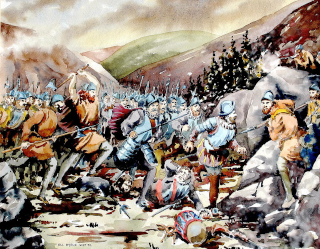
While climbing the steep slopes of the valley, the inexperienced English soldiers are ambushed by the Irish who were hiding in the woods. The English are sniped at for a long period of time before their discipline collapses and they turn and flee down the valley. It is at this point that most of their casualties occur, as the Irish leave their cover and fall upon the English with swords, spears, and axes. Hundreds of English soldiers are cut down by the pursuing Irish as they try to escape the field. The remaining English have to fight a rearguard action for several miles until they reach the town of Rathdrum.
Irish sources state that around 800 English soldiers are killed, though the English put their losses at 360 dead. Among those killed is Peter Carew, cousin of his namesake colonist who had made claims to, and won, large tracts of land in southern Ireland. The remainder of the English force retreat to lowland Wicklow and from there to Dublin. However, the following year, when offered terms, most of the Irish soldiers, including O’Byrne, come in and surrender. The exception is Baltinglass, who flees to France.
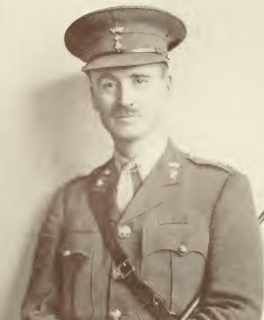
Commissioned into the Royal Inniskilling Fusiliers in 1909, O’Sullivan spends much of the next three years serving in China with his unit, 2nd Battalion. From 1912, the battalion is based in British India but on the outbreak of World War I is brought back to England.
The Royal Inniskilling Fusiliers form part of 29th Division, intended for service in the Gallipoli campaign. Now a captain in the 1st Battalion, O’Sullivan commands a company during the landing at X Beach on the Gallipoli peninsula on April 25, 1915, and acquits himself well during the early stages of the fighting. On June 18, 1915, the Turks mount an attack on positions adjacent to those of O’Sullivan’s company, forcing the troops manning the defenses to abandon it. He leads his company in a counterattack to reclaim the lost position which exchanges hands several times during the next few hours. The commanding officer in the area, Brigadier General W. R. Marshall, eventually directs O’Sullivan to lead a party of Inniskilling and South Wales Borderers soldiers to capture the position which is achieved at dawn the following day.
Two weeks later, O’Sullivan is involved in a further action near Krithia, and this results in his recommendation for the Victoria Cross (VC). The citation, published in The London Gazette on September 1, 1915, reads as follows:
“For most conspicuous bravery during operations south-west of Krithia on the Gallipoli Peninsula. On the night of July 1-2, 1915, when it was essential that a portion of a trench which had been lost should be regained, Captain O’Sullivan, although not belonging to the troops at this point volunteered to lead a party of bomb throwers to affect the recapture. He advanced in the open under a very heavy fire and in order to throw his bombs with greater effect, got up on the parapet, where he was completely exposed to the fire of the enemy occupying the trench. He was finally wounded, but not before his inspiring example had led his party to make further efforts, which resulted in the recapture of the trench. On the night of June 18-19, 1915, Captain O’Sullivan had saved a critical situation in the same locality by his personal gallantry and good leading.”
The wounds O’Sullivan receives in the action of July 1-2 necessitates his evacuation to Egypt for medical treatment, but he quickly recovers and returns to his unit on August 11, 1915. The 29th Division is now at Suvla Bay and preparing for a new offensive. The Inniskillings are tasked with the capture of a feature known as Hill 70 or Scimitar Hill. During this battle, on August 21, 1915, he leads a charge of 50 men to the hilltop but is killed.
O’Sullivan has no known grave and is remembered on the Helles Memorial to the Missing. His VC is delivered to his mother who lives in Dorchester, and his name also appears on the memorial there.
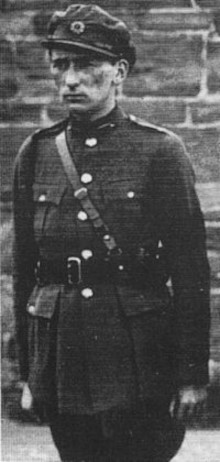
McElroy is born on May 14, 1893, at Donnybrook, County Dublin, to Samuel and Ellen McElroy. He enlists promptly at the start of World War I in August 1914 and is shipped out to France two months later. He is serving as a corporal in the Motor Cyclist Section of the Royal Engineers when he is first commissioned as a second lieutenant on May 9, 1915. While serving in the Royal Irish Regiment he is severely affected by mustard gas and is sent home to recuperate. He is in Dublin in April 1916, during the Easter Rising, and is ordered to help quell the insurrection. He refuses to fire upon his fellow Irishmen and is transferred to a southerly garrison away from home.
On June 1, 1916, McElroy relinquishes his commission in the Royal Irish Regiment when awarded a cadetship at the Royal Military Academy, Woolwich, from which he graduates on February 28, 1917, and is commissioned as a second lieutenant in the Royal Garrison Artillery.
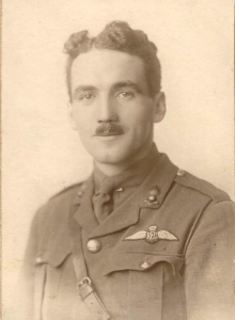
McElroy is promptly seconded to the Royal Flying Corps, being trained as a pilot at the Central Flying School at Upavon Aerodrome and appointed a flying officer on June 28. On July 27 his commission is backdated to February 9, 1916, and he is promoted to lieutenant on August 9. On August 15 he joins No. 40 Squadron RFC, where he benefits from mentoring by Edward “Mick” Mannock. He originally flies a Nieuport 17, but with no success in battle. By the year’s end he is flying Royal Aircraft Factory S.E.5s and claims his first victory on December 28.
An extremely aggressive dogfighter who ignores often overwhelming odds, McElroy’s score soon grows rapidly. He shoots down two German aircraft in January 1918, and by February 18 has run his string up to 11. At this point, he is appointed a flight commander with the temporary rank of captain and transferred to No. 24 Squadron RFC. He continues to steadily accrue victories by ones and twos. By March 26, when he is awarded the Military Cross, he is up to 18 “kills.” On April 1, the Army’s Royal Flying Corps (RFC) and the Royal Naval Air Service (RNAS) are merged to form the Royal Air Force, and his squadron becomes No. 24 Squadron RAF. He is injured in a landing accident on April 7 when he brushes a treetop while landing. By then he has run his score to 27. While he is sidelined with his injury, on April 22, he is awarded a bar to his Military Cross. Following his convalescence, he returns to No. 40 Squadron in June, scoring three times, on June 26, June 28, and June 30. The latter two triumphs are observation balloons and run his tally to 30.
In July, McElroy adds to his score almost daily, a third balloon busting on July 1, followed by one of the most triumphant months in the history of fighter aviation, adding 17 victims during the month. His run of success is threatened on July 20 by a vibrating engine that entails breaking off an attack on a German two-seater and a rough emergency landing that leaves him with scratches and bruises. There is a farewell luncheon that day for his friend Gwilym Hugh “Noisy” Lewis. Their mutual friend “Mick” Mannock pulls McElroy aside to warn him about the hazards of following a German victim down within range of ground fire.
On July 26, “Mick” Mannock is killed by ground fire. Ironically, on that same day, “McIrish” McElroy receives the second Bar to his Military Cross. He is one of only ten airmen to receive the second Bar.
McElroy’s continues apparent disregard for his own safety when flying and fighting can have only one end. On July 31, 1918, he reports destroying a Hannover C for his 47th victory. He then sets out again. He fails to return from this flight and is posted missing. Later it is learned that he had been killed by ground fire. He is 25 years old.
McElroy receives the Distinguished Flying Cross posthumously on August 3, citing his shooting down 35 aeroplanes and three observation balloons. The Bar would arrive still later, on September 21, and would laud his low-level attacks. In summary, he shoots down four enemy aircraft in flames and destroys 23 others, one of which he shares destroyed with other pilots. He drives down 16 enemy aircraft “out of control” and out of the fight. In one of those cases, it is a shared success. He also destroys three balloons.
McElroy is interred in Plot I.C.1 at the Laventie Military Cemetery in La Gorgue, northern France.
The Battle of Ballyellis, a clash during the Irish Rebellion of 1798, takes place on June 30, 1798. The battle is between a surviving column of the dispersed Wexford rebel army and pursuing British forces. It is the last Irish victory in the most violent Irish rebellion in modern history with at least 10,000 killed in a campaign that sees appalling atrocities inflicted by English and Irish.
The British victory at the Battle of Vinegar Hill on June 21 had denied the rebels static bases of operation but had not finished the rebellion and at least three major columns of rebels are operating throughout the southeast, moving outwards from County Wexford in an effort to spread and revive the rebellion.
One such column, numbering about 1,000 but accompanied by a number of women and juveniles, is mobile in north County Wexford, continually altering course to elude combined movements of pursuing British forces. The column is led by Joseph Holt, and under his command Denis Taaffe. It heads in the direction of Carnew, County Wicklow, toward the security offered by its mountain ranges when one of its foraging parties is intercepted and destroyed by a cavalry patrol. It quickly becomes evident to the British authorities that this party is a detachment from the main body of rebels. A mounted force of 200 troops consisting of Ancient Britons, dragoons, and three yeomanry corps, assemble near the neighbourhood of Monaseed to begin a pursuit of the rebels.
However, the approaching British are spotted and a force of rebels then moves ahead of the main force to prepare an ambush at the townland of Ballyellis. The spot chosen is behind a curve in the road flanked by high ditches and estate walls. Wagons are placed on the road and access points cut into the ditches. The main force arrives and deploys itself behind the wagons, on the wall and ditches with a small force left to stand on the road ahead of the barricades standing to face and lure in the approaching soldiers.
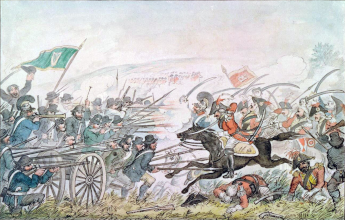
Upon spotting the small force standing on the road, the pursuing British quicken their pace and charge forward, assuming that they are facing only the rearguard of the fleeing column. Upon reaching the turn, they are met by a barrage of gunfire and are hemmed in by the rebels on three sides. As more mounted troops arrive they press their comrades further into the trap making effective manoeuvre impossible and many are easily picked off by the long pikes of the rebels.
The rear-ranks quickly flee with a few more soldiers escaping by jumping their mounts over the ditch. The rebels organise a relentless pursuit of the soldiers who are tracked and killed through the adjoining fields. At the end of the action about 120 troops, including a French émigré, and two officers are killed with no rebel casualties.
The news of this rebel victory comes as a shock to the authorities in Dublin Castle who had assumed that the offensive capabilities of the rebels had been finished at the Battle of Vinegar Hill. Reports of the defeat are downplayed and the scale of losses withheld from the general public, but the military now recognises Wicklow as the main theatre of rebel operations and begins to transfer troops there in anticipation of a new anti-insurgency campaign.
The Irish Citizen Army also becomes involved in the battle, supporting the anti-Treaty IRA in the O’Connell Street area. The fighting begins with an assault by Provisional Government forces on the Four Courts building and ends in a decisive victory for the Provisional Government.
On April 14, 1922, about 200 Anti-Treaty IRA militants, with Rory O’Connor as their spokesman, occupy the Four Courts in Dublin, resulting in a tense stand-off. They want to spark a new armed confrontation with the British, which they hope will bring down the Anglo-Irish Treaty, unite the two factions of the IRA against their former common enemy and restart the fight to create an all-Ireland Irish Republic. At the time the British Army still has thousands of soldiers concentrated in Dublin, awaiting evacuation.
Winston Churchill and the British cabinet have been applying pressure on the Provisional Government to dislodge the rebels in the Four Courts, as they consider their presence a violation of the Treaty. Such pressure falls heaviest on Michael Collins, President of the Provisional Government Cabinet and effective head of the regular National Army. Collins, a chief IRA strategist during the War of Independence from Britain, has resisted giving open battle to the anti-Treaty militants since they occupied Four Courts in April. His colleagues in the Provisional Government Cabinet, including Arthur Griffith, agree that Collins must mount decisive military action against them.
In June 1922 the Provisional Government engages in intense negotiations with the British Cabinet over a draft Constitution that seeks to avert the impending civil war. They particularly seek to remove the requirement of an oath to the British Crown by all members of the Dublin government, a key point of contention with anti-Treaty partisans. However, the conservative British Cabinet refuses to cooperate. The pro-treaty element of Sinn Féin wins the elections on June 16.
Following the assassination of Sir Henry Wilson in London on June 22, 1922, and the arrest by Four Courts troops of National Army Deputy Chief of Staff Gen. J. J. “Ginger” O’Connell, British pressure on the Provisional Government intensifies. The British now threaten to invade and re-occupy all of Ireland. On June 27 the Provisional Government Cabinet agrees on an ultimatum to the Four Courts garrison to evacuate or face immediate military action.
Churchill offers a loan of British artillery for use by the National Army, along with 200 shells from their store of 10,000 at Kilmainham, three miles away. It is possible that some British special troops are also covertly loaned. Two 18-pounder field guns are placed on Bridge Street and Winetavern Street, across the River Liffey from the Four Courts complex. After an ultimatum is delivered to the anti-Treaty garrison in the early hours of June 28, the National Army commences the bombardment of Four Courts.
No authoritative record exists regarding the order to commence bombardment. Historians tend to attribute the order to Collins, but some biographers dispute this. Anti-Treaty survivors allege that they are preparing for an 8:00 a.m. evacuation when the bombardment begins at 4:00 a.m.
Inside the building are 12 members of the Irish Republican Army Executive, including Chief of StaffJoe McKelvey, Director of Engineering Rory O’Connor, Quartermaster General Liam Mellows and Director of Operations Ernie O’Malley. The garrison consists of roughly 180 men drawn from the 1st and 2nd Battalions of the IRA’s 1st Dublin Brigade, commanded by Commandant Paddy O’Brien, armed for the most part only with small arms apart from one captured armoured car, which they name “The Mutineer.” The members of the IRA Army Executive are the political leaders of the garrison but serve as common soldiers under the command of O’Brien. The Anti-Treaty side fortifies the Four Courts to some extent, planting mines around the complex and barricading the doors and windows, but their leadership orders them not to fire first, in order to retain the moral high ground, and so the Free State troops are allowed to surround the Four Courts.
After the first day’s bombardment proves ineffective, the British give the Free State two more 18-pounder cannon and proffer 60-pounder howitzers along with an offer to bomb the Four Courts from the air. Collins turns down the latter two offers because of the risk of causing heavy civilian casualties. On June 29, Free State troops storm the eastern wing of the Four Courts, losing three killed and 14 wounded and taking 33 prisoners. The republicans’ armoured car is disabled and abandoned by its crew. Early the next day O’Brien is injured by shrapnel and O’Malley takes over military command in the Four Courts. By this time the shelling has caused the Four Courts to catch fire. In addition, orders arrive from Oscar Traynor, the anti-treaty IRA commander in Dublin, for the Four Courts garrison to surrender, as he cannot reach their position to help them. O’Malley rules this order invalid, as the Four Courts is a GHQ operation. However, in view of the rapidly deteriorating situation, at 3:30 p.m. on June 30, O’Malley surrenders the Four Courts to Brigadier GeneralPaddy Daly of the Free State’s Dublin Guard unit. Three of the republican garrison die in the siege.
Several hours before the surrender, the Public Record Office of Ireland (PRO) block located in the western block of the Four Courts, which is used as an ammunition store by the Four Courts garrison, is the centre of a huge explosion, destroying Irish state records going back to the Anglo-Norman conquest. Forty advancing Free State troops are badly injured. Assigning blame for the explosion remains controversial. It is alleged by the National Army Headquarters that the Anti-treaty forces deliberately booby-trapped the PRO to kill advancing Free State troops. Tim Healy, a government supporter, later claims that the explosion is the result of land mines laid before the surrender, which explode after the surrender. However, a study of the battle concludes that the explosion is caused by fires ignited by the shelling of the Four Courts, which eventually reach two truckloads of gelignite in the munitions factory. A towering mushroom cloud rises 200 feet over the Four Courts.
At this stage in the battle troops on each side still have a sense of kinship with the other, as most of them had fought together in the Irish Republican Army during the Irish War of Independence. By appealing to friends on the Free State side, several anti-Treaty leaders among the Four Courts garrison, notably Ernie O’Malley and Seán Lemass, escape from captivity to continue the fight.
Despite the Free State force’s success in taking the Four Courts, fighting continues in Dublin until July 5. On June 29 anti-Treaty IRA units from the Dublin Brigade led by Oscar Traynor have occupied O’Connell Street, part of Parnell Square, York Street and some of other locations to try to distract Free State attention from their attack on the Four Courts. Not all the IRA units in the capital are prepared to fight against the new Irish government, however, and their numbers are probably about 500 throughout the city. Their numbers are supplemented by about 150 Citizen Army men and women who bring with them arms and ammunition dumped since the insurrection of Easter 1916.
The republicans occupy the northeastern part of O’Connell Street, with their strong point at “the block,” a group of buildings that the Anti-Treatyites had connected by tunneling through the walls. They had also taken over the adjoining Gresham, Crown, Granville and Hammam hotels. Their only position on the western side of the street is in the YMCA building. Additionally, they have an outpost south of the River Liffey at the Swan Pub on Aungier Street. Oscar Traynor apparently hopes to receive reinforcements from the rest of the country, but only Anti-Treaty units in Belfast and Tipperary reply and both of them arrive too late to take part in the fighting.
The Provisional Government troops, commanded by General Tom Ennis, start by clearing out the outlying anti-treaty garrisons, which is accomplished by July 1. They then draw a tighter cordon around O’Connell Street. Artillery is used to drive the Anti-Treaty fighters out of positions on Parnell Street and Gardiner Street, which gives the Free State troops a clear field of fire down O’Connell Street.
The republican outpost in the YMCA is eliminated when Free State troops tunnel underneath it and detonate a bomb. Traynor’s men in “the block” hold out until artillery is brought up, under the cover of armored cars, to bombard them at point-blank range. Incendiary bombs are also planted in the buildings. Traynor and most of his force make their escape when the buildings they are occupying catch fire. They mingle with civilian crowds and make their way to Blessington.
Left behind is Republican leader Cathal Brugha and a rear guard of 15 men, who stay behind in the Hammam Hotel after Traynor, and most other IRA men have left. At 5:00 p.m. on July 5, when the fires make the hotel untenable, Brugha orderes his men to surrender. He, however, stays behind, only to emerge from the building alone, armed with a revolver. He is shot in the thigh by Free State troops and dies later from blood loss. There are some further sporadic incidents of fighting around the city as Free State troops disperse anti-treaty IRA groups.
Cathal Brugha is the last casualty in the Battle of Dublin, which costs the lives of at least 80 people (15 anti-Treaty IRA Volunteers, 29 National Army soldiers, one British Royal Air Force serviceman and 35 civilians) and over 280 wounded. In addition, the Free State takes over 450 Republican prisoners. The high civilian casualties are doubtless the result of the use of heavy weapons, especially artillery, in a densely populated urban area.
When the fighting in Dublin dies down, the Free State government is left firmly in control of the Irish capital and the anti-treaty forces disperse around the country. Roundups after the fighting result in more Republican prisoners and the death of prominent anti-Treaty activist Harry Boland who is shot dead in Skerries, Dublin, on July 31.
Oscar Traynor, Ernie O’Malley and the other anti-Treaty fighters who escape the fighting in Dublin regroup in Blessington, around 30 km southwest of the city. An anti-Treaty IRA force from County Tipperary had arrived there but too late to participate in the Dublin fighting. Instead, this force heads south and takes a string of towns, including Enniscorthy and Carlow, but quickly abandons them when faced with superior Free State forces. Most of the Republicans then retreat further south to the so-called Munster Republic, territory southwest of a line running from Limerick to Waterford. This in turn is taken by the Free State in an offensive from July to August 1922.
Four of the Republican leaders captured in the Four Courts, Rory O’Connor, Liam Mellows, Joe McKelvey and Richard Barrett, are later executed by the government in reprisal for the Anti-Treaty side’s killing of TDSeán Hales. The street where Cathal Brugha is killed is later renamed Cathal Brugha Street in his honour.
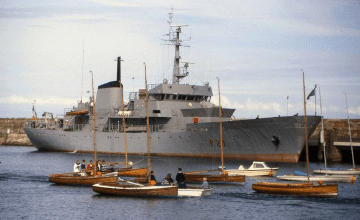
The LÉ Deirdre (P20), an offshore patrol vessel in the Irish Naval Service, is commissioned by Lt. Cdr. Liam Brett on June 19, 1972. The building of LÉ Deirdre marks a milestone in the development of the Naval Service, being the first ship purpose-built in Ireland to patrol in Irish waters. She is named after Deirdre, a tragic heroine from Irish mythology who committed suicide after her lover’s murder.
In 1971, a contract is signed with Verlome Cork Dockyard (VCD) to build an offshore patrol vessel for the Naval Service. Built in 1972, LÉ Deirdre is built as a replacement for the Ton-class minesweepers, and one of the first vessels custom-built for the Irish Naval Service. She has a longer range and is a more seaworthy ship for work in the Atlantic. LÉ Deirdre becomes the prototype for the later Emer-type vessels.
LÉ Deirdre undertakes a number of search and rescue operations throughout her career. For example, LÉ Deirdre is one of the vessels involved in the 1979 Fastnet race rescue operations, assisting the crews of two yachts. In 1990, during the rescue of a Spanish trawler crew in Bantry Bay, a member of LÉ Deirdre‘s crew dies and is posthumously awarded the Distinguished Service Medal and Spanish Cross of Naval Merit.
By the time of the vessel’s naval decommissioning in early 2001, LÉ Deirdre has travelled approximately 450,000 nautical miles. She is replaced by a Róisín-class patrol vessel.
LÉ Deirdre is sold at public auction for IR£190,000 to the English yacht chartering company Seastream International for conversion into the luxury charter yacht Tosca IV for the company’s owner, businessman Christopher Matthews. Speaking on the radio, a Seastream spokesman appears pleased with their bargain as they had been prepared to bid up to IR£500,000. The auction starting price had been IR£60,000.
The conversion in a Polish shipyard is not completed as the English owner is killed while piloting a Eurocopter EC130 helicopter which crashes at Sauk Prairie, Wisconsin after hitting power lines over Lake Wisconsin on August 6, 2004. In 2007 LÉ Deirdre is towed to Brazil for further refit and completion. Substantially complete, she arrives at Jacksonville, Florida in September 2012 for final outfitting as Santa Rita I. However, in August 2014, Santa Rita I is towed to Green Cove Springs, Florida, for breaking.
Patterson is born on November 10, 1867, at Forgney, Ballymahon, County Longford, the son of a Protestant father and a Roman Catholic mother. He joins the British Army at Dublin in 1885 and is posted with the 3rd Dragoon Guards to India. In 1892 he is seconded to the Indian military works department as a supervisor of civil engineering projects. In 1894 he marries Frances Helena Gray, daughter of William Gray of Cork and Belfast, a building surveyor who founded the free library movement in Belfast. She goes on to earn science and law degrees.
In 1898 Patterson is sent to British East Africa to supervise 3,000 Indian and African labourers who are building a railway bridge spanning the Tsavo River as part of the Mombasa to Lake Victoria line. Construction is interrupted when two man-eating lions repeatedly attack the labourers’ camp at night. He embarks on a lion hunt, but by the time he shoots the two lions they have mauled and mutilated between 130 and 140 labourers.
The following year Patterson leads a safari trip in the protectorate accompanied by Audley James Blyth, a son of James Blyth, 1st Baron Blyth, and his wife, Ethel Jane. During the expedition Blyth shoots himself in the head with a revolver and dies. Patterson claims that Blyth was suffering from heat stroke, but there are rumours of a romantic attachment between Patterson and Mrs. Blyth. The colonial secretary Lord Crewe exonerates Patterson in return for his resignation as chief game warden. The incident serves as the plot for Ernest Hemingway‘s short story “The Short Happy Life of Francis Macomber.”
In 1913 Patterson commands the West Belfast division of the Ulster Volunteer Force (UVF) and sees service in Flanders before being sent to Egypt in early 1915. In Alexandria, two Russian Jewish Zionists, the journalistZe’ev Jabotinsky and veteran of the Russo–Japanese WarJoseph Trumpeldor, ask General John Maxwell, commander of the British forces in Egypt, to establish a Jewish legion that will liberate the Holy Land from the Turks. Maxwell refuses, proposing instead that the Jews form a volunteer transport unit to serve in Gallipoli. Patterson, who is imbued with a deep knowledge of the Old Testament and draws spiritual sustenance from biblical heroes such as Joshua and Gideon, is appointed commander of the Assyrian Jewish refugee mule corps, a colonial corps of the Egyptian expeditionary force. He sails with the Zion Mule Corps, as it is popularly known, to Gallipoli in April 1915, where the corps serves with distinction, carrying water and ammunition to the Allied troops on the peninsula. He falls ill in November 1915 and is sent to convalesce in London. The Zion Mule Corps is evacuated from Gallipoli in December and disbanded in March 1916.
When manpower and political considerations persuade the British authorities to create the Jewish Legion in 1917, Patterson is appointed its commander. He marches his 38th Battalion Royal Fusiliers through the City of London and Whitechapel, cheered by a crowd of several thousand Jews. The Jewish Legion participates in General Edmund Allenby‘s sustained attack, which successfully pushes the Turks out of Palestine. His experiences with his Jewish soldiers turn him into a committed Zionist. In 1916 he writes With the Zionists in Gallipoli, and in 1922 With the Judaeans in the Palestine Campaign, which contain a scathing attack on Britain’s policy towards the Jews during and after World War I.
Throughout the 1920s and 1930s, Patterson increasingly allies himself with the revisionist Zionist agenda espoused by Jabotinsky’s New Zionist Organisation. When World War II breaks out, he travels with Jabotinsky to the United States, moving permanently to La Jolla, California, in 1940. With others, including the Irish Jew and later Lord Mayor of DublinRobert Briscoe, he agitates for the formation of a large Jewish army that would fight with the Allies against Nazi Germany. After Jabotinsky’s death in 1940, he works with Benzion Netanyahu, the Palestinian Jewish executive director of the American revisionist Zionists. In 1946 he becomes godfather to Netanyahu’s first son, who is named Yonatan (the closest Hebrew name to John) in Patterson’s honour. Yonatan later leads Operation Entebbe, the successful 1976 Israeli raid on Entebbe Airport to free Israeli hostages.
On June 18, 1947, just a year before the establishment of the Zionist state of Israel, for which he had worked so hard, Patterson dies at Bel Air, California. A week later, the United Zionist Revisionists of Great Britain hold a memorial meeting at the Anglo–Palestinian Club near Piccadilly Circus in Patterson’s memory. His documents and personal effects are held at the Jabotinsky Institute and Museum in Tel Aviv. His uniform and other memorabilia are on display in Beit Hagdudim, the Jewish Legions Museum at Netanya, Israel. His two man-eating lions are on display in Chicago’s Field Museum of Natural History, where his son Bryan Patterson later serves as curator.
(From: “Patterson, John Henry” by Yanky Fachler, Dictionary of Irish Biography, http://www.dib.ie)
O’Connell is tutored at home in Latin and Greek, and before he is sixteen, he leaves with his cousin, Murty O’Connell, to join the French army. On February 13, 1760, he becomes a cadet in the Régiment de Royal Suédois. He spends almost his entire career in France or serving abroad with French regiments, but remains in close contact with his family, being in constant correspondence with the head of the clan, his brother Maurice O’Connell, who is almost twenty years his senior, and later arranging army appointments for a host of young nephews and cousins.
O’Connell serves with the Royal Suédois in the last two campaigns of the Seven Years’ War and is made assistant adjutant (sous-aide-major) of the regiment. At the close of the war, he is recommended for the military academy of Strasbourg (1765–66). He has a talent for self-advancement and is well regarded by his seniors, being tall, strong, handsome, disciplined, industrious, and sober. He has an almost morbid horror of drink, and his great boast is that he has never wasted a moment of his time or a farthing of his money.
Appointed to Col. Meade’s regiment of Lord Clare’s Irish Brigade with the rank of captain in October 1769, he sets sail immediately for Mauritius. Two years later he is allowed a visit home to Kerry for the first time in eleven years. In 1775 the death of Lord Clare’s son and the extinction of the title results in the reduction of the Irish Brigade and destroys O’Connell’s chance of promotion. He devotes himself to the study of chemistry, literature, and the military. A published study, Discipline of the army, comes under the notice of the military authorities, who obtain for him a Cross of Saint Louis, a pension of 2,000 livres a year, and the rank of lieutenant-colonel with which he is posted to his old regiment, the Royal Suédois, in 1778. With them he serves at the taking of Menorca in 1781 and is severely wounded at the Great Siege of Gibraltar in 1782 but manages to save the life of Charles Philippe, Count of Artois, the future Charles X. For these services he is made a count, one of only twenty-two people outside the royal family to receive this honour, and is made colonel of the German regiment of Salm-Salm in French pay, which at a grand review of 30,000 French troops in Alsace in 1785 is pronounced the best regiment. He begins to move in court circles and in 1788 kisses the hand of Marie Antoinette and rides in the king’s coach.
In 1788 O’Connell recommends to his brother Maurice the college of Saint-Omer as a suitable school for his nephews, Maurice and Daniel O’Connell, but taking belated notice of the gathering revolutionary storm, tries unsuccessfully to dissuade them. During the French Revolution of 1789 he allegedly announces his readiness to move his regiment into the capital to disperse revolutionary mobs but is not able to obtain the king’s permission. In 1790 his men mutiny, leaving him in the anomalous position of a colonel without a regiment. A protégé of the Ancien Régime, he nevertheless remains in Paris in 1790–91, serving the nouveau régime as a member of a commission engaged in revising army regulations.
In 1792 O’Connell joins Charles William Ferdinand, Duke of Brunswick‘s émigré army at Koblenz and takes part in the disastrous Battle of Valmy in Berchini’s regiment. Ever cautious, he serves as a private, refusing any command so that his name would not be mentioned in France. In November 1792 he is in London, almost penniless and bent on concealing that he had served against the republic. An alibi is procured and attested at Tralee to the effect that O’Connell had been in Ireland all the time and was forwarded to Paris to prevent the confiscation of property.
In London O’Connell petitions William Pitt the Younger to reconstruct the Irish Brigade in the service of George III. Six regiments are raised, with O’Connell appointed colonel of the 4th, but the scheme is only partially realised as three of the regiments are sent to the West Indies and Nova Scotia, where they succumb to pestilence. By 1798 the brigade has entirely ceased to exist, though he retains his full pay as a British colonel, which he draws to the end of his life. At this period his name is mooted by Gen. Henry Clarke and Theobald Wolfe Tone as a possible commander of their troops. Clarke gives his opinion that O’Connell is a good parade officer but has no genius in command, to which Wolfe Tone replies that he “was in favour of his being employed for I know he hates England.”
In 1796, O’Connell marries Martha, comtesse de Bellevue (née Drouillard de Lamarre; d. 1807), a young widow with three children, at the French chapel in Covent Garden. In 1802 he takes advantage of the peace of Amiens to return to France. On the renewal of war, the couple is detained by Napoleon as British subjects, and remain virtual prisoners in France until the restoration of the Bourbons in 1814. Back in favour, O’Connell receives the rank of lieutenant-general in the French army and commander of the Order of Saint Louis. His fortunes revive, he advances a large sum to his nephew Daniel to save him from bankruptcy in 1815 and comes to his rescue again in 1818, though by this date he has already settled the bulk of his fortune on his great-nephews. He follows his namesake’s career with keen interest, but his advice is invariably cautious and is not much heeded. After the French Revolution of 1830 he refuses to take the oath of allegiance to Louis Philippe I and is struck off the military list, though he becomes a naturalised French citizen in 1831.
O’Connell dies on July 9, 1833, at the Château de Bellevue at Meudon, near Blois, and is buried at the cemetery at Coudé. He has no children and his title, though not his fortune, descends to his godson, the Baron d’Eschegoyen’s second son, who takes the name O’Connell. A portrait by Paul Guérin hangs in Derrynane House.
(From: “O’Connell, Count Daniel Charles” by Bridget Hourican, Dictionary of Irish Biography, http://www.dib.ie)
Tobin is born William Joseph Tobin at 13 Great Georges Street in Cork, County Cork, on November 15, 1895, the eldest son of Mary Agnes (nee Butler) and David Tobin, a hardware clerk. He has two younger siblings, Katherine and Nicholas Augustine Tobin, also born in Cork. His family moves to John Street in Kilkenny and then to Dublin. He goes to school in Kilkenny and is an apprentice in a hardware shop at the time of the 1916 Easter Rising. As a participant in the Rising he fights in the Four Courts garrison under Edward Daly. He is arrested, court martialed, and sentenced to death but his sentence is commuted to life imprisonment. He is a prisoner in Kilmainham, Mountjoy, Lewes, Dartmoor, Broadmoor and Pentonville prisons. He is released in June 1917.
In October 1921, Tobin travels with the Irish Treaty Delegation as part of Collins’ personal staff.
Tim Pat Coogan and James Mackay have examined Tobin’s involvement in the assassination of British Field MarshalSir Henry Wilson. Wilson’s public tirades about Collins is evidence of mutual personal dislike between the two men. In May 1922 Collins tells Tobin “We’ll kill a member of that bunch” to the news of “bloody pogroms” in Belfast. Wilson is intimately involved with the Ulster loyalist cause, including the Curragh Mutiny and the establishment of the Ulster Special Constabulary. Just before the shooting, Coogan places Tobin in London. He meets courier Peig Ni Braonain at Euston Station collecting a document that has been sent from Dublin. Returning to Dublin before the incident, he is jubilant when he tells defence ministerRichard Mulcahy about Wilson’s death. Mulcahy is appalled and threatens to resign.
In October 1922, Tobin’s brother Nicholas, a Free State captain, is accidentally shot dead by his own troops during the raid and capture of a bomb making factory at number 8 Gardiner’s Place, Dublin.
Tobin believes in the stepping stone doctrine which sees the Treaty as a stage towards full independence. With the outbreak of the Irish Civil War he remains loyal to Collins and takes the Pro-Treaty side. He leads in the fight against the Anti-Treaty IRA in the south. Disillusioned with the continuing hostilities and in the aftermath of the death of Collins, he forms an association called the IRA Organisation (IRAO) or “Old Irish Republican Army” to distinguish themselves from the anti-treaty insurgents.
Richard Mulcahy, the new Irish defence minister, proposes to reduce the army from 55,000 to 18,000 men in the immediate post- Civil-War period. Tobin knows his own position is to be affected and shares the perception that the Irish Army treats former British officers better than former IRA officers. On March 7, 1924, Tobin, together with Colonel Charlie Dalton, sends an ultimatum to President of the Executive Council of the Irish Free StateW. T. Cosgrave demanding an end to the army demobilisation. The immediate response is an order for the arrest of the two men on a charge of mutiny. The cabinet, already wary of the Irish Army, orders an inquiry and appoints Garda CommissionerEoin O’Duffy to the army command.
On March 18, the mutineers assemble with hostile intent at a Dublin pub. An order is made to arrest the mutineers and the cabinet demands the resignation of the army council. The generals resign, affirming the subservience of the military to the civilian government of the new state.
In later years, Tobin rebuilds relations with his Civil War foes and joins Éamon de Valera‘s Anti-Treaty Fianna Fáil party. He joins up with Joseph McGrath to form the Irish Hospitals’ Sweepstake in the 1930s. Many other former army comrades find work in this lottery. He leaves the Sweep in 1938. After World War II, he becomes Superintendent of the Oireachtas for the Irish Dáil.
On October 14, 1929, Tobin marries Monica “Mona” Higgins at the Church of the Holy Family, Aughrim Street, Dublin. They have two daughters, Máire and Anne Tobin. Following the death of his father, David, in 1956, Tobin’s health declines, resulting in his death in Dublin on April 30, 1963.
Lawless, a Catholic, is the confidant of Lord Edward FitzGerald, and Professor of Anatomy and Physiology in the Royal College of Surgeons in Ireland, Dublin. Closely connected with John Sheares in the direction of affairs in the spring of 1798, a warrant for his arrest is issued on May 20 with a reward of £300. Timely notice is, however, given him of the fact by Mr. Stewart, the Surgeon-General, and he escapes to France, where his abilities and spirit recommend him to the special favour of Napoleon. While in Paris, he spends time with other United Irishmen in exile, including Myles Byrne and William James MacNeven.
Lawless is placed on half-pay in 1800, but in 1803 is appointed captain of the Irish Legion, and in July 1806 is ordered to Vlissingen, then besieged by the English, to command the Irish battalion. To reach his post he has to pass in a small open boat through the English fleet. He is dangerously wounded in a sortie, and when General Monet capitulates without stipulating for the treatment of the Irish as prisoners of war, Lawless escapes from the town with the eagle of his regiment, conceals himself for two months in a doctor’s house, and at length finds an opportunity of getting to Antwerp by night in a fishing boat. MarshallJean Baptiste Jules Bernadotte welcomes him, extols him in general orders, and reports his exploits to Napoleon, who summons him to Paris, decorates him with the Legion of Honour, and promotes him to be lieutenant-colonel. In 1812 he gains a colonelcy, and on August 21, 1813, he loses a leg at the Battle of Dresden. He retires to his country house in Tours.
After the restoration of the Bourbons, Lawless is returned, in October 1814, to half-pay with the rank of brigadier general. He dies in Paris at the age of 52 on December 25, 1824. His remains are buried at Père Lachaise Cemetery in Paris. He is one of the best officers of the last large French unit of The Wild Geese. Thomas Moore describes him as “a person of that mild and quiet exterior which is usually found to accompany the most determined spirit.”
(Pictured: Gravesite of General William Lawless in Père Lachaise Cemetery in Paris, France)