seamus dubhghaill

Promoting Irish Culture and History from Little Rock, Arkansas, USA


Leave a comment

The Capture of Bandon

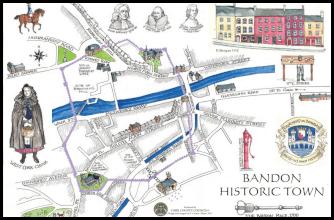
The Capture of Bandon begins on February 23, 1689, when the town of Bandon, County Cork, is forcibly seized from its rebellious Protestant inhabitants by force of Irish Army troops under Justin McCarthy. The skirmishing at the town takes place during the early stages of the Williamite War in Ireland. The Jacobite success at Bandon helps suppress any chance of a general Munster uprising against the rule of James II similar to that which occurs in Ulster the same year. The slogan “No Surrender!” is believed to have been first used at Bandon and subsequently taken up, more famously, by the defenders at the Siege of Derry later in the year.

In 1685, the Catholic James II comes to the throne. This leads to a sharp reversal of government policy in Ireland, which had previously favoured the Protestant inhabitants. This is quickly changed by James’ representative Richard Talbot, 1st Earl of Tyrconnell. Under Talbot’s administration, the army and civil government are mostly purged of Protestants, who are replaced by Catholics. In Bandon, the previous town burgesses are replaced by Catholic nominees.

Talbot’s actions lead to a growing hostility amongst the Protestant inhabitants across the island toward the King and his Irish government. Bandon is a historic centre of Protestants, dating back to the Plantation of Munster in the Elizabethan era and is a natural focus of dissent against James’s rule. In 1688, a similar opposition in England leads to the Glorious Revolution, in which William III successfully invades with a Dutch Army. Many Protestants now believe William to be their rightful King while Catholics, and some Protestants, remain loyal to James. During the growing turmoil, many rural County Cork Protestants come to shelter in Bandon.

Fearing a potential outbreak of rebellion in Bandon will occur, the government sends a detachment of the Irish Army under Captain Daniel O’Neill to take the town. They reportedly enter on a Sunday morning while the inhabitants are attending church services. The following day, February 24, sometimes referred to as “Black Monday,” the townspeople rise and attack the soldiers. Various sources say between three and eight of the redcoats are killed and the remainder are driven out of the town. Using their captured weapons, the Protestants then make an effort to prepare Bandon to withstand an assault.

Having received word about the growing rebellion in the county, Talbot in Dublin has already dispatched six companies of infantry under Justin McCarthy, an experienced Irish Catholic soldier. Instead of immediately assaulting Bandon, McCarthy first seizes nearby Cork, another major centre of Protestants in the south of the country and clamps down on other potential dissidents. He then proceeds to Bandon with his troops, plus some cavalry and artillery. Although they had previously hung out a banner proclaiming “No Surrender,” the defenders negotiate a surrender in exchange for generous conditions. Despite the usual punishment for rebellion being death, the town corporation is fined £1,000 and the walls are ordered to be demolished.

The comparatively light terms imposed on the town are part of a wider attempt by King James to convince Protestants of his goodwill toward them. It angers more hardline Catholics, including McCarthy’s nephew, Donough MacCarthy, 4th Earl of Clancarty, who wants a harsher punishment for the rebels.

The fighting at Bandon is part of a succession of defeats of locally raised Protestant troops both across Munster (at Castlemartyr) and Ireland as a whole, with the Ulster-raised Army of the North suffering heavy defeats at the Break of Dromore and the Battle of Cladyford. The advance of the mainly Catholic Jacobite Army is halted by the successful Protestant defence of Enniskillen and Derry. The arrival of large-scale reinforcements under Frederick Schomberg and King William reverse the tide, and Dublin is captured following the Battle of the Boyne in 1690. The same year, Bandon is re-taken by Protestant forces following John Churchill, 1st Duke of Marlborough‘s successful Siege of Cork. The walls are not rebuilt, as they are becoming increasingly militarily obsolete.


Leave a comment

The Battle of Roanoke Island

The Battle of Roanoke Island, an amphibious operation of the American Civil War, is fought on February 7-8, 1862, with Irishmen present on both sides of the battle.

The opening phase of what comes to be called the Burnside Expedition, the Battle of Roanoke Island is fought in the North Carolina Sounds, a short distance south of the Virginia border. The attacking force consists of a flotilla of gunboats of the Union Navy drawn from the North Atlantic Blockading Squadron, commanded by Flag Officer Louis M. Goldsborough, a separate group of gunboats under Union Army control, and an army division led by Major General Ambrose Burnside. The defenders are a group of gunboats from the Confederate States Navy, termed the Mosquito Fleet, under Captain William F. Lynch, and about 2,000 Confederate soldiers commanded locally by Brigadier General Henry A. Wise. The defense is augmented by four forts facing on the water approaches to Roanoke Island, and two outlying batteries. At the time of the battle, Wise is hospitalized, so leadership falls to his second in command, Colonel Henry M. Shaw.

During the first day of the battle, the Federal gunboats and the forts on shore engage in a gun battle, with occasional contributions from the Mosquito Fleet. Late in the day, Burnside’s soldiers go ashore unopposed. They are accompanied by six howitzers manned by sailors. As it is too late to fight, the invaders go into camp for the night.

On the second day, February 8, the Union soldiers advance but are stopped by an artillery battery and accompanying infantry in the center of the island. Although the Confederates believe that their line is safely anchored in impenetrable swamps, they are flanked on both sides and their soldiers are driven back to refuge in the forts. The forts are taken in reverse. With no way for his men to escape, Col. Shaw surrenders to avoid pointless bloodshed.

Aside from the men who are taken into captivity, casualties are rather light by American Civil War standards. The Federal forces lose 37 killed, 214 wounded, and 13 missing. The Confederates lose 23 killed, 58 wounded, and 62 missing.

Roanoke Island remains in Union control for the rest of the war. Immediately after the battle, the Federal gunboats pass the now-silent Confederate forts into Albemarle Sound and destroy what is left of the Mosquito Fleet at the Battle of Elizabeth City. Burnside uses the island as staging ground for later assaults on New Bern and Fort Macon, resulting in their capture. Several minor expeditions take other towns on the sounds. The Burnside Expedition ends in July, when its leader is called to Virginia to take part in the Richmond campaign.

After Burnside leaves, North Carolina ceases to be an active center of the war. With only one or two exceptions, no notable military actions take place until the last days of the conflict, when the Second Battle of Fort Fisher closes Wilmington, the last open port in the Confederacy.


Leave a comment

The Battle of Ballymore-Eustace

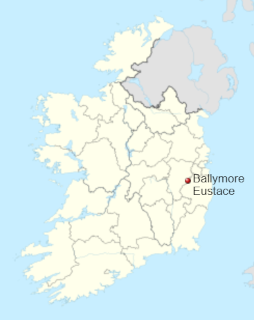
The Battle of Ballymore-Eustace is one of the events in the United Irish rebellion of 1798. It takes place on May 24, 1798, after the stationing of the 9th Dragoons, and members of the Tyrone, Antrim and Armagh Militias at Ballymore-Eustace in County Kildare near the border with County Wicklow on May 10. The town has been recently garrisoned by almost 200 soldiers and militia who have been sent to repress sedition in the area. The troops have been dispersed in billets among the populace as per counter-insurgency practice of “free-quarters” where responsibility for the provisioning and sheltering of militia is foisted onto the populace. During this time a quantity of arms are surrendered and letters of protection issued.

On May 23, one hundred twenty soldiers are recalled, leaving a garrison of around 80 men. At around 1:00 a.m. on May 24, the rebel force of approximately 200 attack the town. As in the attacks on Naas and Prosperous, the rebels seek to surprise and overwhelm the garrison by coordinated attacks before it can react and rally against them. The houses containing troops of the 9th Dragoons and the Tyrone Militia are to be attacked simultaneously.

However, the attack on garrison headquarters is miscarried due to lack of coordination and numbers so that the building becomes a rallying point for the Government troops. Captain Beevor is attacked in his own bedchamber by two rebels. Lieutenant Parkinson and some dragoons come to his aid and both rebels are slain. Other isolated billets are attacked but some units manage to cut themselves free and fight their way through the streets to the headquarters. A number of properties, including the Protestant church, are set on fire.

For two hours, the rebels attack the strongpoint but, without artillery, are unable to take the building and lose many men in the process. The momentum has by now slipped away from the rebels and they draw off their attack leaving behind around 50 dead but at a cost to the garrison of at least 12 dead and 5 wounded.

The battle leads directly to the Dunlavin Green executions, in which fears of a possible rebel attack on the garrison at nearby Dunlavin lead to the summary execution of rebel prisoners.


1 Comment

Irish Regiments Fight with Spain in the Battle of Villaviciosa

Three Irish regiments in the service of Spain fight in the Battle of Villaviciosa on December 10, 1710, during the War of the Spanish Succession. The regiments are commanded by Colonel Don Demetrio MacAuliffe, Colonel Don John de Comerford, and Colonel Don Reynaldo Mac Donnell. This last becomes known as the Hibernia Regiment.

The Battle of Villaviciosa is a battle between a Franco-Spanish army led by Louis Joseph, Duke of Vendôme, and Philip V of Spain and a Habsburg-allied army commanded by Austrian Guido Starhemberg. The battle takes place one day after a Franco-Spanish victory at Brihuega against a British army under James Stanhope, 1st Earl Stanhope. Both Philip V of Spain and the Archduke Charles of Austria claim victory, but the number of dead and wounded, the number of artillery and other weapons abandoned by the Allied army and the battle’s strategic consequences for the war confirm victory for Philip.

The battle is largely determined by the Spanish dragoons commanded by the Marquis of Valdecañas and the Count of Aguilar, which far exceeds the opposing forces. The Austrian forces retreat, pursued by Spanish cavalry, and the allied army is reduced to 6,000 or 7,000 men when it reaches Barcelona, one of the few places in Spain still recognizing Charles’ authority, on January 6.

After victories in the Battle of Almenar on July 27 and the Battle of Saragossa on August 20, the Habsburg allies supporting Archduke Charles capture Madrid for the second time and Charles enters Madrid on September 21. The 1710 invasion is a repetition of the one in 1706, and the 23,000-strong allied army is reduced at Almenara and Saragossa and in skirmishes with the Spanish-Bourbon militia. The allied troops are unable to maintain an occupation.

The allied position in Madrid is dangerous. On November 9, the city is evacuated and the retreat to Catalonia begins, pursued by Spanish cavalry led by the Marquis of Valdecañas. The archduke leaves the army with 2,000 cavalry and rushes back to Barcelona, while the rest of the army marches in two detachments. Austrian general Starhemberg and the main body of 12,000 men are a day’s march ahead of the 5,000 British troops under Lord Stanhope. The British force, surprised, is defeated at Brihuega on December 9, 1710. The British are taken prisoner, including Stanhope, who finally surrenders.

When General Starhemberg is informed of the attack on the British column, he moves his troops to help Stanhope’s army, unaware that the latter had capitulated. The next morning, December 10, the Franco-Spanish army is waiting on the plain of Villaviciosa. Compared to the Austrian general’s 14,000 troops, the Duke of Vendôme deploys about 20,000 men, including King Philip and other troops who had joined the duke that morning. The armies deploy in two lines on parallel ridges.

The battle begins during the afternoon, lasting until midnight. Each army has 23 pieces of artillery, deployed in three batteries. The artillery fire begins simultaneously, damaging both armies. The Marquis de Valdecañas, commanding the cavalry in the Bourbon right wing, begins the attack. Valdecañas sends his cavalry against the allied left wing, composed of German infantry and Portuguese and Spanish cavalry under Imperial General von Frankenberg. The German infantry and Portuguese cavalry try to stop the Bourbon charge before yielding, and the left wing is destroyed. The Spanish capture the artillery pieces, killing the Anglo-Dutch troops sent to aid the left wing. With the allied left wing defeated, the archduke’s infantry advances toward the Franco-Spanish center and drives back the Bourbon infantry. The Marquis of Toy tries to prevent losses in the center and avoid the division of the army, but most of his men are taken prisoner by the Portuguese.

Although the Bourbons in the center are in difficulty, the Count of Aguilar throws his cavalry against the archduke’s right wing, commanded by General Starhemberg and comprising the best grenadiers and cavalry squadrons of the allied army. The allies are unable to stop the Count of Aguilar’s cavalry. The archduke’s right wing is saved from disaster by support from the center, led by the Spanish general Antoni de Villarroel. Starhemberg regroups his forces, repulses the Count of Aguilar’s cavalry and charges the Bourbon left wing. After capturing the left-wing cannons, Starhemberg launches his army against the center.

The Bourbon center and left wing begin to retreat, and the right-wing cavalry pursues the allied left wing. The Count of Aguilar then attacks against the archduke’s right wing with his dragoons. Although the German and Portuguese cavalry, under Pedro Manuel de Ataíde, 5th Count of Atalaya, resist the first charge, Aguilar’s cavalry breaks the allied right wing. Valdecañas’ cavalry also deals a severe blow to the allied army, and Lt. Gen. Mahony and Field Marshal Amezaga’s troops charge from the right wing. Starhemberg in return launches three cavalry charges against them. During the fighting, Amezaga is wounded in the face. Starhemberg’s forces retreat to a nearby forest to escape the Franco-Spanish cavalry, and the allied forces begin their withdrawal under cover of night. The British regiments suffer heavy losses. Brigadier-General Lepell, the senior British officer, reports two regiments have been cut off while over 107 men are missing from his own and he has only two squadrons still available.

Although Philip V of Spain and the Archduke Charles both claim victory, the number of dead and wounded, the weapons abandoned by the allied army, and the strategic consequences in the war confirm French domination.

Starhemberg continues his retreat, harassed by Spanish cavalry. His army is reduced to 6,000 or 7,000 men by the time he reaches Barcelona. The Spanish throne is finally secured for Philip when Charles leaves Spain in April 1711 to become Holy Roman Emperor after the death of his older brother.

(Pictured: “Battle of Villaviciosa, December 10, 1710,” oil on canvas by Jean Alaux, Museum of the History of France)


Leave a comment

Oliver Cromwell Abandons the First Siege of Waterford

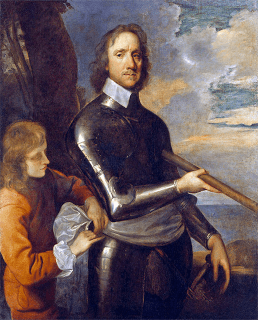
Oliver Cromwell abandons the First Siege of Waterford on December 2, 1649, and goes into winter quarters at Dungarvan. Waterford is besieged twice during 1649 and 1650 during the Cromwellian conquest of Ireland. The town is held by Confederate Ireland, also referred to as the Irish Catholic Confederation, under General Richard Farrell and English Royalist troops under General Thomas Preston. It is besieged by English Parliamentarians under Cromwell, Michael Jones and Henry Ireton.

Waterford is a Catholic city and like most other towns in southeast Ireland, the populace has supported the Confederate Catholic cause since the Irish Rebellion of 1641. Late in 1641, Protestant refugees, displaced by the insurgents, begin to arrive in the town, creating tension among the Catholic townspeople. The city’s mayor wants to protect the refugees, but the recorder and several of the aldermen on the city council want to strip them of their property and let in the rebels, who arrive outside the walls in early 1642. At first, the Mayor’s faction is successful in refusing to admit rebel forces, but by March 1642, the faction in the municipal government sympathetic to the rebellion prevails. The Protestants in Waterford are expelled, in most cases put on ships to England, sometimes after having their property looted by the city mob. In 1645, Confederate troops under Thomas Preston besiege and capture nearby Duncannon from its English garrison, thus removing the threat to shipping coming to and from Waterford.

Waterford’s political community is noted for its intransigent Catholic politics. In 1646, a synod of Catholic Bishops, based in Waterford, excommunicate any Catholic who supports a treaty between the Confederates and English Royalists, which does not allow for the free practice of the Catholic religion. The Confederates finally agree to a treaty with Charles I of England in 1648, in order to join forces with the Royalists against their common enemy, the English Parliament, which is both anti-Catholic and hostile to the King. The Parliamentarians land a major expeditionary force in Ireland at Dublin, under Cromwell in August 1649.

The English Parliamentarian New Model Army arrives to besiege Waterford in October 1649. One of the stated aims of Cromwell’s invasion of Ireland is to punish the Irish for the mistreatment of Protestants in 1641. Given Waterford’s history of partisan Catholic politics, this provokes great fear amongst the townspeople. This fear is accentuated by the fate of Drogheda and nearby Wexford which had recently been taken and sacked by Cromwell’s forces and their garrisons massacred.

Waterford is very important strategically in the war in Ireland. Its port allows for the importation of arms and supplies from continental Europe and its geographical position commands the entrance of the rivers Suir and Barrow.

Before besieging Waterford, Cromwell has to take the surrounding garrisons held by Royalist and Confederate troops in order to secure his lines of communication and supply. Duncannon, whose fort commands the sea passage into Waterford, is besieged by Parliamentarians under Ireton from October 15 to November 5. However, due to a stubborn defence, the garrison there under Edward Wogan holds out. This means that heavy siege artillery cannot be brought up to Waterford by sea.

New Ross surrenders to Cromwell on October 19 and Carrick-on-Suir is taken on November 19. A counterattack on Carrick by Irish troops from Ulster under a Major Geoghegan is repulsed on November 24, leaving 500 of the Ulstermen dead.

Having isolated Waterford from the east and north, Cromwell arrives before the city on November 24. However, Waterford still has access to reinforcements from the west and up to 3,000 Irish soldiers from the Confederate’s Ulster Army under Richard O’Farrell are fed into the city in the course of a week. O’Farrell, having been a successful officer in the Spanish Army, is highly trained and experienced in siege warfare from battles in Flanders. Cromwell has come up against a superior minded soldier and commander. The weather is extremely cold and wet, and the Parliamentarian troops suffer heavily from disease. Out of 6,500 English Parliamentarian soldiers who besiege Waterford in 1649, only 3,000 or so are still fit by the time the siege is called off. Added to this, Cromwell is able to make little headway in taking the city. The capture of a fort at Passage East enables him to bring up siege guns by sea, but the wet weather means that it is all but impossible to transport them close enough to Waterford’s walls to use them. Farrell proves tactically superior in defending Waterford and repels Cromwell’s attempts. Eventually Cromwell has to call off the siege on December 2 and go into winter quarters at Dungarvan. Among his casualties is his commander Michael Jones, who dies of disease.


Leave a comment

Patrick Cleburne Commands Brigade at the Battle of Perryville

On October 8, 1862, Irish-born Confederate Brigadier General Patrick Cleburne commands a brigade at the Battle of Perryville, (Kentucky) in the American Civil War. His brigade is part of the army of General Braxton Bragg. Encouraged by Jefferson Davis, Bragg invades Kentucky in August. On August 30, at the Battle of Richmond, Cleburne receives a very painful injury when a ball passes through his open mouth and out his left cheek, taking several teeth with it. However, less than a month later, he is back with his command in time for the crucial battle at Perryville.

The largest and last major battle of the Confederate Heartland Offensive (Kentucky Campaign), the Battle of Perryville, pits Bragg’s Confederate army against General Don Carlos Buell‘s Union army. While Bragg wins the battle tactically, Confederate forces retreat from the battlefield and end the campaign, leaving Kentucky under Union control for the rest of the war.

In conjunction with General Edmund Kirby Smith, Bragg invades the Commonwealth of Kentucky in August 1862. While the Confederate forces see early success in the Battles of Richmond and Munfordville, they ultimately are unable to achieve their larger goal of taking control of the state. By late October, Bragg and Smith’s armies retreat into Tennessee.

On October 7, 1862, the 55,000-man Union Army of the Ohio under the command of General Buell converges on the small crossroads town of Perryville, Kentucky, in three columns. Union forces first skirmish with Confederate cavalry on the Springfield Pike before the fighting continues on Peters Hill as the gray-clad infantry arrive. Based on the intelligence Bragg receives from his cavalry, he believes that he faces only a small portion of General Buell’s army, not the main body. Both sides settle in for the coming battle that would decide the fate of Kentucky.

In the early morning hours of October 8, 1862, fighting begins around Peters Hill as a Union division advances up the pike searching for water, halting just before the Confederate line. General Bragg orders his army to attack the supposedly isolated Union force, but it is noon before the assault gets underway. By that point, a new Union Corps, numbering about 13,000, arrives on the field further to the Union left, led by General Alexander M. McCook. The Confederates shift their focus on this isolated corps, believing it to be the force they faced earlier in the morning.

In the afternoon, the Confederate attacks open up. Bragg plans to commit three divisions. Due to the surprise of the Confederates, the plan works. Many of the Union soldiers in McCook’s corps are inexperienced and have been in the service for less than three months. For over five hours, McCook’s corps struggle to survive.

Cleburne’s brigade enters the battle at about 3:40 p.m. Cleburne’s horse, Dixie, is killed by an artillery shell, which also wounds Cleburne in the ankle, but he keeps his troops moving forward. As they advance up the slope, they are subjected to Confederate artillery fire. Cleburne later surmises that the friendly fire is caused by his men wearing blue uniform trousers, which had been captured from Union soldiers at Richmond. On Cleburne’s left, Brigadier General Daniel W. Adams‘s brigade joins the attack against the 15th Kentucky, which had been reinforced by three companies of the 3rd Ohio. The Union troops retreat to the west toward the Russell House, McCook’s headquarters.

Meanwhile, the majority of the veteran Union forces are under orders not to engage because General Buell, only two miles from the main fight, cannot hear the battle raging. The acoustic shadow dissipates in the area’s rolling hills. In the fighting, the Confederates see much success all across the battlefield at places like Open Knob, where they capture seven Union cannons, Loomis’s Heights, and the H. P. Bottoms Farm. They manage to push back the Union corps over a mile from their positions. Eventually, the Union troops are reinforced by two brigades that stabilize their line, bringing the Confederate attack to a halt. Later, a Confederate brigade assaults the Union force on the Springfield Pike but is repulsed and falls back into Perryville. The Union forces pursue, and skirmishing occurs in the streets in the evening before dark.

After five hours of brutal fighting, on October 8, 1862, night falls upon the battlefield at Perryville. During the night, word finally reaches General Bragg of the true nature of what lay before him. Rather than facing a small Union force, he faces Gen. Buell’s entire army, the majority of which do not see combat. Weighing his options, Bragg, short of men and supplies, withdraws during the night and, after pausing at Harrodsburg, continues the Confederate retreat by way of the Cumberland Gap into East Tennessee.

Cleburne performs a final valuable service to the Confederate cause during Bragg’s retreat. He saves thousands of rifles, cartridges, and other supplies by using stragglers to drag the supply-wagon train to safety.

The Confederate offensive is over and the Union controls Kentucky.


Leave a comment

The Second Battle of Sabine Pass

A small Confederate force commanded by Lieutenant Richard W. Dowling, a red-headed 25-year-old native of Knockballyvishteal, Milltown, County Galway, and Houston saloon owner, wins one of the most remarkable victories of the American Civil War on September 8, 1863. The Second Battle of Sabine Pass is a failed Union Army attempt to invade the Confederate state of Texas. The Union Navy supports the effort and loses three gunboats during the battle, two captured and one destroyed. It is often credited as the war’s most one-sided Confederate victory. Confederate President Jefferson Davis writes in 1876 that he “considered the [second] battle of Sabine pass the most remarkable in military history.”

On the afternoon of September 8, 1863, Union Navy Lieutenant Frederick Crocker (“Acting Captain”) is in command of the advance squadron composed of four gunboats. Crocker is a veteran officer of considerable recent experience in Union river-gunboat actions and blockade duty. His ship is the USS Clifton, a steam-powered side-wheeler. Besides the USS Clifton, Crocker’s advance squadron includes USS Granite City, USS Sachem, and USS Arizona, all recently commissioned ironclad warships. Less than three miles southeast downriver, well out of range of the Confederate fort’s cannons, are anchored seven U.S. Navy transports carrying most of the Union Army soldiers of the landing force. The USS Suffolk, hosting invasion force commander Union Army Major General William B. Franklin and his staff, heads the seven-vessel squadron. Outside the principal Gulf shore sandbar, an additional two miles downstream of this squadron, lay at anchor the remaining ships of the 22-vessel invasion fleet. The total number of Union infantry assault troops in the landing force is given as 5,000 infantrymen, which includes 500 listed as aboard the USS Granite City, those aboard the six troop transports in the seven-ship squadron headed by USS Suffolk, plus an artillery company somewhere among them. The first wave of 500 men aboard USS Granite City, which steams as close behind USS Clifton as possible but out of range of the fort’s guns, are to land in the open space adjacent to and downstream of the fort. This is a flat, often muddy area already cleared of brush by the Confederate garrison as a clear field of fire for the canister and grapeshot of the fort’s artillery. The Union Army’s invasion plan, therefore, absolutely requires that the Confederate guns be silenced before any troops are debarked. This engagement is to be the largest amphibious assault on enemy territory in the history of the U.S. military to date.

Confederate Captain Leon Smith, who is at Beaumont, Texas, immediately orders all Confederate troops in Beaumont, some eighty men, aboard the steamer Roebuck and sends them down the river to reinforce Fort Griffin. Smith and a Captain Good ride to the fort on horseback, reaching the fort some three hours before the steamer, arriving just as the Union gunboats USS Clifton and USS Sachem come within range, and assist in the defense of the fort.

Dowling’s well practiced Irish-Texan artillerymen, whose chosen and officially approved unit name is “Jefferson Davis Guards,” had placed range-stakes in the two narrow and shallow river channels. These are the “Texas channel” near the southwest shore and the “Louisiana channel” against the Louisiana shore. The white-painted stakes are for determining accurate range of the fort’s six old smooth-bore cannons. Each “Davis Guards” gun crew during gunnery practice thereby works to predetermine the approximate amount of gunpowder needed for each type of projectile (ball, canister, or grapeshot) available for their specific gun and which specific guns, charges, and loads have the best potential to hit each range-stake.

Crocker’s squadron has no local river pilots, only general knowledge of the river’s channels, no assurance of locations of the constantly varying depths especially of large oystershell “reefs” or “banks” between the river’s two channels. There is no mention in official U.S. Navy reports of whether Union sailors were making observations and taking depth soundings from the gunboats now dangerous top decks, while the Confederate cannon shots pounded and shook their ships. The few maps to which they have access are old and outdated and cannot account for recent changes in river-bottom conditions. On Captain Crocker’s signal the USS Sachem, followed by USS Arizona, advance up the right channel (Louisiana side) as fast as they dare, firing their port-side guns at the fort. USS Clifton approaches in the lead, ascending the Texas channel at full speed. USS Granite City hovers out of range behind USS Clifton, having orders not to risk debarking the 500 assault troops until the fort surrenders or its guns are silenced. As USS Sachem enters among the range-stakes, the Confederates open fire. Then USS Clifton comes into range, followed by USS Arizona. Despite their old smoothbore cannon, one of which has just become inoperable, after only a few rounds it is obvious the Confederate artillerymen’s months of training and target practice is an astounding success as their aim is deadly accurate.

The Confederates capture USS Clifton and USS Sachem with a total of 13 heavy cannon, including at least two new potent Parrott rifles, which are handed over to Leon Smith’s Texas Marine Department. The Union casualties amount to two dozen killed and badly wounded, about 37 missing, and 315 Navy men captured. The combined Union Army and Navy invasion force withdraw and return to New Orleans. The Confederates have no casualties.

In recognition of the victory, the Confederate States Congress passes a resolution of special thanks to the officers and men of the Davis Guard. In addition, Houston residents raise funds to provide medals to the Guard. The Davis Guards Medals are made from silver Mexican pesos by smoothing off the coins, then hand-stamping and hand-engraving on one side the battle name and date and on the other side the initials “D G” and a cross pattée. The medals are hung on green ribbons and presented to the members of the Davis Guard. The official Confederate silver medals are presented in a public ceremony a year later and are the only such medal ever awarded by that government.

The Battle of Sabine Pass is of moderate tactical or strategic significance to the American Civil War. It is successful in ensuring that the anticipated overland Union invasion of Texas is delayed indefinitely. A Confederate supply line from Mexico to Texas had existed out of the Port of Bagdad since the outbreak of the war but is held by the increasingly isolated Mexican Republicans. By the time Imperial French and Mexican forces capture Baghdad in 1864, a supply line to anywhere in the Confederacy east of the Mississippi River is no longer feasible on account of the Union victory at Vicksburg in July 1863. The Confederacy is therefore forced to continue its reliance on blockade running to import valuable materials and resources.

In 1937 a statue of Dowling is unveiled on the site of the fort. In 1998 a bronze plaque honoring Dowling is unveiled at the Tuam Town Hall in County Galway.

(Pictured: Richard William “Dick” Dowling, circa 1865)


Leave a comment

Irish 69th New York Infantry Regiment Fights at the First Battle of Bull Run

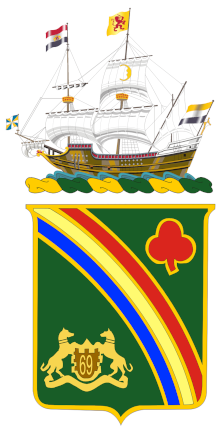
On July 21, 1861, at the First Battle of Bull Run, the first major engagement of the American Civil War, the Irish 69th New York Infantry Regiment fights under the green flag of Erin and the Stars and Stripes for the first time. The unit is in a brigade commanded by Col. William Tecumseh Sherman, whose name is now one of the most well-known of the war. He is not, however, well loved by the 69th New York.

The battle, called the Battle of First Manassas by the Confederate State Army, is fought in Prince William County, Virginia, just north of the city of Manassas and about thirty miles west-southwest of Washington, D.C. The Union Army is slow in positioning themselves, allowing Confederate reinforcements time to arrive by rail. Each side has about 18,000 poorly trained and poorly led troops. The Union army suffers an ignominious defeat that day, but the 69th is among a handful of Union regiments that perform well during the battle. Held in reserve at first, the 69th soon advances and routs the 4th Alabama. But when the brigade meets stiffer opposition, Sherman attacks with one regiment at a time, wasting his numbers. The battle is followed by a disorganized post-battle retreat of the Union forces.

Just months after the start of the war at Fort Sumter, the northern public clamors for a march against the Confederate capital of Richmond, Virginia, which is expected to bring an early end to the Confederacy. Yielding to political pressure, Brigadier General Irvin McDowell leads his unseasoned Union Army across Bull Run against the equally inexperienced Confederate Army of Brigadier General P. G. T. Beauregard, whose forces are camped near Manassas Junction. McDowell’s ambitious plan for a surprise flank attack on the Confederate left is poorly executed; nevertheless, the Confederates, who had been planning to attack the Union left flank, find themselves at an initial disadvantage.

Confederate reinforcements under Brigadier General Joseph E. Johnston arrive from the Shenandoah Valley by railroad, and the course of the battle quickly changes. A brigade of Virginians under a relatively unknown brigadier general from the Virginia Military Institute, Thomas J. Jackson, stands its ground, which results in Jackson receiving his famous nickname, “Stonewall.” The Confederates launch a strong counterattack, and as the Union troops begin withdrawing under fire, many panic and the retreat turns into a rout. McDowell’s men frantically run without order in the direction of Washington, D.C.

One of the last regiments off the field, the 69th loses 38 men that day, the first being Capt. James Haggerty from Donegal, and 59 wounded. Ninety-five are sent to Confederate prison camps, including its Sligo-born colonel, Michael Corcoran. One of the last men off the field is Waterford‘s Thomas Francis Meagher, captain of Company K, who eventually swims the last yards to safety across Bull Run creek. It is a rough beginning, but the regiment has begun a storied history that soon earns them the sobriquet “Fighting 69th.”

Both armies are sobered by the fierce fighting and the many casualties and realize that the war is going to be much longer and bloodier than anticipated. The First Battle of Bull Run highlights many of the problems and deficiencies that are typical of the first year of the war. Units are committed piecemeal, attacks are frontal, infantry fails to protect exposed artillery, tactical intelligence is minimal, and neither commander is able to employ his whole force effectively. McDowell, with 35,000 men, can commit only about 18,000, and the combined Confederate forces, with about 32,000 men, also commit 18,000.


Leave a comment

The Battle of Antrim

The Battle of Antrim is fought on June 7, 1798, in County Antrim during the Irish Rebellion of 1798 between British troops and Irish insurgents led by Henry Joy McCracken. The British win the battle, beating off a rebel attack on Antrim town following the arrival of reinforcements but the county governor, John O’Neill, 1st Viscount O’Neill, is fatally wounded.

The outbreak of the United Irish rebellion in Leinster on May 23 had prompted calls from Ulster United Irishmen to take to the field in support of their southern comrades. However, the organisation in Ulster had been severely damaged in a brutal disarmament campaign the previous year, and the new leadership are less radical and are not willing take to the field without French assistance, which is expected daily.

After waiting for two weeks while the rebellion rages in the south, the grassroots United Irish membership in Antrim decides to hold a number of meetings independent of their leaders. The outcome is the election of Henry Joy McCracken as their adjutant general and the decision to rise immediately. McCracken, together with James Hope, quickly formulate a plan to attack and seize all government outposts in County Antrim and then for the main attack to fall on Antrim town. Then using artillery seized at Antrim, the rebels are to march on Belfast in conjunction with the United Irish rebels in County Down.

McCracken has high hopes that many members of the militia will desert and join him, as disaffection is believed to be widespread, evidenced by the execution of four of the Monaghan militia for treason in Belfast in May.

On 6 June, McCracken and James Hope issue a proclamation calling for the United army of Ulster to rise. The initial plan meets with success, as the towns of Larne, Ballymena, Portaferry and Randalstown are taken and the bridge at Toome damaged to prevent the government from rushing reinforcements into Antrim from west of the River Bann. The rebels then assemble at Donegore Hill in preparation for the march and attack on Antrim town, where an emergency meeting of the county’s magistrates called by the county governor, Lord O’Neill, is due to take place.

Although almost 10,000 rebels assemble at Donegore, many display reluctance for the coming fight and stay on the hill in reserve or desert later so that probably fewer than 4,000 actually take part in the attack. The United Irishmen in Ulster are mostly Presbyterian, but are joined with Catholic Defenders and the tension between the two groups on the march likely causes some desertions. These difficulties lead to a loss of momentum, and the attack is delayed. McCracken is forced to make adjustments to his plan of attack, which had envisaged a simultaneous overwhelming assault on the town from four separate points.

The town is garrisoned by a small force of about 200 yeomen, cavalry under Lt. Col. William Lumley and armed volunteers but they also have four artillery pieces and the delay in the rebel attack allows them to send requests for assistance to Belfast and Lisburn from where reinforcements are already on the way. The garrison forms themselves at the base of the demesne wall of Antrim Castle, with artillery to the front and cavalry to the rear with their flanks anchored by the Market House and Presbyterian Meeting House. A part of the Scottish Quarter in the town is also burned by the garrison as it is perceived to be a stronghold of rebel sympathisers.

The attack finally begins shortly before 3:00 p.m. when the rebels begin a cautious march through the town. As rebel front ranks arrive to face the garrison’s defensive line, artillery opens fire on the rebels, causing them to pull back out of range. Large clouds of dust and smoke are thrown up which, together with the fires from the Scottish Quarter, obscure the garrison’s view of events.

The rebel withdrawal is mistaken for a full retreat and the cavalry moves out to pursue and rout the supposed fleeing rebels. The cavalry effectively runs into a gauntlet of rebels who are protected by a long churchyard wall and stationed in houses along the main street, suffering heavy losses to the gunfire and pikes of the rebels.

After routing the cavalry, the rebels attack the remainder of the garrison, which then begins to pull back to the safety of the castle wall. This is mistaken by a newly arrived rebel column as an attack on them, causing them to flee in panic. In the confusion, the county commander, Lord O’Neill, trapped with his magistrates, is fatally wounded by James Clements who avoids trial by joining the army. A rebel attempt to seize the artillery is only narrowly beaten off by troops stationed behind the demesne wall.

At this critical juncture, British reinforcements from Belfast arrive outside the town and, assuming it to be held by the rebels, begin to shell it with their artillery. This prompts more desertions and the rebel army begins to disintegrate, but their withdrawal is protected by a small band under James Hope which fights a successful rearguard action from the church grounds along the main street. This allows the bulk of the rebels to withdraw safely.

When the military enters the town, they begin a spree of looting, burning and murder, of which the most enthusiastic perpetrators are reported to be the Monaghan militiamen, who are anxious to prove their loyalty and expunge the shame of the recent executions of their comrades for sedition. The town of Templepatrick is burned to the ground and Old Stone Castle is razed to the ground. McCracken, Hope and their remaining supporters withdraw northward, establishing camps of ever dwindling size along the route of their retreat until news of the defeat at Ballynahinch causes their final dispersion. McCracken is arrested by yeomen on July 7 and is hanged in Belfast on July 17, having refused an offer of clemency in return for informing on his comrades.

Commemoration of the centenary of the battle, marked by a nationalist parade in Belfast on June 6, 1898, provokes loyalist riots.


Leave a comment

General Patrick Cleburne Commands Division in the Battle of Stones River

Irish-born Confederate States Army General Patrick Cleburne commands a division in the Battle of Stones River, also known as the Second Battle of Murfreesboro, one of the fiercest battles of the Western theater of the American Civil War. The battle takes place in Middle Tennessee from December 31, 1862, to January 2, 1863.

In early December 1862, the transfer of Confederate General Simon Bolivar Buckner creates a vacancy for a division command in General Braxton Bragg‘s Army of Tennessee. There is no man in that Army who can breathe a word against the promotion of Patrick Ronayne Cleburne to that post, nor the promotion to major general that goes with it. Usually, the months of December and January are quiet times, with soldiers in winter camps, but Union Major General William S. Rosecrans intends to drive Bragg’s army from Tennessee, winter or not.

Rosecrans’s Army of the Cumberland marches from Nashville, Tennessee, on December 26, 1862, to challenge Bragg’s Army of Tennessee at Murfreesboro. Bragg awaits his advance along Stones River, just west of Murfreesboro.

On December 31, each army commander plans to attack his opponent’s right flank, but Bragg has a shorter distance to go and thus strikes first. Cleburne’s division is on the Confederate left. A massive assault by the corps of Major General William J. Hardee, followed by that of Leonidas Polk, overruns the wing commanded by Major General Alexander M. McCook and drives the corps from the field. Union General Thomas Crittenden, observing from a distance, says it is the first time the Army of the Cumberland has ever seen such panic.

A stout defense by the division of Brigadier General Philip Sheridan in the right center of the line prevents a total collapse, and the Union assumes a tight defensive position backing up to the Nashville Turnpike. Repeated Confederate attacks are repulsed from this concentrated line, most notably in the cedar “Round Forest” salient against the brigade of Colonel William B. Hazen. Bragg attempts to continue the assault with the division of Major General John C. Breckinridge, but the troops are slow in arriving and their multiple piecemeal attacks fail.

Later, Confederate Corps commander William Hardee expresses his belief that had a fresh division followed up Cleburne’s, Rosecrans entire army would have been routed. Night falls, however, and the two armies bring in the New Year sleeping on their arms. Rosecran’s army is badly whipped, but it stays put on January 1st.

Bragg is cautious and only probes to discover if the Union army is still there. The Union army has fortified their position to the west of the river, in front of Cleburne. Bragg decides to attack them east of the river. Fighting resumes on January 2, 1863, when Bragg orders Breckinridge to assault a lightly defended Union position on a hill to the east of the Stones River. Chasing the retreating Union forces, this attack is successful at first, but they are led into a deadly trap. Faced with overwhelming artillery, the Confederates are repulsed with heavy losses. Bragg chooses to withdraw his army on January 3 to Tullahoma, Tennessee. Though his army has abandoned the field, Cleburne’s performance in his first battle as a major general has been outstanding. His eventual rise to corps command seems certain, but factors away from the battlefield prevent that.

The battle ends in a victory for the Union army following the Confederate army’s withdrawal on January 3, largely due to a series of tactical miscalculations by Confederate General Braxton Bragg, but the victory is costly for the Union army. Nevertheless, it is an important victory for the Union because it provides a much-needed boost in morale after the Union’s recent defeat at the Battle of Fredericksburg and also reinforces President Abraham Lincoln‘s foundation for issuing the Emancipation Proclamation, which ultimately discourages European powers from intervening on the Confederacy’s behalf.