O’Donoghue is born to Irish parents and grows up in the Hans Town area of Chelsea. He is the son of John O’Donoghue, a bricklayer from Kilworth, County Cork, and Bridget Griffin, who is from County Tipperary. He is the third of nine children, and has four brothers, Thomas, John, James, and Edmund, and four sisters, Mary, Ellen, Katherine, and Agnes. He is first an upholsterer‘s apprentice from the age of sixteen before becoming a journalist and author.
O’Donoghue attends a Catholic school and furthers his education at the British Museum. He begins his journalistic work by writing for the Dublin papers upon subjects relating to Irish music, art, and literature. A founder-member of the Irish Literary Society in London, he is also vice president of the National Literary Society, Dublin, and the compiler of a biographical dictionary, The Poets of Ireland (1891–93; revised edition, 1912), with entries on 2,000 authors. His published works also include Irish Poetry of the Nineteenth Century (1894), Humor of Ireland (1894), List of 1300 Irish Artists (1894), The Life and Writings of James Clarence Mangan (1897), Bibliographical Catalogue of Collections of Irish Music (1899), and Geographical Distribution of Irish Ability (1906).
In 1896 O’Donoghue moves to Dublin. In 1909 he becomes librarian of University College Dublin. He is co-editor of Catalogue of the Gilbert Library (in Dublin; 1918). William Butler Yeats writes of him in his Autobiographies of William Butler Yeats (1938).
Campbell is born into a Catholic and Irish nationalist family from County Down. He is educated at St. Malachy’s College, Belfast. After working for his father he teaches for a while. He travels to Dublin in 1902, meeting leading nationalist figures. His literary activities begin with songs, as a collector in Antrim, County Antrim and working with the composer Herbert Hughes. He is then a founder of the Ulster Literary Theatre in 1904. He contributes a play, The Little Cowherd of Slainge, and several articles to its journal Uladh edited by Bulmer Hobson. The Little Cowherd of Slainge is performed by the Ulster Literary Theatre at the Clarence Place Hall in Belfast on May 4, 1905, along with Lewis Purcell’s The Enthusiast.
Campbell moves to Dublin in 1905 and, failing to find work, moves to London the following year where he is involved in Irish literary activities while working as a teacher. He marries Nancy Maude in 1910, and they move shortly thereafter to Dublin, and then later to County Wicklow. His play Judgement is performed at the Abbey Theatre in April 1912.
Campbell takes part as a supporter in the Easter Rising of 1916, doing rescue work. The following year he publishes a translation from Irish of the short stories of Patrick Pearse, one of the leaders of the Rising.
Campbell becomes a Sinn FéinCouncillor in Wicklow in 1921. Later in the Irish Civil War he is on the Republican side, and is interned in 1922-23. His marriage breaks up, and he emigrates to the United States in 1925 where he settles in New York City. He lectures at Fordham University, and works in academic Irish studies, founding the University’s School of Irish Studies in 1928, which lasts four years. He is the editor of The Irish Review (1934), a short lived “magazine of Irish expression.” The business manager is George Lennon, former Officer Commanding of the County WaterfordFlying Column during the Irish War of Independence. The managing editor is Lennon’s brother-in-law, George H. Sherwood.
Campbell returns to Ireland in 1939, settling at Glencree, County Wicklow. He dies at Lacken Daragh, Enniskerry, County Wicklow on June 6, 1944.
O’Reily is born John O’Reilly on November 19, 1846, in Kilkenny, County Kilkenny, the son of Michael, a military officer, and Anne, née Gallagher. He completes his primary education at the parochial school of St. John’s Parish, and spends six and a half years at St. Kieran’s College. Due to poor health, he decides against pursuing a military career, and in 1864 he enters All Hallows College in Dublin to study for the priesthood. He learns the Irish language and studies mental philosophy, mathematics and ecclesiastical studies, achieving first prize in each of his classes.
After being ordained on June 21, 1869, O’Reily leaves Ireland for Western Australia in October, arriving in January 1870. Having served briefly in Newcastle (present day Toodyay) and Northam, he becomes a parish priest in Fremantle, establishing the West Australian Catholic Record in 1874 and serving as its publisher, editor and printer from 1883.
When the Diocese of Port Augusta is established in 1887, Pope Leo XIII names O’Reily as its first bishop. Concerned about the financial position of the diocese, which had inherited significant debt from the Diocese of Adelaide, he accepts the posting reluctantly. As bishop, he greatly improves the financial position of the new diocese, reducing its debt by half and earning a reputation as a competent administrator.
In 1894, O’Reily is appointed to replace the deceased Christopher Reynolds as Archbishop of Adelaide. The archdiocese he inherits is burdened with substantial debt, again left over from the old Diocese of Adelaide. Through the sale of church assets and a fundraising campaign, he is able to eliminate most of the Archdiocese’s liabilities while still investing in church infrastructure. He also actively participates in public discussions relating to education policy at a time when the role of the state in supporting religious education is topical. He publicly advocates government assistance for religious schools, stating that it is unfair Catholics pay taxes to support state schools, but receive no funding for their own.
In the later years of his life, poor health forces O’Reily to spend less time attending to his episcopal duties, and from 1905, he keeps to himself in his house in Glen Osmond, leading to the local press referring to him as the “Recluse of Glen Osmond.” Increasingly, his episcopal duties are fulfilled by Bishop of Port Augusta John Norton, who has to visit the more remote parts of O’Reily’s see on his behalf.
As he becomes more frail, O’Reily asks certain priests to accompany him when he travels, among whom is the DominicanpriorRobert Spence. When O’Reily requests a coadjutor in 1913, he chooses Spence as his first preference for the role. Despite the reluctance of some clergy to the appointment of a religious as Archbishop, Spence is consecrated as coadjutor, with right of succession, in August 1914.
O’Reily dies at his house in Adelaide on July 6, 1915 and is buried under a large Celtic cross at the West Terrace Cemetery in Adelaide. He is highly regarded by many in South Australian society, with Adelaide’s daily newspapers praising his character, administrative ability and positive relations with non-Catholics.
O’Kelly is born on August 25, 1882, on Capel Street in the north inner-city of Dublin. He joins the National Library of Ireland in 1898 as a junior assistant. That same year, he joins the Gaelic League, becoming a member of the governing body in 1910 and General Secretary in 1915.
In 1905 O’Kelly joins Sinn Féin who, at the time, supports a dual monarchy. He is an honorary secretary of the party from 1908 until 1925. In 1906 he is elected to Dublin Corporation, which is Dublin’s city council. He retains the seat for the Inns Quay Ward until 1924.
O’Kelly is elected Sinn Féin MP for Dublin College Green in the 1918 Irish general election. Along with other Sinn Féin MPs he refuses to take his seat in the British House of Commons. Instead, they set up an Irish parliament, called Dáil Éireann, in Dublin. O’Kelly is Ceann Comhairle (Chairman) of the First Dáil. He is the Irish Republic’s envoy to the post-World War I peace treaty negotiations at the Palace of Versailles, but the other countries refuse to allow him to speak as they do not recognise the Irish Republic.
O’Kelly is a close friend of Éamon de Valera, and both he and de Valera oppose the Anglo-Irish Treaty of December 1921. When de Valera resigns as President of the Irish Republic on January 6, 1922, O’Kelly returns from Paris to try to persuade de Valera to return to the presidency but de Valera orders him to return to Paris.
During the Irish Civil War, O’Kelly is jailed until December 1923. Afterwards he spends the next two years as a Sinn Féin envoy to the United States.
In 1926 when de Valera leaves Sinn Féin to found his own republican party, Fianna Fáil, O’Kelly follows him, becoming one of the party’s founding members. In 1932, when de Valera is appointed President of the Executive Council of the Irish Free State, he makes O’Kelly the Minister for Local Government and Public Health. He often tries to publicly humiliate the Governor-General of the Irish Free State, James McNeill, which damages O’Kelly’s reputation and image, particularly when the campaign backfires.
In 1938, many believe that de Valera wants to make O’Kelly the Fianna Fáil choice to become President of Ireland, under the new Irish constitution, Bunreacht na hÉireann. When Lord Mayor of Dublin, Alfie Byrne, says he wants to be president there is an all-party agreement to nominate Douglas Hyde, a Protestant Irish Senator, Irish language enthusiast and founder of the Gaelic League. They believe Hyde to be the only person who might win an election against Alfie Byrne. O’Kelly is instead appointed Minister of Finance and helps create Central Bank in 1942.
O’Kelly leaves the cabinet when he is elected President of Ireland on June 18, 1945, in a popular vote of the people, defeating two other candidates. He is re-elected unopposed in 1952. During his second term he visits many nations in Europe and speaks before the United States Congress in 1959. He retires at the end of his second term in 1959, to be replaced by his old friend, Éamon de Valera. Following his retirement, he is described as a model president by the normally hostile newspaper, The Irish Times. Though controversial, he is widely seen as genuine and honest, but tactless.
O’Kelly’s strong Roman Catholic beliefs sometimes cause problems. Éamon de Valera often thinks that O’Kelly either deliberately or accidentally leaks information to the Knights of Saint Columbanus and the Church leaders. He ensures that his first state visit, following the creation of the Republic of Ireland in 1949, is to the Vatican City to meet Pope Pius XII. He accidentally reveals the Pope’s private views on communism. This angers the Pope and Joseph Stalin and is why he is not given the papal Supreme Order of Christ which is given to many Catholic heads of state.
O’Kelly dies in Blackrock, Dublin on November 23, 1966, at the age of 84, fifty years after the Easter Rising that first brought him to prominence. He is buried in Glasnevin Cemetery, Glasnevin, Dublin.
Born on November 23, 1845, at Cahirmoyle, County Limerick, O’Brien is the younger daughter in a family of five sons and two daughters. Her father is William Smith O’Brien, the Irish nationalist and her mother is Lucy Caroline, eldest daughter of Joseph Gabbett, of High Park, County Limerick. On her father’s return in 1854 from the penal colony in Tasmania, she rejoins him in Brussels and stays there until he comes back to Cahirmoyle in 1856. On her mother’s death in 1861, she moves with her father to Killiney, near Dublin, and is his constant companion until his death at Bangor, Gwynedd in 1864.
From 1864, O’Brien lives at Cahirmoyle with her brother Edward, caring for his motherless children until his remarriage in 1880. Having been hard of hearing since childhood, by 1879 she has become entirely deaf. She goes to live at Ardanoir near Foynes on the River Shannon and spends time writing. She becomes a staunch supporter of Charles Stewart Parnell.
A bad harvest in Ireland in 1879, combined with Irish political turmoil, causes many Irish people to emigrate to the United States. In articles and letters to newspapers and reviews, O’Brien exposes the awful conditions that exist in the Queenstown (Cobh) lodging houses, on board the emigrant ships, and in the dock slums of New York City, where the Irish have to stay upon landing. A notable piece she writes is the Horrors of the Immigrant Ship which appears in ThePall Mall Gazette on May 6, 1881.
A visit to Queenstown, the port of embarkation, and a tour of the White Star Line‘s Germanic leads her to successfully lobby to get a Catholic priest aboard the emigrant ship to help ease the passage, at least spiritually. That achievement captures even more public attention by virtue of the fact that O’Brien herself is Protestant. Despite the limit of 1,000 passengers, she notes the steamer has carried as many as 1,775 at one time.
O’Brien presses the Board of Trade for greater vigilance, and in April 1882, founds a 105-bed boarding house at Queenstown for the reception and protection of girls on the point of emigrating. The O’Brien Emigrants Home at The Beach, Queenstown fails because it is boycotted by other boardinghouse keepers and local merchants, forcing her to order provisions from Cork.
O’Brien also daily visits three or four of the ships for which her lodgers are destined along with a medical officer. She makes passages herself to America, using the occasion to investigate shipboard conditions and lobby for the reform and enforcement of health and safety standards.
O’Brien finds little effort to provide food, drink or accommodation at the Castle Garden entry facility. She also finds that often the illiterate young women are being tricked into prostitution through spurious offers of employment. Additionally, she notes the high infant mortality rates in the tenements where the women live. She proposes to Archbishop John Ireland of Minnesota an information bureau at Castle Garden, a temporary shelter to provide accommodation for immigrants and a chapel. Archbishop Ireland agrees to raise the matter at the May 1883 meeting of the Irish Catholic Association which endorses the plan and votes to establish an information bureau at Castle Garden. Ireland also contacts Cardinal John McCloskey, Archbishop of New York, about providing a priest for immigrants arriving at Castle Garden.
The Mission opens on January 1, 1884, with Rev. John J. Riordan appointed as the first chaplain at Castle Garden. Immigrant girls needing accommodation are placed in local boarding houses until May 1 when a Home for Immigrant Girls is opened at 7 Broadway. In 1885, the James Watson House at 7 State Street is purchased from Isabella Wallace for the Mission of Our Lady of the Rosary for the Protection of Irish Immigrant Girls to serve as a way station for young immigrant women. Between 1884 and 1890, the Mission provides assistance to 25,000 Irish immigrant women.
In 1881–82, O’Brien embarks on a campaigning lecture tour in the United States. She encounters problems, however, particularly given her Protestant background and the need to enlist support from Catholic clergy. Poor health, and her profound deafness cause her to curtail her activities in America. When she returns to Ireland in 1883, she finds herself suspected of being a British agent whose Emigrant Boarding house and whose plans for an American home for Irish immigrant girls facilitate the government’s assisted emigrant scheme. Supposedly, this would be the scheme that helps landlords clear their estates of poor tenants. In fact, O’Brien opposes assisted emigration, but she continues to assist those who are sent to her.
O’Brien retires from active public work in 1886, moving to Ardanoir, Foynes, on the Shannon Estuary. She spends considerable time in Dublin, where she socialises with Douglas Hyde and the painter William Osbourne. She joins the Roman Catholic Church in 1887. She dies of heart failure on June 3, 1909, at Foynes, and is buried at Knockpatrick.
Rice is born into a Catholic family and is one of nine children. It comes as a surprise that a Catholic family can be prosperous in these days but they have a lease of a good-sized farm and are industrious people. In view of his future work in education it is fortunate that he receives a very good education himself, first at a local hedge school and then at a private secondary school in Kilkenny.
Rice is apprenticed to his uncle, Michael Rice, in Waterford at the age of 17. Waterford is then the second largest port in Ireland with an expanding trade with England, France and Spain and has very special trading links across the Atlantic with Newfoundland. His uncle is involved in providing food and services for the crews and passengers of the ships trading in and out of the port of Waterford. His uncle becomes a very prosperous businessman, and his business expands even more after it is handed over to his nephew. His great wealth is later to be used in transforming the lives of countless young boys.
At the age of 25 Rice marries Mary Elliot and is left a widower two years later when she dies after falling from a horse. He is left with a handicapped daughter, Mary. He calls in his stepsister Joan Murphy to help him care for his daughter so he can develop the business he inherited from his uncle.
In 1802, having properly cared for his daughter, Rice begins a night school for the uneducated boys from the quays of Waterford. His deep desire is to found a religious order of men who will educate these poor boys so that they can live with dignity and high self-esteem. But his volunteer assistants cannot stick with it. Neither can the paid teachers he later employs. Just when his spirits are lowest, and he looks to be a failure to all his business colleagues, two men from his native Callan join him not only to educate these unruly boys but also to join him in his plan to found a religious order. To do such a thing is contrary to the law. Nevertheless, Rice and his growing number of companions proceed. In 1808 seven of them take religious vows under Bishop Power of Waterford. They are called Presentation Brothers. This is the first congregation of men to be founded in Ireland and one of the few ever founded in a Church by a layman. Rice has in the meantime built a substantial school out of his own money, but it is already proving too small for the many boys who flock to him for an education.
Gradually an extraordinary transformation takes place in the “quay kids” of Waterford. Rice and his Brothers educate them, clothe and feed them. Other Bishops in Ireland supply him with men whom he prepares for religious life and teaching. In this way the Presentation Brothers spread throughout Ireland. However, the groups in separate dioceses are not under his control but that of the bishop. This creates problems when Brothers need to be transferred. Rice seeks and ultimately obtains approval from Pope Pius VII for his Brothers to be made into a pontifical congregation with Rice as Superior General. He is then able to move Brothers to wherever they are most needed. From this time on they are called Christian Brothers. By 1825 there are 30 Christian Brothers working in 12 towns and cities and educating 5,500 boys, free of charge. Many of these boys are also being clothed and fed.
Rice’s life is steeped in a spirituality that is strong and practical. He is forever caring for the poor in the wretched circumstances of their lives, for he believes there is a great need “to give to the poor in handfuls.” Many people, both men and women, from many cultures, young and old are helped and given hope and purpose and a new footing in life. He and his Brothers even card for the inmates of the jails of Waterford. He is privileged to comfort and accompany many a condemned man to the gallows. The poor never forget his love for them and see him as “a man raised up by God.”
Rice endures many and severe trials and in 1829 it seems the Christian Brothers are going to be suppressed by the law of the land. They face extinction but this does not happen. An even worse trial comes to him personally when some of his own Brothers try to undermine his work. Fortunately, they are unsuccessful. He gave his Brothers as their motto a text from the Book of Job that means so much to him in his life: “The Lord has given, and the Lord has taken away; blessed be the name of the Lord forever.”
In 1838, at the age of 76, Rice retires from leadership of the congregation and returns to Waterford. After living in a near-comatose state for more than two years, he dies at Mount Sion, Waterford on August 29, 1844, where his remains lie in a casket to this day.
Rice is declared to be Blessed Edmund Rice by Pope John Paul II in Rome on October 6, 1996. His Feast Day in the Catholic Church is 5 May.
Davitt is born in Strade, County Mayo, on March 25, 1846, the son of an evicted tenant farmer. Following their eviction, the family emigrates to England. In 1856, at the age of 10, he starts work in a cotton mill, where he loses an arm in a machinery accident a year later. As is typical for the era, he does not receive any compensation.
In 1865, Davitt joins the revolutionary Fenian Brotherhood, an international secret society that seeks to secure political freedom for Ireland. He becomes secretary of its Irish analogue, the Irish Republican Brotherhood (IRB), in 1868. Arrested in Paddington Station in London for sending firearms to Ireland on May 14, 1870, he is sentenced to 15 years in Dartmoor Prison and there lays plans to link Charles Stewart Parnell’s constitutional reform with Fenian activism to achieve political-agrarian agitation.
Paroled from prison in 1877, Davitt rejoins the IRB and goes to the United States, where the Fenian movement originated. There he is deeply influenced by Henry George’s ideas about the relationship between land monopoly and poverty.
Back in Ireland, using funds raised by John Devoy and Clan na Gael in the United States, Davitt wins Parnell’s cooperation in organizing the Irish National Land League in 1879, which leads, however, to his expulsion from the supreme council of the IRB in 1880. He is also imprisoned for seditious speeches in 1881 and 1883. He is elected to Parliament representing North Meath in the 1892 United Kingdom general election, but his election is overturned on petition because he had been supported by the Roman Catholic hierarchy. He stands unopposed for North East Cork at a by-election in February 1893, making his maiden speech in favour of the Home Rule Bill in April, which passes the House of Commons but is defeated in the House of Lords in September.
Because of his public championing of Henry George’s theories of land reform, Parnell repudiates him. Davitt actively defends the Nationalists before the Parnell Commission, which meets between 1887 and 1889. When the Irish party splits in 1890 over Parnell’s involvement in Capt. William Henry O’Shea’s divorce case, Davitt is among the first to oppose Parnell’s continuance as leader. He is elected again, for South Mayo in 1895, but resigns in 1899 in protest against the Second Boer War.
Davitt dies in Elphis Hospital, Dublin on May 30, 1906, at the age of 60, from blood poisoning. The fact that the Lord Lieutenant of Ireland attends his funeral is a public indication of the dramatic political journey this former Fenian prisoner has taken. There is no plan for public funeral, and hence Davitt’s body is brought quietly to the Carmelite Friary, Clarendon Street, Dublin. However, the next day over 20,000 people file past his coffin. His remains are taken by train to Foxford, County Mayo, and buried in the grounds of Strade Abbey at Strade, near his place of birth.
Davitt’s book, The Fall of Feudalism in Ireland (1904), is a valuable record of his time.
Kennedy meets his future wife, Jacqueline Lee “Jackie” Bouvier (1929–1994), while he is a congressman. Charles L. Bartlett, a journalist, introduces the pair at a dinner party. They are married a year after he is elected senator, on September 12, 1953. Following a miscarriage in 1955 and a stillbirth in 1956, they produce three children, Caroline, John, Jr., and Patrick, who dies of complications two days after birth.
In the 1960 presidential election, Kennedy narrowly defeats Republican opponent Richard Nixon, who is the incumbent vice president. His humor, charm, and youth in addition to his father’s money and contacts are great assets in the campaign. His campaign gains momentum after the first televised presidential debates in American history. He is the first Catholic elected president of the United States.
Kennedy’s administration includes high tensions with communist states in the Cold War. As a result, he increases the number of American military advisors in South Vietnam. The Strategic Hamlet Program begins in Vietnam during his presidency. In April 1961, he authorizes an attempt to overthrow the Cuban government of Fidel Castro in the failed Bay of Pigs Invasion. He authorizes the Cuban Project, also known as Operation Mongoose, in November 1961. He rejects Operation Northwoods, plans for false flag attacks to gain approval for a war against Cuba, in March 1962. However, his administration continues to plan for an invasion of Cuba in the summer of 1962.
In October 1962, U.S. spy planes discover Soviet missile bases have been deployed in Cuba. The resulting period of tensions, termed the Cuban Missile Crisis, nearly results in the breakout of a global thermonuclear conflict. He also signs the first nuclear weapons treaty in October 1963.
After Kennedy’s death, Congress enacts many of his proposals, including the Civil Rights Act of 1964 and the Revenue Act of 1964. Despite his truncated presidency, he ranks highly in polls of U.S. presidents with historians and the general public. His personal life has also been the focus of considerable sustained interest following public revelations in the 1970s of his chronic health ailments and extramarital affairs. He is the last U.S. President to have been assassinated as well as the last U.S. president to die in office.
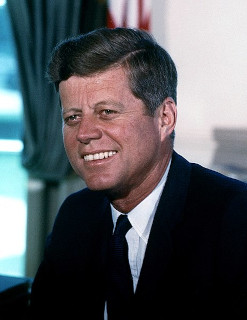
(Pictured: John F. Kennedy, photograph in the Oval Office, July 11, 1963)
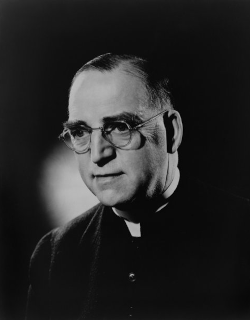
In 1904, Flanagan emigrates to the United States and becomes a US citizen in 1919. He attends Mount St. Mary’s University in Emmitsburg, Maryland, where he receives a Bachelor of Arts degree in 1906 and a Master of Arts degree in 1908. He studies at Saint Joseph’s Seminary in Dunwoodie, Yonkers, New York. He continues his studies in Italy and at the University of Innsbruck in Austria where he is ordained a priest on July 26, 1912. His first parish is in O’Neill, Nebraska, where from 1912 he serves as an assistant pastor at St. Patrick’s Catholic Church. He then moves to Omaha, Nebraska, to serve as an assistant pastor at St. Patrick’s Church and later at St. Philomena’s Church.
In 1917, Flanagan founds a home for homeless boys in Omaha. Bishop Jeremiah James Harty of the Diocese of Omaha has misgivings but endorses Flanagan’s experiment. Because the downtown facilities are inadequate, he establishes Boys Town, ten miles west of Omaha in 1921. Under his direction, Boys Town grows to be a large community with its own boy-mayor, schools, chapel, post office, cottages, gymnasium, and other facilities where boys between the ages of 10 and 16 can receive an education and learn a trade.
Boys Town, a 1938 film starring Spencer Tracy based on Flanagan’s life, wins Tracy an Academy Award for Best Actor for his performance. Mickey Rooney also stars as one of the residents. Tracy spends his entire Oscar acceptance speech talking about Flanagan. Without confirming it with Tracy, an overzealous MGM publicity representative announces incorrectly that Tracy is donating his Oscar to Flanagan. The Academy of Motion Picture Arts and Sciences hastily strikes another inscription, so Tracy keeps his statuette and Boys Town gets one as well. A sequel also starring Tracy and Rooney, Men of Boys Town, is released in 1941.
Flanagan himself appears in a separate 1938 MGM short, The City of Little Men, promoting Boys Town and giving a tour of its facilities. The actor Stephen McNally plays Flanagan in a 1957 episode of the ABC religion anthology series, Crossroads.
Flanagan receives many awards for his work with the delinquent and homeless boys. Pope Pius XI names him a Domestic Prelate with the title Right Reverend Monsignor in 1937. He serves on several committees and boards dealing with the welfare of children and is the author of articles on child welfare. Internationally known, he travels to the Republic of Ireland in 1946, where he is appalled by the children’s institutions there, calling them “a national disgrace.” When his observations are published after returning to Omaha, instead of improving the horrid conditions, vicious attacks are leveled against him in the Irish print media and the Oireachtas. He is invited by General Douglas MacArthur to Japan and Korea in 1947 to advise on child welfare, as well as to Austria and Germany in 1948. While in Germany, he dies of a heart attack on May 15, 1948. He is interred at Dowd Memorial Chapel of the Immaculate Conception Parish in Boys Town, Nebraska.
On February 25, 2012, the Catholic Archdiocese of Omaha, Nebraska opens the canonization process of Flanagan. At a March 17, 2012 prayer service at Boys Town’s Immaculate Conception Church, he is given the title “Servant of God,” the first of three titles bestowed before canonization as a Catholic saint. The investigation is completed in June 2015 and the results forwarded to the Vatican. If the Vatican approves the local findings, Flanagan will be declared venerable. The next steps will be beatification and canonization.
There is a portrait statue dedicated to Fr. Edward J. Flanagan in Ballymoe, County Galway.
A farmer’s son, Kelly is raised amid the horror of the Irish Civil War. The family is burned out when he is five and, penniless, goes north to take a worker’s house near the Harland & Wolff shipyard in Belfast. Even though they are Protestant the Kellys are met with a cold welcome. To counter that, his mother starts a bakery while he and his father sell the hot rolls to the area pubs.
Kelly initially attends a shipyard workers’ school, sometimes without shoes, and then goes on to Methodist College Belfast, where only boys prepared to work hard are welcome. His mother, who had taught him to play the piano by marking out the keyboard on the kitchen table, is so cross when she hears that he has been playing football in the street that she tells the headmaster that he does not have enough homework.
On a visit to an elder sister at Trinity College, Dublin, Kelly is so impressed by her smoking and her painted nails that he decides to follow her to the university, where he reads legal science. After being called to the Bar of Northern Ireland in 1944, he has the usual slow start, traveling up to 100 miles to earn a five-guinea fee. However, aided by a photographic memory and the patronage of Catholicsolicitors, he gradually builds up a large practice, concentrating on crime and workers’ compensation while earning a reputation as the finest cross-examiner in the province.
Kelly first makes a mark by his successful defence of an aircraftman accused of killing a judge’s daughter. The man is found guilty but insane, though the complications involved bring it back to court 20 years later. After appointment as Queen’s Counsel in 1958 he skillfully conducts two cases which go to the House of Lords. One involves the liability of a drunken psychopath, the other the question of automatism where a person, acting like a sleepwalker, does not know what he is doing.
In 1973, Kelly is appointed as a judge of the High Court of Northern Ireland, and then as a Lord Justice of Appeal of Northern Ireland in 1984, when he is also knighted and appointed to the Privy Council of the United Kingdom. On the bench he proves a model of fairness and courtesy with a mastery of facts, but his role often puts him in danger.
A Provisional Irish Republican Army (IRA) gang once targets him with a bomb-laden milk van, intending to drive it through his gates. But the police are alerted and immediately take him to Stormont, where he lives for the next two months.
For a year Kelly presides alone over a non-jury Diplock court, protected by armed police and wearing a bulletproof vest before writing his judgment under Special Air Service (SAS) guard in England. He convicts dozens of people on “supergrass” evidence, though there are subsequently doubts about the informant and some of his judgments are overturned.
One of the accused, Kevin Mulgrew, is sentenced to 963 years in prison, with Kelly telling him, “I do not expect that any words of mine will ever raise in you a twinge of remorse.” While the IRA grumbles about the jail terms he dispenses, and he is often portrayed as an unthinking legal hardliner by Sinn Féin, he is a more subtle figure and is often merciful towards those caught up in events or those whom he considers too young for prison.
Kelly retires in 1995 and moves to England, where he dies at the age of 88 at his home in Berkshire on December 5, 2008, following a short illness. He is survived by his wife, Pamela Colmer.
(From: “Basil Kelly,” Independent.ie (www.independent.ie), January 4, 2009)





 seamus dubhghaill