seamus dubhghaill

Promoting Irish Culture and History from Little Rock, Arkansas, USA


Leave a comment

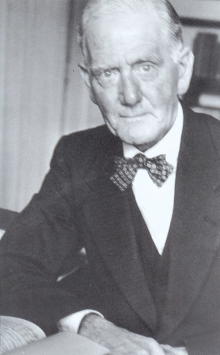
Death of John Havelock Nelson, Composer & Conductor

John Havelock Nelson, composer and conductor, dies in Belfast, Northern Ireland, on August 5, 1996. He makes an immense contribution to the development of the cultural life of the province – and beyond – over the second half of the 20th century.

Nelson is born of middle-class parents in Cork, County Cork, on May 25, 1917, his distinctive forename being taken from a cousin of his mother who lost his life in World War I. Despite his birthplace, both his parents’ ancestral roots lie firmly in Northern Ireland.

Nelson’s father Robert comes from Larne, County Antrim, where he was raised. However, the early years of his mother Grace are quite eventful. She is born in the Belgian Congo on account of her father’s placement there as a missionary in the latter years of the 19th century (his family hail from Tobermore, County Londonderry). She is eventually sent home at an early age, due to the threat of malaria, and is raised in Belfast by an aunt and uncle who have no family of their own. It appears that Nelson inherits his musical genes from both parents. Although his father is trained as a chartered accountant, he is a capable baritone singer who studies in the early 1900s with C. J. Brennan, later to become the organist and choirmaster at St. Anne’s Cathedral, Belfast). Meanwhile, his mother shows talent as a pianist during her upbringing in her adopted city and by her early 20s is offering her services as an accompanist.

By chance, this is how his parents meet. They marry in 1916, shortly before their arrival in Cork where Robert takes up his first accountancy job. Within a month of Nelson’s birth, the family moves to Dublin where his father has secured a better post, eventually settling near Dún Laoghaire, just south of the capital city. From the age of five, now the eldest of four brothers born a year apart, he starts piano lessons and makes such rapid progress that, by the age of ten, he is able to play in a piano trio and to accompany his father in informal concerts. By the age of twelve, he wins a scholarship to the Royal Irish Academy of Music, Dublin, giving him the opportunity to study piano and theory and helping him to establish his core musical skills. Soon he adds conducting and organ lessons to his study programme.

As far as Nelson’s general education is concerned, this is completed at St. Andrew’s College, Dublin, where he excels in English, history and the sciences. By his late teens, he is determined to pursue a professional career as a musician. His father, however, exercises caution in this regard, advising him to take a science degree in the first instance. Consequently, he gains entry to Trinity College Dublin (TCD) in 1935 to read Natural Science, then makes a decision the following year to change to Medical Science. By 1939, he completes his primary degree in Medical Science, leading to doctoral research in bacteriology. At the same time, he begins a 4-year music degree at TCD while remaining musically active outside the university in relation to his piano studies, and also co-founds and conducts the Dublin Orchestral Players, a body that continues to provide an invaluable platform for amateur performers. He completes his university studies in 1943, graduating with a PhD in Medical Science and a primary Music degree. Seven years later he also completes a doctorate in Music from the same university.

His university career now behind him, like many fellow Irishmen, Nelson feels a desire to contribute to the World War II effort and applies for a commission in the medical branch of the Royal Air Force (RAF) in 1944. Eventually, he is called up and located at RAF Halton, Buckinghamshire, where he remains until after the end of the War, only returning to Dublin for his marriage in 1945. By nature, an outgoing, sociable person, he wastes no time in immersing himself in music-making activities when off duty, both inside and outside his RAF base. It is during this immediate post-war period that he becomes convinced that he wants to pursue a career in music. By chance, his attention is drawn to a BBC advertisement regarding a number of regional posts for staff accompanists, including Northern Ireland. His application is successful, and he reports for duty at BBC Northern Ireland in March 1947, where he remains for the next 30 years. In his new post, his main role is to play and accompany on the piano. To this end, he becomes involved in a number of new radio programmes, notably Children’s Hour. Elsewhere, he composes and arranges music for adult dramas and serials, the best known being The McCooeys. Another responsibility is to assist in auditioning local musicians for broadcasting opportunities, a process that uncovers much local talent, including a young James Galway. While his activities revolve around radio work in the 1950s, the next 20 years embrace opportunities arising from the new medium of television, including the popular Songs of Praise which involve him as conductor.

Nelson’s decision to retire from the BBC in 1977 enables him to focus fully on his free-lance career which had been running parallel, up until then, with his broadcasting work. In this capacity he is able to give full rein to his diverse range of musical skills as choral and orchestral conductor, chamber musician, music-festival adjudicator, composer and arranger. One should not overlook his role as animateur in founding the Studio Symphony Orchestra (1947) and the Studio Opera Group (1950). Both became integral parts of the local cultural scene during Nelson’s lifetime. His contribution as a festival adjudicator is an important activity, notably when undertaking tours abroad, including to Canada and the Caribbean. His visits to the latter area lead him to form the Trinidad and Tobago Opera Company shortly after his BBC retirement. In his busy lifestyle, he makes time to satisfy his creative energy as a composer and arranger. In total he publishes over 100 pieces, many inspired by his love of Irish traditional song and are of short duration and scored for a variety of vocal combinations. His enjoyment of his reputation as a piano accompanist of international standing is confirmed by his association with some of the leading Irish and British professional singers of the period, including Bernadette Greevy (soprano), Margaret Marshall (soprano), Peter Pears (tenor) and Ian Wallace (bass-baritone).

During his lifetime, Nelson’s outstanding services to music, both inside and outside the province, are recognised by a number of awards. The first of these is an OBE in 1966, followed in the latter part of his life by four honorary doctorates, three from local universities. A gifted and versatile musician, his personality is described by one colleague as “magnetic”- he has the unique ability to reach out to everybody irrespective of their age, status and position in life in whatever role he performs. In his best-known role as a conductor, a critic says of him that, “Dr. Nelson has a remarkable touch in getting people to do what he wants in the pleasantest way possible.” His vision and determination help to establish a vibrant music culture throughout Northern Ireland, an achievement that will remain his lasting legacy.

Nelson is survived by his three children and eight grandchildren; his wife Hazel having predeceased him in 1983.

(From: “John Havelock Nelson (1917-1996),” Dictionary of Ulster Biography, http://www.newulsterbiography.co.uk)


Leave a comment

Death of Vincent O’Brien, Organist & Composer

Vincent O’Brien, Irish organist, music teacher and composer, dies in Dublin on June 21, 1948, leaving behind a lasting legacy in Irish music and education.

O’Brien is born in Dublin on May 9, 1871, where he lives all his life. He is an important figure in early 20th-century Irish music. For some, he is mainly known as the first teacher of singers such as John McCormack, Margaret Burke Sheridan and the writer James Joyce.

O’Brien is the eldest child of a Roman Catholic church musician. In 1885, he first appears in a public piano recital and, later in the year, becomes the organist of Rathmines parish church, a position he holds until 1888. He holds another organist’s position at the Dublin Carmelite church from 1897 to 1899 but is chiefly known as organist and choir director of Dublin’s largest Roman Catholic Church, St. Mary’s Pro-Cathedral, between 1903 and 1946. In 1898, he is the founder and first director of the Palestrina Choir, originally all-male, which is still active, and which is financed for many years by Edward Martyn.

O’Brien studies with Robert Prescott Stewart at the Royal Irish Academy of Music (1888-90), where he is the first winner of the Coulson Scholarship and frequently performs as both tenor singer, piano accompanist, and organist in many public concerts during the 1890s. As a church musician, he becomes particularly involved in the Cecilian Movement, conducting works by Michael Haller and others, and also pursuing their artistic ideals in his own sacred choral compositions.

O’Brien is the founding conductor of the Dublin Oratorio Society (1906), the Brisan Opera Company (1916) and conducts at many ad hoc events. In 1925, he becomes the first music director of Radio Éireann (originally called 2RN), a position he holds until 1941. He singles out his work as music director for the 31st International Eucharistic Congress in Dublin (1932) as his most prized personal achievement. As late as 1945, he founds Our Lady’s Choral Society, a large oratorio choir still in existence, which originally is recruited mainly from the various Roman Catholic church choirs in Dublin.

Among his teaching positions, O’Brien teaches at the diocesan seminary at Holy Cross College, is Professor of Gregorian Chant at the missionary seminary of All Hallows College from 1903, and Professor of Music at the Ladies’ Teacher-Training College at Carysfort Park, Blackrock, County Dublin, from 1908 until his death in Dublin on June 21, 1948. As a much-demanded vocal coach, he teaches at his home, his best-known pupils including John McCormack, Margaret Burke Sheridan and James Joyce. He performs the piano accompaniments for McCormack’s first gramophone recordings and accompanies him during his 1913–14 Australasian tour of 60 performances in three months, during which he also gives organ recitals at the Irish-dominated Catholic cathedrals of Sydney and Melbourne.

In 1932, O’Brien receives a doctorate honoris causa from the National University of Ireland (NUI).

Of his two sons, Oliver O’Brien (1922–2001) largely follows in his father’s footsteps, as organist and director of the Palestrina Choir, of Our Lady’s Choral Society, music teacher at Carysfort College and as teacher in various Dublin schools. His other son, Colum O’Brien, is organist in the Pro-Cathedral.

Before his work for the Palestrina Choir, O’Brien’s musical interests are very broad, culminating in 1893 in the composition of the full-scale opera Hester. As a church music composer, he follows Cecilian ideals, with a number of hymns, motets and other choral works. He also composes a number of songs for voice and piano, with The Fairy Tree (1930) being a particular favourite of John McCormack’s.


Leave a comment

Death of Musicologist Francis Llewellyn Harrison

Francis Llewellyn Harrison, better known as “Frank Harrison” or “Frank Ll. Harrison” and one of the leading musicologists of his time and a pioneering ethnomusicologist, dies in Canterbury, England, on December 29, 1987.

Initially trained as an organist and composer, he turns to musicology in the early 1950s, first specialising in English and Irish music of the Middle Ages and increasingly turning to ethnomusicological subjects in the course of his career. His Music in Medieval Britain (1958) is still a standard work on the subject, and Time, Place and Music (1973) is a key textbook on ethnomusicology.

Harrison is born in Dublin on September 29, 1905, the second son of Alfred Francis Harrison and Florence May (née Nash). He becomes a chorister at St. Patrick’s Cathedral, Dublin in 1912 and is educated at the cathedral grammar school and Mountjoy School. A competent organist, he is deputy organist at St. Patrick’s from 1925 to 1928. In 1920, he also begins musical studies at the Royal Irish Academy of Music, where he studies with John Francis Larchet (composition), George Hewson (organ) and Michele Esposito (piano). In 1926, he graduates Bachelor of Music at Trinity College Dublin and is awarded a doctorate (MusD) in 1929 for a musical setting of Psalm 19. He then works in Kilkenny for one year, serving as organist at St. Canice’s Cathedral and music teacher at Kilkenny College.

In 1930, Harrison emigrates to Canada to become organist at Westminster Presbyterian Church in New Glasgow, Nova Scotia. In 1933, he studies briefly with Marcel Dupré in France but returns to Canada in 1934 to become organist at Knox Presbyterian Church in Ottawa. In 1935, he takes a position as organist and choirmaster at St. George’s Cathedral in Kingston, Ontario, as well as taking up the newly created post of “resident musician” at Queen’s University at Kingston. His duties include giving lectures, running a choir and an orchestra, and conducting concerts himself. His course in the history and appreciation of music is the first music course to be given for full credit at Queen’s. He resigns from St. George’s in 1941 to become assistant professor of music at Queen’s in 1942. During his years in Canada he still pursues the idea of remaining a performing musician and composer, winning three national composition competitions: for Winter’s Poem (1931), Baroque Suite (1943) and Night Hymns on Lake Nipigon (1945).

On a year’s leave of absence from Queen’s, Harrison studies composition with Paul Hindemith at Yale University, also taking courses in musicology with Leo Schrade. In 1946, he takes up a position at Colgate University in Hamilton, New York, and then moves on to Washington University in St. Louis as head of the new Department of Music (1947–1950).

In 1951, Harrison takes the degrees of Master of Arts (M.A.) and Doctor of Music (DMus) at Jesus College, Oxford, and becomes lecturer (1952), senior lecturer (1956), and reader in the history of music (1962–1970) there. In 1965, he is elected Fellow the British Academy and Senior Research Fellow at Oxford. From 1970 to 1980, he is Professor of Ethnomusicology at the University of Amsterdam in the Netherlands, retiring to part-time teaching in 1976.

Harrison also holds Visiting Professorships in musicology at Yale University (1958–1959), Princeton University (spring 1961 and 1968–1969), and Dartmouth College (winter 1968 and spring 1972). He also briefly returns to Queen’s University at Kingston as Queen’s Quest Visiting Professor in the fall of 1980 and is Visiting Andrew W. Mellon Professor of Music at the University of Pittsburgh for the calendar year 1981.

Harrison’s honorary titles also include Doctor of Laws at Queen’s University, Kingston (1974), Corresponding Member of the American Musicological Society (1981), and Vice President and Chairman of the Plainsong and Medieval Music Society (1985). At Queen’s also, the new Harrison-LeCaine Hall (1974) is partly named in his honour.

Harrison dies in Canterbury, England on December 29, 1987.

In 1989, Harry White appreciates Harrison as “an Irish musicologist of international standing and of seminal influence, whose scholarly achievement, astonishingly, encompassed virtually the complete scope of the discipline which he espoused.” David F. L. Chadd writes of him “He was above all things an explorer, tirelessly curious and boyishly delighted in the pursuit of knowledge, experience and ideas, and totally heedless of artificially imposed constraints and boundaries.”

Since 2004, the Society for Musicology in Ireland (SMI) awards a bi-annual Irish Research Council Harrison Medal in his honour to distinguished international musicologists.


Leave a comment

Birth of Composer Ian Wilson

Irish composer Ian Wilson is born in Belfast, Northern Ireland, on December 26, 1964. He has written over one hundred and fifty works, including chamber operas, concertos, string quartets, a range of orchestral and chamber music and multi-media pieces.

Wilson studies violin and piano, graduating with a Doctor of Philosophy (DPhil) in composition from Ulster University at Jordanstown in 1990, where he is a research fellow from 2000 to 2003. He is a composer-in-residence with Leitrim County Council and is music director of the Sligo New Music Festival from 2003 to 2011. He receives the Macaulay Fellowship from the Arts Council of Ireland in 1992. In 1998, he is elected to Aosdána, Ireland’s academy of creative artists. Since 2009, he has been a post-doctoral research fellow at Dundalk Institute of Technology, investigating aspects of traditional (ethnic) Irish performance practice as basis for new works of art music.

Wilson’s compositions have been performed and broadcast on six continents, and presented at festivals including the BBC Proms, Venice Biennale, ISCM World Music Days, Frankfort Book Fair and the Ultima Oslo Contemporary Music Festival and at venues such as New York City’s Carnegie Hall, London’s Royal Albert Hall and Wigmore Hall, Amsterdam’s Royal Concertgebouw and Muziekgebouw aan ‘t IJ, Vienna’s Wiener Musikverein and Tokyo’s Suntory Hall. His music has been performed by such diverse groups as the RTÉ National Symphony Orchestra, the London Mozart Players, the Irish Chamber Orchestra (ICO), the pianist Hugh Tinney and many others.

There are commercially available recordings of over fifty of Wilson’s works on labels including Diatribe Records, Riverrun, RTÉ Lyric fm, Black Box, Timbre, Guild, Meridian and Chandos Records. His music is published by Ricordi (London) and Universal Edition.


Leave a comment

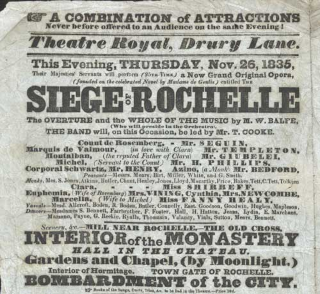
“The Siege of Rochelle” First Performed at Drury Lane Theatre

Irish composer Michael William Balfe‘s opera The Siege of Rochelle is first performed at the Drury Lane Theatre in London on October 29, 1835.

The opera is originally prepared for the English Opera House but for some reason the theatrical manager, Samuel James Arnold, does not want it. Instead, Alfred Bunn, the manager of Drury Lane Theatre, seizes the opportunity and begins what is a very fruitful collaboration with Balfe that lasts a decade. Balfe is to become the mainstay of English Opera for almost the next 30 years with a succession of popular operas.

The opera runs for 70 nights on its initial run and is revived in the following three seasons with Balfe singing the role of Michel. Queen Victoria sees the opera on November 15, 1837, her first state visit to a theatre during her reign. In 1836, the opera is reported as staged in Leeds, York, Sheffield, Manchester, Liverpool, Bath and Dublin with Abigail Betts as Clara. John Wilson, who sings in the initial run of the opera, also sings in, at least, some of these. Madame Balfe chooses the opera for her benefit in 1841, and Bunn opens his 1843 season with it on September 30. Emma Romer uses it to open her 1853 season at the Surrey Theatre, although it is being described by then as “somewhat hacknied.”

October 1875 sees a revival of the opera by the Carl Rosa Opera Company at the Princess’s Theatre, and it is then included in the company’s repertoire that tours to Manchester in 1875, Liverpool in 1876, Birmingham in 1877 and Dublin in 1879. The Turner Company tours it in 1893. This is possibly the opera’s last performance until the Wexford Festival Opera performances in 1963. The overture and songs from the opera, such as “When I beheld the anchor weigh’d” continue to retain a place in the concert hall and the home into the 20th century.

In 1838, the opera is performed by the Caradori-Allan troupe at the Park Theatre in New York but fails although it appears to be retained in the repertory. In 1839, it is performed again in Dublin with Balfe as Michel and in Sydney in 1848.

The opera’s production sparks an acrimonious argument between a correspondent in The Examiner accusing Balfe of plagiarism from Luigi Ricci‘s 1832 opera, Chiara di Rosemberg, and, in defence, Frederick Beale, from Balfe’s publishers, and Balfe. The matter seems to be settled in Balfe’s favour when the score of Chiara di Rosemberg is displayed at music publisher Cramer, Beale and Co. so that people can compare the two for themselves. While Edward Fitzball probably uses Ricci’s libretto as the basis for his, it does not seem to have been a straight translation, as some allege, but similarities would help to feed the accusations of plagiarism, bolstered by the Italian training and approach of both composers and the fact that Balfe had sung in Chiara di Rosemberg in Italy in 1834.

Balfe is said to have been paid £5 a night by Bunn and 400 guineas for the score by the publishers Cramer, Beale and Co. In 1871, the Bury and Norwich Post (April 11, 1871) report that the copyright has sold for £156 and just over ten years later the Aberdeen Evening Express (May 8, 1883) notes that the copyright has been sold again for approximately £20, adding “So much for Balfe’s ‘popularity.”


Leave a comment

Death of John Francis Larchet, Composer & Teacher

John Francis Larchet, Irish composer and teacher, dies in Dublin on August 10, 1967.

Larchet is born on July 13, 1884, at Sandymount, Dublin, the son of John Edward Larchet, manager of a wine business, and his wife Isabella Emily (née Farmar). Educated at the Catholic University School in Leeson Street, Dublin, he subsequently commences study under Michele Esposito at the Royal Irish Academy of Music (RIAM) in Dublin, winning many prizes for composition, theory, harmony, and counterpoint from 1903 to 1912. As a student at Trinity College Dublin (TCD), he obtains his Bachelor of Music in 1915 and Doctor of Music in 1917 and comes to dominate the music profession in Dublin over the next forty years, moulding the composers, teachers, and conductors of the next generation, while developing an Irish school of music based on folk tradition but writing in the modern idiom. A senior professor at the RIAM by 1920, the following year he is appointed professor of music at University College Dublin (UCD), where he remains until 1958, successfully establishing music as a serious discipline within the university. He is director of music examinations for Irish secondary schools (1907–34) and succeeds in raising standards of teaching, particularly with regard to rectifying weakness in the teaching of the theory of music.

Along with Aloys Fleischmann and composer Frederick May, Larchet keeps discourse on music in the public domain during the 1930s and 1940s, frequently addressing the need for a national school of music and a system of music education that would raise standards of musical appreciation and nurture a school of Irish composers.

Appointed music director at the Abbey Theatre in 1907, he is closely associated with Lady Gregory and W. B. Yeats, establishing a tradition of music at the theatre that delights critics. A popular myth at the time is that there are some who leave the theatre during the acts and return to enjoy Larchet’s music during the intervals. Appointed musical adviser to the army in 1923, he introduces a new philharmonic pitch, and serves as president of the Dublin Grand Opera Society for many years.

A fellow of the RIAM, Larchet also conducts the Dublin Amateur Orchestra Society, is choir master of the Jesuit church in Gardiner Street, Dublin, and organises annual orchestral concerts at the Royal Dublin Society (RDS). He is also involved in preparing a report for the commission on vocational organisation on behalf of the Musical Association of Ireland. The products of his own creative endeavour are mostly orchestral and choral works including An Ardglass Boat Song, Pádraic the Fiddler, and Diarmuid’s Lament.

Perhaps the main challenge facing Larchet in the 1920–50 period is the divide between “colonial” and “native” which has characterised the history of music in Ireland. A gentle-mannered, kindly man who is acutely aware of the lack of a national policy for music, he is a persuasive advocate of the European aesthetic and his main aim is said to have been “a reconciliation between the cultural chauvinism of Ireland as an emergent nation state and the central value (artistic as well as educational) of music as a vital dynamic in Irish cultural affairs.”

Although it can be argued that Larchet is not possessed of a uniquely original voice, with his authority coming rather from his enormous workload and his essential contribution as a teacher, it is no exaggeration to claim that the majority of Irish composers who emerge in the decades after the 1940s are influenced by his guidance, including Frank Llewellyn Harrison, Frederick May, Joan Trimble and Brian Boydell.

In addition to receiving an honorary Doctor of Music from the National University of Ireland (NUI) in 1953, Larchet is made a Commendatore of the Italian Republic.

Larchet dies in Dublin on August 10, 1967. He is survived by his wife, Madeleine Moore, a well-known musician, and their two daughters and son, also musicians. His daughter, Sheila Larchet Cuthbert, is an Irish harpist and author. She publishes The Irish Harp Book: A Tutor and Companion (Dublin, 1975).

(From: “Larchet, John Francis” by Diarmaid Ferriter, Dictionary of Irish Biography, http://www.dib.ie, October 2009)


Leave a comment

Birth of Herbert Hughes, Composer, Music Critic, Collector & Arranger

Herbert Hughes, Irish composer, music critic and a collector and arranger of Irish folksongs, is born in Belfast on May 16, 1882. He was the father of Spike Hughes.

Hughes is raised in Belfast but completes his formal music education at the Royal College of Music, London, where he studies with Charles Villiers Stanford and Charles Wood, graduating in 1901. Subsequently, he works as a music critic, notably for The Daily Telegraph from 1911 to 1932.

Described as having an “ardent and self-confident manner,” Hughes is first heard of in an Irish musical capacity (beyond being honorary organist at St. Peter’s Church on Antrim Road at the age of fourteen) collecting traditional airs and transcribing folksongs in North Donegal in August 1903 with his brother Fred, Francis Joseph Bigger, and John Patrick Campbell. Dedicated to seeking out and recording such ancient melodies as are yet to be found in the more remote glens and valleys of Ulster, he produces Songs of Uladh (1904) with Joseph Campbell, illustrated by his brother John and paid for by Bigger. Throughout his career, he collects and arranges hundreds of traditional melodies and publishes many of them in his own unique arrangements. Three of his best-known works are the celebrated songs, My Lagan Love, She Moved Through the Fair, and Down by the Salley Gardens, which are published as part of his four collections of Irish Country Songs, his key achievement. These are written in collaborations with the poets Joseph Campbell and Padraic Colum, and W. B. Yeats himself. A dispute with Hamilton Harty over copyright on My Lagan Love is pursued on Bigger’s advice, but fails.

Hughes has a unique approach to arranging Irish traditional music. He calls upon the influence of the French impressionist Claude Debussy in his approach to harmony: “Musical art is gradually releasing itself from the tyranny of the tempered scale. […] and if we examine the work of the modern French school, notably that of M. Claude Debussy, it will be seen that the tendency is to break the bonds of this old slave-driver and return to the freedom of primitive scales.” He regards arrangements as an independent art form on an equal level with original composition: “[…] under his [i.e. the arranger’s] hands it is definitively transmuted into an art-song, an art-song of its own generation.” His folksong arrangements have been sung all across the English-speaking world. John McCormack and Kathleen Ferrier are the first to record them on gramophone records.

An admirer of James Joyce‘s poetry, Hughes in 1933 edits The Joyce-Book, a volume of settings of Joyce’s poetry, with 13 pieces by 13 composers including, besides Hughes himself, Arnold Bax, Arthur Bliss, Herbert Howells, John Ireland, and non-British composers such as George Antheil, Edgardo Carducci-Agustini, and Albert Roussel. The large-format, blue-cloth covered volume has since become a collector’s item.

Hughes also composes a limited amount of original chamber music (a violin sonata is mentioned in a letter to Hughes from Bernard van Dieren dated April 4, 1932), and some scores for the stage (like And So to Bed by James Bernard Fagan) and film. Hughes and John Robert Monsell also create songs for a musical version of Richard Brinsley Sheridan‘s The Rivals called Rivals!, which is staged at the Kingsway Theatre in London in October 1935 by Vladimir Rosing and runs for 86 performances.

Married to Lillian Florence (known as Meena) Meacham and Suzanne McKernan, Hughes has three children: Patrick, known professionally as Spike Hughes, Angela and Helena. He dies in Brighton, England, at the relatively early age of fifty-four on May 1, 1937.


Leave a comment

Birth of Vincent O’Brien, Organist, Composer & Teacher

Vincent O’Brien, Irish organist, music teacher and composer, is born in Dublin on May 9, 1871, where he lived all his life. He is an important figure in early 20th-century Irish music. For some, he is mainly known as the first teacher of singers such as John McCormack, Margaret Burke Sheridan and the writer James Joyce.

O’Brien is the eldest child of a Roman Catholic church musician. In 1885, he first appears in a public piano recital and, later in the year, becomes the organist of Rathmines parish church, a position he holds until 1888. He holds another organist’s position at the Dublin Carmelite church from 1897 to 1899 but is chiefly known as organist and choir director of Dublin’s largest Roman Catholic Church, St. Mary’s Pro-Cathedral, between 1903 and 1946. In 1898, he is the founder and first director of the Palestrina Choir, originally all-male, which is still active, and which is financed for many years by Edward Martyn.

O’Brien studies with Robert Prescott Stewart at the Royal Irish Academy of Music (1888-90), where he is the first winner of the Coulson Scholarship and frequently performs as both tenor singer, piano accompanist, and organist in many public concerts during the 1890s. As a church musician, he becomes particularly involved in the Cecilian Movement, conducting works by Michael Haller and others, and also pursuing their artistic ideals in his own sacred choral compositions.

O’Brien is the founding conductor of the Dublin Oratorio Society (1906), the Brisan Opera Company (1916) and conducts at many ad hoc events. In 1925, he becomes the first music director of Radio Éireann (originally called 2RN), a position he holds until 1941. He singles out his work as music director for the 31st International Eucharistic Congress in Dublin (1932) as his most prized personal achievement. As late as 1945, he founds Our Lady’s Choral Society, a large oratorio choir still in existence, which originally is recruited mainly from the various Roman Catholic church choirs in Dublin.

Among his teaching positions, O’Brien teaches at the diocesan seminary at Holy Cross College, is Professor of Gregorian Chant at the missionary seminary of All Hallows College from 1903, and Professor of Music at the Ladies’ Teacher-Training College at Carysfort Park, Blackrock, County Dublin, from 1908 until his death in Dublin on June 21, 1948. As a much-demanded vocal coach, he teaches at his home, his best-known pupils including John McCormack, Margaret Burke Sheridan and James Joyce. He performs the piano accompaniments for McCormack’s first gramophone recordings and accompanies him during his 1913–14 Australasian tour of 60 performances in three months, during which he also gives organ recitals at the Irish-dominated Catholic cathedrals of Sydney and Melbourne.

In 1932, O’Brien receives a doctorate honoris causa from the National University of Ireland (NUI).

Of his two sons, Oliver O’Brien (1922–2001) largely follows in his father’s footsteps, as organist and director of the Palestrina Choir, of Our Lady’s Choral Society, music teacher at Carysfort College and as teacher in various Dublin schools. His other son, Colum O’Brien, is organist in the Pro-Cathedral.

Before his work for the Palestrina Choir, O’Brien’s musical interests are very broad, culminating in 1893 in the composition of the full-scale opera Hester. As a church music composer, he follows Cecilian ideals, with a number of hymns, motets and other choral works. He also composes a number of songs for voice and piano, with The Fairy Tree (1930) being a particular favourite of John McCormack’s.


Leave a comment

Birth of Seóirse Bodley, Composer & Associate Professor of Music at UCD

Seóirse Bodley, Irish composer and former associate professor of music at University College Dublin (UCD), is born George Pascal Bodley in Dublin on April 4, 1933. In 2008, he is the first composer to become a Saoi of Aosdána. He is widely regarded as one of the most important composers of twentieth-century art music in Ireland, having been “integral to Irish musical life since the second half of the twentieth century, not just as a composer, but also as a teacher, arranger, accompanist, adjudicator, broadcaster, and conductor.”

Bodley’s father is George James Bodley (1879–1956), an employee in the Dublin office of the London Midland & Scottish Railway Company, and later of the Ports and Docks Board. His mother, Mary (née Gough, 1891–1977), works for the Guinness Brewery. He attends schools in the Dublin suburbs of Phibsborough and Glasnevin before he moves at the age of nine to an Irish-speaking Christian Brothers school at Parnell Square. He later studies at the School of Commerce in Rathmines, where he obtains his Leaving Certificate.

Music is encouraged in his parents’ home, and Bodley receives initial lessons on the mandolin from his father and on the piano from his mother. He studies the piano, harmony and counterpoint at the Royal Irish Academy of Music and obtains a Licentiate in piano from Trinity College London (TCL). From the age of 13, he also enrolls for a time at the Brendan Smith Academy of Acting. While he is still at school, he receives his first lessons in composition privately from the Dublin-based German choral conductor Hans Waldemar Rosen (1904–94), which continues, on and off, until 1956. From his student days he performs as an accompanist to singers and takes part in chamber music performances. An important element in his musical education is the twice-weekly free concerts given by the Radio Éireann Symphony Orchestra in the Phoenix Hall, Dame Court, where he has the opportunity to hear leading Irish and international performers and conductors presenting both classics and modern repertory.

From 1952 Bodley studies for a Bachelor of Music degree from University College Dublin, mainly with Anthony Hughes. He obtains the degree in 1955. From 1957 to 1959 he studies composition (with Johann Nepomuk David) and conducting at the Württembergische Hochschule für Musik in Stuttgart, Germany, and a year later he obtains a Doctorate in Music from UCD. He also takes classes in conducting with Hans Müller-Kray and Karl Maria Zwißler, and in piano with Alfred Kreutz. He returns to Germany several times in the early 1960s to participate in courses at the Darmstädter Ferienkurse, which significantly expands his knowledge of avant-garde techniques.

From 1959 until his retirement in 1998, Bodley lectures at the university’s music department, becoming associate professor in 1984. During the 1960s, he is conductor of the Culwick Choral Society.

Bodley’s development as a composer sees several distinct phases. In the 1970s he merges avant-garde styles with elements from Irish traditional music and becomes a figure of national importance. He receives several prestigious commissions for large-scale works, such as Symphony No. 3 (1981), written for the opening of the National Concert Hall.

In 1982 Bodley becomes a founder-member of Aosdána and President Mary McAleese confers the distinction of Saoi on him in November 2008. McAleese says that Bodley “has helped us to recast what it means to be an artist in Ireland.”


Leave a comment

Birth of John Buckley, Composer & Pedagogue

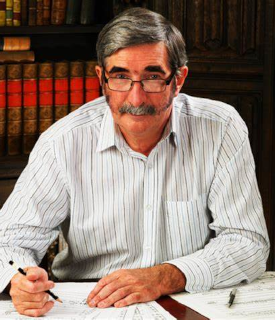
John Buckley, Irish composer and pedagogue, is born in Templeglantine, County Limerick, on December 19, 1951. He is a co-founder of the Ennis Summer School and a member of Aosdána, Ireland’s state-sponsored academy of creative artists.

Buckley grows up in a rural environment and is introduced to traditional music learning the button accordion from the local player Liam Moloney when he is 9 years of age. In 1969 he moves to Dublin to study for the Teacher’s Diploma at St. Patrick’s College, Drumcondra. Here he has his first opportunity to hear live classical and modern music including contemporary and avantgarde works by Irish composers including Aloys Fleischmann, Brian Boydell, John Kinsella, and Seóirse Bodley, as well as works by international composers such as Krzysztof Penderecki. He becomes a student at the Royal Irish Academy of Music, Dublin (1969–74), studying the flute with Doris Keogh and composition with A. J. Potter and James Wilson. He continues his musical studies with Alun Hoddinott in Cardiff, Wales (1978–82), Aloys Fleischmann in Cork (M.A. in composition, 1980), and briefly with John Cage during a summer school for composers and choreographers at Guildford, Surrey, in 1981. Initially working as secondary school teacher, from 1982 he is able to work independently as a composer.

In 1983, Buckley is the co-founder, with James Wilson, of the annual Ennis Summer School for composition, which becomes an influential training ground for aspiring young Irish composers; pupils include Michael Alcorn, Rhona Clarke, and Gráinne Mulvey. He becomes a member of Aosdána in 1984. Since 2001 he has been a lecturer in music at St. Patrick’s College, Drumcondra. From the National University of Ireland at Maynooth (now Maynooth University) he receives a PhD in 2002 and a DMus in 2007.

Apart from membership in Aosdána, Buckley is honoured with the Varming Prize (1976), the Macaulay Fellowship (1978), the Arts Council‘s Composers’ Bursary (1982) and the Marten Toonder Award (1991).

Buckley’s output includes many commissions for solo instruments, chamber ensembles, choirs, bands and orchestra. His music has been widely performed and broadcast in Ireland and in more than fifty countries worldwide. He has represented Ireland at the UNESCO International Rostrum of Composers on five occasions and at the 1990 Prix Italia. His music has also been performed at five International Society for Contemporary Music (ISCM) festivals.

Buckley’s music does not adhere to any particular compositional school. He acknowledges the influence of Luciano Berio, Witold Lutoslawski, György Ligeti, and Olivier Messiaen. His harmonic approach is freely atonal. Structurally, there is frequently a gradual build-up from initially very limited pitch material to large formal constructions. Many compositions work towards a climax in the fourth quarter of a piece and then return to initial pitch sequences. In a number of early works he explores the Celtic myths of his native Ireland in orchestral scores such as Taller than Roman Spears (1977) and Fornocht do chonac thú (1980) and in small-scale works such as Oileáin (1979) for piano, Boireann (1983) for flute and piano, or I am Wind on Sea (1987) for mezzo-soprano and percussion. Later this aspect becomes less important for him. Works since the late 1980s display “a textural subtlety in marked contrast to the more robust sonorities explored in Buckley’s earlier keyboard works,” a “French refinement of sound, and an elevation of timbre as central characteristics” and “a concern with achieving a greater degree of formal unity” and “an exploration of analogies between sound and light.” O’Leary (2013) describes his style as “characterised by a broad harmonic idiom, contrasting consonance and dissonance in a non-tonal but strongly coloured soundworld.”

In 2010, Buckley arranges a number of Irish traditional songs for flute, some with harp, viola, percussion and string quartet. These are skilled and tasteful settings in a tonal harmonic language, quite unlike his original compositions.