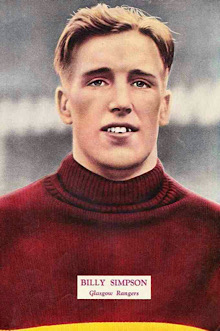
Simpson signs for Rangers from Linfield for a sum of £11,500 in 1950. He spends nine years (1950–59) at Rangers making 239 appearances and scoring 163 goals. He wins three championship medals and a Scottish Cup winners medal with Rangers to add to the two Northern Ireland Football League and two Irish Cups he wins with Linfield. He leaves Ibrox Stadium in 1959 and spends the last couple of years of his career with Stirling Albion, Partick Thistle and (then non-league) Oxford United.
As an illustration of his popularity, in the fictional song “A Trip to Ibrox,” Simpson is credited with scoring twice in a “Ne’erday” Old Firm Derby at Ibrox. Whereby Rangers are 1-0 down at halftime, and Simpson inspires his team to a second half comeback after Willie Waddell has scored an equaliser.
In recognition of his service to that club, Simpson is made a member of the Rangers F.C. Hall of Fame.
Simpson makes his debut for Northern Ireland in 1951 against Wales, scoring in the process. He represents his country twelve times in total between 1951 and 1958, scoring five goals. He is selected in Northern Ireland’s squad for the 1958 FIFA World Cup in Sweden but a late injury ensures he does not play at all during the finals.
In April 2015, the feature-length documentarySpirit of ’58 is screened as part of the Belfast Film Festival. It features Simpson prominently alongside the other surviving players (Billy Bingham, Peter McParland, Jimmy McIlroy and Harry Gregg) as it tells the story of Northern Ireland’s journey throughout the 1950s under the managership of Peter Doherty, culminating in the 1958 World Cup.
Hammond is the son of Leslie Hammond, a tram driver, and his wife Annie (née Lamont). His parents are not city people; his mother grew up near Ballybogy in the Ballymoney area of County Antrim, and his father, though from a family with roots in south County Londonderry, had lived in Ballymoney as a boy, and had been apprenticed to a blacksmith there. Both have a strong sense of their rural identity and maintain the Ulster Scots dialect of their childhood. They are never quite at home in the Belfast suburb of Cregagh, and in particular do not share the sectarian attitudes that are much more present in 1930s Belfast than they had been in north Antrim, one of the last strongholds of Presbyterian radicalism. Even as a boy, Hammond is interested in the old songs that his mother sang and realises that the traditions in which his parents had been nurtured are disappearing quickly in an increasingly urbanising and modernising world. When he encounters the work of Emyr Estyn Evans in the early 1940s, he is encouraged to document both rural tradition and the street life of the city, and he and a couple of friends, though still just teenagers, ride off on their bicycles to look for folklore in the hinterland of Belfast.
After primary school, Hammond wins a scholarship in 1941 to Methodist College Belfast, where he does well in examinations, and then goes to Stranmillis University College to train as a teacher. In his first job, in Harding Memorial primary school in east Belfast, he proves to be a popular, idealistic teacher, and is remembered by his pupils fifty years later as a fine singer and a teller of ghost stories, who had taken the class on memorable youth-hosteling trips to the Mourne Mountains. Youth hosteling and folklore collecting increases his awareness and understanding of the rich traditions of the whole community in the north of Ireland, and he is never constrained by political or religious barriers. His early career mirrors closely that of James Hawthorne, and their paths are to cross in later life.
Hammond is friendly with many others active in the cultural life of Northern Ireland and makes a name for himself as a song collector and eventually as an expert on all aspects of traditional singing. In 1956, he is awarded a scholarship to travel in the United States to meet the important pioneers of folk-music collecting and performance there. He records his first LP record of Ulster songs, I Am The Wee Falorie Man (1958), in the United States, and becomes friends with Pete Seeger, the Appalachian singer Jean Ritchie, with old blues singers, and notably with Liam Clancy, one of the three Clancy brothers who as a quartet with Tommy Makem are to popularise Irish folk music in the United States and elsewhere.
On returning to Belfast, Hammond takes a job in 1958 in Orangefield secondary school in the east of the city, where the highly regarded headmaster John Malone encourages new approaches to education. Among his pupils at Orangefield is George Ivan “Van” Morrison, who credits him with inspiring his interest in Irish traditional music. Hammond enjoys teaching but is increasingly drawn to folk-song performance and recording. He appears regularly on radio programmes of the BBC and Radio Éireann, and in 1964 joins the school’s department in BBC Northern Ireland. There, with colleagues like Sam Hanna Bell, James Hawthorne and others, he works on programmes such as Today and Yesterday in Northern Ireland, which for the first time introduces pupils (and many adults) to local history and to aspects of tradition. In 1968, with two friends, the poets Seamus Heaney and Michael Longley, he puts on poetry and traditional music events in schools all over the province. The Arts Council funds the Room to Rhyme project, which is immensely influential and inspiring, and is still talked about many years later by those who attended as children.
Hammond is creatively involved with hundreds of hours of broadcasting, in television as well as radio, and eventually for adults as well as children. He writes scripts, produces documentary series such as Ulster in Focusand Explorations, and brings an artistic sensibility to filming, as well as working sympathetically with traditional singers and craftspeople. Dusty Bluebells, a sensitively made film of Belfast children’s street games, wins the prestigious Golden Harp award in 1972. After he leaves the BBC to work as a freelance, and founds Flying Fox Films in 1986, he continues making documentaries on many aspects of Ulster life and heritage. His film called Steel Chest, Nail in the Boot and the Barking Dog (1986), about working in the Belfast shipyards, also wins a Golden Harp award. A companion book of the same name is published. Another book is Belfast, City of Song(1989), with Maurice Leyden. In 1979, he edits a volume of the songs of Thomas Moore. His documentary programmes include films about singers from Boho, County Fermanagh, and about the big houses of the gentry in Ireland. The Magic Fiddle (1991/2) examines the role of the instrument in the folk music of Ireland, Scandinavia, Canada, and the American south, while Another Kind of Freedom (1993) is about the experiences of a former Orangefield pupil, the Beirut hostage Brian Keenan. He also produces and directs the films Something to Write Home About (1998), Where Are You Now? (1999), and Bogland (1999), all of which explore Seamus Heaney’s home region and experiences.
The first poem in Heaney’s collection Wintering Out (1972) is entitled “For David Hammond and Michael Longley.” Their lifelong friendship leads to several other creative collaborations. In particular, after a distressing evening in 1972 when Hammond, affected by the despair and terror unleashed by Irish Republican Army (IRA) bombing of his city, is for once unable to sing, Heaney meditates on the experience in an essay and in an important poem, “The singer’s house” (subsequently included in his 1979 Field Work collection). The poem urges the singer to keep singing, to defend the values of art and friendship in a hostile time. Hammond collaborates with Dónal Lunny and other traditional musicians to bring out an LP also called The Singer’s House(1978), which includes Heaney’s poem on the album sleeve, and features some of the songs that he had made famous, such as “My Aunt Jane” and “Bonny Woodgreen,” from his vast repertoire of songs from Ulster. The album is reissued in 1980.
In 1995, Hammond is one of Heaney’s personal guests at the award of his Nobel prize in Stockholm, characteristically wearing his usual, mustard-yellow, cattle-dealer boots with evening dress. On another formal occasion, when he is awarded an honorary doctorate by Dublin City University in November 2003, he surprises the audience by standing up in his academic robes to sing “My Lagan love,” instead of giving an address. His unique, light mellow voice is an ideal vehicle for the traditional ballads which he knows so well. He records a number of records in the 1960s, including Belfast Street Songs, and publishes the book Songs of Belfast (1978). He also encourages traditional musicians like Arty McGlynn, and collaborates with them on various recording projects. He is well known for live and often impromptu performances at festivals and venues in Ireland and the United States. He also performs at the John F. Kennedy Center for the Performing Arts in Washington, D.C.
Hammond is also a notable collaborator with poets and dramatists, especially in the important Field Day Theatre Company project, of which he is a director, along with Seamus Heaney, Tom Paulin, Seamus Deane, Thomas Kilroy, and the project’s founders, Brian Friel and Stephen Rea. He supports the Field Day search for a “fifth province,” where history and community and culture can intersect, believing that to speak unthinkingly of “two traditions” is to perpetuate superficial political divisions. As he says in an interview in The Irish Times on July 4, 1998, songs can “take you out of yourself” and become bridges to unite people.
Hammond receives many honours. In 1994, he receives the Estyn Evans award for his contribution to mutual understanding, and his work is featured in several major events in his honour: in the University of North Florida (1999), in the Celtic Film Festival in Belfast (2003), and in Belfast’s Linen Hall Library (2005). A Time to Dream, a film about his life and work, is broadcast on BBC Northern Ireland in December 2008.
Hammond dies in hospital in Belfast, after a long illness, on August 25, 2008, survived by his wife Eileen (née Hambleton), whom he marries on July 19, 1954, and by their son and three daughters. His funeral in St. Finnian’s Church is a major cultural event, where friends sing, play and speak in his honour.
In Seamus Heaney’s last collection of poetry, Human Chain (2010), he includes a poignant farewell to Hammond. The poet imagines (or perhaps dreams) of another visit to the singer’s house, but this time “The door was open, and the house was dark.”
(From: “Hammond, David Andrew (‘Davy’)” by Linde Lunney, Dictionary of Irish Biography, http://www.dib.ie, December 2014)
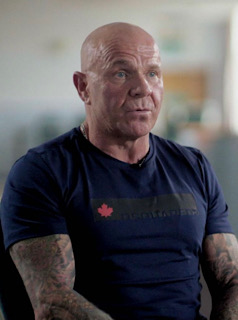
Johnny Adair, leader of “C Company” of the Ulster Loyalistparamilitary organisation Ulster Freedom Fighters (UFF), a cover name of the Ulster Defence Association, is born in Belfast, Northern Ireland, on October 27, 1963. He is known as Mad Dog. He is expelled from the organisation in 2002 following a violent power struggle. Since 2003, he, his family and a number of supporters have been forced to leave Northern Ireland by other loyalists.
Adair is born into a working class loyalist background and raised in Belfast. He grows up in the Lower Oldpark area, a site of many sectarian clashes during “The Troubles.” By all accounts, he has little parental supervision, and does not attend school regularly. He takes to the streets, forming a skinheadstreet gang with a group of young loyalist friends, who “got involved initially in petty, then increasingly violent crime.” Eventually, he starts a rock band called Offensive Weapon, which during performances espouses support for the British National Front.
While still in his teens, Adair joins the Ulster Young Militants (UYM), and later the Ulster Defence Association, a loyalist paramilitary organisation which also calls itself the Ulster Freedom Fighters.
By the early 1990s, Adair has established himself as head of the UDA/UFF’s “C Company” based on the Shankill Road. When he is charged with terrorist offences in 1995, he admits that he had been a UDA commander for three years up to 1994. During this time, he and his colleagues are involved in multiple and random murders of Catholic civilians. At his trial in 1995, the prosecuting lawyer says he is dedicated to his cause against those whom he “regarded as militant republicans – among whom he had lumped almost the entire Roman Catholic population.” Royal Ulster Constabulary (RUC) detectives believe his unit killed up to 40 people during this period.
Adair once remarks to a Catholic journalist from the Republic of Ireland upon the discovery of her being Catholic, that normally Catholics travel in the boot of his car. According to a press report in 2003, he is handed details of republican suspects by British Army intelligence, and is even invited for dinner in the early 1990s. In his autobiography, he claims he was frequently passed information by sympathetic British Army members, while his own whereabouts were passed to republican paramilitaries by the RUC Special Branch, who, he claims, hated him.
The Provisional Irish Republican Army (IRA) bombing of a fish shop on the Shankill Road in October 1993 is an attempt to assassinate Adair and the rest of the UDA’s Belfast leadership in reprisal for attacks on Catholics. The IRA claims that the office above the shop is regularly used by the UDA for meetings and one is due to take place shortly after the bomb is set to explode. The bomb goes off early, killing one IRA man, Thomas Begley, and nine Protestant civilians. The UFF retaliates with a random attack on the Rising Sun bar in Greysteel, County Londonderry, which kills eight civilians, two of whom are Protestants. Adair survives 13 assassination attempts, most of which are carried out by the IRA and Irish National Liberation Army (INLA).
During this time, undercover officers from the Royal Ulster Constabulary record months of discussions with Adair, in which he boasts of his activities, producing enough evidence to charge him with directing terrorism. He is convicted and sentenced to 16 years in HM Prison Maze. In prison, according to some reports, he sells drugs such as cannabis, ecstasy tablets and amphetamines to other loyalist prisoners, earning him an income of £5000 a week.
In January 1998, Adair is one of five loyalist prisoners visited in the prison by British Secretary of State for Northern Ireland, Mo Mowlam. She persuades them to drop their objection to their political representatives continuing the talks that leads to the Good Friday Agreement in April. In 1999, he is released early as part of a general amnesty for political prisoners after the Agreement.
Following his release, much of Adair’s activities are bound up with violent internecine feuds within the UDA and between the UDA and other loyalist paramilitary groupings. The motivation for such violence is sometimes difficult to piece together. It involves a combination of political differences over the loyalist ceasefires, rivalry between loyalists over control of territory and competition over the proceeds of organised crime.
In 1999, shortly after his release from prison, Adair is shot at and grazed in the head by a bullet at a UB40 concert in Belfast. He blames the shooting on republicans, but it is thought that rival loyalists are to blame.
In August 2000, Adair is again mildly injured by a pipe bomb he is transporting in a car. He again attempts to blame the incident on an attack by republicans, but this claim is widely discounted. A feud breaks out at the time between the UDA and the Ulster Volunteer Force (UVF) leaving several loyalists dead. As a result of Adair’s involvement in the violence, the then Secretary of State for Northern Ireland, Peter Mandelson, revokes his early release and returns him to prison.
In May 2002, Adair is released from prison again. Once free, he is a key part of an effort to forge stronger ties between the UDA/UFF and the Loyalist Volunteer Force (LVF), a small breakaway faction of the UVF loyalist paramilitary organization in Northern Ireland. The most open declaration of this is a joint mural depicting Adair’s UDA “C company” and the LVF. Other elements in the UDA/UFF strongly resist these movements, which they see as an attempt by Adair to win external support in a bid to take over the leadership of the UDA. Some UDA members dislike his overt association with the drugs trade, with which the LVF are even more heavily involved. A loyalist feud begins, and ends with several men dead and scores evicted from their homes.
On September 25, 2002, Adair is expelled from the UDA/UFF along with close associate John White, and the organisation almost splits as Adair tries to woo influential leaders such as Andre Shoukri, who are initially sympathetic to him. There are attempts on Adair’s and White’s lives.
Adair returns to prison in January 2003, when his early release licence is revoked by Secretary of State for Northern Ireland, Paul Murphy, on grounds of engaging in unlawful activity. On February 1, 2003, UDA divisional leader John Gregg is shot dead along with another UDA member, Rab Carson, on returning from a Rangers F.C. match in Glasgow. The killing is widely blamed on Adair’s C Company as Gregg is one of those who organised his expulsion from the UDA. Five days later, on February 6, about twenty Adair supporters, including White, flee their homes for Scotland, widely seen as a response to severe intimidation.
Adair is released from prison again on January 10, 2005. He immediately leaves Northern Ireland and joins his family in Bolton, Lancashire, where it is claimed he stays with supporters of Combat 18 and the Racial Volunteer Force.
The police in Bolton question Adair’s wife, Gina, about her involvement in the drugs trade, and his son, nicknamed both “Mad Pup” and “Daft Dog,” is charged with selling crack cocaine and heroin. Adair is arrested and fined for assault and threatening behaviour in September 2005. He had married Gina Crossan, his partner for many years and the mother of his four children, at HM Prison Maze on February 21, 1997. She is three years Adair’s junior and grew up in the same Lower Oldpark neighbourhood.
After being released, Adair is almost immediately arrested again for violently assaulting Gina, who suffers from ovarian cancer. Since this episode he reportedly moves to Scotland, living in Troon in Ayrshire.
In May 2006, Adair reportedly receives £100,000 from John Blake publishers for a ghost-written autobiography.
In November 2006, the UK’s Five television channel transmits an observational documentary on Adair made by Dare Films.
Adair appears in a documentary made by Donal MacIntyre and screened in 2007. The focus of the film centers around Adair and another supposedly reformed character, a Neo-Nazi from Germany called Nick Greger, and their trip to Uganda to build an orphanage. Adair is seen to fire rifles, stating it is the first time he has done so without wearing gloves. He also admits to being “worried sick” and “pure sick with worry” after Greger disappears in Uganda for days on end. It turns out that he had gone off and married a Ugandan lady. Adair confesses via telephone that he “thought something might have happened to Nick.”
On July 20, 2015, three Irish republicans, Antoin Duffy, Martin Hughes and Paul Sands, are found guilty of planning to murder Adair and Sam McCrory. Charges against one of the accused in the trial are dropped on July 1.
On September 10, 2016, Adair’s son, Jonathan Jr., is found dead in Troon, aged 32. He dies from an accidental overdose while celebrating the day after his release from prison for motoring offences. He had been in and out of prison since the family fled Northern Ireland. He served a five-year sentence for dealing heroin and crack cocaine. The year before, he had been cleared of a gun raid at a party and in 2012 is the target of a failed bomb plot. He was also facing trial later that year on drugs charges.
In December 2023, while recording a podcast with far-right activist Tommy Robinson, Adair surprisingly expresses a grudging respect for the IRA hunger strikers, describing the manner of their deaths as “dedication at the highest level” for a political cause and admitting that he would not have volunteered to do the same if asked.
O’Shannon is awarded lifetime membership of the Irish Film & Television Academy in 2010, to which he says it is “particularly gratifying that it occurs before I pop my clogs”.
The Irish radio and television broadcaster Terry Wogan describes O’Shannon as possibly the greatest Irish television journalist of the 20th century.
O’Shannon first becomes a journalist with The Irish Times on leaving the Royal Air Force in 1947. Later he joins the Irish state broadcasting service Raidió Teilifís Éireann (RTÉ).
In July 1972, O’Shannon records a notable television interview with 31-year-old Muhammad Ali, when Ali is in Dublin to compete at Croke Park in a bout with Alvin Lewis.
O’Shannon receives a Jacob’s Award for his 1976 TV documentary, Even the Olives are Bleeding, which details with the activities of the “Connolly Column” in the Spanish Civil War. Two years later he is honoured with a second Jacob’s Award for his television biography Emmet Dalton Remembers (1978).
In 1978, O’Shannon leaves RTÉ to join Canadian company Alcan which is setting up an aluminum plant at Aughinish, County Limerick, in 1978. He is head-hunted to become its Director of Public Affairs, an important post at a time when there are environmental concerns about the effects of aluminum production. He admits that he is attracted by the salary, “five times what RTÉ were paying me,” but he also later says that one reason for the move is that he had become unhappy with working at RTÉ, stating in an interview that: “The real reason I got out of RTÉ was that they wouldn’t let me do what I wanted to do journalistically.” He had submitted proposals to the station’s editors for television documentary series on the Irish Civil War, and also one on the wartime Emergency period, but they had been rejected. While he enjoys the social life with lavish expenses which his public relations duties involve, his friends believe that he misses the varied life and travel of journalism. He retires early from Aughinish in 1992, and returns to making television documentaries with RTÉ.
O’Shannon’s wife, Patsy, whom he met while they were working at The Irish Times office in London, dies in 2006. They had been married for more than 50 years.
On January 12, 2007, O’Shannon announces his retirement at the age of 80. In a 2008 television documentary, he admits that throughout his marriage he had been a serial womaniser and had repeatedly engaged in extra-marital affairs unbeknownst to his wife.
After weakening health for two years, and spending his last days in a hospice at Blackrock, O’Shannon dies at the Beacon Hospital in Dublin on October 22, 2011, in his 84th year. His body is reposed at Fanagans Funeral Home in Dublin on October 25, followed by a funeral the following day at Glasnevin Cemetery Chapel, where his remains are cremated afterward.
Director General of RTÉNoel Curran says O’Shannon had brought into being “some of the great moments in the RTÉ documentary and factual schedule over the past five decades.” In tribute, RTÉ One shows the documentary Cathal O’Shannon: Telling Tales on November 10, 2011. It had originally aired in 2008 to mark his 80th birthday
Manahan’s career begins when, as a young woman, she is recruited by the legendary Irish impresarios and theatrical directorsMicheál Mac Liammóir and Hilton Edwards. She later marries stage director Colm O’Kelly, who dies not long afterward of polio, which he contracts after swimming in the Nile during a theatre tour of Egypt. They have no children and she never remarries. She is known professionally by her maiden name. In 1946 she appears in a production by Irish playwrightTeresa Deevy, The Wild Goose, where she plays the part of Eileen Connolly. This is performed by Equity Productions in the Theatre Royal, Waterford.
In 1957, Manahan plays Serafina in the first Irish production of Tennessee Williams‘s The Rose Tattoo and achieves unexpected notoriety when she and several other members of the cast are arrested for the possession of a condom on stage.
Manahan plays a minor role in the Irish cultsoap operaThe Riordans (1960s), and as Mrs. Mary Kenefick in the TV comedy Me Mammy (1970s). She also plays the lead in the Irish comedy series, Leave It To Mrs O’Brien (1980s) and Mrs. Cadogan in The Irish R.M. (1980s). Most recently she plays Ursula in Fair City, for which her niece, Michele Manahan (daughter of Michael Manahan), is a writer.
Manahan has an extensive theatre portfolio having played at theatres throughout Ireland including the Abbey Theatre, the United Kingdom, continental Europe, the United States and Australia. She wins the Tony Award for Best Featured Actress in a Play for her role as Mag in Martin McDonagh’s The Beauty Queen of Leenane on Broadway. She previously receives a Tony nomination in 1969 for Brian Friel’s Lovers.
The Irish playwright John B. Keane writes the play Big Maggie specifically for Manahan. In 2001 she stars in Keane’s The Matchmaker with veteran Irish actor Des Keogh. In 2005 she stars in Sisters, a new play by Declan Hassett that is also written for her and for which she is nominated for a Drama Desk Award in the category of Outstanding Solo Performance. The production tours Ireland and is staged at the International Festival of World Theatre in Colorado and also plays at the 59E59 Theater in New York City in 2006.
In 2004 Manahan starts to play the role of Ursula in Fair City. All About Anna (2005), a documentary on her life and work is made by Charlie Mc Carthy/Icebox Films for RTÉ Television. In 2008, she becomes the first ever patron of the Active Retirement Ireland organization.
Manahan dies of multiple organ failure on March 8, 2009 in Waterford. She had suffered from a longterm illness.
Her funeral is held on March 11, officiated by her “longtime friend” the psychoanalyst, poet, and priest Bernard Kennedy. “As the final curtain falls, the lights dim, the auditorium becomes silent, we remember her” he says. Describing her as a woman of faith (who “sought to bring the word of God alive”), he says she had brought everyone together to be present at “her last great exit from this great stage of life,” saying her life’s work had drawn people from all over the world. “Anna believed in the empty tomb of the Resurrection and she believed the empty tomb could be filled by hearing the word take the place of the emptiness,” he says. “She knew the bedsits which preceded the Tony nomination.”
On May 12, 1992, a unit of the Provisional Irish Republican Army (IRA) East Tyrone Brigade launches a bomb attack on a British Army foot patrol near the republican stronghold of Cappagh, County Tyrone. One soldier of the Parachute Regiment, Alistair Hodgson, loses both legs as a result. The improvised land mine is described in an IRA statement as an “anti-personnel device.” Other paratroopers receive lesser wounds, according to the same statement. The incident triggers a rampage by members of the Parachute Regiment in the nearby, overwhelmingly Irish nationalist town of Coalisland, some ten miles to the east. The IRA attack is described as a “provocation” tactic, devised to produce an over-reaction by troops to make them even more unpopular among local nationalists.
The deployment of the paratroopers, which begins in April has already been criticised by republican activist and former Member of ParliamentBernadette Devlin McAliskey, who denounces beatings, shootings and damages to property reportedly carried out by the troops. These previous incidents include the destruction of fishing gear and boats in the townland of Kinturk, near Ardboe, and a brawl on April 22 between soldiers and motorists at a checkpoint in Stewartstown, in which plastic bullets are fired that end with a civilian and two paratroopers wounded. Unionist politician and Ulster Defence Regiment (UDR) officer Ken Maginnis, then-Member of Parliament for the area, calls for the withdrawal of the regiment after receiving a large number of complaints about their behaviour.
On May 12, two hours after the IRA ambush at Cappagh, members of the regiment seal off the town of Coalisland, ten miles east of Cappagh. According to a Social Democratic and Labour Party (SDLP) politician, the soldiers fabricate a bogus bomb warning, while the Royal Ulster Constabulary (RUC) states that the operation began when a joint police/military patrol was stoned by a crowd. Two pubs are ransacked by the troops and a number of civilian cars are damaged. Several people are allegedly hit with sticks. Following this, a lieutenant is suspended from duty and the regiment is removed from patrol duties in Coalisland.
On the evening of May 17, a fistfight begins at Lineside Road, where a group of young men are having a drink. A passing four-man patrol of the King’s Own Scottish Borderers regiment is challenged to a “boxing match” by the residents. The soldiers set aside their weapons and engage the youths. Noncritical injuries are reported on both sides. The official claim is that the patrol was attacked by a mob of at least 30 people. In the melée, a rifle and a light machine gun are stolen. The rifle is later recovered nearby. The youths smash a backpack radio which is left behind by the troops. Two KOSB soldiers are hospitalised, while in the end seven other soldiers, including paratroopers, receive lesser injuries, one of them hit by a car that crashes through two roadblocks set up by the British Army.
The Parachute Regiment is called to the scene again, and at 8:30 p.m., a major riot starts outside The Rossmore pub between local people and about 20 to 25 paratroopers. The soldiers claim one of their colleagues is isolated and dragged by the crowd. Some witnesses claim paratroopers were in a frenzy, showing their guns and inviting civilians to try to take them. Suddenly, shots are fired by the troops — first into the air and then toward the people outside the pub. Three civilians are rushed to hospital in Dungannon with gunshot wounds, while the soldiers return to their barracks. Another four civilians suffer minor injuries. The paratroopers claim that a “member of the growing crowd” attempted to fire the stolen machine gun at them, but the weapon jammed. One of the wounded is the brother of IRA volunteer Kevin O’Donnell, who had been killed by the Special Air Service (SAS) in February during an ambush at the nearby hamlet of Clonoe, shortly after carrying out a machine-gun attack on the local RUC base.
About 500 people attend a protest rally in Coalisland on May 19, and the wisdom of deploying the troops to patrol the town is questioned by members of the Dáil in Dublin. The Minister for Foreign Affairs of the Republic of Ireland, David Andrews, asks the British Government to withdraw the regiment. As a result, the paratroopers are redeployed outside the urban areas. The RUC claims that the stolen machine gun is found 11 days later at a farmhouse near Cappagh, along with another light machine gun and an AK-47 rifle. The IRA denies they had the machine gun in their possession. Republicans question whether the weapon had really been stolen, suggesting this was merely an excuse for the soldiers’ rampage in Coalisland. Bernardette McAliskey goes even further, suggesting that the recovery of the machine gun near Cappagh, where the initial IRA attack had taken place, was actually staged by the security forces as a publicity stunt. British officials accuse Sinn Féin of being the instigators of the riots, while Michael Mates, then Minister of State at the Northern Ireland Office, states that the incidents were due to “a gang of thugs motivated by the IRA.” Eventually the battalion’s 1992 tour in Northern Ireland is scaled down, with the patrols suspended before the official end of the deployment. The Third Brigade’s commander, Brigadier Tom Longland, is replaced by Brigadier Jim Dutton. This is the first occasion that a high-ranking officer is disciplined in such a way during the Troubles.
The last patrol takes place on June 27, when two paratroopers drown while crossing the River Blackwater. The same day there are further clashes with local residents, this time in the town of Cookstown, when a group of people that the BelfastNews Letter calls “drunken hooligans” assault a number of paratroopers trying to help an elderly man who is suffering a heart attack.
The 3rd Battalion of the Parachute Regiment is replaced by the 1st Battalion of the Coldstream Guards.
Six soldiers face criminal charges for their roles in the May riots but are acquitted one year later. Five are bound over. Maurice McHugh, the presiding magistrate, avers that the soldiers were “not entirely innocent,” while Sinn Féin sources dub the ruling “a farce.” Dungannon priest Father Denis Faul is of the opinion that the soldiers should have been charged with conspiracy. The Ulster TelevisiondocumentaryCounterpoint of June 1993 claims that Director of Public Prosecutions for Northern Ireland, Sir Alasdair Fraser, returned the case file to the RUC recommending no prosecution. The programme also interviews Alistair Hodgson, the soldier maimed at Cappagh, who says that “had another member of my unit been injured in the way that I was, I would have been with the rest of the lads attacking the locals.” Authors Andrew Sanders and Ian S. Wood suggest that the deployment of the battalion in Coalisland and elsewhere hindered the British policy of police primacy in Northern Ireland.
Fresh clashes between local residents and troops are reported at Coalisland on March 6, 1994, a few months before the first IRA ceasefire, when a crowd assaults two soldiers after the RUC searched a car. Plastic bullets are fired, and three civilians and two soldiers are slightly injured.
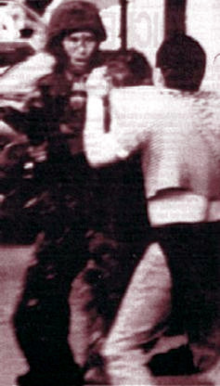
(Pictured: Confrontation between a British paratrooper and a civilian in Coalisland, May 1992)
The trio is believed to be planning a car bomb attack on British military personnel in Gibraltar. They are shot dead while leaving the territory, having parked a car. All three are found to be unarmed, and no bomb is discovered in the car, leading to accusations that the British government conspired to murder them. An inquest in Gibraltar rules that the authorities had acted lawfully but the European Court of Human Rights holds that, although there had been no conspiracy, the planning and control of the operation is so flawed as to make the use of lethal force almost inevitable. The deaths are the first in a chain of violent events in a fourteen-day period. On March 16, the funeral of the three IRA members is attacked, leaving three mourners dead. At the funeral of one, two British soldiers are murdered after driving into the procession in error.
In late 1987, British authorities become aware of an IRA plan to detonate a bomb outside the governor’s residence in Gibraltar. On the day of the shootings, Savage, a known IRA member, is seen parking a car near the assembly area for the parade. Fellow members McCann and Farrell are seen crossing the border shortly afterward. As SAS personnel move to intercept the three, Savage splits from McCann and Farrell and runs south. Two soldiers pursue him while two others approach McCann and Farrell. The soldiers report seeing the IRA members make threatening movements when challenged, so the soldiers shoot them multiple times. All three are found to be unarmed, and Savage’s car does not contain a bomb.
When the bodies are searched, a set of car keys is found on Farrell. Spanish and British authorities conduct enquiries to trace the vehicle. Two days after the shootings, their enquiries lead them to a red Ford Fiesta in a car park in Marbella, fifty miles from Gibraltar. The car contains a large quantity of Semtex surrounded by 200 rounds of ammunition, along with four detonators and two timers.
The IRA notifies the McCann, Savage, and Farrell families of the deaths on the evening of March 6, and the following day publicly announces that the three were members of the IRA. A senior member of Sinn Féin, Joe Austin, is tasked with recovering the bodies. On March 9, he and Terence Farrell (Mairéad Farrell’s brother) travel to Gibraltar to identify the bodies. A charter aircraft flies the corpses to Dublin on March 14. Two thousand people wait to meet the coffins in Dublin, which are then driven north to Belfast. At the border, the Northern Irish authorities meet the procession with a large number of police and military vehicles, and insist on intervals between the hearses, causing tensions between police and members of the procession.
The joint funeral of McCann, Farrell and Savage takes place on March 16 at Milltown Cemetery in Belfast. The Royal Ulster Constabulary (RUC) agree to maintain a minimal presence at the funeral in exchange for guarantees from the families that there will be no salute by masked gunmen. This agreement is leaked to Michael Stone, who describes himself as a “freelance Loyalistparamilitary.” During the burial, Stone throws grenades into the crowd and begins shooting with an automatic pistol, injuring 60 people. Several mourners chase Stone, throwing rocks and shouting abuse. Stone continues shooting and throwing grenades at his pursuers, killing three of them. He is chased onto a road and his pursuers beat him until the RUC arrive to extract and arrest him.
Two months after the shootings, the documentary “Death on the Rock” is broadcast on British television. Using reconstructions and eyewitness accounts, it presents the possibility that the three IRA members had been unlawfully killed.
The inquest into the deaths begins in September 1988. The authorities state that the IRA team had been tracked to Málaga, where they were lost by the Spanish police, and that the three did not re-emerge until Savage was seen parking his car in Gibraltar. The soldiers testify that they believed the suspected bombers had been reaching for weapons or a remote detonator. Several eyewitnesses recall seeing the three shot without warning, with their hands up, or while they were on the ground. One witness, who told “Death on the Rock” he saw a soldier fire at Savage repeatedly while he was on the ground, retracts his statement at the inquest, prompting an inquiry into the programme which largely vindicated it. The inquest returns a verdict of lawful killing. Dissatisfied, the families take the case to the European Court of Human Rights. Delivering its judgement in 1995, the court finds that the operation had been in violation of Article 2 of the European Convention on Human Rights as the authorities’ failure to arrest the suspects at the border, combined with the information given to the soldiers, rendered the use of lethal force almost inevitable. The decision is cited as a landmark case in the use of force by the state.
(Pictured: The three IRA members shot in Gibraltar: (l to r) Sean Savage, Mairéad Farrell, Daniel McCann, PA Archive / PA Images)
O’Faolain describes her early life as growing up in a Catholic country which, in her view, fears sexuality and forbids her even information about her body. In her writings she often discusses her frustration at the sexism and rigidity of roles in Catholic Ireland that expect her to marry and have children, neither of which she does.
O’Faolain becomes internationally well known for her two volumes of memoir, Are You Somebody? and Almost There; a novel, My Dream of You; and a history with commentary, The Story of Chicago May. The first three are all featured on The New York Times Best Seller list. Her posthumous novel Best Love, Rosie is published in 2009.
O’Faolain’s formative years coincide with the emergence of the women’s movement, and her ability to expose misogyny in all its forms is formidable, forensic and unremitting. However, her feminism stems from a fundamental belief in social justice. Unlike most commentators, who maintain a detached, lofty tone, she places herself at the centre of things, a high-risk strategy that works because of her broad range of erudition, worn lightly, her courage and a truthfulness that sometimes borders on the self-destructive.
O’Faolain is engaged at least once but never marries. In Are You Somebody? she speaks candidly about her fifteen-year relationship with the journalist Nell McCafferty, who publishes her own memoir, Nell. From 2002 until her death, she lives much of the time with Brooklyn-based attorney John Low-Beer and his daughter Anna. They are registered as domestic partners in 2003.
O’Faolain splits her time between Ireland and New York City. She is diagnosed with metastaticcancer and is interviewed on the Marian Finucane radio show on RTÉ Radio 1 on April 12, 2008, in relation to her terminal illness. She tells Finucane, “I don’t want more time. As soon as I heard I was going to die, the goodness went from life.”
In a last attempt to grasp as much of life as she can, O’Faolain holidays with family members in Sicily and visits Berlin with a group of friends to hear music and see art. She previously tended to avoid Berlin because, through contact with Jewish friends and lovers, she associated it with the Holocaust. She dies at the Blackrock Hospice, Dublin, on May 9, 2008.
O’Faolain wins a Jacob’s Award in 1985 for her work as the producer of the RTÉ One television programme Plain Tales. In 2006, she wins the Prix Femina étranger, a French literary award, for The Story of Chicago May.
O’Faolain is the subject of a film documentary, Nuala: A Life and Death (2011), directed by Patrick Farrelly and Kate O’Callaghan, and produced and narrated by Marian Finucane. Hugo Hamilton‘s novel Every Single Minute (2014) is based on his experiences when accompanying O’Faolain to Berlin shortly before her death.
Three years after moving to the United States, Moloney co-founds Green Fields of America, an ensemble of Irish musicians, singers, and dancers which tour across the country on several occasions. He also serves as the artistic director for several major arts tours. One of these is the 1985 festival in Manhattan titled “Cherish the Ladies” to highlight female musicians in the area of Irish traditional music, which had been dominated by men until that decade. He produces an album for the female group by the same name titled Irish Women Musicians in America. The group’s leader, Joanie Madden, is one of several future fellows of the National Endowment for the Arts (NEA) to be mentored by Moloney. He produces and performs on over 70 albums and serves as advisor for numerous festivals and concerts across America, with ethnomusicologist and musician Daniel T. Neely putting the figure as high as 125 albums.
In addition to music performance, Moloney writes Far from the Shamrock Shore: The Story of Irish American History Through Song, which is published by Crown Publications in February 2002 with a supplementary CD on Shanachie Records. He hosts three nationally syndicated series covering folk music on American Public Television (APT). He works as a consultant, performer, and interviewee on the RTÉ special Bringing It All Back Home, and is also a participant, consultant, and music arranger for Out of Ireland, a documentary film by PBS. He performs on the PBS special The Irish in America: Long Journey Home.
Moloney is married three times over the course of his life. His first marriage is to Miriam Murphy. His second marriage is to Philomena Murray. Together, they have one child but eventually divorce. His third marriage to Judy Sherman also ends in divorce. He is in a domestic partnership with Sangjan Chailungka at the time of his death. During his later years, he divides his time between Bangkok, where he resides with Chailungka, and his apartment in Greenwich Village. In Bangkok, he volunteers as a music therapist and teacher for abandoned children with HIV at the Mercy Center in the Khlong Toei district, which is founded by the Redemptorist priest Joseph H. Maier.
Moloney dies at the age of 77 on July 27, 2022, at his home in Manhattan, having played at the Maine Celtic Festival less than a week before. The cause of death is not announced.
Hammond is born on December 5, 1928, in Miss Kells’s nursing home on the Castlereagh Road in Belfast, the son of Leslie Hammond, a tram driver, and his wife Annie (née Lamont). His parents are not city people; his mother grew up near Ballybogy in the Ballymoney area of County Antrim, and his father, though from a family with roots in south County Londonderry, had lived in Ballymoney as a boy, and had been apprenticed to a blacksmith there. Both have a strong sense of their rural identity and maintain the Ulster Scots dialect of their childhood. They are never quite at home in the Belfast suburb of Cregagh, and in particular do not share the sectarian attitudes that are much more present in 1930s Belfast than they had been in north Antrim, one of the last strongholds of Presbyterian radicalism. Even as a boy, Hammond is interested in the old songs that his mother sang and realises that the traditions in which his parents had been nurtured are disappearing quickly in an increasingly urbanising and modernising world. When he encounters the work of Emyr Estyn Evans in the early 1940s, he is encouraged to document both rural tradition and the street life of the city, and he and a couple of friends, though still just teenagers, ride off on their bicycles to look for folklore in the hinterland of Belfast.
After primary school, Hammond wins a scholarship in 1941 to Methodist College Belfast, where he does well in examinations, and then goes to Stranmillis University College to train as a teacher. In his first job, in Harding Memorial primary school in east Belfast, he proves to be a popular, idealistic teacher, and is remembered by his pupils fifty years later as a fine singer and a teller of ghost stories, who had taken the class on memorable youth-hosteling trips to the Mourne Mountains. Youth hosteling and folklore collecting increases his awareness and understanding of the rich traditions of the whole community in the north of Ireland, and he is never constrained by political or religious barriers. His early career mirrors closely that of James Hawthorne, and their paths are to cross in later life.
Hammond is friendly with many others active in the cultural life of Northern Ireland and makes a name for himself as a song collector and eventually as an expert on all aspects of traditional singing. In 1956, he is awarded a scholarship to travel in the United States to meet the important pioneers of folk-music collecting and performance there. He records his first LP record of Ulster songs, I Am The Wee Falorie Man (1958), in the United States, and becomes friends with Pete Seeger, the Appalachian singer Jean Ritchie, with old blues singers, and notably with Liam Clancy, one of the three Clancy brothers who as a quartet with Tommy Makem are to popularise Irish folk music in the United States and elsewhere.
On returning to Belfast, Hammond takes a job in 1958 in Orangefield secondary school in the east of the city, where the highly regarded headmaster John Malone encourages new approaches to education. Among his pupils at Orangefield is George Ivan “Van” Morrison, who credits him with inspiring his interest in Irish traditional music. Hammond enjoys teaching but is increasingly drawn to folk-song performance and recording. He appears regularly on radio programmes of the BBC and Radio Éireann, and in 1964 joins the school’s department in BBC Northern Ireland. There, with colleagues like Sam Hanna Bell, James Hawthorne and others, he works on programmes such as Today and Yesterday in Northern Ireland, which for the first time introduces pupils (and many adults) to local history and to aspects of tradition. In 1968, with two friends, the poets Seamus Heaney and Michael Longley, he puts on poetry and traditional music events in schools all over the province. The Arts Council funds the Room to Rhyme project, which is immensely influential and inspiring, and is still talked about many years later by those who attended as children.
Hammond is creatively involved with hundreds of hours of broadcasting, in television as well as radio, and eventually for adults as well as children. He writes scripts, produces documentary series such as Ulster in Focus and Explorations, and brings an artistic sensibility to filming, as well as working sympathetically with traditional singers and craftspeople. Dusty Bluebells, a sensitively made film of Belfast children’s street games, wins the prestigious Golden Harp award in 1972. After he leaves the BBC to work as a freelance, and founds Flying Fox Films in 1986, he continues making documentaries on many aspects of Ulster life and heritage. His film called Steel Chest, Nail in the Boot and the Barking Dog (1986), about working in the Belfast shipyards, also wins a Golden Harp award. A companion book of the same name is published. Another book is Belfast, City of Song (1989), with Maurice Leyden. In 1979, he edits a volume of the songs of Thomas Moore. His documentary programmes include films about singers from Boho, County Fermanagh, and about the big houses of the gentry in Ireland. The Magic Fiddle (1991/2) examines the role of the instrument in the folk music of Ireland, Scandinavia, Canada, and the American south, while Another Kind of Freedom (1993) is about the experiences of a former Orangefield pupil, the Beirut hostage Brian Keenan. He also produces and directs the films Something to Write Home About (1998), Where Are You Now? (1999), and Bogland (1999), all of which explore Seamus Heaney’s home region and experiences.
The first poem in Heaney’s collection Wintering Out (1972) is entitled “For David Hammond and Michael Longley.” Their lifelong friendship leads to several other creative collaborations. In particular, after a distressing evening in 1972 when Hammond, affected by the despair and terror unleashed by Irish Republican Army (IRA) bombing of his city, is for once unable to sing, Heaney meditates on the experience in an essay and in an important poem, “The singer’s house” (subsequently included in his 1979 Field Work collection). The poem urges the singer to keep singing, to defend the values of art and friendship in a hostile time. Hammond collaborates with Dónal Lunny and other traditional musicians to bring out an LP also called The Singer’s House (1978), which includes Heaney’s poem on the album sleeve, and features some of the songs that he had made famous, such as “My Aunt Jane” and “Bonny Woodgreen,” from his vast repertoire of songs from Ulster. The album is reissued in 1980.
In 1995, Hammond is one of Heaney’s personal guests at the award of his Nobel prize in Stockholm, characteristically wearing his usual, mustard-yellow, cattle-dealer boots with evening dress. On another formal occasion, when he is awarded an honorary doctorate by Dublin City University in November 2003, he surprises the audience by standing up in his academic robes to sing “My Lagan love,” instead of giving an address. His unique, light mellow voice is an ideal vehicle for the traditional ballads which he knows so well. He records a number of records in the 1960s, including Belfast Street Songs, and publishes the book Songs of Belfast (1978). He also encourages traditional musicians like Arty McGlynn, and collaborates with them on various recording projects. He is well known for live and often impromptu performances at festivals and venues in Ireland and the United States. He also performs at the John F. Kennedy Center for the Performing Arts in Washington, D.C.
Hammond is also a notable collaborator with poets and dramatists, especially in the important Field Day Theatre Company project, of which he is a director, along with Seamus Heaney, Tom Paulin, Seamus Deane, Thomas Kilroy, and the project’s founders, Brian Friel and Stephen Rea. He supports the Field Day search for a “fifth province,” where history and community and culture can intersect, believing that to speak unthinkingly of “two traditions” is to perpetuate superficial political divisions. As he says in an interview in The Irish Times on July 4, 1998, songs can “take you out of yourself” and become bridges to unite people.
Hammond receives many honours. In 1994, he receives the Estyn Evans award for his contribution to mutual understanding, and his work is featured in several major events in his honour: in the University of North Florida (1999), in the Celtic Film Festival in Belfast (2003), and in Belfast’s Linen Hall Library (2005). A Time to Dream, a film about his life and work, is broadcast on BBC Northern Ireland in December 2008.
Hammond dies in hospital in Belfast, after a long illness, on August 25, 2008, survived by his wife Eileen (née Hambleton), whom he marries on July 19, 1954, and by their son and three daughters. His funeral in St Finnian’s church is a major cultural event, where friends sing, play and speak in his honour.
In Seamus Heaney’s last collection of poetry, Human Chain (2010), he includes a poignant farewell to Hammond. The poet imagines (or perhaps dreams) of another visit to the singer’s house, but this time “The door was open, and the house was dark.”
(From: “Hammond, David Andrew (‘Davy’)” by Linde Lunney, Dictionary of Irish Biography, http://www.dib.ie, December 2014)




 seamus dubhghaill