seamus dubhghaill

Promoting Irish Culture and History from Little Rock, Arkansas, USA


Leave a comment

Death of Maolra Seoighe, Wrongly Convicted & Hanged

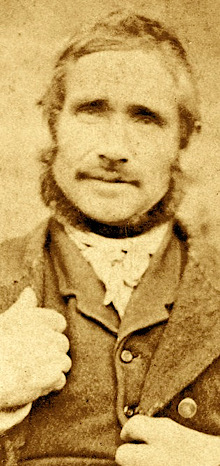
Maolra Seoighe (English: Myles Joyce), is an Irish man who is wrongfully convicted and hanged on December 15, 1882. He is found guilty of the Maumtrasna Murders and is sentenced to death. Though he can only speak Irish, the case is heard in English without any translation service. He is posthumously pardoned in 2018.

Seoighe is the most prominent figure in a controversial trial in 1882 that takes place while Ireland is part of the United Kingdom. Three Irish language speakers are condemned to death for the murder of a local family (John Joyce, his wife Brighid, his mother Mairéad, his daughter Peigí and son Mícheál) in Maumtrasna, on the border between County Mayo and County Galway. It is presumed by the authorities to be a local feud connected to sheep rustling and the Land War. Eight men are convicted on what turns out to be perjured evidence and three of them condemned to death: Maolra Seoighe (a father of five children), Pat Casey and Pat Joyce.

Covering the incident, The Spectator writes the following:

“The Tragedy at Maumtrasna, investigated this week in Dublin, almost unique as it is in the annals of the United Kingdom, brings out in strong relief two facts which Englishmen are too apt to forget. One is the existence in particular districts of Ireland of a class of peasants who are scarcely civilised beings, and approach far nearer to savages than any other white men; and the other is their extraordinary and exceptional gloominess of temper. In remote places of Ireland, especially in Connaught, on a few of the islands, and in one or two mountain districts, dwell cultivators who are in knowledge, in habits, and in the discipline of life no higher than Maories or other Polynesians.”

The court proceedings are carried out in a language the accused do not understand (English), with a solicitor from Trinity College Dublin (TCD), who does not speak Irish. The three are executed in Galway by William Marwood for the crime in 1882. The role of John Spencer, 5th Earl Spencer, who is then Lord Lieutenant of Ireland, is the most controversial aspect of the trial, leading most modern scholars to characterise it as a miscarriage of justice. Research carried out in The National Archives by Seán Ó Cuirreáin, has found that Spencer “compensated” three alleged eyewitnesses to the sum of £1,250, equivalent to €157,000 (by 2016 rates).

As of 2016, nobody has issued an apology or pardon for the executions, though the case has been periodically taken up by various political figures. The then MP for WestmeathTimothy Harrington, takes up the case, claiming that the Crown Prosecutor for the case George Bolton, had deliberately withheld evidence from the trial. In 2011, two sitting members of the House of Lords, the Liberal Democrat life peers David Alton and Eric Lubbock, request a review of the case. Crispin Blunt, Tory Parliamentary Under-Secretary of State for Prisons and Youth Justice, states that Seoighe was “probably an innocent man,” but he does not seek an official pardon.

Seoighe’s final words are: “Feicfidh mé Iosa Críost ar ball beag – crochadh eisean san éagóir chomh maith. … Ara, tá mé ag imeacht … Go bhfóire Dia ar mo bhean agus a cúigear dílleachtaí.” (I will be seeing Jesus Christ soon – he too was also unjustly hanged … I am leaving … the blessings of God on my wife and her five orphans.)

On April 4, 2018, Michael D. Higgins, the President of Ireland, issues a pardon on the advice of the government of Ireland saying “Maolra Seoighe was wrongly convicted of murder and was hanged for a crime that he did not commit”. It is the first presidential pardon relating to an event predating the foundation of the state in 1922 and the second time a pardon has been issued after an execution. Seoighe’s case is not an isolated one, and there are strong similarities with the case of Patrick Walsh who was hanged in the Galway jail on September 22, 1882, just three months before Seoighe for the murders of Martin and John Lydon. The same key players and political factors are active in both cases and his conviction is just as questionable as that of Seoighe.

In September 2009, the story is featured on RTÉ‘s CSI programme under an episode entitled CSI Maamtrasna Massacre. A dramatised Irish language film regarding the affair, entitled Murdair Mhám Trasna, produced by Ciarán Ó Cofaigh is released in 2017.


Leave a comment

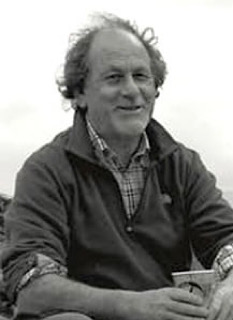
Birth of Derek Mahon, Northern Irish Poet

Norman Derek Mahon, Irish poet, is born in Belfast, Northern Ireland, on November 23, 1941, but lives in a number of cities around the world. At his death it is noted that his “influence in the Irish poetry community, literary world and society at large, and his legacy, is immense.” President of Ireland Michael D. Higgins says of Mahon, “he shared with his northern peers the capacity to link the classical and the contemporary but he brought also an edge that was unsparing of cruelty and wickedness.”

Mahon is the only child of Ulster Protestant working class parents. His father and grandfather work at Harland and Wolff while his mother works at a local flax mill. During his childhood, he claims he is something of a solitary dreamer, comfortable with his own company yet aware of the world around him. Interested in literature from an early age, he attends Skegoneill Primary School and then the Royal Belfast Academical Institution, known locally as Inst.

At Inst Mahon encounters fellow students who share his interest in literature and poetry. The school produces a magazine in which he produces some of his early poems. According to the critic Hugh Haughton, his early poems are highly fluent and extraordinary for a person so young. His parents cannot see the point of poetry, but he sets out to prove them wrong after he wins his school’s Forrest Reid Memorial Prize for the poem ”The power that gives the water breath.”

Mahon pursues third level studies at Trinity College Dublin (TCD) in French, English, and Philosophy and where he edits Icarus, and forms many friendships with writers such as Michael LongleyEavan Boland and Brendan Kennelly. He starts to mature as a poet. He leaves TCD in 1965 to take up studies at the Sorbonne in Paris.

After leaving the Sorbonne in 1966, Mahon works his way through Canada and the United States. In 1968, while spending a year teaching English at Belfast High School, he publishes his first collection of poems, Night Crossing (1968, Oxford University Press). He later teaches in a school in Dublin and works in London as a freelance journalist. He lives in Kinsale, County Cork. On March 23, 2007, he is awarded the David Cohen Prize for Literature. He wins the Poetry Now Award in 2006 for his collection, Harbour Lights, and again in 2009 for his Life on Earth collection.

At times expressing anti-establishment values, Mahon describes himself as an “aesthete” with a penchant “for left-wingery […] to which, perhaps naively, I adhere.”

In March 2020, at the beginning of the COVID-19 pandemicRTÉ News ends its evening broadcast with Mahon reading his poem Everything Is Going to Be All Right.

Mahon dies in Cork, County Cork, on October 1, 2020, after a short illness, aged 78. He is survived by his partner, Sarah Iremonger, and his three children, Rory, Katy, and Maisie. His papers are held at Emory University.

Mahon features on the Irish Leaving Certificate course with ten of his poems (Grandfather, Day Trip to Donegal, Ecclesiastes, After the Titanic, As It Should Be, A Disused Shed in Co. Wexford, Rathlin, The Chinese Restaurant in Portrush, Kinsale and Antarctica)


Leave a comment

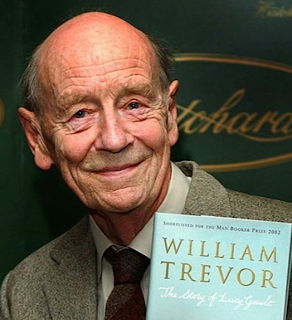
Death of William Trevor, Writer & Playwright

William Trevor Cox KBE, Irish novelist, playwright, and short story writer, dies in Crediton, Devon, England, on November 20, 2016. One of the elder statesmen of the Irish literary world, he is widely regarded as one of the greatest contemporary writers of short stories in the English language. He wins the Whitbread Prize three times and is nominated five times for the Booker Prize, the last for his novel Love and Summer (2009), which is also shortlisted for the International Dublin Literary Award in 2011. His name is also mentioned in relation to the Nobel Prize in Literature.

Trevor wins the 2008 International Nonino Prize in Italy. In 2014, he is bestowed with the title of Saoi within Aosdána. He resides in England from 1954 until his death in 2016, at the age of 88.

Trevor is born as William Trevor Cox on May 24, 1928, in Mitchelstown, County Cork, to a middle classAnglo-Irish Protestant (Church of Ireland) family. He moves several times to other provincial locations, including SkibbereenTipperaryYoughal and Enniscorthy, as a result of his father’s work as a bank official.

Trevor is educated at a succession of schools including St Columba’s College, Dublin (where he is taught by Oisín Kelly) and at Trinity College Dublin (TCD), from which he receives a degree in history. He works as a sculptor under the name Trevor Cox following his graduation from TCD, supplementing his income by teaching

Trevor marries Jane Ryan in 1952 and emigrates to England, working as a teacher, a sculptor and then as a copywriter for an advertising agency. During this time he and his wife have their first son. In 1952, he becomes an art teacher at Bilton Grange, a prep school near Rugby. He is commissioned to carve reliefs for several churches, including All Saints’ ChurchBraunstonNorthamptonshire. In 1956, he moves to Somerset to work as a sculptor and carries out commissions for churches. He stops wood carving in 1960. 

Trevor’s first novel, A Standard of Behaviour, is published in 1958 by Hutchinson & Co. of London, but receives little critical success. He later disowns this work, and, according to his obituary in The Irish Times, “refused to have it republished.” It is, in fact, republished in 1982 and in 1989.

In 1964, at the age of 36, Trevor is awarded the Hawthornden Prize for The Old Boys. This success encourages him to become a full-time writer.

In 1971, he and his family move from London to Devon in South West England, first to Dunkeswell, then in 1980 to Shobrooke, where he lives until his death. Despite having spent most of his life in England, he considers himself to be “Irish in every vein”.

Trevor dies peacefully in his sleep, at the age of 88, at Crediton, Devon, England, on November 20, 2016.


Leave a comment

Birth of Liam Ó Muirthile, Poet, Writer & Journalist

Liam Ó Muirthile, prominent Irish language poet and journalist who also writes plays and novels, is born in Cork, County Cork, on November 15, 1950. He originally comes to the fore as a member of a group of poets from University College Cork (UCC) who collaborate in the journal Innti in the late 1960s.

Ó Muirthile is educated at cork, taking a BA in Irish and French at UCC. His Irish is acquired at school and from sojourns in the Gaeltacht of West Kerry. He is a member of a group of poets at UCC in the late 1960s who choose Irish as a creative medium and are closely associated with the modernist poetry journal Innti, founded by fellow poet Michael Davitt. They are influenced by the work of Cork poet Seán Ó Ríordáin, by the musician and composer Seán Ó Riada, and by popular American culture.

Greg Delanty, writing for Poetry International, claims that a fundamental achievement of Ó Muirthile and other members of the Innti group was to adapt the language to a contemporary urban landscape in a way that reflected the counterculture of the sixties.

Ó Muirthile has been described as a poet of immense formal and musical mastery who reads deeply into the classical and neo-classical poetry of the Irish language. He studies French literature as a student and this influences his work. He translates poetry by Guillaume ApollinaireFrançois VillonJacques Prévert and Anne Hébert.

Ó Muirthile’s first collection of poetry is Tine Chnámh (1984). This receives the Irish American Cultural Institute’s literary award and an Oireachtas prize for poetry. He subsequently publishes a number of other collections. In 1996, he receives the Butler Award for his novel Ar Bhruach na Laoi. Several plays by him have been staged. From 1989 to 2003 he writes a weekly column, “An Peann Coitianta,” for The Irish Times. Poems by him have been translated into EnglishGerman, French, ItalianHungarian and Romanian.

Two of Ó Muirthile‘s poems, Meachán Rudaí and Áthas, have been put to music by the Irish/American group The Gloaming and featured on their third studio album The Gloaming 3.

Ó Muirthile dies peacefully in St. Vincent’s Hospital, Dublin, on May 18, 2018. A Requiem Mass is held in Holy Family Church, Kill of the Grange, County Dublin, on May 21. This is followed with prayers and music in St. Gobnait’s Church, Cúil Aodha, County Cork, which precedes his burial in Reilig Ghobnatan, Ballyvourney.


Leave a comment

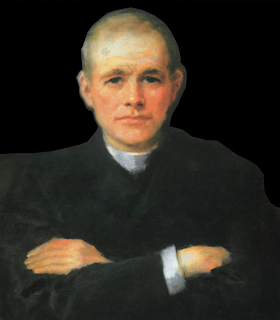
Death of Patrick Dinneen, Lexicographer & Historian

Patrick Stephen Dinneen (Irish: Pádraig Ua Duinnín), an Irish lexicographer, historian and a leading figure in the Gaelic revival, dies in Dublin on September 29, 1934.

Dinneen is born near Rathmore, County Kerry on December 25, 1860, the fifth of ten children of Maitiú Ó Duinnín, farmer and livestock trader, and Máire Ní Dhonnchadha. He is educated at Shrone and Meentogues National Schools and at St. Brendan’s College in Killarney. He earns second class honours bachelor’s and master’s degrees from the Royal University of Ireland. The BA (1885) is in classics and mathematical science, the MA (1889) is in mathematical science. He joins the Society of Jesus in 1880 and is ordained a priest in 1894, but leaves the order in 1900 to devote his life to the study of the Irish language while still remaining a priest. After his ordination, he teaches Irish, English, classics, and mathematics in three different Jesuit colleges, including Clongowes Wood College, a Jesuit boarding school near Clane, County Kildare.

Dinneen is a leading figure in the Irish Texts Society, publishing editions of Geoffrey Keating‘s Foras Feasa ar Éirinn, poems by Aogán Ó RathaillePiaras FeiritéarTadhg Gaelach Ó Súilleabháin, and other poets. He also writes a novel and a play in Irish, and translates such works as Charles Dickens‘s A Christmas Carol into Irish. His best known work, however, is his Irish–English dictionaryFoclóir Gaedhilge agus Béarla, which is first published in 1904. The stock and plates of the dictionary are destroyed during the Easter Rising of 1916, so Dinneen takes the opportunity to expand the dictionary. A much larger second edition, compiled with the assistance of Liam S. Gógan, is published in 1927. His request to the Irish Texts Society to include Gogan’s name on the title page is refused. Gogan continues to work on the collection of words up to his death in 1979. This complementary dictionary is published online in 2011.

Dinneen dies in Dublin at the age of 73 on September 29, 1934, and, following a funeral Mass in the Jesuits’ Gardiner Street church, is buried in Glasnevin Cemetery, Dublin.

(Pictured: Portrait of Patrick S. Dinneen, oil on canvas by John Butler Yeats, National Gallery of Ireland)


Leave a comment

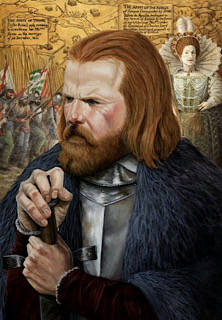
The Battle of Doire Leathan

The Battle of Doire Leathan takes place on September 14, 1590, at Doire Leathan (English: Derrylahan), a townland and hamlet located between Kilcar and Carrick in southwestern County Donegal in the Irish province of Ulster.

Doire Leathan is on the eastern shores of Teelin Bay, being just across from the village of Teelin. The battle is part of the ongoing succession dispute for the leadership of the Gaelic lordship of O’Donnell. A combined force of Irish clans and Scottish Redshank mercenaries hired by Iníon Dubh (pronounced “In-neen Doo”) defeat and kill Sir Domhnall Ó Domhnaill (Sir Donnell O’Donnell). The Tanist of Tír Conaill, Sir Domhnall’s younger half-brother and Iníon Dubh’s son, Red Hugh O’Donnell, is still imprisoned in Dublin Castle, but later rises following a subsequent escape to lead Clan O’Donnell and is a prominent figure during the Nine Years’ War.

According to the Annals of the Four Masters, “The son of O’Donnell, i.e. Donnell, the son of Hugh, son of Manus, son of Hugh Duv, son of Hugh Roe, son of Niall Garv, son of Turlough of the Wine, attempt to depose his father, after he had grown weak and feeble from age, and after his other son had been imprisoned in Dublin; so that Donnell brought under his power and jurisdiction that part of Tirconnell from the mountain westwards, i.e. from Bearnas to the River Drowes; and also the people of Boylagh and Tir-Boghaine. It was a cause of great anguish and sickness of mind to Ineenduv, the daughter of James Mac Donnell, that Donnell should make such an attempt, lest he might attain the chieftainship of Tirconnell in preference to her son, Hugh Roe, who was confined in Dublin, and who she hoped would become chief, whatever time God might permit him to return from his captivity; and she, therefore, assembled all the Kinel-Connell who were obedient to her husband, namely, O’Doherty, with his forces; Mac Sweeny-na dTuath (Owen Oge), with his forces; and Mac Sweeny Fanad, with his forces; with a great number of Scots along with them. After Donnell O’Donnell had received intelligence that this muster had been made to oppose him, he assembled his forces to meet them. These were they who rose up to assist him on this occasion: Mac Sweeny Banagh (Donough, the son of Mulmurry); a party of the Clan Sweeney of Munster, under the conduct of the three sons of Owen, the son of Mulmurry, son of Donough, son of Turlough, and their forces; and O’Boyle (Teige Oge, the son of Teige, son of Turlough), with all his forces, assembled. The place where the son of O’Donnell happened to be stationed along with these chieftains was Doire-leathan at the extremity of Tir-Boghaine, to the west of Gleann Choluim Cille. The other party did not halt until they came to them to that place; and a battle ensued between them, which was fiercely fought on both sides. The Scots discharged a shower of arrows from their elastic bows, by which they pierced and wounded great numbers, and, among the rest, the son of O’Donnell himself, who, being unable to display prowess or defend himself, was slain at Doire-leathan, on one side of the harbour of Telinn, on the 14th of September. Seldom before that time had his enemies triumphed over him; and the party by whom he was slain had not been by any means his enemies until they encountered on this occasion; and although this Donnell was not the rightful heir of his father, it would have been no disgrace to Tirconnell to have elected him as its chief, had he been permitted to attain to that dignity. In this conflict were slain along with Donnell the three sons of Owen, son of Mulmurry, son of Donough above mentioned, together with two hundred others, around Donnell.”

(Pictured: Hugh Roe O’Donnell, otherwise known in history and lore as Red Hugh O’Donnell)


Leave a comment

Death of Liam Ó Briain, Irish Language Expert & Political Activist

Liam Ó BriainIrish language expert and political activist, dies on August 12, 1974, in CabinteelyCounty Dublin.

Christened as William O’Brien, Ó Briain is born at 10 Church Street, North Wall, Dublin, on September 16, 1888, the seventh child of Arthur O’Brien, clerk, and Mary O’Brien (née Christie), who is from County Meath. He takes an interest in the Irish language from an early age and begins learning Irish by himself from a grammar book, as it is not encouraged by his teachers at the Christian Brothers’ O’Connell School nor spoken by his parents. While still at the O’Connell School, he starts using the Irish version of his name. He also attends meetings of the Gaelic League, then attends University College Dublin (UCD) on a scholarship, where he studies FrenchEnglish and Irish, receiving a BA (1909) and an MA (1910).

UCD decides to start awarding one annual scholarship for overseas travel in 1911, and Ó Briain wins the first one, using it to visit Germany and study under Kuno Meyer and Rudolf Thurneysen. After three years, he returns home, where he rejoins the Gaelic League and begins teaching French at UCD. He also joins the Irish Volunteers then, the following year, Seán T. O’Kelly convinces him to join the Irish Republican Brotherhood (IRB).

During the 1916 Easter Rising, Ó Briain sees action with the Irish Citizen Army. He comes into conflict with his commander, Michael Mallin, as he wants to pursue a strategy without the Dublin brigade being “cooped up in the city.” However, Mallin overrules him and insists they should focus on taking Dublin Castle. He spends two months in Wandsworth Prison in London and six months in Frongoch internment camp in Wales before being released to discover that he has been fired from his job. However, he quickly obtains a professorship in Romance languages at University College Galway (UCG).

Around this time, Ó Briain joins Sinn Féin, and he stands unsuccessfully for the party in Mid Armagh at the 1918 United Kingdom general election in Ireland, taking 5,689 votes. His campaign leads, indirectly, to his arrest and three months in jail in Belfast. In 1920, following his release, he is appointed a judge in the then-illegal republican court system in Galway, and visits both France and Italy to try to source weapons for the Irish Republican Army (IRA). In November 1920, he is arrested in the UCG dining room by Black and Tans, and is imprisoned for thirteen months, first in Galway and then in the Curragh camp in County Kildare, thereby missing the conclusion of the Irish War of Independence. By the time he is released, the Anglo-Irish Treaty has been signed. He supports the treaty and takes no further part in militant activity.

In the newly independent Ireland, Ó Briain remains a professor at Galway. He also stands in the 1925 Seanad election, although he is not successful. He is the founding secretary of the Taibhdhearc na Gaillimhe theatre, also acting in many of its productions, and spends much time translating works from English and the Romance languages into Irish. He stands to become president of UCG in 1945, but is not elected, and in the 1940s and 1950s is best known for his many appearances on television and radio.

From his retirement in 1959, Ó Briain lives in Dublin. In 1974, the National University of Ireland (NUI) confers an honorary doctorate on him. He dies on August 12, 1974, at St. Gabriel’s Hospital, Cabinteely, County Dublin. His funeral to Glasnevin Cemetery is almost a state occasion, with a huge attendance of public figures, and a military firing party at the graveside, where the oration is given by Micheál Mac Líammóir and a lesson is read by Siobhán McKenna. For days after his death, the newspapers carry tributes to his many-sided career and personality. On the one hundredth anniversary of his birth, Proinsias Mac Aonghusa and Art Ó Beoláin write commemorative articles in Feasta.

On September 1, 1921, Ó Briain marries Helen Lawlor, of Dublin, who dies two years before him. The couple’s only child is Eibhlín Ní Bhriain, who is a journalist for The Irish Times and other periodicals.


Leave a comment

Birth of Dónal McKeown, Roman Catholic Bishop of Derry

Dónal McKeown, Roman Catholic prelate from Northern Ireland who has served as Bishop of Derry since 2014, is born in Belfast on April 12, 1950.

McKeown is one of four children born to James McKeown and his wife Rose (née McMeel), and is baptised in St. Patrick’s Church, Belfast. He is brought up in Randalstown, County Antrim, where he plays Gaelic football and hurling with Kickhams GAC Creggan.

McKeown attends primary school at Mount St. Michael’s Primary School, Randalstown, and secondary school as a boarder at St. MacNissi’s College, Camlough, between 1961 and 1968, completing his O-Levels and A-Levels with special distinctions in Modern Languages. Two of his teachers at St. MacNissi’s College are his future brother bishops, Anthony Farquhar and Patrick Walsh.

McKeown begins studying for the priesthood at St. Malachy’s College, Belfast, in 1968, and obtains a bachelor’s degree with honours in German and Italian from Queen’s University Belfast (QUB). He teaches English at a school in Dieburg, Germany, between 1970 and 1971, and subsequently works as Northern Ireland correspondent for the Catholic media company Katholische Nachrichten-Agentur between 1971 and 1973.

McKeown completes a licentiate in sacred theology at the Pontifical Gregorian University, Rome, between 1973 and 1978, during which he also works for Vatican Radio and as a correspondent for An Saol Mór, an Irish-language programme on RTÉ.

McKeown is ordained to the priesthood on July 3, 1977.

Following ordination, McKeown’s first pastoral assignment is as chaplain at Mater Infirmorum Hospital, before returning to Rome to complete his licentiate. He returns to the Diocese of Down and Connor in 1978, where he is appointed as a teacher at Our Lady and St. Patrick’s College, Knock, while also serving as assistant priest in Derriaghy. He returns to St. MacNissi’s College in 1983, where he continues his involvement with youth ministry and is given responsibility for organising the annual diocesan pilgrimage to Lourdes.

McKeown subsequently returns to St. Malachy’s College in 1987, where he teaches and serves as dean of the adjoining seminary, before succeeding Canon Noel Conway as president in 1995. During his presidency, he completes a Master of Business Administration at the University of Leicester in 2000, specialising in educational management.

McKeown has completed the Belfast Marathon on two occasions: as a priest with a team of 48 from Derriaghy in 1982, and as a bishop fundraising for a minibus for St. Malachy’s College in 2001.

McKeown is appointed auxiliary bishop-elect for the Diocese of Down and Connor and titular bishop of Cell Ausaille by Pope John Paul II on February 21, 2001, the first Irish bishop to be appointed in the third millennium. He is consecrated by the Bishop of Down and Connor, Patrick Walsh, on April 29 in St. Peter’s Cathedral, Belfast.

In response to a 2007 decision by Amnesty International to campaign for the legalisation of abortion in certain circumstances, McKeown supports the decision of Catholic schools in the diocese to disband their Amnesty International support groups, on the grounds that it is no longer appropriate to promote the organisation in their schools.

It is reported in an article in The Irish News that the mention of McKeown as a possible successor to Walsh as Bishop of Down and Connor is actively opposed by some priests in the diocese, who regard him as being “too soft” on the issue of integrated education. This opposition is branded a “Stop Donal” campaign.

McKeown also serves as a member of the Irish Catholic Bishops’ Conference, with responsibility for the promotion of Catholic education, youth ministry, university chaplaincies and the promotion of vocations. His interests include the interface between faith and the empirical sciences, and working with Catholic schools in Norway, Denmark, Lithuania, Poland and Germany.

McKeown also serves as a member of the Irish Catholic Bishops’ Conference and its committee on education and chairs its committees on vocations and youth. He leads the youth of the diocese to World Youth Day in 2002 and 2005 and also travels to Rome with his brother bishops for their quinquennial visit ad limina in 2006. He is also a regular contributor on Thought for the Day on BBC Radio Ulster.

McKeown is appointed Bishop-elect of Derry by Pope Francis on February 25, 2014. He is installed on April 6 in St. Eugene’s Cathedral, Derry.

Following the appointment of Noël Treanor as Apostolic Nuncio to the European Union on November 26, 2022, McKeown is announced as Apostolic Administrator of Down and Connor on January 21, 2023. He serves in this role until the installation of Alan McGuckian, following his appointment as Bishop of Down and Connor on February 2, 2024.

McKeown starts a 33-day journey of prayer toward the Consecration to Jesus Christ through Mary on January 9, 2025. The prayer takes place online each evening at 7:00 p.m. The 33 days of prayer take place the week following the Baptism of the Lord until the Feast of Our Lady of Lourdes on February 11.


Leave a comment

Death of Charlotte Brooke, Poet, Dramatist & Author

Charlotte Brooke, author of Reliques of Irish Poetry, a pioneering volume of poems collected by her in the Irish language, with facing translations, dies in Longford, County Longford, on March 29, 1793, of a malignant fever.

Brooke is born around 1740 in Rantavan House, Mullagh, County Cavan. She is one of twenty-two children of the writer Henry Brooke, author of the play Gustavus Vasa, and Catherine Brooke (née Meares) of County Westmeath. Only she and her brother Arthur survive childhood.

Brooke is educated by her father and immerses herself in reading history and literature at an early age. While the rest of her family is sleeping, she often goes down to the study where she spends hours reading.

Brooke is part of the first generation of the Protestant Anglo-Irish settler class who take a strong interest in the Irish language and Gaelic history. Her primary interest in Irish language and literature is generated by her hearing it being spoken and recited by the labourers in County Cavan and on the County Kildare estates where her family moves around 1758. She is led to the study of the Irish language, and in less than two years she finds herself in love with it. From reading Irish poetry and admiring its beauties, she proceeds to translate it into English, one of her earliest efforts being a song and monody by Turlough O’Carolan, which appears in Joseph Cooper Walker‘s Historical Memoirs of Irish Bards (1786).

Brooke, who is frail herself, takes care of her father after her mother dies in 1773. Meanwhile, the family has moved back to County Cavan, where they begin living in a house they name Longfield which has been built near the Rantavan Estate. A few years after her father dies in 1783, she runs into financial troubles, after a model industrial village set up in County Kildare by her cousin Captain Robert Brooke goes bankrupt in 1787. Walker and other members of the recently created Royal Irish Academy (RIA) seek to make an income for her, but she realises she has to rely on her writings and translations.

In 1792, though in declining health and poor circumstances, Brooke publishes a selection of her father’s writings in three volumes, prefacing the work with a memoir of her father and a defence of his reputation as a writer. She also publishes a direct and simple presentation of Christian doctrine for children using her father’s didactic method, The school for Christians in dialogue for the use of children (1791). She dies of a malignant fever on March 29, 1793, at Longford, County Longford, in the home of the Brownes, friends with whom she has lived for some years.


Leave a comment

Death of Sir Robert Prescott Stewart, Organist, Conductor & Composer

Sir Robert Prescott Stewart, organist, conductor, composer, teacher, and academic, dies in Dublin on March 24, 1894. He is one of the most influential (classical) musicians in 19th-century Ireland.

Stewart is born on December 16, 1825, the second of two sons of Charles Frederick Stewart of 6 Pitt Street (now Balfe Street), Dublin, librarian of King’s Inns. Nothing is known of his mother other than that she studies music with one of the Logier family, presumably the noted military musician and piano teacher Johann Bernhard Logier, a resident of Dublin from 1809.

Stewart is educated at Christ Church Cathedral school in Dublin, where he is a chorister. He begins to accompany choral services in his early teens, and in 1844 is appointed organist of Christ Church Cathedral and the Trinity College Dublin (TCD) chapel. In addition, in 1852 he becomes de facto organist of St. Patrick’s Cathedral, and holds all three positions concurrently for the rest of his life.

Stewart’s first conducting appointment is with the Dublin University Choral Society in 1846, to which he later adds similar appointments in Dublin, Bray, and Belfast. He is active as a teacher, both privately and from 1869 at the Royal Irish Academy of Music (RIAM), and as a critic with the Dublin Daily Express. On occupying the University of Dublin‘s chair of music in 1862, he takes steps to formalise requirements for the music baccalaureate, introducing examinations in a modern language, Latin (or a second modern language), English (literature and composition), arithmetic, and music history. As a result, though not until 1878, similar examinations are introduced at the University of Oxford and the University of Cambridge. In his professorial capacity he delivers in the 1870s public lectures on Bach, Handel, Wagner, church music, music education, organology, and, most notably, Irish music, in which he reveals an uncanny knowledge of the wire-strung harp and the uilleann pipes. He also contributes entries on Irish music and musicians to the first edition of George Grove‘s A Dictionary of Music and Musicians.

By all accounts, Stewart is a very adept musician, having perfect pitch, a formidable memory, and astonishing facility in transposition. Apparently an autodidact, he is the first Irish organist to cultivate pedal technique, while in the art of improvisation both Joseph Robinson and Sir John Stainer hold him to be the equal of Mendelssohn.

Intent on broadening his musical horizons, Stewart travels widely. From 1851 he is a regular visitor to London, and from 1857 makes frequent trips to Continental Europe, attending the Beethoven and Schumann festivals at Bonn in 1871 and 1873 respectively and Wagner’s first Bayreuth Festival in 1876. On the initiative of the Dublin University Choral Society, he is conferred with the simultaneous degrees of Mus.B. and Mus.D. at a special ceremony on April 9, 1851. On February 28, 1872, he is knighted at Dublin Castle by John Poyntz Spencer, 5th Earl Spencer, a social climb that Stewart, who has no independent income, can afford only by accumulating professional appointments and by relentless private teaching. In addition to successive townhouses in the vicinity of Merrion Square, he owns a smaller property on Bray Esplanade, named Holyrood.

Among Stewart’s compositions, his disciple James Culwick lists about forty part songs (of which several win prizes), more than twenty solo songs, fifteen anthems, several church services, a quantity of shorter liturgical music, and sixteen choral cantatas with orchestra. Three of the cantatas set texts by John Francis Waller: the 24-movement A Winter Night’s Wake (1858), The Eve of St. John (1860) and Inauguration Ode for the Opening of the National Exhibition of Cork (1852) for the opening of the Irish Industrial Exhibition in Cork. Other occasional pieces are Who Shall Raise the Bell? (The Belfry Cantata) for the inauguration of Trinity College campanile in 1854, Ode to Shakespeare (1870) for the Birmingham Triennial Music Festival, Orchestral Fantasia (1872) for the Boston Peace Festival, How Shall We Close Our Gates? (1873) for the Dublin Exhibition and Tercentenary Ode (1892) for the tercentenary of Trinity College Dublin.

Though Stewart destroys many of his works, his surviving music is consistently well crafted, and the rapid decline in the popularity of the odes is at least partly attributable to the tawdry and ephemeral character of their texts. Yet despite his esteem for Wagner, he never shakes off the conservative stylistic influences of Handel, Beethoven, and Mendelssohn, and the posthumous performance of his music has been restricted almost entirely to the Dublin cathedrals.

In August 1846 Stewart marries Mary Emily Browne, the daughter of Peter Browne of Rahins House, Castlebar, County Mayo. They have four daughters, of whom the eldest dies in 1858. Following Mary’s death on August 7, 1887, he marries on August 9, 1888, Marie Wheeler of Hyde, Isle of Wight, the daughter of Joseph Wheeler of Westlands, Queenstown (now Cobh).

Stewart dies in Dublin on March 24, 1894, and is buried at Mount Jerome Cemetery alongside his first wife and eldest daughter. Portraits of him are in the possession of the Dublin University Choral Society and the Royal Irish Academy of Music (RIAM), and his statue, erected on Leinster Lawn in 1898, still stands.

(From: “Stewart, Sir Robert Prescott” by Andrew Johnstone, Dictionary of Irish Biography, http://www.dib.ie, October 2009)