seamus dubhghaill

Promoting Irish Culture and History from Little Rock, Arkansas, USA


Leave a comment

Birth of Gordon Lambert, Businessman, Senator & Art Collector

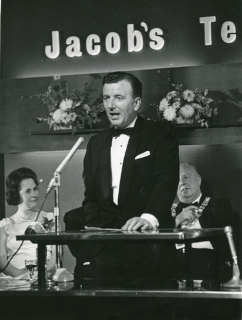
Charles Gordon Lambert, Irish businessman, senator and art collector, is born on April 9, 1919, in the family home at Highfield Road, Rathmines, Dublin, the youngest of four sons of Robert James Hamilton Lambert, a veterinarian and renowned cricketer, and his wife Nora (née Mitchell). His eldest brother, Noel Hamilton “Ham” Lambert, is a versatile sportsman and noted veterinary practitioner.

Lambert is educated at Sandford Park School, Dublin, and at Rossall School, Lancashire. He is steered by his mother toward a career in accountancy for which he prepares by studying commerce at Trinity College Dublin (TCD). Graduating in 1940, he joins the accounting firm Stokes Brothers and Pim, qualifying Associate Chartered Accountant in 1943. In 1944, after auditing biscuit manufacturers W. & R. Jacob and Co. Ltd, one of Ireland’s largest and most prestigious industrial companies, he is offered and accepts a £300 a year job at Jacob’s as assistant accountant.

In 1953, Lambert becomes Jacob’s chief accountant as the management grooms him for an executive career. During 1948–56, Jacob’s suffers from profit and price controls, lack of capital investment and complacency brought about by the absence of competition. The entry of Boland’s Bakery into the Irish biscuit market in 1957 is exploited by Lambert who urges the alarmed board, which has long regarded advertising as vulgar, to market its products more vigorously. This assertiveness yields his advancement to the position of commercial manager in 1958. A year later he becomes the first non-member of the Bewley and Jacob families to be appointed to the board.

Between 1959 and 1970, biscuit consumption in Ireland doubles for which Lambert can claim much credit. Recognising that the advent of self-service stores means that manufacturers can no longer rely on retailers to sell their products, he pioneers advanced promotional techniques in Ireland, particularly the use of marketing surveys and of mass advertising in newspapers, on radio and on the emerging medium of television. To further accord with retailers’ preferences, Jacob’s drives the widespread packaging of biscuits in airtight packets rather than tins, and also introduces a striking red flash logo for its packets. His interest in contemporary art enables him to contribute directly to Jacob’s packaging designs.

Lambert is appointed to the board of the Electricity Supply Board (ESB) in 1964, a position he holds until 1977, and serves as president of the National Agricultural and Industrial Development Association (NAIDA) in 1964–65, spearheading a “Buy Irish” campaign. His involvement with NAIDA dates to the mid-1950s and leads to his friendship with Jack Lynch, Minister for Industry and Commerce. This relationship and his admiration for Seán Lemass incline him toward Fianna Fáil. He also believes the party is the one most likely to deliver economic growth.

In 1977, Lambert is appointed to Seanad Éireann by Taoiseach Jack Lynch. He sits as an independent but assures Lynch he will broadly support the government. Dismayed by Ireland’s economic uncompetitiveness, he uses this platform to bemoan the state’s financial profligacy and failure to control inflation, and the indifference of Irish politicians towards the business community, contending that Irish industrialists suffer and need to learn from the expert lobbying of the indigenous agricultural sector and of large multi-national companies based in Ireland. He also articulates his social liberalism, desire for peaceful reconciliation in Northern Ireland and support for cultural and environmental causes. But his commitment to the Seanad wanes as he grasps its irrelevance. When Lynch resigns in December 1979, Lambert joins the Fianna Fáil party in a futile bid to preserve his political influence.

Following Jacob’s takeover of Boland’s Bakery in 1966, Lambert becomes joint managing director of a new entity, Irish Biscuits Ltd, the manufacturing and trading company for the Boland’s and Jacob’s biscuits operations. W. & R. Jacob and Co. Ltd becomes a holding company. In 1968, he becomes the sole managing director. From 1977 he begins withdrawing from the active administration of the company, relinquishing his managing directorship in 1979 to become chairman.

Initially, Lambert views art as a hobby but he comes to see it as a calling, drawing inspiration from Sir William Basil Goulding, his predecessor as Ireland’s leading collector and advocate of modern art. From the late 1970s he serves as head of the Contemporary Irish Art Society (CIAS) and on the Arts Council of Northern Ireland, the advisory committee of the Dublin Municipal Gallery, the board of the National Gallery of Ireland, the editorial board of the Irish Arts Review and the international council of the Museum of Modern Art (MoMA) in New York City.

The Irish Museum of Modern Art (IMMA) opens in 1991 and receives through the medium of the Gordon Lambert Trust some 212 works, which form the centerpiece of its collection. Thereafter Lambert gifts another 100 works to IMMA. He sits on IMMA’s board from 1991, and the west wing of the museum is named after him in 1999.

Despite being diagnosed with Parkinson’s disease in 1988, Lambert remains relatively active and plays golf into his 80s. In 1999 he receives an honorary LLD from TCD. From 1997, he relies increasingly on Anthony Lyons, an acquaintance of longstanding, to care for him. His last years are overshadowed by the collapse in autumn 2002 of his close but complex relationship with his family. Thereafter he shuns his relations and changes his will, granting Lyons a substantial portion of his estate while curtailing the amount to be received by his family. He dies in a Dublin hospital on January 27, 2005. Relatives challenge his final will in the High Court in 2009 but it is upheld.

(Pictured: Photograph of director of Jacob’s Biscuits, Gordon Lambert, speaking from a podium at the first Jacob’s Television Awards. The Lord Mayor of Dublin, James O’Keefe, is sitting behind Lambert. The awards ceremony takes place at the Bishop Street factory, Dublin.)


Leave a comment

Death of Thekla Beere, Irish Civil Servant

Thekla Beere, an Irish civil servant who chairs Ireland’s Commission on the Status of Women in 1970 and is secretary of the Department of Transport and Power, dies on February 19, 1991, in Killiney, County Dublin. She is the first woman to lead a government department in Ireland.

Beere is born on June 20, 1901, in Kilmore, Columbkille, near Granard, County Longford, one of two daughters of the Rev. Francis John Armstrong Beere, Church of Ireland vicar of Streete, County Westmeath, and Lucie Beere (née Potterton). She attends Alexandra College in Milltown, Dublin, and does a moderatorship in Legal and Political Sciences and an LL.B. at Trinity College Dublin.

Beere joins the Civil Service of the Republic of Ireland in 1924 and works initially in the Statistics Branch. In 1925, she wins a Rockefeller Foundation scholarship and travels extensively in the United States before resuming her Civil Service career. From 1939, she works in the Department of Industry and Commerce where during The Emergency, as World War II is known in Ireland, she works in the area of supply with Minister Seán Lemass. She becomes Assistant Secretary of that Department in 1953. She is the first woman to achieve the rank of Department Secretary, the highest-ranking post in a government department, doing so at the Department of Transport and Power in 1959. President Mary McAleese calls her the “ultimate civil servant.”

Trinity College Dublin confers an honorary doctorate of Doctor of Laws upon her in 1960. After her retirement in 1967 she is active in public life, serving as a governor of Alexandra College and as a director of The Irish Times. She is requested by the Government to chair the Commission on the Status of Women in 1970, and the Beere Report is presented to the Minister for Finance in December 1972. The report provides a model for change in equal pay, the Civil Service marriage bar (which requires female civil servants to resign from their position upon marriage) and the widow’s pension. Her name is mentioned as a possible candidate for the Irish presidency in 1976.

Beere has a lifelong interest in the proceedings of the Statistical and Social Inquiry Society of Ireland and serves as its President. She is a Governor of The Irish Times Trust and chairwoman of the International Labour Organization office in Geneva, Switzerland. She is a member of the organising committee, which on May 7, 1931, sets up An Óige (the Irish Youth Hostel Association), of which she is President from 1968 to 1974. She also has an extensive interest in the arts, in particular the paintings of Cecil King.

Beere dies on February 19, 1991, in Killiney, County Dublin. She never marries but has a 40-year companionship with businessman JJ O’Leary.


Leave a comment

Birth of Alfred Denis Godley, Scholar & Poet

Alfred Denis Godley, Anglo-Irish classical scholar and author of humorous poems is born on January 22, 1856, at Ashfield, County Cavan.

Godley is the eldest son of Rev. James Godley, rector of Carrigallen, County Leitrim, and Eliza Frances Godley (née La Touche). After attending Tilney Basset’s preparatory school in Dublin, he goes to Harrow College and Balliol College, Oxford, graduating BA in 1878. At Oxford he becomes known for his classical scholarship and wins several prizes, including the Craven scholarship and the Gaisford Prize for Greek Verse. In 1879 he is appointed assistant classical master at Bradfield College. He returns to Oxford in 1883 as tutor and fellow of Magdalen College (1883–1912). Serving as deputy public orator of Oxford (1904–06), he is elected public orator in 1910, a post he holds until his death.

Godley also enjoys renown as a writer of satiric verse and prose, beginning his literary career as a contributor to The Oxford Magazine in 1883. In 1890 he becomes its editor, and two years later publishes his first book of poems, Verses to Order (1892). Later publications include Lyra Frivola (1899), Second Strings (1902) and The Casual Ward (1912). His work is very popular and two volumes, Reliquiae (1926) and Fifty Poems (1927), are published posthumously. He also publishes numerous works of serious scholarship including Socrates and Athenian Society in His Day (1896) and Oxford in the Eighteenth Century (1908). Noted as a translator of Herodotus, Tacitus, and Horace, he serves as joint-editor of The Classical Review (1910–20). He also edits and publishes volumes of the poetry of Thomas Moore and Winthrop Mackworth Praed.

Active in political life, Godley serves as an alderman on Oxford City Council. During the Second Boer War (1899–1901) he organises volunteer forces, commanding a battalion of the 4th Oxfordshire Light Infantry (1900–05). He serves in this capacity again during World War I and is lieutenant-colonel of the Oxfordshire Volunteer Corps (1916–19). A staunch unionist, during the Home Rule Crisis, he supports the formation of the Ulster Volunteer Force (UVF) and writes some political verse, notably The Arrest, which is popular among unionists. A pioneer in the sport of mountaineering, he is a founding member of the Alpine Club and a committee member (1908–11). He is also a member of the governing body of Harrow School. Towards the end of his career he is awarded honorary doctorates from Princeton (1913) and Oxford (1919).

In 1925 Godley goes on a tour of the Levant and contracts a fever which ultimately leads to his death on June 27, 1925, at his Oxford home, 27 Norham Road. He is buried at Wolvercote Cemetery.

In 1894 Godley marries Amy Hope Cay, daughter of Charles Hope Cay, fellow of Gonville and Caius College, Cambridge. They have no children.

(From: “Godley, Alfred Denis” by David Murphy, Dictionary of Irish Biography, http://www.dib.ie, October 2009)


Leave a comment

Gorbachev Samples Pint of Guinness During Ireland Visit

Former Soviet leader Mikhail Gorbachev samples a pint of Guinness with Lord Mayor of Dublin Michael Mulcahy in the famous Doheny & Nesbitt pub in Baggot Street, Dublin, on Tuesday, January 8, 2002.

Gorbachev arrives in Dublin earlier in the day for a two-day visit to the Republic of Ireland. He attends a series of events in Dublin where he meets the President of Ireland, Mary McAleese, and is granted the Freedom of the City of Dublin.

Gorbachev, the man who led Russia through the most difficult days of his country’s shift to democracy, is also conferred with an honorary degree. On his arrival he goes to Trinity College Dublin to receive the honour before launching the new European Russian Trust. He later dines as a guest of the Irish Government in Dublin Castle.

On the following day, Gorbachev is accompanied by Dublin’s Lord Mayor Michael Mulcahy during a visit to see members of the city’s Russian community at the Hugh Lane Gallery. He also chats with local shop owners and residents during an informal tour of The Liberties area. After addressing the Institute of European Affairs and lunching with President McAleese at Áras an Uachtaráin, the president’s official residence and principal workplace, he is granted freedom of the Irish capital at a special ceremony.

Following his visit with President McAleese, Gorbachev jokes with Mulcahy that he fully intends to exercise his right to graze sheep in the city. Mulcahy says, “This visit will help to cement relations between us, as well as doing appropriate honour to a genuinely great man whose place in history is already secure.”

Gorbachev formally announced his resignation as Soviet President and Commander-in-Chief on December 25, 1991. The following day, the Soviet of the Republics, the upper house of the Supreme Soviet of the Soviet Union, formally voted the Soviet Union out of existence. The Soviet Union officially ceased to exist at midnight on December 31, 1991. As of that date, all Soviet institutions that had not been taken over by Russia ceased to function.

(Pictured: Mikhail Gorbachev samples a pint of Guinness watched by Dublin’s Lord Mayor Michael Mulcahy, in Doheny & Nesbitt’s pub in Merrion Row. Picture by Donal Doherty)


Leave a comment

Birth of Feargal Quinn, Businessman, Politician & TV Personality

Feargal Quinn, Irish businessman, politician and television personality, is born in Dublin on November 27, 1936. He is the founder of the Superquinn supermarket chain and serves as a Senator in Seanad Éireann representing the National University of Ireland constituency from 1993 to 2016.

Quinn’s father, Eamonn, founds a grocery brand and later the Red Island resort in Skerries, Dublin. He is a first cousin of Labour Party politician Ruairi Quinn and of Lochlann Quinn, former chairman of Allied Irish Banks (AIB). He is educated at Newbridge College and is a commerce graduate of University College Dublin (UCD). He builds a career in business and later takes on a range of public service roles.

Quinn founds the national supermarket chain Superquinn (originally Quinn’s Supermarkets), of which he remains non-executive president for some years after his family sells out their interest in August 2005 for over €400 million. Superquinn is known for its focus on customer service and pioneers a number of innovations, including Ireland’s first supermarket loyalty card in 1993, SuperClub. It also introduces self-scanning of goods by customers in a number of its outlets. Superquinn becomes the first supermarket in the world to guarantee the absolute traceability of all its beef from pasture to plate, using DNA TraceBack, a system developed at Trinity College, Dublin by IdentiGEN.

Quinn becomes the chairman of the Interim Board for Posts and serves as chairman of its successor An Post (the Irish postal administration) until 1989. He also serves on several other public authorities and boards. From 1993 to 1998, he chairs the steering committee which oversees the development of the Leaving Certificate Applied. In 2006, he is appointed an Adjunct Professor in Marketing at National University of Ireland Galway. He is also chairman of Springboard Ireland.

Quinn is a former President of EuroCommerce, the Brussels-based organisation which represents the retail, wholesale and international trade sectors in Europe. He also serves on the board of directors of CIES, the Food Business Forum based in Paris, as well as the American-based Food Marketing Institute.

In 2009, Quinn works with independent shops and helps them to revamp, modernise and stave off stiff competition from multi-national retailers. It airs as RTÉ‘s six-part television series, Feargal Quinn’s Retail Therapy. A second series airs in 2011, and a third series airs in 2012. In 2011, he fronts RTÉ’s Local Heroes campaign in Drogheda, County Louth, which is an assembled team of experts to kick-start the local economy. It airs as RTÉ One‘s six-part television series, Local Heroes – A Town Fights Back.

Quinn is first elected as a senator in 1993 from the National University of Ireland constituency and is re-elected in 1997, 2002, 2007 and 2011. He is a member of the Joint Oireachtas Committee on European Affairs, the Joint Committee on Finance and Public Service and is an Oireachtas member of the National Economic and Social Forum, along with the Joint Committee on Jobs and Innovation.

Quinn is one of the co-founders and is a driving force behind Democracy Matters – a civil society group that is formed to oppose the Government’s plans to abolish Seanad Éireann. In May 2013, with Senators Katherine Zappone and Mary Ann O’Brien, he introduces the Seanad Bill 2013 to reform the system of electing the elected members of Seanad Éireann (as provided for in Article 18.10 of the Constitution of Ireland) through a one-person, one vote franchise. The Seanad Bill 2013 succeeds in being passed at Second Stage in the Seanad. During the Seanad abolition referendum campaign, the Bill demonstrates to the electorate, in a very palpable way, that reform of the Seanad is achievable if they vote for its retention. In a referendum held in October 2013 on the Abolition of Seanad Éireann, the people vote to retain the Seanad by 51.7%.

In 2014, Quinn reveals that since being first elected to Seanad Éireann, he has donated his entire salary to charity and in more recent years he has refused to accept any salary. In March 2015, he opposes the Marriage Equality bill in the Seanad, and votes ‘No’ in the referendum. He serves as Chairman of the Independent Alliance. He does not contest the 2016 Seanad election.

Quinn is the recipient of five honorary doctorates from education institutions, including NUI Galway in 2006, a papal knighthood along with a fellowship and the French Ordre National du Mérite. He shares with Oprah Winfrey the 2006 “Listener of the Year” award of the International Listening Association.

Quinn dies peacefully at his home in Howth, County Dublin, on April 24, 2019, following a short illness. His funeral Mass takes place at St. Fintan’s Church in Sutton, north County Dublin. In attendance is President Michael D. Higgins, a representative for Taoiseach Leo Varadkar, Minister for Children Katherine Zappone, Senator Michael McDowell, and a host of other current and former politicians, business figures, and past colleagues of the “Superquinn family.” Fittingly, the coffin is carried from the church to the tune of Frank Sinatra’s “My Way.”


Leave a comment

Death of Cornelius Ryan, Irish American Journalist & Author

Cornelius Ryan, Irish American journalist and author mainly known for his writings on popular military history, dies in Manhattan on November 23, 1974. He is especially known for his World War II books The Longest Day: 6 June 1944 D-Day (1959), The Last Battle (1966), and A Bridge Too Far (1974).

Ryan is born in Dublin on June 5, 1920. He is educated at Synge Street CBS, Portobello, Dublin. He is an altar boy at St. Kevin’s Church, Harrington Street and studies the violin at the Irish Academy of Music in Dublin. He is a boy scout in the 52nd Troop of the Catholic Boy Scouts of Ireland and travels on their pilgrimage to Rome on the liner RMS Lancastria in 1934. He moves to London in 1940 and becomes a war correspondent for The Daily Telegraph in 1941.

Ryan initially covers the air war in Europe, flying along on fourteen bombing missions with the Eighth and Ninth United States Army Air Forces (USAAF). He then joins General George S. Patton‘s Third Army and covers its actions until the end of the European war. He transfers to the Pacific theater in 1945 and then to Jerusalem in 1946.

Ryan emigrates to the United States in 1947 to work for Time, where he reports on the postwar tests of atomic weapons carried out by the United States in the Pacific. He then reports for Time on the Arab-Israeli war in 1948. This is followed by work for other magazines, including Collier’s Weekly and Reader’s Digest.

Ryan marries Kathryn Morgan, a novelist, and becomes a naturalized citizen of the United States in 1951.

On a trip to Normandy in 1949 Ryan becomes interested in telling a more complete story of Operation Overlord than has been produced to date. He begins compiling information and conducting over 1,000 interviews as he gathers stories from both the Allies and the Germans, as well as the French civilians.

In 1956 Ryan begins to write down his World War II notes for The Longest Day: 6 June 1944 D-Day, which tells the story of the D-Day Invasion of Normandy, published three years later in 1959. It is an instant success, and he assists in the writing of the screenplay for the 1962 film of the same name. Darryl F. Zanuck pays the author U.S.$175,000 for the screen rights to the book.

Ryan’s 1957 book One Minute to Ditch! is about the successful ocean ditching of a Pan American Boeing 377 Stratocruiser. He had written an article about the ditching for Collier’s in their December 21, 1956, issue and then expanded it into the book.

Ryan’s next work is The Last Battle (1966), about the Battle of Berlin. The book contains detailed accounts from all perspectives: civilian, American, British, Russian and German. It deals with the fraught military and political situation in the spring of 1945, when the forces of the western allies and the Soviet Union contend for the chance to liberate Berlin and to carve up the remains of Germany.

This work was followed by A Bridge Too Far (1974), which tells the story of Operation Market Garden, the ill-fated assault by allied airborne forces on the Netherlands culminating in the Battle of Arnhem. It is made into a major 1977 film of the same name.

Ryan is awarded the French Legion of Honour and an honorary Doctor of Literature degree from Ohio University, where the Cornelius Ryan Collection is housed in the Alden Library. He is diagnosed with prostate cancer in 1970 and struggles to finish A Bridge Too Far during his illness. He dies in Manhattan on November 23, 1974, while on tour promoting the book, only two months after publication. He is buried in the Ridgebury Cemetery in northern Ridgefield, Connecticut.

Four years after his death, Ryan’s struggle with prostate cancer is detailed in A Private Battle, written by his widow, from notes he had secretly left behind for that purpose.


Leave a comment

Birth of Marina Carr, Irish Playwright

Irish playwright Marina Carr is born in Dublin on November 17, 1964. She has written almost thirty plays, including By the Bog of Cats (1998) which is revived at the Abbey Theatre in 2015.

Carr spends the majority of her childhood in Pallas Lake, County Offaly, adjacent to the town of Tullamore. Her father, Hugh Carr, is a playwright and studies music under Frederick May, while her mother, Maura Eibhlín Breathnach, is the principal of the local school and writes poetry in Irish. It is said that “there were a lot of literary rivalries.” As a child, she and her siblings build a theater in their shed.

Carr attends University College Dublin (UCD), studying English and philosophy. She graduates in 1987. In 2011, she receives an honorary degree of Doctorate of Literature from her alma mater.

Carr has held posts as writer-in-residence at the Abbey Theatre and has taught at Trinity College Dublin, Princeton University, and Villanova University. She lectures in the English department at Dublin City University in 2016. She is considered one of Ireland’s most prominent playwrights and is a member of Aosdána.

The Mai wins the Dublin Theatre Festival‘s Best New Irish Play award (1994-1995) and Portia Coughlan wins the nineteenth Susan Smith Blackburn Prize (1996-1997). Other awards include The Irish Times Playwright award 1998, the E. M. Forster Award from the American Academy of Arts and Letters and The American Ireland Fund Award, the Macaulay Fellowship and The Hennessy Award. Carr is named a recipient of the Windham-Campbell Literature Award, administered by the Beinecke Rare Book & Manuscript Library at Yale University. The award, which includes a financial prize of $165,000 (or €155,000), is formally presented in September 2017. She is the second Irish author to receive the prize, following playwright Abbie Spallen in 2016.


Leave a comment

Bridget Dirrane Featured in the Guinness Book of Records at Age 104

Bridget Dirrane, who was imprisoned with Kevin Barry and who canvassed for John F. Kennedy in the United States, celebrates her 104th birthday on November 15, 1998, with news that she is to be featured in the new edition of the Guinness Book of Records. Earlier in the year, she receives a Master of Arts honorary degree from NUI Galway which makes her the oldest person in the world to be awarded a degree.

Dirrane is born in Oatquarter in the townland of Kilmurvey on Inishmore, Aran Islands, County Galway on November 15, 1894. She is the youngest child of Joseph Gillan and Maggie (née Walsh). Her father is a weaver of flannel cloth and has a small farm. She has four brothers and three sisters. Her oldest brother is a fisherman, who dies at age 21 in 1901, and her father dies before 1911. Despite this hardship, all of the children go to school, with one of her brothers becoming an Irish teacher, and later an Irish inspector. The family speaks Irish at home, but they are all bilingual with English. She is schooled at the national school in Oatquarter until the age of 14. She leaves to work in local homes, looking after children. When she writes her memoirs late in life, she claims to have met Joseph Plunkett, Éamonn Ceannt, Thomas MacDonagh, Thomas Ashe and Patrick Pearse when they visited the island, visiting a house where she looked after the children, discussing politics and plans for the Easter Rising with them. She is a republican, becoming a member of Cumann na mBan in 1918 while she is working for Fr. Matthew Ryan as a housekeeper. She is involved in drilling and assisting fugitives from the authorities. Because of their known republican sympathies, the Black and Tans raid the Gillan family homes.

Dirrane moves to Dublin in 1919 to train in Saint Ultan’s Children’s Hospital as a nurse. She is still under surveillance, being arrested alongside her employer, Claude Chavasse, when she is working as a nurse in his house. She is held in Dublin’s Bridewell Garda Station for two days before being transferred to Mountjoy Prison. In the time of her imprisonment, she is not charged or put on trial. Her refusal to speak English angers the guards, culminating in her going on hunger strike for a number of days in 1920 until she is released. She takes part in the Cumann na mBan vigil outside of Mountjoy Prison in November 1920, when Kevin Barry is hanged.

Dirrane works in Richard Mulcahy‘s house for two years, before emigrating to the United States in 1927 to continue her career as a nurse. She works in Boston where she is an active member of the Irish emigrant community alongside former neighbours from the Aran Islands and some relatives. She works in a hotel for a time but returns to nursing after her marriage to Edward ‘Ned’ Dirrane in November 1932 in the Jamaica Plain section of Boston. Ned, a labourer in Boston and also from Inishmore, dies from heart failure in 1940. Dirrane continues her career nursing in hospitals and as a district nurse. On May 13, 1940, she naturalises as U.S. citizen. During World War II, she works as a nurse in a munitions factory, and at a U.S. Army Air Forces bomber base in Mississippi. She canvases for John F. Kennedy in the Irish community in South Boston when he runs for president in 1960. Jean Kennedy Smith visits Dirrane in 1997 in Galway to acknowledge her contribution. She also meets Senator Edward Kennedy.

Following her retirement, Dirrane lives with her nephew, but she returns to the Aran Islands in 1966 at age 72. There she lives with her brother-in-law, Pat Dirrane, a widower with three grown sons. They marry in a private ceremony on April 27, 1966. She continues to live on the island after Pat’s death on February 28, 1990, living with her stepson. She eventually moves into a nursing home in Newcastle in the suburbs of Galway. When she celebrates her 100th birthday, she funds a statue of Our Lady Mary at a holy well in Corough on Inishmore. At age 103, the matron of her nursing home arranges for a local writer, Jack Mahon, to record her memories and collate the information into a book. The book, A Woman of Aran, is published in 1997 and is a bestseller for several weeks. She is awarded an honorary degree, an MA honoris causa, from NUI Galway in May 1998, the oldest person to ever receive one.

Dirrane dies at age 109 on December 31, 2003, in Galway. She is buried on Inishmore.


Leave a comment

Birth of Irish Mathematician James Thomson

James Thomson, Irish mathematician notable for his role in the formation of the thermodynamics school at the University of Glasgow, Is born on November 13, 1786, in Ballynahinch, County Down, in what is now Northern Ireland. He is the father of the engineer and physicist James Thomson and the physicist William Thomson, 1st Baron Kelvin.

Born into an Ulster Scots family, Thomson is the fourth son of Agnes Nesbit and James Thomson, a small farmer, at Annaghmore, near Ballynahinch, County Down, in Ulster. His early education is from his father. At the age of 11 or 12 he finds out for himself the art of dialling. His father sends him to a school at Ballykine, near Ballynahinch, kept by Samuel Edgar, father of John Edgar. Here he soon rises to be an assistant.

Wishing to become a minister of the Presbyterian church, Thomson enters the University of Glasgow in 1810, where he studies for several sessions, supporting himself by teaching in the Ballykine school during the summer. He graduates MA in 1812, and in 1814 he is appointed headmaster of the school of arithmetic, bookkeeping, and geography in the newly established Royal Belfast Academical Institution. In 1815 he is Professor of Mathematics in its collegiate department. Here he proves himself as a teacher. In 1829 the honorary degree of LL.D. is conferred upon him by the University of Glasgow, where in 1832 he is appointed Professor of Mathematics. He holds this post until his death on January 12, 1849.

Thomson is buried with his family on the northern slopes of the Glasgow Necropolis to the east of the main bridge entrance. The grave is notable due to the modern memorial to Lord Kelvin at its side.

Thomson is the author of schoolbooks that have passed through many editions including Arithmetic (1819), Trigonometry, Plane and Spherical (1820), Introduction to Modern Geography (1827), The Phenomena of the Heavens (1827), The Differential and Integral Calculus (1831), and Euclid (1834).

A paper, “Recollections of the Battle of Ballynahinch, by an Eye-witness,” which appears in the Belfast Magazine for February 1825, is from his pen.


Leave a comment

Death of Sir James Charles Mathew, Barrister & Judge

Sir James Charles Mathew, barrister and judge, dies in London on November 9, 1908.

Mathew is born on July 10, 1830, at Lehenagh House, County Cork, eldest son of Charles Mathew, gentleman, of Lehenagh House and Castlelake, County Tipperary, and his wife Mary, daughter of James Hackett of Cork. He is of a Roman Catholic family and his uncle is Fr. Theobald Mathew, the temperance movement campaigner. His initial education is at a private school in Cork. He enters Trinity College Dublin (TCD) in July 1845, graduating BA (1850) as a gold medalist and senior moderator. In Hilary term 1850 he is admitted to the King’s Inns in Dublin. He moves to London, entering Lincoln’s Inn on June 1, 1851, and is called to the English bar in Hilary term 1854.

Mathew is a founding member of the Hardwicke Society, a legal debating society, and builds up a substantial practice as a junior barrister, being much in demand as counsel for jury cases in the Guildhall sittings. Despite being highly regarded by his peers, a certain lack of confidence holds him back and even when vacancies arise, he does not apply to be made a Queen’s Counsel (QC). In 1873, however, he represents the treasury as a junior counsel in the prosecution of the Tichborne claimant, Arthur Orton, in one of the most celebrated legal cases of the day. He is the only counsel for the treasury who does not get into heated arguments in court with Orton’s leading council, Dr. Edward Vaughan Hyde Kenealy.

Mathew possesses an encyclopedic knowledge of legal procedure and in 1881 is made a bencher at Lincoln’s Inn and awarded an honorary doctorate by TCD. Although still only a junior counsel he is appointed a judge in the Queen’s Bench Division in March 1881 and knighted. After the return to office of the Liberal Party in August 1892 he becomes chairman of the commission established to investigate the state of evicted tenants in Ireland. His appointment is perhaps unfortunate, as he is a home ruler in politics and the home rule MP John Dillon is his son-in-law. When the commission begins its hearings on November 7, 1892, he announces that he will not allow witnesses to be cross-examined. This provokes protests from Edward Carson, who had recently been replaced as solicitor general for Ireland. Counsel is ordered to withdraw and eventually two members of the commission resign, while the landlords refuse to cooperate with the proceedings. Despite severe criticism, many of the commission’s recommendations are incorporated in the Wyndham Land Purchase Act of 1903.

Throughout his legal career, Mathew argues for the establishment of a separate commercial court and eventually succeeds in convincing the other members of the bench and also Lord Russell of Killowen, who is appointed Lord Chief Justice in 1894, that such a court be established. As a result of this, he is appointed as the first judge of the Commercial Court when it is set up in 1895. In 1901 he is made a privy councilor and appointed judge in the Court of Appeal.

On December 6, 1905, Mathew is seized with a paralytic stroke at the Athenaeum Club in London, and his resignation is announced on the following day. On November 9, 1908, he dies at his London home, 46 Queen’s Gate Gardens. His remains are returned to Ireland, where they are interred in St. Joseph’s Cemetery, Cork.

Mathew marries Elizabeth Blackmore, eldest daughter of the Rev. Edwin Biron, JP and vicar of Lympne near Hythe, Kent, in December 1861. They have two sons and three daughters. His eldest daughter, Elizabeth Mathew, marries John Dillon. A portrait of Sir James Charles Mathew, by Frank Holl, is in the possession of the family. In 1896 a cartoon portrait of him by ‘Spy’ appears in Vanity Fair.

(From: “Mathew, Sir James Charles” by David Murphy, Dictionary of Irish Biography, http://www.dib.ie | Pictured: Sir James Charles Mathew by Alexander Bassano, half-plate glass negative, 1883, National Portrait Gallery, London)