Hayes is born into a family languishing in poverty. One of ten siblings, seven of Hayes’ brothers and sisters die of malnutrition and disease over a twelve-year period. The family had been evicted from Lord Cloncurry‘s estate in 1872 for non-payment of rent, forcing them into destitution. The family returns to the estate in 1894.
During the 1920s Hayes becomes an admirer of Benito Mussolini, with whom he is granted an audience during a visit to Rome in 1930. He is intrigued by corporatism and comes to believe it can uplift rural communities. Similarly, he is influenced by continental movements such as the BelgianBoerenbond league, which encourages rural inhabitants to form cooperatives.
Hayes comes to national prominence with the foundation of Muintir na Tíre in 1931, a rural development organisation which has core principles of neighbourliness, self-help and self-sufficiency. It is to act as a rural self-help group based on collective parish organisation with a strong emphasis on the teaching of the papal encyclicals Rerum novarum (1891) and Quadragesimo anno (1931). He is successfully able to draw on the power of the media, Irish newspapers and radio, to promote Muintir na Tíre and quickly becomes a figure of national prominence in doing so. In promoting and developing Muintir na Tíre Hayes resists calls in some quarters to limit the membership to Catholics, remarking “this country is becoming so Catholic it forgets to be Christian.” Nonetheless, under his leadership, there is eventually an overlap in membership between Muintir na Tíre and the Catholic fraternal organisation the Knights of Saint Columbanus.
Hayes is appointed parish priest of Bansha and Kilmoyler in County Tipperary in 1946. Due largely to his endeavours, a factory, Bansha Rural Industries, is started and enjoys some success producing preserves for the Irish home market. Bansha is to the forefront in developing many Muintir na Tíre initiatives and for a time in the 1950s enjoys the soubriquet of The Model Parish.
Hayes spearheads many initiatives including rural electrification, the “Parish Plan for Agriculture,” and the setting up of small industry in rural areas in an attempt to stop emigration. He is later made a canon of his cathedral chapter.
Hayes dies on January 30, 1957 in a Tipperary nursing home following a minor operation. His funeral in Bansha is a national occasion, attended by leaders of Church and State. His grave is at the rear of the Church of the Annunciation, Bansha. He is later commemorated on an Irish postage stamp.
The Rebellion comes about because of the resentment felt by the Irish Catholics, both Gael and Old English, in regard to the loss of their lands to Protestant settlers from England and Scotland.
Irish Catholics are frightened by reports that the Covenanter army in Scotland is considering an invasion of Ireland in order to eradicate the Catholic religion. At the same time, there is also a threat of invasion by Oliver Cromwell’s Puritans who are at war against King Charles I. It is hoped that the King would redress the complaints of the Catholics and halt or even reverse the policy of plantation. It is not an act of rebellion against the Royal domain.
The uprising is led by Rory O’ Moore from Leix, with Sir Phelim Roe O’ Neill and his brother Turlough of Tyrone, the Maguires of Fermanagh, the Magennis, O’ Reilly and the MacMahons. They plan to begin the rebellion on October 23, 1641, with attacks on Dublin and various other British strongholds throughout the country. However, their plans are betrayed to the British by a native Irish convert to Protestantism, Owen O’ Connolly.
As a result of this betrayal, Dublin does not fall. However, the rebellion proceeds in the north with the towns of Dungannon, Newry, and Castleblayney, along with the fort at Charlemont falling to the rebels.
Most of the province of Ulster comes under the control of the rebel leaders. The rebel army, consisting of 30,000 men, has been instructed to take no life except in battle, to arrest the gentry and to spare the Scottish planters as they are considered kindred. For a week after the rebellion, these instructions are adhered to but many of the rebels have lost their lands to the Protestant planters, and they want revenge. They attack farms and settlements, killing and turning many people away, robbing and stripping them of all their goods.
Sir Phelim O’ Neill has been himself thought to have ordered the murder of Protestants in Tyrone and Armagh. It is believed that about 12,000 people are slaughtered although contemporary reports put the death toll as much higher. It is thought that up to 30% of the Ulster planters lost their lives while 10% is the figure for the whole of Ireland.
As the rebellion progresses in Ulster there are uprisings in Leinster by November and thereafter throughout the whole of Ireland. In Munster, where many English settlers are planted, the rebels do not shed much blood, but they do turn out these settlers, many of whom flee back to England.
In 1642 the Scottish Covenanters invade the North and they, in turn, take to killing Catholics in revenge for the deaths of Protestants. The Covenanter Clan Campbell of Argyll takes the opportunity to attack and slaughter the Catholic Rathlin Islanders who belong to ancient enemies, Clan Mac Donald. The Covenanters also slaughter the approximately 3,000 Catholics on Islandmagee. Catholic prisoners and traders in Newry are murdered.
This ruthless slaughtering of civilians, by both sides, is only brought under control when Owen Roe O’ Neill arrives back from exile in France to take control of the Confederate army and, with Major General Robert Monroe in charge of the Covenanter Army, continues the war under the code of conduct that they had both learned on the Continent. However, the effects of the rebellion last to the present day, especially in Ulster where sectarian divide remains strong during The Troubles.
(Pictured: Depiction of the massacre of Ulster Protestants during the 1641 rebellion, The LIFE Picture Collection via Getty Images)
On October 2, 1975, the Ulster Volunteer Force (UVF), a loyalistparamilitary group, carries out a wave of shootings and bombings across Northern Ireland. Six of the attacks leave 12 people dead (mostly civilians) and around 45 people injured. There is also an attack in the small village of Killyleagh, County Down. There are five attacks in and around Belfast which leave people dead. A bomb which explodes near Coleraine leaves four UVF members dead. There are also several other smaller bombs planted around Northern Ireland, sixteen in total, but other than causing damage they do not kill or injure anyone.
There is a rise in sectarian killings during the Provisional Irish Republican Army (IRA) truce with the British Army, which begins in February 1975 and officially lasts until February 1976. Loyalists, fearing they are about to be forsaken by the British government and forced into a united Ireland, increase their attacks on Irish Catholics/Irish nationalists. Loyalists kill 120 Catholics in 1975, the vast majority civilians. They hope to force the IRA to retaliate and thus end the truce. Some IRA units concentrate on tackling the loyalists. The fall-off of regular operations causes unruliness within the IRA and some members, with or without permission from higher up, engage in tit-for-tat killings.
The first attack of the day takes place at Casey’s Bottling Plant in Belfast. The UVF group, which is alleged to have been led by Shankill Butchers leader Lenny Murphy, enters the premises by pretending to have an order to be filled before launching the attack. Four employees are shot and killed in the attack, sisters Frances Donnelly (35), Marie McGrattan (47) and Gerard Grogan (18) all die that day, with a fourth, Thomas Osborne (18), dying of his wounds three weeks later. Murphy personally shoots all except Donnelly who is killed by his accomplice William Green. The two sisters are forced to kneel on the ground and are shot in the back of the head.
In the next attack Thomas Murphy (29), a Catholic photographer from Belfast, is killed in a booby-trap bomb and gun attack, when two UVF gunmen enter his premises on Carlisle Circus (close to both the loyalist Shankill Road and republican New Lodge areas of Belfast) and shoot him in the chest, before planting a duffel bag bomb in his shop. The resulting explosion injures several people including a female passer-by who loses her leg.
Next the UVF carries out a gun and bomb attack on McKenna’s Bar near Crumlin, County Antrim, which kills a Catholic civilian John Stewart (35) and injures scores of people.
In Killyleagh, County Down, a no-warning bomb explodes outside a Catholic-owned bar, The Anchor Inn. Irene Nicholson (37), a Protestant woman, is killed as she is passing by while the attack is being carried out. Three UVF members are later arrested for this attack in Bangor and one of them claims the attack was “a small one to scare them.”
Next Ronald Winters (26), a Protestant civilian, is shot dead by the UVF in his parents’ house on London Road, Belfast.
Later that night four UVF members are killed as they drive along a road in Farrenlester, near Coleraine, when the bomb they are transporting explodes prematurely.
The following day, October 3, the UVF is once again made a proscribed terrorist organisation. Secretary of State for Northern IrelandMerlyn Rees had unbanned the UVF in May 1974, the same day the ban on Sinn Féin was lifted, a move never extended to the IRA. Despite this the UVF are still able to kill Catholic civilians at will for the remainder of 1975 and for most of 1976 also.
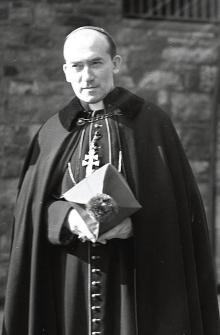
Ordained in 1924, the theology in which McQuaid is trained is conservative — strongly neo-scholastic and hostile to modernism and liberalism. His hatred of the French Revolution is expressed in several pastorals and speeches throughout his career. He also regards Protestantism as a fundamental error from which Irish Catholics should be quarantined as much as possible.
Appointed Dean of Studies at Blackrock College, McQuaid becomes a prominent figure in Catholic education and chairs the Catholic Headmasters’ Association for several years. In 1931 he is appointed president of Blackrock College, in which capacity he becomes acquainted with Éamon de Valera, the future Irish Taoiseach whose sons attend the school. In 1936 while drafting a new Irish constitution, de Valera consults McQuaid, although he rejects McQuaid’s draft “One, True Church” clause which states, among other things, that the Catholic Church is the one true church in Ireland.
When McQuaid is appointed Archbishop of Dublin in 1940, the appointment of a priest from the regular clergy causes considerable surprise. Irish government archives reveal that de Valera, as is suspected at the time, presses McQuaid’s claims at the Vatican. However, it is doubtful whether the Vatican needs much persuasion. There is a dearth of potential episcopal talent and McQuaid has an outstanding reputation as a Catholic educationalist.
Once appointed, McQuaid proves to be one of the ablest administrators in the history of the Irish Church. In the first two years of his episcopate, he sets up the Catholic Social Service Conference to alleviate the poverty and distress in Dublin which is aggravated by the war, and the Catholic Social Welfare Bureau to help the thousands of Irish emigrants going to Britain for war work. These two organizations fill a much-needed gap and continue to exist after the war. The expansion of Dublin city and its suburbs during his episcopate requires the building of new churches, schools, and hospitals. Meeting these demands also necessitates a considerable increase in the number of clergies, secular and regular, whose numbers more than double in the period from 1941 to 1972.
Given his previous career, the importance McQuaid assigns to education is not surprising. He is critical of the low priority accorded to education by successive governments and is particularly critical of the poor and pay conditions of teachers. His intervention in the primary teachers’ strike in 1946 is poorly received by the government and marks the souring of his relationship with de Valera. During his episcopate the number of primary schools increases by a third while the number of secondary schools more than double but, as with social welfare, the government increasingly assumes a dominant role in education from the 1960s onwards. Almost immediately after his appointment in 1940, he takes a hardline stand against the attendance of Catholic students at Trinity College Dublin (TCD). The ban lasts until 1970, when the increase in student numbers renders it untenable and he accedes reluctantly.
McQuaid has a formidable list of achievements in health care, especially maternity and pediatric services, physical and mental handicap services, and the treatment of alcoholism. It is ironic, therefore, that the most controversial episode of his career occurs in this area — the Irish hierarchy’s rejection in 1951 of a free mother-and-child health service. This leads to the resignation of the Minister for Health, Dr. Noël Browne, and is a watershed in Church-State relations in Ireland. With Irish tuberculosis and infant mortality statistics ranking among the highest in the world, the hierarchy, and particularly McQuaid, lose considerable support by lining up with the conservative medical establishment to resist efforts at socialized medicine.
From various pastorals that McQuaid issues at the time, it is clear that he does not see the need for the Second Vatican Council. As its deliberations proceed, his unease grows, and he becomes increasingly preoccupied with the issue of episcopal power and independence that he believes are being threatened by the Council. In the areas of liturgical reform, greater lay participation, and ecumenism, he is slow in implementing the Vatican II reforms. His views on ecumenism had always been lukewarm and had led to allegations that he was anti-Protestant. His personality and policies are criticized by a more assertive Dublin laity, but being a shy, reserved man who increasingly feels the isolation of office, he never responds to such comments. In 1968 the reaction to Humanae vitae causes open rebellion in the Dublin diocese, the force of which catches him unaware. His last pastoral as archbishop in 1971 betrays his anger and bemusement at the response to Humanae vitae in Dublin.
McQuaid’s substantial archives are released by the Dublin Diocesan Archives in the late 1990s. In 1999 journalist John Cooney publishes a hostile biography of McQuaid, which makes controversial allegations of sexual abuse against McQuaid. The allegations are based on tenuous evidence gathered by McQuaid’s nemesis from the 1951 Mother and Child controversy, Dr. Noël Browne, who had died in 1997. No corroborating evidence is produced or has since emerged.
Plunkett is born on November 1, 1625 (earlier biographers give his date of birth as November 1, 1629, but 1625 has been the consensus since the 1930s) in Loughcrew, County Meath, to well-to-do parents with Hiberno-Norman ancestors. A grandson of James Plunket, 8th Baron Killeen (c. 1542-1595), he is related by birth to a number of landed families, such as the recently ennobled Earls of Roscommon, as well as the long-established Earls of Fingall, Lords Louth, and Lords Dunsany. Until his sixteenth year, his education is entrusted to his cousin Patrick Plunkett, Abbot of St. Mary’s, Dublin, and brother of Luke Plunket, 1st Earl of Fingall, who later becomes successively Bishop of Ardagh and of Meath.
As an aspirant to the priesthood, Plunkett sets out for Rome in 1647, under the care of Father Pierfrancesco Scarampi of the Roman Oratory. At this time the Irish Confederate Wars are raging in Ireland. These are essentially conflicts between native Irish Catholics, English and Irish Anglicans and Nonconformists. Scarampi is the Papal envoy to the Catholic movement known as the Confederation of Ireland. Many of Plunkett’s relatives are involved in this organisation.
Plunkett is admitted to the Pontifical Irish College in Rome and proves to be an able pupil. He is ordained a priest in 1654 and deputed by the Irish bishops to act as their representative in Rome. Meanwhile, the Cromwellian conquest of Ireland (1649–53) had defeated the Catholic cause in Ireland. In the aftermath the public practice of Catholicism is banned, and Catholic clergy are executed. As a result, it is impossible for Plunkett to return to Ireland for many years. He petitions to remain in Rome and, in 1657, becomes a professor of theology. Throughout the period of the Commonwealth and the first years of Charles II‘s reign, he successfully pleads the cause of the Irish Catholic Church and also serves as theological professor at the College of Propaganda Fide. At the Congregation of Propaganda Fide on July 9, 1669, he is appointed Archbishop of Armagh, the Irish primatial see, and is consecrated on November 30 at Ghent by the Bishop of Ghent, Eugeen-Albert, count d’Allamont. He eventually sets foot on Irish soil again on March 7, 1670, as the Stuart Restoration of 1660 had begun on a basis of toleration. The pallium is granted him in the Consistory of July 28, 1670.
After arriving back in Ireland, Plunkett tackles drunkenness among the clergy, writing, “Let us remove this defect from an Irish priest, and he will be a saint.” The Penal Laws had been relaxed in line with the Declaration of Breda in 1660 and he is able to establish a Jesuit College in Drogheda in 1670. A year later 150 students attend the college, no fewer than 40 of whom are Protestant, making this college the first integrated school in Ireland. His ministry is a successful one and he is said to have confirmed 48,000 Catholics over a four-year period. The government in Dublin, especially under the Lord Lieutenant of Ireland, James Butler, 1st Duke of Ormond (the Protestant son of Catholic parents), extend a generous measure of toleration to the Catholic hierarchy until the mid-1670s.
On the enactment of the Test Act in 1673, to which Plunkett does not agree for doctrinal reasons, the college is closed and demolished. He goes into hiding, travelling only in disguise, and refuses a government edict to register at a seaport to await passage into exile. For the next few years, he is largely left in peace since the Dublin government, except when put under pressure from the English government in London, prefer to leave the Catholic bishops alone.
In 1678 the so-called Popish Plot, concocted in England by clergyman Titus Oates, leads to further anti-Catholic action. Archbishop of DublinPeter Talbot is arrested, and Plunkett again goes into hiding. Despite being on the run and with a price on his head, he refuses to leave his flock. He is arrested in Dublin on December 6, 1679, and imprisoned in Dublin Castle, where he gives absolution to the dying Talbot. He is tried at Dundalk for conspiring against the state by allegedly plotting to bring 20,000 French soldiers into the country, and for levying a tax on his clergy to support 70,000 men for rebellion. Though this is unproven, some in government circles are worried about the possibility that a repetition of the Irish Rebellion of 1641 is being planned and, in any case, this is a convenient excuse for proceeding against Plunkett.
Plunkett is found guilty of high treason in June 1681 “for promoting the Roman faith,” and is condemned to death. Numerous pleas for mercy are made but Charles II, although himself a reputed crypto-Catholic, thinks it too politically dangerous to spare Plunkett.
Plunkett is hanged, drawn and quartered at Tyburn on July 1, 1681, the last Catholic martyr to die in England. His body is initially buried in two tin boxes, next to five Jesuits who had died previously, in the courtyard of St. Giles in the Fields church. The remains are exhumed in 1683 and moved to the Benedictine monastery at Lamspringe, near Hildesheim in Germany. The head is brought to Rome, and from there to Armagh, and eventually to Drogheda where since June 29, 1921, it has rested in St. Peter’s Roman Catholic Church. Most of the body is brought to Downside Abbey, England, where the major part is located today, with some parts remaining at Lamspringe. On the occasion of his canonization in 1975 his casket is opened, and some parts of his body given to the St. Peter’s Church in Drogheda.
Béaslaí is born Percy Frederick Beazley in Liverpool, England on February 15, 1881, to Irish Catholic parents, Patrick Langford Beazley, originally from Killarney, County Kerry, and Nannie Hickey, from Newcastle West, County Limerick. During his summer holidays in his younger years, he spends time in Ireland (near Kenmare, County Kerry) with his paternal uncle, Father James Beazley, where he begins to learn the Irish language. He is educated at St. Francis Xavier’s College in Liverpool, where he develops his keen interest in Irish. By the time he is aged 17 his Irish proficiency is exceptional.
After finishing his education at St. Francis Xavier’s, Béaslaí is encouraged to begin Irish poetry by Tadhg Ó Donnchadha. He follows his father’s footsteps into journalism, initially working for the local Wallasey News. In 1906 he moves to Dublin, and within a year becomes a freelance writer for the Irish Peasant, Irish Independent, Freeman’s Journal and Express. He is offered a permanent position with Independent Newspapers, as assistant leader writer and special reporter for the Dublin Evening Telegraph. He writes regularly for the Freeman’s Journal, including a daily half-column in Irish.
After his early introduction to Irish poetry Béaslaí becomes involved in staging Irish-language amateur drama at the Oireachtas annual music festival. He begins to write both original works and adaptations from foreign languages. One of these works, Eachtra Pheadair Schlemiel (1909), is translated from German into Irish.
Later Béaslaí continues to write poetry, such as the collection “Bealtaine 1916” agus Dánta Eile (1920), and short stories such as “Earc agus Aine agus Scéalta Eile.” Between 1913 and 1939 he writes many plays, including Cliuche Cartaí (1920), An Sgaothaire agus Cúig Drámaí Eile (1929), An Danar (1929) and An Bhean Chródha (1931). He writes two books about his comrade Michael Collins: Michael Collins and the Making of a New Ireland (2 volumes, 1926) and Michael Collins: Soldier and Statesman (1937).
Béaslaí’s works revolve around the Irish language movement and the Irish Republican Army (IRA), focusing on the independence struggle of Ireland. He writes about these topics in newspapers such as the Standard and The Kerryman. His most notable work in newspapers during his later life includes his contribution to the Irish Independent, which publishes a section called ‘A Veteran Remembers’ five days a week from May 16 to June 1957, as well as a weekly section called ‘Moods and Memories’ on Wednesdays from May 24, 1961, to June 16, 1965.
One of the awards Béaslaí gains during his career is on August 14, 1928, a gold medal at the Tailteann Literary Awards. While in Dublin, he joins the Keating Branch of the Gaelic League, and after he moves to Ireland, he begins using the Irish form of his name, Piaras Béaslaí, rather than Percy Beazley.
Béaslaí is a founding member of the Irish Volunteers in 1913. In January 1916 he serves as a courier for political activist and revolutionary leader Seán Mac Diarmada. By the time of the Easter Rising that year, he is deputy commanding officer of the 1st Dublin Battalion. In an audio recording to which he contributes in 1958, he details his experience in the Rising, describing the rebels assembling before noon in Blackhall Street at battalion headquarters. After midday they march out to the Four Courts, erecting barricades as they do so. The Four Courts is his main station.
In the audio, Béaslaí recalls a green flag with a gold harp in the centre. This is the non-Sinn Féin flag at the time. He is in direct charge of the Four Courts area, and at one point during the fight he orders a complete blackout. He recalls, “things were going badly for the English soldiers” and describes the whole event as “a weird experience.” He remembers the streets being lit up with fires in the darkness as if it were bright as day. He speaks of the intensity of the firing line and then how it suddenly ceases on the Friday. He remembers falling asleep and when he awakens being presented with Patrick Pearse‘s order to surrender. The rebels are brought to Richmond Barracks. He then spends fifteen months in English prisons.
Béaslaí serves three years of penal servitude divided between a stringent HM Prison Portland and a more lenient HM Prison Lewes. He is then imprisoned two times within four months during 1919, both terms ending in celebrated escapes. After his final prison release, Michael Collins approaches him about editing An tOglach, the Irish Volunteer newspaper. This sees communication between GHQ and local volunteers drastically improve.
Later, Béaslaí becomes director of publicity for the Irish Republican Army, and at the 1918 Irish general election he is elected to the First Dáil as Sinn Féin MP for East Kerry. Sinn Féin MPs elected in the Westminster elections of 1918 refuse to recognise the Parliament of the United Kingdom, and instead assemble the following January at the Mansion House in Dublin as a revolutionary parliament, Dáil Éireann. Béaslaí is noted for his translation of the democratic programme of the First Dáil, which he reads aloud at the inaugural sitting.
Béaslaí and Con Collins share the distinction of having been elected in three Irish general elections unopposed by any other candidates.
During Béaslaí’s time in London, he gives a lot of his time to the Gaelic League. In the Keating branch of the league, in Ireland, he develops an interest in the IRB. Cathal Brugha, a branch member, asks him to join the IRB. The Keating branch is where Béaslaí meets Michael Collins, eventually introducing Collins to his cousin and fellow branch member, Elizabeth Mernin. He is also instrumental in establishing An Fáinne, an Irish-speaking league whose members vow to speak solely Irish among themselves and wear a membership badge of a circle. This coincides with his involvement in the IRB. His love of the Irish language gives him an opportunity to delve into his other hobbies. He writes for Banba, an Irish journal published by the Gaelic League. He is able to express his love for theatre, in the Gaelic League, forming a group of men called “Na hAisteoirí.”
Doyle is born close to New Ross, County Wexford in 1786, the posthumous son of a respectable Catholic farmer. His mother, Anne Warren, of Quaker extraction, is living in poverty at the time of his birth. At the age of eleven he witnesses the horrors of the Battle of New Ross between the United Irishmen and British Crown forces supplemented by the militia and yeomanry.
Doyle receives his early education at Clonleigh, at Rathconrogue at the school of a Mr. Grace, and later at the Augustinian College, New Ross under the care of an Augustinian monk, Rev. John Crane.
Doyle joins the Augustinian friars in 1805 at Grantstown, County Wexford, and then studies for his doctorate at Coimbra in Portugal (1806–08). His studies are disturbed by the Peninsular War, during which he serves as a sentry in Coimbra. Later, he accompanies the British Army with Arthur Wellesley‘s forces to Lisbon as an interpreter.
Following Doyle’s return to Ireland, he is ordained to the priesthood on October 1, 1809, at Enniscorthy. He teaches logic at the Augustinian College, New Ross. In 1813, he is appointed to a professorship at St. Patrick’s, Carlow College, holding the Chair of Rhetoric and in 1814, the Professorship of Theology.
Michael Corcoran, Bishop of Kildare and Leighlin, dies on February 22, 1819. Doyle is a popular choice of the clergy and bishops of the Archdiocese of Dublin and is chosen by the Holy See as Corcoran’s successor. He is formally named in August 1819 and is duly consecrated in Carlow Parish Church on November 14. During his fifteen-year tenure as Bishop of Kildare and Leighlin, he earns respect nationwide for his polemics in furtherance of the Catholic position in both Irish and British society, and in supporting the work of the Catholic Association. His books on pastoral, political, educational and inter-denominational matters provide a rich source of material for social and religious historians. He is a close ally of Daniel O’Connell in the political campaign for Catholic emancipation which is finally passed in 1829 by the Wellington government.
In 1830, the new tithe-proctor of Graigue, a parish of 4,779 Catholics and 63 Protestants, decides to break with the tradition of Doyle’s predecessor and to enforce seizure orders for the collection of arrears of Tithes. Tithes provide financial support of the established AnglicanChurch of Ireland. Some of the recalcitrant Catholics habitually transfer ownership of their livestock to Doyle in order to avoid seizure at the town fair. The new proctor requests their priest’s cooperation in handing over the assets. Doyle refuses, and the proctor, aided by the Royal Irish Constabulary, seize some of the livestock. A mass riot breaks out at the fair and there is several casualties. A civil disobedience campaign follows, peppered with sporadic violence mostly at county fairs over the seizure of livestock. A period of instability that becomes known as the Tithe War follows.
Doyle is a leader of nonviolent resistance to the Tithe, devoting himself both to strengthening the nonviolent resistance and to discouraging like paramilitary secret societies who have taken to using violence to drive out tithe-collectors and to intimidate collaborators. He says, “I maintain the right which [Irish Catholics] have of withholding, in a manner consistent with the law and their duty as subjects, the payment of tithe in kind or in money until it is extorted from them by the operation of the law.”
Given Doyle’s prior experience in education, his major contribution is arguably in helping the establishment of National Schools across Ireland from 1831, the initiative of Edward Smith-Stanley, Chief Secretary for Ireland, which are initially started with a UK government grant of £30,000. The proposed system is ahead of state provision for education in England or Scotland at that time. This Model School prototype is, in some respects, experimental. His involvement is a sign of his practicality and foresight.
Doyle makes statements on other issues: the theological status of ‘non-Catholic’ Christians, freedom to convert to Protestantism, mixed marriages and, as already mentioned, on the union of Catholics and Anglicans. On this last issue he is asked to resign by Rome and is eventually allowed to continue after agreeing not to speak on the issue again.
The construction of Carlow Cathedral of the Assumption crowns Doyle’s career, being started in 1828 and finished at the end of November 1833. He falls ill for a number of months before dying on June 15, 1834. He is buried in his new cathedral. A sculpture, by John Hogan, in memorial to Doyle is finished in 1839.
Several biographies are written on Doyle before 1900 and his influence on the later Irish Catholic bishops in the period 1834-1900 is considerable. He had proved that negotiations with government could be beneficial to his church, his congregation, and its finances.
Griffin is born in Limerick, County Limerick, on December 12, 1803, the youngest son of thirteen children of a substantial Catholic farming family. Patrick Griffin, his father, also makes a living through brewing, and he participates as one of Henry Grattan‘s Irish Volunteers (18th century). His mother comes from the ancient O’Brien dynasty and first introduces him to English literature. When he is aged seven, the family moves to Fairy Lawn, a house near Loghill, County Clare, which sits on a hill above the bank of the Shannon Estuary, about twenty-seven miles from Limerick. Here he has an idyllic childhood and receives a classical education.
In 1820 the family at Fairy Lawn is broken up. The parents with several of the children emigrate to the United States and settle in Pennsylvania. Griffin, with one brother and two sisters, is left behind under the care of his elder brother William, a practicing physician in Adare, County Limerick. He meets John Banim in Limerick. Inspired by the successful production of Banim’s play Damon and Pythias (1821), Griffin, at nineteen years of age, moves to London in 1823. After an unsuccessful attempt at becoming a playwright, he endures years of poverty in London, managing only to scrape by through writing reviews for periodicals and newspapers. At the end of two years, he obtains steady employment in the publishing house as reader and reviser of manuscripts, and in a short time becomes frequent contributor to some of the leading periodicals and magazines. His early pieces in The Literary Gazette vividly describe the rural setting of his childhood, recount Irish folklore, translate the Celtic Irish language for the English readers, and, as Robert Lee Wolff observes, “waxed richly sardonic about Irishmen who tried to be more English than the English.”
Griffin’s Holland-Tide or Munster Popular Tales is published by Simpkin & Marshall in 1827. Holland-Tide is a collection of seven short stories, all of which are told in the house of a hospitable Munster farmer during All Hallows’ Eve in Munster. Holland-Tide establishes his reputation, and he returns to Ireland, where he writes Tales of the Munster Festivals in Pallaskenry to which his brother William has moved.
Experience leads Griffin to modify his expectations in relation to literary work, and, with a view to the legal profession, he enters the University of London as a law student, but in a short time removes to Dublin for the study of ancient Irish history, preparatory to his work The Invasion, which is published in 1832. This work has a good sale and is highly praised by scholars but never becomes popular.
With the exception of a tour through Scotland and a short trip on the European continent, Griffin lives with his brother, keeping up to some extent his literary labours. By 1833, he is increasingly concerned that he is wasting his time and begins to devote himself to teaching the poor children of the neighborhood. In 1838, hes all of his unpublished manuscripts and joins the Congregation of Christian Brothers, a Catholic religious order which has as its special aim the education of children of the poor. Writing to an old friend he says he feels a great deal happier in the practice of this daily routine than he ever did while roving about the great city, absorbed in the modest project of rivaling Shakespeare and throwing Scott in the shade. In June 1839, he is transferred from Dublin to Cork, where he dies of typhus fever at the age of thirty-six on June 12, 1840.
One of Griffin’s most famous works is The Collegians, a novel based on a trial that he had reported on, involving the murder of a young Irish Catholic girl (Ellen Hanley) by a ProtestantAnglo-Irish man (John Scanlon). The novel is later adapted for the stage as The Colleen Bawn by Dion Boucicault.
Griffin has a street named after him in Limerick and another in Cork. Loughill/Ballyhahill GAA club in west Limerick plays under the name of Gerald Griffins.
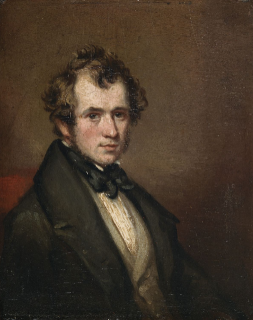
(Pictured: “Portrait of Gerald Griffin (1803-1840), Poet and Novelist,” painting by Richard Rothwell (1800-1868), National Gallery of Ireland)
Butler is born in Cambrai, France, the youngest daughter of Walter Butler, 16th Earl of Ormonde, of Garryricken, County Tipperary, and his wife, Ellen (née Morres), of Latargh, County Tipperary. Her family are members of the old Catholic gentry, and her father is the sole lineal representative of James Butler, 2nd Duke of Ormonde. In 1740 her family returns to the Garryricken estate, where she spends part of her childhood. She is educated by the English Benedictine nuns of the convent of Our Lady of Consolation in Cambrai, where her Jacobite grand-aunt is a pensioner. Reared in the liberal and anti-clerical environment at Cambrai, she is open about her opposition to Irish Catholicism. She is also well read in literature.
By the time Butler returns to Ireland, her brother John has claimed the family titles and is recognised as 17th Earl of Ormonde. Though he never uses the title, his sisters are recognised as the daughters of an earl. As the family is impoverished, and she is not disposed to marriage, a decade is passed in unhappiness. Then in 1768 the thirteen-year-old Sarah Ponsonby arrives in Kilkenny to attend a local school. Following her visit to the Butler home at Kilkenny Castle, and despite the difference in age, the two form an immediate friendship and correspond secretly, having discovered their mutual interest in the arts and Jean-Jacques Rousseau‘s ideal of pastoral retirement.
Ponsonby, on finishing school, is sent to live with relatives at the nearby Woodstock Estate, and there is subject to the uninvited attention of a middle-aged guardian. Butler is discontented with her life and the prospects of her family’s wish to send her back to Cambrai, so the two plan to leave their difficulties behind and settle in England. In their first attempt to flee in March 1778, they leave for Waterford disguised as men and wielding pistols, but their families manage to catch up with them. Butler is then sent to the home of her brother-in-law Thomas ‘Monarch’ Kavanagh of Borris, County Carlow, but makes a second, successful attempt and runs away to find Ponsonby at the Woodstock Estate. Her persistence wins out when both families finally capitulate and accept their plans to live together.
The two set out for Wales in May 1778 and, after an extensive tour of Wales and Shropshire, eventually settle in Llangollen Vale, where they rent a cottage which is renamed Plas Newydd. They are accompanied by Mary Carryl, a former servant of the Woodstock household, who remains in their service until her death in 1809. Having made a deliberate decision to retire from the world, they spend the greater part of their days corresponding with friends, reading, building up a large library and making alterations to Plas Newydd, which takes on a fashionable Gothic look. Their garden, landscaped under their direction, becomes a popular attraction for visitors. Butler meticulously records their daily routine in a series of journals, some of which are now lost.
Their seclusion, eccentricities, semi-masculine dress and short-cropped powdered hair gain them notoriety, and it becomes fashionable to call on them. Their numerous and illustrious visitors include Hester Lynch Piozzi, Charles and Erasmus Darwin, Sir Walter Scott, Sir Arthur Wellesley, the Duke of Gloucester and Josiah Wedgwood. In 1792 they entertain Pamela Sims, later that year to become the wife of Lord Edward FitzGerald, and her mother Madame de Genlis. Following the arrest of Edward FitzGerald in 1798, Pamela and her suite flee to London and on May 27 pass through Llangollen, where the events in Dublin are already known. On hearing that Pamela FitzGerald is staying in the local inn, Butler and Ponsonby invite her to call in. However, when Pamela wishes to stay for the day, their apprehension of Jacobinism leads them to persuade her “principally for her own sake and a little for [our] own to proceed as fast and as incognito as possible for London.”
Both Anna Seward and William Wordsworth, who stay at Plas Newydd, write poems celebrating their friendship, and Lord Byron sends them a copy of The corsair. Owing to her support of the Bourbons, Butler is sent the Croix St. Louis, which she wears about her neck. Their celebrity does have its drawbacks: an article in the General Evening Post of July 24, 1790, entitled ‘Extraordinary female affection’, suggests indirectly that their relationship is unnatural. Butler is particularly angered by this publicity and appeals to Edmund Burke for legal advice. Their retirement is also continually dogged by financial difficulties. They live mainly off their respective allowances and Butler’s royal pension, granted through the influence of Lady Frances Douglas, but spend beyond their means and are often in debt. To add to their problems, Butler receives no mention in her father’s will. However, the Gothic eccentricities of their cottage, which they succeed over time in purchasing, and garden attract even the interest of Queen Charlotte.
Though it is claimed that neither woman spent a night away from Plas Newydd, in January 1786 they stay with their friends the Barretts of Oswestry, and that September they visit Sir Henry Bridgeman of Weston Park, near Staffordshire. In June 1797 they take their only holiday, at the coastal resort of Barmouth. Despite their isolation they are well informed about international events and society gossip. The Irish serjeant-at-law Charles Kendal Bushe recalls how they gave him all the news of Dublin, London, Cheltenham, and Paris. In later years Butler’s eyesight deteriorates, preventing her from keeping her journal. She is secretly painted as an old woman with Ponsonby by Lady Mary Leighton and sketched by Lady Henrietta Delamere. A distinctive, anonymous silhouette shows the two generously proportioned women in traditional riding habits (National Portrait Gallery, London).
Butler dies on June 2, 1829, and is buried alongside Mary Carryl at St. Collen’s Church in Llangollen. Sarah Ponsonby is subsequently buried with them.
(From: “Butler, Lady (Charlotte) Eleanor” by Frances Clarke, Dictionary of Irish Biography, http://www.dib.ie)
The Teebane bombing takes place on January 17, 1992, at a rural crossroads between Omagh and Cookstown in County Tyrone, Northern Ireland. A roadside bomb destroys a van carrying 14 construction workers who had been repairing a British Army base in Omagh. Eight of the men are killed and the rest are wounded. The Provisional Irish Republican Army (IRA) claims responsibility, saying that the workers were killed because they were “collaborating” with the “forces of occupation.”
Since the beginning of its campaign in 1969, the Provisional IRA has launched frequent attacks on British Army and Royal Ulster Constabulary (RUC) bases in Northern Ireland. In August 1985 it begins targeting civilians who offer services to the security forces, particularly those employed by the security forces to maintain and repair its bases. Between August 1985 and January 1992, the IRA kills 23 people who had been working for (or offering services to) the security forces. The IRA also alleges that some of those targeted had links with Ulster loyalistparamilitaries.
On the evening of January 17, 1992, the 14 construction workers leave work at Lisanelly British Army base in Omagh. They are employees of Karl Construction, based in Antrim. They travel eastward in a Ford Transit van towards Cookstown. When the van reaches the rural Teebane Crossroads, just after 5:00 PM, IRA volunteers detonate a roadside bomb containing an estimated 600 pounds (270 kg) of homemade explosives in two plastic barrels. Later estimates report a 1,500-pound (680 kg) device. The blast is heard from at least ten miles away. It rips through one side of the van, instantly killing the row of passengers seated there. The vehicle’s upper part is torn asunder, and its momentum keeps it tumbling along the road for 30 yards. Some of the bodies of the dead and injured are blown into the adjacent field and ditch. IRA volunteers had detonated the bomb from about 100 yards away using a command wire. A car travelling behind the van is damaged in the explosion, but the driver is not seriously injured. Witnesses report hearing automatic fire immediately prior to the explosion.
Seven of the men are killed outright. They are William Gary Bleeks (25), Cecil James Caldwell (37), Robert Dunseath (25), David Harkness (23), John Richard McConnell (38), Nigel McKee (22) and Robert Irons (61). The van’s driver, Oswald Gilchrist (44), dies of his wounds in hospital four days later. Robert Dunseath is a British soldier serving with the Royal Irish Rangers. The other six workers are badly injured; two of them are members of the Ulster Defence Regiment (UDR). It is the highest death toll from one incident in Northern Ireland since 1988.
The IRA’s East Tyrone Brigade claims responsibility for the bombing soon afterward. It argues that the men were legitimate targets because they were “collaborators engaged in rebuilding Lisanelly barracks” and vowed that attacks on “collaborators” would continue.
Both unionist and Irish nationalist politicians condemn the attack. Sinn Féin president Gerry Adams, however, describes the bombing as “a horrific reminder of the failure of British policy in Ireland.” He adds that it highlights “the urgent need for an inclusive dialogue which can create a genuine peace process.” British Prime MinisterJohn Major visits Northern Ireland within days and promises more troops, pledging that the IRA will not change government policy.
As all of those killed are Protestant, some interpret the bombing as a sectarian attack against their community. Less than three weeks later, the Ulster loyalist Ulster Defence Association (UDA) launches a ‘retaliation’ for the bombing. On February 5, two masked men armed with an automatic rifle and revolver enter Sean Graham’s betting shop on Ormeau Road in an Irish nationalist area of Belfast. The shop is packed with customers at the time. The men fire indiscriminately at the customers, killing five Irish Catholic civilians, before fleeing to a getaway car. The UDA claims responsibility using the cover name “Ulster Freedom Fighters,” ending its statement with “Remember Teebane.” After the shootings, a cousin of one of those killed at Teebane visits the betting shop and says, “I just don’t know what to say but I know one thing – this is the best thing that’s happened for the Provos [Provisional IRA] in this area in years. This is the best recruitment campaign they could wish for.”
The Historical Enquiries Team (HET) conducts an investigation into the bombing and releases its report to the families of the victims. It finds that the IRA unit had initially planned to carry out the attack on the morning of January 17 as the workers made their way to work but, due to fog, it was put off until the afternoon. Although suspects were rounded up and there were arrests in the wake of the attack, nobody has ever been charged or convicted of the bombing.
Karl Construction erects a granite memorial at the site of the attack and a memorial service is held there each year. In January 2012, on the 20th anniversary of the attack, Democratic Unionist Party (DUP) MLA, Trevor Clarke, whose brother-in-law Nigel McKee at age 22 was the youngest person killed in the bombing, demands that republicans provide the names of the IRA bombers.






 seamus dubhghaill