seamus dubhghaill

Promoting Irish Culture and History from Little Rock, Arkansas, USA


Leave a comment

Birth of John Millington Synge, Poetic Dramatist

John Millington Synge, a leading figure in the Irish Literary Revival, is born at Rathfarnham, near Dublin, on April 16, 1871. He is a poetic dramatist of great power who portrays the harsh rural conditions of the Aran Islands and the western Irish seaboard with sophisticated craftsmanship.

After studying at Trinity College and at the Royal Irish Academy of Music in Dublin, Synge pursues further studies from 1893 to 1897 in GermanyItaly, and France. In 1894 he abandons his plan to become a musician and instead concentrates on languages and literature. He meets William Butler Yeats while studying at the Sorbonne in Paris in 1896. Yeats inspires him with enthusiasm for the Irish renaissance and advises him to stop writing critical essays and instead to go to the Aran Islands and draw material from life. Already struggling against the progression of Hodgkin’s lymphoma which is untreatable at the time and eventually causes his death, Synge lives in the islands during part of each year between 1898 and 1902, observing the people and learning their language, recording his impressions in The Aran Islands (1907) and basing his one-act plays In the Shadow of the Glen and Riders to the Sea (1904) on islanders’ stories. In 1905 his first three-act play, The Well of the Saints, is produced.

Synge’s travels on the Irish west coast inspire his most famous play, The Playboy of the Western World (1907). This morbid comedy deals with the moment of glory of a peasant boy who becomes a hero in a strange village when he boasts of having just killed his father but who loses the villagers’ respect when his father turns up alive. In protest against the play’s unsentimental treatment of the Irishmen’s love for boasting and their tendency to glamorize ruffians, the audience riots at its opening at Dublin’s Abbey Theatre. Riots of Irish Americans accompany its opening in New York City in 1911, and there are further riots in Boston and Philadelphia. Synge remains associated with the Abbey Theatre, where his plays gradually win acceptance, until his death. His unfinished Deirdre of the Sorrows, a vigorous poetic dramatization of one of the great love stories of Celtic mythology, is performed there in 1910.

John Millington Synge dies at the Elpis Nursing Home in Dublin on March 24, 1909, at the age of 37, and is buried in Mount Jerome Cemetery and CrematoriumHarold’s Cross, Dublin.

In the seven plays he writes during his comparatively short career as a dramatist, Synge records the colourful and outrageous sayings, flights of fancy, eloquent invective, bawdy witticisms, and earthy phrases of the peasantry from Kerry to Donegal. In the process he creates a new, musical dramatic idiom, spoken in English but vitalized by Irish syntax, ways of thought, and imagery.


Leave a comment

The American Civil War Begins

The American Civil War begins on April 12, 1861. There is perhaps no other ethnic group so closely identified with the Civil War years and the immediate aftermath of the war as Irish Americans.

Of those Irish who come over much later than the founding generations, fully 150,000 of them join the Union army. Unfortunately, statistics for the Confederacy are sketchy at best. Still, one has but to listen to the Southern accent and listen to the sorts of tunes Southern soldiers love to sing to realize that a great deal of the South is settled by Irish immigrants. But because the white population of the Confederate states is more native-born than immigrant during the Civil War years, there does not seem as much of a drive in the Southern army to recognize heritage in the names and uniforms of regiments as there is in the Union forces.

In the Union army there is the fabled Irish Brigade, likely the best known of any brigade organization, organized in 1861 and led by the flamboyant General Thomas Francis Meagher. They go into battle with an emerald green flag with a large golden harp in its center, celebrating their heritage even in the midst of death. The Irish Brigade makes an unusual reputation for dash and gallantry. It belongs to the First Division of the Second Corps and is numbered as the Second Brigade. The Irish Brigade loses over 4,000 men in killed and wounded during the war; more men than ever belong to the brigade at any given time. The Irish Brigade is commanded, in turn, by General Thomas Francis Meagher, Colonel Patrick Kelly (killed), General Thomas A. Smyth (killed), Colonel Richard Byrnes (killed), and General Robert Nugent.

In the North, centers of Irish settlement are Boston and New York, both of which have sizeable Irish neighborhoods. There are major immigration periods in the 1830s, 1840s, and 1850s. The numbers steadily increase until, according to the 1860 census, well over one and a half million Americans claimed to have been born in Ireland. The majority of these live in the North. There are periods of severe economic difficulties both before and after the war when the immigrant Irish are singled out for the distrust and hatred of their fellow Americans. “No Irish Need Apply” is a frequently seen placard sign above the doors of factories, shops, warehouses, and farms.

The Irish are chiefly distrusted because they are Catholic, and there is much opposition in the United States to the Church of Rome. The frustration this prejudice causes leads indirectly to the boil-over of tempers in July 1863, when the first official draft is held. A mob of mostly immigrant laborers gather at the site of the draft lottery, and as names are called and those not wealthy enough to purchase a substitute are required to join up, the mob’s temper flares.

The situation escalates into full-scale rioting. For three days, cities like New York and Boston are caught up in a rampage of looting, burning, and destruction. Many of the rioters are frustrated Irish laborers who cannot get jobs, and their targets are draft officials, as well as free blacks living in the North, who seem able to get jobs that the Irish are denied. It takes the return of armed troops from the fighting at the Battle of Gettysburg to bring the cities back to peace and quiet.

Such events do little to help the image of the Irish in America, until many years after the war. Despite their wartime heroics, many Irish veterans come home to find the same ugly bias they faced before going off to fight for the Union. Many of them choose to go into the post war army.

Still others follow Thomas Meagher into Canada, where they join up in an attempt to free Canada from British domination. Many simply choose to remain in the Eastern cities, hoping matters will improve as time goes by. Eventually things do get better for the Irish, but it is many long years before ugly anti-Irish prejudice fades.


Leave a comment

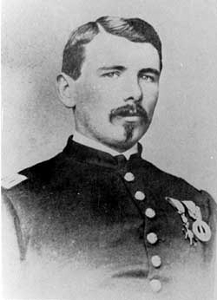
Birth of Myles Walter Keogh, Last Man Killed at the Battle of Little Big Horn

Myles Walter Keogh, soldier in the United States Army, is born in Orchard House in LeighlinbridgeCounty Carlow, on March 25, 1840. It is said by the Sioux that he is the last man killed at the Battle of Little Big Horn, where his horse is the only U.S. survivor.

Keogh attends the National School in Leighlinbridge and is long thought to have attended St. Patrick’s College in Carlow but that college has no record of his attendance. It is possible that he attends St. Mary’s Knockbeg College.

By 1860, a twenty-year-old Keogh volunteers, along with over one thousand of his countrymen, to rally to the defence of Pope Pius IX following a call to arms by the Catholic clergy in Ireland. By August 1860, Keogh is appointed second lieutenant of his unit in the Battalion of St. Patrick, Papal Army under the command of General Christophe Léon Louis Juchault de Lamoricière. Once the fighting is over and duties of the Pontifical Swiss Guard become more mundane, Keogh sees little purpose in remaining in Rome. In March 1862, with civil war raging in America, he resigns his commission in the Company of St. Patrick and sets out for New York City, arriving on April 2.

Keogh actively participates in several prominent American Civil War battles including the Shenandoah Valley, the Battle of Antietam, the Battle of Fredericksburg, and the Battle of Gettysburg.

Perhaps the strongest testimony to Keogh’s bravery and leadership ability comes at the Battle of the Little Bighorn, also known as Custer’s Last Stand, on June 25, 1876. The senior captain among the five companies wiped out with General George Armstrong Custer that day, and commanding one of two squadrons within the Custer detachment, Keogh dies in a “last stand” of his own, surrounded by the men of Company I. When the sun-blackened and dismembered dead are buried three days later, Keogh’s body is found at the center of a group of troopers. The slain officer is stripped but not mutilated, perhaps because of the “medicine” the Indians see in the Agnus Dei (“Lamb of God”) he wears on a chain about his neck or because many of Sitting Bull‘s warriors are believed to be Catholic. Keogh’s left knee has been shattered by a bullet that corresponds to a wound through the chest and flank of his horse, indicating that horse and rider may have fallen together prior to the last rally.

The badly injured animal is found on the fatal battlefield, and nursed back to health as the 7th Cavalry’s regimental mascot, which he remains until his death in 1890. This horse, Comanche, is considered the only U.S. military survivor of the battle, though several other badly wounded horses are found and destroyed at the scene. Keogh’s bloody gauntlet and the guidon of his Company I are recovered by the army three months after Little Bighorn at the Battle of Slim Buttes.

Originally buried on the battlefield, Keogh’s remains are disinterred and taken to Auburn, as he had requested in his will. He is buried at Fort Hill Cemetery on October 26, 1877, an occasion marked by citywide official mourning and an impressive military procession to the cemetery.

Tongue River Cantonment in southeastern Montana is renamed after him to be Fort Keogh. The fort is first commanded by Nelson A. Miles. The 55,000-acre fort is today an agricultural experiment station. Miles City, Montana is located two miles from the old fort.


Leave a comment

Birth of Artist Sarah Henrietta Purser

Sarah Henrietta Purser, Irish artist mainly noted for her work with stained-glass, is born on March 22, 1848, in Kingstown (now Dún Laoghaire) in County Dublin, and raised in DungarvanCounty Waterford. She is educated in Switzerland and afterwards studies at the Metropolitan School of Art in Dublin and in Paris at the Académie Julian.

Purser works mostly as a portraitist. She is also associated with the stained-glass movement, founding a stained-glass workshop, An Túr Gloine, in 1903. Some of her stained-glass work is commissioned from as far as New York City, including a window at Christ Church, Pelham dedicated to the memory of Katharine Temple Emmet and Richard Stockton Emmet, grandson of the Irish patriot, Thomas Addis Emmet. Through her talent and energy and owing to her friendship with the Gore-Booths, she is very successful in obtaining commissions, famously commenting, “I went through the British aristocracy like the measles.”

In 1977 Bruce Arnold noted, “some of her finest and most sensitive work was not strictly portraiture, for example, An Irish Idyll in the Ulster Museum, and Le Petit Déjeuner (in the National Gallery of Ireland).”

Sarah Purser becomes wealthy through astute investments, particularly in Guinness. She is very active in the art world in Dublin and is involved in the setting up of the Hugh Lane Municipal Gallery, persuading the Irish government to provide Charlemont House to house the gallery. In 1923 she becomes the first female member of the Royal Hibernian Academy (RHA).

Until her death she lives for years in Mespil House, a Georgian mansion with beautiful plaster ceilings on Mespil Road, on the banks of the Grand Canal. After her death in Dublin on August 7, 1943, it is demolished and is developed into apartments. She is buried in Mount Jerome Cemetery in Dublin.


Leave a comment

Birth of Physician & Writer William James MacNeven

William James MacNeven, Irish American physician and writer, is born on March 21, 1763, at Ballynahowna, near Aughrim, County Galway. One of the oldest obelisks in New York City is dedicated to him at St. Paul’s Chapel on Broadway while a second obelisk is dedicated to Thomas Emmet, a fellow United Irishman and Attorney General of New York. MacNeven’s monument features a lengthy inscription in Irish, one of the oldest existent dedications of this kind in the Americas.

The eldest of four sons, at the age of 12 MacNeven is sent by his uncle Baron MacNeven to receive his education abroad, for the penal laws render education impossible for Catholics in Ireland. This Baron MacNeven is William O’Kelly MacNeven, an Irish exile physician, who for his medical skill in her service has been created an Austrian noble by the Empress Maria Theresa. Young MacNeven makes his collegiate studies at Prague. His medical studies are made at Vienna where he is a pupil of Pestel and takes his degree in 1784. The same year he returns to Dublin to practise.

MacNeven becomes involved in the United Irishmen of the time, with such men as Lord Edward FitzGeraldThomas Addis Emmet, and his brother Robert Emmet. He is arrested in March 1798, and confined in Kilmainham Gaol, and afterwards in Fort George, Scotland, until 1802, when he is liberated and exiled. In 1803, he is in Paris seeking an interview with Napoleon Bonaparte in order to obtain French troops for Ireland. Disappointed in his mission, MacNeven comes to America, landing at New York on July 4, 1805.

In 1807, MacNeven delivers a course of lectures on clinical medicine in the recently established College of Physicians and Surgeons. Here in 1808, he receives the appointment of professor of midwifery. In 1810, at the reorganization of the school, he becomes the professor of chemistry, and in 1816 is appointed in addition to the chair of materia medica. In 1826 with six of his colleagues, he resigns his professorship because of a misunderstanding with the New York Board of Regents and accepts the chair of materia medica in Rutgers Medical College, a branch of the New Jersey institution of that name, established in New York as a rival to the College of Physicians and Surgeons. The school at once becomes popular because of its faculty, but after four years is closed by legislative enactment on account of interstate difficulties. The attempt to create a school independent of the regents results in a reorganization of the University of the State of New York.

MacNeven’s best known contribution to science is his “Exposition of the Atomic Theory” (New York, 1820), which is reprinted in the French Annales de Chimie. In 1821 he publishes with emendations an edition of Brande’s “Chemistry” (New York, 1829). Some of his purely literary works, his “Rambles through Switzerland” (Dublin, 1803), his “Pieces of Irish History” (New York, 1807), and his numerous political tracts attract wide attention. He is co-editor for many years of the “New York Medical and Philosophical Journal.”

William James MacNeven dies on July 13, 1841, at the age of 78 in New York City.


Leave a comment

Birth of U2 Bassist Adam Clayton

adam-clayton

Adam Charles Clayton, Irish musician best known as the bass guitarist of the rock band U2, is born in Chinnor, Oxfordshire, England, on March 13, 1960.

Clayton is the oldest child of Brian and Jo Clayton. His father is a pilot with the Royal Air Force, who moves into civil aviation, and his mother is a former airline flight attendant. When he is 4 years old his father works in Kenya as a pilot with East African Airways. Clayton regards this as the happiest period of his childhood. In 1965 the family moves to Malahide, County Dublin, where Clayton’s brother Sebastian is born. The Clayton family becomes friends with the Evans family, including their son, David, who later becomes a fellow U2 band-member with Clayton.

When he is eight years old Clayton is sent to the private junior boarding Castle Park School in Dalkey, Dublin, which he did not enjoy because he is not particularly sports orientated. At age 13 he enters the private St. Columba’s College secondary school in Rathfarnham, Dublin. Here he makes friends with other pupils who are enthusiastic about pop/rock music. It is here in the school band where Clayton plays the bass guitar for the first time.

Clayton later changes school to Mount Temple Comprehensive School in Dublin, where he meets future bandmates, Paul Hewson (aka “Bono“) and Larry Mullen Jr., and is reunited with his childhood friend David Evans (aka “The Edge”). In September 1976, Mullen puts an advert onto the school’s bulletin board seeking other musicians to form a band. The original band is a five-piece band known as “Feedback,” consisting of Bono, The Edge, Mullen, Dik Evans, and Clayton. The name is subsequently changed to “The Hype,” but changes to “U2” soon after Dik Evans leaves the band. Clayton stands in as the nearest thing that the band has to a manager in its early life, handing over the duties to Paul McGuinness in May 1978.

In 1981, around the time of U2’s second, spiritually charged October album, a rift is created in the band between Clayton and McGuinness, and the three other band members. Bono, The Edge, and Mullen have joined a Christian group, and are questioning the compatibility of rock music with their spirituality. However, Clayton, with his more ambiguous religious views, is less concerned, and so is more of an outsider, until Bono’s wedding to Alison Hewson (née Stewart), in which Clayton is the best man.

Clayton makes international headlines in August 1989 when he is arrested in Dublin for carrying a small amount of marijuana. He avoids conviction by making a large donation to charity. Clayton also has alcohol problems, which come to a head on November 26, 1993, when he is so hung over that he is unable to play that night’s show in Sydney, the dress rehearsal for their Zoo TV concert film. Bass duties are fulfilled by Clayton’s technician Stuart Morgan. After that incident, however, Clayton gives up alcohol.

In 1995, after the Zoo TV Tour and Zooropa album, Clayton heads to New York City with bandmate Mullen to receive formal training in the bass as until then Clayton has been entirely self-taught. Bono says of Clayton’s early bass playing, “Adam used to pretend he could play bass. He came round and started using words like ‘action’ and ‘fret’ and he had us baffled. He had the only amplifier, so we never argued with him. We thought this guy must be a musician; he knows what he’s talking about. And then one day, we discovered he wasn’t playing the right notes. That’s what’s wrong, y’know?”

In 2011 Clayton becomes an ambassador for the Dublin-based St. Patrick’s Hospital‘s Mental Health Service “Walk in My Shoes” facility.

Clayton and U2 have won numerous awards in their career, including 22 Grammy Awards, including seven times for Best Rock Duo or Group, and twice each for Album of the Year, Record of the Year, Song of the Year, and Best Rock Album.


Leave a comment

Birth of Novelist Mickey Spillane

mickey-spillane

Frank Morrison Spillane, better known as Mickey Spillane, American crime novelist whose stories often feature his signature detective character Mike Hammer, is born in Brooklyn, New York City, on March 9, 1918. More than 225 million copies of his books have sold internationally. Spillane is also an occasional actor, once even playing Hammer himself.

Born in Brooklyn and raised in Elizabeth, New Jersey, Spillane is the only child of his Irish bartender father, John Joseph Spillane, and his Scottish mother, Catherine Anne. Spillane attends Erasmus Hall High School, graduating in 1935. He starts writing while in high school, briefly attends Fort Hays State College in Kansas, and works a variety of jobs, including summers as a lifeguard at Breezy Point, Queens, and a period as a trampoline artist for the Ringling Bros. and Barnum & Bailey Circus.

Spillane starts as a writer for comic books. While working as a salesman in Gimbels department store basement in 1940, he meets tie salesman Joe Gill, who later finds a lifetime career in scripting for Charlton Comics. Gill tells Spillane to meet his brother, Ray Gill, who writes for Funnies Inc., an outfit that packages comic books for different publishers. Spillane soon begins writing an eight-page story every day.

Spillane joins the United States Army Air Forces on December 8, 1941, the day after the attack on Pearl Harbor, becoming a fighter pilot and a flight instructor. While flying over Murrells Inlet, South Carolina, he says, “That is where I want to live.” Later, he uses his celebrity status to publicize the Grand Strand on television, but when it becomes a popular resort area and traffic becomes a problem, Spillane says, “I shouldn’t have told people about it.”

Spillane decides to boost his bank account by writing a novel. In nineteen days he writes I, the Jury. At the suggestion of Ray Gill, he sends it to E. P. Dutton. With the combined total of the 1947 hardcover and the Signet paperback (December 1948), I, the Jury sells 6-1/2 million copies in the United States alone. I, the Jury introduces Spillane’s most famous character, hard-boiled detective Mike Hammer.

Spillane is an active Jehovah’s Witness. He and Mary Ann Spillane have four children, and their marriage ends in 1962. In November 1965, he marries his second wife, nightclub singer Sherri Malinou. After that marriage ends in divorce and a lawsuit in 1983, Spillane shares his waterfront house in Murrells Inlet with his third wife, Jane Rogers Johnson, whom he marries in October 1983, and her two daughters.

In the 1960s, Spillane becomes a friend of the novelist Ayn Rand. Despite their apparent differences, Rand admires Spillane’s literary style, and Spillane becomes, as he describes it, a fan of Rand’s work.

He receives an Edgar Allan Poe Grand Master Award in 1995. Spillane’s novels go out of print, but in 2001, the New American Library begins reissuing them.

Spillane dies July 17, 2006, at his home in Murrells Inlet, of pancreatic cancer. After his death, his friend and literary executor, Max Allan Collins, begins the task of editing and completing Spillane’s unpublished typescripts, beginning with a Mike Hammer novel, The Goliath Bone (2008).

In July 2011, the town of Murrells Inlet names U.S 17 Business the “Mickey Spillane Waterfront 17 Highway.” The proposal first passes the Georgetown County Council in 2006 while Spillane is still alive, but the South Carolina General Assembly rejects the plan at that time.


Leave a comment

Birth of Patrick Michael Clancy

patrick-michael-clancy

Patrick Michael Clancy, Irish folk singer best known as a member of The Clancy Brothers and Tommy Makem, is born on March 7, 1922, at Carrick-on-Suir, County Tipperary. In addition to singing and storytelling, Clancy plays the harmonica with the group, which is widely credited with popularizing Irish traditional music in the United States and revitalizing it in Ireland. He also starts and runs the folk music label Tradition Records, which records many of the key figures of the American folk music revival.

Clancy is one of eleven children and the eldest of four boys born to Johanna McGrath and Bob Clancy. During World War II he serves as a flight engineer in the Royal Air Force in India. After his demobilization, Clancy works as a baker in London. In 1947 he emigrates to Toronto, Canada with his brother Tom Clancy. The following year, the two brothers move to Cleveland, Ohio to stay with relatives. Later, they attempt to move to California, but their car breaks down and they relocate to the New York City area instead.

After moving to Greenwich Village in 1951, both Patrick and Tom devote themselves primarily to careers in the theater. In addition to appearing in various Off-Broadway productions and television shows, they produce and star in plays at the Cherry Lane Theatre in Greenwich Village and at a playhouse in Martha’s Vineyard. After losing money on some unsuccessful plays, the brothers begin singing concerts of folk songs after their evening acting jobs are over. They soon dub these concerts “Midnight Specials” and the “Swapping Song Fair.” Patrick and Tom are often joined by other prominent folk singers of the day, including Pete Seeger, Woody Guthrie, and Jean Ritchie.

In 1956 their younger brother, Liam Clancy, immigrates to New York, where he teams up with Tommy Makem, whom he had met while collecting folk songs in Ireland. The two begin singing together at Gerde’s Folk City, a club in Greenwich Village. Patrick and Tom sing with them on occasion, usually in informal folk “sing-songs” in the Village. Around the same time, Patrick founds Tradition Records with folk-song collector and heiress Diane Hamilton, and in 1956 the Clancy Brothers and Tommy Makem release their first album, The Rising of the Moon, with only Patrick’s harmonica as musical accompaniment. However, the Clancys and Makem do not become a permanent singing group until 1959.

In the late 1950s, Clancy with his brothers and Makem begin to take singing more seriously as a permanent career, and soon they record their second album, Come Fill Your Glass with Us. This album proves to be more successful than their debut album, and they begin receiving job offers as singers at important nightclubs, including the Gate of Horn in Chicago and the Blue Angel in New York City. The group garners nationwide fame in the United States after an appearance on The Ed Sullivan Show, which leads to a contract with Columbia Records in 1961. Over the course of the 1960s, the Clancy Brothers and Tommy Makem record approximately two albums a year for Columbia. By 1964, Billboard magazine reports that the group was outselling Elvis Presley in Ireland.

The group performs together on stage, recordings, and television to great acclaim in the United States, Ireland, the United Kingdom, Canada, and Australia until Tommy Makem leaves to pursue a solo career in 1969. They continue performing first with Bobby Clancy and then with Louis Killen until Liam leaves in 1976 also to pursue a solo career. In 1977 after a short hiatus, the group reforms with Patrick, Tom, and Bobby Clancy and their nephew Robbie O’Connell. Liam returns in 1990 after the death of Tom Clancy.

In 1968, after two decades in North America, Clancy returns to live in Carrick-on-Suir, where he purchases a dairy farm and breeds exotic cattle. When not on tour or working on his farm, he spends much of his time fishing, reading, and doing crossword puzzles. In the late 1990s, he is diagnosed with a brain tumor. The tumor is successfully removed, but he is also stricken with terminal lung cancer around the same time. He continues performing until his failing health prevents him from doing so any longer.

Patrick Clancy dies at home of lung cancer on November 11, 1998, at the age of 76. He is buried, wearing his trademark white cap, in the tiny village of Faugheen, near Carrick-on-Suir.


Leave a comment

Death of Singer Delia Murphy Kiernan

delia-murphy

Delia Murphy Kiernan, singer and collector of Irish ballads, dies of a massive heart attack on February 11, 1971, five days before her 69th birthday. She records several 78 RPM records in the 1930s, 1940s, and 1950s. In 1962 she records her only LP record, The Queen of Connemara, for Irish Prestige Records, New York, on the cover of which her name appears alongside the LP title. Her notable voice gives her the nickname the “Queen of Connemara.”

Murphy is born on February 16, 1902, in Ardroe, Roundfort, County Mayo, to a well-off family. Her father, John Murphy, from nearby Hollymount, makes his fortune in the Klondike Gold Rush. While in America, he marries Ann Fanning from Roscrea, County Tipperary. They return to Ireland in 1901 and purchase the large Mount Jennings Estate in Hollymount. Murphy’s father encourages her interest in singing ballads from a young age. He also allows Irish travellers to camp on the estate. According to her own account, she learns her first ballads at their campfires.

Murphy is educated at Presentation Convent in Tuam, Dominican College in Dublin, and University College Galway (UCG), where she graduates with a Bachelor of Commerce degree. While at UCG she meets Dr. Thomas J. Kiernan, and they marry in 1924, on her 22nd birthday. Kiernan then joins the Irish diplomatic service, where his first posting is to London. While there Murphy sings at many venues including many gatherings of Irish emigrants and becomes quite well-known. In 1939 she records The Blackbird, The Spinning Wheel, and Three Lovely Lassies for HMV.

In 1941, Kiernan is appointed Irish Minister Plenipotentiary to the Holy See in Rome. The Irish legation is the only English-speaking legation to remain open after the United States enters World War II. Murphy becomes one of those who assist Monsignor Hugh O’Flaherty in saving the lives of 6,500 Allied soldiers and Jews. In 1943, when Italy changes sides, many escaped POWs are helped by the legation to leave Italy.

In 1946, Murphy is awarded to Dame Commander of the Equestrian Order of the Holy Sepulchre.

Kiernan later serves as Irish High Commissioner and later first Ambassador in Australia, and later to West Germany, Canada, and the United States. In 1961, while living in Ottawa, Murphy makes the recording of The Queen of Connemara produced by Ken Goldstein. Murphy and Kiernan purchase a farmhouse in Jasper, Ontario, near the Rideau Canal where she spends most of her time, even after Kiernan is posted to Washington, D.C. Tom Kiernan dies in December 1967.

By 1969 Murphy’s health is in decline. In November of that year, she sells her farmhouse in Canada and returns to Ireland. She lives in a cottage in Strawberry Beds, Chapelizod, County Dublin, until her death. During her lifetime she records upwards of 100 songs.


Leave a comment

Death of John O’Mahony, Founder of the Fenian Brotherhood

john-omahony

John Francis O’Mahony, Gaelic scholar and the founding member of the Fenian Brotherhood in the United States, sister organisation to the Irish Republican Brotherhood, dies in New York City on February 7, 1877.

O’Mahony is born in 1816 in Kilbeheny, County Limerick. His father and uncle were members of the Society of United Irishmen and took part in the Irish Rebellion of 1798. On the death of an elder brother, he inherits a property which yields £300 per annum. He enters Trinity College, Dublin, where he studies Sanskrit, Hebrew, and Irish. He becomes an accomplished Gaelic scholar, and later teaches Greek and Latin, and contributes articles to Irish and French journals. He leaves Trinity without getting a degree.

In 1843, O’Mahony joins Daniel O’Connell‘s movement for the Repeal of the Acts of Union 1800, but quickly becomes dissatisfied with the lack of progress and joins the Young Ireland movement which William Smith O’Brien leads and takes part in the failed Young Ireland Rebellion of 1848. His participation in the rebellion obligates him to leave Ireland, and he settles for a time in Paris, where he lives in great poverty. In 1854, he joins John Mitchel in New York City, and takes part in the Emigrant Aid Association, the Emmet Monument Association, and other Irish organisations.

In 1857, O’Mahony publishes History of Ireland, by Geoffrey Keating, D. D., translated from the Original Gaelic, and Copiously Annotated (New York, 1857). O’Mahony’s notes are copied from John O’Donovan‘s translations of Annals of the Four Masters, and it is on this ground that Hodges & Smith procures an injunction against the sale of the book in the United Kingdom. The mental strain to which O’Mahony is subjected in the preparation of this work, which brings him no pecuniary gain, affects his reasoning and he is removed by his friends for a short time to a lunatic asylum.

In 1860, O’Mahony organises the Fenian Brotherhood, also known as the Irish Republican Brotherhood. The object of the association is to secure the freedom of Ireland. The name is probably derived from O’Mahony’s Gaelic studies, the Fenians having been a military body in pagan Ireland, celebrated in the songs of Ossian. The organisation of the new society is completed at conventions that are held in Chicago in 1864 and in Cincinnati in January 1865.

At the time of the Cincinnati convention, O’Mahony holds the rank of colonel of the 69th Regiment of New York State Militia, recruited mainly from the ranks of the Brotherhood, which has also furnished a large proportion of Thomas Francis Meagher‘s Irish Brigade, Michael Corcoran‘s legion, and Irish regiments engaged in the American Civil War. The rapid growth in membership of the Fenian Brotherhood renders it impossible for O’Mahony to retain the colonelcy of the 69th regiment, which he has held for some time. He resigns in order to give all his attention to the spread of Fenianism.

The close of the civil war in the spring of 1865 gives a great impetus to the Fenians, owing to the number of Irish American soldiers that are disbanded and anxious to see service elsewhere. Money pours into the Fenian exchequer. Many differences occur between O’Mahony and James Stephens and the Central Council relative to the policy to be pursued for the attainment of their object, but O’Mahony remains president of the organisation for several years. He does not take any part personally in the attempted insurrection in Ireland or in the raids on Canada, although his advice counts for much in these enterprises.

He devotes the last years of his life to literary pursuits, but suffers from ill health, and he has a hard struggle to secure the bare means for subsistence. However, visionary may have been his objectives, he is honest, and although thousands have passed through his hands, he is often at a loss for a dollar. When his poverty is discovered, he declines to receive assistance in any form. He dies in New York City on February 7, 1877, and soon after his death his remains are returned to Ireland and interred with the honors of a public funeral in Glasnevin Cemetery in Dublin.