To seek to achieve unity among the Irish people on the issue of restoring national sovereignty and to promote the revolutionary ideals of republicanism and to this end involve itself in resisting all forms of colonialism and imperialism.
To seek the immediate and unconditional release of all Irish republican prisoners throughout the world.
The 32CSM does not contest elections but acts as a pressure group, with branches, or cumainn, organised throughout the traditional counties of Ireland. It has been described as the “political wing” of the now defunct Real Irish Republican Army (Real IRA or RIRA), but this is denied by both organisations. The group originates in a split from Sinn Féin over the Mitchell Principles.
The organisation is founded on December 7, 1997, at a meeting of like-minded Irish republicans in the Dublin suburb of Finglas. Those present are opposed to the direction taken by Sinn Féin and other mainstream republican groups in the Northern Ireland peace process, which eventually leads to the Good Friday Agreement, also known as the Belfast Agreement, the following year. The same division in the republican movement leads to the paramilitary group now known as the Real IRA breaking away from the Provisional Irish Republican Army at around the same time.
Most of the 32CSM’s founders had been members of Sinn Féin, with some having been expelled from the party for challenging the leadership’s direction, while others felt they had not been properly able to air their concerns within Sinn Féin at the direction its leadership had taken. Bernadette Sands McKevitt, wife of Michael McKevitt and a sister of hunger strikerBobby Sands, is a prominent member of the group until a split in the organisation.
The name refers to the 32 counties of Ireland which were created during the Lordship of Ireland and Kingdom of Ireland. With the partition of Ireland in 1920–22, twenty-six of these counties form the Irish Free State which is abolished in 1937 and is now known as Ireland since 1949. The remaining six counties of Northern Ireland remain part of the United Kingdom. Founder Bernadette Sands McKevitt says in a 1998 interview with The Mirror that people did not fight for “peace” – “they fought for independence” – and that the organisation reaffirms to the republican position in the 1919 Irish Declaration of Independence.
Before the referendums on the 1998 Good Friday Agreement, the 32CSM lodges a legal submission with the United Nations challenging British sovereignty in Ireland. The referendums are opposed by the 32CSM but are supported by 71% of voters in Northern Ireland and by 94% in the Republic of Ireland. It is reported in February 2000 that the group had established a “branch” in Kilburn, London.
In November 2005, the 32CSM launches a political initiative titled Irish Democracy, A Framework for Unity.
On May 24, 2014, Gary Donnelly, a member of the 32CSM, is elected to the Derry and Strabane super council. In July 2014, a delegation from the 32CSM travels to Canada to take part in a six-day speaking tour. On arrival the delegation is detained and refused entry into Canada.
In 2015, the 32CSM organises a demonstration in Dundee, Scotland, in solidarity with the men convicted of shooting Constable Stephen Carroll, the first police officer to be killed in Northern Ireland since the formation of the PSNI. The organisation says the “Craigavon Two” are innocent and are victims of a miscarriage of justice.
The 32CSM also operates outside of the island of Ireland to some extent. The Gaughan/Stagg Cumann covers England, Scotland and Wales, and has an active relationship of mutual promotion with a minority of British left-wing groups and anti-fascist organisations. The James Larkin Republican Flute Band in Liverpool and the West of Scotland Band Alliance, the largest section of which is the Glasgow-based Parkhead Republican Flute Band, are also supporters of the 32CSM. As of 2014, the 32CSM’s alleged paramilitary wing, the Real IRA, is reported to still be involved in attempts to perpetrate bombings in Britain as part of the dissident Irish republican campaign, which has been ongoing since 1998.
The 32CSM is currently considered a foreign terrorist organization (FTO) in the United States, because it is considered to be inseparable from the Real IRA, which is designated as an FTO. At a briefing in 2001, a spokesman for the U.S. Department of State states that “evidence provided by both the British and Irish governments and open-source materials demonstrate clearly that the individuals who created the Real IRA also established these two entities to serve as the public face of the Real IRA. These alias organizations engage in propaganda and fundraising on behalf of and in collaboration with the Real IRA.” The U.S. Department of State’s designation makes it illegal for Americans to provide material support to the Real IRA, requires U.S. financial institutions to block the group’s assets and denies alleged Real IRA members travel visas into the United States.
In his early years, Devlin is active in various local debating societies, where his associates include Cathal O’Byrne, who he retains a personal friendship despite later political differences. A committee member of the Belfast branch of the Irish National League (INL) in 1890, he joins the anti-Parnellite faction during the O’Shea divorce scandal (1891), becoming local secretary of the Irish National Federation (INF). His political model at this time is Thomas Sexton, MP for Belfast West, whose campaign he organises at the 1892 United Kingdom general election.
Although Healyism is strong in CatholicUlster, Devlin aligns himself with the faction led by John Dillon and, from 1899, with the United Irish League (UIL), founded by William O’Brien. From the late 1890s this brings Devlin into conflict with the Belfast Catholic Association of Dr. Henry Henry, bishop of Down and Connor (1895–1908). This organisation, though sometimes regarded as Healyite, is essentially based on the view that mass nationalist political mobilisation in Belfast can only bring trouble and ostracism, and that Catholic interests are best represented by allowing a small group of lay and clerical notables to broker concessions from the unionist majority. After a series of local election contests in Catholic wards and controversies between the pro-Devlin weekly Northern Star and the clerically controlled The Irish News, Devlin succeeds in marginalising the politically maladroit Henry by 1905. In the process, however, he takes on some of the qualities of his “Catholic establishment” opponents. At the same time, he moves onto the national political stage.
Returned unopposed for North Kilkenny (1902–06), Devlin is appointed secretary of the United Irish League of Great Britain in 1903, and of the parent body in Dublin in 1904. A speaking tour of the United States in 1902–03 convinces him of the organisational potential of Catholic fraternal organisations, and in 1905 he takes over the presidency of the Board of Erin faction of the Ancient Order of Hibernians (AOH), a specifically Catholic body which he proceeds to develop as an organisational arm of the Nationalist Party. Under his tutelage the AOH expands from 10,000 members in 1905 to 60,000 in 1909, despite opposition from some Catholic bishops who distrust it because of its close affiliation to Dillonism, its secrecy, and its habit of staging dances and other entertainments without paying what they regard as due deference to local priests. His AOH also faces opposition from a rival separatist body, the Irish-American Alliance AOH. Though far less numerous, this group is able to draw on the support of separatists within the American AOH and hinder Devlin’s attempts to mobilise the American organisation in his support. The AOH expands further after 1910 and is strengthened by becoming an approved society under the National Insurance Act 1911.
Belfast is where Devlin’s political career begins and where it ends. Organisational skill contributes substantially to his hold on the largely working-class seat of Belfast West, which he wins in 1906 on a platform that seeks to transcend religious boundaries by combining labour issues with the home rule demand. A lifelong bachelor, though short in stature, he is apparently highly attractive to women, and takes a special interest in their problems, no doubt mindful of the influence they might have on the political behaviour of their spouses. He founds a holiday home for working-class women. When the scholar Betty Messenger interviews former Belfast linen workers in the late 1960s and early 1970s, she is startled to discover the extent to which Devlin is remembered as a champion of the workers decades after his death. This image persists among Protestant workers as well as Catholics, and he is generally credited with various ameliorations of workplace conditions even when he had not been responsible for them.
Possessed of great oratorical skills and even greater organisational ability, Devlin effectively becomes the key organiser of the Nationalist Party from the early years of the twentieth century, relieving the party leader, John Redmond, of a great deal of the administrative burden of party affairs, and becoming well known abroad through fund-raising trips, especially in North America. His personal geniality makes him a great favourite at Westminster, and Irish socialists are dismayed at the willingness of British Labour Party MPs to accept him as an authentic Labour representative. Several MPs elected after 1906 can be identified as his protégés, and groups of Hibernian strong-arm men uphold the party leadership in such contests as the 1907 North Leitrimby-election and the 1909 “baton convention” which witnesses the final departure of William O’Brien and his supporters from the UIL. He is the only post-Parnellite MP to be admitted to the tight leadership group around Redmond. In 1913 he is a leading organiser of the National Volunteers.
When William O’Brien embarks on his personal initiative to deal with the Ulster problem through conciliation in the early Edwardian period, he finds a stern critic in Devlin and in turn demonises the “Molly Maguires” as sectarian corruptionists. Personally non-sectarian, Devlin, like other party leaders, endorses the shibboleth that home rule will prove a panacea for Ireland’s problems, including Ulster, and uses his credentials as a labour representative to dismiss popular unionism as a mere product of elite manipulation. In a period when the Vatican‘s Ne Temere decree on religiously mixed marriages is heightening Protestant fears about the “tyranny” of Rome, he seems to be oblivious to how his integration of Hibernianism and nationalism is exacerbating that problem. As the third home rule bill passes through Parliament and the Ulster Volunteer Force (UVF) mobilises, he encourages the Irish party leaders in the view that the Ulster unionist campaign is a gigantic bluff, dismissing contrary opinions even when held by other nationalist MPs. During these years the AOH clashes with the Irish Transport and General Workers’ Union (ITGWU) during the Dublin lock-out, and from late 1913 the AOH spearheads the Redmondite attempt to take over and dominate the Irish Volunteers.
Devlin endorses Redmond’s support for the British war effort and engages in extensive recruiting activity. He seems to be motivated, at least in part, by the belief that after the war nationalist ex-soldiers can be used to overawe the Ulster unionists by the threat of force. According to Stephen Gwynn, Devlin wishes to apply for an officer’s commission but is asked not to do so by Redmond on the grounds that the party needs his organisational skills.
Devlin’s career is decisively shaped by his decision to use his influence to persuade northern nationalists to accept temporary partition, in fulfilment of the flawed agreement arrived at between David Lloyd George, Sir Edward Carson, and Redmond in the aftermath of the 1916 Easter Rising. He later claims he has been decisively influenced by the prospect that under this agreement the excluded area would be governed directly from Westminster, rather than by a local, Orange-dominated parliament. He forces the agreement through a Belfast-based convention despite protests from west Ulster nationalists, but the proposal collapses after it transpires that Lloyd George has made incompatible commitments to nationalists and unionists. Northern nationalism immediately splits between west and south Ulster dissidents and Devlin’s loyalists predominant in Belfast and east Ulster, and the next year sees massive secessions of AOH members outside Ulster to Sinn Féin. Although he retains a core of loyal supporters, he is reduced from a national to a sectional leader. As a member of the Irish convention (1917–18) he sides with Bishop Patrick O’Donnell against Redmond on the issue of seeking a compromise settlement with southern unionists on the basis of home rule without fiscal autonomy. He is offered the leadership of the Nationalist Party on Redmond’s death in 1918, but concedes the honour to his long-standing mentor, John Dillon.
Devlin holds Belfast West until 1918 and easily sweeps aside an attempt by Éamon de Valera to displace him from the Falls division of Belfast at the general election of that year, though the electoral decimation of the Nationalist Party elsewhere leaves him leading a rump of only seven MPs. In the ensuing parliament he is an outspoken critic of government policy towards Ireland and highlights sectarian violence against northern nationalists. Clearly discouraged and with boundary changes militating against retention of the Falls seat, he unsuccessfully contests the Liverpool Exchange constituency as an Independent Labour candidate in 1922. Elected for Antrim and Belfast West to the Parliament of Northern Ireland in 1921, he eventually takes his seat in 1925, holding it until 1929, when he combines representation for Belfast Central with that for Fermanagh and South Tyrone at Westminster.
Only after the boundary commission ends the border nationalists’ hopes of speedy incorporation in the Irish Free State is Devlin able to assert leadership of northern nationalism as a whole on the basis of attendance at the northern parliament. Even then he is considerably handicapped by recriminations over the events of 1916–25. He embarks on his last significant political campaign in 1928, when he seeks to unite minority politics through the agency of the National League of the North (NLN). The initiative, emphasising social reform, is unsuccessful. His own political baggage is a hindrance to the unity of the factions that minority politics had thrown up over the previous ten years, while the minority community itself is politically demoralised by the fate that has overtaken it, and the unionist government shows itself unwilling to make concession to him. The project, moreover, coincides with the onset of the gastric illness, exacerbated by heavy smoking, that takes his life on January 18, 1934. For some time before his death he ceases to attend the Northern Ireland parliament.
Devlin’s political career is one of great promise only partially fulfilled, its ultimate realisation undermined firstly by the fallout from the Easter Rising that destroyed the vehicle of his political ambitions, and secondly by the sequence of events that led to the creation of a constitutional entity so constructed that all nationalist politicians, regardless of talent, were effectively denied a route to power. Only at his death does the unionist regime adequately acknowledge his political stature. His funeral is attended by at least three Northern Ireland cabinet ministers, together with representatives of the government of the Irish Free State. Northern nationalism never again produces a leader of his ability in the Stormont era. His ability to use Westminster to promote the interests of Ulster nationalists is comparable to John Hume‘s use of Europe for the same purpose from the mid 1970s. After his death the nationalist party in Belfast grows increasingly reliant on middle-class leadership and is eventually displaced by nationalist labour splinter groups, some of whose prominent activists, such as Harry Diamond, had begun their careers as election workers for Devlin.
On January 12, 1939, the Army Council sends an ultimatum, signed by Patrick Fleming, to British Foreign SecretaryLord Halifax. The communiqué duly informs the British government of “The Government of the Irish Republic” intention to go to “war.” Excerpt from the ultimatum:
“I have the honour to inform you that the Government of the Irish Republic, having as its first duty towards its people the establishment and maintenance of peace and order here, demand the withdrawal of all British armed forces stationed in Ireland. The occupation of our territory by troops of another nation and the persistent subvention here of activities directly against the expressed national will and in the interests of a foreign power, prevent the expansion and development of our institution in consonance with our social needs and purposes, and must cease.”
“The Government of the Irish Republic believe that a period of four days is sufficient notice for your Government to signify its intentions in the matter of the military evacuation and for the issue of your Declaration of Abdication in respect of our country. Our Government reserves the right of appropriate action without further notice if upon the expiration of this period of grace, these conditions remain unfulfilled.”
~ General Headquarters, Dublin, January 12th, 1939, to His Excellency the Rt. Hon. Viscount Halifax, C.G.B.
On Sunday, January 15, with no reply from the British Government, a proclamation is posted in public places throughout Ireland announcing the IRA’s declaration of war on Britain. This proclamation is written by Joseph McGarrity, leader of Clan na Gael in the United States, and is signed by six members of the Army Council: Stephen Hayes, Patrick Fleming, Peadar O’Flaherty, George Oliver Plunkett, Larry Grogan and Seán Russell. The seventh Army Council member, Máirtín Ó Cadhain, refuses to sign as he believes the IRA is not ready to begin the campaign.
This proclamation also calls upon Irishmen both at home and “in Exile” to give their utmost support to compel the withdrawal of the British from the island of Ireland so that a free Irish Republic can be established. As the campaign begins in Britain the same proclamation appears posted around Irish communities in British cities. The proclamation references the December 17, 1938 statement by the group naming itself the “Executive Council of Dáil Éireann, Government of the Republic” and reads:
“On the twenty-third day of April in the year 1916 in the City of Dublin, seven men, who were representative in spirit and outlook and purpose of the Irish Nation that had never yielded to nor accepted the British conquest, set their humble and almost unknown names to the foregoing document that has passed into history, making the names of the seven signatories immortal. These signatures were sealed with the blood of the immortal seven, and of many others who followed them into one of the most gallant fights in the history of the world; and the Irish Nation rose from shame to honour, from humiliation to pride, from slavery to freedom….”
“Unfortunately, because men were foolish enough to treat with an armed enemy within their gates, the English won the peace. Weakness and treachery caused a resumption of the war and the old English tactics of ‘divide and conquer’ were exploited to the fullest extent. Partition was introduced, the country divided into two parts with two separate Parliaments subject to and controlled by the British Government. The armed forces of England still occupy six of our counties in the North and reserve the right ‘in time of war or strained relations’ to reoccupy the ports which they have just evacuated in the southern part of Ireland. Ireland is still tied, as she has been for centuries past, to take part in England’s wars. In the Six Counties, a large number of Republican soldiers are held prisoners by England. Further weakness on the part of some of our people, broken faith and make-believe, have postponed the enthronement of the living Republic, but the proclamation of Easter Week and the declaration of independence stand and must stand for ever. No man, no matter how far he has fallen away from his national faith, has dared to repudiate them. They constitute the rallying centre for the unbought manhood of Ireland in the fight that must be made to make them effective and to redeem the nation’s self-respect that was abandoned by a section of our people in 1923.”
“The time has come to make that fight. There is no need to redeclare the Republic of Ireland, now or in the future. There is no need to reaffirm the declaration of Irish independence. But the hour has come for the supreme effort to make both effective. So in the name of the unconquered dead and the faithful living, we pledge ourselves to that task. We call upon England to withdraw her armed forces, her civilian officials and institutions, and representatives of all kinds from every part of Ireland as an essential preliminary to arrangements for peace and friendship between the two countries; and we call upon the people of all Ireland, at home and in exile, to assist us in the effort we, are about to make, in God’s name, to compel that evacuation and to enthrone the Republic of Ireland.”
Significantly, there is an IRA bomb incident in or around a major British city almost every other day in the first nine months of 1939. During the campaign there are 300 explosions, 10 deaths and 96 injuries.
(From: “IRA Army Council Declare War on England and the Sabotage Campaign (S-Plan) Begins a Day Later,” Stair na hÉireann, https://stairnaheireann.net | Pictured: The aftermath of an IRA bike bomb in Coventry on August 25, 1939)
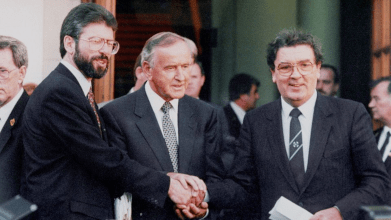
The Provisional Irish Republican Army (IRA) announces a ceasefire on August 31, 1994, after a quarter century of what it calls its “armed struggle” to get the British out of Northern Ireland. The statement comes just after 11:00 a.m. BST and says there will be a “complete cessation of military operations” from midnight and that the organisation is willing to enter into inclusive talks on the political future of the Province.
The statement raises hopes for peace and an end to 25 years of bombing and shooting that led to the deaths of more than 3,000 people. There is scepticism from the loyalist community and celebration in the Catholic areas of Belfast and Derry.
But loyalists are suspicious of the declaration and fear it may lead to a sell-out in which Northern Ireland’s position within the United Kingdom is under threat. The Ulster Unionist Party (UUP) MPJames Molyneaux says no moves towards talks should begin until the IRA has added the word “permanent” to the ceasefire declaration.
The announcement comes 18 months after secret talks began between the British Government and Irish republicans. It leads to the Anglo-Irish Downing Street Declaration in December 1993 which states that any change in the partition of Ireland can only come with the consent of those living north of the border. It also challenges republicans to renounce violence.
Ian Paisley, leader of the hardline Democratic Unionist Party (DUP), rejects the wording of the declaration and says it is an “insult to the people [the IRA] has slaughtered because there was no expression of regret.”
Seven weeks later, on October 13, the loyalist terrorist groups announce their own ceasefire. On December 9, British officials meet Sinn Féin representatives for their first formal talks in 22 years.
The IRA ceasefire ends on February 9, 1996, when it plants a huge bomb in the London Docklands. It kills two, injures more than 100 and causes more than £85m of damage.
A new ceasefire is finally announced in July 1997.
(Pictured: (L to R) Sinn Féin President Gerry Adams, Taoiseach Albert Reynolds and Social Democratic and Labour Party leader John Hume)
The Second Dáil (Irish: An Dara Dáil) is Dáil Éireann as it convenes on August 16, 1921, following the dissolution of the First Dáil. The Second Dáil runs until June 8, 1922.
From 1919 to 1922, Dáil Éireann is the revolutionary parliament of the self-proclaimed Irish Republic. The Second Dáil consists of members elected at the 1921 Irish elections, but with only members of Sinn Féin taking their seats. On January 7, 1922, it ratifies the Anglo-Irish Treaty by 64 votes to 57 which ends the Irish War of Independence and leads to the establishment of the Irish Free State on December 6, 1922.
Since 1919, those elected for Sinn Féin at the 1918 Irish general election had abstained from the House of Commons and established Dáil Éireann as a parliament of a self-declared Irish Republic, with members calling themselves Teachtaí Dála or TDs. In December 1920, in the middle of the Irish War of Independence, the British Government passes the Government of Ireland Act 1920, which enacts partition by establishing two home rule parliaments in separate parts of Ireland. These provisions arise out of discussions held at the Irish Convention held in 1917, from which Sinn Féin abstains. In May 1921 the first elections to the House of Commons of Northern Ireland and the House of Commons of Southern Ireland are held, by means of the single transferable vote. On May 10, 1921, the Dáil passes a resolution that the elections scheduled to take place later in the month in both parts of the country will be “regarded as elections to Dáil Éireann.”
In the elections for Southern Ireland, all seats are uncontested, with Sinn Féin winning 124 of the 128 seats, and Independent Unionists winning the four seats representing the Dublin University. In the 1921 Northern Ireland general election, the Ulster Unionist Party (UUP) wins 40 of the 52 seats, with Sinn Féin and the Nationalist Party winning 6 seats each. Of the six seats won by Sinn Féin in Northern Ireland, five are held by people who had also won seats in Southern Ireland.
The Second Dáil responds favourably to the proposal from King George V on June 22, 1921, for a truce, which becomes effective from noon on July 11, 1921. This is upheld by nearly all of the combatants while the months-long process of arranging a treaty gets under way. The Truce allows the Dáil to meet openly without fear of arrest for the first time since September 1919, when it had been banned and driven underground.
On September 14, 1921, the Dáil ratifies the appointment of Arthur Griffith, Michael Collins, Robert Barton, Eamonn Duggan and George Gavan Duffy as envoys plenipotentiary for the peace conference in England. These envoys eventually sign the Anglo-Irish Treaty on December 6. The debate on the Treaty starts on December 14 and continues until January 7, 1922. On that date, the Dáil approves the treaty by 64 in favour to 57 against. As the leader of the anti-Treaty minority, de Valera resigns as President. He allows himself to be nominated again but is defeated on a vote of 60–58. He is succeeded as president by Arthur Griffith. The anti-Treaty deputies continue to attend the Dáil, with de Valera becoming the first Leader of the Opposition in the Dáil.
The ratification specified by the Treaty is by “a meeting summoned for the purpose of the members elected to sit in the House of Commons of Southern Ireland.” The Dáil vote does not fulfil this because four unionists are absent and one Northern Ireland member is present. The requisite approval comes at a separate meeting on January 14, 1922, attended by the unionists and boycotted by anti-Treaty TDs. The meeting also approves a Provisional Government led by Collins, which runs in parallel to Griffith’s Dáil government and with overlapping membership. The Government of Ireland Act 1920 requires the Commons to be summoned by the Lord Lieutenant and its members to take an oath of allegiance to the king, whereas the meeting on January 14 is summoned by Griffith and the members present do not take an oath.
Under the terms of the Treaty, a Constituent Assembly is to be elected to draft a Constitution for the Irish Free State to take effect by December 6, 1922. The assembly is also to serve as a “Provisional Parliament” to hold the Provisional Government responsible. This election is held on June 16, 1922, pursuant to both a resolution by the Second Dáil on May 20 and a proclamation by the Provisional Government on 27 May 27.
The Third Dáil is elected at the general election held on June 16, 1922. This election is required to be held under the Anglo-Irish Treaty signed on December 6, 1921.
(Pictured: Some members of the Second Dáil at the Grosvenor Hotel in London, seated (L to R) Éamon de Valera and Arthur Griffith, National Library of Ireland, NPA-RPH-10)
In Bangor, County Down, a group of loyalist protesters put up a Union Flag outside the offices of Sinn Féin education minister Martin McGuinness at his department’s Rathgael House headquarters. Another group of PUP protesters demonstrate at government buildings in Adelaide Street in Belfast city centre, where the Union Flag is flying above two of the government buildings in the street.
The PUP’s Billy Hutchinson criticises Sinn Féin ministers over their refusal to fly the Union Flag. “These people cannot even recognise that we have a monarch who’s 100 years old and they can’t even fly the flag, just because they think that everything that is British is no good,” he says. “These people forget that they have lived in Britain all their lives, most of them. They weren’t even born at Partition (of Ireland).” He adds that Sinn Féin’s ministers should accept that they are “British ministers in a British state.”
However, Sinn Féin’s Alex Maskey condemns the protests as “intimidating and sectarian.” He says Sinn Féin’s position on the flying of flags is designed not to cause offence. “Where British cultural and political symbols are invoked in public life, equivalent Irish cultural and political symbols should be given equal prominence. Where this cannot be agreed, no such symbols should fly,” he says.
The issue of flags has been emotive and divisive in Northern Ireland. The Sinn Féin ministers anger unionists on May 2 by ordering their civil servants not to fly the flag as part of the Coronation Day celebrations. The row reaches a head when the anti-agreement Democratic Unionist Party (DUP) attempts to guarantee the flying of the Union Flag with an assembly motion in June. However, the party fails to win enough support for their motion to be passed.
There are about 13 days in the year when the Union Flag is flown on designated government offices in the United Kingdom. Government buildings across the UK – from Whitehall ministries to town council offices are expected to raise the Union Flag on these days.
It is the second time in a week that the health minister has run into controversy. On Wednesday, August 2, she is confronted by angry loyalist protesters during an official visit to a County Antrim hospital. Around 20 demonstrators picket the Lagan Valley Hospital in Lisburn, while she is on a visit to see a GP scheme as part of a programme to learn about aspects of the health service. The tyres on the minister’s car are let down and an egg is thrown. De Brun is forced to leave the complex by another door.
(From: “Trimble joins Union Flag row,” BBC News, news.bbc.co.uk, Friday, August 4, 2000 | Pictured: Protesters picket the Department of Health)
MacSwiney Brugha is the daughter of the former Lord Mayor of Cork Terence MacSwiney and his wife Muriel Frances Murphy. Her father dies on hunger strike when she is two years old. Her father is in jail when she is born and does not see her until she is brought to see him when she is three months old. Her family’s republican and political activities leave a strong mark on her life.
Following the death of her father, her mother moves to Dublin. MacSwiney Brugha goes to live with Madame O’Rahilly, widow of The O’Rahilly, and sees her mother intermittently. Although as a child her parents decide she would speak the Irish language, her father’s death and her mother’s health results in her move to Germany in 1923 and there she is moved around a lot. She learns German and speaks no English and little or no Irish. In 1930 she is moved to Grainau in Bavaria, where she attends school. Her aunt, Mary MacSwiney, a legal guardian of hers, eventually comes to collect her and takes her back to Ireland. This causes a court case when it is claimed her aunt had kidnapped her. As a result of the court case her aunt is given custody, and she and her mother became estranged.
MacSwiney Brugha attends Scoil Íte and then St. Louis Secondary School in Monaghan where, in 1936, she completes her Leaving Certificate and gets a scholarship to University College Cork to study arts. In 1937 she plays the lead role in a play, The Revolutionist, published in 1914 and written by her father and produced by her aunt. She returns to Germany in 1938 to keep up her German and graduates with a first-class honours degree. She goes on to get her higher diploma and becomes a teacher. She spends some time teaching in Scoil Íte and then goes to Dublin in 1942 to get a master’s degree. She meets Ruairí Brugha while in Dublin. His father, Cathal Brugha, was killed in the Irish Civil War in 1922. They marry on July 10, 1945. The marriage produces four children: Deirdre, Cathal, Traolach and Ruairí.
MacSwiney Brugha’s husband has a strong political career with her support. He is a senator, a TD, and a member of the European Parliament. She leads her Fianna Fáilcumann and volunteers with the aid agency Gorta. With her husband as Official Opposition Spokesman on Northern Ireland from 1975 to 1977, the couple are very much involved in creating the policy of developing conciliation rather than aimed more at ending partition which they previously have been focused on.
At the age of 85 and after her sight has failed MacSwiney Brugha dictates her story to her daughter-in-law, Catherine Brugha. History’s Daughter: A Memoir from the Only Child of Terence MacSwiney is launched in 2005. Her own story is recorded in Irish Life and Lore. Her story is also the subject of a radio production. She dies unexpectedly at her home in Clonskeagh, County Dublin, at the age of 93 on May 20, 2012. She is buried in Glasnevin Cemetery.
Fianna Fáil leader Micheál Martin describes her as having made a “strong and valued” contribution to the development of Fianna Fáil while Gerry Adams says she “made her mark” on Irish history.
(Pictured: Máire MacSwiney Brugha on her wedding day, July 10, 1945)
On February 21, 2003, a letter signed by Irish revolutionary leader Michael Collins, written in 1922 upon his return from London, fetches a record price of €28,000 at an auction at James Adam & Sons Ltd. on Dublin’s St. Stephen’s Green. Estimated to fetch up to €8,000.00, despite fierce bidding by the National Library of Ireland, the letter is purchased by singer Enya’s manager, Mickey Ryan, who says he wants the letter to remain in Ireland.
The letter is written after Collins returns to Dublin from a meeting in London with Churchill and Craig. He states in the letter that Craig’s stance on partition is seen as “an unreasonable one and not ours.”
“All the British statesmen are agreed that it was most disastrous on Craig’s part to talk about agreeing to nothing less than the six county area,” Collins writes.
Collins expresses his belief that ties would increase between leaders in the north and south, leading to a united Ireland in the long term. He tells Walsh that he is “no lover of partition, no matter what form it appears,” and that any form of partition is “distasteful” to him. “It would be far better to fix our minds for a time on a united Ireland, for this course will not leave minorities which would be impossible to govern,” he writes. He also says he hopes that one day a multi-denominational party might be formed in the north east, developing links with the Free State and destabilising the northern administration.
Fermanagh County Council is formed under orders issued in accordance with the Local Government (Ireland) Act 1898 which comes into effect on April 18, 1899. Elections are held using proportional representation until 1922 when it is abolished in favour of first-past-the-post voting. On December 15, 1921, shortly before the partition of Ireland and transfer of power from the Dublin Castle administration, Fermanagh County Council passes a resolution on a 13–10 majority not to recognise the newly formed Parliament of Northern Ireland and pledges their allegiance to the unrecognised republicanSecond Dáil of the self-proclaimed Irish Republic in Southern Ireland before the ratification of the Anglo-Irish Treaty. The resolution states, “We, the County Council of Fermanagh, in view of the expressed desire of a large majority of people in this county, do not recognise the partition parliament in Belfast and do hereby direct our Secretary to hold no further communications with either Belfast or British Local Government Departments, and we pledge our allegiance to Dáil Éireann.” In response, the Royal Irish Constabulary evict them from their council offices and confiscate official documents. As a result, the council is temporarily dissolved. The council are replaced by Commissioners appointed by Sir Dawson Bates.
The council is reformed by the time of the 1924 Northern Ireland local elections. As a protest against the abolition of proportional representation nationalist parties boycott the election, allowing unionist parties to take control of the council uncontested. Due to the abolition of proportional representation and gerrymandering, the council always has a unionist majority of councillors elected up until abolition. In 1967, the Government of Northern Ireland passes the County Fermanagh (Transfer of Functions) Order 1967. This makes Fermanagh County Council amalgamate with the smaller Enniskillen Borough Council and the rural district councils in Enniskillen, Irvinestown and Lisnaskea to turn Fermanagh County Council into a unitary authority.
In 1969, the Fermanagh Civil Rights Association publishes a booklet criticising the council and accusing them of favouring the Protestant community over the Catholic community. Some of the accusations include that the council deliberately hires Protestants for skilled local government and school jobs and that they propose to build a new village for Catholics in a gerrymandered district that already has a Catholic majority. The council is abolished in accordance with the Local Government Act (Northern Ireland) 1972 on October 1, 1973 and replaced by Fermanagh District Council.
(Pictured: Coat of arms of Fermanagh County Council, Northern Ireland)
On December 9, 1994, Sinn Féin, the political wing of the Irish Republican Army (IRA), holds its first formal talks with the British Government in over 70 years. The negotiations take place in Belfast, almost one year after Britain and Ireland began an uncertain program to try to resolve the conflict in Northern Ireland. The first session is held at Stormont, a gigantic, columned edifice on top of a hill on the outskirts of Belfast that houses the old Northern Ireland parliament.
Although the announcement of the negotiations is not a surprise, it still sets off an exciting ripple that history is in the making. British officials have conducted secret talks with Sinn Féin leaders in the past, but never before have they sat down openly at the same table with them.
In both a letter to the Sinn Féin leader, Gerry Adams, and in a three-paragraph statement, Downing Street pointedly refers to the meeting as “exploratory dialogue.” This is in keeping with London‘s position that it is simply joining in “talks about talks,” not a full negotiating session, which must involve all parties to the conflict.
For 25 years the IRA has been fighting in the name of the Roman Catholic minority of 650,000 in Northern Ireland. It wants to link Ulster, the six counties of Northern Ireland that remain British after partition, to the Irish Republic, a move opposed by most of the province’s 950,000 Protestants.
The announcement of talks evoke a predictable pattern of responses across Northern Ireland’s political spectrum. Adams, who works to persuade the IRA to go along with a unilateral cease-fire that was declared on September 1, welcomes it. “The opportunity to realize a lasting peace, which will benefit all of the people of Ireland, has never been greater,” he says in a statement. Adams had been accusing London of foot-dragging on the peace effort. Now, he says, it is time to move on to “the next phase of dialogue — multilateral talks led by both Governments.”
The Ulster Unionist Party (UUP), the main Protestant political group in Northern Ireland, is skeptically accepting, as it has been all along. John Taylor, a UnionistMember of Parliament, says the talks will at least establish whether “Sinn Féin really is to become a normal political party.”
The Rev. Ian Paisley, a Member of Parliament whose Democratic Unionist Party (DUP) has become a rejectionist front, continues to oppose talks or any move smacking of compromise. He tells the House of Commons that “a vast majority of people” resent the decision to talk to “the men of blood.”
Sinn Féin is represented at the talks by Martin McGuinness, a veteran IRA political leader who took part in secret contacts that broke up the previous year. In 1972, together with Adams, he was flown to London for a meeting with William Whitelaw, who was then Secretary of State for Northern Ireland. Those talks eventually failed.
Adams is in Washington, D.C. on Wednesday, December 7. He attends a meeting at the White House, his first one there, with Anthony Lake, President Bill Clinton‘s National Security Advisor. Seven weeks earlier, Britain protests vigorously at the thought of Adams visiting the White House. But events moved so swiftly that he gains a kind of legitimacy that is hard for Whitehall to deny. His visa to the United States, good for three months, allows several visits.
The Government team of civil servants, in contrast to higher-level ministers, are led by Quentin Thomas, deputy secretary of the British administration called the Northern Ireland Office.
Going into the negotiations, the key question is what will be discussed. On the British side, the top of the agenda is how to get the IRA to turn over its considerable stash of 100 tons of arms and explosives. There is nothing, of course, that Sinn Féin is less likely to agree to at the outset. So should the British make this a condition for multilateral talks to begin, the two sides will meet an obstacle right away.
McGuinness says that the issue of IRA weapons has to be considered “in the context of us removing the causes of conflict, the reason why people use armed force in our society.”
From its side, Adams says Sinn Féin wants to discuss being treated with “a parity of esteem” with the other parties, and “the release of all political prisoners.”
The British Government says that it will soon hold talks with the so-called loyalist paramilitaries on the Protestant side. And it indicates it will have no objection if elected Sinn Féin councillors attend a major international investment conference in Belfast on December 13 and 14.
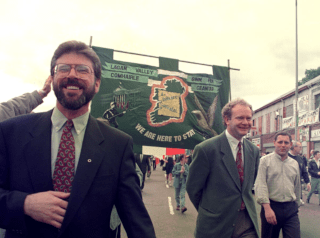
(From: “Britain and I.R.A. Group to Begin Talks in Northern Ireland” by John Darnton, The New York Times, December 2, 1994 | Pictured: Gerry Adams and Martin McGuinness lead a Republican parade in Belfast, commemorating 25 years of British troops on the streets of Northern Ireland in 1994)





 seamus dubhghaill