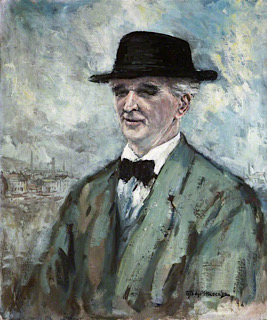
Marrinan becomes ill with infantile paralysis at the age of five, and as a result is tutored privately. He has no formal training in art but is largely influenced by his reading matter, particularly the American comic strips of Bud Fisher. The variety of facial expressions that Fisher can achieve, with only a pencil, intrigues and inspires him. Likewise, the images evoked by Celtic mythology and religious art also contributes to his visual language, and many hours are spent in the Belfast Museum and Art Gallery studying the paintings in their collection.
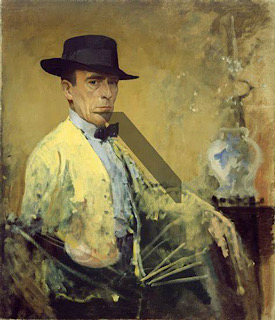
Marrinan exhibits with the Ulster Academy of Arts from an address at 524 Donegall Road, Belfast, entering “The Wee Gate, Earl Street, Belfast” (1931) and “The Painter’s Father” and the “Apache” (1934), which is judged “picture of the year.” He last exhibits with a landscape, “Connemara,” along with four other works in 1949.
Marrinan paints and sketches portraits of many notable Irish figures, among which is the charcoal drawing of northern Fenian Robert Johnston (1934; National Gallery of Ireland) and a sketch of the Donegal storyteller Niall Duffy (University College Dublin). His literary portraits include one of Brian Friel. He holds a one-man show in 1951 at 55a Donegall Place, Belfast, where he exhibits a bust of John McLaverty. He takes an interest in sculpture although painting and drawing remain his preferred form of expression. Important commissions are for a memorial portrait (completed 1952) of Éamonn Ceannt for Ceannt Barracks officers’ mess, Curragh Camp, County Kildare, and for a portrait of Vice-brigadier Peadar Clancy for Clancy Barracks, Dublin. He paints two memorial portraits of PresidentJohn F. Kennedy, one of which is in the Irish Club, London.
Marrinan is an honorary member of the Royal Ulster Academy and exhibits with them every year from 1950 onward, showing a portrait of Mrs. Padraig Marrinan in 1967 (no other details of his marriage are known). He is preparing for an exhibition to be held at the Irish Club, London, in 1974, but dies on October 25, 1973, at Tyrone County Hospital in Omagh. He is then living at James Street, Omagh.
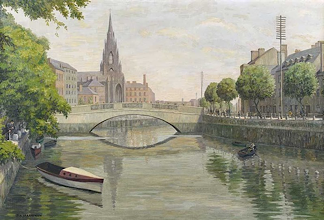
(From: “Marrinan, Padraig H.” by Ruth Devine, Dictionary of Irish Biography, http://www.dib.ie, October 2009 | Pictured: “The River Lee, Cork City, Ireland” by Padraig Marrinan, oil on canvas)
Whelan is awarded many prizes in the Royal Dublin Society (RDS) Taylor art competitions, including one in 1912 for a portrait of his sister Lena, entitled On the Moors, rendered in a strongly academic technique. In 1916, he wins the Taylor scholarship for the Royal Hibernian Academy (RHA) schools for his finest early work, The Doctor’s Visit, an adroitly executed composition of contrasting shadows and light. Typical of many of his genre interiors, the painting depicts a room in the family home, with relatives as models: Whelan’s mother sits by the bed watching over his ill cousin, while his sister, dressed in a Mater hospital nurse’s uniform, is in the background opening the door for the doctor. The subtly evoked atmosphere of restrained emotion foreshadowed a hallmark of his mature style.
Whelan exhibits annually at the RHA for forty-five years (1911–56), averaging six works per year. He is elected an RHA associate in 1920, becoming a full member in 1924. He participates in the Exposition d’art irlandais at the Galerie Barbazanges in Paris in 1922. A visiting teacher at the RHA schools in 1924, he also teaches in the DMSA for a time. He has studios at 64 Dawson Street (1914–27) and 7 Lower Baggot Street (1931–56). Beginning in the 1910s, he receives regular commissions for portraits, constituting his primary source of income. Having become the family’s main breadwinner following his parents’ deaths in the 1920s, he concentrates most of his production on this lucrative activity, portraying numerous leading figures in the spheres of politics, academia, religion, society, medicine, and law.
Situated securely in the academic tradition, in most of his portraits Whelan favours a sombre, restricted palette, with the sitter placed, in grave demeanour, against a monotone background with few accessories. In a 1943 interview he asserts that twentieth-century portraiture suffers from the drabness of modern costume, for which the artist must compensate by careful rendition of the subject’s hands. He tends to depart from his prevailing portrait style when painting women, whom he characteristically depicts in meticulously observed interiors, a notable example being his portrait of Society hostess Gladys Maccabe (c.1946; NGI).
Whelan’s commercial concentration on portraiture notwithstanding, he expresses his true talent in genre compositions, especially kitchen interiors, in which he emulates the technique of the Dutch painter Johannes Vermeer. Two of the most accomplished of these depict his sister Frances in the basement kitchen of the family home: The Kitchen Window (1927; Crawford Art Gallery, Cork) demonstrates a particularly skillful use of light, while Interior of a Kitchen (1935) is notable for the dexterous handling of objects of varied shapes and textures. His genre works include both urban and rural scenes, with a distinctive interest in portraying occupations and other activities. Gypsy (1923), an Orpenesque composition of a shawled woman in a west-of-Ireland landscape with a caravan in the background, receives wide contemporary critical acclaim. Jer (c.1925), depicting a man seated by the fire in a cottage interior, is reproduced in J. Crampton Walker’s Irish Art and Landscape (1927). The Fiddler (c.1932), a naturalistic, sensitively characterised study, is first shown at an Ulster Academy exhibition at Stranmillis, Belfast. A Kerry Cobbler is reproduced in Twelve Irish Artists (1940), introduced by Thomas Bodkin, as among the works denoting the development of a distinctively Irish school of painting.
In 1929, Whelan designs the first Irish Free State commemorative stamp, a portrait of Daniel O’Connell for the centenary of Catholic emancipation. Commissioned by the Thomas Haverty trust to paint an incident from the life of Saint Patrick for the 1932 Eucharistic Congress, he executes The Baptism by St. Patrick of Ethna the Fair and Fedelmia the Ruddy, Daughters of the Ard Rí Laoghaire, a work highly conservative in style. He rapidly completes an oil study of the papal legate, Lorenzo Lauri, also for the Eucharistic Congress. He is represented in the art competitions at the 1932 Summer Olympics in Los Angeles. His depiction of Saint Brigid, shown at the Academy of Christian Art exhibition (1940), becomes a familiar image owing to the wide circulation of reproductions.
Whelan’s political portraits are influential in creating a strong, assured image of the newly formed Irish state, and thus retain an historical significance. His posthumous portrait, The Late General Michael Collins, exhibited at the RHA in 1943 and now held in Leinster House, is an iconic, heroic image of the fallen leader. His portraits of Arthur Griffith and Kevin O’Higgins – commissioned posthumously, as is the Collins, by Fine Gael – also hang in Leinster House, while that of John A. Costello, exhibited at the RHA in 1949, is now held in the King’s Inns, Dublin. He paints two presidents, Douglas Hyde and Seán T. O’Kelly, both works currently in Áras an Uachtaráin. A portrait of Éamon de Valera, painted in 1955 when the sitter is Leader of the Opposition, is in Leinster House. In 1954, he designs a second commemorative stamp, picturing a reproduction of a portrait bust of John Henry Newman, to mark the centenary of the Catholic University of Ireland.
Whelan is elected an honorary academician of both the Ulster Academy of Arts (1931), and the Royal Ulster Academy (1950). He becomes a member of the United Arts Club in 1934. As a representative of the RHA, he sits on the board of governors of the National Gallery of Ireland for many years, and is on the advisory committee of the Municipal Gallery of Modern Art. Unmarried, he resides until his death at the Eccles Street address, with two sisters who continue to manage the family hotel. He dies on November 6, 1956, from leukemia at the Mater private nursing home in Dublin. He is buried in Glasnevin Cemetery.
(From: “Whelan, (Michael) Leo,” by Carmel Doyle, Dictionary of Irish Biography, http://www.dib.ie, October 2009)
Charles Jervas, Irish portrait painter, translator, and art collector of the early 18th century, dies at his home at Cleveland Court, London, on November 2, 1739.
Born in Shinrone, County Offaly, around 1675, Jervas is one of seven children (five sons and two daughters) of John Jervas of Clonlisk, Shinrone, and his wife Elizabeth, daughter of Captain John Baldwin, High Sheriff of County Offaly, of Shinrone. He studies in London as an assistant under Sir Godfrey Kneller between 1694 and 1695.
After selling a series of small copies of the Raphael Cartoons around 1698 to Dr. George Clarke of All Souls College, Oxford, the following year, he travels to Paris and Rome (while financially supported by Clarke and others) remaining there for most of the decade before returning to London in 1709 where he finds success as a portrait painter.
Painting portraits of the city’s intellectuals, among them such personal friends as Jonathan Swift and the poet Alexander Pope, both of which are now in the National Portrait Gallery, London, Jervas becomes a popular artist often referred to in the works of literary figures of the period.
Jervas gives painting lessons to Pope at his house in Cleveland Court, St. James’s, which Pope mentions in his poem, To Belinda on the Rape of the Lock, written in 1713 and published in 1717 in Poems on Several Occasions.
Pope’s verse Epistle to Mr. Jervas, written around 1715, is published in the 1716 edition of John Dryden‘s 1695 translation of Fresnoy’s Art of Painting (Charles Alphonse du Fresnoy‘s De arte graphica, 1668). In it, Pope refers to Jervas’s skill as an artist:
O, lasting as those colours may they shine, Free as they stroke, yet faultless as thy line; New graces yearly like thy works display, Soft without weakness, without glaring gay!
With his growing reputation, Jervas succeeds Kneller as Principal Painter in Ordinary to King George I in 1723, and subsequently King George II. In 1727 he marries Penelope Hume, a wealthy widow with a supposed fortune of £20,000, and moves to Hampton, London. He continues to live in London until his death on November 2, 1739.
Jervas’s translation of Miguel de Cervantes‘s novel Don Quixote, published posthumously in 1742 as being made by Charles “Jarvis” due to a printer’s error, has since come to be known as “the Jarvis translation.” He is first to provide an introduction to the novel including a critical analysis of previous translations of Don Quixote. It has been highly praised as the most accurate translation of the novel up to that time, but also strongly criticised for being stiff and humourless, although it goes through many printings during the 19th century.
As principal portraitist to the King of England, Jervas is known for his vanity and luck, as mentioned in the Imperial Biographical Dictionary, “He married a widow with $20,000; and his natural self-conceit was greatly encouraged by his intimate friend [Alexander] Pope, who has written an epistle full of silly flattery.”
According to one account, after comparing a painting he had copied from Titian, Jervas is said to have stated, “Poor little Tit, how he would starve!”
Upon being told that Jervas had set up a carriage with four horses, Godfrey Kneller replies, “Ach, mein Gott, if his horses do not draw better than he does, he will never get to his journey’s end.”
Crilley is born in Newry, County Down, (present-day Northern Ireland), on August 1, 1884, one of six children of Patrick Crilley. Her date of birth is often given as July 29, 1888, though local records do not support this, suggesting she is born four years earlier. Having initially trained at Newry technical school with her sister Mary, intending to become a teacher, in 1905, she wins a scholarship to attend the Dublin Metropolitan School of Art. There she studies under William Orpen, who regards her as one of his most promising students. She completes her studies in 1911 attaining an Art Teacher’s Certificate and begins working as Orpen’s assistant.
In 1914, Crilley marries her fellow student Harry Clarke, much to the surprise of their family and acquaintances. The couple moves into a flat at 33 North Frederick Street. They have three children, Michael, David and Ann. Harry’s brother, Walter, marries Margaret’s sister, Mary, in 1915.
Clarke first exhibits with the Royal Hibernian Academy in 1913 and goes on to exhibit over 60 artworks in the forty years until 1953, the majority being portraits. Among the portrait commissions she receives are ones for Dermod O’Brien, President Éamon de Valera, ArchbishopJohn Charles McQuaid, and Lennox Robinson. She spends a great deal of time on the Aran Islands with fellow artist Seán Keating and her husband, from which she produces a number of landscapes and smaller studies.
Clarke becomes the director of the Harry Clarke Stained Glass Studios following the death of her husband in 1931.
A critic notes in 1939 that Clarke produces “remarkable drawings in which individuality is caught in a few swift economical lines.” Over her lifetime she wins many awards including the Tailteann gold, silver and bronze medals in 1924, and another Tailteann bronze in both 1928 and 1932. She is elected an Associate of the Royal Hibernian Academy (ARHA) in 1926, and a full RHA member in 1927. Upon the founding of the Irish Exhibition of Living Art in 1943, she is appointed a member of the executive committee.
Clarke dies in Dublin on 31 October 31, 1961, and is buried in the Redford Cemetery, Greystones, County Wicklow. She is commemorated with a blue plaque at her birthplace in Newry.
Shawcross studies at Bolton College of Art from 1955 to 1958, and Lancaster College of Art from 1958 to 1960, before moving to Belfast in 1962 to take up a part-time lecturer’s post at the Belfast College of Art, becoming full-time in 1968. He continues to lecture there until his retirement in 2004.
Shawcross has exhibited nationally, with one-man shows in London, Manchester, Dublin and Belfast, and internationally in Hong Kong and the United States, and his work is found in many private and corporate collections.
Shawcross is elected an Associate of the Royal Ulster Academy of Art in 1975, and is made a full Academician in 1977. He wins the Academy’s Conor Award in 1975, its gold medal in 1978, 1982, 1987, 1994, 1997 and 2001, and its James Adam Prize in 1998. He is also a member of the Royal Hibernian Academy (RHA). He is awarded the Gallaher Portrait Prize in 1966.
In 2010, the Merrion Hotel, Dublin, hosts a private collection of the works of Shawcross. In 2015, he exhibits a collection of six foot tall book covers inspired by original Penguin paperbacks at the National Opera House in Wexford, County Wexford. In 2018, he donates to Belfast City Council a collection of 36 paintings dedicated to ‘Writers of Belfast’ in a show of appreciation to his adopted home city. A major retrospective of his works are exhibited at the F.E. McWilliam Gallery and Studio, Banbridge, County Down, in the same year.
Shawcross is a Patron of the charity YouthAction Northern Ireland. He lives in Hillsborough, County Down, Northern Ireland.
Ganly also studies painting in the Royal Hibernian Academy School where she has Margaret Clarke and Seán O’Sullivan as teachers. She is made an associate of the Royal Hibernian Academy (RHA) in 1928 and becomes a member in 1935 though, in 1969, resigns her membership in protest of the lack of young artists being given the opportunity to exhibit. In 1972 she is made an honorary member and returns.
Ganly is a representational artist and while known as a portrait artist, she also paints landscapes, interiors and may be best known for her still lifes. Some of her best works are portraits of her husband, her sister Ethel, her father, and her friend Sheila Pim. She illustrates the book-jackets of Sheila Pim’s works. She has many exhibitions, with the RHA and the Water Colour Society of Ireland. There is a retrospective of her life in 1998 at the Hugh Lane Gallery and her works are in the collections there. She is also in the collections of the Waterford Municipal Gallery, Crawford Art Gallery, Cork and in The National Self-Portrait Collection of Ireland. She is part of the 2014 exhibition ‘Irish Women Artists: 1870-1970.’
Ganly’s sister-in-law is Kitty Wilmer O’Brien with whom she often exhibits. She marries Andrew Ganly, a dental surgeon and writer with a strong involvement in theatre, in 1936. He dies in 1982. They have two children, Eoghan and Phillida.
Brigid Ganly dies on March 25,2002.
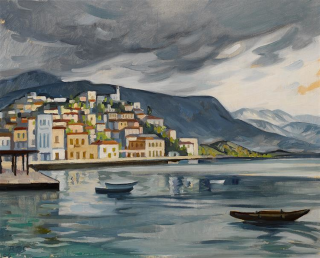
(Pictured: “Storm Over Poros” (1964) by Rosaleen Brigid Ganly, HRHA)
O’Brien marries Mabel Emmeline Smyly, daughter of Sir Philip Crampton Smyly, on March 8, 1902. Together they have five children. His son Brendan, a surgeon in Dublin, marries artist Kitty Wilmer O’Brien. His daughter Rosaleen Brigid becomes an artist, also known as Brigid Ganly after her marriage to Andrew Ganly. Another artistic relative is Geraldine O’Brien.
Unlike many of his Irish contemporaries, after graduating from Cambridge O’Brien does not study art in Dublin, opting instead to travel to Paris, where he studies the paintings at the Louvre. In 1887, he visits galleries in Italy and then enrolls at the Royal Academy of Fine Arts in Antwerp, Belgium. At the Academy he is a fellow student of Walter Osborne. He leaves Antwerp in 1891 and returns to Paris, where he studies at Académie Julian. He relocates to London in 1893 and then Dublin in 1901.
O’Brien is designated an associate of the Royal Hibernian Academy in 1906, a member in 1907, and is later president between 1910 and 1945. He is made an honorary member of the Royal Academy of Arts, London in 1912.
Basil Blackshaw, Northern Irish artist, dies at the age of 83 on May 2, 2016. He is best known for his paintings of dogs, horses, landscapes and people and is regarded as one of the country’s most talented artists.
Blackshaw’s home and studio is in County Antrim by Lough Neagh. He becomes well known for his country scenes including landscapes, farm buildings and horses, painted in an expressionist style.
Blackshaw is initially acclaimed for his mastery of traditional approaches to painting. He continues to develop as an artist, becoming most highly regarded for his very loose gestural application of paint and a very distinctive and subtle use of colour. His paintings of such sports as horse racing and boxing make him particularly popular, but he is also a talented portrait painter.
Blackshaw’s paintings are often figurative in form, but with a non-naturalistic palette which re-balances the composition in an expressionist, even abstract, way. His themes are very Irish and often rural; greyhounds, Irish Travellers, and the landscape. He also produces portraits and designs posters for Derry‘s Field Day Theatre Company.
The Arts Council of Northern Ireland organises a major retrospective of Blackshaw’s work in 1995, which travels from Belfast to Dublin, Cork and many galleries in the United States. In 2001 he receives the GlenDimplex Award for a Sustained Contribution to the Visual Arts in Ireland. The Ulster Museum holds a major exhibition of his work in 2002 and a major book is published by Eamonn Mallie on the artist in 2003.
For a 2005 exhibition at the Fenton Gallery in Cork, Blackshaw works exclusively over a period of 20 months creating a dramatic collection of fifteen new paintings. His choice of arguably mundane subjects, The Studio Door, Car, Wall, Six Trees, express both an engagement with tradition and a watchful detachment.
In 2006 Blackshaw’s work is exhibited at the Irish College in Paris (French: Centre Culturel Irlandais).
Blackshaw is elected as an associate of The Royal Ulster Academy of Arts in 1977 and elected an Academician in 1981. Dublin’s Royal Hibernian Academy describes him as “one of Ireland’s greatest artists” who was “lauded by the art world and his fellow painters.”
Basil Blackshaw dies on May 2, 2016. Father to well-known artist Anya Waterworth, he is buried in a wicker coffin in a humanist funeral, the ceremony ending to Bob Dylan‘s “Mr. Tambourine Man” at Roselawn Cemetery on the outskirts of Belfast. More than 100 mourners come to pay their respects. Among them are artists Jack Pakenham and Neil Shawcross, actor Stephen Rea and boxing legend Barry McGuigan.
At age four, Banim’s parents send him to a local school where he learns the basics of reading and grammar. At age five, he is sent to the English Academy at Kilkenny where his older brother Michael (1796–1874) is a student. After five years at the English Academy, he is sent to a seminary run by a Reverent Magrath, considered to be the finest Roman Catholic school in Ireland. After a year at the seminary, he transfers to another academy run by a teacher named Terence Doyle. Throughout his school years, he reads avidly and writes his own stories and poems. When he is ten, he visits the poet Thomas Moore, bringing along some of his own poetry in manuscript. Moore encourages him to continue writing and gives him a season ticket to his private theatre in Kilkenny.
At the age of 13, Banim enters Kilkenny College and devotes himself specially to drawing and miniature painting. He pursues his artistic education for two years in the schools of the Royal Dublin Society, and afterwards teaches drawing in Kilkenny, where he falls in love with one of his pupils, a 17-year-old girl named Anne. His affection is returned, but her parents disapprove of their relationship and send her out of town. Anne dies two months later of tuberculosis. Her death makes a deep impression on him and his health suffers severely and permanently.
In 1820 Banim goes to Dublin and settles finally to the work of literature. He publishes a poem, The Celt’s Paradise, and his play Damon and Pythias is performed at Covent Garden in 1821. During a short visit to Kilkenny he marries, and in 1822, in conjunction with Michael, plans a series of tales illustrative of Irish life, which should be for Ireland what the Waverley Novels are for Scotland. The influence of his model is distinctly traceable in his writings.
Banim then sets out for London, and supports himself by writing for magazines and for the stage. A volume of miscellaneous essays is published anonymously in 1824, called Revelations of the Dead Alive. The first series of Tales of the O’Hara Family appears in April 1825, which achieves immediate and decided success. One of the most powerful of them, Crohoore of the Bill Hook, is by Michael Banim.
In 1826, a second series is published, containing the Irish novel, The Nowlans. Banim’s health has given way, and the next effort of the “O’Hara family” is almost entirely the production of his brother Michael. The Croppy, a Tale of 1798 (1828), a novel of the Irish Rebellion of 1798, is hardly equal to the earlier tales, though it contains some wonderfully vigorous passages.
The Mayor of Windgap, and The Ghost Hunter (both by Michael Banim), The Denounced (1830) and The Smuggler (1831) follow in quick succession, and are received with considerable favour. Most of these deal with the darker and more painful phases of life, but the feeling shown in his last, Father Connell, is brighter and tenderer. Banim, meanwhile, suffers from illness and consequent poverty. In 1829, he goes to France, and while he is abroad a movement to relieve his wants is set on foot by the English press, headed by John Sterling in The Times. A sufficient sum is obtained to remove him from any danger of actual want.
Banim returns to Ireland in 1835, taking up residence in Dublin. On meeting him again in August, Michael Banim finds his brother’s condition to be that of a complete invalid. He is often in pain and has to use opiates to sleep, but during the short intervals between the attacks of his illness, he is able to enjoy conversation and the company of his brother and friends. In September he returns to Kilkenny and is received with an address from the citizens of Kilkenny showing their appreciation of him, and a subscription from them of £85. After a short stay in his childhood home, he settles in Windgap Cottage, then a short distance from Kilkenny. He passes the remainder of his life there, dying on August 13, 1842.
Michael Banim acquires a considerable fortune which he loses in 1840 through the bankruptcy of a firm with which he had business relations. After this disaster he writes Father Connell (1842), Clough Fionn (1852), and The Town of the Cascades (1862). He dies at Booterstown.
“The true place of the Banims in literature is to be estimated from the merits of the O’Hara Tales; their later works, though of considerable ability, are sometimes prolix and are marked by too evident an imitation of the Waverley Novels. The Tales, however, are masterpieces of faithful delineation. The strong passions, the lights and shadows of Irish peasant character, have rarely been so ably and truly depicted. The incidents are striking, sometimes even horrible, and the authors have been accused of straining after melodramatic effect. The lighter, more joyous side of Irish character, which appears so strongly in Samuel Lover, receives little attention from the Banims.”
Hill is born at Southampton, Hampshire on December 6, 1916, the son of a wealthy sugar trader. He first works as a theatre designer in Leningrad in the 1930s and later as an historian. In World War II he registers as a conscientious objector and works on a farm.
Hill’s long association with Ireland begins when he visits Glenveagh Castle in County Donegal to paint the portrait of the Irish American art collector Henry McIlhenny, whose grandfather had emigrated to the United States from the nearby village of Milford, and who subsequently made a fortune from his patent gas meter.
Hill begins to enjoy increased success as a portrait painter from the 1960s. His subjects include many notable composers, musicians, politicians and statesmen, such as broadcaster Gay Byrne, Jerusalem mayor Teddy Kollek and The Prince of Wales. He is also an enthusiastic art collector and traveller, with a wide range of friends such as Bryan Guinness and Isaiah Berlin. Greta Garbo visits Hill in the 1970s, a visit which forms inspiration for Frank McGuinness‘ 2010 play Greta Garbo Came to Donegal.
An exhibition of his work and personal art collection can be seen at the House and associated Glebe Gallery at Churchill, near Letterkenny. Another collection of his work is held at Mottisfont Abbey. Many of his landscapes portray scenes from Tory Island, where he has a painting hut for years, and starts and then mentors the artists’ community there, teaching the local fishermen how to paint. This leads to the informal but busy “Tory School” of artists such as James Dixon and Anton Meenan, who find that they have the time to paint and use their wild surroundings as a dramatic subject.
Hill is made a CBE in 1997. A Retrospective exhibition is arranged for and by him at the Royal Hibernian Academy in 1998. On January 13, 1999, he is made an honorary Irish citizen by the President of Ireland Mary McAleese.
Arthur Derek Hill dies at the age of 83 at a London hospital on July 30, 2000. He is buried in Hampshire in the South of England with his parents. Memorial services are held for him in Dublin at St. Patrick’s Cathedral, as well as St. James’s Church, Piccadilly, London, and his local Church in Trentagh, County Donegal.