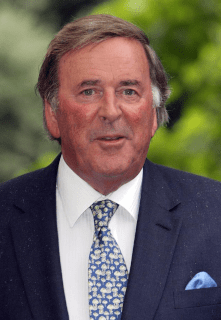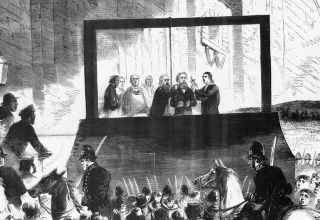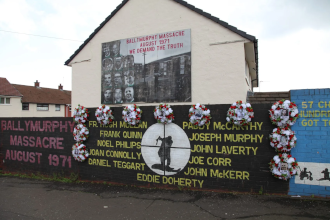
Mary Lou McDonald is ratified as the new president of Sinn Féin at a special party Ardfheis on February 10, 2018. Approximately 2,000 party delegates gather for the meeting in Dublin. After almost 35 years, Gerry Adams officially steps down as party leader, a role he has held since November 1983.
McDonald takes the helm with a sweeping speech that touches on everything from abortion to Brexit and promises a united Ireland “in our time.”
McDonald, 48, is the first woman to lead the party, and the first Sinn Féin leader with no direct connection to Ireland’s period of violence known as the Troubles. “We must only agree that the past is never again repeated,” she says. “On other things, we can agree to disagree. The poet Maya Angelou put it well: ‘History, despite its wrenching pain, cannot be unlived. But if faced with courage, need not be lived again.’”
McDonald takes over for Adams, a divisive politician who was the face of the Irish republican movement as it shifted from violence to peace. The end of Adams’ tenure marks a new era for the party, which wants to unite the United Kingdom’s Northern Ireland with the Republic of Ireland to the south.
Adams, who announced in November 2017 he was stepping down after almost 35 years, was the key figure in the peace process that saw the signing of the 1998 Good Friday Agreement and the formation of a power sharing government between Northern Ireland’s pro-British and republican factions. But many believe Sinn Féin’s popularity among voters has been hindered by the presence of leaders linked to the Troubles, which killed over 3,600 people.
McDonald immediately puts her own stamp on the future, trying to infuse new energy into the movement that has lawmakers on both sides of the Irish border. But she also focuses on Sinn Féin’s founding principle: a united Ireland. “We are the generation of republicans who will see the rising of the moon,” she says. “Sinn Féin in government, both North and South. Irish unity in our time.”
McDonald also lays out her positions on the key issues of the day.
On the United Kingdom’s upcoming departure from the European Union, or Brexit, she says Sinn Féin will not accept any deal that reinstates border controls between Northern Ireland and the Republic. Brexit represents a threat to the prosperity of Ireland as a whole.
McDonald also says the party will campaign for women’s right to an abortion in Ireland’s upcoming referendum on the issue and says she is committed to reaching an agreement that will restore Northern Ireland’s power sharing government on the basis of “respect and integrity for all.”
Northern Ireland’s last government collapsed more than a year earlier amid a corruption scandal.
(From: “Mary Lou McDonald takes over as Sinn Féin party leader” by Danica Kirka, AP News, apnews.com, February 10, 2018)
FitzGerald joins Fine Gael, attaching himself to the liberal wing of the party. and in 1969 is elected to Dáil Éireann, the lower house of the Oireachtas, the Irish parliament. He later gives up his university lectureship to become Minister for Foreign Affairs in the coalition government of Liam Cosgrave (1973–1977). When the coalition government is resoundingly defeated in the 1977 Irish general election, Cosgrave yields leadership of Fine Gael to FitzGerald. In his new role as Leader of the Opposition and party leader, he proceeds to modernize and strengthen the party at the grass roots. He briefly loses power in 1982 when political instability triggers two snap elections.
By the time of the 1981 Irish general election, Fine Gael has a party machine that can easily match Fianna Fáil. The party wins 65 seats and forms a minority coalition government with the Labour Party and the support of a number of Independent TDs. FitzGerald is elected Taoiseach on June 30, 1981. To the surprise of many FitzGerald excludes Richie Ryan, Richard Burke and Tom O’Donnell, former Fine Gael stalwarts, from the cabinet.
On May 5, 2011, it is reported that FitzGerald is seriously ill in a Dublin hospital. Newly elected Fine Gael Taoiseach Enda Kenny sends his regards and calls him an “institution.” On May 6 he is put on a ventilator. On May 19, after suffering from pneumonia, he dies at the Mater Private Hospital in Dublin at the age of 85.
In a statement, Irish PresidentMary McAleese hails FitzGerald as “a man steeped in the history of the State who constantly strove to make Ireland a better place for all its people.” Taoiseach Enda Kenny pays homage to “a truly remarkable man who made a truly remarkable contribution to Ireland.” Henry Kissinger, the former United States Secretary of State, who serves as an opposite number to FitzGerald in the 1970s, recalls “an intelligent and amusing man who was dedicated to his country.”
FitzGerald’s death occurs on the third day of Queen Elizabeth II‘s state visit to the Republic of Ireland, an event designed to mark the completion of the Northern Ireland peace process that had been “built on the foundations” of FitzGerald’s Anglo-Irish Agreement with Margaret Thatcher in 1985. In a personal message, the Queen offers her sympathies and says she is “saddened” to learn of FitzGerald’s death.
On his visit to Dublin, United States PresidentBarack Obama offers condolences on FitzGerald’s death. He speaks of him as “someone who believed in the power of education; someone who believed in the potential of youth; most of all, someone who believed in the potential of peace and who lived to see that peace realised.”
FitzGerald is the author of a number of books, including Planning in Ireland (1968), Towards a New Ireland (1972), Unequal Partners (1979), All in a Life: An Autobiography (1991), and Reflections on the Irish State (2003).
Spring Rice is educated at Trinity College, Cambridge, and later studies law at Lincoln’s Inn, but is not called to the Bar. His family is politically well-connected, both in Ireland and Great Britain, and he is encouraged to stand for Parliament by his father-in-law, Lord Limerick.
Spring Rice first stands for election in Limerick City in 1818 but is defeated by the Tory incumbent, John Vereker, by 300 votes. He wins the seat in 1820 and enters the House of Commons. He positions himself as a moderate unionist reformer who opposes the radical nationalist politics of Daniel O’Connell and becomes known for his expertise on Irish and economic affairs. In 1824 he leads the committee which establishes the Ordnance Survey in Ireland.
Spring Rice’s fluent debating style in the Commons brings him to the attention of leading Whigs and he comes under the patronage of the Marquess of Lansdowne. As a result, he is made Under-Secretary of State for the Home Department under George Canning and Lord Goderich in 1827, with responsibility for Irish affairs. This requires him to accept deferral of Catholic emancipation, a policy which he strongly supports. He then serves as joint Secretary to the Treasury from 1830 to 1834 under Lord Grey. Following the Reform Act 1832, he is elected to represent Cambridge from 1832 to 1839. In June 1834, Grey appoints him Secretary of State for War and the Colonies, with a seat in the cabinet, a post he retains when Lord Melbourne becomes Prime Minister in July. A strong and vocal unionist throughout his life, he leads the Parliamentary opposition to Daniel O’Connell’s 1834 attempt to repeal the Acts of Union 1800. In a six-hour speech in the House of Commons on April 23, 1834, he suggests that Ireland should be renamed “West Britain.” In the Commons, he also champions causes such as the worldwide abolition of slavery and the introduction of state-supported education.
The Whig government falls in November 1834, after which Spring Rice attempts to be elected Speaker of the House of Commons in early 1835. When the Whigs return to power under Melbourne in April 1835, he is made Chancellor of the Exchequer. As Chancellor, he has to deal with crop failures, a depression and rebellion in North America, all of which create large deficits and put considerable strain on the government. His Church Rate Bill of 1837 is quickly abandoned and his attempt to revise the charter of the Bank of Ireland ends in humiliation. Unhappy as Chancellor, he again tries to be elected as Speaker but fails. He is a dogmatic figure, described by Lord Melbourne as “too much given to details and possessed of no broad views.” Upon his departure from office in 1839, he has become a scapegoat for the government’s many problems. That same year he is raised to the peerage as Baron Monteagle of Brandon, in the County of Kerry, a title intended earlier for his ancestor Sir Stephen Rice. He is also Comptroller General of the Exchequer from 1835 to 1865, despite Lord Howick‘s initial opposition to the maintenance of the office. He differs from the government regarding the exchequer control over the treasury, and the abolition of the old exchequer is already determined upon when he dies.
From 1839 Spring Rice largely retires from public life, although he occasionally speaks in the House of Lords on matters generally relating to government finance and Ireland. He vehemently opposes John Russell, 1st Earl Russell‘s policy regarding the Irish famine, giving a speech in the Lords in which he says the government had “degraded our people, and you, English, now shrink from your responsibilities.”
Spring Rice is well regarded in Limerick, where he is seen as a compassionate landlord and a good politician. An advocate of traditional Whiggism, he strongly believes in ensuring society is protected from conflict between the upper and lower classes. Although a pious Anglican, his support for Catholic emancipation wins him the favour of many Irishmen, most of whom are Roman Catholic. He leads the campaign for better county government in Ireland at a time when many Irish nationalists are indifferent to the cause. During the Great Famine of the 1840s, he responds to the plight of his tenants with benevolence. The ameliorative measures he implements on his estates almost bankrupts the family and only the dowry from his second marriage saves his financial situation. A monument in honour of him still stands in the People’s Park in Limerick.
Even so, Spring Rice’s reputation in Ireland is not entirely favourable. In a book regarding assisted emigration from Ireland, a process in which a landlord pays for their tenants’ passage to the United States or Australia, Moran suggests that Spring Rice was engaged in the practice. In 1838, he is recorded as having “helped” a boat load of his tenants depart for North America, thereby allowing himself the use of their land. However, he is also recorded as being in support of state-assisted emigration across the British Isles, suggesting that his motivation is not necessarily selfish.
O’Connor is educated in St. Mary’s College, Dublin, and then in Clongowes Wood College, County Kildare, a public school run by the Jesuit order. It is also attended by the man who later condemns O’Connor to death, his close friend Kevin O’Higgins. He studies experimental physics, logic, and metaphysics. He also attends the College of Science, Merrion Street. He takes a BA (1906) and receives a B.Eng (1911). In 1910, he takes his Bachelor of Engineering and Bachelor of Arts degrees at University College Dublin (UCD), then known as the National University. Prominent in the university’s Literary and Historical Society, he advocates militant constitutional nationalism as one of the many society members active in the Young Ireland branch of the United Irish League.
During the subsequent Irish War of Independence (1919-21) O’Connor is Director of Engineering of the Irish Republican Army (IRA), a military organisation descended from the Irish Volunteers. The specialist skills of engineering and signaling are essential to the development of the 5th Battalion, Dublin Brigade. Its men are forbidden frontline duty as their contribution is regarded as vital, their number too small. But units only expand on an incremental local basis, disappointing General Richard Mulcahy.
O’Connor is also involved in the Republican breakout from Strangeways Prison in Manchester, England, on October 25, 1919. Michael Collins takes a particular interest in the escape and actually visits Austin Stack in the prison under a false name to finalise the arrangements. IRA men hold up traffic while a ladder is propped up against the outside of a prison wall. In all six prisoners escape, among them Piaras Beaslaí.
O’Connor refuses to accept the Anglo-Irish Treaty of 1921, which establishes the Irish Free State. It is ratified by a narrow vote in Dáil Éireann, the Irish parliament. He and many like him feel that the Treaty copper-fastens the partition of the six counties of Northern Ireland and undermines the Irish Republic declared in 1916.
On January 10, a meeting is held at O’Connor’s home in Monkstown, Dublin. In attendance are all senior anti-Treaty IRA officers except Liam Mellows. O’Connor is appointed to chair this grouping, known as the Republican Military Council. It is agreed that an IRA convention should be called without delay; failing this, a separate GHQ will be formed. At a further meeting in O’Connor’s office on March 20, a temporary IRA GHQ staff is elected under Liam Lynch as chief of staff. O’Connor remains in charge of engineering.
On March 26, 1922, the anti-Treaty officers of the IRA hold a convention in Dublin, in which they reject the Treaty and repudiate the authority of the Dáil. However, they are prepared to discuss a way forward. The convention meets again on April 9. It creates a new army constitution and places the army under a newly elected executive of 16 men, including O’Connor, that are to choose an army council and headquarters staff. Asked by a journalist if this development means the anti-Treatyites ware proposing a “military dictatorship” in Ireland, O’Connor replies, “You can take it that way if you want.”
On April 14, 1922, O’Connor is one of a number of IRA leaders in a 200-strong force that occupies the Four Courts building in the centre of Dublin in defiance of the Provisional Government. They intend to provoke the British troops, who are still in the country, into attacking them, which they believe will restart the war with Britain and re-unite the IRA against their common enemy. They also occupy other smaller buildings regarded as being associated with the former British administration, such as the Ballast Office and the Freemasons‘ Hall in Molesworth Street, but the Four Courts remains the focus of interest. On June 15, O’Connor sends out men to collect the rifles that belong to the mutineers of the Civic Guards.
Michael Collins tries desperately to persuade the IRA men to leave the Four Courts. At the Third IRA Convention on June 18, the Executive is split over whether the Irish Government should demand that all British troops leave within 72 hours. A motion to this effect, opposed by Lynch, is narrowly defeated, whereupon O’Connor and others leave the meeting to set up a separate GHQ. The IRA effectively splits into two factions opposed to the government.
On June 22, 1922, Sir Henry Wilson is assassinated in London by two IRA men, Reginald Dunne and Joseph O’Sullivan, each a former British soldier. Some now argue that this was done on the orders of Michael Collins, who had been a close friend of Dunne’s in the London Irish Republican Brotherhood (IRB). Prime MinisterDavid Lloyd George writes an angry letter to Collins, which includes the line “…still less can Mr. Rory O’Connor be permitted to remain his followers and his arsenal in open rebellion in the heart of Dublin… organizing and sending out from this centre enterprises of murder not only in the area of your Government…”
On June 28, 1922, after the Four Courts garrison has kidnapped J. J. “Ginger” O’Connell, a general in the National Army, Collins gives orders for the shelling of the Four Courts with borrowed artillery lent by Winston Churchill. The shelling leads to the Four Courts catching fire, damaging parts of the building in addition to destroying numerous government documents. O’Connor is one of 130 men that surrender on June 30, some of whom are arrested and imprisoned in Mountjoy Prison. This incident marks the official start of the Irish Civil War, as fighting breaks out openly around the country between pro- and anti-Treaty factions.
On December 8, 1922, along with three other republicans, Liam Mellows, Richard Barrett and Joe McKelvey, captured with the fall of the Four Courts, O’Connor is executed by firing squad in reprisal for the anti-Treaty IRA’s killing of Free State Teachta Dála (TD) Sean Hales. The execution order is signed by Kevin O’Higgins. O’Connor had been best man at O’Higgins’s wedding on October 27, 1921. Their deaths remain a symbol of the bitterness and division of the Irish Civil War. O’Connor, one of 77 republicans executed by the Provisional Government, is seen as a martyr by the Republican movement in Ireland.
On O’Connor’s execution, the equestrienne Joan de Sales La Terriere, a close friend of his, names her son in his honour. “Rory O’Connor Place” in Arklow is named in his honour. There is also a pub in Crumlin, Dublin, named after him and a housing estate near Dún Laoghaire, County Dublin, called “Rory O’Connor Park.” A Sinn Féincumann (UCD) is named after him.
(Pictured: Rory O’Connor addressing members of the IRA’s Dublin City Brigade at Smithfield, April 1922)
McCarthy is educated in Cork. He begins his career as a journalist at the age of 18 in Cork. From 1853 to 1859 he is in Liverpool, on the staff of the Northern Daily Times. In March 1855, he marries Charlotte Ailman. In 1860 he moves to London, as parliamentary reporter to the Morning Star, of which he becomes editor in 1864. He gives up his post in 1868 and, following a lecturing tour in the United States, joins the staff of The Daily News as leader-writer in 1870. In this capacity he becomes one of the most useful and respected upholders of the liberal politics of the time. He lectures again in America in 1870–71 and in 1886–87.
At the 1886 United Kingdom general election, McCarthy is returned unopposed in North Longford, but also stands in Londonderry City, where he is declared the loser to the Irish Unionist Alliance candidate by the narrow margin of 1778 votes to 1781. However, the result is later overturned on petition and McCarthy opts to sit for Londonderry City. During the divorce controversy surrounding Charles Stewart Parnell in November 1890, the British Prime MinisterWilliam Ewart Gladstone expresses a warning, given to McCarthy as intermediary, that if Parnell retains leadership of the Irish Parliamentary Party, it will mean the loss of the next election, the end of their alliance and Home Rule. When the annual party leadership election meeting is called later that month, the threat is somehow not conveyed to the members, who re-elect Parnell leader of the Party.
After a further historical meeting of the Irish Party MPs in early December, Parnell refuses to retire and the Party divides. McCarthy becomes chairman of the Anti-Parnellite group, the Irish National Federation, for a year in 1891–92. His nationalism is of a temperate and orderly kind, and though his personal distinction singles him out for the chairmanship during the party dissensions of this period, he is in no active sense the political leader.
It is claimed that McCarthy’s true vocation is literature. His earliest publications are novels, some of which, such as A Fair Saxon (1873), Dear Lady Disdain (1875), Miss Misanthrope (1878), and Donna Quixote (1879), attain considerable popularity. His most important work is his History of Our Own Times, which treats of the period between Queen Victoria‘s accession and her Diamond Jubilee. He begins a History of the Four Georges (1884–1901) and the latter half is written by his son, Justin Huntly McCarthy.
Justin McCarthy dies at the age of 81 in Folkestone, Kent, England on April 24, 1912.
(Pictured: Portrait style photograph of Irish politician Justin McCarthy, taken in 1891 by Herbert Rose Barraud)
Casement is born into an Anglo-Irish family, and lives his very early childhood at Doyle’s Cottage, Lawson Terrace, Sandycove. His father, Captain Roger Casement of the (King’s Own) Regiment of Dragoons, is the son of Hugh Casement, a Belfast shipping merchant who goes bankrupt and later moves to Australia. After the family moves to England, Casement’s mother, Anne Jephson (or Jepson), of a DublinAnglican family, purportedly has him secretly baptised at the age of three as a Roman Catholic in Rhyl, Wales.
The family lives in England in genteel poverty. Casement’s mother dies when he is nine years old. His father takes the family back to County Antrim in Ireland to live near paternal relatives. His father dies when he is thirteen years old. He is educated at the Diocesan School, Ballymena (later the Ballymena Academy). He leaves school at 16 and goes to England to work as a clerk with Elder Dempster Lines, a Liverpool shipping company headed by Alfred Lewis Jones.
Casement is a British consul in Portuguese East Africa (1895–98), Angola (1898–1900), Congo Free State (1901–04), and Brazil (1906–11). He gains international fame for revealing atrocious cruelty in the exploitation of native labour by white traders in the Congo and the Putumayo River region of Peru. His Congo report, published in 1904, leads to a major reorganization of Belgian rule in the Congo in 1908, and his Putumayo report of 1912 earns him a knighthood, which is ultimately forfeited on June 29, 1916.
Ill health forces Casement to retire to Ireland in 1912. Although he comes from an Ulster Protestant family, he has always sympathized with the predominantly Roman Catholic Irish nationalists. Late in 1913 he helps form the National Volunteers, and in July 1914 he travels to New York City to seek American aid for that anti-British force. After World War I breaks out in August, he hopes that Germany might assist the Irish independence movement as a blow against Great Britain. On arriving in Berlin in November 1914, he finds that the German government is unwilling to risk an expedition to Ireland and that most Irish prisoners of war would refuse to join a brigade that he intends to recruit for service against England.
Later, Casement fails to obtain a loan of German army officers to lead the Irish rising planned for Easter 1916. In a vain effort to prevent the revolt, he sails for Ireland on April 12 in a German submarine. Put ashore near Tralee, County Kerry, he is arrested on April 24 and taken to London, where, on June 29, he is convicted of treason and sentenced to death. An appeal is dismissed, and he is hanged at London’s Pentonville Prison on August 3, 1916, despite attempts by influential Englishmen to secure a reprieve in view of his past services to the British government. During this time, diaries reputedly written by Casement and containing detailed descriptions of homosexual practices are circulated privately among British officials. After years of dispute over their authenticity, the diaries are made available to scholars by the British home secretary in July 1959. It is generally considered that the passages in question are in Casement’s handwriting.
In 1965 Casement’s remains are repatriated to Ireland. Despite the annulment, or withdrawal, of his knighthood in 1916, the 1965 UK Cabinet record of the repatriation decision refers to him as “Sir Roger Casement.”
Casement’s last wish is to be buried at Murlough Bay on the north coast of County Antrim, in present-day Northern Ireland, but Prime MinisterHarold Wilson‘s government had released the remains only on condition that they could not be brought into Northern Ireland, as “the government feared that a reburial there could provoke Catholic celebrations and Protestant reactions.”
Casement’s remains lay in state at the Garrison Church, Arbour Hill (now Arbour Hill Prison) in Dublin for five days, close to the graves of other leaders of the 1916 Easter Rising. After a state funeral, his remains are buried with full military honours in the Republican plot in Glasnevin Cemetery in Dublin, alongside other Irish republicans and nationalists. The President of Ireland, Éamon de Valera, then the last surviving leader of the Easter Rising, attends the ceremony, along with an estimated 30,000 others.
The Provisional Irish Republican Army (IRA) announces a ceasefire on August 31, 1994, after a quarter century of what it calls its “armed struggle” to get the British out of Northern Ireland. The statement comes just after 11:00 a.m. BST and says there will be a “complete cessation of military operations” from midnight and that the organisation is willing to enter into inclusive talks on the political future of the Province.
The statement raises hopes for peace and an end to 25 years of bombing and shooting that led to the deaths of more than 3,000 people. There is scepticism from the loyalist community and celebration in the Catholic areas of Belfast and Derry.
But loyalists are suspicious of the declaration and fear it may lead to a sell-out in which Northern Ireland’s position within the United Kingdom is under threat. The Ulster Unionist Party (UUP) MPJames Molyneaux says no moves towards talks should begin until the IRA has added the word “permanent” to the ceasefire declaration.
The announcement comes 18 months after secret talks began between the British Government and Irish republicans. It leads to the Anglo-Irish Downing Street Declaration in December 1993 which states that any change in the partition of Ireland can only come with the consent of those living north of the border. It also challenges republicans to renounce violence.
Ian Paisley, leader of the hardline Democratic Unionist Party (DUP), rejects the wording of the declaration and says it is an “insult to the people [the IRA] has slaughtered because there was no expression of regret.”
Seven weeks later, on October 13, the loyalist terrorist groups announce their own ceasefire. On December 9, British officials meet Sinn Féin representatives for their first formal talks in 22 years.
The IRA ceasefire ends on February 9, 1996, when it plants a huge bomb in the London Docklands. It kills two, injures more than 100 and causes more than £85m of damage.
A new ceasefire is finally announced in July 1997.
(Pictured: (L to R) Sinn Féin President Gerry Adams, Taoiseach Albert Reynolds and Social Democratic and Labour Party leader John Hume)
The road and castle are on the northern bank of the Newry River, which marks the border between Northern Ireland and the Republic of Ireland. The Republic’s side of the river, the Cooley Peninsula in County Louth, is an ideal spot from which to launch an ambush. It is thickly wooded, which gives cover to the ambushers, and the river border prevents British forces from giving chase.
On the afternoon of August 27, a British Army convoy of one Land Rover and two four-ton lorries carrying soldiers of the 2nd Battalion, Parachute Regiment is driving from Ballykinlar Barracks to Newry. The British Army is aware of the dangers of using the stretch of road along the Newry River and often declares it out of bounds. However, they sometimes use it to avoid setting a pattern. At 4:40 p.m., as the convoy is driving past Narrow Water Castle, an 800-pound fertiliser bomb, hidden among bales of straw on a parked flatbed trailer, is detonated by remote control by IRA members watching from across the border in County Louth. The explosion catches the last lorry in the convoy, hurling it onto its side and instantly killing six paratroopers, whose bodies are scattered across the road. There are only two survivors amongst the soldiers traveling in the lorry, both of whom receive serious injuries. The lorry’s driver, Anthony Wood (19), is one of those killed. All that remains of his body is his pelvis, welded to the seat by the fierce heat of the blast.
According to the soldiers, immediately after the blast they are targeted by rifle fire from the woods on the Cooley Peninsula on the other side of the border, with this view supported by two part-time firefighters assisting the wounded. Shortly afterwards, the two IRA members arrested by the Garda Síochána and suspected of being behind the ambush, are found to have traces of gunsmoke residue on their hands and on the motorbike they are riding. The IRA’s first statement on the incident, however, denies that any shots had been fired at the troops, and according to Royal Ulster Constabulary (RUC) researchers, the soldiers might have mistaken the sound of ammunition cooking off for enemy gunfire. Nevertheless, at the official inquiry the soldiers declare on oath that they had been fired on.
The surviving paratroopers radio for urgent assistance, and reinforcements are dispatched to the scene by road. A rapid reaction unit is sent by Gazelle helicopter, consisting of Lieutenant Colonel David Blair, commanding officer of the Queen’s Own Highlanders, his signaler Lance Corporal Victor MacLeod, and army medics. Another helicopter, a Wessex, lands to pick up the wounded. Colonel Blair assumes command once at the site.
William Hudson, a 29-year-old from London, is killed by the British Army and his cousin Barry Hudson, a 25-year-old native of Dingle, is wounded when shots are fired across the Newry River into the Republic of Ireland about 3 km from the village of Omeath, County Louth.
The pair are partners in ‘Hudson Amusements’ and had been operating their amusements in Omeath for the duration of the Omeath Gala. When the first explosion is heard across the Lough, the pair go down to the shore to see what is unfolding. The pair makes their way to Narrow Water on the southern side of the border to get a better view of what is happening on the northern side. Barry Hudson is shot in the arm and as he falls to the ground he sees his cousin, who is the son of a coachman at Buckingham Palace, fall to the ground, shot in the head. He dies almost immediately.
The IRA had been studying how the British Army behaves after a bombing and correctly predicts that they would set up an incident command point (ICP) at the stone gateway on the other side of the road. At 5:12 p.m., thirty-two minutes after the first explosion, another 800-pound bomb hidden in milk pails explodes at the gateway, destroying it and hurling lumps of granite through the air. It detonates as the Wessex helicopter is taking off carrying wounded soldiers. The helicopter is damaged by the blast but does not crash.
The second explosion kills twelve soldiers, ten from the Parachute Regiment and the two from the Queen’s Own Highlanders. Lieutenant Colonel Blair is the second Lieutenant Colonel to be killed in the Troubles up until then, following Lieutenant Colonel Corden-Lloyd of the 2nd Battalion Royal Green Jackets in 1978. Only one of Colonel Blair’s epaulettes remains to identify him as his body had been vaporised in the blast. The epaulette is taken from the scene by BrigadierDavid Thorne to a security briefing with Prime MinisterMargaret Thatcher to “illustrate the human factor” of the attack. Mike Jackson, then a major in the Parachute Regiment, is at the scene soon after the second explosion and later describes seeing human remains scattered over the road, in the water and hanging from the trees. He is asked to identify the face of his friend, Major Peter Fursman, still recognisable after it had been ripped from his head by the explosion and recovered from the water by divers from the Royal Engineers.
Press photographer Peter Molloy, who arrives at the scene after the first explosion, comes close to being shot by an angry paratrooper who sees him taking photographs of the dead and dying instead of offering to help the wounded. The soldier is tackled by his comrades. Molloy says, “I was shouted at and called all sorts of things, but I understood why. I had trespassed on the worst day of these fellas’ lives and taken pictures of it.”
The Warrenpoint ambush is a victory for the IRA. It is the deadliest attack on the British Army during the Troubles and the Parachute Regiment’s biggest loss since World War II, with sixteen paratroopers killed. General Sir James Glover, Commander of British forces in Northern Ireland, later says it was “arguably the most successful and certainly one of the best planned IRA attacks of the whole campaign.” The ambush happens on the same day that Lord Mountbatten, a prominent member of the British royal family, is killed by an IRA bomb aboard his boat at Mullaghmore, County Sligo, along with three others.
Republicans portray the attack as retaliation for Bloody Sunday in 1972 when the Parachute Regiment shot dead 13 unarmed civilians during a protest march in Derry. Graffiti appears in republican areas declaring “13 gone and not forgotten, we got 18 and Mountbatten.” The day after the Mountbatten and Warrenpoint attacks, the Ulster Volunteer Force (UVF) retaliates by shooting dead a Catholic man, John Patrick Hardy (43), at his home in Belfast‘s New Lodge estate. Hardy is targeted in the mistaken belief that he is an IRA member.
Very shortly after the ambush, IRA volunteers Brendan Burns and Joe Brennan are arrested by the Gardaí. They are stopped while riding a motorbike on a road opposite Narrow Water Castle. They are later released on bail due to lack of evidence. Burns dies in 1988 when a bomb he is handling explodes prematurely. In 1998, former IRA member Eamon Collins claims that Burns had been one of those who carried out the Warrenpoint ambush. No one has ever been criminally charged.
According to Toby Harnden, the attack “drove a wedge” between the Army and the RUC. Lieutenant General Sir Timothy Creasey, General Officer Commanding Northern Ireland, suggests to Margaret Thatcher that internment should be brought back and that liaison with the Gardaí should be left in the hands of the military. Sir Kenneth Newman, the RUC Chief Constable, claims instead that the British Army practice since 1975 of supplying their garrisons in south County Armagh by helicopter gives too much freedom of movement to the IRA. One result is the appointment of Sir Maurice Oldfield to a new position of Co-ordinator of Security Intelligence in Northern Ireland. His role is to co-ordinate intelligence between the military, MI5 and the RUC. Another is the expansion of the RUC by 1,000 members. Tim Pat Coogan asserts that the deaths of the 18 soldiers hastens the move to Ulsterisation.
On July 30, 1919, the first assassination authorised by Michael Collins is carried out by The Squad, also known as the Twelve Apostles, when Detective Sergeant “the Dog” Smith is shot near Drumcondra, Dublin.
On April 10, 1919, the First Dáil announces a policy of ostracism of Royal Irish Constabulary (RIC) men. At the time Sinn Féin official policy is against acts of violence. Boycotting, persuasion and mild intimidation succeed against many officers. However, others escalate their activities against republicans and in March 1920 Collins asks Dick McKee to select a small group to form an assassination unit.
When The Squad is formed, it comes directly under the control of the Director of Intelligence or his deputy and under no other authority. The Squad is commanded by Mick McDonnell.
The original “Twelve Apostles” are Mick McDonnell, Tom Keogh, Jimmy Slattery, Paddy Daly, Joe Leonard, Ben Barrett, Vincent Byrne, Sean Doyle, Paddy Griffin, Eddie Byrne, Mick Reilly and Jimmy Conroy. After some time, The Squad is strengthened with members Ben Byrne, Frank Bolster, Mick Keogh, Mick Kennedy, Bill Stapleton and Sam Robinson. Owen Cullen, a member of 2nd Battalion, is driver for a short time, and Paddy Kelly of County Clare for a short time. They are employed full-time and received a weekly wage.
Sometimes, as occasion demands, The Squad is strengthened by members of the IRA Intelligence Staff, the Active Service Unit, munition workers and members of the Dublin Brigade, TipperaryFlying Column men, Dan Breen, Séumas Robinson, Seán Treacy and Seán Hogan, and also Mick Brennan and Michael Prendergast of County Clare. The IRA Intelligence Staff consists of the Director of Intelligence Michael Collins, the Deputy Director of Intelligence Liam Tobin, the Second Deputy Director of Intelligence Tom Cullen, the Third Director of Intelligence Frank Thornton, and members Joe Dolan, Frank Saurin, Ned Kelleher, Joe Guilfoyle, Paddy Caldwell, Paddy Kennedy, Charlie Dalton, Dan McDonnell and Charlie Byrne. The munitions workers include Mat Furlong, Sean Sullivan, Gay McGrath, Martin O’ Kelly, Tom Younge and Chris Reilly.
Other members include Mick Love, Gearoid O’Sullivan, Patrick Caldwell, Charlie Dalton, Mick O’Reilly, Sean Healy, James Ronan, Paddy Lawson, John Dunne, Johnny Wilson and James Heery. Seán Lemass and Stephen Behan, the father of Irish writers Brendan and Dominic Behan, have also been listed as members of the Apostles. There is no hard evidence to support the inclusion of many of the names, but those who subsequently serve in the Irish Army have their active service recorded in their service records held in the Military Archives Department in Cathal Brugha Barracks, Rathmines. Andrew Cooney is also reported to have been associated with The Squad. Stephen Behan’s involvement is first made public in 1962, when the BBC broadcasts an episode of This Is Your Life dedicated to Behan. During the broadcast, remaining members of the squad joined Behan on the set of the show.
Following “The Dog” Smith’s assassination, The Squad continues to target plainclothes police, members of the G Division of the Dublin Metropolitan Police, and, occasionally, problematic civil servants. Organisationally it operates as a subsection of Collins’ Intelligence Headquarters. Two of the executions by The Squad are the killing on January 21, 1920, of RIC Inspector William Redmond of the DMP “G” Division and on March 2, 1920, a British double agent John Charles Byrnes.
One of the Apostles’ particular targets is the Cairo Gang, a deep-cover British intelligence group, so called since it has either been largely assembled from intelligence officers serving in Cairo or from the Dublin restaurant called The Cairo, which the gang frequents. Sir Henry Wilson brings in the Cairo Gang in the middle of 1920, explicitly to deal with Michael Collins and his organization. Given carte blanche in its operations by Wilson, the Cairo Gang adopts the strategy of assassinating members of Sinn Féin unconnected with the military struggle, assuming that this will cause the IRA to respond and bring its leaders into the open.
The most well-known operation executed by the Apostles occurs on what becomes known as Bloody Sunday, November 21, 1920, when British MI5 officers, linked to the Cairo Gang and significantly involved in spying, are shot at various locations in Dublin with fourteen killed and six wounded. In addition to the The Squad, a larger number of IRA personnel are involved in this operation. The only IRA man captured during the operation is Frank Teeling. In response to the killings, the Black and Tans retaliate by shooting up a Gaelic football match between Dublin and Tipperary at Croke Park, the proceeds from which are for the Irish Republican Prisoners Fund. Fourteen civilians are killed including one of the players, Michael Hogan, and 68 are wounded. The Hogan stand at Croke Park is named after Hogan.
The elimination of the Cairo Gang is seen in Dublin as an intelligence victory, but British Prime MinisterDavid Lloyd George comments dismissively that his men “… got what they deserved, beaten by counterjumpers…”. Winston Churchill adds that they were “.. careless fellows … who ought to have taken precautions.”
Some members of The Squad are hanged in 1921 for the killings on Bloody Sunday, including Thomas Whelan and Patrick Moran. Moran had killed a vet, Patrick MacCormack, who seems to have been an innocent victim.
In May 1921, after the IRA’s Dublin Brigade takes heavy casualties during the burning of the Custom House, The Squad and the Brigade’s Active Service Unit are amalgamated into the Dublin Guard, under Paddy Daly. Under the influence of Daly and Michael Collins, most of the Guard take the Free State side and join the National Army in the Irish Civil War of 1922–23. During this conflict some of them are attached to the Criminal Investigation Department and are accused of multiple assassinations of Anti-Treaty fighters. They are also involved in several atrocities against Republican prisoners, particularly after the death of Collins, due to many of them having personal ties with him.
Bill Stapleton goes on to become a director in Bord na Móna, Charles Dalton and Frank Saurin become directors in the Irish Sweepstakes. In October 1923, Commandant James Conroy is implicated in the murder of two Jewish men, Bernard Goldberg and Emmanuel ‘Ernest’ Kahn. He avoids arrest by fleeing to Mexico, returning later to join the Blueshirts. A later application for an army pension is rejected. The killings are the subject of a 2010 investigative documentary by RTÉ, CSÍ: Murder in Little Jerusalem.
The 860-ruling Unionist Party council had been scheduled to meet on Saturday, May 13, but postponed the session for a week to allow Trimble to broaden his support among unionists still opposed to the deal. The council is expected to vote on resuming participation in a joint executive, which had been suspended on February 11 after the Irish Republican Army (IRA) failed to initiate disarmament.
The postponement of the unionist council meeting means a scheduled restart of devolution two days later will also be postponed. Great Britain and Ireland had offered to restore the Northern Ireland Assembly and a power-sharing executive composed of unionist, nationalist and republican members by May 22.
Great Britain and Ireland are co-sponsors of the 1998 Good Friday Agreement on reconciliation between the Catholic and Protestant communities. Trimble tells news media he is ready to support a return to sharing power with Sinn Féin, the IRA’s political wing, after receiving assurances on the arms issue.
Earlier in the month, the IRA broke the stalemate with an offer to put its arms arsenals beyond use under international supervision. The IRA offer fell short of a pledge to submit its weapons to destruction, as was understood from previous talks on the issue, but both Great Britain and Ireland back the compromise and press for its acceptance by unionists and nationalists as well.
Great Britain’s Northern Ireland SecretaryPeter Mandelson describes the postponement as the “correct decision.” He says, “David Trimble has been clarifying some issues and driving a hard bargain over others. Now he needs time to present the outcome to his party.” He says he is confident that Trimble will be successful and the way will then be paved for the return to power-sharing.
However, hard-line Ulster Unionist leader Jeffrey Donaldson says he does not believe that weapons will be put beyond use. “What we actually need to know and hear from the IRA is are they going to decommission their weapons?” Donaldson, a member of the British parliament, says in a BBC interview. “We haven’t had any clarification from the IRA.”
British Prime MinisterTony Blair says in parliament on Wednesday, May 17, the IRA offer to put its weapons “beyond use” is “an important confidence-building measure” but only the start of a process of silencing the guns. “We need to make progress until the time when these weapons are indeed completely, verifiably, beyond use,” Blair says.
(From: “Unionist leader says he will back Ulster deal,” UPI Archives, http://www.upi.com/archives, May 18, 2000)