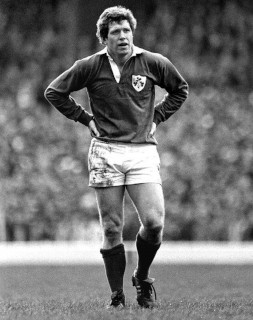
In 1971, Slattery first tours with the British and Irish Lions squad that toured New Zealand, missing out on a start in the third Test due to illness. With the back-row berths claimed by John Taylor, Peter Dixon and Mervyn Davies and still being a newcomer at international level he has to wait until 1974 for his shot at a Lions Test jersey. In the meantime, he plays for the Barbarian F.C. in the famous 1973 game against the All Blacks in Cardiff.
Slattery tours with the Lions again in 1974, playing in all four Tests and captaining the side for two provincial matches. In South Africa he is an invaluable member of the touring party that comes to be known as “the invincibles.” He starts all four Tests as the Lions win the series 3-0 and skippers the side twice during midweek tour matches.
For Ireland, Slattery captains their hugely successful touring side in Australia in 1979 when they win seven of the eight matches including the two Tests in Brisbane and Sydney. In 1982 he starts all four games of Ireland’s Triple Crown season, being denied the Grand Slam by France in the final game of the Five Nations Championship.
O’Brien is born on December 15, 1930, the youngest child of farmer Michael O’Brien and Lena Cleary at Tuamgraney, County Clare, a place she would later describe as “fervid” and “enclosed.” Her father inherits a “thousand acres or more” and “a fortune from rich uncles,” but is a “profligate” hard drinker who gambles away his inheritance, the land sold off or bartered to pay debts. From 1941 to 1946 she is educated by the Sisters of Mercy at the Convent of Mercy boarding school at Loughrea, County Galway – a circumstance that contributes to a “suffocating” childhood. In 1950, having studied at night at pharmaceutical college and worked in a Dublin pharmacy during the day, she is awarded a licence as a pharmacist. She reads such writers as Leo Tolstoy, William Makepeace Thackeray, and F. Scott Fitzgerald.
In Dublin, O’Brien purchases Introducing James Joyce, with an introduction written by T. S. Eliot, and says that when she learned that James Joyce‘s A Portrait of the Artist as a Young Man was autobiographical, it made her realise where she might turn, should she want to write herself. “Unhappy houses are a very good incubation for stories”, she says. In London she starts work as a reader for Hutchinson, a publishing firm, where on the basis of her reports she is commissioned, for £50, to write a novel. She publishes her first book, The Country Girls, in 1960. This is the first part of a trilogy of novels (later collected as The Country Girls Trilogy), which includes The Lonely Girl (1962) and Girls in Their Married Bliss (1964). Shortly after their publication, these books are banned and, in some cases, burned in her native country due to their frank portrayals of the sex lives of their characters. She is accused of “corrupting the minds of young women.” She later says, “I felt no fame. I was married. I had young children. All I could hear out of Ireland from my mother and anonymous letters was bile and odium and outrage.”
In the 1960s, O’Brien is a patient of R. D. Laing. “I thought he might be able to help me. He couldn’t do that – he was too mad himself – but he opened doors,” she later says. Her novel A Pagan Place (1970) is about her repressive childhood. Her parents were vehemently against all things related to literature. Her mother strongly disapproved of her daughter’s career as a writer. Once when her mother found a Seán O’Casey book in her daughter’s possession, she tried to burn it.
O’Brien is a panel member for the first edition of BBC One‘s Question Time in 1979. In 2017 she becomes the sole surviving member.
In addition to the Irish PEN Award, O’Brien’s awards include The Yorkshire Post Book Award in 1970 for A Pagan Place, and the Los Angeles Times Book Prize in 1990 for Lantern Slides. In 2006, she is appointed adjunct professor of English Literature at University College Dublin.
In 2019, O’Brien is awarded the David Cohen Prize for Literature at a ceremony in London. The £40,000 prize, awarded every two years in recognition of a living writer’s lifetime achievement in literature, has been described as the “UK and Ireland Nobel in literature.” Judge David Park says, “In winning the David Cohen Prize, Edna O’Brien adds her name to a literary roll call of honour.”
(Pictured: Edna O’Brien speaking at the 2016 Hay Festival, photo by Andrew Lih and licensed under the Creative Commons Attribution-Share Alike 3.0 Unported license)
In 1956, Whitaker is appointed Secretary of the Department of Finance. His appointment takes place at a time when Ireland’s economy is in deep depression. Economic growth is non-existent, inflation apparently insoluble, unemployment rife, living standards low and emigration at a figure not far below the birth rate. He believes that free trade, with increased competition and the end of protectionism, will become inevitable and that jobs will have to be created by a shift from agriculture to industry and services. He forms a team of officials within the department which produces a detailed study of the economy, culminating in a plan recommending policies for improvement. The plan is accepted by the government and is transformed into a white paper which becomes known as the First Programme for Economic Expansion. Quite unusually this is published with his name attached in November 1958. The programme which becomes known as the “Grey Book” brings the stimulus of foreign investment into the Irish economy. Before devoting himself to poetry, Thomas Kinsella is Whitaker’s private secretary.
In 1977, TaoiseachJack Lynch nominates Whitaker as a member of the 14th Seanad Éireann. He serves as a Senator from 1977–81, where he sits as an independent Senator.
In 1981, Whitaker is nominated to the 15th Seanad Éireann by Taoiseach Garret FitzGerald, where he serves until 1982. FitzGerald also appoints him to chair a Committee of Inquiry into the Irish penal system, and he chairs a Parole Board or Sentence Review Group for several years.
Whitaker also serves as Chancellor of the National University of Ireland from 1976 to 1996. He is also President of the Royal Irish Academy and as such, a member of the Board of Governors and Guardians of the National Gallery of Ireland, from 1985 to 1987. He has a very strong love for the Irish language throughout his career and the collection of Irish poetry, An Duanaire: Poems of the Dispossessed 1600–1900, edited by Seán Ó Tuama and Thomas Kinsella, is dedicated to Whitaker. From 1995–96 he chairs the Constitution Review Group, an independent expert group established by the government, which publishes its report in July 1996.
Whitaker receives many national and international honours and tributes for his achievements during his lifetime, most notably the conferral of “Irishman of the 20th Century” in 2001 and Greatest Living Irish Person in 2002. In November 2014, the Institute of Banking confers an Honorary Fellowship on Whitaker and creates an annual T.K. Whitaker Scholarship in his name. In April 2015, he is presented with a lifetime achievement award by University College Dublin’s Economics Society for his outstanding contribution to Ireland’s economic policy.
In November 2016, to mark his centenary year, Dún Laoghaire-Rathdown County Council acknowledges Whitaker’s “outstanding and progressive contribution to Irish public service and to society.” The Cathaoirleach of Dún Laoghaire Rathdown, Cormac Devlin, presents a special award to Whitaker which is accepted by Ken Whitaker on behalf of his father.
Michelle Smith, married name Michelle Smith de Bruin, lawyer and retired Irish swimmer who wins four medals at the 1996 Summer Olympics in Atlanta, is born in Rathcoole, County Dublin on December 16, 1969. As a result of the medals captured in Atlanta, she becomes the most successful Olympian in Ireland and the country’s first woman to capture a gold medal.
Smith begins swimming competitively at age thirteen. Though she develops into one of Ireland’s premier junior swimmers, she realizes that without more advanced facilities and training techniques, she will never be able to compete at the international level. She goes to the United States to attend school and swim at the University of Houston, where she graduates with a degree in communications. Her times steadily improve and she makes the Irish Olympic teams for the 1988 Summer Olympics in Seoul, South Korea and the 1992 Summer Olympics in Barcelona, Spain. At both of those Games, however, she is eliminated in the preliminary rounds.
In 1994 Smith moves to the Netherlands with her coach and future husband, Erik de Bruin, to prepare for the 1996 Games. The next year she emerges as an elite athlete, winning the 200-metre butterfly and the 200-metre individual medley at the 1995 European Aquatics Championships. She continues to improve in 1996, taking 19 seconds off her best time in the 400-metre freestyle. In response to questions about her sudden turnaround, she credits more sophisticated training techniques and a single-minded focus on swimming. She also points out that she is probably the most tested athlete in Irish history and that she had never tested positive for banned substances.
Prior to the Atlanta Games, Ireland had won only five Olympic gold medals, and no medal — gold, silver, or bronze — had been won by Irish women. In one week, however, Smith rewrites the Irish record books. The 26-year-old swimmer wins the gold in three events — the 200-metre individual medley, the 400-metre individual medley, and the 400-metre freestyle — and captures the bronze medal in the 200-metre butterfly. Her triumph, however, is somewhat tarnished by unsubstantiated rumours that she had used performance-enhancing drugs. Some observers question her dramatic improvements in time and point to her marriage to de Bruin, a Dutchdiscus thrower who had been suspended from international competition for steroid use. Smith passes all the pre- and post-Olympic drug tests, however.
Smith’s success continues at the 1997 European Aquatic Championships, where she wins gold medals in the 200-metre butterfly and the 200-metre individual medley. In 1998, however, she receives a four-year ban for tampering with a urine sample during a drug test. She maintains her innocence, but her appeal of the ban before the Court of Arbitration for Sport (CAS) fails. She is 28 at the time, and the ban effectively ends her competitive swimming career. She is not stripped of her Olympic medals, as she has never tested positive for any banned substances.
Smith’s experiences at the CAS has an effect beyond her swimming career. It is there that she develops an interest in the law. After officially announcing her retirement from swimming in 1999, she returns to university, graduating from University College Dublin with a degree in law. In July 2005 she is conferred with the degree of Barrister at Law of King’s Inns, Dublin. While a student at the King’s Inns she wins the highly prestigious internal Brian WalshMoot Court competition. Her book, Transnational Litigation: Jurisdiction and Procedure is published in 2008 by Thomson Round Hall.
In 1996, Smith releases her autobiography, Gold, co-written with Cathal Dervan. She lives in Kells, County Kilkenny with her husband and their two children.
In 1916 Flannery joins the Irish Volunteers alongside his brother Peter, although he does not take part in the Easter Rising. However, he does participate in the Irish War of Independence. Following the outbreak of the Irish Civil War, he fights as part of the Anti-Treaty IRA until his capture by the National Army on November 11, 1922, in Roscrea, County Tipperary. He is imprisoned for nearly a year and a half in Dublin’s Mountjoy Prison (C Wing). While there he witnesses the execution of Anti-Treaty IRA leaders Richard Barrett, Joe McKelvey, Liam Mellows and Rory O’Connor from his cell window. Following a 28-day hunger strike, he is placed in the Curragh Camp until May 1, 1924, when he is finally released, a full year after the end of the civil war.
Following the creation of Fianna Fáil and their entry into the Irish Parliament Dáil Éireann, Flannery becomes affiliated with Sinn Féin, who had voted to retain their abstentionist policy towards the Dáil and their refusal to acknowledge it as the legitimate government of Ireland. Sinn Féin tasks him with drumming up support for the party in New York. However, following the start of the Great Depression he finds it difficult to focus on politics in the face of mounting poverty. By 1933 finding support for Sinn Féin and the IRA becomes particularly tough when Fianna Fáil expands greatly the range of people eligible for military pensions, which under the previous government had been biased against members of the Anti-Treaty IRA. For the next 40 years Flannery works for the Metropolitan Life Insurance Company.
Upon the onset of The Troubles in Northern Ireland, Flannery is once again drawn into the world of Irish Republicanism. In a response to the mounting violence, he sets up the Irish Northern Aid Committee, or as it became better known as, NORAID. The official purpose of NORAID is to provide funds to the families of imprisoned Irish Republicans and victims of violence. However, opponents level the accusation against the organisation that it is also providing funding directly to the Provisional Irish Republican Army, and perhaps even also supplying firearms.
In 1970 Flannery travels around America and sets up 62 chapters of NORAID. In 1971 he says, “The more coffins sent back to Britain, the sooner this will be all over,” referring to British soldiers.
In 1982 Flannery is indicted, with four other members of NORAID, for arms smuggling, but all defendants are acquitted after their legal defence is able to successfully argue their actions had been sanctioned the CIA.
In 1986 Flannery quietly resigns from NORAID following the decision by Sinn Féin to drop its abstentionist policy in the Republic of Ireland and to recognise Dáil Éireann as the legitimate governing body of Ireland.
Flannery opposes the Northern Ireland peace process, believing that Sinn Féin and the Provisionals have “sold out,” and believes the removal of British troops from Northern Ireland is the only starting point upon which negotiations can begin.
Flannery dies at the age of 92 in New York City on September 30, 1994. He is buried in Mount Saint Mary’s Cemetery in Flushing, Queens, New York.
Kettle is born on February 9, 1880, in Malahide or Artane, Dublin, the seventh of twelve children of Andrew J. Kettle (1833–1916), a leading Irish nationalist politician, progressive farmer, agrarian agitator and founding member of the Irish National Land League, and his wife, Margaret (née McCourt). One of his brothers is the industrial pioneer, Laurence Kettle. He is influenced considerably through his father’s political activities.
Kettle is killed in action with ‘B’ Company of the 9th Battalion of the Royal Dublin Fusiliers in an attack on German lines on September 9, 1916, near the village of Ginchy during the Somme Offensive in France. During the advance he is felled when the Dublin Fusiliers are “struck with a tempest of fire,” and having risen from the initial blow, he is struck again and killed outright. His body is buried in a battlefield grave by the Welsh Guards, but the location of the grave is subsequently lost. His name is etched on the monumental arched gateway for the missing of the Somme at Thiepval.
Kettle is one of the leading figures of the generation who, at the turn of the twentieth century, give new intellectual life to Irish party politics, and to the constitutional movement towards All-Ireland Home Rule. A gifted speaker with an incisive mind and devastating wit, his death is regarded as a great loss to Ireland’s political and intellectual life.
As G. K. Chesterton surmises, “Thomas Michael Kettle was perhaps the greatest example of that greatness of spirit which was so ill rewarded on both sides of the channel […] He was a wit, a scholar, an orator, a man ambitious in all the arts of peace; and he fell fighting the barbarians because he was too good a European to use the barbarians against England, as England a hundred years before has used the barbarians against Ireland.”
O’Rourke makes his debut on the inter-county scene when he is picked for the Meath minor team. He later joins the under-21 side but enjoys little success in these grades. He makes his senior debut during the 1975-1976 league. Over the course of the next twenty years he is a regular member of the starting fifteen and wins back-to-back All-Ireland medals in 1987 and 1988. He also wins five Leinster Senior Football Championship medals, three National Football League titles and is named Texaco Footballer of the Year in 1991. He plays his last game for Meath in July 1995.
In retirement from playing O’Rourke combines his teaching career with a new position as a sports broadcaster. His media career begins with RTÉ where he has worked as a studio analyst with the flagship programme The Sunday Game for over twenty-five years. He also writes a weekly column for the Sunday Independent.
Brian Moore, novelist and screenwriter who is acclaimed for the descriptions in his novels of life in Northern Ireland after World War II, is born in Belfast, Northern Ireland on August 25, 1921. He has been described as “one of the few genuine masters of the contemporary novel.”
In 1948 Moore emigrates to Canada to work as a reporter for the Montreal Gazette and becomes a Canadian citizen. While eventually making his primary residence in California, he continues to live part of each year in Canada up to his death.
Moore lives in Canada from 1948 to 1958, where he meets his first wife, Jacqueline (“Jackie”) Sirois, a French Canadian and fellow journalist. They marry in 1952. He moves to New York City in 1959 to take up a Guggenheim Fellowship and remains there until his divorce in October 1967. He then moves to the west coast of the United States, settling in Malibu, California, with his new wife Jean Denney, a former commentator on Canadian TV. There he teaches creative writing at UCLA.
Moore writes his first novels in Canada. His earliest novels are thrillers, published under his own name or using the pseudonyms Bernard Mara or Michael Bryan. His first novel outside the genre, Judith Hearne, remains among his most highly regarded. The book is rejected by ten American publishers before being accepted by a British publisher. It is made into a film, with British actress Maggie Smith playing the lonely spinster who is the book/film’s title character.
Some of Moore’s novels feature staunchly anti-doctrinaire and anti-clerical themes, and in particular he speaks strongly about the effect of the Church on life in Ireland. A recurring theme in his novels is the concept of the Catholic priesthood. On several occasions he explores the idea of a priest losing his faith. At the same time, several of his novels are deeply sympathetic and affirming portrayals of the struggles of faith and religious commitment, Black Robe most prominently.
Moore dies at his Malibu home, which is celebrated in Seamus Heaney‘s poem Remembering Malibu, on January 11, 1999, from pulmonary fibrosis. His widow, Jean, lives on in the house until it is destroyed in 2018 in the Woolsey Fire.
At the time of his death, Moore is working on a novel about the 19th-century French symbolist poet Arthur Rimbaud. His last published work before his death is an essay entitled “Going Home.” It is a reflection inspired by a visit he made to the grave in Connemara of his family friend, the Irish nationalist Bulmer Hobson. The essay is commissioned by Granta and published in The New York Times on February 7, 1999.
In 1996, the Brian Moore Short Story Awards is launched by the Creative Writers Network in Northern Ireland and is open to all authors of Irish descent. Previous judges have included Glenn Patterson, Lionel Shriver, Carlo Gébler and Maeve Binchy.
In 1975 Moore arranges for his literary materials, letters and documents to be deposited in the Special Collections Division of the University of Calgary Library, an inventory of which is published by the University of Calgary Press in 1987. His archives, which include unfilmed screenplays, drafts of various novels, working notes, a 42-volume journal (1957–1998), and his correspondence, are housed at the Harry Ransom Center at the University of Texas at Austin.
During 1920 and 1921, Kennedy is a senior legal adviser to the representatives of Dáil Éireann during the negotiations for the Anglo-Irish Treaty. He is highly regarded as a lawyer by Michael Collins, who later regrets that Kennedy had not been part of the delegation sent to London in 1921 to negotiate the terms of the treaty.
On January 31, 1922, Kennedy becomes the first Attorney General in the Provisional Government of the Irish Free State. Later that year he is appointed by the Provisional Government to the Irish Free State Constitution Commission to draft the Constitution of the Irish Free State, which is established on December 6, 1922. The functions of the Provisional Government are transferred to the Executive Council of the Irish Free State. He is appointed Attorney General of the Irish Free State on December 7, 1922.
In 1923, Kennedy is appointed to the Judiciary Commission by the Government of the Irish Free State, on a reference from the Government to establish a new system for the administration of justice in accordance with the Constitution of the Irish Free State. The Judiciary Commission is chaired by James Campbell, 1st Baron Glenavy, who had also been the last Lord Chancellor of Ireland. It drafts the Courts of Justice Act 1924 for a new court system, including a High Court and a Supreme Court, and provides for the abolition, inter alia, of the Court of Appeal in Ireland and the Irish High Court of Justice. Most of the judges are not reappointed to the new courts. Kennedy personally oversees the selection of the new judges and makes impressive efforts to select them on merit alone. The results are not always happy. His diary reveals the increasingly unhappy atmosphere, in the Supreme Court itself, due to frequent clashes between Kennedy and his colleague Gerald Fitzgibbon, since the two men prove to be so different in temperament and political outlook that they find it almost impossible to work together harmoniously. In a similar vein, Kennedy’s legal opinion and choice of words could raise eyebrows amongst legal colleagues and fury in the Executive Council e.g. regarding the Kenmare incident.
Kennedy is also a delegate of the Irish Free State to the Fourth Assembly of the League of Nations between September 3-29, 1923.
Kennedy is elected to Dáil Éireann on October 27, 1923, as a Cumann na nGaedheal TD at a by-election in the Dublin South constituency. He is the first person to be elected in a by-election to Dáil Éireann. He resigns his seat when he is appointed Chief Justice of Ireland in 1924.
On June 5, 1924, Kennedy is appointed Chief Justice of Ireland, thereby becoming the first Chief Justice of the Irish Free State. He is also the youngest person appointed Chief Justice of Ireland. When he is appointed, he is 44 years old. Although the High Court of Justice and the Court of Appeal had been abolished and replaced by the High Court and the Supreme Court respectively, one of his first acts is to issue a practice note that the wearing of wigs and robes will continue in the new courts. This practice is still continued in trials and appeals in the High Court and the Supreme Court (except in certain matters). He holds the position of Chief Justice until his death on December 1, 1936, in Goatstown, Dublin.
In September 2015, a biography by Senator Patrick Kennedy (no relation) is written about Kennedy called Hugh Kennedy: The Great but Neglected Chief Justice.
Garret FitzGerald succeeds Charles Haughey to become the eighth Taoiseach of Ireland on June 30, 1981. He serves in the position from June 1981 to March 1982 and December 1982 to March 1987.
FitzGerald joins Fine Gael, attaching himself to the liberal wing of the party. and in 1969 is elected to Dáil Éireann, the lower house of the Oireachtas, the Irish parliament. He later gives up his university lectureship to become Minister for Foreign Affairs in the coalition government of Liam Cosgrave (1973–1977). When the coalition government is resoundingly defeated in the 1977 Irish general election, Cosgrave yields leadership of Fine Gael to FitzGerald. In his new role as Leader of the Opposition and party leader, he proceeds to modernize and strengthen the party at the grass roots. He briefly loses power in 1982 when political instability triggers two snap elections.
By the time of the 1981 Irish general election, Fine Gael has a party machine that can easily match Fianna Fáil. The party wins 65 seats and forms a minority coalition government with the Labour Party and the support of a number of Independent TDs. FitzGerald is elected Taoiseach on June 30, 1981. To the surprise of many FitzGerald excluded Richie Ryan, Richard Burke and Tom O’Donnell, former Fine Gael stalwarts, from the cabinet.
On May 5, 2011, it is reported that FitzGerald is seriously ill in a Dublin hospital. Newly elected Fine Gael Taoiseach Enda Kenny sends his regards and calls him an “institution.” On May 6 he is put on a ventilator. On May 19, after suffering from pneumonia, he dies at the Mater Private Hospital in Dublin at the age of 85.
In a statement, Irish PresidentMary McAleese hails FitzGerald as “a man steeped in the history of the State who constantly strove to make Ireland a better place for all its people.” Taoiseach Enda Kenny pays homage to “a truly remarkable man who made a truly remarkable contribution to Ireland.” Henry Kissinger, the former United States Secretary of State, who serves as an opposite number to FitzGerald in the 1970s, recalls “an intelligent and amusing man who was dedicated to his country.”
FitzGerald’s death occurs on the third day of Queen Elizabeth II‘s state visit to the Republic of Ireland, an event designed to mark the completion of the Northern Ireland peace process that had been “built on the foundations” of FitzGerald’s Anglo-Irish Agreement with Margaret Thatcher in 1985. In a personal message, the Queen offers her sympathies and says she is “saddened” to learn of FitzGerald’s death.
On his visit to Dublin, United States PresidentBarack Obama offers condolences on FitzGerald’s death. He speaks of him as “someone who believed in the power of education; someone who believed in the potential of youth; most of all, someone who believed in the potential of peace and who lived to see that peace realised.”
FitzGerald is the author of a number of books, including Planning in Ireland (1968), Towards a New Ireland (1972), Unequal Partners (1979), All in a Life: An Autobiography (1991), and Reflections on the Irish State (2003).