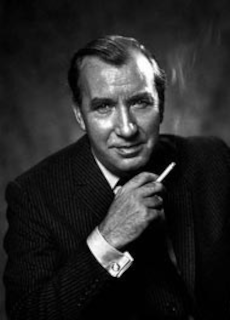
Ryan emigrates to the United States in 1947 to work for Time, where he reports on the postwar tests of atomic weapons carried out by the United States in the Pacific. He then reports for Time on the Arab-Israeli war in 1948. This is followed by work for other magazines, including Collier’s Weekly and Reader’s Digest.
Ryan marries Kathryn Morgan, a novelist, and becomes a naturalized citizen of the United States in 1951.
On a trip to Normandy in 1949 Ryan becomes interested in telling a more complete story of Operation Overlord than has been produced to date. He begins compiling information and conducting over 1,000 interviews as he gathers stories from both the Allies and the Germans, as well as the French civilians.
In 1956 Ryan begins to write down his World War II notes for The Longest Day: 6 June 1944 D-Day, which tells the story of the D-Day Invasion of Normandy, published three years later in 1959. It is an instant success, and he assists in the writing of the screenplay for the 1962 film of the same name. Darryl F. Zanuck pays the author U.S.$175,000 for the screen rights to the book.
Ryan’s 1957 book One Minute to Ditch! is about the successful ocean ditching of a Pan AmericanBoeing 377 Stratocruiser. He had written an article about the ditching for Collier’s in their December 21, 1956, issue and then expanded it into the book.
Ryan’s next work is The Last Battle (1966), about the Battle of Berlin. The book contains detailed accounts from all perspectives: civilian, American, British, Russian and German. It deals with the fraught military and political situation in the spring of 1945, when the forces of the western allies and the Soviet Union contend for the chance to liberate Berlin and to carve up the remains of Germany.
This work was followed by A Bridge Too Far (1974), which tells the story of Operation Market Garden, the ill-fated assault by allied airborne forces on the Netherlands culminating in the Battle of Arnhem. It is made into a major 1977 film of the same name.
Ryan is awarded the French Legion of Honour and an honorary Doctor of Literature degree from Ohio University, where the Cornelius Ryan Collection is housed in the Alden Library. He is diagnosed with prostate cancer in 1970 and struggles to finish A Bridge Too Far during his illness. He dies in Manhattan on November 23, 1974, while on tour promoting the book, only two months after publication. He is buried in the Ridgebury Cemetery in northern Ridgefield, Connecticut.
Four years after his death, Ryan’s struggle with prostate cancer is detailed in A Private Battle, written by his widow, from notes he had secretly left behind for that purpose.
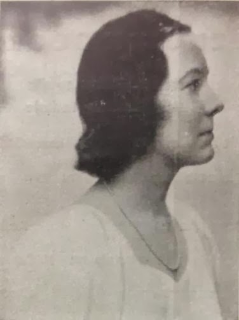
Married in 1893, Hinkson’s parents initially settle in England, where he studies law and is called to the Inner Temple in 1902. After suffering the loss of their first two sons in infancy, they have two more sons in addition to their daughter, Pamela. During this time her mother earns the main family income, and it is likely that she determines their return to Ireland in 1911. The Hinksons initially settle in Dalkey, County Dublin, before moving to a house called Clarebeg in Shankill. When Henry Hinkson is appointed resident magistrate for south Mayo (Castlebar) in October 1914, the family moves to Claremorris, County Mayo.
Hinkson is educated privately in England and on the Continent, and in Ireland attends a local convent day-school. She is exposed to her mother’s literary milieu which includes prominent writers of the Irish revival, including George William Russell, James Stephens, and Padraic Colum. Her mother’s memoir, The Years of the Shadow (1919), recalls Pamela’s developing talent for writing poetry and her predilection for war themes, as evidenced by The Blind Soldier, one of her first published poems. By the time she turns her hand to short stories, her earnings from writing enable her to buy the latest fashions.
Two key events that consumed Hinkson’s life and later spark her creativity are World War I and the Easter Rising. H. G. Wells describes in the foreword to his war novel Mr. Britling Sees It Through (1916) a conversation he had with her when she was 12, recalling how she had boldly set him straight on the “Irish question.” Her parents send her away to boarding school in County Wicklow in the hope that she will be distracted from her gloomy preoccupations, which are accentuated by the absence of her brothers, serving in the British Army. After the war she is deeply concerned by the redundancy experienced by demobilised and often maimed soldiers and contributes to the welfare work of the Irish servicemen’s Shamrock Club in London. These issues inform two early novels, The Victors (1925) and Harvest (1926), both written in the guise of an ex-serviceman under the pseudonym “Peter Deane.” By masking her identity, she avoids the possibility of her works being discredited because of her gender and lack of first-hand experience of war. Subsequently she writes under her own name for thirty years.
In contrast to her close relationship with her mother, Hinkson deeply dislikes her father. With the exception of her beloved brother Giles A. Hinckson, a correspondent for The Times in Buenos Aires and Santiago, she never meets a man who matches her high ideals. Though briefly engaged to be married, she is ultimately disillusioned by all men, dismissing them as she had her father. After his death early in 1919, she and her mother are left in financial difficulties, and have to resort to friends and boarding houses for accommodation. Without the financial means to embark on a university degree, she remains at her mother’s side. Though she continues to write, she leads a somewhat stifled life. From 1922 onwards they spend several years on the Continent.
Hinkson’s first novel, The End of All Dreams (1923), addresses the decline of the “big house” amid the revolutionary upheavals of recent Irish history, a theme to which she returns in later works, such as The Deeply Rooted (1935) and her last book, The Lonely Bride (1951). During the 1920s she writes much girls’ school fiction, while her novel Wind from the West (1930) is informed by a period spent in France, where she works as a governess. Her transcription of the memoirs of Lady Fingall (Elizabeth Burke-Plunkett), published under the title Seventy Years Young (1937), illustrates the decline of the Anglo-Irish ascendancy. Informed by war and the Irish troubles, her novels characteristically are solemn, and reflect her ambivalent relationship with Ireland. Inspired by the Irish landscape, but never an ardent supporter of Irish independence, she maintains an abiding attachment to England.
The death of Hinkson’s mother in 1931 is a devastating blow that triggers her most forceful and first truly successful novel, The Ladies’ Road (1932). Documenting the lives of the Irish and English ascendancies before, during, and after World War I, this novel, without being explicitly autobiographical, contains many motifs that resonate with her own life story. When published in the United States in 1946 it proves a massive success, selling 100,000 copies in the Penguin Books edition, a rare feat for a World War I novel appearing immediately after World War II. Other notable works are The Light on Ireland (1935) and her sketches of Irish life, Irish Gold (1939), written while she lodges with friends near Lough Derg, County Tipperary.
Hinkson’s visit to India in the late 1930s as a guest of the viceroy, which she recounts in Indian Harvest (1941), results in her appointment to the Ministry of Information in London (1939–45). She lectures on India in the United States during World War II, and also lectures to British troops and local audiences in Germany (1946–47), broadcasts on radio, and contributes to The Observer, The Spectator, New Statesman, The Manchester Guardian, and Time and Tide. Her novel Golden Rose (1944), written in London during The Blitz, romanticises the British colonial presence in India. Forthright in the expression of her numerous strongly held opinions, she argues ardently and controversially for women’s rights, animal welfare, and retention of Northern Ireland in the UK. Devout in her Catholicism, she is none the less critical of certain Catholic precepts.
Hinkson returns to Ireland in 1959 where she suffers poor health for twenty years until her death in Dublin on May 26, 1982.
(From: “Hinkson, Pamela” by Jessica March, Dictionary of Irish Biography, http://www.dib.ie)
Dirrane is born in Oatquarter in the townland of Kilmurvey on Inishmore, Aran Islands, County Galway on November 15, 1894. She is the youngest child of Joseph Gillan and Maggie (née Walsh). Her father is a weaver of flannel cloth and has a small farm. She has four brothers and three sisters. Her oldest brother is a fisherman, who dies at age 21 in 1901, and her father dies before 1911. Despite this hardship, all of the children go to school, with one of her brothers becoming an Irish teacher, and later an Irish inspector. The family speaks Irish at home, but they are all bilingual with English. She is schooled at the national school in Oatquarter until the age of 14. She leaves to work in local homes, looking after children. When she writes her memoirs late in life, she claims to have met Joseph Plunkett, Éamonn Ceannt, Thomas MacDonagh, Thomas Ashe and Patrick Pearse when they visited the island, visiting a house where she looked after the children, discussing politics and plans for the Easter Rising with them. She is a republican, becoming a member of Cumann na mBan in 1918 while she is working for Fr. Matthew Ryan as a housekeeper. She is involved in drilling and assisting fugitives from the authorities. Because of their known republican sympathies, the Black and Tans raid the Gillan family homes.
Dirrane moves to Dublin in 1919 to train in Saint Ultan’s Children’s Hospital as a nurse. She is still under surveillance, being arrested alongside her employer, Claude Chavasse, when she is working as a nurse in his house. She is held in Dublin’s Bridewell Garda Station for two days before being transferred to Mountjoy Prison. In the time of her imprisonment, she is not charged or put on trial. Her refusal to speak English angers the guards, culminating in her going on hunger strike for a number of days in 1920 until she is released. She takes part in the Cumann na mBan vigil outside of Mountjoy Prison in November 1920, when Kevin Barry is hanged.
Dirrane works in Richard Mulcahy‘s house for two years, before emigrating to the United States in 1927 to continue her career as a nurse. She works in Boston where she is an active member of the Irish emigrant community alongside former neighbours from the Aran Islands and some relatives. She works in a hotel for a time but returns to nursing after her marriage to Edward ‘Ned’ Dirrane in November 1932 in the Jamaica Plain section of Boston. Ned, a labourer in Boston and also from Inishmore, dies from heart failure in 1940. Dirrane continues her career nursing in hospitals and as a district nurse. On May 13, 1940, she naturalises as U.S. citizen. During World War II, she works as a nurse in a munitions factory, and at a U.S. Army Air Forcesbomber base in Mississippi. She canvases for John F. Kennedy in the Irish community in South Boston when he runs for president in 1960. Jean Kennedy Smith visits Dirrane in 1997 in Galway to acknowledge her contribution. She also meets Senator Edward Kennedy.
Following her retirement, Dirrane lives with her nephew, but she returns to the Aran Islands in 1966 at age 72. There she lives with her brother-in-law, Pat Dirrane, a widower with three grown sons. They marry in a private ceremony on April 27, 1966. She continues to live on the island after Pat’s death on February 28, 1990, living with her stepson. She eventually moves into a nursing home in Newcastle in the suburbs of Galway. When she celebrates her 100th birthday, she funds a statue of Our Lady Mary at a holy well in Corough on Inishmore. At age 103, the matron of her nursing home arranges for a local writer, Jack Mahon, to record her memories and collate the information into a book. The book, A Woman of Aran, is published in 1997 and is a bestseller for several weeks. She is awarded an honorary degree, an MA honoris causa, from NUI Galway in May 1998, the oldest person to ever receive one.
Dirrane dies at age 109 on December 31, 2003, in Galway. She is buried on Inishmore.
O’Riordan joins the Communist Party of Ireland in 1935 while still in the IRA and works on the communist newspaper The Irish Workers’ Voice. In 1937, following the urgings of Peadar O’Donnell, several hundred Irishmen, mostly IRA or ex-IRA men, go to fight for the Spanish Republic in the Spanish Civil War with the XVth International Brigade. They are motivated in part by enmity towards the 800 or so Blueshirts, led by Eoin O’Duffy who go to Spain to fight on the “nationalist” side in the Irish Brigade. He accompanies a party led by Frank Ryan. In the Republic’s final offensive of July 25, 1938, he carries the flag of Catalonia across the River Ebro. On August 1, he is severely injured by shrapnel on the Ebro front. He is repatriated to Ireland the following month, after the International Brigades are disbanded.
In 1938 O’Riordan is offered an Irish Army commission by the Irish Free State but chooses instead to train IRA units in Cork. As a result of his IRA activities during World War II, or the Emergency as it is known in neutral Ireland, he is interned in the Curragh internment camp from 1939 until 1943 where he is Officer Commanding of the Cork Hut and partakes in Máirtín Ó Cadhain’s Gaelic League classes as well as publishing Splannc (Irish for “Spark,” named after Vladimir Lenin‘s newspaper).
In 1944 O’Riordan is founding secretary of the Liam Mellows Branch of the Labour Party and in 1945 is a founding secretary of the Cork Socialist Party, whose other notable members include Derry Kelleher, Kevin Neville and Máire Keohane-Sheehan.
In 1947, O’Riordan is a founding secretary of the Irish Workers’ League and general secretary thereafter, and of its successor organisation the Irish Workers’ Party from 1962–70.
In all O’Riordan runs for election five times, campaigning throughout for the establishment of a socialist republic in Ireland but given Ireland’s Catholic conservatism and fear of communism, he does so without success. He does, however, receive playwright Sean O’Casey‘s endorsement in 1951.
O’Riordan’s participation in the Spanish Civil War is always an important part of his political identity. In 1966 he attends the International Brigades’ Reunion in Berlin and is instrumental in having Frank Ryan’s remains repatriated from Germany to Ireland in 1979.
O’Riordan is a member of the Irish Chile Solidarity Committee and attends the 1st Party Congress of the Communist Party of Cuba in 1984. He also campaigns on behalf of the Birmingham Six and attends their Appeal trial in 1990. He serves as General Secretary of the Communist Party of Ireland (1970–83) and as National Chairman of the party (1983–88). He publishes many articles under the auspices of the CPI.
O’Riordan’s last major public outing comes in 2005 at the re-dedication of the memorial outside Dublin’s Liberty Hall to the Irish veterans of the Spanish Civil War. He and other veterans are received by President of IrelandMary McAleese. He is also presented with Cuba’s Medal of Friendship by the Cuban Consul Teresita Trujillo to Ireland on behalf of Cuban President Fidel Castro.
In 1969, according to Soviet dissident Vasili Mitrokhin, O’Riordan is approached by IRA leaders Cathal Goulding and Seamus Costello with a view to obtaining guns from the Soviet KGB to defend Irish republican areas of Belfast during the communal violence that marks the outbreak of the Troubles. Mitrokhin alleges that O’Riordan then contacts the Kremlin, but the consignment of arms does not reach Ireland until 1972. The operation is known as Operation Splash. The IRA splits in the meantime between the Provisional IRA and the Official IRA and it is the latter faction who receives the Soviet arms. Mitrokhin’s allegations are repeated in Boris Yeltsin‘s autobiography.
O’Riordan’s book, Connolly Column – The Story of the Irishmen who fought for the Spanish Republic 1936–1939, is published in 1979 and deals with the Irish volunteers of the International Brigade who fought in support of the Spanish Republic against Francisco Franco in the Spanish Civil War (1936–1939). An updated version of the book is reprinted in 2005 and is launched by the Lord Mayor of Dublin, Cllr. Michael Conaghan at a book launch at SIPTU headquarters, Liberty Hall. The book is the inspiration for Irish singer-songwriter Christy Moore‘s famous song “Viva la Quinta Brigada.”
In 1991, O’Riordan’s wife dies at the age of 81 at their home. He continues to live in their family home before moving to Glasnevin in 2000 to be close to his son Manus who lives nearby. He lives there until falling ill in November 2005 and is taken to the Mater Hospital. His health rapidly deteriorates, and he quickly develops Alzheimer’s disease. Soon afterwards he is moved to St. Mary’s Hospital in the Phoenix Park where he spends the final few months of his life, before his death at the age of 88 on May 18, 2006.
O’Riordan’s funeral at Glasnevin Crematorium is attended by over a thousand mourners. Following a wake the previous night at Finglas Road, hundreds turn up outside the house of his son Manus and traffic grounds to a halt as family, friends and comrades – many of whom are waving the red flag of the Communist Party of Ireland – escort O’Riordan to Glasnevin Cemetery. A secular ceremony takes place led by Manus O’Riordan, Head of Research at SIPTU, with contributions from O’Riordan’s family, Communist Party general secretary Eugene McCartan and IBMT representative Pauline Frasier.
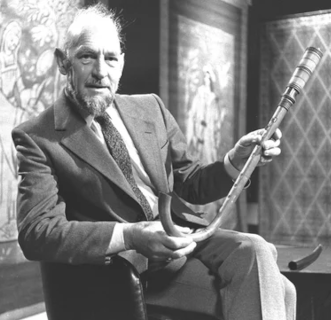
Brian Patrick Boydell, Irish composer whose works include orchestral pieces, chamber music, and songs, dies on November 8, 2000. He is Professor of Music at Trinity College Dublin for 20 years, founder of the Dowland Consort, conductor of the Dublin Orchestral Players, and a prolific broadcaster and writer on musical matters. He was also a prolific musicologist specialising in 18th-century Irish musical history.
Boydell is born on March 17, 1917, in Howth, County Dublin, into a prosperous Anglo-Irish family. His father James runs the family maltings business while his mother, Eileen Collins, is one of the first women graduates of Trinity College. Following their son’s birth, the Boydells move from Howth and live in a succession of rented houses before settling in Shankill, County Dublin. The young Boydell begins his formal education at Monkstown Park in Dublin and is subsequently sent to the Dragon School at Oxford, England. From there he goes to Rugby School, where he comes under the influence of Kenneth Stubbs, the music master. Although he later speaks of his resentment at the anti-Irish attitude he experiences at Rugby, he appreciates the very good education in science and music he receives there.
Having completed his secondary education, Boydell spends the summer of 1935 developing his musical knowledge at Heidelberg, Germany, where he writes his first songs and also studies organ. He wins a choral scholarship to Clare College, Cambridge, where, perhaps through parental pressure, he studies natural science, graduating in 1938 with a first-class degree.
Upon the outbreak of World War II, Boydell returns to Dublin and achieves further academic success in 1942 with a Bachelor of Music degree from Trinity College. He also takes further lessons in composition from John F. Larchet.
Boydell’s busy working life combines teaching, performing and composing. Following a brief stint in his father’s business, he plunges himself into Dublin’s classical music scene. In 1943, he succeeds Havelock Nelson as conductor of the Dublin Orchestral Players, beginning an association with the amateur orchestra that endures for a quarter of a century (until 1966). In 1944, he is appointed Professor of Singing at the Royal Irish Academy of Music, a position he holds for eight years. Along with fellow composers Edgar M. Deale, Aloys Fleischmann, and Frederick May he founds the Music Association of Ireland in 1948 as a vehicle to promote classical music throughout the country.
Boydell’s interest in Renaissance music, in particular the madrigal, leads in 1959 to founding the Dowland Consort, a vocal ensemble with which he performs for many years and records an LP. In 1962, having obtained a Doctorate in Music, he is appointed Professor of Music at Trinity College, a position he holds until 1982. He immediately revamps the course making it more relevant to the second half of the twentieth century. He also finds time to sit on the Arts Council throughout the 1960s, 70s, and early 80s.
Boydell’s communication skills combined with his infectious enthusiasm makes him a natural broadcaster. The appeal of his programmes on the history and performance of music, first on RTÉ Radio 1 and later on Telefís Éireann, go beyond a specialist audience and are, for many people, their introduction to a new world of aural pleasure.
Boydell has many interests beyond music. As a surrealist painter in the 1940s, having taken lessons from Mainie Jellett, he is a member of The White Stag Group. He is also passionate about cars and photography.
Following retirement from Trinity as Fellow Emeritus, Boydell devotes himself to musical scholarship, writing two books on the music of 18th century Dublin. He also contributes to The New Grove Dictionary of Music and Musicians.
Boydell dies at his home in Howth on November 8, 2000, at the age of 83 and in the company of his wife of 56 years, Mary (née Jones) and their sons, Cormac and Barra. A third son, Marnac, predeceases him.
Boydell is awarded several honorary titles in recognition of his services to music, including the Honorary Doctorate of Music from the National University of Ireland (1974), the Order of Merit of the Italian Republic (1983), the election to Aosdána, Ireland’s academy of creative artists (1984), and Honorary Fellowship of the Royal Irish Academy of Music (1990).
MacGreevy is the son of a policeman and a primary school teacher. At age 16, he joins the British Civil Service as a boy clerk.
At the outbreak of World War I, MacGreevy is promoted to an intelligence post with the Admiralty. He enlists in 1916 and sees active service at the Ypres Salient and the Somme, being wounded twice. After the war, he studies at Trinity College, Dublin, in whose library his papers are now held. He then becomes involved in various library organisations, begins publishing articles in Irish periodicals, and writes his first poems.
In 1924, MacGreevy is first introduced to James Joyce in Paris. The following year he moves to London, where he meets T. S. Eliot and begins writing for The Criterion and other magazines. He also begins publishing his poetry.
In 1934, Poems is published in London and New York City. The work shows that MacGreevy has absorbed the lessons of Imagism and of The Waste Land, but also demonstrates that he has brought something of his own to these influences. The book is admired by Wallace Stevens and the two poets become regular correspondents.
Unfortunately, although MacGreevy continues to write poetry, this is the only collection published in his lifetime. Since his death there have been two Collected Poems issued, one in 1971 and an edited edition collecting his published and unpublished poetry published twenty years later.
In 1929 MacGreevy begins working at Formes, a journal of the fine arts. He also publishes a translation of Paul Valéry‘s Introduction à la méthode de Léonard de Vinci as Introduction to the Method of Leonardo da Vinci. In the mid-1930s, he moves back to London and earns his living lecturing at the National Gallery there.
From 1938 to 1940 MacGreevy is the chief art critic for The Studio. He publishes several books on art and artists, including Jack B. Yeats: An Appreciation and an Interpretation and Pictures in the Irish National Gallery (both 1945), and Nicolas Poussin (1960).
MacGreevy is a lifelong Roman Catholic. His faith informs both his poetry and his professional life. On returning to Dublin during World War II, he writes for both the Father Mathew Record and the Capuchin Annual and joins the editorial board of the latter.
MacGreevy is director of the National Gallery of Ireland from 1950–63. Although to many he seems a surprising choice, his latent talents as an administrator are brought to the fore. He is instrumental in bringing to the gallery such ideas as a lecture series and in-house restoration, which are commonplace abroad. It is through his persistent requests to the government that an extension to the gallery is approved. Unfortunately, the demands of the position take its toll. He has two heart attacks in 1956 and 1957 and ill health forces him to retire in 1963.
During his last years MacGreevy begins writing poetry again. He also begins his memoirs, which he never completes. He is admitted to the Portobello Nursing Home in Dublin for what is to be a minor operation in March 1967. He dies from heart failure on Saint Patrick’s Day eve, March 16, 1967.
McCormack is born on June 14, 1884, in Athlone, County Westmeath, the second son and fifth of the 11 children of Andrew McCormack and his wife Hannah Watson. His parents are both from Galashiels, Scotland, and work at the Athlone Woolen Mills, where his father is a foreman. He is baptised in St. Mary’s Church, Athlone, on June 23, 1884.
McCormack receives his early education from the Marist Brothers in Athlone and later attends Summerhill College, Sligo. He sings in the choir of the old St. Peter’s Church in Athlone under his choirmaster Michael Kilkelly. When the family moves to Dublin, he sings in the choir of St. Mary’s Pro-Cathedral where he is discovered by Vincent O’Brien. In 1903 he wins the coveted gold medal of the Dublin Feis Ceoil. He marries Lily Foley in 1906 and they have two children, Cyril and Gwen.
In March 1904, McCormack becomes associated with James Joyce, who at the time has singing ambitions himself. He persuades Joyce to enter the Feis Ceoil that year, where the not yet famous writer is awarded the Bronze Medal.
Fundraising activities on his behalf enable McCormack to travel to Italy in 1905 to receive voice training by Vincenzo Sabatini, father of the novelist Rafael Sabatini, in Milan. Sabatini finds McCormack’s voice naturally tuned and concentrates on perfecting his breath control, an element that becomes part of the basis of his renown as a vocalist.
In 1906, McCormack makes his operatic début at the Teatro Chiabrera, Savona. The next year, he begins his first important operatic performance at Covent Garden in Pietro Mascagni‘s Cavalleria rusticana, becoming the theatre’s youngest principal tenor. In 1909, he begins his career in the United States.
In February 1911, McCormack plays Lieutenant Paul Merrill in the world premiere of Victor Herbert‘s opera Natoma with Mary Garden in the title role. Later that year, he tours Australia after DameNellie Melba engages him, then at the height of his operatic career, aged 27, as a star tenor for the Melba Grand Opera Season. He returns for concert tours in subsequent years.
By 1912, McCormack is beginning to become involved increasingly with concert performances, where his voice quality and charisma ensures that he becomes the most celebrated lyric tenor of his time. He does not, however, retire from the operatic stage until after his performance of 1923 in Monte Carlo, although by then the top notes of his voice have contracted. Famous for his extraordinary breath control, he can sing 64 notes on one breath in Mozart‘s “Il mio tesoro” from Don Giovanni, and his Handelian singing is just as impressive in this regard.
McCormack makes hundreds of recordings, his best-known and most commercially successful series of records being those for the Victor Talking Machine Company during the 1910s and 1920s. He is Victor’s most popular Red Seal recording artist after tenor Enrico Caruso. In the 1920s, he sings regularly on radio and later appears in two sound films, Song o’ My Heart (1930), playing an Irish tenor, and as himself appearing in a party scene in Wings of the Morning (1937), the first British three-strip Technicolor feature.
McCormack is one of the first artists to record the popular ballad “I Hear You Calling Me” written in 1908 by Harold Harford and Charles Marshall. He records it twice for Odeon Records starting in 1908 and a further four times for Victor between 1910 and 1927, becoming his best seller. He is the first artist to record the famous World War I song “It’s a Long Way to Tipperary” in 1914. He also records a best-selling version of another popular World War I tune, “Keep the Home Fires Burning,” in 1917. He also sings songs expressive of Irish nationalism and endorses the Irish Nationalist estrangement from the United Kingdom. He is associated particularly with the songs of Thomas Moore, notably “The Harp That Once Through Tara’s Halls,” “The Minstrel Boy,” “Believe Me If All (Those Endearing Young Charms),” and “The Last Rose of Summer.” Between 1914 and 1922, he records almost two dozen songs with violin accompaniment provided by Fritz Kreisler, with whom he also tours. He records songs of Hugo Wolf for the Hugo Wolf Society in German. In 1918, he records the song “Calling Me Home to You.”
In 1917, McCormack becomes a naturalised citizen of the United States. In June 1918, he donates $11,458 toward the U.S. World War I effort. By then, his career is a huge financial success, earning millions in his lifetime from record sales and appearances.
By 1920, Edwin Schneider has become McCormack’s accompanist and the two are “inseparable.” When Schneider retires, Gerald Moore takes over as accompanist from 1939 to 1943.
In 1927, McCormack moves into Moore Abbey, Monasterevin, County Kildare, and adopts a very opulent lifestyle by Irish standards. He also owns apartments in London and New York. He hopes that one of his racehorses, such as Golden Lullaby, would win The Derby, but this never occurs.
McCormack also purchases Runyon Canyon in Hollywood in 1930 from Carman Runyon. He sees and likes the estate while there filming Song o’ My Heart (1930), an early all-talking, all-singing picture. He uses his salary for this movie to purchase the estate and builds a mansion he calls ‘San Patrizio,’ after Saint Patrick. He and his wife live in the mansion until they return to England in 1938.
McCormack tours often, and in his absence, the mansion is often let to celebrities such as Janet Gaynor and Charles Boyer. The McCormacks make many friends in Hollywood, among them Errol Flynn, Will Rogers, John Barrymore, Basil Rathbone, Ronald Colman, Charles E. Toberman and the Dohenys. After his farewell tour of America in 1937, the McCormacks deed the estate back to Carman Runyon expecting to return to the estate at a later date. World War II intervenes and he does not return.
McCormack originally ends his career at the Royal Albert Hall in London, during 1938. However, one year after that farewell concert, he is back singing for the Red Cross and in support of the war effort. He gives concerts, tours, broadcasts and records in this capacity until 1943 when poor health finally forces him to retire permanently.
Ill with emphysema, McCormack purchases a house near the sea, “Glena,” Booterstown, Dublin. After years of increasingly poor health, and a series of infectious illnesses, including influenza and pneumonia, he dies at his home in Booterstown on September 16, 1945. He is buried in Deans Grange Cemetery, St. Patrick’s section, plot reference E/120.
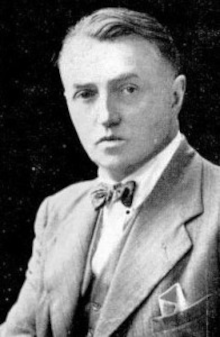
Soon afterwards Hazell transfers to the Royal Flying Corps. In April and May he is assigned to No. 5 Reserve Squadron, based at Castle Bromwich. He is appointed a flying officer on June 5 and survives a severe crash before completing his training. He eventually joins No. 1 Squadron on the Western Front. Flying Nieuport 17 Scouts, he shoots down 20 enemy aircraft between March and August 1917, being appointed a flight commander with the acting rank of captain on May 25, and is awarded the Military Cross on July 26.
After serving as an instructor at the Central Flying School in 1918, Hazell takes command of “A” Flight, No. 24 Squadron, flying the S.E.5a. On August 22, 1918, he shoots down an observation balloon despite its escort of seven Fokker D.VIIs. The escort is led by German ace Ernst Udet, who attacks and riddles Hazell’s petrol tank, propeller, and two longerons with bullets. In spite of this Hazell fights his way back, eyes full of petrol, and lands safely. Udet thinks he has forced the British pilot to crash and actually claims him as his 60th victory. Hazell finishes the war with 43 confirmed kills, the top British surviving ace of the war (excluding Dominion airmen). He is twice awarded the Distinguished Flying Cross. On June 11, 1927, he returns to the RAF Depot at Uxbridge and is placed on the retired list on July 20, 1927, at his own request.
In 1944, at the age of 52, Hazell becomes the commander of “D” Company, 24th (Tettenhall) Battalion, South Staffordshire Home Guard during the later part of World War II.
Hazell dies in Newport, County Mayo, on September 4, 1946, and is buried at the BurrishooleChurch of Ireland Cemetery there. In 2014 his grave, which had been largely forgotten and neglected, is restored, repaired, and re-dedicated in a ceremony on August 4, 2014, the 100th anniversary of the declaration of World War I.
The road and castle are on the northern bank of the Newry River, which marks the border between Northern Ireland and the Republic of Ireland. The Republic’s side of the river, the Cooley Peninsula in County Louth, is an ideal spot from which to launch an ambush. It is thickly wooded, which gives cover to the ambushers, and the river border prevents British forces from giving chase.
On the afternoon of August 27, a British Army convoy of one Land Rover and two four-ton lorries carrying soldiers of the 2nd Battalion, Parachute Regiment is driving from Ballykinlar Barracks to Newry. The British Army is aware of the dangers of using the stretch of road along the Newry River and often declares it out of bounds. However, they sometimes use it to avoid setting a pattern. At 4:40 p.m., as the convoy is driving past Narrow Water Castle, an 800-pound fertiliser bomb, hidden among bales of straw on a parked flatbed trailer, is detonated by remote control by IRA members watching from across the border in County Louth. The explosion catches the last lorry in the convoy, hurling it onto its side and instantly killing six paratroopers, whose bodies are scattered across the road. There are only two survivors amongst the soldiers traveling in the lorry, both of whom receive serious injuries. The lorry’s driver, Anthony Wood (19), is one of those killed. All that remains of his body is his pelvis, welded to the seat by the fierce heat of the blast.
According to the soldiers, immediately after the blast they are targeted by rifle fire from the woods on the Cooley Peninsula on the other side of the border, with this view supported by two part-time firefighters assisting the wounded. Shortly afterwards, the two IRA members arrested by the Garda Síochána and suspected of being behind the ambush, are found to have traces of gunsmoke residue on their hands and on the motorbike they are riding. The IRA’s first statement on the incident, however, denies that any shots had been fired at the troops, and according to Royal Ulster Constabulary (RUC) researchers, the soldiers might have mistaken the sound of ammunition cooking off for enemy gunfire. Nevertheless, at the official inquiry the soldiers declare on oath that they had been fired on.
The surviving paratroopers radio for urgent assistance, and reinforcements are dispatched to the scene by road. A rapid reaction unit is sent by Gazelle helicopter, consisting of Lieutenant Colonel David Blair, commanding officer of the Queen’s Own Highlanders, his signaler Lance Corporal Victor MacLeod, and army medics. Another helicopter, a Wessex, lands to pick up the wounded. Colonel Blair assumes command once at the site.
William Hudson, a 29-year-old from London, is killed by the British Army and his cousin Barry Hudson, a 25-year-old native of Dingle, is wounded when shots are fired across the Newry River into the Republic of Ireland about 3 km from the village of Omeath, County Louth.
The pair are partners in ‘Hudson Amusements’ and had been operating their amusements in Omeath for the duration of the Omeath Gala. When the first explosion is heard across the Lough, the pair go down to the shore to see what is unfolding. The pair makes their way to Narrow Water on the southern side of the border to get a better view of what is happening on the northern side. Barry Hudson is shot in the arm and as he falls to the ground he sees his cousin, who is the son of a coachman at Buckingham Palace, fall to the ground, shot in the head. He dies almost immediately.
The IRA had been studying how the British Army behaves after a bombing and correctly predicts that they would set up an incident command point (ICP) at the stone gateway on the other side of the road. At 5:12 p.m., thirty-two minutes after the first explosion, another 800-pound bomb hidden in milk pails explodes at the gateway, destroying it and hurling lumps of granite through the air. It detonates as the Wessex helicopter is taking off carrying wounded soldiers. The helicopter is damaged by the blast but does not crash.
The second explosion kills twelve soldiers, ten from the Parachute Regiment and the two from the Queen’s Own Highlanders. Lieutenant Colonel Blair is the second Lieutenant Colonel to be killed in the Troubles up until then, following Lieutenant Colonel Corden-Lloyd of the 2nd Battalion Royal Green Jackets in 1978. Only one of Colonel Blair’s epaulettes remains to identify him as his body had been vaporised in the blast. The epaulette is taken from the scene by BrigadierDavid Thorne to a security briefing with Prime MinisterMargaret Thatcher to “illustrate the human factor” of the attack. Mike Jackson, then a major in the Parachute Regiment, is at the scene soon after the second explosion and later describes seeing human remains scattered over the road, in the water and hanging from the trees. He is asked to identify the face of his friend, Major Peter Fursman, still recognisable after it had been ripped from his head by the explosion and recovered from the water by divers from the Royal Engineers.
Press photographer Peter Molloy, who arrives at the scene after the first explosion, comes close to being shot by an angry paratrooper who sees him taking photographs of the dead and dying instead of offering to help the wounded. The soldier is tackled by his comrades. Molloy says, “I was shouted at and called all sorts of things, but I understood why. I had trespassed on the worst day of these fellas’ lives and taken pictures of it.”
The Warrenpoint ambush is a victory for the IRA. It is the deadliest attack on the British Army during the Troubles and the Parachute Regiment’s biggest loss since World War II, with sixteen paratroopers killed. General Sir James Glover, Commander of British forces in Northern Ireland, later says it was “arguably the most successful and certainly one of the best planned IRA attacks of the whole campaign.” The ambush happens on the same day that Lord Mountbatten, a prominent member of the British royal family, is killed by an IRA bomb aboard his boat at Mullaghmore, County Sligo, along with three others.
Republicans portray the attack as retaliation for Bloody Sunday in 1972 when the Parachute Regiment shot dead 13 unarmed civilians during a protest march in Derry. Graffiti appears in republican areas declaring “13 gone and not forgotten, we got 18 and Mountbatten.” The day after the Mountbatten and Warrenpoint attacks, the Ulster Volunteer Force (UVF) retaliates by shooting dead a Catholic man, John Patrick Hardy (43), at his home in Belfast‘s New Lodge estate. Hardy is targeted in the mistaken belief that he is an IRA member.
Very shortly after the ambush, IRA volunteers Brendan Burns and Joe Brennan are arrested by the Gardaí. They are stopped while riding a motorbike on a road opposite Narrow Water Castle. They are later released on bail due to lack of evidence. Burns dies in 1988 when a bomb he is handling explodes prematurely. In 1998, former IRA member Eamon Collins claims that Burns had been one of those who carried out the Warrenpoint ambush. No one has ever been criminally charged.
According to Toby Harnden, the attack “drove a wedge” between the Army and the RUC. Lieutenant General Sir Timothy Creasey, General Officer Commanding Northern Ireland, suggests to Margaret Thatcher that internment should be brought back and that liaison with the Gardaí should be left in the hands of the military. Sir Kenneth Newman, the RUC Chief Constable, claims instead that the British Army practice since 1975 of supplying their garrisons in south County Armagh by helicopter gives too much freedom of movement to the IRA. One result is the appointment of Sir Maurice Oldfield to a new position of Co-ordinator of Security Intelligence in Northern Ireland. His role is to co-ordinate intelligence between the military, MI5 and the RUC. Another is the expansion of the RUC by 1,000 members. Tim Pat Coogan asserts that the deaths of the 18 soldiers hastens the move to Ulsterisation.
O’Shannon first becomes a journalist with The Irish Times on leaving the RAF in 1947. Later he joins the Irish state broadcasting service Raidió Teilifís Éireann (RTÉ).
In July 1972 O’Shannon records a notable television interview with 31-year-old Muhammad Ali, when Ali is in Dublin to compete at Croke Park in a bout with Alvin Lewis.
O’Shannon receives a Jacob’s Award for his 1976 TV documentary, Even the Olives are Bleeding, which details the activities of the “Connolly Column” in the Spanish Civil War. Two years later he is honoured with a second Jacob’s Award for his television biography Emmet Dalton Remembers (1978).
In 1978, O’Shannon leaves RTÉ to join Canadian company Alcan, which is setting up an aluminum plant at Aughinish, County Limerick, in 1978. He is head-hunted to become its Director of Public Affairs, an important post at a time when there are environmental concerns about the effects of aluminium production. He admits that he was attracted by the salary, “five times what RTÉ were paying me,” but he also later says that one of the reasons for the move is that he had become unhappy with working at RTÉ, stating in an interview that “The real reason I got out of RTÉ was that they wouldn’t let me do what I wanted to do journalistically.” He had submitted proposals to the station’s editors for a television documentary series on the Irish Civil War, and also one on the wartime Emergency period, but they had been rejected. While he enjoys the social life with lavish expenses which his public relations duties involve, his friends believe that he missed the varied life and travel of journalism. He retires early from Aughinish in 1992 and returns to making television documentaries with RTÉ.
O’Shannon announces his retirement at the age of 80 on January 12, 2007.
O’Shannon is awarded lifetime membership in the Irish Film & Television Academy in 2010, to which he says is “particularly gratifying that it occurs before I pop my clogs.”
After weakening health for two years, and spending his last days in hospice at Blackrock, O’Shannon dies at the Beacon Hospital in Dublin on October 22, 2011. His body is reposed at Fanagans Funeral Home in Dublin on October 25, 2011, followed by a funeral the following day at Glasnevin Cemetery Chapel, where it is afterwards cremated.
O’Shannon’s wife, Patsy, whom he met while they were working for The Irish Times office in London, dies in 2006. They are married for more than 50 years. In a 2008 television documentary O’Shannon admits that throughout his marriage he had been a serial womaniser, who had repeatedly engaged in extra-marital affairs unbeknownst to his wife.
Director-General of RTÉNoel Curran says O’Shannon had brought into being “some of the great moments in the RTÉ documentary and factual schedule over the past five decades.” In tribute, RTÉ One shows the documentary Cathal O’Shannon: Telling Tales on November 10, 2011. It had originally aired in 2008 to mark his 80th birthday.





 seamus dubhghaill