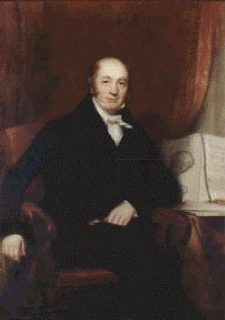
Mallet is the son of factory owner John Mallet. He is educated at Trinity College, Dublin, entering it at the age of 16 and graduating in science and mathematics in 1830 at the age of 20.
Following his graduation, Mallet joins his father’s iron foundry business and helps build the firm into one of the most important engineering works in Ireland, supplying ironwork for railway companies, the Fastnet Rock lighthouse, and a swing bridge over the River Shannon at Athlone. He also helps manufacture the characteristic iron railings that surround Trinity College, and which bear his family name at the base.
In 1838 Mallet becomes a life member of the Royal Geological Society of Ireland and serves as its President from 1846–1848. From 1848–1849 he constructs the Fastnet Rock lighthouse, southwest of Cape Clear.
On February 9, 1846, Mallet presents to the Royal Irish Academy his paper On the Dynamics of Earthquakes, which is considered to be one of the foundations of modern seismology. He is also credited with coining the word “seismology” and other related words which he uses in his research. He also coins the term epicentre.
From 1852 to 1858, Mallet is engaged in the preparation of his work, The Earthquake Catalogue of the British Association (1858) and carries out blasting experiments to determine the speed of seismic propagation in sand and solid rock.
On December 16, 1857, the area around Padula, Italy is devastated by the Great Neapolitan earthquake which causes 11,000 deaths. At the time it is the third largest known earthquake in the world and has been estimated to have been of magnitude 6.9 on the Richter Scale. Mallet, with letters of support from Charles Lyell and Charles Darwin, petitions the Royal Society of London and receives a grant of £150 to go to Padula and record at first hand the devastation. The resulting report is presented to the Royal Society as the Report on the Great Neapolitan Earthquake of 1857. It is a major scientific work and makes great use of the then new research tool of photography to record the devastation caused by the earthquake. In 1862, he publishes the Great Neapolitan Earthquake of 1857: The First Principles of Observational Seismology in two volumes. He brings forward evidence to show that the depth below the Earth’s surface, from where the impulse of the Neapolitan earthquake originated, is about 8–9 geographical miles.
One of Mallet’s papers is Volcanic Energy: An Attempt to develop its True Origin and Cosmical Relations, in which he seeks to show that volcanic heat may be attributed to the effects of crushing, contortion, and other disturbances in the crust of the earth. The disturbances leading to the formation of lines of fracture, more or less vertical, down which water would find its way, and if the temperature generated be sufficient volcanic eruptions of steam or lava would follow.
Pat Falvey, Irish high-altitude mountaineer, expedition leader, polar explorer, entrepreneur, author, corporate/personal trainer/coach, and motivational speaker, is born in Cork, County Cork, on June 2, 1957. He is the first person to complete the Seven Summits twice, with the summiting of Mount Everest reached from both the Tibetan (1996) and Nepalese sides (2004). He is expedition leader of the team that sees Clare O’Leary become the first Irish woman to reach the summit of Mount Everest in 2004. Other extreme expeditions that he makes include walking to the South Pole, crossing South Georgia island, and traversing the Greenland ice sheet. He starts his first business at 15 years of age and has since had businesses in property development, finance, construction, insurance, tourism, and film production. He has been a motivational speaker since the 1990s.
Raised on the north side of Cork city, Falvey starts mountain climbing in his late twenties, having worked as a builder and property developer from his late teens onward. Following the economic recession of the mid-1980s in Ireland, he loses most of his wealth and discovers mountaineering in his late 20s.
Falvey begins his climbing career with hill walking and climbing on the MacGillycuddy’s Reeks in County Kerry. He then devotes himself to training to become a high-altitude mountaineer. He trains initially with the Cork Mountaineering Club, at Tiglin in County Wicklow and becomes a member of Kerry Mountain Rescue, climbing very frequently in Ireland, Scotland, France and the Himalayas.
In June 1994, Falvey climbs Denali, also known as Mount McKinley, in Alaska, reaching the first summit in his Seven Summits attempt. This is followed by Mount Kilimanjaro in Tanzania (January 1995), Mount Everest via the Northeast Ridge (June 1995), Aconcagua in Argentina (December 1995), Mount Elbrus in Russia (March 1996), Vinson Massif in Antarctica (January 1997) and Mount Kosciusko in Australia (February 1997). He is the first Irish man (and the 32nd person in the world) to complete the Seven Summits.
Falvey is the expedition leader of the first Irish team to reach the summit of Cho Oyu in China and Nepal without oxygen, on May 20, 1998. He reaches the summit of Ama Dablam in Nepal on November 3, 1999. In 2003, he is the expedition leader of the first Irish team to reach the summit of Mount Everest via the South-Southeast Ridge, with team members Ger McDonnell and Mick Murphy reaching the summit. On May 18, 2004, he reaches the summit of Everest via the South-Southeast Ridge, and leads the expedition that sees the first Irish woman, Dr. Clare O’Leary, reach the top of Everest.
Falvey and O’Leary complete the Seven Summits on December 16, 2005, when he becomes the first person to complete the Seven Summits twice by climbing Mount Everest from both the Tibetan and Nepalese sides.
In 2006, Falvey leads a group of 32 across the South Georgia Traverse on South Georgia island in honour of Polar explorers Sir Ernest Shackleton and Kerryman Tom Crean, in the Beyond Endurance Antarctic expedition. He leads the first Irish traverse of Greenland in 2006. In January 2008, he leads a four-person Irish expedition to the South Pole. In April 2009, he and O’Leary do a “symbolic” walk to the North Pole, completing the final four-day trek to the Pole.
Falvey joins the Kerry county football team as a “sports performance coach” in 2021. Manager Peter Keane says, “You take us in this country with five million people and we have had some unbelievable adventurers like Shackleton and Crean; you look at someone like Pat who has climbed Everest twice from two different sides, managed to climb the Seven Summits twice, and I am looking to see if he can bring something different in here.”
Falvey’s publications include Reach for the Sky (The Collins Press, 1997), A Journey to Adventure: Stories I never thought I’d tell (The Collins Press, 2007), The Summit: How Triumph Turned to Tragedy on K2’s Deadliest Days (Beyond Endurance Publishing with The O’Brien Press, 2013), You Have the Power: Explore the Mindset You Need to Realise Your Dreams (Beyond Endurance Publishing, 2016) and Accidental Rebel (Beyond Endurance Publishing, 2018).
O’Byrne is the son of James Burns, a farmer, and his wife Isabella (née Arnett). His biographer states that his parents came from County Wicklow, which would imply that their name had been anglicised from the form “O’Byrne,” which their son readopts. He never marries and spends most of his life living with his unmarried sister Teresa. He has other siblings, as he is survived by four nieces and two nephews.
O’Byrne’s childhood is spent in the Balmoral district of south Belfast in a comfortable but slightly precarious middle-class Catholic environment. Although sparse in direct autobiographical references, his writings contain references to excursions around the Malone and Stranmillis areas, with particular reference to the Botanic Gardens. He is educated at St. Malachy’s College. After leaving school, he manages a spirit grocery on the Beersbridge Road in east Belfast and is active in the Sexton Debating Society, named after Thomas Sexton, then home rule MP for Belfast West, and led by Joseph Devlin, who remains a lifelong friend despite their later political differences. He also studiess music with Carl Hardebeck, acquiring an extensive knowledge of Irish folk music and becoming an accomplished singer of Irish tunes in Hardebeck’s arrangements.
O’Byrne subsequently joins the Belfast Gaelic League, becoming a leading member, though he never masters the Irish language. He moves in the literary and antiquarian circles around Francis Joseph Bigger, whose friendship becomes central to his career and self-definition. He is a regular participant in Bigger’s soirées and establishes friendships with many prominent political and cultural figures, among them Roger Casement and Alice Milligan. Although he is usually seen as a specifically northern writer, he draws extensively on a wider Irish tradition of defensively self-glorifying Catholic-nationalist antiquarianism, including the works of W. H. Grattan Flood and Archbishop of Tuam, John Healy, a major source for his later pamphlet on Saint Patrick and for the descriptions of Ulster monasteries in As I Roved Out: A Book of the North (1946).
In 1900, O’Byrne publishes a collection of verses, A Jug of Punch, of which no copies are known to survive, and in 1905 collaborates with Cahir Healy on another collection, The Lane of the Thrushes, which applies Celtic revival imagery to rural Ulster. He publishes another collection, The Grey Feet of the Wind, in 1917. The manuscript of his unpublished Collected Poems (1951) is in the Public Record Office of Northern Ireland.
In 1902, O’Byrne gives up the spirit grocery to work full time as a journalist, singer, and storyteller. He appears at a wide variety of concerts, where he cuts a striking figure in Gaelic dress with saffron kilt. He provides musical interludes at productions by the Ulster Literary Theatre, and his recitation of Eleanor Alexander’s humorous piece on the battle of Scarva inspires Harry Morrow’s celebrated satirical play Thompson in Tir-na-nOg (1912). In 1913, he founds and manages the Celtic Players, a theatre company which stages some plays of his own composition, including The Dream of Bredyeen Dara, possibly a nativity story incorporating Saint Brigid of Kildare.
During World War I O’Byrne achieves immense cross-community success with a weekly dialect column in the Unionist paper Ireland’s Saturday Night, describing the domestic activities of “Mrs. Twigglety” and her working-class friends. At the same time, he has abandoned his earlier support for Devlin’s home rule politics to embrace physical-force republicanism under the influence of Denis McCullough. During Casement’s imprisonment and trial, he carries on an intense correspondence with him, comforting him, urging him to convert to Catholicism, and sending him religious icons. Some commentators have detected homoerotic undertones in their exchanges, though this is a matter of opinion.
After the Easter Rising of 1916, O’Byrne is active in the reconstituted Irish Republican Army (IRA), and in 1919–20 he smuggles arms from Belfast to Dublin. In August 1920, he emigrates to the United States, where he goes on a six-month lecture tour to raise funds for victims of the Belfast pogroms. He allegedly raises $100,000 and funds the construction of Amcomri Street in west Belfast. He spends the next eight years in the United States as a speaker and entertainer, contributing to American Catholic publications. He develops an abiding fondness for Chicago and considers applying for American citizenship. At one point he corresponds with the film star Rudolph Valentino, who admires his verses on Italian themes.
O’Byrne returns to Belfast in September 1928 with the intention of opening a bookshop in Dublin, but this has to be abandoned after the loss of his savings in the Wall Street crash of October 1929. He settles into respectable semi-poverty in Cavendish Street, off the Falls Road, and remains a presence on the fringes of Belfast literary life. In 1930, he founds the Cathal O’Byrne Comedy Company, which performs plays of his own composition, notably the slight comedies The Returned Swank and The Burden, drawing on The Drone, by Samuel Waddell. In 1932, he sings at a concert in the Dublin Mansion House held to mark the Eucharistic Congress. He writes extensively for Catholic publications in Ireland and elsewhere, in particular the Capuchin Annual, Irish Monthly, and Irish Rosary, and publishes several pamphlets with the Catholic Truth Society (CTS). The sensibility displayed in these writings has much in common with that of Brian O’Higgins, Aodh de Blácam, Daniel Corkery and Gearoid Ó Cuinneagáin.
O’Byrne also publishes The Gaelic Source of the Brontë Genius (1932), Pilgrim in Italy (1930), and the story collection From Far Green Hills (1935), which retells gospel episodes in the style of an Irish storyteller with elements of Wildean orientalist exoticism. Pilgrim in Italy is published by the Three Candles Press of Colm Ó Lochlainn, an old friend through the Bigger circle, as is his last story collection, Ashes on the Hearth (1948), a series of slight reveries in which the narrator, wandering the back streets of Dublin, relives such resonant moments as the last days of James Clarence Mangan.
O’Byrne is best remembered, however, for As I Roved Out (1946), a collection of 128 articles on Belfast history originally published from the late 1930s in the Belfast Irish News. It displays considerable knowledge of Belfast history, drawn from lifelong reading and from conversations with Bigger, and can be seen as at once the summation of and a lament for the northern branch of the Irish revival associated with such figures as Bigger and Alice Milligan. The pieces, moving out from central Belfast to surrounding rural districts are held together by the storyteller surveying the landscape. Surveys of Belfast by journalistic flâneurs are not unprecedented, O’Byrne dismisses the mercantile and unionist establishment of Belfast as hopelessly materialistic and oppressive, casting himself and, by implication, his Catholic/nationalist readers as internal exiles forced into the side streets of history, treasuring a martyred religious faith and gazing back wistfully to the bright and fleeting hope represented by the Society of United Irishmen and the cultural revival. The book is punctuated by expressions of anger against the whole heritage of the Ulster plantation. The economic success of the planters is attributed solely to their plunder of the natives. The textile industry is discussed solely in terms of exploitation and starvation wages. Shipbuilding is dismissed with a remark that ships were built in Ulster long before the planters arrived. Finally, the history of Belfast is summed up in the confrontation between the Belfast merchant, ancestor of the unionist “establishment,” and would-be slave-trader Waddell Cunningham and the United Irishman and self-declared “Irish slave” William Putnam McCabe.
There are numerous contemptuous references to the Sabbatarianism and respectable dullness of late Victorian Belfast, contrasted with the lively artistic activities of the volunteer period. The book is reprinted three times in O’Byrne’s lifetime and is seen by nationalists as an underground classic. Its image of Belfast layered with fragmentary and hidden memories has been drawn on by authors as diverse as Ciaran Carson and Gerry Adams, and in the early twenty-first century O’Byrne is commemorated as one of the city’s significant writers. A plaque is placed on his Cavendish Street house in 2004. It is ironic that his reputation should rest on his memorialisation of Belfast, for he denounced it as “interminable miles of mean streets . . . one of the ugliest cities in the world.”
O’Byrne is believed by some, though not all, of his acquaintances to be homosexual. This view is supported by references to the descriptions of male beauty (based on Gaelic saga models) which recur in his writings and by the expressions of longing which permeate his work (which might also reflect a wider sense of loneliness or cultural displacement). His last years, 1954–57, are spent in the Nazareth Nursing Home in Ormeau Road, Belfast, where he dies on August 1, 1957, a month after suffering a stroke. His funeral is crowded, and his gravestone describes him as “singer, poet and writer who brought joy into the lives of others.”
(From: “O’Byrne, Cathal” by Patrick Maume, Dictionary of Irish Biography, http://www.dib.ie, October 2009)
McCabe resigns his Dáil seat on October 30, 1924, along with several other TDs, and the resulting by-election on March 11, 1925, is won by the Cumann na nGaedheal candidate Martin Roddy. He does not stand for public office again and returns to his post as a schoolteacher.
In the 1930s McCabe is involved with the short-lived but widely followed Irish Christian Front (ICF), serving as the organisation’s secretary and announcing its creation to the public on August 22, 1936. He is also a member of the Blueshirts during this period and later the Irish Friends of Germany (later known as the “National Club”) during World War II, a would-be Nazi Collaborator group in the event Germany were to invade Ireland. He chairs their meetings, denies the group is a fifth column and expresses the belief that a German victory will lead to a United Ireland. He is interned in 1940–41 because of his pro-German sympathies, which he claims resulted from the desire to “see the very lifeblood squeezed out of England.”
In 1935, McCabe co-founds the Educational Building Society with Thomas J. O’Connell. He retires from teaching in the 1940s and becomes the full-time managing director of the EBS.
McCabe dies in Dublin on May 31, 1972, leaving his wife, son, and three daughters. There is a bronze bust of him in the headquarters of the Educational Building Society, Westmoreland Street, Dublin.
Bedford then mainly works in theatre in the United States, on both coasts, but mainly in New York City both on and off Broadway. He is in the premiere of Tennessee Williams‘s last play Small Craft Warnings at the New Theatre in New York in 1972. Other stage appearances include Brian Friel’s The Mundy Scheme in New York in 1969 and as John Adams in the nationwide tour of the musical 1776. He appears in over 200 stage productions throughout his career.
Bedford dies at the age of 67 on November 20, 1999, in Manhattan, New York City, of cancer six weeks after entering the hospital.
Harrington’s force consists of five foot companies, but four of them are inexperienced levies recently raised in England. The only experienced foot company is that of Captain Loftus, whose men are mostly Irish. The companies are organised into a regiment under the command of Sir Alexander Radcliffe. To this is added fifty horsemen commanded by Captain Charles Montague. Harrington wants to take his troops out to scout the Irish fortifications on the ford of the Avonmore River at Rathdrum, and possibly to give his raw troops some experience in fieldcraft. His first attempt to view the Irish position on May 28 fails. Harrington returns to his camp about a mile from the ford. A second effort to view the Irish fortifications is made on May 28, but this is turned back due to poor weather. Harrington orders the men to march back to Wicklow town.
The English army stretches out in a column. In the lead is the van, then the baggage, followed by the battle and then the rear. Captain Atherton, the Sergeant Major of the army, has little doubt that the weight of any Irish attack will fall on the rear of the column. Thus, the horse (cavalry) is placed at the rear. The army has marched little over a mile before the Irish shot (musketeers and caliver-men) begin skirmishing with the rear of Harrington’s force. The Irish try to take a ford to block the advance, but the English secure the crossing, with the shot of the English rear skirmishing with the Irish, allowing the rest of the army to pass unhindered.
The march continues two miles to another ford, with the rear continuing to hold O’Byrne’s Irish shot at bay. Again, the English shot secures the crossing, as Irish fire slackens, possibly due to a shortage of gunpowder. Harrington places 40–50 shot behind an earthen bank on the left flank of the column on the far side of the ford. The Irish bring up a stand of pikemen, but their attack is limited to the English left, as the right of the column is shielded by thick gorse bushes. Atherton gathers 60–80 men to counter-attack the Irish pike. The English shot behind the bank is to hold their fire until Atherton attacks, but instead prematurely fires a single volley at the Irish pike then abandons their position. Without the support from their shot, Atherton’s men refuse to charge the Irish, then withdraw to the main body of the English column.
Atherton finds that the English shot have fled the column, abandoning the main stand of English pike. Now exposed to Irish gunfire, the English pike become disordered as they press to make the river crossing. Exploiting the English confusion, the Irish pike charges into the English rear, killing many without resistance. Montague’s English cavalry charges to support the panicking infantry, but the Irish pike square opens, allowing the horse to pass through. The Irish pike spear the English horse as they pass, including Montague who is wounded by a pike thrust into his side. Despite their officer’s best efforts, the English soldiers’ resistance collapses. The rout continues with the Irish slaughtering Harrington’s men to within one and a half miles of Wicklow town. All the English companies lose their colours, except for Captain Loftus, but they are later recovered by the English horse. After the battle, Radcliffe estimates the English army has lost 250 men killed, missing or deserted.
The first English reports suggest that they lost the battle due to the inexperience of most of their troops. Harrington at first blames the English pikemen for refusing to fight, but at the court-martial in July, Harrington, supported by two of his officers (Captains Linley and Mallory) blames Captain Loftus and his Lieutenant Walsh. This is convenient, as Loftus had died from his wounds and could not refute their accusations. Their version is supported by a map drawn of the battle, possibly by Montague (Harrington’s nephew). Loftus and Walsh are found guilty by the court-martial. Loftus is already dead, but Walsh is executed by firing squad. Mallory and Linley are not found guilty, but they are cashiered, losing command of their foot companies. The men in Loftus’ company are sentenced to death but this is commuted to decimation by drawing lots. Even by Elizabethan standards this is deemed overly harsh. Though Harrington is not charged with misconduct, he is never given command of a force this size again.
Born on December 18, 1895, Roe is the daughter of William Ernest Roe and Anne Lambert Sheilds of Mountrath, County Laois. Her grandfather is Francis Henry Sheilds of Parsonstown (now Birr, County Offaly), owner of the King’s County Chronicle. She is sent first to the local primary school and then to the Preston School in Abbeyleix. Although she attends Trinity College Dublin (TCD), she does not begin her career due to the outbreak of World War I. She joins the St. John’s Ambulance Brigade and serves at the Cambridge Military Hospital and at Aldershot Barracks. In the immediate aftermath, she continues her medical career with the Military Hospital in Bray, County Wicklow. She also spends time touring in Europe visiting museums and beginning her appreciation for medieval art. She is raised Protestant and has done her duty as part of the aristocracy by serving in the war. But the soldiers treat her as Irish and abuse her especially during the Easter Rising of 1916. The result is that she supports nationalism from that point forward. She goes back to TCD and completes her degree in modern languages in 1921. She finally completes her MA in 1924 and begins a teaching career. She spends time working in the Royal School, Dungannon, and Alexandra College, Milltown, Dublin.
In 1926, Roe’s parents need her, and she returns home. She then becomes the County Librarian in Laois. While working as a librarian she is able to study further and, as a rare person with a car, she tours sites and visits schools. One result of her presentations to schools is to inspire Ireland’s first female archaeologist, Ellen Prendergast. In 1940, she retires from the library and moves to Dublin where she is able to buy a house and garden. Apart from her antiquarian work, she is a regular supporter of charities and is honorary secretary of The Queen’s County Protestant Orphan’s Society and actively involved in The Dublin University Mission to Chota Nagpur, India.
Roe becomes a regular contributor to various journals and newspapers including Journal of the Royal Society of Antiquaries of Ireland, An Leabharlann, Béaloideas, Seanchas Ard Mhacha, Carloviana, the The Irish Press and the Leinster Express. From 1965 until 1968 she serves as the president of the Royal Society of Antiquaries of Ireland, the first woman to be elected to the position. She is elected to be a member of the Royal Irish Academy in 1984. She continues touring and lecturing into her nineties.
Roe lives at Santry, Dublin, and later at Oak House, Sussex Road, Dublin. She dies on May 28, 1988, at Grove Nursing Home, Killiney, County Dublin, and is buried beside her parents at St. Peter’s Churchyard, Mountrath, County Laois.
The Royal Society of Antiquaries of Ireland have an annual lecture in her honour and have named one of their lecture rooms after her.
Brenan is born in Cork, County Cork, on November 17, 1828. He begins to write verse at an early age and is one of the genuine poets of the Young Ireland movement. His earlier poems are published under the initials “J. B., Cork,” or “J. B—n,” and some of his American verses under the pseudonym “Gondalez.” He is also an able prose writer.
Brenan is an active member of the Cork Historical Society, and is one of the editors of the Cork Magazine, which appears in November 1847, and continues to be published until the end of 1848, when the journal ceases publication. Some of its contributors, who include Frazer, Martin MacDermott, Fitz James O’Brien, Mulchinock and Mary Savage, later either end up in jail or in exile.
In January 1848, John Mitchel visits Cork and, according to Michael Cavanagh, who publishes a sketch of Brenan’s life in Young Ireland, Dublin, in June and July 1885, Brenan for the first time “beheld the man he most admired on earth, and with whose future destiny, whether for weal or woe, he felt his own was bound up. Never had the archenemy of England a more faithful or earnest follower.”
Brenan contributes to the Mitchel’s United Irishman and sells his rifle to obtain train fare so he can take up his residence in Dublin, the headquarters of the revolutionary movement. He later publishes articles in John Martin‘s The Irish Felon urging the Confederate Clubs members, many of whom have arms, to be in readiness for action. “The sooner you realise the fact,” he writes in a letter addressed to the Members of the Provincial Confederate Clubs, “that the Confederation was got up for the purpose of doing something, the better for us all. Just think what it undertook to do. It undertook to defeat the strongest Government and to liberate the most degraded country that ever existed. It undertook to give – to a province—to strike the chains off millions of slaves and, if necessary, to wash out the iron moulds in blood.”
In another letter to “the Young Men of Ireland” on July 22, 1848, he writes, “On you I principally rely. You realise that you are very ‘rash,’ rather inclined to be ‘violent,’ and have exceedingly little prudence to spare. Brothers, let your watchword be ‘Now or never—now and forever’ rashly.”
Brenan is associated with John Savage and John O’Mahony while Savage is operating on the slopes of the Comeragh Mountains. He is arrested and kept in prison for seven months alternately in Newgate Prison, Carrickfergus and Kilmainham Gaols. During his confinement he writes some fine poems, according to T. F. O’Sullivan, one, entitled Yearnings, evidently addressed to Mary Savage, sister of John.
After his release without trial in March 1849, Brenan becomes editor of the Irishman which had been started in Dublin by Bernard Fulham, and for six months attempts to rekindle the insurrectionary flame in the country. He is implicated in the attack on the Cappoquin police barracks on September 16, 1848, and in October escapes to the United States.
In America Brenan becomes associated with a number of journals, including Horace Greeley‘s New-York Tribune, Devin Reilly’s People, The Enquirer of Newark, New Jersey, and the New Orleans Delta in which he writes a series of papers under the pen-name Ben Fox. On August 27, 1851, he marries Mary Savage, in her parents’ house, on Thirteenth Street, New York.
Brenan writes some articles and poems for John Mitchel’s Irish Citizen in 1854. He is an enthusiastic supporter of the Southern cause and founds the New Orleans Times.
Brenan dies on May 27, 1857, at the early age of twenty-nine and is buried in the old French cemetery of New Orleans. During the last year of his life, he is almost totally blind. He is attended in his last illness by Dr. Dalton Williams. There are seven children of his and Mary’s marriage, only one of whom, Florence, survives their parents. She possesses her father’s literary ability but devotes her life to religion as a member of the Mercy Order.
Brenan’s best-known poem, “Come to Me, Dearest,” is addressed to Mary Savage before their marriage. The love story of Brenan and Mary is told in the sketch by Ellen Mary Patrick Downing, afterwards Sister Mary Alphonsus.
Ernest Bernard (Ernie) O’Malley, Irish republican revolutionary and writer, is born on May 26, 1897, in Ellison Street, Castlebar, County Mayo, the second child among nine sons and two daughters of Luke Malley, solicitor’s clerk, of County Mayo, and Marion Malley (née Kearney) of County Roscommon. Christened Ernest Bernard Malley, his adoption of variations on this name reflects his enthusiasm for a distinctively Irish identity – an enthusiasm that lay at the heart of his republican career and outlook.
In 1906, O’Malley’s family moves to Dublin, where he attends the Christian Brothers‘ School, North Richmond Street. In 1915, he begins to study medicine at University College Dublin (UCD). Having initially intended to follow his older brother into the British Army, he rather joins the Irish Volunteers in the wake of the 1916 Easter Rising, as a member of F Company, 1st Battalion, Dublin Brigade. He becomes a leading figure in the Irish Republican Army (IRA) during the Irish War of Independence which the Easter Rising helps to occasion. In 1918, having twice failed his second-year university examination, he leaves home to commit himself to the republican cause. He is initially a Volunteer organiser with the rank of second lieutenant, under the instruction of Richard Mulcahy, operating in Counties Tyrone, Offaly, Roscommon, and Donegal. His work in 1918 involves the reorganisation, or new establishment, of Volunteer groups in the localities.
In August 1918, O’Malley is sent to London by Michael Collins to buy arms. During 1919 he works as an IRA staff captain attached to General Headquarters (GHQ) in Dublin, and also trains and organises Volunteers in Counties Clare, Tipperary, and Dublin. He has a notable military record with the IRA during the Irish War of Independence and is a leading figure in attacks on Hollyford barracks in County Tipperary (May 1920), Drangan barracks in County Kilkenny (June 1920), and Rearcross barracks in County Tipperary (July 1920). His IRA days thus involve him with comrades such as Dan Breen, Séumas Robinson, and Seán Treacy. In December 1920, he is captured in County Kilkenny by Crown forces. He escapes from Dublin’s Kilmainham Gaol in February 1921, to take command of the IRA’s 2nd Southern Division, holding the rank of commandant-general.
O’Malley’s republican commitment has political roots in his conviction that Ireland should properly be fully independent of Britain, and that violence is a necessary means to achieve this end. But the causes underlying his revolutionism are layered. Family expectations of respectable, professional employment combined with a religious background and an enthusiasm for soldiering provide some of the foundations for his IRA career. As an IRA officer he enjoys professional, military expression for a visceral CatholicIrish nationalism. He also finds excitement, liberation from the frequent dullness of his life at home, defiant rebellion against his non-republican parents, an alternative to his stalled undergraduate career, and, in political and cultural Irish separatism, a decisive resolution of the profound tension between his anglocentrism and his anglophobia.
O’Malley rejects the 1921 Anglo–Irish Treaty as an unacceptable compromise. He spends the 1921 truce period training IRA officers in his divisional area, in preparation for a possible renewal of fighting. He is, in the event, to be a leading anti-treatyite in the 1922–23 Irish Civil War. In the Four Courts in 1922, at the start of the latter conflict, he is captured on the republicans’ capitulation on June 30 but then manages to escape from captivity. Subsequently he is appointed assistant Chief of Staff of the anti-Treaty IRA and also becomes part of a five-man anti-Treaty army council, along with Liam Lynch, Liam Deasy, Frank Aiken and Thomas Derrig.
O’Malley is dramatically captured and badly wounded by Free State forces in Dublin in November 1922. Imprisoned until July 1924, he is during the period of his incarceration elected as a TD for Dublin North in the 1923 Irish general election and is also a forty-one-day participant in the republican hunger strike later that year. Following release from prison, he returns home to live with his parents in Dublin. He decides not to focus his post-revolutionary energy on a political career. During 1926–28 and 1935–37 he unsuccessfully tries to complete his medical degree at UCD, but increasingly his post-1924 efforts are directed toward life as a Bohemian traveler and writer. He spends much of 1924–26 on a recuperative journey through France, Spain, and Italy; and 1928–35 traveling widely in North America. During 1929–32 he spends time in New Mexico and Mexico City. In Taos, New Mexico, he mixes with, and is influenced by, writers and artists as he works on what are to become classic autobiographies of the Irish revolution: On Another Man’s Wound (1936) and The Singing Flame (1978).
O’Malley meets Helen Hooker, daughter of Elon and Blanche Hooker, in Connecticut in 1933. They marry in London in 1935, each rejecting something of their prior lives in the process: he, his Irish republicanism, through marriage to somebody entirely unconnected with that world; she, her wealthy and respectable upbringing, through liaison with a Catholic, Irish, unemployed, bohemian ex-revolutionary. They settle first in Dublin then, from 1938 onward, primarily in County Mayo. Burrishoole Lodge, near Newport, is his main base until 1954, when he moves to Dublin. Three children are born to the O’Malleys: Cahal (1936), Etáin (1940), and Cormac (1942). Sharing enthusiasm for the arts, he and Helen enjoy several years of intimacy. However, by the mid-1940s their relationship has frayed. In 1950, Helen kidnaps (the word is used by both parents and by all three children) the couple’s elder two children and takes them to the United States. From there she divorces O’Malley in 1952. Cormac remains with his father.
O’Malley’s post-American years are devoted to a number of projects. He writes extensively, including work for The Bell and Horizon. He is involved with the film director John Ford in the making of his Irish films, including The Quiet Man (1952). He gives radio broadcasts on Mexican painting for BBC Third Programme (1947), and on his IRA adventures for Radio Éireann (1953). In the latter year he suffers a heart attack, and his remaining years are scarred by ill health. He dies of heart failure on March 25, 1957, in Howth, County Dublin, at the house of his sister Kathleen. Two days later he is given a state funeral with full military honours. He is buried in the Malley family plot in Glasnevin Cemetery, Dublin.
O’Malley exemplifies some important themes in modern Irish political and intellectual history. His powerful memoirs form part of a tradition of writing absorbedly about Ireland, while under idiosyncratic emigrant influences which lend the writing much of its distinctiveness. His aggressive republicanism exemplifies a persistent but ultimately unrealisable tradition of uncompromising IRA politics. His unflinching single-mindedness is the condition for much courageous and striking activity, but also lay behind his infliction and his suffering of much pain. Literary, intellectual, and defiantly dissident, he is the classic bohemian revolutionary. His historical significance lies in his having been both a leading Irish revolutionary and the author of compelling autobiographical accounts of those years. His memoirs are distinguished from their rivals on the shelf by subtlety, self-consciousness, and literary ambition. In particular, his preparedness to identify motives for Irish revolutionary action, beyond the terms of ostensible republican purpose, renders his writing of great value to historians. Similarly, the large body of archival material left in his name (especially, perhaps, the papers held in UCD archives, and those in the private possession of his children) leaves scholars in his debt. The most striking and evocative visual images of O’Malley are, arguably, the set of photographic portraits taken in 1929 by Edward Weston and held at the University of Arizona‘s Center for Creative Photography (CCP). These capture with precision his reflective concentration, his piercing earnestness, and his troubled intensity.
(From: “O’Malley, Ernest Bernard (‘Ernie’)” by Richard English, Dictionary of Irish Biography, http://www.dib.ie, October 2009 | Pictured: Photograph of Ernie O’Malley taken by Helen Hooker, New York City, 1934)
The Custom House in Dublin is occupied and then burned in an operation by the Irish Republican Army (IRA) on May 25, 1921, during the Irish War of Independence. At the time, the Custom House is the headquarters of the Local Government Board for Ireland, an agency of the British administration in Ireland, against which the IRA is fighting in the name of the self-proclaimed Irish Republic. The operation, involving over 100 IRA volunteers, is a propaganda coup for the republicans but a military disaster for the IRA in the Irish capital. A force of British Auxiliaries quickly arrives, and a gun battle erupts. Five IRA volunteers, John Doyle, Edward Dorins, Daniel Head, Captain Patrick and Lieutenant Stephen O’Reilly, are killed, along with three civilians. Approximately 80 volunteers are captured.
The operation is the largest action in Dublin by rebels since the Easter Rising of April 1916.
The Irish War of Independence is a guerrilla campaign by the IRA in support of the Irish Republic. The conflict enters its bloodiest phase in the first six months of 1921. In Dublin, a total of 309 people are killed in the conflict and several hundred more wounded.
Dublin is garrisoned by over 10,000 British troops and 1,600 police including 400 men of the Royal Irish Constabulary (RIC) Auxiliary Division. Most IRA actions in the city consist either of assassinations of selected police, military or administration figures by the Squad, or ambushes on British forces by one of the four Active Service Units (ASU) of the IRA’s Dublin Brigade, together comprising about 100 men. These are usually rapid and fleeting attacks using grenades and handguns, followed by a quick getaway. There are strict orders given to IRA units to avoid prolonged engagements with the better-armed British forces.
However, this policy is reversed after a meeting of the Ministry of Dáil Éireann in May 1921 where the President of the Republic, Éamon de Valera, calls for a spectacular public show of force by the IRA, to reinforce the idea that it is an army representing an Irish government. For this reason, it is decided to attack and burn the Custom House, which, although an important government building, is not defended by the British military. Michael Collins is against the attack but is overruled.
Michael O’Kelly, Lieutenant E Company, 2nd Battalion, Dublin Brigade, recalls plans to “deliver a smashing blow to England.” Two large scale operations – to capture Beggars Bush Barracks, or to destroy the Customs House are initially considered. The Custom House is eventually chosen. IRA member Vincent Byrne says that the operation is “one of many under review.”
In the early afternoon of May 25, 1921, roughly 120 non-uniformed IRA Volunteers begin to gather around the Custom House in groups of two or three. Three quarter of those involved belonged to the 2nd Battalion of the Dublin Brigade under Tom Ennis. Only a minority of them are experienced guerrilla fighters and they are armed only with pistols and a limited amount of ammunition. At 1:00 p.m., they rush the Custom House and overpower the police guard. A lorry pulls up outside the building with tins of petrol and bales of cotton, which are then sprinkled throughout the building. The IRA Volunteers herd all the staff into the main hall. The caretaker of the building, Francis Davis, is shot dead when he tries to call the police.
However, at about 1:10 p.m., a watching policeman notifies British forces and 60 Auxiliaries in three lorries and an armored car quickly arrive on the scene. IRA Volunteers from the 1st, 3rd and 4th battalions are positioned outside the building to stop the enemy from approaching.
Four Auxiliaries are wounded in a gun battle with one of these IRA protection teams outside the building. Other Auxiliaries fire into the building with rifles and Lewis machine guns, exchanging fire with the IRA fighters inside. A number of IRA Volunteers and civilians are killed or wounded by the Auxiliaries. As fighting rages outside, IRA Volunteers inside the building are ordered to set it alight.
The ammunition of the IRA Volunteers quickly runs out and the firefight ends within 30 minutes. Some Volunteers are shot as they try to run away. Tom Ennis, in command of the operation, escapes but is hit twice in the leg. Many others are arrested along with civilians as they come out of the now burning Custom House with their hands up. The Fire Brigade, which had been delayed from responding by other IRA companies in the city, arrives too late to put out the fire.
British military forces composed of units from the Wiltshire Regiment arrive and take over the operation from the Auxiliaries at this point. A total of 111 people are arrested, of whom 70–80 are IRA volunteers.
The Custom House burns for five days and is all but completely destroyed by the fire. With it are destroyed many centuries of local government records. The Irish Bulletin, official gazette of the Irish Republic, reports:
“A detachment of the Dublin Brigade of the Irish Army was ordered to carry out the destruction of the Custom House in accordance with a decision arrived at after due deliberation of the ministry of Dáil Éireann. We in common with the rest of the nation regret the destruction of historical buildings. But the lives of four million people are a more cherished charge than any architectural masterpiece. The Custom House was the seat of an alien tyranny.”
From the republican point of view, the operation is successful for its propaganda value, but it is a heavy blow in terms of the numbers lost, both killed and arrested. Following the operation, the Dublin Brigade and The Squad are amalgamated into the Dublin Guard. However, the operation does not totally impede the IRA’s campaign in Dublin. The Dublin Brigade carries out 107 attacks in the city in May and 93 in June, showing a decline but not a dramatic one.
The memoir of Harry Colley, Adjutant of the Dublin IRA, estimates the numbers in the five Dublin battalions at 1,400 in early 1921.
The armed conflict is brought to an end on July 11, 1921, and negotiations are opened which produces the Anglo-Irish Treaty in December of that year. The Custom House is re-built after the end of the war.
Irish local government records from the 1600s had been brought from rural parts of Ireland to the Custom House for safekeeping, and these are lost in the blaze. At the time, The New York Times subtitles their report on the fire as “Priceless Records Lost.” Some genealogists still lament the loss of these historical records.
(Pictured: The Custom House in flames, taken on May 25, 1921)