seamus dubhghaill

Promoting Irish Culture and History from Little Rock, Arkansas, USA


Leave a comment

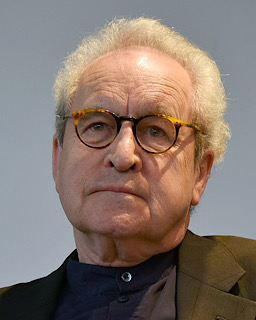
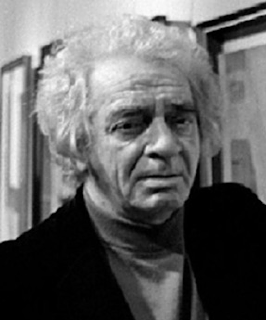
Birth of Novelist John Banville

William John Banvillenovelistshort story writer, adapter of dramas, and screenwriter, is born in Wexford, County Wexford, on December 8, 1945. He also has a 30-year career working in the Irish newspaper industry and serves as literary editor of The Irish Times from 1988 until 1999.

Banville is born to Agnes (née Doran) and Martin Banville, a garage clerk, in Wexford. He is the youngest of three siblings. He is educated at CBS Primary, Wexford, a Christian Brothers school, and at St. Peter’s College, Wexford. Despite having intentions of being a painter and an architect, he does not attend university. After school, he works as a clerk at Aer Lingus, which allows him to travel at deeply discounted rates. He takes advantage of these rates to travel to Greece and Italy. He begins working as a sub-editor at The Irish Press in 1969.

Banville publishes his first book, a collection of short stories titled Long Lankin, in 1970. His first novelNightspawn, appears in 1971, followed by his second, Birchwood, two years later. His The Revolutions Trilogy, published between 1976 and 1982, comprises works named after renowned scientists: Doctor CopernicusKepler and The Newton Letter. His next work, Mefisto, has a mathematical theme, and, in combination with the three books from The Revolutions Trilogy, is the fourth book from the “Scientific Tetralogy.” His 1989 novel, The Book of Evidence, begins The Frames Trilogy, dealing with the work of art. It is completed by Ghosts and Athena. His thirteenth novel, The Sea, wins the Booker Prize in 2005. In addition, he publishes crime novels as Benjamin Black, most of which feature the character of Quirke, an Irish pathologist based in 1950s Dublin. His alternative history novel, The Secret Guests (2020), is published under the name B. W. Black.

Banville wins the 1976 James Tait Black Memorial Prize, the 2003 International Nonino Prize, the 2005 Booker Prize, the 2011 Franz Kafka Prize, the 2013 Austrian State Prize for European Literature and the 2014 Prince of Asturias Award for Literature. He is elected a Fellow of the Royal Society of Literature in 2007. Italy makes him a Cavaliere of the Ordine della Stella d’Italia (a knighthood) in 2017. He is a former member of Aosdána, having voluntarily relinquished the financial stipend in 2001 to another, more impoverished, writer. He is considered a contender for the Nobel Prize in Literature.

In 1969, Banville marries the American textile artist Janet Dunham, whom he met in San Francisco the previous year while she is a student at the University of California, Berkeley. The couple has two sons together. The marriage breaks down after Banville has an affair with a neighbour, Patricia Quinn, who subsequently becomes director of the Arts Council of Ireland. Banville has two daughters with Quinn, born around 1990 and 1997. Despite separating, Banville and Dunham never divorce and he describes them as remaining “on good terms.” Dunham dies at Blackrock Clinic on November 22, 2021, after which Banville states that he experienced “brain fog” due to grief and is unable to write for six months. In a 2024 interview, he expresses regret over his relationship history, saying, “I caused Janet such anguish. I have caused Patricia Quinn such anguish. I wasn’t good with my children. I was not a good parent. I am not a good person. I am selfish. But I have to have responsibility.”

Banville currently lives in Howth, Dublin.


Leave a comment

Death of Albert Morrow, Illustrator, Poster Designer & Cartoonist

Albert George Morrow, Irish illustrator, poster designer and cartoonist, dies at his home in West Sussex, England, on October 26, 1927.

Morrow is born on April 26, 1863, in Comber, County Down, the second son of George Morrow, a painter and decorator from Clifton Street in west Belfast. Of his seven brothers, four, GeorgeJack, Edwin, and Norman, are also illustrators and all but one are artists. He is a keen ornithologist in his youth. In later life he is a keen walker and paints landscapes for leisure.

Morrow is educated at the Belfast Model School and latterly at the Belfast Government School of Art between 1878 and 1881.

While studying under T. M. Lindsay at the Government School of Art in 1880, Morrow is awarded a £10 prize for drawing from the eminent publishers Cassell, Petter and Galpin. In 1881, while still learning his trade, he paints a mural of Belfast for the Working Men’s Institute in Rosemary Street, where his father is chairman. Later in that same year he exhibits a watercolour sketch of a standing figure entitled Meditative at the gallery of Rodman & Company, Belfast.

Morrow then wins a three-year scholarship worth £52 per year which he takes to the National Art Training School at South Kensington in 1882, where he begins a lifelong friendship with the British sculptor Albert Toft. In 1883, while still attending South Kensington, he joins the staff of The English Illustrated Magazine in preparation for the launch of the first edition. Two of his works are published in the Sunday at Home magazine in September of the same year.

J. Comyns Carr, first editor of The English Illustrated Magazine, commissions Morrow to complete a series on English industry when he has yet to complete his studies at South Kensington.

In 1890, Morrow begins illustrating for Bits and Good Words. He exhibits nine works at the Royal Academy of Arts between 1890 and 1904, all of which are watercolours, and another in 1917, and an offering in chalk at the 159th Exhibition, in the year of his death.

Morrow becomes a member of the Belfast Art Society in 1895, exhibiting with them in the same year. In 1896, a Morrow print is published in Volume 2 of the limited-edition print-collection Les Maîtres de l’Affiche selected by “Father of the Poster” Jules Chéret. In the same year he shows a watercolour of a Gurkha at the Earls Court in the Empire of India and Ceylon exhibition. In 1900, he exhibits with two Ulster artists, Hugh Thomson and Arthur David McCormick, at the Linen Hall Library in Belfast, who along with Morrow had contributed to the early success of The English Illustrated Magazine.

Morrow is one of the founders of the Ulster Arts Club in November 1902 along with five of his brothers, an organisation that has a nonsectarian interest in Celtic ideas, language and aesthetics. In November 1903, he exhibits at the first annual exhibition of the Club when he shows alongside John LaveryHans Iten, James Stoupe and F. W. Hull. He exhibits The Itinerant Musician, a watercolour that he had previously shown at the Royal Academy in 1902. Honorary membership is conferred upon him the following year. Three years later he is honoured with a solo exhibition of sketches and posters in conjunction with the Ulster Arts Club, at the Belfast Municipal Gallery.

In 1908, Morrow joins his brothers in an exhibition at 15 D’Olier Street, Dublin, an address which is later registered to the family business in 1913. Among his contributions to the family exhibition is his painting of Brandon ThomasThe Clarionette Player, which had previously been exhibited at the Royal Academy, and a poster entitled Irving in Dante.

In 1917, Morrow joins his brother George and 150 artists and writers, in petitioning the British Prime Minister David Lloyd George to find a way of enacting the unsigned codicil to Hugh Lane’s will and establish a gallery to house Lane’s art collection in Dublin. Among the 32 notable artists who sign this petition are Jack B. Yeats, Sir William Orpen, Sir John Lavery, and Augustus John.

Morrow illustrates books for children and adults, but he is best known for the hundreds of posters he designs for the theatre, with the bulk of his commissions coming from just one lithographical printer, David Allen and Sons. As a cartoonist he draws for children’s annuals, and contributes three cartoons to Punch in 1923, 1925 and posthumously in 1931.

Morrow dies at his home in West Hoathly, West Sussex, on October 26, 1927, at the age of 64. He is survived by his wife and two children. His headstone in the local churchyard at All Saints Church, Highbrook is designed by his friend, the sculptor and architect, Albert Toft.

Morrow’s works can be found in many public and private collections such as the Victoria and Albert MuseumMusée des Arts Décoratifs and the British Museum.

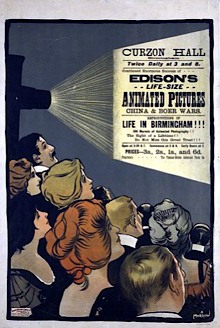
(Pictured: Colour lithograph poster by Albert Morrow advertising a cinematic showing at the Curzon Hall, Birmingham, c. 1902)


Leave a comment

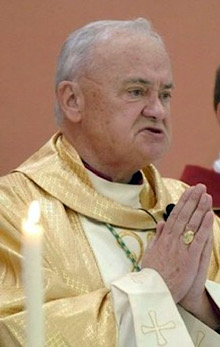
Birth of John Magee, Bishop Emeritus of Cloyne

John Magee SPS, a Roman Catholic bishop emeritus in Ireland, is born in Newry, County DownNorthern Ireland, in the Roman Catholic Diocese of Dromore, on September 24, 1936. He is Bishop of Cloyne from 1987 to 2010. Following scandal he resigns from that position on March 24, 2010, becoming a bishop emeritus. He is the only person to have been private secretary to three popes.

Magee’s father is a dairy farmer. He is educated at St. Colman’s College in Newry and enters the St Patrick’s Missionary Society at KilteganCounty Wicklow, in 1954. He also attends University College Cork (UCC) where he obtains a degree in philosophy before going to study theology in Rome, where he is ordained priest on March 17, 1962.

Magee serves as a missionary priest in Nigeria for almost six years before being appointed Procurator General of St. Patrick’s Society in Rome. In 1969, he is an official of the Congregation for the Evangelization of Peoples in Rome, when he is chosen by Pope Paul VI to be one of his private secretaries. On Pope Paul’s death he remains in service as a private secretary to his successor, Pope John Paul I and Pope John Paul II. He is the only man to hold the position of private secretary to three Popes in Vatican history. He also acts as chaplain to the Vatican’s Swiss Guard.

Magee is appointed papal Master of Pontifical Liturgical Celebrations in 1982, and is appointed Bishop of the Diocese of Cloyne on February 17, 1987. He is consecrated bishop on March 17, 1987, Saint Patrick’s Day, by Pope John Paul II at St. Peter’s Basilica in the Vatican.

On April 28, 1981, Magee travels, without the knowledge or approval of the Vatican’s Secretariat of State, to the Long Kesh Detention Centre outside Belfast to meet with Irish Republican Army (IRA) hunger striker Bobby Sands. He seeks, unsuccessfully, to convince Sands to end his hunger strike. Sands dies the following week.

Magee plays a role in the Irish Catholic Bishops’ Conference where he is featured in the modernisation of the liturgy in Ireland. His pastoral approach places heavy emphasis on the promotion of vocations to the priesthood but, after some initial success, the number of vocations in the diocese of Cloyne declines, a trend reflected across the island of Ireland. He appoints Ireland’s first female “faith developer” and entrusts her with the task of transforming an Irish rural diocese into a cosmopolitan pastoral model using techniques borrowed from several urban dioceses in the United States.

Magee involves himself in a dispute with the Friends of St. Colman’s Cathedral, a local conservationist group in Cobh which organises an effective and professional opposition to the Bishop’s plans to re-order the interior of the cathedral, plans similar to previous re-orderings in KillarneyCork and Limerick cathedrals. In an oral hearing conducted by An Bord Pleanála, the Irish Planning Board, it emerges that irregularities have occurred in the planning application that are traced to Cobh Town Council, which accommodates the Bishop’s plans to modify the Victorian interior designed by E. W. Pugin and George Ashlin. On June 2, 2006, when Bishop Magee was in Lourdes, An Bord Pleanála directs Cobh Town Council to refuse the Bishop’s application.

On July 25, 2006, Magee publishes a pastoral letter stating: “As a result of An Bord Pleanála’s decision, the situation concerning the temporary plywood altar still remains unresolved and needs to be addressed. The Diocese will initiate discussions with the planning authorities in an attempt to find a solution, which would be acceptable from both the liturgical and heritage points of view.”

A diocesan official explains that the bishop does not wish to institute a judicial review in the Irish High Court because of the financial implications of such an action and because of the bishop’s desire to avoid a Church-State clash.

Claims that the decision of An Bord Pleanála infringes the constitutional property rights of religious bodies are dismissed when it is revealed that the cathedral is the property of a secular trust established in Irish law. It is estimated that Bishop Magee spent over €200,000 in his bid to re-order the cathedral. The controversy is reported even outside Ireland.

A February 2006 article by Kieron Wood in The Sunday Business Post claims that Magee does not have the backing of the Vatican in his proposals for St. Colman’s. At the oral hearing of An Bord Pleanála he is requested to provide a copy of the letter from the Vatican in which he claims he has been given approval for the modernising of the cathedral. The letter that he produces is a congratulatory message dated December 9, 2003 to the team of architects who worked on the cathedral project from Cardinal Francis Arinze, Prefect of the Dicastery for Divine Worship and the Discipline of the Sacraments. The whole text of this letter is then reproduced in a publication called Conserving Cobh Cathedral: The Case Stated pp. 108–109.

At a meeting of his liturgical advisers and diocesan clergy in November 2006, Bishop Magee speaks of his conversation with the Pope in the course of that ad limina visit at the end of the previous month. He mentions that he has been closely questioned on several aspects of his proposals to re-order St. Colman’s Cathedral. It is obvious, he says, that the Pope has been kept well informed of the entire issue.

Bishop Magee’s contribution to the ad limina visit concerns not only his diocese of Cloyne but also ceremonial matters on behalf of the Conference. He also facilitates the broadcasting, in coincidence with the visit, of a life of Pope John Paul I prepared some months earlier by Italian state television (RAI). In an interview published on the Italian Catholic daily Avvenire on October 26, 2006, Cardinal Secretary of State Tarcisio Bertone criticises the image that the programme presents of Pope John Paul I.

After the ad limina visit, Bishop Magee represents the Irish bishops at a meeting in Rome of the International Commission for Eucharistic Congresses.

In 2007, for the third year in succession, Magee fails to complete his personal schedule of confirmations in Cloyne diocese. On May 12, 2007, he is admitted to the Bon Secours Hospital in Cork to undergo a knee replacement operation. All official engagements are cancelled for the next ten weeks to allow him to recuperate, after which he resumes work.

In December 2008, Magee is at the centre of a controversy concerning his handling of child sexual abuse cases by clergy in the diocese of Cloyne. Calls for his resignation follow. On March 7, 2009, he announces that, at his request, the Pope has placed the running of the diocese in the hands of Dermot Clifford, metropolitan archbishop of the Archdiocese of Cashel and Emly, to whose ecclesiastical province the diocese of Cloyne belongs. Magee remains Bishop of Cloyne, but withdraws from administration in order, he says, to dedicate his full-time to the matter of the inquiry. On March 24, 2010, the Holy See announces that Magee has formally resigned from his duties as Bishop of Cloyne. He is eventually succeeded by Canon William Crean whose appointment comes on November 25, 2012.

The subsequent report of the Irish government judicial inquiry, The Cloyne Report, published on July 13, 2011, finds that Bishop Magee’s second in command, Monsignor Denis O’Callaghan, then the parish priest of Mallow, had falsely told the Government and the HSE in a previous inquiry that the diocese was reporting all allegations of clerical child sexual abuse to the civil authorities.

The inquiry into Cloyne – the fourth examination of clerical abuse in the Church in Ireland – finds the greatest flaw in the diocese is repeated failure to report all complaints. It finds nine allegations out of 15 were not passed on to the Garda.

Speaking in August 2011, Magee says that he felt “horrified and ashamed” by abuse in his diocese. He says he accepts “full responsibility” for the findings. “I feel ashamed that this happened under my watch – it shouldn’t have and I truly apologise,” he says. “I did endeavour and I hoped that those guidelines that I issued in a booklet form to every person in the diocese were being implemented but I discovered they were not and that is my responsibility.”

Magee also offers to meet abuse victims and apologise “on bended knee.” He says he had been “truly horrified” when he read the full extent of the abuse in the report. However, a victim says apologies would “never go far enough.” “It’s too late for us now, the only thing it’s not too late for is that maybe there will be a future where people will be more enlightened, more aware and protect their children better,” she says. Asked about restitution for victims, Magee says it is a matter for the Cloyne Diocese.


Leave a comment

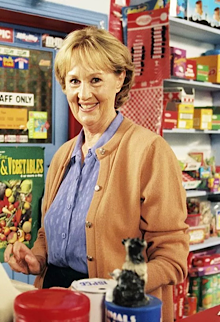
Death of Joan O’Hara, Stage, Film & Television Actress

Joan O’Hara, Irish stagefilm and television actress, dies in Dublin on July 23, 2007. She is one of Ireland’s most popular actresses and is, at the time of her death, recognisable to television viewers as Eunice Dunstan, a gossip in Fair City on RTÉ One.

O’Hara is born in Rosses PointCounty Sligo, on October 10, 1930, the daughter of Major John Charles O’Hara, an officer in the British Corps of Royal Engineers and his wife, Mai (née Kirwan). One of her sisters, Mary (born 1935), is a soprano/harpist. Her brother Dermot (born 1934) now lives with his family in Canada. She attends the same Ursuline convent school as fellow actress and friend Pauline Flanagan.

O’Hara lives most of her life in Monkstown, Dublin, with a stay in London, with her husband, the poet and architect Francis J. Barry. The couple has four children: Siubhan, Jane, Guy, and Sebastian, an author/playwright, whose works include The Steward of Christendom, and the Booker-shortlisted novels A Long Long Way and The Secret Scripture. She is also a year-round sea-swimmer.

O’Hara is a member of the renowned Abbey Players and performs in many plays in the Abbey Theatre in Dublin, including those by Seán O’CaseyLady Gregory and W.B. Yeats. She appears as Maurya in the 1988 film The Dawning. She appears in a number of other films, including Ron Howard‘s Far and AwayDaFootfallsHome is the Hero and just before her death, How About You. In this her final film, she stars with Vanessa Redgrave and her friend Brenda Fricker. The strength of her performance and bravery in carrying it out is acknowledged by the cast and crew in a standing ovation.

More recently, O’Hara is best known for appearing in the popular Irish television soap opera Fair City, broadcast on RTÉ One. She joins the soap in 1994, portraying the character Eunice Dunstan until her death in 2007. Thus, she is described as both one of Ireland’s most popular actresses and as one of the finest actors of her generation on her death. She admires in particular Samuel BeckettFederico García Lorca and Ingmar Bergman. While she takes a no-nonsense approach to her craft, famously giving the advice that when in doubt, one should relate to the fireplace, she is educated at the Abbey School of Acting and has a deep appreciation and knowledge of theoretical approaches to acting and is an admirer of the European and American avant-garde. As actor Alan Stanford says after her death, “She had the most amazing energy. She was in the truest sense one of the last of the greats.”

Joan O’Hara Barry (she keeps her maiden name as her stage name) dies in Dublin on July 23, 2007, of complications from heart disease, aged 76. Her death is announced on RTÉ News the following day.


Leave a comment

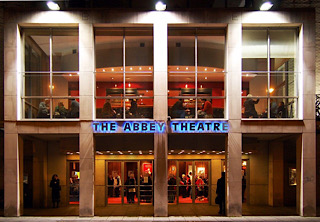
Reopening of New Abbey Theatre

The newly unveiled Abbey Theatre opens its doors for the first time on July 18, 1966.

Fifteen years earlier, in 1951, the original buildings of the theatre are destroyed by fire during the run of The Plough and the Stars. Ironically, the play closes to the strains of “Keep the Home Fires Burning.” The fire forces the theatre company to find a new home.

They relocate to the Queen’s Theater on Pearse Street for what is intended to be a temporary stay but instead lasts for a decade and a half. A week before the brand new premises on Abbey Street are opened, the company has its final performance at the Queen’s Theatre in what is a bittersweet evening. For the Abbey Theatre it signals the end of an era and the beginning a new one, but the future of the Queen’s Theatre is far less bright.

After the final performances from the Abbey, Never the Time and the Place by Lennox Robinson and The Irishwoman of the Year by John Power, uncertainty shrouds the fate of the theatre with the Irish Independent reporting that “It will be used for variety performances up to the end of September, but after that it is just a matter for speculation.” It is ultimately closed in 1969 and is demolished in 1975.

The jubilee year of the 1916 Easter Rising, the 1966 Abbey opening recalls memories of the events that had taken place fifty years earlier.

In an article published the day after opening night, the Irish Independent recalls that “Thomas MacDonagh, one of the executed leaders of the Rising was himself an Abbey playwright and when news of the seizure of the General Post Office reached the theatre at a rehearsal, members of the Abbey players and other hands made a hurried exit to join the fighting. And by then others of the company were already at the barricades.”

A world away from the battleground of the Rising, the opening of the new Abbey Theatre is attended by a who’s who of arts, culture and politics.

Alongside Abbey actors, playwrights and staff are members of parliament including President of Ireland Éamon de Valera, Minister for Finance Jack Lynch, James Dillon and Lord Mayor of Dublin Eugene Timmons. Eammon Andrews, Raidió Teilifís Éireann’s director-general Kevin McCourt, theatre personalities Hilton Edwards and Micheál Mac Liammóir and Lord Moyne, himself an Abbey playwright and who gave the Company its temporary home immediately after the fire in Rupert Guinness Memorial Home, are also there on the night.

The Abbey’s new home is opened by President Éamon de Valera, who once graced the Abbey Stage as an amateur actor.

The new building is designed by Irish architect Michael Scott, who also designed the nearby Busáras building. He is considered one of the great modern architects and his vision for the new Abbey is thought to be the last word in modern-day design.


Leave a comment

Birth of James G. Douglas, Businessman & Politician

James Green Douglas, Irish businessman and politician, is born July 11, 1887, at 19 Brighton Square, Dublin. In 1922, he serves as the first-ever Leas-Chathaoirleach (deputy chairperson) of Seanad Éireann, the upper house of the newly independent Irish parliament. He goes on to serve in the Seanad for 30 years.

Douglas is the eldest of nine children of John Douglas, proprietor of John Douglas & Sons Ltd, drapers and outfitters of Wexford Street and originally of Grange, County Tyrone, and his wife, Emily, daughter of John and Mary Mitton of Gortin, Coalisland, County Tyrone. The genealogy of the Douglas family to which he belongs can be traced to Samuel Douglas of Coolhill, Killyman, County Tyrone.

Douglas attends (1895–98) a small school for Quaker children and is a boarder (1898–1902) in the Friends’ School, Lisburn. In 1902, he begins a three-year apprenticeship in his father’s business.

On February 14, 1911, Douglas marries Georgina (Ena) Culley (1883–1959), originally of Tirsogue, LurganCounty Armagh, whom he meets during his apprenticeship. Their children are John Harold Douglas, who succeeds to the family business and replaces his father as senator, and James Arthur Douglas, who becomes a well-known architect.

From an early age Douglas is fascinated by politics and influenced by the newspapers edited by Arthur Griffith. He becomes a member of the Dublin Liberal Association, whose members for the most part are Protestant home rulers. After the 1916 Easter Rising, with George Russell and others, who also regard themselves as neither unionists nor nationalists, he sets out to promote what they term “full dominion status” for Ireland. This paves the way for the Irish Convention (1917–18), which, however, fails to reconcile the polarised political attitudes of the time.

On February 1, 1921, Douglas, with the help of Sinn Féin, sets up the Irish White Cross. As honorary treasurer and trustee he almost singlehandedly runs the White Cross in 1921. He is appointed by Michael Collins as chairman of the committee to draft the Constitution of the Irish Free State following the Irish War of Independence.

Douglas goes on to become a very active member of Seanad Éireann between 1922 and 1936 under the constitution he had helped to prepare. In 1922, he is elected as the first vice-chairman of the Senate. The Senate is abolished in 1936 and re-established under the terms of the 1937 Constitution of Ireland. He is again an active Senator between 1938 and 1943, and from 1944 to 1954. The topics most associated with him during his work as Senator are international refugees and the League of Nations.

For some thirty years he runs the family business, and is also a director of Aspro (Ireland) Ltd, Nugent & Cooper Ltd, Philips Lamps (Ireland) Ltd, and the Greenmount & Boyne Linen Co. Ltd. In addition, he serves as president of the Linen and Cotton Textile Manufacturers Association and as a member of the council of the Federated Union of Employers.

Douglas dies on September 16, 1954.


Leave a comment

Death of John Roberts, Anglo-Irish Architect

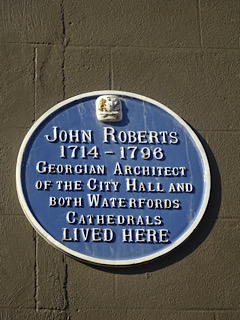
John RobertsAnglo-Irish architect working in the Georgian style, dies in Waterford, County Waterford, on May 23, 1796. He is best known for the buildings he designed in that city.

Roberts is born in Waterford in 1712 or 1714, the son of Thomas Roberts, an architect and builder. Little is known of his early life, although he possibly trains in London for a time. At 17, he elopes with Mary Susannah Sautelle, a Huguenot heiress who also lives in Waterford.

In 1746, Roberts is asked by the Church of Ireland (ProtestantBishop of Waterford and LismoreRichard Chenevix, to complete the new Bishop’s Palace.

Around 1760 Roberts designs Mount Congreve, near Kilmeadan.

In 1785, Roberts builds a house in Waterford for William Morris, now the Harbour Commissioners’ headquarters and the Chamber of Commerce. In 1786, he designs Newtown House, later Newtown School, a Quaker school. In 1787, he designs The Leper Hospital and Church of St. Stephen. He also builds the Assembly Rooms on Waterford’s Mall in 1788, which is now the Theatre Royal and City Hall.

Roberts had the unusual distinction of designing both the Protestant and Catholic cathedrals of Waterford: Christ Church Cathedral (1770s) and the Cathedral of the Most Holy Trinity (1790s) respectively.

Outside of Waterford, Roberts designs Curraghmore and Mount Congreve (both in County Waterford), St Iberius’ Church (Wexford) and is reputed to have designed Tyrone House (County Galway), Cappoquin House(County Waterford) and Moore Hall, County Mayo.

Roberts has between 21 and 24 children with his wife Susannah, of whom eight live to adulthood, including the painters Thomas Roberts and Thomas Sautelle Roberts. They live for many years in the old bishop’s palace, opposite the cathedral, with a country residence at Roberts Mount. He is nicknamed “Honest John” because he pays his workers so reliably, sometimes giving half their pay directly to their wives so that it would not be wasted on alcohol.

Roberts dies on May 23, 1796, after falling asleep on the floor of the Cathedral of the Most Holy Trinity, Waterford, and contracting pneumonia. The main square in Waterford is named John Roberts Square in his honour.

His son, the Reverend John Roberts became a magistrate and rector. The Rev. John’s son is Abraham Roberts, a general in the East India Company, and Abraham’s son is Frederick Roberts, 1st Earl Roberts, a World War I field marshal. Roberts’ sons Thomas and Sautelle become artists, as does his daughter, who paints scenery for the Waterford Theatre and landscapes.

Another great-grandson is the architect Samuel Ussher Roberts (1821–1900).


Leave a comment

Death of Sir Thomas Drew, Architect & Antiquarian

Sir Thomas Drew, Anglo-Irish architect and antiquarian, dies in Dublin on March 13, 1910.

Drew is born on September 18, 1838, in Victoria Place, Belfast, into the large family of Rev. Thomas Drew, son of a Limerick grocer, and Isabella Drew (née Dalton). He is one of four sons and eight daughters of the couple, although most of the children die young. His sister, Catherine Drew, is a prominent London journalist and an early champion of women’s rights.

Drew is educated in Belfast and in 1854 articled to the Antrim county surveyor and architect Sir Charles Lanyon, before moving to work in Dublin in 1862, where he becomes principal assistant to William George Murray. In 1865, he becomes the diocesan architect of the united dioceses of Down, Connor and Dromore. From this point forward, church architecture is his principal activity. He is consulting architect for both St. Patrick’s Cathedral and Christ Church Cathedral in Dublin.

Drew marries Adelaide Anne, sister of William George Murray, in 1871.

Among other projects, Drew is responsible for the design of the Ulster Bank on Dame Street, Rathmines Town Hall and the Graduates’ Building at Trinity College Dublin (TCD). He takes an interest in historic buildings and is the first to draw serious attention to the architectural and historic importance of the St. Audoen’s Church, Dublin’s oldest parish church, in 1866. He produces detailed plans of the church for which he wins the Fitzgerald medal from the Royal Institute of the Architects of Ireland (RIAI), carries out excavations and draws up a paper on the church and its history.

From 1885 to 1892, Richard Orpen works with Drew as a managing assistant. Drew’s most significant work in Belfast is St. Anne’s Cathedral, completed in 1899.

Drew is knighted in the 1900 Birthday Honours and is the inaugural president of the Royal Society of Ulster Architects (RSUA), serving from 1901 to 1903. In addition, he is president of the Royal Institute of the Architects of Ireland (RIAI), the Royal Society of Antiquaries of Ireland (RSAI) and the Royal Hibernian Academy (RHA) and holds the chair in architecture at the National University of Ireland (NUI).

From 1879 onward Drew lives in Gortnadrew, one half of a pair of semi-detached houses of his own design, on Alma Road in Monkstown, County Dublin. For many years he serves as a commissioner of the local township of Blackrock, Dublin. He dies on March 13, 1910, a month after an unsuccessful operation for appendicitis. He is buried in Dean’s Grange Cemetery in the suburban area of Deansgrange in Dún Laoghaire–Rathdown, County Dublin.

Drew is commemorated in a memorial brass in Christ Church Cathedral, Dublin. His wife survives him by three years and in her will bequeaths back to the RIAI the loving cup presented to her husband in commemoration of his knighthood, and to the Belfast Municipal Museum and Art Gallery (Ulster Museum since 1962) an 1852 portrait of his father Thomas. A portrait of Drew by Walter Osborne is held in the National Gallery of Ireland (NGI) in Dublin.


Leave a comment

Birth of Charles Lanyon, Civil Engineer & Architect

Sir Charles Lanyon, DL, JP, civil engineer and architect, is born on January 6, 1813, at Eastbourne, Sussex, England, third son of John Jenkinson Lanyon, purser in the Royal Navy, and Catherine Lanyon (née Mortimer). His work is most closely associated with Belfast, Northern Ireland.

Following his local education, Lanyon becomes an apprentice civil engineer with Jacob Owen in Portsmouth. When Owen is made senior Engineer and Architect of the Irish Board of Works and moves to Dublin, Lanyon follows. In 1835 he marries Owen’s daughter, Elizabeth Helen. They have ten children, including Sir William Owen Lanyon, an army officer and future administrator of the Transvaal in southern Africa.

Lanyon is county surveyor in County Kildare briefly, a post he exchanges for its equivalent in County Antrim, based in Belfast, when the incumbent, Thomas Jackson Woodhouse, resigns in 1836. By 1842, he has built the Antrim coast road between Larne and Portrush, through spectacular natural surroundings. He designs the lofty three-arched Glendun viaduct on this route near Cushendun, an early example of his versatile talent for monumental display as well as the Ormeau Bridge over the River Lagan. He remains county surveyor of Antrim until 1861 when he resigns from the post to concentrate on private work and other interests.

Lanyon is elected Mayor of Belfast in 1862, and Conservative MP for the city between 1865 and 1868. In 1868 he is also knighted and serves on the Select Committee on Scientific Instruction.

Lanyon loses his Belfast parliamentary seat in 1868 to William Johnston but continues to serve as a Belfast Town councillor until 1871. From 1862 to 1886 he is Belfast Harbour Commissioner. He serves as Deputy Lieutenant for County Antrim and is appointed High Sheriff of Antrim in 1876. He is also a Justice of the Peace for many years.

Lanyon’s other business interests include being director of the Blackstaff Flax Spinning Company and chairman of several railway companies. He is made director of the Northern Counties Railway in 1870 but resigns in 1887 because of ill-health. Alongside his business activities he is an active Freemason and serves as Provincial Deputy Grand Master of Belfast and North Down between 1863 and 1868, Provincial Deputy Grand Master of Antrim between 1868 and 1883 and Provincial Grand Master of Antrim between 1883 and 1889.

Lanyon lives at The Abbey, a grand house in Whiteabbey, County Antrim, which eventually becomes a sanitorium during World War I and is now part of Whiteabbey Hospital. His wife dies in 1858, and his son William dies from cancer at the age of 44 in 1887. He dies at The Abbey on May 31, 1889, and is buried in Knockbreda Cemetery, Belfast, in a tomb also of his design.


Leave a comment

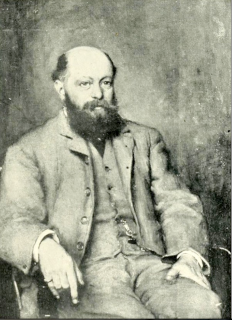
Birth of Richard Orpen, Architect, Painter & Illustrator

Richard Francis Caulfield Orpen, Irish architect, painter, illustrator and designer, is born on December 24, 1863.

Orpen is born to Anne (née Caulfield) and Arthur Herbert Orpen, a solicitor of Oriel, Blackrock, Dublin. His maternal grandfather is the Bishop of Nassau, Charles Caulfield. He is the eldest of four brothers and two sisters. His youngest brother is William, the painter. He attends St. Columba’s College in Whitechurch, Dublin, and graduates from Trinity College Dublin (TCD) with a BA in 1885. While attending St. Columba’s, he publishes an Irish comic alphabet for the present times in 1881, which is a mix of cartoons and verse mocking Charles Stewart Parnell and the home rule movement.

Orpen wants to pursue painting, but “for family reasons” he becomes an architect. He spends eleven years with Thomas Drew, initially as a pupil, and later as a managing assistant from 1885 to 1892. From around 1884, he attends the annual excursions of the English Architectural Association. Around 1890, he establishes his own architectural practice in Drew’s offices at 22 Clare Street, Dublin. In 1896, he moves his office to 7 Leinster Street. In 1888 he is elected as a member of the Royal Institute of the Architects of Ireland (RIAI), serving as a council member from 1902 to 1910, as honorary secretary from 1903 to 1905, and as president from 1914 to 1917. He designs the institute’s official seal in 1909. In 1904, the Irish Builder describes him as the “originator of the bungalow in Ireland.”

From 1888, Orpen exhibits with the Royal Hibernian Academy (RHA), with watercolours and architectural drawings. He continues to exhibit with them until 1936. He collaborates with Percy French on a number of projects, including illustrating Racquetry Rhymes (1888) and The First Lord Liftinant and Other Tales (1890). He provides cartoons for French’s periodical, The Jarvey. His architectural illustrations are included in H. Goldsmith Whitton’s Handbook of the Irish Parliament Houses… (1891). He is one of the original members of the Architectural Association of Ireland, serving as its first president in 1896, and as vice-president in 1910.

Orpen is appointed the architect to St. Columba’s from 1897 to 1938, following a fire at the college in 1896. He becomes a fellow of the college, and the sanatorium becomes known as the Orpen building. He is an active member of the Arts and Crafts Society of Ireland, serving as secretary in 1895, on the committee in 1904, and in 1917 sits on the organising committee for the fifth exhibition. In 1906, he is a founding member of the Arts Club. In 1906 he moves his architectural practice to 13 South Frederick Street, and moves into a house he designed, Coologe, Carrickmines, County Dublin.

At the 1907 Irish International Exhibition, Dublin, Orpen exhibits a number of chalk drawings. The same year he designs the cover of a satirical pamphlet, The Abbey row, not edited by W. B. Yeats, which mocks The Arrow and the riots at the first production of The Playboy of the Western World. He unveils a bust of Hugh Lane at the opening of the Municipal Gallery of Modern Art on Harcourt Street in 1908. He is appointed secretary to the municipal gallery committee by Lane. In 1910, he is appointed architect to Christ Church Cathedral, as well as architect to St. Canice’s Cathedral, Kilkenny, and St. Patrick’s Cathedral, Dublin. In 1911 he is elected an associate of the Royal Hibernian Academy, a full member in 1912, and was the academy’s secretary from 1925 to 1937.

From 1910 to 1914, Orpen is in an architectural partnership with Page Dickinson, with the two collaborating on plans for the new Dublin municipal gallery and conversion of the Turkish Baths, Lincoln Place. Lane rejects his and Dickinson’s gallery plans, leading to him refusing to work with Lane’s choice of architect, Sir Edwin Lutyens. In 1914, he is appointed a guardian of the National Gallery of Ireland, and lectures at the Dublin Metropolitan School of Art on architectural history in 1914 and 1915. He is involved in the design of a number of memorials including the setting for a bronze relief by Beatrice Campbell for the members of the Royal Irish Regiment killed in the Second Boer War and the war memorial at the Rathgar Methodist church. He serves as president of the arts and crafts section of the Royal Dublin Society (RDS). He is also a governor of the Royal National Hospital for Consumption for Ireland in Newcastle, County Wicklow.

Orpen marries Violet Caulfield in 1900. They are both descended from William Caulfeild, 1st Viscount Charlemont. He dies on March 27, 1938, at his home, Coologe, and is buried in Dean’s Grange Cemetery.

Orpen features as one of the many portraits in Seán Keating‘s Homage to Sir Hugh Lane. St. Columba’s College holds a portrait of Orpen by his brother, William, as well as a memorial stained-glass window to him by Catherine O’Brien.