The party is small throughout its existence. According to the ISRP historian David Lynch, the party never has more than 80 members. Upon its founding one journalist comments that the party has more syllables than members. Nevertheless, the ISRP is regarded by many Irish historians as a party of seminal importance in the early history of Irish socialism and republicanism. It is often described as the first socialist and republican party in Ireland, and the first organisation to espouse the ideology of socialist republicanism on the island. During its lifespan it only has one really active branch, the Dublin branch. There are several attempts to create branches in Cork, Belfast, Limerick, Naas, and even in northern England but they never come to much. The party establishes links with feminist and revolutionary Maud Gonne who approves of the party.
The party produces the first regular socialist paper in Ireland, the Workers’ Republic, runs candidates in local elections, represents Ireland at the Second International, and agitates over issues such as the Boer War and the commemorations of the Irish Rebellion of 1798. Politically the ISRP is before its time, putting the call for an independent “Republic” at the centre of its propaganda before Sinn Féin or other political organizations.
A public meeting held by the party is described in Irish socialist playwrightSean O’Casey‘s autobiography Drums under the Window.
Connolly, who is the full-time paid organiser for the party, subsequently leaves Ireland for the United States in 1903 following internal conflict. In fact, it seems that a combination of the petty infighting and his own poverty that causes Connolly to abandon Ireland (he returns in 1910). Connolly clashes with the party’s other leading light, E. W. Stewart, over trade union and electoral strategy. A small number of members around Stewart establish an anti-Connolly micro organisation called the Irish Socialist Labour Party. In 1904, this merges with the remains of the ISRP to form the Socialist Party of Ireland.
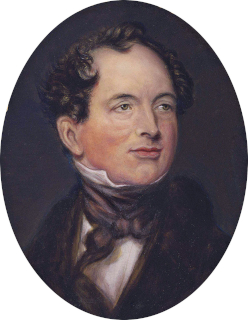
The son of a Roman Catholic wine merchant, Moore graduates from Trinity College, Dublin, in 1799 and then studies law in London. His major poetic work, Irish Melodies (1807–34), earns him an income of £500 annually for a quarter of a century. It contains such titles as “The Last Rose of Summer” and “Oft in the Stilly Night.” The Melodies, a group of 130 poems set to the music of Moore and of Sir John Stevenson and performed for London’s aristocracy, arouses sympathy and support for the Irish nationalists, among whom Moore is a popular hero.
Lalla-Rookh (1817), a narrative poem set in an atmosphere of Oriental splendour, gives Moore a reputation among his contemporaries rivaling that of Byron and Sir Walter Scott. It is perhaps the most translated poem of its time, and it earns what was until then the highest price paid by an English publisher for a poem (£3,000). His many satirical works, such as The Fudge Family in Paris (1818), portray the politics and manners of the Regency era.
In 1824 Moore becomes a participant in one of the most celebrated episodes of the Romantic era. He is the recipient of Byron’s memoirs, but he and the publisher John Murray burn them, presumably to protect Byron. He later brings out the Letters and Journals of Lord Byron (1830), in which he includes a life of the poet. His lifelong espousal of the Catholic cause leads him to produce such brilliant works as his parody of agrarian insurgency, The Memoirs of Captain Rock (1824), and his courageous biography of the revolutionary leader of the 1798 rebellion, The Life and Death of Lord Edward Fitzgerald (1831).
Moore’s personal life is dogged by tragedy including the deaths of all five of his children within his lifetime and a stroke in later life, which disables him from performances, the activity for which he is most renowned. Moore dies while being cared for by his wife, Elizabeth (nee Dyke), at Sloperton Cottage, Bromham, Wiltshire, England on February 26, 1852. His remains are in a vault at St. Nicholas churchyard, Bromham, within view of his cottage-home and beside his daughter Anastasia.
(Pictured: Thomas Moore, after a painting by Thomas Lawrence)
Following the outbreak of the rebellion, signaled in Meath by the prearranged signal of the ceasing of a mail coach near Turvey hill, road blocks are posted on the Navan road. Members of the Society of United Irishmen and rebels in Meath begin to assemble at the Hill of Tara. Tara is chosen as it provides strategic control of road access to the capital of Dublin and cultural significance as the former seat of the High Kings of Ireland. Between 4,000-7,000 rebels gather at the hill. Following the outbreak of the rebellion on May 23, there are incidents of violent encounters throughout the countryside as rallying rebels make their way to Tara.
Picking up yeomanry reinforcements along the way, the combined fencible, yeoman and militia force forms up at the bottom of the hill in advance of the attack on the rebels who have established a large camp on the hill. The lack of any cannon or cavalry places the rebels at a great disadvantage despite their numbers. Disciplined volley fire and flanking cavalry action combined with withering grapeshot delivered from a 6 pounder cannon drive the rebels to within the graveyard walls at the summit. There, at dusk, the rebels make their last stand on the hill until a final grenadier assault finishes them.
The loss to the fencibles, yeomen and militia is minimal. However rebel casualties have estimates running from several hundred to several thousand dead and many wounded. Many bodies are removed during the night of the 26th and 350 dead are counted still lying on the battlefield the following day. Witnesses to the burial recollect many more bodies of those rebels who died of their wounds during the night being collected from the surrounding countryside in carts. It is noted by the witnesses that the bodies are universally disembowelled by the victors. The dead are buried in a mass grave marked by the Lia Fáil stone which is moved to mark the burial site. The defeat effectively ends the United Irishmen’s rising in Meath.
(Pictured: The high cross at the site of the Battle of the Hill of Tara, County Meath)
Creighton Hale, Irish American theatre, film, and television actor, is born Patrick Fitzgerald on May 24, 1882, in County Cork. His career extends more than a half-century, from the early 1900s to the end of the 1950s.
Some believe that in 1923 Hale stars in an early pornographic “stag” filmOn the Beach (a.k.a. Getting His Goat and The Goat Man). In the film, three nude women agree to have sex with him, but only through a hole in a fence. Photographs of the scene clearly show that the man in the film is not Hale but is another actor who also wears glasses.
Hale’s two sons, Creighton Hale, Jr. and Robert Lowe Hale, from his first marriage to Victoire Lowe, are adopted by Lowe’s second husband, actor John Miljan. After his divorce, Hale marries Kathleen Bering in Los Angeles in 1931.
Drennan is son the son of ReverendThomas Drennan (1696–1768), minister of Belfast’s First Presbyterian Church on Rosemary Street. Thomas Drennan is an educated man from the University of Glasgow and is ordained to the congregation of Holywood, County Down in 1731. Drennan is heavily influenced by his father, whose religious convictions serve as the foundation for his own radical political ideas. His sister, Martha, marries fellow future United Irishman Samuel McTier in 1773.
In 1769 Drennan follows in his father’s footsteps by enrolling in the University of Glasgow where he becomes interested in the study of philosophy. In 1772 he graduates in arts and then in 1773 he commences the study of medicine at Edinburgh. After graduating in 1778 he sets up practice in Belfast, specialising in obstetrics. He is credited with being one of the earliest advocates of inoculation against smallpox and of hand washing to prevent the spread of infection. He also writes much poetry, coining the phrase “Emerald Isle” and is the founder and editor of a literary periodical, Belfast Magazine. He moves to Newry in 1783 but eventually moves to Dublin in 1789 where he quickly becomes involved in nationalist circles.
Like many other UlsterPresbyterians, Drennan is an early supporter of the American Colonies in the American Revolution and joins the Volunteers who had been formed to defend Ireland for Britain in the event of French invasion. The Volunteer movement soon becomes a powerful political force and a forum for Protestant nationalists to press for political reform in Ireland eventually assisting Henry Grattan to achieve legislative independence for the Irish parliament in 1782. However, Drennan, like many other reformers, quickly becomes dismayed by the conservative and sectarian nature of the Irish parliament and in 1791 he co-founds the Society of United Irishmen with Wolfe Tone and Thomas Russell.
Drennan writes many political pamphlets for the United Irishmen and is arrested in 1794 for seditious libel, a political charge that is a major factor in driving the United Irishmen underground and into becoming a radical revolutionary party. Although he is eventually acquitted, he gradually withdraws from the United Irishmen but continues to campaign for Catholic Emancipation.
On February 8, 1800, Drennan marries Sarah Swanwick, “an English lady of some wealth” from Shropshire. They have one daughter and four sons.
Drennan settles in Belfast in 1807. In 1810 he co-founds the non-denominational Royal Belfast Academical Institution. As a poet, he is best remembered for his poem The Wake of William Orr, written in memory of a United Irishman executed by the British. Despite his links with revolutionary republicans, he gradually becomes alienated from the post-Union nationalism of the period. His abiding concern for Liberalism and post union realities make him contemplate his political ideas anew.
Drennan dies on February 5, 1820. He directs that his coffin be carried by an equal number of Catholics and Protestants with clergy from different denominations in attendance.
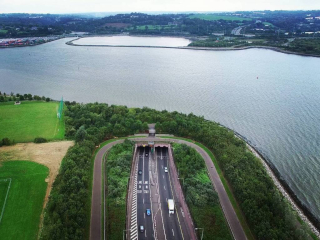
The Jack Lynch Tunnel, described as the most challenging civil engineering project in the history of the state, is unveiled on May 21, 1999 by TaoiseachBertie Ahern at the entrance of the tunnel in Mahon, County Cork.
The Jack Lynch Tunnel is an immersed tube tunnel and an integral part of the N40 southern ring road of Cork. It is named after former Taoiseach Jack Lynch, a native of Cork. Construction involves the excavation of a large casting basin where the tunnel elements or pieces are constructed. After construction of elements is complete, the casting basin is filled with water and joined to the adjacent River Lee, each element is floated out and sunk into position into a carefully dredged river bed.
The tunnel takes the road under the River Lee. North of the tunnel, the ring-road joins the M8 motorway to Dublin and N8 road to the city centre, with the N25 road commencing east to Waterford. The tunnel is completed in May 1999, and carries nearly 40,000 vehicles per day as of 2005. This number rises further as the N40 ring-road’s upgrades progress, with the opening of the Kinsale Road Roundabout flyover in 2006 and subsequent upgrades to the Sarsfield Road and Bandon Road Roundabouts. Traffic in 2015 is 63,000 vehicles a day up from 59,000 in 2013.
The tunnel has two cells, each with two traffic lanes and two footpaths, and a central bore for use in an emergency only. Pedestrians and cyclists are expressly forbidden from using the tunnel. The exclusion of cyclists has been somewhat controversial as the feeder road is a dual-carriageway and so is open to cyclists, but the by-law is applied because of space limitations and the obvious danger of cyclists in an enclosed tunnel.
In May 1920, East Londondockers refuse to load the SS Jolly George, a ship intended to carry arms to be used against the new Bolshevik state. The Munitions Strike begins in Dublin on May 20, 1920, when dock workers follow suit and refuse to handle war material. They are soon joined by members of the Irish Transport and General Workers Union.
When news of the proposed radical action is brought to trade unionist William O’Brien’s desk on May 19, he informs Thomas Foran, General President of the union. The following day, the men standing around waiting to begin work are told that the work is not to start.
On hearing of the political action at the Dublin docks, a second ship was diverted to Dún Laoghaire. There, the military are on hand to unload its cargo, but when the cargo arrives at Westland Row station, workers there refuse to handle the goods. While the dockworkers are casual workers who can be reallocated elsewhere, the railwaymen are permanent employers and members of the separate National Union of Railwaymen.
In the following days, the action taken in Dublin and Dun Laoghaire is replicated elsewhere. To sections of the conservative press, the behaviour of dockers and railwaymen is scandalous. The ever-reliable Punch illustrated news produces a sketch in a June 1920 edition showing an IRA gunman hiding behind a rural wall, joined by a railway worker, or “the blameless accomplice.”
The brave stand that began on the docks of Dublin spreads nationwide, largely thanks to the militancy of railway workers. From arms in storage, the strike is widened to include the carrying of men holding arms representing Crown Forces.
The munitions strike is an effective tactic, proven by the infuriated responses to it from the upper echelons of the British military and political class. In November, the British Government begins closing rail lines, including the Limerick to Waterford and Limerick to Tralee lines,as well as trains into Galway, which instigate a fear among the public that the Irish railway system could be shut down in its entirety.
In the absence of sympathetic strike action in Britain, and with increasingly vicious physical assaults on railwaymen, the Irish leadership feels increasingly vulnerable in the dispute, which eventually winds down in December.
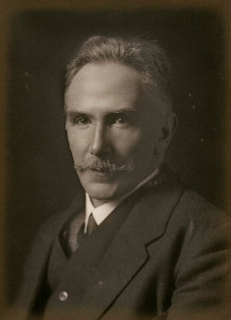
Dixon is the youngest of the seven sons of George Dixon, a soap manufacturer, and Rebecca (née Yeates) Dixon. He is educated at Rathmines School and Trinity College, Dublin. In 1894, after studying in Bonn, Germany, he is appointed assistant and later full Professor of Botany at Trinity. In 1906 he becomes Director of the Botanic Gardens and in 1910 of the Herbarium also. He has a close working relationship with physicist John Joly and together they develop the cohesion theory of the ascent of sap.
Dixon’s early research includes work on the cytology of chromosomes and first mitosis in certain plants. Familiarity with work on transpiration and on the tensile strength of columns of sulfuric acid and water leads Dixon and Joly to experiment on transpiration. “On the Ascent of Sap” (1894) presents the hypothesis that the sap or water in the vessels of a woody plant ascends by virtue of its power of resisting tensile stress and its capacity to remain cohesive under the stress of great differences of pressure. Dixon and Joly further demonstrate that water is transported through passive vessels and not living cells.
Dixon writes Transpiration and the Ascent of Sap in Plants (1914), which brings various theories and experimental works together in a coherent argument. He also writes a textbook, Practical Plant Biology (1922).
In 1907 Dixon marries Dorothea Mary, daughter of Sir John H. Franks, with whom he raises three sons. He is the father of biochemistHal Dixon and grandfather of Adrian Dixon and Joly Dixon.
The Restoration of the monarchy begins in 1660. The Commonwealth of England, Scotland and Ireland (1649–60) result from the Wars of the Three Kingdoms but collapse in 1659. Politicians such as General George Monck try to ensure a peaceful transition of government from the “Commonwealth” republic back to monarchy. From May 1, 1660 the English, Scottish and Irish monarchies are all restored under King Charles II. The term Restoration may apply both to the actual event by which the monarchy was restored, and to the period immediately before and after the event.
With the collapse of The Protectorate in England during May 1659 the republic which had been forced upon Ireland by Oliver Cromwell quickly begins to unravel.
Royalists plan an uprising in Ireland and seek to turn Henry Cromwell and Lord Broghill, who is in contact with the King’s court in the summer of 1659, towards the cause but the plan comes to aught. Henry Cromwell leaves Ireland in June 1659. Broghill shows reluctance to declare for the King, but nevertheless republicans are suspicious of him following George Booth‘s revolt in England in 1659.
Sir Theophilus Jones, a former soldier under Charles I of Ireland and governor of Dublin during the republic, seizes Dublin Castle with a group of officers and declares for Parliament. Acting in Charles II’s interest, Sir Charles Coote seizes Galway while Lord Broghill holds firm in Munster. On January 9, 1660 a council of officers declare Edmund Ludlow a traitor and he flees to England. The regicideHardress Waller re-takes Dublin Castle in February 1660 but with little support he surrenders to Sir Charles Coote. Waller along with fellow regicide John Cook is arrested and sent to England. The officers in Dublin support General Monck.
The army is purged of radicals and a Convention Parliament is called. Coote seeks to move the Convention Parliament towards restoration, but his rival Broghill does not openly declare for the King until May 1660.
In February 1660 Coote sends a representative to King Charles II in the Netherlands and invites him to make an attempt on Ireland, but the King regards it as inexpedient to try to reclaim Ireland before England. At the same time Broghill sends his brother to invite the King to land at Cork. In March 1660 a document is published asking for the King’s return, “begged for his forgiveness, but stipulated for a general indemnity and the payment of army arrears.”
Following events in England, Charles is proclaimed King of Ireland in Dublin on May 14 without any dissent. The Irish Royal Army is reestablished.
After 1660, the commonwealth parliamentary union is treated as null and void. As in England the republic is deemed constitutionally never to have occurred. The Convention Parliament is dissolved by Charles II in January 1661, and he summons his first parliament in Ireland in May 1661.
(Pictured: Charles II in Garter robes by John Michael Wright or studio, c. 1660–1665)
Davis starts as a news reporter with the American network ABC and BBC Northern Ireland before spending 11 years in the newsroom at RTÉ. In the early 1980s he becomes a newsreader for The Six-o-clock News and begins to become well-known due to his sometimes-off-the-cuff comments on news stories.
Davis impersonates Big Tom on the RTÉ satirical programme Hall’s Pictorial Weekly and, as a result, is offered a part in a showband in Cork. After a ballroom tour, he joins RTÉ proper in 1975, initially to work as a television news reporter, eventually becoming newsreader on the nine o’clock news. In the mid-1980s, he hosts his own talk show, Davis at Large. It is on this show, which is screened live, that he is attacked and hurled across the studio by a guest female body builder. In addition to this he has an interactive summer current affairs show, simply called Davis. In 1986, he begins co-hosting (with Thelma Mansfield) RTÉ 1’s afternoon programme Live at 3, a role he fills for eleven years.
Davis presents the Rose of Tralee twice in 1995 and 1996, the first of these when Gay Byrne is taken ill at short notice. He memorably thanks the providers of the air conditioning while wiping sweat from his brow. Live at 3 comes to an end in 1997. Davis returns to the screen in the late 1990s with a marine programme devoted to boats and the waters around Ireland called Out of the Blue, which runs for four series, the last of which is broadcast in 2001.
In 2000, Davis presents a radio quiz show called A Question of Food. During the summer season he takes over RTÉ Radio 1‘s mid-morning slot usually occupied by Today with Pat Kenny, and he also hosts the radio phone-in show, Liveline, when regular presenter Joe Duffy is on holiday. Later, he presents Sunday Magazine with Davis on 4 on 4fm.
In 2005, Davis hosts a show called Time on Their Hands, a travel series for older people. One of his last television appearances is on the second season of Celebrity Bainisteoir in 2009, in which he and seven other Irish celebrities manage an intermediate Gaelic football club team from their home county in an official GAA tournament. Davis’s team wins the tournament.
During the 2010s, Davis makes frequent guest appearances on TV3‘s Tonight with Vincent Browne, where he and another guest preview the following morning’s papers.