She is born Helen Mary Sybil Staunton on December 21, 1892, in Herbert Street, Dublin, to Dorothy Eleanor Redington and Peter Maurice Staunton. Her father is a barrister who later becomes a solicitor. Though he moves to Aram Lodge, Castlerea, County Roscommon where he practises law, she grows up in Dublin and Howth, going to secondary school in Loreto Abbey, Rathfarnham, and later at Loreto Convent, St. Stephen’s Green. She goes on to study German and singing in Koblenz. She marries Albert le Brocquy on December 30, 1915, and settles in Dublin. They have three children, Louis, Noel and Melanie.
Le Brocquy becomes involved in various women’s movements, helping to organise the Women’s International League for Peace and Freedom in July 1926. She is involved with the League of Nations Association as well as helps to establish Irish Civil Rights, PEN International, and Amnesty International in Ireland. She is an active member of Old Dublin Society and for a time president of the Irish Women Writers’ Society. She acts with the Drama League appearing as Helen Staunton. She writes plays and dramatic pieces which are staged by the Drama League at the Abbey Theatre and broadcast by Radio Éireann.
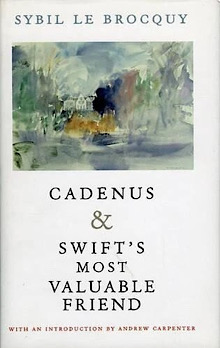
Her writings and work are often historically investigative, finding W. B. Yeats’s birthplace and arguing that Jonathan Swift had a child by Vanessa. She is involved in the Swift Tercentenary celebrations with Cearbhall Ó Dálaigh. As a result of her work, including with Trinity College Dublin Library and representing the Library on the Royal Irish Academy’s National Committee for Anglo-Irish Literature, she is co-opted to the Cultural Committee of the Department of External Affairs and appointed a Trustee of the National Library of Ireland. She is an excellent organiser and fundraiser and is heavily responsible for securing money for the Gate Theatre, Dublin, in 1970. She also initiates the literary prize, the Book of the Year award.
Le Brocquy becomes ill with an undiagnosed illness and dies on September 4, 1973, at the Meath Hospital, Dublin.
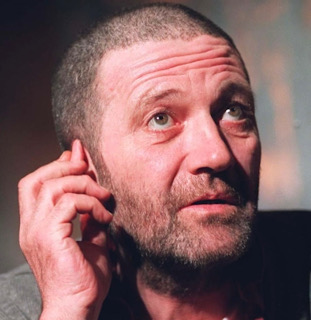
McCann’s career includes parts in many plays from the Irish literary canon, including Tarry Flynn, The Shaughran, and the Gate Theatre‘s highly acclaimed production of Seán O’Casey‘s classic Juno and the Paycock in the 1980s (McCann plays the “Paycock” (Captain Boyle) opposite Geraldine Plunkett as Juno and John Kavanagh as Joxer Daly) as well as a subsequent production of O’Casey’s The Plough and the Stars.
McCann develops a particularly fruitful relationship with the playwright Brian Friel. He plays the role of Gar O’Donnell, the public figure, in a film adaptation of Philadelphia, Here I Come! in 1970 and, despite popular belief, he never plays either public or private Gar on stage. He gives a landmark performance as Frank Hardy, the title character, in Faith Healer in 1980 (a role he reprised in 1994), continuing his relationship with Friel through productions of Translations (1988) and Wonderful Tennessee (1993).
Friel says that McCann’s work “contains extraordinary characteristics that go beyond acting … it is deeply spiritual.” Perhaps McCann’s most renowned role is as Thomas Dunne in Sebastian Barry‘s The Steward of Christendom. He wins the London Critics’ Circle Theatre Award (Drama Theatre) as best actor for this role in 1995. He reprises this role in a 1996 production at the Gate Theatre, Dublin and, following a twelve-week run at the Brooklyn Academy of Music in 1997, his “performance of unarguable greatness” (The New York Observer) had Newsweekhailing him as “a world-class star,” and The New York Times referring to this “astonishing Irish actor…widely regarded as the finest of them all.”
On the London stage, McCann plays in Prayer for My Daughter opposite Antony Sher (1978), and is Jean to Dame Helen Mirren‘s Julie in Miss Julie (1971). This is filmed for the BBC, and he much later plays Judge Brack with Fiona Shaw in the title role of Henrik Ibsen‘s Hedda Gabler, a production filmed for the BBC in 1993.
His best-known film role is as Gabriel Conroy in The Dead (1987), starring opposite Anjelica Huston and directed by her father, John Huston. Significant late roles include Bernardo Bertolucci‘s Stealing Beauty (1996) and in John Turturro‘s Illuminata (released in 1999, after McCann’s death).
McCann’s television work includes the featured role of Phineas Finn in the BBC’s serialised adaptation of Anthony Trollope‘s The Pallisers, Willie Burke in RTÉ‘s Prix Italia drama entry The Burke Enigma (1979) and Barney Mulhall in RTÉ’s Strumpet City (1980), as well as many one-off parts.
McCann plays in Bob Quinn‘s Irish language film Poitín (1979) and in Quinn’s somewhat experimental The Bishop’s Story (1995). After hearing that McCann is ill, Tom Collins asks Quinn to make a TV documentary about McCann for RTÉ called It Must Be Done Right (1999), after a remark by McCann on his craft. The film airs on RTÉ a week before McCann’s death.
In his private life, McCann is a quiet and unassuming man, but he battles both depression and alcoholism all his life. He has many friends in Irish theatre and artistic circles but also across all strata of life. His hobbies include sketching and he is passionate about horse racing.
Remembering McCann on the 25th anniversary of his death, Gerald Smyth writes, “In the melancholy of that life-worn voice could be heard the cadences of a lyric heart.”
Donal Donnelly, Irish theatre and film actor, is born to Irish parents in Bradford, West Yorkshire, England, on July 6, 1931. Perhaps best known for his work in the plays of Brian Friel, he has a long and varied career in film, on television and in the theatre. He lives in Ireland, the United Kingdom and the United States at various times, and his travels lead him to describe himself as “an itinerant Irish actor.”
Donnelly’s father, James, is a doctor from County Tyrone, and his mother, Nora O’Connor, is a teacher from County Kerry.
Donnelly gets his start in an amateur group calling itself the Globe Theatre Players. It is organised and run by Jim Fitzgerald and Monica Brophy. He then later tours with Anew McMaster‘s Irish repertory company before moving to England where he stars with Rita Tushingham in the film The Knack …and How to Get It.
For many years, Donnelly tours a one-man performance of the writings of George Bernard Shaw, adapted and directed by Michael Voysey and entitled My Astonishing Self.
On television, Donnelly plays the lead role of Matthew Browne in the 1970s ITV sitcom Yes, Honestly, opposite Liza Goddard. But from the late 1950s onwards, he often appears in such British TV programs as The Avengers, Z-Cars and The Wednesday Play.
In 1968, Donnelly records an album of Irish songs, Take the Name of Donnelly, which is arranged, produced and conducted by Tony Meehan formerly of the Shadows.
Donnelly, who is a heavy smoker all his life, dies from cancer at the age of 78 in Chicago, Illinois, on January 4, 2010. He is survived by his wife, Patricia ‘Patsy’ Porter, a former dancer he met working on Finian’s Rainbow, and two sons, Jonathan and Damian. Their only daughter, Maryanne, predeceases him after being killed in a riding accident. A brother, Michael Donnelly, is a Fianna Fáil senator and councillor, and Lord Mayor of Dublin(1990–91).
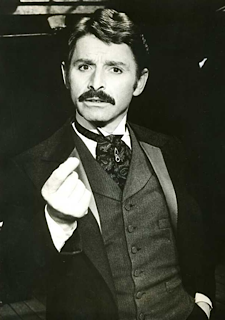
(Pictured: Publicity still of Donal Donnelly as Frederick Treves in the Broadway’s play TheElephant Man)
Davidson is the sixth of ten children of clerk of petty session, Edward Ellice Davidson, and Lucy Rising Davidson (née Doe). Her mother dies in 1888, and it is presumed that she receives a private education but as the family are not affluent, the details are unclear. She goes on to attend the Dublin Metropolitan School of Art (DMSA) from 1895 to 1905. While at the DMSA, she wins prizes in 1895 and 1896 and is awarded a scholarship and free studentship at the Royal Dublin Society (RDS) in 1897, the same year her father dies. She completes her studies in 1905. In the early 1910s, she is living in Rathmines and spends some time in England and Wales.
Davidson is commissioned by Switzer’s department store on Grafton Street to draw costumes in 1899. In 1909, her painting After Rain is exhibited by the Dublin Sketching Club, with her continuing to show work there until 1920. She exhibits The Bonfire with the Water Colour Society of Ireland in 1912, becoming a committee member in 1934 and continuing to exhibit with them until 1954. In 1914, she is one of the artists included in a sale of paintings to aid Belgian refugees. She is first exhibited at the Royal Hibernian Academy (RHA) in 1914, with The Student. Her painting exhibited by the RHA in 1916, The Harbour, St. Ives, demonstrates an influence from Stanhope Forbes and the Newlyn School, with a bright palette and contrasting illumination, which become characteristic of her work. She illustrates C. H. Bretherton’s collection of humorous poems and recollections about London Zoo, A Zoovenir (1919).
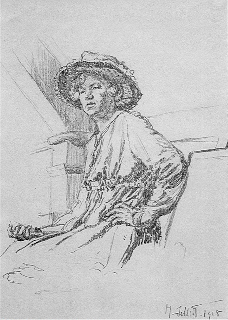
Davidson holds a joint exhibition with Mainie Jellett in 1920, at Mill’s Hall, Merrion Row, Dublin. Jellett produces a pencil portrait of Davison (pictured above), which shows her in a straw hat she frequently wears. The RHA exhibits Davidson’s oil painting, The Flax Pullers, in 1921. This work shows an influence from Paul Henry and French Impressionism in her use of colour-blocking. In the early 1920s, she travels to Switzerland, Belgium, and France, producing works such as Fish Market, Bruges. She lives in Paris in the late 1920s, exhibiting at the Salon de la Societé Nationale in 1924 and 1930. She places a self-portrait in her depiction of a peasant gathering, The Country Races. Reproductions of her drawing of Leinster House and Christ Church Cathedral by Bulmer Hobson are included in A Book of Dublin (1929). Her landscape, Low Tide, Wicklow, which is exhibited at the RHA in 1934, and Boats at Wicklow, Dusk show her ability to depict reflections in water. She continues to paint scenes of rural life, including Cottages – Keel, Achill, which shows an influence from Jack Butler Yeats in her use of space and colour. The fact that her family is not wealthy likely influences her choice of poorer people as her subjects, depicting them in a sympathetic manner. Her work is part of the painting event in the art competitions at the 1928 Summer Olympics.
Davidson’s paintings are exhibited at the Contemporary Picture Galleries, Dublin in 1930, alongside Yeats, Evie Hone, and Harry Kernoff. She is a member of the Picture Hire Club, 24 Molesworth Street, Dublin from 1941 to 1942, and is a frequent contributor to the Munster Fine Arts Club. Her work is exhibited at the Salon des Beaux Arts, Paris, the Royal Academy of Arts, London, and in Amsterdam. A large number of her works from the 1930s show the Irish-speaking area of Galway, Claddagh, such as Night in Claddagh, exhibited with the RHA in 1933. Her Irish landscapes, such as Claddagh Cottages, are included in the Oireachtas Art Exhibitions from 1932 to 1946. From around 1934, she is a member of the Society of Dublin Painters, exhibiting with them from 1939 to 1954. She influences the Society’s move toward the avant-garde in the 1940s. She is elected associate to the RHA in 1940 and continues to exhibit there until her death. Her 1946 work, Gorta, shows influence from Zola, Rilke, Dostoyevsky and Picasso.
Davidson teaches drawing at her studio at 1 Earlsfort Terrace, Dublin. Her pupils include Bea Orpen, Anne Yeats, and Mo Irwin. She also is a teacher at a number of Dublin schools, such as Belgrave school, Rathmines, Wesley College, St. Stephen’s Green, and Castle Park School, Dalkey. She travels to Abbeyleix, County Laois, once a week to teach at Glenbawn boarding school.
As well as painting, Davidson writes a number of plays, short stories, and monologues under a pseudonym, “Ulick Burke.” In 1927, a collection of her poems and Donegal rhymes is published. In 1931, Hilton Edwards directs her stage play Bride, at the Gate Theatre. Her short story, Her Only Son, is published in The Bell under a pseudonym in 1942. In 1935, she is a founder-member of the Torch Theatre, Dublin. She designs scenery, and is the co-director with Hugh Hyland in 1936, under the stage name “Jennifer Maude.”
Davidson dies at her home at 4 Wilton Terrace, Dublin on March 29, 1954. She is buried in an unmarked grave in Mount Jerome Cemetery. The National Gallery of Ireland (NGI) holds her 1938 portrait of Yeats, as well as her crayon drawing of Sarah Purser. She is a regular attendee at Purser’s “Second Tuesdays” gatherings. The Abbey Theatre holds her portrait of Joseph Holloway. She bequeaths The Golden Shawl to the Hugh Lane Gallery, which is a large self-portrait. Two of her works are included in the NGI’s 1987 exhibition, Irish Women Artists from the Eighteenth Century to the Present Day.
Bedford then mainly works in theatre in the United States, on both coasts, but mainly in New York City both on and off Broadway. He is in the premiere of Tennessee Williams‘s last play Small Craft Warnings at the New Theatre in New York in 1972. Other stage appearances include Brian Friel’s The Mundy Scheme in New York in 1969 and as John Adams in the nationwide tour of the musical 1776. He appears in over 200 stage productions throughout his career.
Bedford dies at the age of 67 on November 20, 1999, in Manhattan, New York City, of cancer six weeks after entering the hospital.
Chancellor is born at 8 Fitzwilliam Place, Dublin, on January 9, 1910. Her parents are John William Chancellor, a Dublin clockmaker, jeweler, and photographer, and Cicely Chancellor (née Granger). They marry in Billericay, Essex, in 1904. She has an elder sister, Joyce Fanny, who also becomes an actress. She attends Nightingale Hall and Alexandra College, going on to train as a secretary.
Chancellor’s first appearance on stage is as a fairy in a benefit performance at the Gaiety Theatre in 1914. She appears again at the Gaiety in 1922 as Gwennie in F. Anstey‘s The Man from Blankley’s, and then studies drama under Frank Fay. In the 1920s, she acts in the Dublin Drama League’s productions in the Abbey Theatre. Once she joins the Gate Theatre her career progresses, establishing her as one of the principal actresses in the Gate by the early 1930s.
Chancellor plays Naomi alongside Orson Welles in a production of Jud Süss in October 1931. Welles becomes infatuated with her and later describes her as “the sexiest thing that ever lived.” In 1931, she debuts in J. B. Fagan‘s production of The New Gossoon by George Shiels as Biddy Henley at the Apollo Theatre. Her most noted roles are as Toots in Youth’s the Season in 1932 by Mary Manning, Laura in a production of Carmilla in 1932, based on the Gothicnovella by Sheridan Le Fanu, Ophelia in 1932 and Cicely in The Importance of Being Earnest in 1933. Touring with the Gate company in 1935, she plays Stella in its production of Lord Longford‘s Yahoo performed in the Westminster Theatre, London. She stars with James Mason in the Gate’s production of Pride and Prejudice in 1937. Disappointed with the parts she is getting at the Gate after that and much to the annoyance of Micheál Mac Liammóir and Hilton Edwards, she joins Lord Longford’s first provincial tour in 1937.
In the late 1930s, Chancellor works more often in London. Following her appearance as Baby Furze in the 1938 production of Spring Meeting by Molly Keane and John Perry, she is nominated as “Star of the Future” by the Daily Mail. She acts alongside Alec Guinness and Peggy Ashcroft in 1940 in Clemence Dane‘s Cousin Muriel at the Globe Theatre, directed by John Gielgud.
Chancellor returns to the Gaiety Theatre in 1941 to act with Hilton Edwards in a production of Caesar and Cleopatra by George Bernard Shaw, a production that marks the 75th anniversary of the Gaiety. The press welcomes her return to the company, but her fellow actors are disturbed by the fact she is then living with Denis Johnston, the husband of fellow actress Shelah Richards. After Johnston’s divorce, they marry in March 1945 in Dungannon, County Tyrone. She partly retires from acting to raise their sons, but also due to her increasing deafness that had begun in her teens.
In 1969, Chancellor returns to Ireland with her family and settles in Dalkey, County Dublin. She dies in Dún Laoghaire on April 27, 1984, and is buried in the close of St. Patrick’s Cathedral, Dublin.
Mac Liammóir is born Alfred Willmore on October 25, 1899. He is born to a Protestant family living in the Kensal Green district of London.
As Alfred Willmore, he is one of the leading child actors on the English stage, in the company of Noël Coward. He appears for several seasons in Peter Pan. He studies painting at London’s Slade School of Fine Art, continuing to paint throughout his lifetime. In the 1920s he travels all over Europe. He is captivated by Irish culture and learns the Irish language which he speaks and writes fluently. He changes his name to an Irish version, presenting himself in Ireland as a descendant of Irish Catholics from Cork. Later in his life, he writes three autobiographies in Irish and translates them into English.
While acting in Ireland with the touring company of his brother-in-law Anew MacMaster, Mac Liammóir meets the man who becomes his partner and lover, Hilton Edwards. Their first meeting takes place in the Athenaeum, Enniscorthy, County Wexford. Deciding to remain in Dublin, where they live at Harcourt Terrace, the pair assists with the inaugural production of Galway‘s Irish language theatre, An Taibhdhearc. The play is Mac Liammóir’s version of the mythical story Diarmuid agus Gráinne, in which Mac Liammóir plays the lead role as Diarmuid.
Mac Liammóir and Edwards then throw themselves into their own venture, co-founding the Gate Theatre in Dublin in 1928. The Gate becomes a showcase for modern plays and design. Mac Liammóir’s set and costume designs are key elements of the Gate’s success. His many notable acting roles include Robert Emmet/The Speaker in Denis Johnston‘s The Old Lady Says “No!” and the title role in Hamlet.
In 1948, Mac Liammóir appears in the NBC television production of Great Catherine with Gertrude Lawrence. In 1951, during a break in the making of Othello, he produces Orson Welles‘s ghost-story Return to Glennascaul which is directed by Hilton Edwards. He plays Iago in Welles’s film version of Othello (1951). The following year, he goes on to play ‘Poor Tom’ in another Welles project, the TV film of King Lear (1953) for CBS.
Mac Liammóir claims when talking to Irish playwright Mary Manning, to have had a homosexual relationship with General Eoin O’Duffy, former Garda Síochána Commissioner and head of the paramilitary Blueshirts in Ireland, during the 1930s. The claim is revealed publicly by RTÉ in a documentary, The Odd Couple, broadcast in 1999. However, Mac Liammóir’s claims have not been substantiated.
Mac Liammóir’s life and artistic development are the subject of a major study by Tom Madden, The Making of an Artist. Edwards and Mac Liammóir are the subject of a biography, titled The Boys by Christopher Fitz-Simon.
Micheál Mac Liammóir dies at his and Edwards’s Dublin home, 4 Harcourt Terrace, at the age of 78 on March 6, 1978. Edwards and Mac Liammóir are buried alongside each other at St. Fintan’s Cemetery, Sutton, Dublin.
In 1990, Cusack, in the role of Masha, joins two of her sisters, Niamh (as Irina) and Sorcha (as Olga), and her father, Cyril Cusack (as Chebutykin) for a well-received production of Anton Chekhov‘s tragicomedy Three Sisters in a new version by Frank McGuinness, directed by Adrian Noble at the Gate Theatre, Dublin, before transferring to the Royal Court Theatre in London. The production also features Niamh’s husband, Finbar Lynch, as Solenyi and Lesley Manville as Natasha. The production wins the three real-life sisters the Irish Life Award in 1992.
One of Cusack’s best known stage roles is Our Lady of Sligo by Sebastian Barry in 1998, in which she plays the principal role of Mai O’Hara in performances in Ireland, on Broadway and at the National Theatre. For this she wins the 1998 Evening Standard Theatre Award for Best Actress, the 1998 Critics’ Circle Theatre Award for Best Actress and her fourth Olivier Award nomination for Best Actress. In 2006-07 she stars with Rufus Sewell in Tom Stoppard‘s Rock ‘n’ Roll at the Royal Court Theatre in London which transfers to the West End and Broadway, winning Cusack her fifth Olivier Award nomination and her second Tony Award nomination.
In 2015, Cusack returns to Ireland’s Abbey Theatre, where she begins her theatre career. She appears in the world première of Mark O’Rowe‘s play Our Few and Evil Days, acting opposite long-time collaborator Ciarán Hinds. She wins the Irish Times Irish Theatre Award for Best Actress.
Cusack stars with Peter Sellers in the film Hoffman (1970). She guest stars in an episode of The Persuaders! (1971), a TV series starring Tony Curtis and Roger Moore, as Jenny Lindley, a wealthy heiress who suspects that a man claiming to be her dead brother is in fact an impostor. In 1975, she makes three appearances in the TV series Quiller as the character Roz.
Further starring roles include lead roles in Oliver’s Travels (1995), Have Your Cake and Eat It (1997) for which Cusack wins the Royal Television Society‘s RTS Award for Best Actress and Frank McGuinness’s The Hen House (1989) for BBC Television. She stars in the title role of George du Maurier‘s Trilby (1976), in an adaptation for the BBC’s Play of the Month, with Alan Badel as Svengali. She also stars in the BBC mini-series North & South (2004, from the novel by Elizabeth Gaskell) as Mrs. Thornton. She stars in the BBC sitcom Home Again (2006) and appears in the TV series Camelot (2011), which runs for one season. She has featured roles in the mini-series The Deep (2014) and the series Marcella (2016), an eight-episode murder mystery.
Along with other actresses, including Paola Dionisotti, Fiona Shaw, Juliet Stevenson and Harriet Walter, Cusack contributes to a book by Carol Rutter called Clamorous Voices: Shakespeare’s Women Today (1994). The book analyses modern acting interpretations of female Shakespearean roles.
Cusack marries British actor Jeremy Irons in 1978, and they have two sons, Samuel James and Maximilian Paul. Prior to marrying Irons, she gives birth to a son in 1967 and places the boy for adoption. In 2007, a journalist for the Irish Sunday Independent, Daniel McConnell, reveals that Cusack is the mother of left-wing general election candidate and now member of Irish parliament Richard Boyd Barrett. The two have since been reunited.
Cusack is a patron of the Burma Campaign UK, the London-based group campaigning for human rights and democracy in Burma. In 1998, she is named, along with her husband, in a list of the biggest private financial donors to the British Labour Party. In August 2010, she signs the “Irish artists’ pledge to boycott Israel” initiated by the Palestine Solidarity Campaign.
(Pictured: Sinéad Cusack reciting poetry for the British Library in October 2021)
Donal Donnelly, Irish theatre and film actor, dies in Chicago, Illinois, on January 4, 2010. Perhaps best known for his work in the plays of Brian Friel, he has a long and varied career in film, on television and in the theatre. He lives in Ireland, the United Kingdom and the United States at various times, and his travels lead him to describe himself as “an itinerant Irish actor.”
Donnelly gets his start in an amateur group calling itself the Globe Theatre Players. It is organised and run by Jim Fitzgerald and Monica Brophy. He then later tours with Anew McMaster‘s Irish repertory company before moving to England where he stars with Rita Tushingham in the film The Knack …and How to Get It.
For many years, Donnelly tours a one-man performance of the writings of George Bernard Shaw, adapted and directed by Michael Voysey and entitled My Astonishing Self.
On television, Donnelly plays the lead role of Matthew Browne in the 1970s ITV sitcom Yes, Honestly, opposite Liza Goddard. But from the late 1950s onwards, he often appears in such British TV programs as The Avengers, Z-Cars and The Wednesday Play.
In 1968, Donnelly records an album of Irish songs, Take the Name of Donnelly, which is arranged, produced and conducted by Tony Meehan formerly of the Shadows.
Donnelly, who is a heavy smoker all his life, dies from cancer at the age of 78 in Chicago, Illinois, on January 4, 2010. He is survived by his wife, Patricia ‘Patsy’ Porter, a former dancer he met working on Finian’s Rainbow, and two sons, Jonathan and Damian. Their only daughter, Maryanne, predeceases him after being killed in a riding accident. A brother, Michael Donnelly, is a Fianna Fáil senator and councillor, and Lord Mayor of Dublin (1990–91).
Edwards is born in London on February 2, 1903. He begins his career acting with the Charles Doran Shakespeare Company in 1920 in Windsor and then joins The Old Vic in London, playing in all but two of Shakespeare‘s plays before leaving the company a few years later. Trained in music, he also sings baritone roles with the Old Vic Opera company.
After touring with various companies in Britain and South Africa, Edwards goes to Ireland in 1927 for a season with Anew McMaster‘s company and meets McMaster’s brother-in-law, Micheál Mac Liammóir. As he tells an interviewer once, both men want a theater of their own. Mac Liammóir wants it to be in Ireland and Edwards does not care. “I don’t care about nationalism, I care about the theater,” he says.
In New York City in 1948 Edwards plays in and directs John Bull’s Other Island and directs The Old Lady Says No and Where Stars Walk. In 1961, Edwards takes a two-year leave from the Gate to become the first Head of Drama at Telefís Éireann. A year later, he wins a Jacob’s Award for his television series Self Portrait.
Hilton Edwards dies in a Dublin hospital on November 18, 1982. Edwards and Mac Liammóir are the subject of a biography, titled The Boys by Christophor Fitz-Simon.



 seamus dubhghaill