seamus dubhghaill

Promoting Irish Culture and History from Little Rock, Arkansas, USA


Leave a comment

Birth of Letitia Marion Hamilton, Landscape Artist

Letitia Marion Hamilton, Irish landscape artist and Olympic bronze medalist, is born on July 30, 1878, in Hamwood House, County Meath.

Hamilton is the daughter of Charles Robert Hamilton and Louisa Caroline Elizabeth Brooke. She attends Alexandra College. She and her sister Eva are great-granddaughters of the artist Marianne-Caroline Hamilton, and cousins of watercolourist Rose Maynard Barton. The sisters’ father can only afford one dowry, so the sisters remain unmarried, with their artistic careers helping to support the household. Both she and her sister study at the Dublin Metropolitan School of Art under William Orpen. She studies enameling there also, winning a silver medal in 1912 by both the School and the Board of Education National Commission. Her work shows elements of Art Nouveau, foreshadowing her later modernist leanings. She also studies in Belgium with Frank Brangwyn and the Slade School of Fine Art.

Hamilton first exhibits in 1902 and goes go on to become a prolific painter of the Irish countryside, exhibiting more than 200 paintings at the Royal Hibernian Academy (RHA). Both sisters travel widely in Europe, with Letitia being influenced by modern European artistic trends of the early 20th-century. She is internationally exhibited, Royal Academy of Arts, Burlington Gallery and Kensington Art Gallery in London, in Scotland, and Paris. Her exposure to impressionism comes from studying with Anne St. John Partridge in France. Her style matures in the 1920s. That year, she is one of the founding members of the Society of Dublin Painters, along with Paul Henry, Grace Henry, Mary Swanzy, and Jack Butler Yeats. It is around this time that she changes her signature from MH (May Hamilton) to LMH, reflecting her full name. She works on small oil sketches, which later develop into finished works. Her style is rapid, with loose, fluid brush strokes. In the early 1920s, she travels to Venice, painting on a gondola studio loaned to her by artist and friend Ada Longfield. The works from this trip are considered among her best, with her exploring light effects, pastel shades, and strong outlines. She later employs these elements into her works on Irish landscapes.

Hamilton becomes a member of the Royal Hibernian Academy in 1943. In 1948, she becomes the last person to win a bronze medal at the art competitions at the London Olympic Games. She serves as president of the Society of Dublin Painters in the late 1950s. Despite her failing eyesight later in life, she continues to paint, mounting her final exhibition in 1963, a year before her death at the age of 86 in Dublin on August 11, 1964. She is also a committee member of the Water Colour Society of Ireland.

Examples of Hamilton’s work are held in a number of collections, including Hugh Lane Gallery, Limerick City Gallery of Art, Crawford Art Gallery, Ulster Museum, National Gallery of Ireland, and Waterford Art Gallery. Her painting Canal Scene in Venice attains the highest price for a Hamilton work in 2004, which sells at Sotheby’s in London, for £33,600.

(Pictured: “Slieve Donard, Co. Down” by Letitia Marion Hamilton, oil on canvas, signed with monogram lower left)


Leave a comment

Death of Andrew O’Connor, American Irish Sculptor

Andrew O’Connor, American Irish sculptor whose work is represented in museums in the United States, Ireland, Britain and France, dies in Dublin on June 9, 1941.

O’Connor is born on June 7, 1874, at Worcester, Massachusetts, the eldest of three sons and two daughters of Andrew O’Connor, a stonecutter from Lanarkshire, Scotland, who becomes a professional sculptor, and Marie Anne O’Connor (née McFadden), of County Antrim. Educated in Worcester public schools, at the age of 14 he becomes apprenticed to his father, helping him to design monuments for cemeteries. He is employed in the early 1890s on sculptural work for the World’s Columbian Exposition (Chicago World’s Fair), being active in the studio of William Ordway Partridge, and assisting Daniel Chester French on his colossal Statue of the Republic, a landmark of the 1893 Columbian exposition.

Moving to London (1894–98), O’Connor works on bas-reliefs in the studio of the painter John Singer Sargent, who uses him as a model for his mural Frieze of Prophets for the Boston Public Library. His first independent work, Sea Dreams, a relief of a head, is exhibited at the Royal Academy of Arts in 1896. Returning to the United States (1898–1903), he becomes a studio assistant of French, through whom he receives his first public commission, for the Vanderbilt Memorial Doors for St. Bartholomew’s Episcopal Church, Manhattan, New York, a project completed in 1902 to wide critical acclaim. He also executes the tympanum and lateral friezes.

Around 1900, O’Connor marries an artist’s model named Nora, by whom he has a daughter. In 1902, he hires as studio model Jessie Phoebe Brown from New Jersey and of County Down parentage. The following year he elopes with her to Paris, where they marry and have four sons, the youngest of whom, Patrick O’Connor, becomes an artist and gallery curator. Jessie continues for many years as his primary model, sitting for the heads of both female and male figures, O’Connor coarsening the features for the latter.

During his years in Paris (1903–14), O’Connor is influenced by the work of Auguste Rodin, whom he befriends. Among his pupils in Paris is the American sculptor and heiress Gloria Vanderbilt Whitney. He continues to fulfil numerous commissions for funerary and public monuments in the United States, an example of the former being the Recuillement in Sleepy Hollow Cemetery, near Tarrytown, New York. From 1906 he exhibits annually at the Salon in Paris, where he is the first foreigner to win a second-class medal, for his bronze statue of Gen. Henry Lawton. Included in his only exhibition at the Royal Hibernian Academy (1907) is a bronze relief of the prophet Nehemiah adapted from a panel of the Vanderbilt doors. The relief is subsequently included in his one-man show at the Galerie Hébrard, Paris in 1909.

In 1909, O’Connor wins a competition open to sculptors of Irish descent to execute a monument to Commodore John Barry, the County Wexford-born “father of the American navy,” for Washington, D.C. His design includes a frieze depicting events in Irish history, flanked by a group of three nude Irish emigrants entitled Exile from Ireland, and another group representing the Genius of Ireland, which includes a female figure of the “Motherland.” Probably owing to opposition from the Barry family to the depiction of their ancestor as a rough-and-ready sailor, the commission is not completed. His marble statue of Gen. Lew Wallace (author of Ben-Hur: A Tale of the Christ), a plaster of which is exhibited at the Salon in Paris in 1909, is placed by the state of Indiana in the National Statuary Hall in the United States Capitol, Washington, D.C. Another marble, Peace by Justice, is commissioned as a gift from the United States to the Peace Palace in The Hague in 1913.

O’Connor returns with his family to the United States on the outbreak of World War I, and sets up a studio in Paxton, Massachusetts. In 1918, his standing statue of the youthful Abraham Lincoln is placed outside the Illinois State Capitol at Springfield, Illinois. He later presents a marble head of Lincoln to the American ambassador’s residence, Phoenix Park, Dublin. His memorial in Chicago to President Theodore Roosevelt (1919) is commissioned as a tribute to Roosevelt’s associations with the Boy Scouts of America. The design of four standing scouts, modelled on O’Connor’s sons, is exhibited at the Philadelphia Art Alliance in 1920. He becomes an associate of the National Academy of Design, New York in 1919. In the early 1920s he executes an equestrian statue of the Marquis de Lafayette for South Park, at Mount Vernon, Baltimore, Maryland.

Returning to Paris in the mid-1920s, O’Connor becomes the first foreigner to win a gold medal at the Salon des Artistes in 1928, for the marble sculpture Tristan and Iseult, now held in the Brooklyn Museum, New York. The French government makes him a Chevalier of the National Order of the Legion of Honour in 1929. In 1926 he had exhibited a plaster group, Monument aux morts de la Grande Guerre, at the Salon in Paris. The sculpture is requested in 1932 by the people of Dún Laoghaire, County Dublin, as a memorial to Christ the King, O’Connor obligingly altering the interpretation of his iconography. Imposed on a “Tree of life” are three figures of Christ, representing in turn “Desolation,” “Consolation” and “Triumph.” Cast in bronze, throughout World War II the statue remains hidden in Paris to avoid its being melted down for the valuable metal. Transported to Dún Laoghaire in 1949, due to clerical opposition to its unconventional iconography, it is not at first erected, but for years lay on its side in a garden in Rochestown Avenue until its eventual unveiling in 1978 as Triple Cross in Haigh Terrace, where it stands in Moran Park. His other chief work in Ireland is a bronze statue of Daniel O’Connell in the Bank of Ireland, College Green, Dublin. Inspired by Rodin’s famous Monument to Balzac, the work is executed at his studio in a converted stable at Leixlip Castle, County Kildare in 1931–32.

During the 1930s, O’Connor lives and works in London and Ireland, where he has residences at Glencullen House, County Wicklow, and 77 Merrion Square, Dublin. He dies at the latter address on June 9, 1941, and is buried in Glasnevin Cemetery. His own bronze relief, Le feu sacré, marks the grave. A portrait painting, executed by his son Patrick in 1940, is in Dublin City Gallery The Hugh Lane, which also holds twenty-six sculptures presented by O’Connor late in his life, and posthumously by his family. The collection includes a marble self-portrait bust of 1940, a bronze of the Lafayette cast by the gallery in 1984 from a reduced plaster model presented by the artist, and a bronze group entitled The Victim, on view in Merrion Square Park, from an uncommissioned and uncompleted war memorial conceived by O’Connor under the general title Le Débarquement. The National Gallery of Ireland has the Desolation maquette for the Triple Cross. A centenary exhibition of his work is held at Trinity College Dublin in 1974. His widow dies in Dublin in 1974.

(From: “O’Connor, Andrew” by Lawrence William White and Carmel Doyle, Dictionary of Irish Biography, http://www.dib.ie, October 2009)


Leave a comment

Death of Harry Clarke, Stained-Glass Artist & Illustrator

Henry Patrick (Harry) Clarke, Irish stained-glass artist and book illustrator, dies on January 6, 1931, in Chur, Switzerland. He is a leading figure in the Irish Arts and Crafts movement.

Clarke is born in Dublin on March 17, 1889, the younger son and third child of Joshua Clarke and Brigid Clarke (née MacGonigal). Church decorator Joshua Clarke moves to Dublin from Leeds, West Yorkshire, England, in 1877 and starts a decorating business, Joshua Clarke & Sons, which later incorporates a stained-glass division. Through his work with his father, Clarke is exposed to many schools of art but Art Nouveau in particular.

Clarke is educated at the Model School in Marlborough Street, Dublin, and Belvedere College, which he leaves in 1905. After his mother’s death in 1903, he is apprenticed into his father’s studio and attends evening classes in the Metropolitan College of Art and Design. His The Consecration of St. Mel, Bishop of Longford, by St. Patrick wins the gold medal for stained-glass work in the 1910 Board of Education National Competition. At the art school in Dublin, he meets fellow artist and teacher Margaret Crilley. They marry on October 31, 1914.

Clarke moves to London to seek work as a book illustrator. Picked up by London publisher George G. Harrap and Co., he starts with two commissions which are never completed. Difficulties with these projects makes Fairy Tales by Hans Christian Andersen his first printed work, in 1916. It includes 16 colour plates and more than 24 halftone illustrations. This is followed by illustrations for an edition of Edgar Allan Poe‘s Tales of Mystery and Imagination, the second version of which, published in 1923, makes his reputation as a book illustrator. His work can be compared to that of Aubrey Beardsley, Kay Nielsen, and Edmund Dulac. His final book, Selected Poems of Algernon Charles Swinburne, is published in 1928.

Clarke also continues to work in stained-glass, producing more than 130 windows. His glass is distinguished by the finesse of its drawing and his use of rich colours. He is especially fond of deep blues. His use of heavy lines in his black-and-white book illustrations echoes his glass techniques.

Clarke’s stained-glass work includes many religious windows, including the windows of the Honan Chapel in University College Cork. He also produces much secular stained-glass such as a window illustrating John KeatsThe Eve of St. Agnes (now in the Hugh Lane Gallery in Dublin) and the Geneva Window, (now in the Wolfsonian Museum, Miami Beach, Florida). Perhaps his most seen works are the windows he creates for Bewley’s on Dublin’s Grafton Street.

Clarke is plagued with ill health, in particular respiratory problems. He is diagnosed with tuberculosis in 1929 and goes to a sanatorium in Davos, Switzerland. Fearing that he will die abroad, he begins his journey back to Dublin in 1931, but dies on this journey on January 6, 1931, in Chur where he is buried. A headstone is erected but local law requires that the family pledge to maintain the grave 15 years after the death. This is not explained to the Clarke family and Harry Clarke’s remains are disinterred in 1946 and reburied in a communal grave.


Leave a comment

Death of Margaret Clarke, Portrait Painter

Margaret Clarke RHA (née Crilley), Irish portrait painter, dies in Dublin on October 31, 1961.

Crilley is born in Newry, County Down, (present-day Northern Ireland), on August 1, 1884, one of six children of Patrick Crilley. Her date of birth is often given as July 29, 1888, though local records do not support this, suggesting she is born four years earlier. Having initially trained at Newry technical school with her sister Mary, intending to become a teacher, in 1905, she wins a scholarship to attend the Dublin Metropolitan School of Art. There she studies under William Orpen, who regards her as one of his most promising students. She completes her studies in 1911 attaining an Art Teacher’s Certificate and begins working as Orpen’s assistant.

In 1914, Crilley marries her fellow student Harry Clarke, much to the surprise of their family and acquaintances. The couple moves into a flat at 33 North Frederick Street. They have three children, Michael, David and Ann. Harry’s brother, Walter, marries Margaret’s sister, Mary, in 1915.

Clarke first exhibits with the Royal Hibernian Academy in 1913 and goes on to exhibit over 60 artworks in the forty years until 1953, the majority being portraits. Among the portrait commissions she receives are ones for Dermod O’Brien, President Éamon de Valera, Archbishop John Charles McQuaid, and Lennox Robinson. She spends a great deal of time on the Aran Islands with fellow artist Seán Keating and her husband, from which she produces a number of landscapes and smaller studies.

Clarke becomes the director of the Harry Clarke Stained Glass Studios following the death of her husband in 1931.

A critic notes in 1939 that Clarke produces “remarkable drawings in which individuality is caught in a few swift economical lines.” Over her lifetime she wins many awards including the Tailteann gold, silver and bronze medals in 1924, and another Tailteann bronze in both 1928 and 1932. She is elected an Associate of the Royal Hibernian Academy (ARHA) in 1926, and a full RHA member in 1927. Upon the founding of the Irish Exhibition of Living Art in 1943, she is appointed a member of the executive committee.

Clarke dies in Dublin on 31 October 31, 1961, and is buried in the Redford Cemetery, Greystones, County Wicklow. She is commemorated with a blue plaque at her birthplace in Newry.

Clarke’s work can be found in the collections of the National Gallery of Ireland, the Hugh Lane Gallery, the Crawford Art Gallery, the Ulster Museum, Limerick City Gallery of Art, The National Self-Portrait Collection of Ireland, and the Pontifical Irish College in Rome.

The exhibition at National Gallery of Ireland in 2017 reevaluates Margaret Clarke’s great artistic reputation.

(Pictured: “Self-portrait,” 1914, by Margaret Clarke, © Artist’s Estate)


Leave a comment

Birth of Gordon Lambert, Businessman, Senator & Art Collector

Charles Gordon Lambert, Irish businessman, senator and art collector, is born on April 9, 1919, in the family home at Highfield Road, Rathmines, Dublin, the youngest of four sons of Robert James Hamilton Lambert, a veterinarian and renowned cricketer, and his wife Nora (née Mitchell). His eldest brother, Noel Hamilton “Ham” Lambert, is a versatile sportsman and noted veterinary practitioner.

Lambert is educated at Sandford Park School, Dublin, and at Rossall School, Lancashire. He is steered by his mother toward a career in accountancy for which he prepares by studying commerce at Trinity College Dublin (TCD). Graduating in 1940, he joins the accounting firm Stokes Brothers and Pim, qualifying Associate Chartered Accountant in 1943. In 1944, after auditing biscuit manufacturers W. & R. Jacob and Co. Ltd, one of Ireland’s largest and most prestigious industrial companies, he is offered and accepts a £300 a year job at Jacob’s as assistant accountant.

In 1953, Lambert becomes Jacob’s chief accountant as the management grooms him for an executive career. During 1948–56, Jacob’s suffers from profit and price controls, lack of capital investment and complacency brought about by the absence of competition. The entry of Boland’s Bakery into the Irish biscuit market in 1957 is exploited by Lambert who urges the alarmed board, which has long regarded advertising as vulgar, to market its products more vigorously. This assertiveness yields his advancement to the position of commercial manager in 1958. A year later he becomes the first non-member of the Bewley and Jacob families to be appointed to the board.

Between 1959 and 1970, biscuit consumption in Ireland doubles for which Lambert can claim much credit. Recognising that the advent of self-service stores means that manufacturers can no longer rely on retailers to sell their products, he pioneers advanced promotional techniques in Ireland, particularly the use of marketing surveys and of mass advertising in newspapers, on radio and on the emerging medium of television. To further accord with retailers’ preferences, Jacob’s drives the widespread packaging of biscuits in airtight packets rather than tins, and also introduces a striking red flash logo for its packets. His interest in contemporary art enables him to contribute directly to Jacob’s packaging designs.

Lambert is appointed to the board of the Electricity Supply Board (ESB) in 1964, a position he holds until 1977, and serves as president of the National Agricultural and Industrial Development Association (NAIDA) in 1964–65, spearheading a “Buy Irish” campaign. His involvement with NAIDA dates to the mid-1950s and leads to his friendship with Jack Lynch, Minister for Industry and Commerce. This relationship and his admiration for Seán Lemass incline him toward Fianna Fáil. He also believes the party is the one most likely to deliver economic growth.

In 1977, Lambert is appointed to Seanad Éireann by Taoiseach Jack Lynch. He sits as an independent but assures Lynch he will broadly support the government. Dismayed by Ireland’s economic uncompetitiveness, he uses this platform to bemoan the state’s financial profligacy and failure to control inflation, and the indifference of Irish politicians towards the business community, contending that Irish industrialists suffer and need to learn from the expert lobbying of the indigenous agricultural sector and of large multi-national companies based in Ireland. He also articulates his social liberalism, desire for peaceful reconciliation in Northern Ireland and support for cultural and environmental causes. But his commitment to the Seanad wanes as he grasps its irrelevance. When Lynch resigns in December 1979, Lambert joins the Fianna Fáil party in a futile bid to preserve his political influence.

Following Jacob’s takeover of Boland’s Bakery in 1966, Lambert becomes joint managing director of a new entity, Irish Biscuits Ltd, the manufacturing and trading company for the Boland’s and Jacob’s biscuits operations. W. & R. Jacob and Co. Ltd becomes a holding company. In 1968, he becomes the sole managing director. From 1977 he begins withdrawing from the active administration of the company, relinquishing his managing directorship in 1979 to become chairman.

Initially, Lambert views art as a hobby but he comes to see it as a calling, drawing inspiration from Sir William Basil Goulding, his predecessor as Ireland’s leading collector and advocate of modern art. From the late 1970s he serves as head of the Contemporary Irish Art Society (CIAS) and on the Arts Council of Northern Ireland, the advisory committee of the Dublin Municipal Gallery, the board of the National Gallery of Ireland, the editorial board of the Irish Arts Review and the international council of the Museum of Modern Art (MoMA) in New York City.

The Irish Museum of Modern Art (IMMA) opens in 1991 and receives through the medium of the Gordon Lambert Trust some 212 works, which form the centerpiece of its collection. Thereafter Lambert gifts another 100 works to IMMA. He sits on IMMA’s board from 1991, and the west wing of the museum is named after him in 1999.

Despite being diagnosed with Parkinson’s disease in 1988, Lambert remains relatively active and plays golf into his 80s. In 1999 he receives an honorary LLD from TCD. From 1997, he relies increasingly on Anthony Lyons, an acquaintance of longstanding, to care for him. His last years are overshadowed by the collapse in autumn 2002 of his close but complex relationship with his family. Thereafter he shuns his relations and changes his will, granting Lyons a substantial portion of his estate while curtailing the amount to be received by his family. He dies in a Dublin hospital on January 27, 2005. Relatives challenge his final will in the High Court in 2009 but it is upheld.

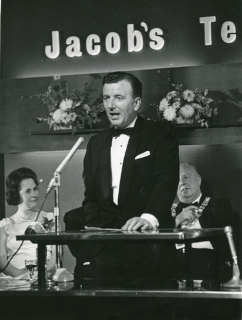
(Pictured: Photograph of director of Jacob’s Biscuits, Gordon Lambert, speaking from a podium at the first Jacob’s Television Awards. The Lord Mayor of Dublin, James O’Keefe, is sitting behind Lambert. The awards ceremony takes place at the Bishop Street factory, Dublin.)


Leave a comment

Birth of Clare Marsh, Still Life & Portrait Artist

Clare Marsh, still life and portrait artist, is born Emily Cecil Clare Marsh on January 13, 1875, at New Court, Bray, County Wicklow, the house of her maternal grandfather, Andrew McCullagh, a wine merchant.

Marsh’s parents are Arthur and Rachel Marsh (née McCullagh). She has four siblings. Her family is descended from the Anglo-Irish aristocracy, specifically from Francis Marsh of Edgeworth, Gloucestershire, with his wife the great-aunt of James II‘s first wife. The family later moves to Raheen, Clondalkin, and later to Cappaghmore, Clondalkin. There is little information about her early life although she is involved in the suffrage movement.

Marsh meets Mary Swanzy at Mary Manning‘s art classes, with Swanzy remembering Marsh as being from “a background of impecuniosity, which did not apparently worry them in spite of a more affluent upbringing.” She is influenced artistically by her aunt and John Butler Yeats, with whom she becomes close friends. In the summer of 1898, Yeats paints Marsh’s portrait at Manning’s studio. She is more drawn to the work of Yeats than of his son, Jack, and models her portraits on that of the older Yeats. He mentors her, encouraging her to see other artists’ work as much as possible and saying, “to produce a picture will force you to think.” He urges her to paint more industriously. She exhibits with the Royal Hibernian Academy (RHA) for the first time in 1900 with East wind effect and Roses. Yeats later claims that Marsh helped him with “line drawing or sketching, by putting him on the track of bulk drawing.”

Alongside Manning’s classes, Marsh takes night classes in sculpture with John Hughes and Oliver Sheppard at the Metropolitan School of Art. Aside from a trip to Paris in 1910 or 1911, she is taught exclusively in Dublin throughout her 20s. She takes a course at Norman Garstin‘s studio in Penzance, and stays in North Wales in 1914, painting two Trearddur Bay scenes. She paints still life and portraits, including one of Lily Yeats. It appears that her portraits of children and dogs are popular based on her submitted works to the RHA, exhibiting without a break from 1900 to 1921. The Hugh Lane Gallery holds her portrait of Lord Ashbourne, which demonstrates her painting style of loose brush strokes with an air of informality. Yeats suggests that she spend some time in the United States, where he is living at the time. She spends two months in New York City, staying with cousins at White Plains and then moves into a room neighbouring that of Yeats in Petitpas. Her uncle strongly disproves of this living arrangement, so she leaves and returns to Ireland in January 1912, which upsets Yeats greatly.

Upon her return from New York, Marsh starts holding classes at her studio at South Anne Street which Swanzy recalls are “well liked and always full,” with Susan Yeats becoming a pupil. She becomes the Professor of Fine Arts at Alexandra College in 1916. In the same year, she paints the fires and destruction of the 1916 Easter Rising. She paints a portrait of Jack Butler Yeats in 1918, which is now held by the Highlanes Gallery. John Butler Yeats later sympathises with her in a letter that she and other women are not elected members of the RHA. Knowing that Yeats is in financial difficulty, she sells some of his drawings and sends the money to him. It appears that over time, she works more with colour, as demonstrated in her portrait of Susan Yeats. Her final paintings are night studies, some of which show a possible influence from Swanzy with whom she shares a studio in the autumn of 1920. She is also believed to be one of the founding members of the Society of Dublin Painters.

Marsh dies on May 5, 1923. A posthumous exhibition of her work is held in October 1923. Due to her early death, she largely falls into obscurity until one of her works is included in the 1987 “Irish Women Artists from the Eighteenth Century to the Present Day” exhibition and publication from the National Gallery of Ireland. The National Gallery of Ireland holds a selection of sketches and paintings by Marsh, and a sketch of her by Swanzy. She is included in an exhibition of art by women artists at the Highlanes Gallery in 2012.

(Pictured: “Self-Portrait” by Clare Marsh, oil on canvas, circa 1900, National Gallery of Ireland)


Leave a comment

Gorbachev Samples Pint of Guinness During Ireland Visit

Former Soviet leader Mikhail Gorbachev samples a pint of Guinness with Lord Mayor of Dublin Michael Mulcahy in the famous Doheny & Nesbitt pub in Baggot Street, Dublin, on Tuesday, January 8, 2002.

Gorbachev arrives in Dublin earlier in the day for a two-day visit to the Republic of Ireland. He attends a series of events in Dublin where he meets the President of Ireland, Mary McAleese, and is granted the Freedom of the City of Dublin.

Gorbachev, the man who led Russia through the most difficult days of his country’s shift to democracy, is also conferred with an honorary degree. On his arrival he goes to Trinity College Dublin to receive the honour before launching the new European Russian Trust. He later dines as a guest of the Irish Government in Dublin Castle.

On the following day, Gorbachev is accompanied by Dublin’s Lord Mayor Michael Mulcahy during a visit to see members of the city’s Russian community at the Hugh Lane Gallery. He also chats with local shop owners and residents during an informal tour of The Liberties area. After addressing the Institute of European Affairs and lunching with President McAleese at Áras an Uachtaráin, the president’s official residence and principal workplace, he is granted freedom of the Irish capital at a special ceremony.

Following his visit with President McAleese, Gorbachev jokes with Mulcahy that he fully intends to exercise his right to graze sheep in the city. Mulcahy says, “This visit will help to cement relations between us, as well as doing appropriate honour to a genuinely great man whose place in history is already secure.”

Gorbachev formally announced his resignation as Soviet President and Commander-in-Chief on December 25, 1991. The following day, the Soviet of the Republics, the upper house of the Supreme Soviet of the Soviet Union, formally voted the Soviet Union out of existence. The Soviet Union officially ceased to exist at midnight on December 31, 1991. As of that date, all Soviet institutions that had not been taken over by Russia ceased to function.

(Pictured: Mikhail Gorbachev samples a pint of Guinness watched by Dublin’s Lord Mayor Michael Mulcahy, in Doheny & Nesbitt’s pub in Merrion Row. Picture by Donal Doherty)


Leave a comment

Death of Irish Sculptor Oliver Sheppard

Oliver Sheppard RHA, Irish sculptor most famous for his 1911 bronze statue of the mythical Cuchulain dying in battle, dies at Knockranny, County Cavan, on September 14, 1941. His work was also part of the art competitions at the 1924 Summer Olympics in Paris and the 1928 Summer Olympics in Amsterdam.

Sheppard is born at Old Town, Cookstown, County Tyrone, on April 10, 1865, to Simpson Sheppard, a sculptor, and Ellen White, of Ormond Quay, Dublin. His main influence is the Frenchman Édouard Lantéri who teaches him at the Royal College of Art in London, and then at the Dublin Metropolitan School of Art (DMSA) in Dublin, now the National College of Art and Design (NCAD), where he later becomes a lecturer.

Sheppard is based in Dublin for almost all of his life, having traveled widely across Europe. His wife Rosie dies in 1931, with whom he has several children. They live at Howth and 30 Pembroke Road in central Dublin.

From 1902 to 1937 Sheppard teaches sculpture at the Dublin Metropolitan School of Art. His annual stipend is £250 but for this he only has to lecture three mornings a week, allowing him plenty of time for work on commissioned projects. One of his most famous students is the sculptor, Kathleen Cox.

The Dying Cuchulain is considered Sheppard’s masterpiece and an important work of Irish art. It is a bronze figure of the mythological warrior-hero Cuchulain, who continued to fight against his enemies while gravely wounded and tied to a tree. It is created in 1911 and later chosen by Éamon de Valera in 1935 as the national memorial to the 1916 Easter Rising. It can still be viewed today in the General Post Office (GPO), O’Connell Street, Dublin.

As a prominent sculptor Sheppard is a member of the Royal Hibernian Academy, the Royal Dublin Society, and is made a governor of the National Gallery of Ireland from 1925–41. He also exhibits works at European exhibitions during his lifetime, occasionally winning prizes.

Sheppard is generally critical of the low standards of sculpture in Ireland: “For the last sixty years or so thousands of figures and groups have been executed in Dublin for ecclesiastical purposes, and, with one or two exceptions … was not up to a reasonable standard. The making of a work of art hardly entered into it at all. The sculptor, well trained and properly encouraged, should collaborate with the architect.”

Sheppard is in the minority of Irish Protestants who support independence, starting with support for the Irish Parliamentary Party in the 1880s, when he is an art student.

In 1890–1910 Sheppard is a part of the Celtic Revival movement, and, from his works such as Inis Fáil, is admired by his student William Pearse. Through him he meets his brother Patrick Pearse who later helps launch the Easter Rising in 1916. While most of the Revival’s artists are writers, playwrights and poets, Sheppard can claim to be the main sculptor working on themes similar to theirs.

After the Irish War of Independence (1919–21) Sheppard says, “They thought me too old to fight but I have tried to help in other ways. My politics are simple. I have always thought that this country should be a free country.” His opinions are not overly dogmatic, considering his work on the war memorials in 1920.

In the mid-1920s the first series of Irish Free State coinage is planned and is finally launched in 1928. Sheppard is one of the designers short-listed but his designs are not accepted.

After his retirement in 1937 from the National College of Art, the now renamed Dublin Metropolitan School of Art, he is appointed in 1938 by the Minister for Education to the College’s standing committee. He is also made a judge in the Royal Dublin Society art competition in 1939 and 1940.

Sheppard dies on September 14, 1941, in Dublin and is buried at Old St. Fintan’s Cemetery, Sutton, Dublin. There is a small retrospective exhibition of fourteen of his works at the Royal Hibernian Academy (RHA) in 1942. There are portraits of Sheppard by George William Russell (Dublin City Gallery The Hugh Lane) and Sir William Orpen (NGI), and photographic portraits in the Sheppard collection, National Irish Visual Arts Library (NIVAL) at the National College of Art and Design, Dublin, where his papers are located.


Leave a comment

Birth of George Campbell, Artist & Writer

George Campbell, Irish artist and writer, is born on July 29, 1917, in Arklow, County Wicklow. Although he grows up in Belfast, Northern Ireland, he spends much of his adult life living and painting in Spain and Dublin.

Campbell is the son of Matthew Arthur Campbell (1866-1925), caterer, and Gretta Campbell (née Bowen) (1880-1981). He attends boarding school at Masonic Orphan Boys’ School at Clonskeagh, Dublin, before moving to Belfast to live with his widowed mother and family.

Campbell is working in an aircraft factory at the time of the Belfast Blitz, and begins to paint, taking the bomb-damage as his subject. He is one of the founders of the Irish Exhibition of Living Art in 1943. In the same year, along with his brother Arthur (1909-94), he publishes a sixteen page book entitled Ulster in Black and White, that includes drawings from the two brothers and their close contemporaries Maurice Wilks and Patricia Webb. Owing to the success of the original publication, the brothers then publish Now in Ulster (1944), an anthology of short stories, essays and poetry by young Belfast writers.

Campbell holds a joint exhibition at the William Mol Gallery, Belfast, with his brother Arthur in 1944. In the same year he also shows with Gerard Dillon at the Portadown gallery of John Lamb. In 1946 he shows with the Victor Waddington Gallery in Dublin, where he is to return on a number of occasions. The Council for the Encouragement of Art and Music hosts a solo exhibition in 1949 where he is to show twice more, in 1952 and 1960. He wins £500 at the first Council for the Encouragement of Music and the Arts (CEMA) Open Painting Competition at the Ulster Museum in 1962. Campbell also shows in one-man exhibitions with the Arts Council of Northern Ireland in 1966 and 1972.

After the war Campbell becomes increasingly interested in Spain. In 1946 he comes to know Spaniards who had settled in Dublin, and when in London paints visiting Spanish dancers in their traditional costume. He first visits Spain in 1951, encouraged by his friendship with Gerard Dillon and “an interest in bohemian characters.” He lives there for six months almost every year throughout much of the following twenty-five years.

Campbell makes stained glass windows for the Cathedral of Our Lady Assumed into Heaven and St Nicholas in Galway. He also plays flamenco guitar. A member of the Royal Hibernian Academy, he wins the Douglas Hyde Gold Medal in 1966 and the Oireachtas Prize for Landscape in 1969. The Spanish government makes him a Knight Commander of Spain in 1978.

Campbell dies in Dublin on May 18, 1979, and is buried at St. Kevin’s Cemetery in Glendalough, County Wicklow. He is survived by his wife Margaret, his mother, and two brothers, Arthur and Stanley. After his death the Arts Council of Northern Ireland and An Chomhairle Ealáion join with the Instituto Cervantes to initiate the George Campbell Memorial Travel Award. In May 2017, Arklow Municipal District Council unveils two plaques at St. Patrick’s Terrace, Arklow, marking Campbell’s birthplace and the centennial of his birth.

Campbell’s work forms part of many private and public art collections, including Queen’s University Belfast, Ulster Museum, Irish Museum of Modern Art, Hugh Lane Gallery, The National Self-Portrait Collection of Ireland, and Municipal Museum of Antequera, Málaga.

(Pictured: “Three Nuns” by George Campbell)


Leave a comment

Death of Nelly O’Brien, Miniaturist, Artist & Activist

Ellen Lucy or Nelly O’Brien, Irish miniaturist, landscape artist, and Gaelic League activist, dies suddenly on April 1, 1925, while visiting her brother Dermod at 66 Elm Park Gardens, London.

O’Brien is born Ellen Lucy O’Brien on June 4, 1864, at Cahirmoyle, County Limerick. She is the eldest child of Edward William O’Brien and Mary O’Brien (née Spring Rice). Her siblings are Lucy and Dermod, with Dermod also becoming an artist. Her father is a landowner, and her mother is a sculptor and painter and sister of Thomas Spring Rice. Her grandfather is William Smith O’Brien.

While a young child, O’Brien spends two years living on the French Riviera from 1866 to 1868. Her mother later dies of tuberculosis, and the three children are raised by their aunt, the writer and nationalist, Charlotte Grace O’Brien. Their father remarries in 1880, to Julia Marshall, with whom he has two sons and two daughters.

O’Brien attends school in England from 1879, and later enrolls to study painting at the Slade School of Fine Art. She meets Walter Osborne through her brother Dermod, and considers herself engaged to him, but Osborne dies on April 24, 1903. A portrait of O’Brien by Osborne is held in the Hugh Lane Gallery.

O’Brien returns to Ireland and begins to paint miniatures on ivory using a magnifying glass. She also paints watercolour landscapes. Her first exhibition with the Royal Hibernian Academy (RHA) is in 1896, where she shows three works including Sketch near Malahide. She exhibits with the RHA on and off until 1922. During some of her time in Dublin, she lives with her half-brother, Edward Conor Marshall O’Brien, on Mount Street.

As part of an exhibition of Irish painters, O’Brien exhibits a number of portrait miniatures at the London Guildhall in 1904. The 1906 Oireachtas na Gaeilge features a number of her paintings, and in the same year she becomes honorary secretary of a newly established art committee. At the MunsterConnacht exhibition in Limerick of 1906, she exhibits a miniature of William Smith O’Brien amongst her 12 works on show. She produces many portraits, including one of Douglas Hyde, which is exhibited by the RHA in 1916.

O’Brien is an early member of the Gaelic League, being present at its first Oireachtas na Gaeilge in 1897 and founding the Craobh na gCúig gCúigí (Branch of the Five Provinces). In 1905, she writes a long letter in defence of Douglas Hyde and the Gaelic League in The Church of Ireland Gazette. She holds meetings of Craobh na gCúig gCúigí in her flat at 7 St. Stephen’s Green every Saturday night in 1907. In 1911, she founds Coláiste Eoghain Uí Chomhraí (O’Curry Irish College) in Carrigaholt, County Clare, which is named in honour of Eugene O’Curry, with the help of her cousin and friend Mary Spring Rice.

One of her ultimate goals is to create a national Irish church, which would unite Protestants and Catholics through the Irish language. To this end, she establishes the Irish Guild of the Church with Seoirse de Rút in 1914. The aim of the organisation is to provide a communal union for members of the Church of Ireland who are dedicated to “Irish Ireland” ideals.

Acting as a representative for the Gaelic League, she travels to the United States with Fionan MacColuim in 1914 to 1915, to fund raise and promote Irish art and industries. At Coláiste Eoghain Uí Chomhraí, she stresses the importance of the Irish language in the home, as well as the skills of housewives and those in domestic service in strengthening the language and Irish culture.

O’Brien notes that she initially thought that the 1916 Easter Rising was “in the nature a demonstration against conscription as it had been announced that the volunteers would resist disarmament.” She is staying with the Hydes at 1 Earlsfort Place during the Rising, as her flat at College Park Chambers had been destroyed. She protests the conscription bill in Ireland as a mass meeting of women at the Mansion House in 1918. She launches the Gaelic Churchman in 1919 as the official publication of the Irish Guild of the Church. In one article entitled A plea for the Irish services, she promotes her campaign for Irish language services in Protestant churches. In her capacity of vice-president of the guild, she invites Éamon de Valera to attend one of their meetings in 1921.

O’Brien dies suddenly on April 1, 1925, while visiting Dermod at 66 Elm Park Gardens, London. She is buried at the family plot in Cahirmoyle.

(Pictured: Nelly O’Brien by Sir Joshua Reynolds, 1723-1792)