McGlinchey is one of eleven siblings born into a staunchly republican home in Ballyscullion Road, Bellaghy, in rural south County Londonderry, Northern Ireland. His father owns a garage and some of his father’s police customers later die at McGlinchey’s hands. His mother Monica is a devout Catholic. He is educated at the local school. When he was sixteen, he begins an apprenticeship in his father’s garage. About this time, he is joining the numerous civil rights marches that are taking place in the county. His precise reasons for doing so are unclear, but speculation is that he is reacting to events around him and the idea of participating in marches offers glamour and a close identification with his own community.
In 1971, McGlinchey is interned without charge for ten months in Long Kesh Detention Centre. Not long after his release the following year, he is imprisoned again on arms charges. On July 5, 1975, during his imprisonment, he marries Mary O’Neil, daughter of Patrick O’Neil from Toomebridge. Together they have three children.
Following his release, McGlinchey joins Ian Milne and future Provisional IRA hunger strikersFrancis Hughes and Thomas McElwee and wages a campaign of shooting and bombing throughout the county and beyond. Together, they later join the Provisional IRA. The gang spends the late 1970s on the run, carrying out operations and evading both the British Army and the Garda Síochána. Following a mailvan robbery, the latter force arrests McGlinchey in County Monaghan in 1977 for carjacking a Garda patrol vehicle and threatening the officer with a pistol, although he claims that the gun is actually a wheel brace. He fails to make bail at Dublin‘s Special Criminal Court after a Garda Superintendent argues that McGlinchey would fail to attend court if bailed. He is convicted and sent to the maximum-security Portlaoise Prison. In 1982, while serving his prison sentence, he clashes with the prison’s IRA leadership and is either expelled by them for indiscipline or leaves the organisation due to strategic differences.
Following his departure from the IRA and his release from prison, McGlinchey joins the INLA. Due to his experience, he rises through the ranks, becoming chief of staff by 1982. Under his leadership, the INLA, which had previously had a reputation for disorganisation, becomes extremely active in cross-borderassassinations and bombings. These include many individual assassinations and woundings, but also massacres such as the Droppin Well bombing of 1982 in which both civilians and soldiers die. There are some failed operations, and McGlinchey, who believes this is the result of an informer within the ranks, devotes much time and energy to finding the cause. Those suspected of betraying the organisation are treated brutally, often by McGlinchey personally. As a result of this resurgence of activity and his high profile, the press nicknames him “Mad Dog.” Under his tenure the Darkley massacre is carried out, ostensibly by another group but using a weapon supplied by McGlinchey. In late 1983, while still on the run, he gives an interview with the Sunday Tribune newspaper in which he condemns the Darkley killings but also lays out his political philosophy and plans for the future.
By 1984, McGlinchey has fallen out with members of a powerful Republican family from South Armagh over what he considers missing funds. Men loyal to this family are subsequently killed by McGlinchey’s unit, which includes his wife. In March of the same year, he is captured in Newmarket-on-Fergus, County Clare, following a gunfight with the Gardaí. At this time, he is wanted in Northern Ireland for the shooting of an elderly woman, but republicans have traditionally been able to avoid extradition by claiming their offences were political. The bloody war in the north is leading the Republic of Ireland to re-evaluate its position, however, and he becomes the first republican to be extradited to Northern Ireland. Although convicted and sentenced there to life imprisonment, this is overturned in 1985. As a result, he is returned to the Republic, where he is sentenced to ten years’ imprisonment on firearms charges. While he is incarcerated, his wife is shot dead at her Dundalk home.
McGlinchey is released in March 1993 and claiming to have no further involvement with the INLA, moves to Drogheda. He survives an assassination attempt soon after his release from prison, but in February 1994, his enemies catch up with him. At around 9:30 on the evening of Thursday, February 10, 1994, he visits and dines with friends of his in Duleek Road, near his home. He leaves about forty minutes later, intending to take a video back to a shop in Brookville, on the north side of town. At around 11:00 p.m. he and his 16-year-old son Dominic are returning home, when he pulls up to make a phone call from a public kiosk on Hardman’s Gardens, near Our Lady of Lourdes Hospital. Almost immediately and despite the presence of four witnesses, a red Mazda pulls up alongside him. While his son watches from the car, three men get out and beat McGlinchey. Once he is on the ground the men, who are armed with three pump action shotguns and a pistol, fire into him fourteen times. The attack finishes with a coup de grâce to the head, although he is already dead. His last words are reputed to be “Jesus, Mary help me.” His son yells for an ambulance.
The following day, an autopsy is carried out in Our Lady of Lourdes Hospital, which indicates McGlinchey had been hit in the neck, skull, the left upper chest, the left arm, and both legs. His inquest is held in Drogheda two weeks later, suspended and then reopened in November 1996. Gardaí forensic officers tell the coroner that they had compared the shell casings they had found with the database, but no matches have been made to other known weapons. The officer notes that no such information has been received from the Royal Ulster Constabulary (RUC). The shotguns used are impossible to trace ballistically, but it is ascertained that the Mazda was registered in the north. His and his wife’s killers have never been found.
McGlinchey’s funeral is held on February 13, 1994, in Bellaghy, with no republican accoutrements. There is no INLA colour guard, and only an Irish tricolor draped over the coffin. Over 1,500 people attend and are watched closely by 200 RUC. Police armoured vans are held on the perimeter. He is buried alongside his wife and their young daughter Máire. His coffin is carried from the McGlinchey family home to St. Mary’s Church by pallbearers who are swapped out from the crowd every 40-yards or so. Martin McGuinness is among them, as is Bernadette McAliskey and her daughter Róisín. His sons carry the coffin for the final yards.
McGlinchey’s posthumous reputation ranges from being a “psycho” to his enemies to being an inspiration to those who followed him. Commentators have speculated on what he would have contributed to Irish politics had he lived. Some have suggested that he would have contributed to the Northern Ireland peace process, while others have argued that dissident republicans, opposed to that process, would have found him a willing rallying point. He remains an influence on Irish fiction and music, with both Edna O’Brien and Martin McDonagh producing acclaimed pieces based on his life and career. He is also featured in popular songs.
In 1968, O’Malley enters politics upon the sudden death of his uncle Donogh who, at that the time, is the sitting Minister for Education. He is chosen after Donogh’s widow, Hilda, still in shock at the sudden death of her husband, turns down the opportunity to contest the by-election necessitated by his death.
O’Malley is subsequently elected as a Fianna Fáil TD for the Limerick East constituency in the by-election. Perhaps the first sign of the defiance that would define his career materialises during the 1969 Irish general election when Hilda asks her nephew to step aside and allow her to contest in the Limerick East constituency as the main Fianna Fáil candidate. He refuses and places third in the four-seat constituency, with his aunt, running as an independent, coming in fifth.
Following the general election, O’Malley is appointed Parliamentary Secretary to both Minister for DefenceJim Gibbons and TaoiseachJack Lynch and serves as Government Chief Whip. In his role as a confidante of Lynch, the political lines within Fianna Fáil that put him on a collision course of over twenty years with Charles Haughey, are drawn. He plays a central role in the Arms Crisis prosecutions of Haughey and Neil Blaney in 1970. After their acquittals, the stage is set within Fianna Fáil for a long-term power struggle that eventually results in O’Malley’s expulsion from the party in 1984.
In the meantime, O’Malley’s next position within Lynch’s government comes when he is made Minister for Justice after Mícheál Ó Móráin is forced to resign due to ill-health. One of the most significant aspects of his legacy transpires during his tenure as Minister for Justice from 1970 to 1973. In response to the ongoing conflict in Northern Ireland, he tries and fails to introduce internment without trial for republicans within the State. He is, however, successful in reintroducing the Offences Against the State Act, which enables convictions for Irish Republican Amy (IRA) membership on the word of a Garda Superintendent, and the Special Criminal Court, a non-jury court presided over by three judges which tries cases of terrorism and serious organised crime.
In 1982, after Fianna Fáil loses its majority but stays in government by virtue of a confidence and supply agreement with Sinn Féin – The Workers Party and two independents, O’Malley is appointed Minister for Trade, Commerce and Tourism, but with the death of Colley and the loss of O’Donoghue’s seat, he becomes increasingly isolated within Fianna Fáil.
After the party whip is removed from him in 1984, amidst inter-party wrangling over the New Ireland Forum, O’Malley is expelled from the party the following year, the final straw being his famous “I stand by the Republic” speech in which he announces his intention to abstain on a vote regarding the liberalisation of the sales of contraceptives, which Fianna Fáil opposes.
O’Malley’s animus for Haughey does not stop him from entering coalition with Fianna Fáil after the 1989 Irish general election, with him once again appointed Minister for Industry and Commerce. While in government, he finally witnesses the downfall of Haughey in 1992, when he is forced to resign over the emergence of new evidence concerning his tapping of journalists’ phones in the 1980s. The coalition with Fianna Fáil does not last long under new Taoiseach Albert Reynolds, with the Government collapsing after Reynolds accuses O’Malley of dishonesty during the Beef Tribunal.
O’Malley retires as leader of the Progressive Democrats in 1993, and the party moves into opposition, only to re-enter government with Fianna Fáil in 1997, where it remains upon O’Malley’s retirement from politics in 2002.
While the Progressive Democrats no longer exist, they are generally credited with the breaking up of the Fianna Fáil versus Fine Gael dichotomy of Irish politics that had dominated since the founding of the Free State. Since 1922, Irish governments have tended to be either single-party Fianna Fáil cabinets, be they minority or majority, or Fine Gael-led coalitions, typically involving the Labour Party. A Fine Gael-Labour coalition is in power at the time of the founding of the Progressive Democrats, and a single-party government or clear majority has not been won in Ireland since.
O’Malley dies in Dublin on July 21, 2021, at the age of 82, having been in poor health for some time. He is predeceased by his wife, Pat, and survived by their six children, four daughters including the former TD Fiona O’Malley, and two sons.
Perhaps O’Malley’s greatest legacy is the political reality of Ireland today: the low-tax, pro-business economic policies of the Progressive Democrats have been the dominant ideology in the State since the 1990s. Sinn Féin, the party most affected by his measures as Minister for Justice, no longer vote against the retention of the Offences Against the State Act and Special Criminal Court.
Hume does not complete his clerical studies but does obtain an M.A. degree in French and history from the college in 1958. He then returns home to his native Derry, where he becomes a teacher at his alma mater, St. Columb’s College. He is a founding member of the Credit Union movement in the city and is chair of the University for Derry Committee in 1965, an unsuccessful fight to have Northern Ireland’s second university established in Derry in the mid-1960s.
Hume becomes the youngest ever President of the Irish League of Credit Unions at age 27. He serves in the role from 1964 to 1968. He once says that “all the things I’ve been doing, it’s the thing I’m proudest of because no movement has done more good for the people of Ireland, north and south, than the credit union movement.”
Hume becomes a leading figure in the civil rights movement in the late 1960s along with people such as Hugh Logue. He is a prominent figure in the Derry Citizens’ Action Committee. The DCAC is set up in the wake of the October 5, 1968, march through Derry which had caused much attention to be drawn towards the situation in Northern Ireland. The purpose of the DCAC is to make use of the publicity surrounding recent events to bring to light grievances in Derry that had been suppressed by the Unionist Government for years. The DCAC, unlike the Northern Ireland Civil Rights Association (NICRA), is aimed specifically at a local campaign, improving the situation in Derry for everyone, and maintaining a peaceful stance. The committee also has a Stewards Association that is there to prevent any violence at marches or sit-downs.
In October 1971, Hume joins four Westminster MPs in a 48-hour hunger strike to protest at the internment without trial of hundreds of suspected Irish republicans. State papers that have been released under the 30-year rule that an Irish diplomat eight years later in 1979 believes Hume supported the return of internment.
Hume is directly involved in secret talks with the British government and Sinn Féin, in an effort to bring Sinn Féin to the discussion table openly. The talks are speculated to lead directly to the Anglo-Irish Agreement in 1985.
The vast majority of unionists reject the agreement and stage a massive and peaceful public rally in Belfast City Centre to demonstrate their distaste. Many Republicans and nationalists also reject it, as they see it as not going far enough. Hume, however, continues dialogue with both governments and Sinn Féin. The “Hume–Adams process” eventually delivers the 1994 Irish Republican Army (IRA) ceasefire which ultimately provides the relatively peaceful backdrop against which the Good Friday agreement is brokered.
In 2015, Hume is diagnosed with Alzheimer’s disease, of which he had first displayed symptoms in the late 1990s. He dies in the early hours of August 3, 2020, at a nursing home in Derry, at the age of 83. On his death, former Labour Party leader and prime ministerTony Blair says, “John Hume was a political titan; a visionary who refused to believe the future had to be the same as the past.” The Dalai Lama says on Twitter, “John Hume’s deep conviction in the power of dialogue and negotiations to resolve conflict was unwavering… It was his leadership and his faith in the power of negotiations that enabled the 1998 Good Friday Agreement to be reached. His steady persistence set an example for us all to follow.”
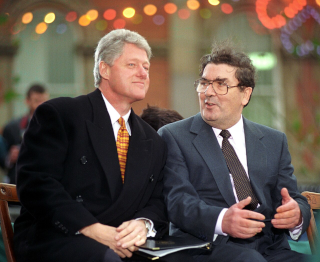
(Pictured: John Hume with U.S. President Bill Clinton in 1995)
In 1918, a system called plural voting is in place in both Britain and Ireland. Plural voting is a practice whereby one person might be able to vote multiple times in an election. Property and business owners can vote both in the constituency where their property lay and that in which they live, if the two are different. In the newly formed Irish Free State this system is ended by the Electoral Act 1923 and is abolished in the United Kingdom by the Representation of the People Act 1948. Plural voting remains in effect in Northern Ireland until 1969.
Sinn Féin is founded by Arthur Griffith in 1905. He believes that Irish nationalists should emulate the Ausgleich of Hungarian nationalists who, in the 19th century under Ferenc Deák, had chosen to boycott the imperial parliament in Vienna and unilaterally establish their own legislature in Budapest.
Griffith initially favours a peaceful solution based on “dual monarchy” with Britain, that is two separate states with a single head of state and a limited central government to control matters of common concern only. However, by 1918, under its new leader, Éamon de Valera, Sinn Féin has come to favour achieving separation from Britain by means of an armed uprising if necessary and the establishment of an independent republic.
In the aftermath of the 1916 Easter Rising, the party’s ranks are swelled by participants and supporters of the rebellion as they are freed from British gaols and internment camps. At its 1917 Ardfheis (annual conference) de Valera is elected leader, and the new, more radical policy is adopted.
Prior to 1916, Sinn Féin had been a fringe movement having a limited cooperative alliance with William O’Brien‘s All-for-Ireland League and enjoyed little electoral success. However, between the Easter Rising of that year and the 1918 general election, the party’s popularity increases dramatically. This is due to the failure to have the Home Rule Bill implemented when the IPP resists the partition of Ireland demanded by Ulster Unionists in 1914, 1916 and 1917, but also popular antagonism towards the British authorities created by the execution of most of the leaders of the 1916 rebels and by their botched attempt to introduce Home Rule on the conclusion of the Irish Convention linked with military conscription in Ireland (see Conscription Crisis of 1918).
Sinn Féin demonstrates its new electoral capability in four by-election successes in 1917 in which George Noble Plunkett, Joseph McGuinness, de Valera and W. T. Cosgrave are each elected, although it loses three by-elections in early 1918 before winning two more with Patrick McCartan and Arthur Griffith. In one case there are unproven allegations of electoral fraud. The party benefits from a number of factors in the 1918 elections, including demographic changes and political factors.
The Darkley killings or Darkley massacre is a gun attack carried out on November 20, 1983, near the village of Darkley, County Armagh, Northern Ireland. Three gunmen attack worshippers attending a church service at Mountain Lodge Pentecostal Church, killing three Protestant civilians and wounding seven. The attackers are rogue members of the Irish National Liberation Army (INLA). They claim responsibility using the cover name “Catholic Reaction Force,” saying it is retaliation for recent sectarian attacks on Catholics by the loyalist Protestant Action Force (PAF). The attack is condemned by INLA leadership.
In the months before the Darkley killings, several Catholic civilians are killed by loyalists. On October 29, 1983, a Catholic civilian member of the Workers’ Party, David Nocher (26), is shot dead in Belfast. On November 8, Catholic civilian Adrian Carroll (24) is shot dead in Armagh. Ulster Defence Regiment (UDR) personnel are later convicted but the convictions are cleared on appeal for three of them (see UDR Four case). Carroll is the brother of an INLA member who was killed a year earlier. These attacks are claimed by the Protestant Action Force, a cover name used mostly by members of the Ulster Volunteer Force (UVF). It is believed the Darkley killings are primarily a retaliation for the killing of Carroll.
On the evening of Sunday, November 20, about sixty people are attending a church service at Mountain Lodge Pentecostal Church. The small, isolated wooden church is outside the village of Darkley, near the border with the Republic of Ireland and several miles from Armagh. As the service begins, three masked gunmen arrive, at least one of whom is armed with a Ruger semi-automatic rifle, and open fire on those standing in the entrance. Three church elders are killed: Harold Browne (59), Victor Cunningham (39) and David Wilson (44). The fatally wounded Wilson staggers into the service, where he collapses and dies. The gunmen then stand outside the building and spray it with bullets, wounding an additional seven people before fleeing in a car. The service is being tape-recorded when the attack takes place. On the tape, the congregation can be heard singing the hymn “Are You Washed in the Blood of the Lamb,” followed by the sound of gunfire. All of the victims are Protestant civilians.
In a telephone call to a journalist, a caller claims responsibility for the attack on behalf of the “Catholic Reaction Force.” He says it is “retaliation for the murderous sectarian campaign carried out by the Protestant Action Force” and adds, “By this token retaliation we could easily have taken the lives of at least 20 more innocent Protestants. We serve notice on the PAF to call an immediate halt to their vicious indiscriminate campaign against innocent Catholics, or we will make the Darkley killings look like a picnic.” The caller names nine Catholics who had been attacked.
The name “Catholic Reaction Force” had never been used before and police say they believe the attack is carried out by members of the INLA. The INLA condemn the attack and deny direct involvement, but say it is investigating the involvement of INLA members or weapons. A week later, INLA leader Dominic McGlinchey admits that one of the gunmen had been an INLA member and admits supplying him with the gun but says there is no justification for the attack. The INLA member’s brother had been killed by loyalists. McGlinchey explains that the INLA member had asked him for a gun to shoot a known loyalist who had been involved in sectarian killings. However, “clearly deranged by the death of his brother,” he “used it instead to attack the Darkley Gospel Hall.” McGlinchey says, “he must have been unbalanced or something to have gone and organised this killing. We are conducting an inquiry.”
There are reprisal sectarian attacks on Catholics in North Belfast, Lisburn, and Portadown within 24 hours of the Darkley massacre. On December 5, fifteen days after the Darkley attack, the PAF shoot dead INLA member Joseph Craven (26) in Newtownabbey.
The name “Catholic Reaction Force” is used several other times. In August 1984, it is used to issue a threat to newspapers against the families of Royal Ulster Constabulary (RUC) officers, after Sean Downes, a Catholic man, dies after the RUC shot him with a plastic bullet during an anti-internment march on the Andersontown Road, Belfast. In May 1986, it is used to claim the killing of Protestant civilian David Wilson (39), who is shot while driving his firm’s van in Donaghmore. The Irish Republican Army (IRA) also claims responsibility, saying Wilson was a member of the UDR. The “Catholic Reaction Force” declares a ceasefire on October 28, 1994. In 2001, the name is used to claim two attacks on homes in which there are no injuries, and in 2002 is used to issue a threat to hospital workers suspected of links to the security forces.
(Pictured: The Mountain Lodge Pentecostal Church at Aughnagurgan outside Darkley, County Armagh, Northern Ireland)
Flannery edits the Dominican bi-monthly journal entitled Doctrine and Life from 1958 to 1988, while at St. Saviour’s Priory, Dublin, where he also serves as prior from 1957 to 1960. He also edits the Religious Life Review. During and after the Second Vatican Council he makes available in English all the documents from the event.
From August 1969, Flannery is a member of the executive committee of the Northern Relief Coordination Committee, raising funds on behalf of the families of those interned without trial in Northern Ireland during the early 1970s.
Flannery embodies the post-Vatican II conception of the priest as a social catalyst engaged by the gospel, closer to his flock than to the clerical hierarchy. He has a great gift for friendship, is indefatigably interested in people, and courts religious affairs commentators and journalists at a time when the hierarchy ignores them, magnifying his influence.
Flannery dies of a heart attack on October 21, 2008, at Kiltipper Woods Care Centre, Dublin. Following a funeral mass at St. Saviour’s Priory, he is buried in the Dominican plot at Glasnevin Cemetery, Dublin, on October 24, 2008.
Ó Brádaigh is born into a middle-class republican family. His father, Matt Brady, is an IRA volunteer who is severely wounded in an encounter with the Royal Irish Constabulary (RIC) in 1919. His mother, May Caffrey, is a Cumann na mBan volunteer and a 1922 graduate of University College Dublin (UCD). His father dies when he is ten and is given a paramilitary funeral led by his former IRA colleagues. His mother, prominent as the Secretary for the County Longford Board of Health, lives until 1974. He is educated at Melview National School at primary level and attends secondary school at St. Mel’s College, leaving in 1950, and graduates from University College Dublin in 1954. That year he takes a job teaching Irish language at Roscommon Vocational School in Roscommon. He is a deeply religious Catholic who refrains from smoking or drinking.
Ó Brádaigh joins Sinn Féin in 1950. While at university, in 1951, he joins the Irish Republican Army. In September 1951, he marches with the IRA at the unveiling of the Seán Russell monument in Fairview Park, Dublin. A teacher by profession, he is also a Training Officer for the IRA. In 1954, he is appointed to the Military Council of the IRA, a subcommittee set up by the IRA Army Council in 1950 to plan a military campaign against Royal Ulster Constabulary (RUC) barracks in Northern Ireland.
On August 13, 1955, Ó Brádaigh leads a ten-member IRA group in an arms raid on Hazebrouck Barracks, near Arborfield, Berkshire, England, a depot for the No. 5 Radar Training Battalion of the Royal Electrical and Mechanical Engineers. It is the biggest IRA arms raid in Britain. Most, if not all, of the weapons are recovered in a relatively short period of time. A van, traveling too fast, is stopped by the police and IRA personnel are arrested. Careful police work leads to weapons that had been transported in a second van and stored in London.
The IRA Border Campaign commences on December 12, 1956. As an IRA General Headquarters Staff (GHQ) officer, Ó Brádaigh is responsible for training the Teeling Column in the west of Ireland. During the Campaign, he serves as second-in-command of the Teeling Column. On December 30, 1956, he partakes in the Teeling Column attack on RUC barracks in Derrylin, County Fermanagh. RUC Constable John Scally is killed in the attack and is the first fatality of the new IRA campaign. Ó Brádaigh and others are arrested by the Garda Síochána across the border in County Cavan the day after the attack. They are tried and jailed for six months in Mountjoy Prison. A leading abstentionist, upon his arrest he refuses to recognize the authority of the Irish government and refuses to renounce violence in exchange for his release.
Upon completing his prison sentence, Ó Brádaigh is immediately interned at the Curragh Camp along with other republicans. On September 27, 1958, he escapes from the camp along with Dáithí Ó Conaill. While a football match is in progress, the pair cuts through a wire fence and escapes from the camp under a camouflage grass blanket. This is an official escape, authorised by the officer commanding (OC) of the IRA internees, Tomás Óg Mac Curtain. He is the first Sinn Féin TD on the run since the 1920s.
In October 1958, Ó Brádaigh becomes the IRA Chief of Staff, a position he holds until May 1959, when Seán Cronin is elected as his replacement. He is arrested in November 1959, refuses to answer questions, and is jailed in Mountjoy Prison under the Offences against the State Act. He is released in May 1960 and, after Cronin is arrested, again becomes Chief of Staff. Although he always emphasises that it is a collective declaration, he is the primary author of the statement ending the IRA Border Campaign in 1962. At the IRA 1962 Convention he indicates that he is not interested in continuing as Chief of Staff.
After Ó Brádaigh’s arrest in December 1956, he takes a leave from teaching at Roscommon Vocational School. He is re-instated and begins teaching again in late 1962, just after he is succeeded by Cathal Goulding in the position of Chief of Staff of the IRA. He remains an active member of Sinn Féin and is also a member of the IRA Army Council throughout the decade.
Ó Brádaigh opposes the decision of the IRA and Sinn Féin to drop abstentionism and to recognise the Westminster parliament in London, the Stormont parliament in Belfast and the Leinster House parliament in 1969/1970. On January 11, 1970, along with Seán Mac Stíofáin, he leads the walkout from the 1970 Sinn Féin Ard Fheis after the majority votes to end the policy of abstentionism, although the vote to change the Sinn Féin constitution fails to receive the required two-thirds majority. The delegates who walk out reconvene at the Kevin Barry Hall in Parnell Square, Dublin, and establish Provisional Sinn Féin.
Ó Brádaigh is voted chairman of the Caretaker Executive of Provisional Sinn Féin. That October, he formally becomes president of the party. He holds this position until 1983. In his presidential address to the 1971 Provisional Sinn Féin Ard Fheis, he says that the first step to achieving a United Ireland is to make Northern Ireland ungovernable. He apparently also serves on the Army Council or the executive of the Provisional Irish Republican Army until he is seriously injured in a car accident on January 1, 1984.
On May 31, 1972, Ó Brádaigh is arrested under the Offences Against the State Act and immediately commences a hunger strike. A fortnight later the charges against him are dropped and he is released. With Dáithí Ó Conaill he develops the Éire Nua policy, which is launched on June 28, 1972. The policy calls for a federal Ireland.
On December 3, 1972, Ó Brádaigh appears on the London Weekend TelevisionWeekend World programme. He is arrested by the Gardaí again on December 29, 1972, and charged in the newly established Special Criminal Court with Provisional IRA membership. In January 1973 he is the first person convicted under the Offences Against the State (Amendment) Act 1972 and is sentenced to six months in the Curragh Camp.
On December 10, 1974, Ó Brádaigh participates in the Feakle talks between the IRA Army Council and Sinn Féin leadership and the leaders of the Protestant churches in Ireland. Although the meeting is raided and broken up by the Gardaí, the Protestant churchmen pass on proposals from the IRA leadership to the British government. These proposals call on the British government to declare a commitment to withdraw, the election of an all-Ireland assembly to draft a new constitution and an amnesty for political prisoners.
The IRA subsequently calls a “total and complete” ceasefire intended to last from December 22, 1974, to January 2, 1975, to allow the British government to respond to proposals. British government officials also hold talks with Ó Brádaigh in his position as president of Sinn Féin from late December to January 17, 1975.
On February 10, 1975, the IRA Army Council, unanimously endorses an open-ended cessation of IRA “hostilities against Crown forces,” which becomes known as the 1975 truce. The IRA Chief of Staff at the time is Seamus Twomey of Belfast. It is reported in some quarters that the IRA leaders mistakenly believe they had persuaded the British Government to withdraw from Ireland and the protracted negotiations between themselves and British officials are the preamble to a public declaration of intent to withdraw. In fact, as British government papers now show, the British entertain talks with the IRA in the hope that this would fragment the movement further and score several intelligence coups during the talks. This bad faith embitters many in the republican movement, and another ceasefire does not happen until 1994.
In late December 1976, along with Joe Cahill, Ó Brádaigh meets two representatives of the Ulster Loyalist Central Co-ordinating Committee (ULCCC), John McKeague and John McClure, at the request of the latter body. Their purpose is to try to find a way to accommodate the ULCCC proposals for an independent Northern Ireland with the Sinn Féin’s Éire Nua programme. It is agreed that if this can be done, a joint Loyalist-Republican approach can then be made to request the British government to leave Ireland. Desmond BoalQC and Seán MacBrideSC are requested and accepted to represent the loyalist and republican positions. For months they have meetings in various places including Paris. The dialogue eventually collapses when Conor Cruise O’Brien, then Minister for Posts and Telegraphs and vociferous opponent of the Provisional IRA, becomes aware of it and condemns it on RTÉ Radio. As the loyalists had insisted on absolute secrecy, they feel unable to continue with the talks as a result.
In the aftermath of the 1975 truce, the Ó Brádaigh/Ó Conaill leadership comes under severe criticism from a younger generation of activists from Northern Ireland, headed by Gerry Adams, who becomes a vice-president of Sinn Féin in 1978. By the early 1980s, Ó Brádaigh’s position as president of Sinn Féin is openly under challenge and the Éire Nua policy is targeted in an effort to oust him. The policy is rejected at the 1981 Sinn Féin Ard Fheis and finally removed from the Sinn Féin constitution at the 1982 Ard Fheis. At the following year’s Ard Fheis, Ó Brádaigh and Ó Conaill resign from their leadership positions, voicing opposition to the dropping of the Éire Nua policy by the party.
On November 2, 1986, the majority of delegates to the Sinn Féin Ard Fheis vote to drop the policy of abstentionism if elected to Dáil Éireann, but not the British House of Commons or the Northern Ireland parliament at Stormont, thus ending the self-imposed ban on Sinn Féin elected representatives from taking seats at Leinster House. Ó Brádaigh and several supporters walk out and immediately assemble at Dublin’s West County Hotel and set up Republican Sinn Féin (RSF). As an ordinary member, he had earlier spoken out against the motion (resolution 162) in an impassioned speech. The Continuity IRA becomes publicly known in 1996. Republican Sinn Féin’s relationship with the Continuity IRA is similar to the relationship between Sinn Féin and the Provisional IRA when Ó Brádaigh was Sinn Féin’s president.
Ó Brádaigh believes RSF to be the sole legitimate continuation of the pre-1986 Sinn Féin, arguing that RSF has kept the original Sinn Féin constitution. RSF readopts and enhances his Éire Nua policy. His party has electoral success in only a few local elections.
Ó Brádaigh remains a vociferous opponent of the Good Friday Agreement, viewing it as a programme to copperfasten Irish partition and entrench sectarian divisions in the north. He condemns his erstwhile comrades in Provisional Sinn Féin and the Provisional IRA for decommissioning weapons while British troops remain in the country. In his opinion, “the Provo sell-out is the worst yet – unprecedented in Irish history.” He condemns the Provisional IRA’s decision to seal off a number of its arms dumps as “an overt act of treachery,” “treachery punishable by death” under IRA General Army Order Number 11.
In July 2005, Ó Brádaigh hands over a portion of his personal political papers detailing discussions between Irish Republican leaders and representatives of the British Government during 1974–1975 to the James Hardiman Library, National University of Ireland, Galway.
In September 2009, Ó Brádaigh announces his retirement as leader of Republican Sinn Féin. His successor is Des Dalton. He is also a long-standing member of the Celtic League, an organization which fosters cooperation between the Celtic people and promotes the culture, identity and eventual self-determination for the people, in the form of six sovereign states, for the Celtic nations – Wales, Cornwall, Brittany, Scotland, Isle of Man and Ireland.
After suffering a period of ill-health, Ó Brádaigh dies on June 5, 2013, at Roscommon County Hospital. His funeral is attended by 1,800 mourners including Fine Gael TD Frank Feighan and is policed by the Garda Emergency Response Unit and Gardaí in riot gear, for “operational reasons,” a show of force believed to have been to deter the republican tradition of firing a three-volley salute of shots over the final place of rest during the graveyard oration. As a result, there are some minor scuffles between gardai and mourners.
The meeting is held under conditions of tight secrecy. Each man has only one assistant with him and there is no briefing for the press afterward. No one expects a firm agreement on any issue of substance. The British appear to be satisfied with a promise to meet again and to keep the communication lines open.
The meeting, the first such tripartite conference since the partition of Ireland 50 years earlier, is itself a considerable accomplishment politically. Even six weeks earlier, it is considered an impossibility by most observers.
At that time, Faulkner is widely regarded as being under such heavy pressure from the right-wing of his Ulster Unionist Party (UUP) that he cannot talk with the Taoiseach. Lynch has been saying that he can meet with Faulkner only as the leader of the Unionist party, not as the Prime Minister of Northern Ireland. That is consistent with Dublin‘s view that the six counties of Ulster are part of the Republic of Ireland.
Heath also seems to have retreated from his previous position. In an angry exchange of telegrams in August, he suggests that the situation in Northern Ireland is a British affair and none of Lynch’s business. The exchange follows the decision to intern suspected members of the Irish Republican Army (IRA) in Ulster without trial. Faulkner, backed by the Heath government, begin arrests of suspects on August 9.
The interment policy arouses a bitter reaction among the Roman Catholics of Ulster, where they make up a third of the population. Lynch denounces the policy. The Catholic opposition members in the Ulster Parliament at Stormont say they will boycott all Government matters until the interned men are released.
What has softened the attitudes of the three leaders is the appalling extent of violence in Belfast and other towns in Northern Ireland since the internments began. In those seven weeks, 17 British soldiers, 36 civilians and one policeman are killed, most of them by IRA bullets and bombs.
The British Government and Faulkner offer broad changes in the constitutional setup of the Ulster regime. They talk about bringing Catholics — non‐Unionists — into the Government for the first time. But internment without trial remains an obstacle even to talking about those ideas with the main opposition group, the Social Democratic and Labor Party (SDLP). The SDLP refuses to join in a proposed conference on political reform while internment goes on.
Ideally, the British would like Lynch to use his influence with the opposition leaders. They want him to urge them to talk about political reform in return for some concession on internment, perhaps the release of some of those currently held. But any such concession might get Faulkner in trouble with his own party or arouse Protestant violence. That is always the trouble in Northern Ireland – any gesture toward one side antagonizes the other.
A new and serious problem for Heath is an apparent waning of the British public’s willingness to bear the military and social burden of Northern Ireland. A poll just before the meeting at Chequers shows that 59% want to bring all British troops home from Ulster at once.
Even Lynch, though he is pledged to the principle of a United Ireland, does not want the hasty withdrawal of British troops. That would almost certainly mean an enlargement of the present terror into civil war.
(From: 3 Prime Ministers Confer on Ulster, The New York Times, September 28, 1971)
Twomey is born on November 5, 1919, on Marchioness Street in Belfast, and lives at 6 Sevastopol Street in the Falls district. Known as “Thumper” owing to his short temper and habit of banging his fist on tables, he receives little education and is a bookmaker‘s “runner.” His father is a volunteer in the 1920s. In Belfast he lives comfortably with his wife, Rosie, whom he marries in 1946. Together they have sons and daughters.
Twomey begins his involvement with the Irish Republican Army in the 1930s and is interned in Northern Ireland during the 1940s on the prison ship HMS Al Rawdah and later in Crumlin Road Gaol in Belfast. Rosie, his wife, is also held prisoner at the women prison, Armagh Jail, in Northern Ireland. He opposes the left-wing shift of Cathal Goulding in the 1960s, and in 1968, helps set up the breakaway Andersonstown Republican Club, later the Roddy McCorley Society.
In 1969, Twomey is prominent in the establishment of the Provisional Irish Republican Army. By 1972, he is Officer Commanding (OC) of the Provisional IRA Belfast Brigade when it launches its bomb campaign of the city, including Bloody Friday when nine people are killed. During the 1970s, the leadership of the Belfast Brigade of the IRA is largely in the hands of Twomey and Ivor Bell.
In March 1973, Twomey is first appointed IRA Chief of Staff after the arrest of Joe Cahill. He remains in this position until his arrest in October 1973 by the Garda Síochána. Three weeks later, on October 31, 1973, the IRA organises the helicopter escape of Twomey and his fellow IRA members J. B. O’Hagan and Kevin Mallon, when an active service unit hijacks and forces the pilot at gunpoint to land the helicopter in the training yard of Mountjoy Prison. After his escape, he returns to his membership of IRA Army Council.
By June/July 1974, Twomey is IRA Chief of Staff for a second time. He takes part in the Feakle talks between the IRA and Protestant clergymen in December 1974. In the IRA truce which follows in 1975, he is largely unsupportive and wants to fight on in what he sees as “one big push to finish it once and for all.”
IRA informer Sean O’Callaghan claims that on January 5, 1976, Twomey and Brian Keenan give the go-ahead for the sectarian Kingsmill massacre, when ten unarmed Ulster Protestant workmen are executed by the Provisional IRA in retaliation for a rash of loyalist killings of Catholics in the area. It is Keenan’s view, O’Callaghan claims, that “The only way to knock the nonsense out of the Prods is to be ten times more savage.”
Twomey is dedicated to paramilitarism as a means of incorporating Northern Ireland into the Republic of Ireland. In an interview with French television on July 11, 1977, he declares that although the IRA had waged a campaign for seven years at that point, it can fight on for another 70 against the British state in Northern Ireland and in England. He supports the bombing of wealthy civilian targets, which he justifies on class lines. On October 29, 1977, for example, a no-warning bomb at an Italian restaurant in Mayfair kills one diner and wounds 17 others. Three more people are killed in similar blasts in Chelsea and Mayfair the following month. He says, “By hitting Mayfair restaurants, we were hitting the type of person that could bring pressure to bear on the British government.”
In December 1977, Twomey is captured in Sandycove, Dublin, by the Garda Síochána, who had been tipped off by Belgian police about a concealed arms shipment, to be delivered to a bogus company with an address in the area. They swoop on a house in Martello Terrace to discover Twomey outside in his car, wearing his trademark dark glasses. After a high-speed pursuit, he is recaptured in the centre of Dublin. The Gardaí later find documents in his possession outlining proposals for the structural reorganisation of the IRA according to the cell system. His arrest ends his tenure as IRA chief of staff. In the 1986 split over abstentionism, Twomey sides with the Gerry Adams leadership and remains with the Provisionals.
After a long illness from a heart condition, Twomey dies in Dublin on September 12, 1989. He is buried in the family plot in Milltown Cemetery, Belfast. His funeral is attended by about 2,000 people.
McCorley is one of three children born to Roger Edmund McCorley, a meat carver in a hotel, and Agnes Liggett. He has two elder brothers, Vincent and Felix. He joins the Fianna in his teens. His family has a very strong republican tradition, and he claims to be the great-grandson of the United Irishmen folk hero Roddy McCorley, who was executed for his part in the Irish Rebellion of 1798.
McCorley is noted for his militancy, as he is in favour of armed attacks on British forces in Belfast. The Brigade’s leaders, by contrast, in particular, Joe McKelvey, are wary of sanctioning attacks for fear of loyalist reprisals on republicans and the Catholic population in general. In addition, McCorley is in favour of conducting an armed defense of Catholic areas, whereas McKelvey does not want the IRA to get involved in what he considers to be sectarian violence. McCorley writes later that in the end, “the issue settled itself within a very short space of time, when the Orange mob was given uniforms, paid for by the British, and called the Ulster Special Constabulary (USC).” The role of the USC, a temporary police force raised for counter-insurgency purposes, in the conflict is still debated, but republicans maintain that the organization was responsible for the indiscriminate killings of Catholics and nationalists.
On January 26, 1921, McCorley, is involved in the fatal shooting of three Auxiliary Division officers in their beds in the Railway View hotel in central Belfast. Shortly afterwards, he and another IRA man, Seamus Woods, organize an active service unit (ASU) within the first battalion of the Belfast Brigade, with the intention of carrying out attacks, with or without the approval of the Brigade leadership. The unit consists of 32 men. McCorley later writes, “I issued a general order that, where reprisal gangs [State forces] were cornered, no prisoners were to be taken.” In March 1921, he personally leads the ASU in the killing of three Black and Tans in Victoria Street in central Belfast. He is responsible for the deaths of two more Auxiliaries in Donegall Place in April. In reprisal for these shootings, members of the RIC assassinate two republican activists, the Duffin brothers in Clonard Gardens in west Belfast. On June 10, 1921, both and Woods and McCorley units are involved in the killing a RIC man who is suspected in the revenge killings of the Duffin brothers. Two RIC men and a civilian are also wounded in that attack.
Thereafter, there is what historian Robert Lynch has described as a “savage underground war” between McCorley’s ASU and RIC personnel based in Springfield Road barracks and led by an Inspector Ferris. Ferris is accused of murdering the Lord Mayor of Cork Thomas MacCurtain and had been posted to Lisburn for his safety. Ferris himself is among the casualties, being shot in the chest and neck, but surviving. McCorley claims to have been one of the four IRA men who shot Ferris. In addition, his men bomb and burn a number of businesses including several cinemas and a Reform Club. In May 1921, however, thirteen of his best men are arrested when surrounded by British troops during an operation in County Cavan. They are held in Crumlin Road Gaol and sentenced to death.
On June 3, McCorley organizes an attack on Crumlin Road Gaol in an attempt to rescue the IRA men held there before they are executed. The operation is not a success; however, the condemned men are reprieved after a truce is agreed between the IRA and British forces in July 1921. On Bloody Sunday (July 10, 1921), he is a major leader in the defense of nationalist areas from attacks by both the police and loyalists. On that day twenty people are killed before he negotiates a truce beginning at noon on July 11. At least 100 people are wounded, about 200 houses are destroyed or badly damaged – most of them Catholic homes, leaving 1,000 people homeless.
In April 1922, McCorley becomes leader of the IRA Belfast Brigade after Joe McKelvey goes south to Dublin to join other IRA members who are against the Anglo-Irish Treaty. With McKelvey’s departure, Seamus Woods becomes Officer Commanding of the IRA’s 3rd Northern Division, which has up to 1,000 members, with McCorley designated as Vice Officer Commanding. McCorley for his part, supports the Treaty, despite the fact that it provides for the partition of Ireland and the continued British rule in Northern Ireland. The reason for this is that Michael Collins and Eoin O’Duffy have assured him that this is only a tactical move and indeed, Collins sends men, money and weapons to the IRA in the North throughout 1922.
However, McCorley’s command sees the collapse of the Belfast IRA. In May 1922, the IRA launches an offensive with attacks all across Northern Ireland. In Belfast, he carries out an assault on Musgrave Street RIC barracks. He also conducts an arson campaign on businesses in Belfast. His men also carry out a number of assassinations, including that of Ulster Unionist PartyMPWilliam J. Twaddell, which causes the internment of over 200 Belfast IRA men.
To escape from the subsequent repression, McCorley and over 900 Northern IRA men flee south, to the Irish Free State, where they are housed in the Curragh. McCorley is put in command of these men. In June 1922, the Irish Civil War breaks out between Pro and Anti-Treaty elements of the IRA. He takes the side of the Free State and Michael Collins. After Collins is killed in August 1922, his men are stood down. About 300 of them join the National Army and are sent to County Kerry to put down anti-Treaty guerrillas there. In the Spring of 1923, bitterly disillusioned by the brutal counterinsurgency against fellow republicans, he resigns his command.
McCorley later asserts that he “hated the Treaty” and only supported it because it allowed Ireland to have its own armed forces. Both he and Seamus Woods are severe critics of the Irish Free State inertia towards Northern Ireland after the death of Michael Collins. He comments that when Collins was killed “the Northern element gave up all hope.”
In 1936 McCorley is instrumental in the establishment of the All-Ireland Old IRA Men’s Organization, serving as Vice-President with President Liam Deasy (Cork No. 3 Brigade) and Secretary George Lennon (Waterford No. 2 Brigade).