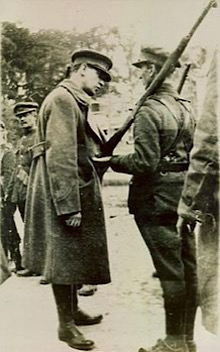
Nationalist forces enter Newcastle West, County Limerick, on Monday, August 7, 1922, after a twelve-hour battle, in which twelve anti-Treaty Irish Republican Army (IRA) members, sometimes referred to as Irregulars, are killed. The casualties of the Nationalists are less than those of the Irregulars.
Taking little respite after Sunday’s labors, the Nationals advance from Rathkele on Monday morning, and by midday are in sight of their fresh objective. Armored cars enter the town and machine gun fire is directed against a party of Irregulars, causing many casualties.
When the artillery goes into action against the headquarters of the Irregulars, the Irregulars flee precipitately along Cord road.
Owing to the slow progress in the operations in Southern Ireland, the meeting of Dáil Éireann, scheduled to open Saturday, is postponed again.
The official army bulletin announces that the Nationals captured Castle Island on Saturday, August 5. It says that the counties of Cork and Kerry with a part of South Tipperary and a small area in County Waterford are the only districts held by the Irregulars with any degree of security.
The streets of Dublin are lined with great crowds of people on Tuesday, August 8, for the military funeral of nine National Army soldiers who were killed in fighting the Republican Irregulars in County Kerry. Michael Collins, Chairman of the Provisional Government, and all the leading officers of the army in Dublin march beside the hearses. Each coffin is covered with the Republican tricolour. There are many clergymen and other civilians in the funeral procession.
Prominent Catholics of Dublin and Belfast are trying to effect a better understanding between the Ulster and Free State Governments, according to the Daily Mail. This newspaper further states that all efforts to this end, which have all been taken with the advice and approval of leading English Catholics, are without official character.
A message from Strabane, County Tyrone, received by the Exchange Telegraph Company on August 8 states that a settlement between the Ulster Government and the Free State authorities is imminent, the terms of agreement having been practically arranged in negotiations proceeding in London.
In Downing Street, however, all knowledge of any such Irish negotiations is disclaimed and a telegram from Belfast quotes Ulster Government officials as denying that a settlement with the Free State is imminent.
The Free State Government is also unaware of any negotiations for a settlement between the Ulster Government and the Free State authorities. It is further states that such negotiations are unlikely to take place.
(From: “Irish Irregulars Routed With Loss,” The New York Times, August 9, 1922 | Pictured: General Michael Collins inspects a soldier at Newcastle West, County Limerick, August 8, 1922)
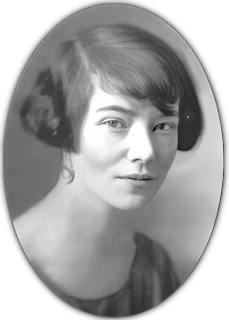
Gifford is the youngest of twelve children of Frederick and Isabella Gifford. Isabella Gifford (née Burton), is a niece of the artist Frederic William Burton, and is raised with her siblings in his household after the death of her father, Robert Nathaniel Burton, a rector, during the Great Famine.
Gifford’s parents—her father is Catholic and her mother Anglican—are married in St. George’s Church, a Church of Ireland church on the north side of Dublin, on April 27, 1872. She grows up in Rathmines and is raised as a Protestant, as are her siblings.
Gifford is educated in Alexandra College in Earlsfort Terrace. After leaving school she studies music at the Leinster House School of Music. It is her music teacher, in her teens, who first gives her her first Irish national newspaper, The Leader. She begins reading this secretly and then starts reading Arthur Griffith’s newspaper, Sinn Féin.
Gifford is a member of Inghinidhe na hÉireann, a women’s political organisation active from the 1900s. It is founded by Maud Gonne and a group of working-class and middle-class women to promote Irish culture and help to alleviate the shocking poverty of Dublin and other cities at a time when Dublin’s slums are unfavourably compared with Calcutta‘s. Gifford, who is already writing under the name “John Brennan” for Sinn Féin, is asked to write for its newspaper Bean na h-Éireann. Her articles vary from those highlighting poor treatment of women in the workplace to fashion and gardening columns, some written under the pseudonym Sorcha Ní hAnlúan.
She also works, along with her sisters, in Maud Gonne’s and Constance Markievicz‘s dinner system in St. Audoen’s Church, providing good solid dinners for children in three Dublin schools – poor Dublin schoolchildren often arrive at school without breakfast, go without a meal for the day, and if their father has been given his dinner when they arrive home, might not eat or might only have a crust of bread that night.
In 1911, Gifford is elected (as John Brennan) to the executive of the political group Sinn Féin.
Gifford is a member of Cumann na mBan (The Irish Women’s Council) from its foundation in Dublin on April 2, 1914. Its members learn first aid, drilling and signalling and rifle shooting, and serve as an unofficial messenger and backup service for the Irish Volunteers. During the fight for Irish Independence the women carry messages, store and deliver guns and run safe houses where men on the run can eat, sleep and pick up supplies.
In 1914, Gifford moves to the United States to work as a journalist. Through her connection with Padraic Colum and Mary Colum, whom she had met through her brother-in-law Thomas MacDonagh, she meets influential Irish Americans such as Thomas Addis Emmet and Irish exiles like John Devoy, and marries a Hungarian lawyer, Arpad Czira, a former prisoner of war who is said to have escaped and fled to America. Their son, Finian, is born in 1922.
Czira writes both for traditional American newspapers and for Devoy’s newspaper, TheGaelic American. She and her sister Nellie found the American branch of Cumann na mBan, and she acts as its secretary. Both sisters tour and speak about the Easter Rising and those involved. She is an active campaigner for Irish independence and against the United States joining the war against Germany, seen as a war for profit and expansion of the British Empire, and so to the disadvantage of the work for Irish independence. She helps Nora Connolly O’Brien to contact German diplomats in the United States.
In 1922, Czira returns to Ireland with her son. As a member of the Women’s Prisoners’ Defence League, she is an activist against the ill-treatment of Republican prisoners during the Irish Civil War. She continues to work as a journalist, though she is stymied in her work, as are the women of her family and many of those who had taken the anti-Free State side. In the 1950s her memoirs are published in The Irish Times, and she moves into work as a broadcaster and produces a series of historical programmes.
Born at 35 William Street in Wexford on September 17, 1886, Corish is the eldest child of carpenter Peter Corish and Mary Murphy. He is educated by the Christian Brothers in the town on George’s Street and leaves school at fourteen years old, which is not unusual at this time.
On September 29, 1913, at 27 years of age, he marries Catherine Bergin, daughter of labourer Daniel Bergin. They have six children, including Brendan.
Corish works as a fitter in the Wexford Engineering foundry the Star Iron Works. It is in this job that he witnesses the poor working conditions that industrial workers have to face all over the country. Many people of Ireland feel that this needs to change and so, in 1909, James Larkin forms the Irish Transport and General Workers’ Union (ITGWU). Many important figures join the union including P. T. Daly, James Connolly and eventually Corish himself, who becomes a voice for the Wexford workers.
The Wexford lockout from 1911 to 1912 that ensues because of this union is the event that first brings public attention to Corish in his hometown. Wexford employers counter the ITGWU by locking out their employees. On a conciliation committee, Corish represents the workers of the town and becomes a leader of this local union. During the lockout, he is arrested, spending a night in jail, for expressing his anger to a recently employed non-union foundry worker.
When visiting Wexford to support the workers, ITGWU leader James Larkin and trusted members James Connolly and P. T. Daly are put up in the Corish household on William Street.
In February 1912, the dispute is resolved with the introduction of the Irish Foundry Workers’ Union of which Corish is secretary until 1915. His career as a tradesman however is over as he is blacklisted by all employers. This new union is absorbed by the ITGWU two years later. He remains a respected figure in the town, especially by the foundry workers, and continues as secretary in the ITGWU until 1921.
Corish first takes his seat in the Wexford Borough Council in January 1913, where he is given the title of “Alderman.”
In May 1916, Corish is arrested after being suspected of having involvement in the Easter Rising and is imprisoned in Stafford, England until June. He is often targeted because of his republican activism, receiving a life-threatening letter in 1920 regarding the killing of Royal Irish Constabulary (RIC) officers.
Corish is first elected to Wexford County Council in 1920 and later that year is appointed mayor of the town.
Corish is an Irish Labour Party representative. However, as the Labour Party in the southern 26 counties, later the Irish Free State, choose not to contest the 1921 Irish elections, Corish runs as a Sinn Féin candidate and is elected to Dáil Éireann for the Wexford constituency.
Corish supports the Anglo-Irish Treaty and votes in favour of it. He also runs as a member of the Labour Party at the 1922 Irish general election. His involvement in the trade union movement and his clear speech-giving skills displayed during a visit from Michael Collins to Wexford that same year are what give him a fighting chance in the election. He is elected and serves in Dáil Éireann until his death in 1945.
He is a public supporter of the Garda Síochána, expressing his disagreement with the reductions in Garda pay and allowances in 1924 and 1929.
Corish is a recipient of the Honorary Freedom of the Borough of Wexford in early 1945 and dies later that year, on July 19, 1945, after serving as mayor and council member for 25 years. During exploratory surgery for stomach pain, the doctors of Wexford County Hospital realise that his condition is much worse than imagined and he dies at the age of 58 shortly thereafter. After appearing in the Dáil only a few days prior, his death is unexpected.
His death causes a by-election to the Dáil which is won by his son, Brendan Corish, who is later a leader of the Labour Party and Tánaiste. He serves as mayor up until his retirement in 1982. Another son, Des Corish, later also becomes mayor of the town. Corish’s granddaughter, Helen Corish, is mayor in 1990.
Corish Park is built in his honour in the early 1950s.
The East Clare Brigade plans to raid the Limerick train to take mail which will reveal the identity of a local spy. The eight IRA men, under the command of John McCormack, build a stone barricade across the tracks and put a red flag on top to stop the train. They will then board the train and take what they need. Tom Bentley, an IRA volunteer from Cratloe, is aboard the train so he can signal his comrades if there are British soldiers or Black and Tans on the train.
When the driver, a republican and supporter of the cause of Irish freedom, sees the barricade, he knows an ambush is about to take place but he also knows there are 30 British soldiers of the Royal Scots Regiment onboard and, should an ambush take place, the IRA will be out numbered and certainly outgunned. He smashes through the stone barricade, which is for the best, as McCormack does not see the signal from Bentley, their man on the train.
As the train passes, McCormack takes a pot shot at a soldier on the train, which turns out to be a bad idea. Once the train reaches Cratloe station, the soldiers make all civilians disembark and at gunpoint force the train driver to return to Woodcock Hill. McCormack knows the soldiers will alert the local military barracks and enemy troops will soon swarm the area. He climbs a telegraph pole to cut the wire but the shears break. He sends Lieutenant James O’Halloran to a nearby house to get replacement shears.
Gleeson and McCarthy are in charge of a group of volunteers waiting at the top of a field armed with rifles. When they see that something is delaying the cutting of the telegraph wires, they walk down the field to see what is happening. When they reach the edge of the tracks, the train comes around the bend one hundred yards from them. The Scots train their two machine guns and rifles on the fleeing volunteers. McCarthy is wounded during the opening volley and falls to the ground. As the rest of the ambushing party scatters, Gleeson realizes that McCarthy is not with them.
Gleeson races down the open field through a hail of British rifle and machine gun fire. He reaches McCarthy and helps him to his feet. In a desperate attempt to escape, Gleeson draws his revolver and staggers uphill supporting McCarthy with one arm and firing back at the British soldiers with his free hand.
They have only covered a short distance when Gleeson is shot and both men collapse to the ground. Gleeson is unable to continue but McCarthy manages to stagger on. Within a few seconds, the advancing British soldiers surround Gleeson and shoot him dead where he lay. McCarthy carries on through the fields but is soon outrun and is captured and killed by Lieutenant A. Gordan and a group of the Royal Scots, who shoot him several times and stab him with their bayonets.
Meanwhile, on the southern side of the railway track, McCormack is lying flat, hidden from the British soldiers. In order to make good his escape, he needs to climb over a thick fence of wire and hedge in full view of the soldiers. The train is only a short distance away and if the British soldiers make a search of the area, he is likely to become the third casualty the day. When he realises McCormack’s difficulty, James O’Halloran attempts to draw the British soldiers’ fire and attention and give McCormack a chance to escape. From behind a stone pier, O’Halloran opens fire on the British soldiers. He comes under heavy rifle fire but stands his ground and succeeds in wounding one of them before his rifle jams and he is forced to retreat. By this time, O’Halloran’s action has allowed McCormack to escape unseen. All the other IRA volunteers also manage to get away safely.
When the fighting ends, the British soldiers go to the scene of the killings and force a number of farm labourers to help them remove the two bodies. McCarthy’s body had been placed on a wicker gate and Michael Doherty and another farm labourer are ordered to carry it. Doherty lifts back the covering that has been placed over McCarthy’s body and sees that his throat has been cut and his chest is riddled with bullet wounds. Immediately, Doherty receives a blow of a rifle butt from one of the Royal Scots, who replaces the covers on McCarthy’s body.
Both bodies are taken to the house of the Collins family where the soldiers guard them until British reinforcements arrive and take them to Limerick. Gleeson and McCarthy are buried in the Republican plot in Meelick churchyard alongside Patrick White, who had been shot by a British sentry at Spike Island Prison, County Cork, earlier in the month.
This event, subsequently known as The Meelick Ambush, is the only occasion in County Clare during the Irish War of Independence when two Republicans are killed in action fighting against the British forces.
Campbell is born in Belfast on July 15, 1879, into a Catholic and Irish nationalist family from County Down. He is educated at St. Malachy’s College, Belfast. After working for his father he teaches for a while. He travels to Dublin in 1902, meeting leading nationalist figures. His literary activities begin with songs, as a collector in Antrim, County Antrim and working with the composer Herbert Hughes. He is then a founder of the Ulster Literary Theatre in 1904. He contributes a play, The Little Cowherd of Slainge, and several articles to its journal Uladh edited by Bulmer Hobson. The Little Cowherd of Slainge is performed by the Ulster Literary Theatre at the Clarence Place Hall in Belfast on May 4, 1905, along with Lewis Purcell’s The Enthusiast.
Campbell moves to Dublin in 1905 and, failing to find work, moves to London the following year where he is involved in Irish literary activities while working as a teacher. He marries Nancy Maude in 1910, and they move shortly thereafter to Dublin, and then later to County Wicklow. His play Judgement is performed at the Abbey Theatre in April 1912.
Campbell takes part as a supporter in the Easter Rising of 1916, doing rescue work. The following year he publishes a translation from Irish of the short stories of Patrick Pearse, one of the leaders of the Rising.
Campbell becomes a Sinn FéinCouncillor in Wicklow in 1921. Later in the Irish Civil War he is on the Republican side, and is interned in 1922-23. His marriage breaks up, and he emigrates to the United States in 1925 where he settles in New York City. He lectures at Fordham University, and works in academic Irish studies, founding the University’s School of Irish Studies in 1928, which lasts four years. He is the editor of The Irish Review (1934), a short lived “magazine of Irish expression.” The business manager is George Lennon, former Officer Commanding of the County WaterfordFlying Column during the Irish War of Independence. The managing editor is Lennon’s brother-in-law, George H. Sherwood.
Campbell returns to Ireland in 1939, settling at Glencree, County Wicklow. He dies at Lacken Daragh, Enniskerry, County Wicklow on June 6, 1944.
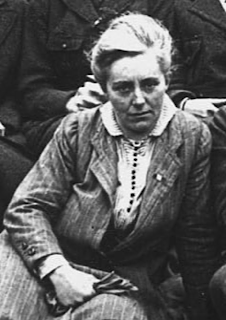
Ffrench-Mullen is born on December 30, 1880, in Malta, where her father, St. Lawrence ffrench-Mullen, a Royal Navy surgeon, is stationed. She has two brothers, St. Lawrence Patrick Joseph (1890–1891) and Douglas (1893–1943).
Ffrench-Mullen’s interest in politics starts young. Her father is a committed Parnellite and their Dundrum home is a campaign headquarters. She is a radical feminist and republican during her life. Like many others of the time, she regards it as a woman’s right to vote. She joins the suffrage movement, and meets women with a similar worldview and values. The women’s suffrage movement is included in the Movements of Extremists reports of the Dublin Metropolitan Police. Ffrench-Mullen goes on to join Inghinidhe na hÉireann, a radical nationalist women’s group founded by Maud Gonne in 1900. The organisation develops into Cumann na mBan in 1913. Suffragist values are central to Cumann na mBan’s goal of standing side-by-side with men in the fight for the Irish Republic. Some members see this as women regaining the rights that had belonged to them in pre-invasion Gaelic civilisation. She is on the socialist wing of the moment, holding to the ideals of universal social equality of the syndicalist James Connolly and the Irish Citizen Army (ICA).
During the 1916 Easter Rising, ffrench-Mullen serves as a lieutenant in the Irish Citizen Army. She sees action with the St. Stephen’s Green and Royal College of Surgeons garrison. In St. Stephen’s Green she is in command of the 15 Citizen Army women who set up a medical station and field kitchen. While occupying St. Stephen’s Green, she and her comrades come under sustained heavy fire from the Shelbourne Hotel and buildings on the north side of the Green. After the surrender of the College of Surgeons garrison, ffrench-Mullen is one of the 77 women who had fought in the Rising who are imprisoned, among them her life partner Kathleen Lynn. While in captivity ffrench Mullen is moved three times, spending time in Richmond Barracks, Kilmainham Gaol and Mountjoy Prison. She is released on June 5, 1916.
Ffrench-Mullen meets Kathleen Lynn through Inghinidhe na h-Éireann. In 1915, she moves into Lynn’s home in Belgrave Road, Rathmines, where they live together for thirty years, until ffrench-Mullen’s death in 1944.
Ffrench-Mullen records in her prison diary in 1916 that she can face prison without fear once Lynn (whom she refers to as “the Doctor”) and she are together. Katherine Lynch of the Women’s Studies Centre at University College Dublin (UCD) describes them as partners, calling them part of a network of lesbians living in Dublin—which includes Helena Molony, Louie Bennett and Elizabeth O’Farrell—who meet through the suffrage movement and later become involved with the national and trade union movement. These women are featured, along with Eva Gore-Booth and others, in a 2023 TG4 documentary about “the radical queer women at the very heart of the Irish Revolution”: Croíthe Radacacha (Radical Hearts).
In 1919, Madeleine ffrench-Mullen and Kathleen Lynn establish Saint Ultan’s Children’s Hospital, also known as Teach Ultan, which is a female-run hospital for infants at 37 Charlemont Street, Dublin. The hospital focuses on children’s health and wellbeing, an area that is perceived at the time as women’s concern. In the aftermath of World War I many health problems have arisen including a rise in venereal diseases such as syphilis, carried from soldiers returning home from war. Many of Ireland’s infants of the time suffer from congenital syphilis (inherited disease from mother at birth), and this is a driving factor in the opening of St Ultan’s hospital. Tuberculosis is endemic in Ireland during its time as a British colony. Against steadfast opposition by the State and the Catholic Church, Lynn and ffrench-Mullen establish a vaccination project, vaccinating thousands of impoverished children who would have died of tuberculosis without their vaccines. Their success leads to the foundation of Ireland’s BCG vaccine programme, which has vaccinated all babies since the 1950s.
Ffrench-Mullen dies at the age of 63 in a Dublin nursing home on May 26, 1944. She is interred with her parents as well as her younger brothers (whom she outlives) in the ffrench-Mullen family plot in Glasnevin Cemetery. Her funeral takes place on the same day as the 1944 Irish general election.
On May 12, 1992, a unit of the Provisional Irish Republican Army (IRA) East Tyrone Brigade launches a bomb attack on a British Army foot patrol near the republican stronghold of Cappagh, County Tyrone. One soldier of the Parachute Regiment, Alistair Hodgson, loses both legs as a result. The improvised land mine is described in an IRA statement as an “anti-personnel device.” Other paratroopers receive lesser wounds, according to the same statement. The incident triggers a rampage by members of the Parachute Regiment in the nearby, overwhelmingly Irish nationalist town of Coalisland, some ten miles to the east. The IRA attack is described as a “provocation” tactic, devised to produce an over-reaction by troops to make them even more unpopular among local nationalists.
The deployment of the paratroopers, which begins in April has already been criticised by republican activist and former Member of ParliamentBernadette Devlin McAliskey, who denounces beatings, shootings and damages to property reportedly carried out by the troops. These previous incidents include the destruction of fishing gear and boats in the townland of Kinturk, near Ardboe, and a brawl on April 22 between soldiers and motorists at a checkpoint in Stewartstown, in which plastic bullets are fired that end with a civilian and two paratroopers wounded. Unionist politician and Ulster Defence Regiment (UDR) officer Ken Maginnis, then-Member of Parliament for the area, calls for the withdrawal of the regiment after receiving a large number of complaints about their behaviour.
On May 12, two hours after the IRA ambush at Cappagh, members of the regiment seal off the town of Coalisland, ten miles east of Cappagh. According to a Social Democratic and Labour Party (SDLP) politician, the soldiers fabricate a bogus bomb warning, while the Royal Ulster Constabulary (RUC) states that the operation began when a joint police/military patrol was stoned by a crowd. Two pubs are ransacked by the troops and a number of civilian cars are damaged. Several people are allegedly hit with sticks. Following this, a lieutenant is suspended from duty and the regiment is removed from patrol duties in Coalisland.
On the evening of May 17, a fistfight begins at Lineside Road, where a group of young men are having a drink. A passing four-man patrol of the King’s Own Scottish Borderers regiment is challenged to a “boxing match” by the residents. The soldiers set aside their weapons and engage the youths. Noncritical injuries are reported on both sides. The official claim is that the patrol was attacked by a mob of at least 30 people. In the melée, a rifle and a light machine gun are stolen. The rifle is later recovered nearby. The youths smash a backpack radio which is left behind by the troops. Two KOSB soldiers are hospitalised, while in the end seven other soldiers, including paratroopers, receive lesser injuries, one of them hit by a car that crashes through two roadblocks set up by the British Army.
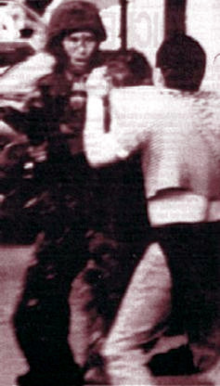
The Parachute Regiment is called to the scene again, and at 8:30 p.m., a major riot starts outside The Rossmore pub between local people and about 20 to 25 paratroopers. The soldiers claim one of their colleagues is isolated and dragged by the crowd. Some witnesses claim paratroopers were in a frenzy, showing their guns and inviting civilians to try to take them. Suddenly, shots are fired by the troops — first into the air and then toward the people outside the pub. Three civilians are rushed to hospital in Dungannon with gunshot wounds, while the soldiers return to their barracks. Another four civilians suffer minor injuries. The paratroopers claim that a “member of the growing crowd” attempted to fire the stolen machine gun at them, but the weapon jammed. One of the wounded is the brother of IRA volunteer Kevin O’Donnell, who had been killed by the Special Air Service (SAS) in February during an ambush at the nearby hamlet of Clonoe, shortly after carrying out a machine-gun attack on the local RUC base.
About 500 people attend a protest rally in Coalisland on May 19, and the wisdom of deploying the troops to patrol the town is questioned by members of the Dáil in Dublin. The Minister for Foreign Affairs of the Republic of Ireland, David Andrews, asks the British Government to withdraw the regiment. As a result, the paratroopers are redeployed outside the urban areas. The RUC claims that the stolen machine gun is found 11 days later at a farmhouse near Cappagh, along with another light machine gun and an AK-47 rifle. The IRA denies they had the machine gun in their possession. Republicans question whether the weapon had really been stolen, suggesting this was merely an excuse for the soldiers’ rampage in Coalisland. Bernardette McAliskey goes even further, suggesting that the recovery of the machine gun near Cappagh, where the initial IRA attack had taken place, was actually staged by the security forces as a publicity stunt. British officials accuse Sinn Féin of being the instigators of the riots, while Michael Mates, then Minister of State at the Northern Ireland Office, states that the incidents were due to “a gang of thugs motivated by the IRA.” Eventually the battalion’s 1992 tour in Northern Ireland is scaled down, with the patrols suspended before the official end of the deployment. The Third Brigade’s commander, Brigadier Tom Longland, is replaced by Brigadier Jim Dutton. This is the first occasion that a high-ranking officer is disciplined in such a way during the Troubles.
The last patrol takes place on June 27, when two paratroopers drown while crossing the River Blackwater. The same day there are further clashes with local residents, this time in the town of Cookstown, when a group of people that the BelfastNews Letter calls “drunken hooligans” assault a number of paratroopers trying to help an elderly man who is suffering a heart attack.
The 3rd Battalion of the Parachute Regiment is replaced by the 1st Battalion of the Coldstream Guards.
Six soldiers face criminal charges for their roles in the May riots but are acquitted one year later. Five are bound over. Maurice McHugh, the presiding magistrate, avers that the soldiers were “not entirely innocent,” while Sinn Féin sources dub the ruling “a farce.” Dungannon priest Father Denis Faul is of the opinion that the soldiers should have been charged with conspiracy. The Ulster TelevisiondocumentaryCounterpoint of June 1993 claims that Director of Public Prosecutions for Northern Ireland, Sir Alasdair Fraser, returned the case file to the RUC recommending no prosecution. The programme also interviews Alistair Hodgson, the soldier maimed at Cappagh, who says that “had another member of my unit been injured in the way that I was, I would have been with the rest of the lads attacking the locals.” Authors Andrew Sanders and Ian S. Wood suggest that the deployment of the battalion in Coalisland and elsewhere hindered the British policy of police primacy in Northern Ireland.
Fresh clashes between local residents and troops are reported at Coalisland on March 6, 1994, a few months before the first IRA ceasefire, when a crowd assaults two soldiers after the RUC searched a car. Plastic bullets are fired, and three civilians and two soldiers are slightly injured.
(Pictured: Confrontation between a British paratrooper and a civilian in Coalisland, May 1992)
Mulcahy is second-in-command to Thomas Ashe in an encounter with the armed Royal Irish Constabulary (RIC) at Ashbourne, County Meath, during the 1916 Easter Rising, one of the few stand-out victories won by republicans in that week and generally credited to Mulcahy’s grasp of tactics. In his book on the Rising, Charles Townshend principally credits Mulcahy with the defeat of the RIC at Ashbourne, for conceiving and leading a flanking movement on the RIC column that had engaged with the Irish Volunteers. Arrested after the Rising, he is interned at Knutsford and at the Frongoch internment camp in Wales until his release on December 24, 1916.
Mulcahy and Michael Collins are largely responsible for directing the military campaign against the British during the Irish War of Independence. During this period of upheaval in 1919, he marries Mary Josephine (Min) Ryan, sister of Kate and Phyllis Ryan, the successive wives of Seán T. O’Kelly. Her brother is James Ryan. O’Kelly and Ryan both later serve in Fianna Fáil governments.
Mulcahy supports the Anglo-Irish Treaty of December 1921. Archive film shows that Mulcahy, as Minister of Defence, is the Irish officer who raises the Irish tricolour at the first hand-over of a British barracks to the National Army in January 1922. He is defence minister in the Provisional Government on its creation and succeeds Collins, after the latter’s assassination, as Commander-in-Chief of the Provisional Government’s forces during the subsequent Irish Civil War.
Mulcahy earns notoriety through his order that anti-Treaty activists captured carrying arms are liable for execution. A total of 77 anti-Treaty prisoners are executed by the Provisional Government. He serves as Minister for Defence in the new Free State government from January 1924 until March 1924, but resigns in protest because of the sacking of the Army Council after criticism by the Executive Council over the handling of the “Army Mutiny,” when some National Army War of Independence officers almost revolt after he demobilises many of them at the end of the Irish Civil War. He re-enters the cabinet as Minister for Local Government and Public Health in 1927.
After the resignation of W. T. Cosgrave as Leader of Fine Gael in 1944, Mulcahy becomes party leader while still a member of the Seanad. Thomas F. O’Higgins is parliamentary leader of the party in the Dáil at the time and Leader of the Opposition. Facing his first general election as party leader, Mulcahy draws up a list of 13 young candidates to contest seats for Fine Gael. Of the eight who run, four are elected. He is returned again to the 12th Dáil as a TD for Tipperary at the 1944 Irish general election. While Fine Gael’s decline had been slowed, its future is still in doubt.
Following the 1948 Irish general election Mulcahy is elected for Tipperary South, but the dominant Fianna Fáil party finishes six seats short of a majority. However, it is 37 seats ahead of Fine Gael, and conventional wisdom suggests that Fianna Fáil is the only party that can possibly form a government. Just as negotiations get underway, however, Mulcahy realises that if Fine Gael, the Labour Party, the National Labour Party, Clann na Poblachta and Clann na Talmhan band together, they would have only one seat fewer than Fianna Fáil and, if they can get support from seven independents, they will be able to form a government. He plays a leading role in persuading the other parties to put aside their differences and join forces to consign the then Taoiseach and Fianna Fáil leader Éamon de Valera, to the opposition benches.
Mulcahy initially seems set to become Taoiseach in a coalition government. However, he is not acceptable to Clann na Poblachta’s leader, Seán MacBride. Many Irish republicans had never forgiven him for his role in the Irish Civil War executions carried out under the Cosgrave government in the 1920s. Consequently, MacBride lets it be known that he and his party will not serve under Mulcahy. Without Clann na Poblachta, the other parties would have 57 seats between them — 17 seats short of a majority in the 147-seat Dáil. According to Mulcahy, the suggestion that another person serve as Taoiseach comes from Labour leader William Norton. He steps aside and encourages his party colleague John A. Costello, a former Attorney General of Ireland, to become the parliamentary leader of Fine Gael and the coalition’s candidate for Taoiseach. For the next decade, Costello serves as the party’s parliamentary leader while Mulcahy remained the nominal leader of the party.
Mulcahy goes on to serve as Minister for Education under Costello from 1948 until 1951. Another coalition government comes to power at the 1954 Irish general election, with Mulcahy once again stepping aside to become Minister for Education in the Second Inter-Party Government. The government falls in 1957, but he remains as Fine Gael leader until October 1959. In October the following year, he tells his Tipperary constituents that he does not intend to contest the next election.
McDonald is born into a middle-class family in south Dublin. Her father Patrick McDonald, a builder and surveyor, and her mother Joan, separate when she is nine years old, and she stays with her mother in Rathgar. She has three siblings, one older and two younger. Her great-uncle, James O’Connor, was a member of the Anti-Treaty IRA and was executed at the Curragh Camp during the Irish Civil War.
She works as a researcher for the Institute of European Affairs, a consultant for the Irish Productivity Centre, a human resources consultancy that is jointly operated by Ibec and Irish Congress of Trade Unions (ICTU), and a trainer in the Partnership Unit of the Educational and Training Services Trust.
McDonald starts her political career by first joining Fianna Fáil in 1998 but leaves the party after a year due to core policy differences, particularly in relation to Northern Ireland and social justice. She quickly realises that Sinn Féin is a more appropriate party for her Republican views after meeting Sinn Féin members through the Irish National Congress.
She first runs for office at the 2002 Irish general election when she unsuccessfully contests the Dublin West constituency for Sinn Féin, polling 8.02% of first preference votes.
In 2004, McDonald becomes Sinn Féin’s first Member of the European Parliament (MEP) in Ireland, when she is elected at the 2004 European Parliament election in Ireland for the Dublin constituency, receiving over 60,000 first preference votes. She serves until 2009 and is a prominent member of the Employment and Social Affairs committee and Civil Liberties committee.
McDonald contests the Dublin Central constituency again at the 2011 Irish general election, this time picking up 13.1% of first preference votes. She is successful in taking the last seat in the constituency. Following the election, she becomes Sinn Féin’s Spokesperson for Public Expenditure and Reform and is a member of the Public Accounts Committee from then until 2017.
After her re-election to the Dáil at the 2016 Irish general election, in which she tops the poll in Dublin Central, she becomes Sinn Féin’s All-Ireland Spokesperson for Mental Health and Suicide Prevention, which she holds until being elected president of Sinn Féin in 2018.
At a Sinn Féin party conference on November 18, 2017, Gerry Adams is re-elected party leader but announces that he will ask party leadership to call for a special Ard Fheis to be held within three months to choose a new president, and that he will not stand for re-election as TD for the Louth constituency in the next election.
At the close of nominations to succeed Adams on January 20, 2018, McDonald is announced as the president-elect of Sinn Féin, as she is the sole nominee to enter the race. She is confirmed as president at a special Ard Fheis on February 10, 2018, in Dublin.
McDonald is nominated as Taoiseach on February 20, 2020, but is defeated 45 to 84. On June 26, 2020, Fianna Fáil, Fine Gael, and the Green Party form a coalition government, leaving Sinn Féin as the largest opposition party, and McDonald as Leader of the Opposition. She dismisses the coalition agreement as a “marriage of convenience,” and accuses Fianna Fáil and Fine Gael of conspiring to exclude Sinn Féin from government.
At the 2024 Irish general election, McDonald is re-elected to the Dáil topping the poll in Dublin Central with Sinn Féin increasing their seat share by two seats, remaining the second largest party by representation in the Dáil and attaining 19% of the first preference votes, a fall of 5.5% from 2020 and fall behind Fianna Fáil by 2.9% and Fine Gael by 1.8%.
McDonald is again nominated as Taoiseach on December 18, 2024, but is defeated 44 to 110.
McDonald’s husband, Martin Lanigan, works as a gas control superintendent for the emergency dispatch division of Gas Networks Ireland, a state infrastructure provider. They have two children and live in Cabra, Dublin.
In October 1964, during the general election campaign, a photo of McMillen is placed in the window of the election office in Divis Street flanked on one side by the Starry Plough flag and on the other by the tricolour. His campaign draws national attention after Ian Paisley demands that police remove the tricolour from McMillen’s election offices. The RUC raids the premises and confiscates the flag, sparking several days of rioting during which McMillen leads several thousand protesters in defiantly displaying the tricolour. He recalls the IRA gaining a “couple of dozen recruits” following the election, but he finishes at the bottom of the poll with 3,256 votes (6%). Around this time, he succeeds Billy McKee as the Officer commanding (OC) of the Belfast Brigade.
McMillen is keen to work for the unity of Protestant and Catholic workers. Roy Garland recalls that McMillan’s grandfather was master of an Orange lodge in Edinburgh and McMillan knew of that heritage and the meaning of the colours of the Irish flag. He prominently displays in his election offices a verse of a poem by John Frazier, a Presbyterian from County Offaly: “Till then the Orange lily be your badge my patriot brother. The everlasting green for me and we for one and other.”
In 1967, McMillen is involved in the formation of the Northern Ireland Civil Rights Association (NICRA) and is a member of a three-man committee which draws up the Association’s constitution. The NICRA’s peaceful activities result in violent opposition from many unionists, leading to fears that Catholic areas will come under attack. In May 1969, when asked at an IRA army council meeting by Ruairí Ó Brádaigh how many weapons the Belfast Brigade has for defensive operations, McMillen states they have only one pistol, a machine gun and some ammunition.
By August 14, 1969, serious rioting has broken out in Belfast and Catholic districts come under attack from both civilian unionists and the RUC. McMillen’s IRA command by this point still has only a limited number of weapons because the leadership in Dublin are reluctant to release guns. While he is involved in some armed actions on this day, he is widely blamed by those who established the Provisional IRA for the IRA’s failure to adequately defend Catholic neighbourhoods from Ulster loyalist attack. He is arrested and temporarily detained by the RUC on the morning of August 15 but is released shortly afterward.
McMillen’s role in the 1969 riots is very important within IRA circles, as it is one of the major factors contributing to the split in the movement in late 1969. In a June 1972 lecture organised by Official Sinn Féin in Dublin, he defends his conduct, stating that by 1969 the total membership of the Belfast IRA is approximately 120 men, and their armaments have increased to a grand total of 24 weapons, most of which are short-range pistols.
In September, McMillen calls a meeting of IRA commanders in Belfast. Billy McKee and several other republicans arrive at the meeting armed and demand McMillen’s resignation. He refuses, but many of those unhappy with his leadership break away and refuse to take orders from him or the Dublin IRA leadership. Most of them join the Provisional Irish Republican Army, when this group splits off from the IRA in December 1969. McMillen himself remains loyal to the IRA’s Dublin leadership, which becomes known as the Official IRA. The split rapidly develops into a bitter rivalry between the two groups. In April 1970, he is shot and wounded by Provisional IRA members in the Lower Falls area of Belfast.
In June 1970, McMillen’s Official IRA have their first major confrontation with the British Army, which had been deployed to Belfast in the previous year, in an incident known as the Falls Curfew. The British Army mounts an arms search in the Official IRA stronghold of the Lower Falls, where they are attacked with a grenade by Provisional IRA members. In response, the British flood the area with troops and declare a curfew. This leads to a three-day gun battle between 80 to 90 Official IRA members led by McMillen and up to 3,000 British troops. Five civilians are killed in the fighting and about 60 are wounded. In addition, 35 rifles, 6 machine guns, 14 shotguns, grenades, explosives and 21,000 rounds of ammunition, all belonging to the OIRA, are seized. McMillen blames the Provisionals for instigating the incident and then refusing to help the Officials against the British.
This ill-feeling eventually leads to an all-out feud between the republican factions in Belfast in March 1971. The Provisionals attempt to kill McMillen again, as well as his second-in-command, Jim Sullivan. In retaliation, McMillen has Charlie Hughes, a young PIRA member, killed. Tom Cahill, brother of leading Provisional Joe Cahill, is also shot and wounded. After these deaths, the two IRA factions in Belfast negotiate a ceasefire and direct their attention instead at the British Army.
When the Northern Ireland authorities introduce internment in August 1971, McMillen flees Belfast for Dundalk in the Republic of Ireland, where he remains for several months. During this time, the Official IRA carries out many attacks on the British Army and other targets in Northern Ireland. However, in April 1972, the organisation in Belfast is badly weakened by the death of their commander in the Markets area, Joe McCann. In May of that year, the Dublin leadership of the OIRA calls a ceasefire, a move which McMillen supports. Nevertheless, in the year after the ceasefire, his command kills seven British soldiers in what they term “retaliatory attacks.” McMillen serves on the Ard Chomhairle (leadership council) of Official Sinn Féin.
By 1974, a group of OIRA members around Seamus Costello are unhappy with the ceasefire. In December 1974, they break away from the Official movement, forming the Irish Republican Socialist Party (IRSP) and the Irish National Liberation Army (INLA). Some OIRA members under McMillen’s command, including the entire Divis Flats unit, defect to the new grouping. This provokes another intra-republican feud in Belfast. The feud begins with arms raids on OIRA dumps and beatings of their members by the INLA. McMillen, in response is accused of drawing up a “death list” of IRSP/INLA members and even of handing information on them over to the loyalist Ulster Volunteer Force (UVF).
The first killing comes on February 20, 1975, when the OIRA shoot dead an INLA member named Hugh Ferguson in west Belfast. A spate of shootings follows on both sides.
On April 28, 1975, McMillen is shot dead by INLA member Gerard Steenson, as he is shopping in a hardware shop on Spinner Street with his wife Mary. He is hit in the neck and dies at the scene. His killing is unauthorised and is condemned by INLA/IRSP leader Seamus Costello. Despite this, the OIRA tries to kill Costello on May 9, 1975, and eventually kills him two years later. McMillen’s death is a major blow to the OIRA in Belfast.



 seamus dubhghaill