seamus dubhghaill

Promoting Irish Culture and History from Little Rock, Arkansas, USA


Leave a comment

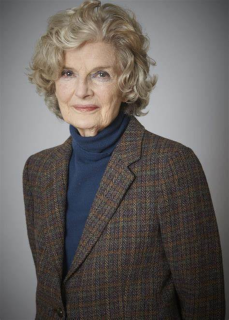
Birth of Julia O’Faolain, Novelist & Short Story Writer

Julia O’Faolain, Irish novelist and short story writer, is born in London on June 6, 1932. She works as a writer, language teacher, editor and translator and lives in France, Italy, and the United States.

Although born in England when her father, Irish writer Seán Ó Faoláin, is lecturing at the Catholic college, St. Mary’s College, at Strawberry Hill, London, O’Faolain grows up in Ireland. The family returns to Ireland when she is just one year old. They live first in Killough House in County Wicklow, where future Taoiseach Garret FitzGerald is a playmate, artist Paul Henry a neighbour and Cork writer Frank O’Connor a regular visitor. The family then moves to Knockaderry House in Killiney, County Dublin, where her father publishes the literary journal The Bell from an outhouse at the bottom of the garden. Writers, poets and intellectuals such as Patrick Kavanagh, Brendan Behan and Conor Cruise O’Brien are regular visitors and often have to entertain her while waiting to speak with her father.

O’Faolain does not begin school until she is eight years old as her mother, Irish writer and teacher Eileen Gould, has little time for nuns. Following her schooling, she completes an arts degree at University College Dublin (UCD) and then further studies at the Sapienza University of Rome and the Sorbonne in Paris. A formidable student and strikingly beautiful, she makes a strong impression on those who meet her.

In search of love, literature and freedom from 1950s Ireland, the young O’Faolain remains abroad working variously as a translator, language teacher, editor and writer in London. She makes lifelong friends who speak highly of her generosity, loyalty and kindness. As well as maintaining a strong interest in politics throughout her life, she attains a black belt in karate and attends karate classes until her early 70s.

In her 2013 memoir, O’Faolain recounts a number of her adult loves before she meets and marries Lauro Martines in Florence in 1957. The couple lives in Florence for a year while Martines completes a travelling fellowship from Harvard University. They then move to Portland, Oregon, where their son Lucien is born in 1959. While in the United States, she teaches French at Reed College in Portland. The family returns to live in Florence from 1962-66 while her husband carries out research. When he is offered a professorship at the University of California, Los Angeles in 1966, they move back to the United States. However, not keen to live full-time in the United States, they purchase a house in Hampstead in 1970 and later in central London where she spends a good deal of time. From the 1990s onwards, she and Lauro spend more and more time in London, and they visit Ireland more during these years. Lucian, a painter and picture repairer, lives in London.

O’Faolain’s novels include No Country for Young Men, which is nominated for the Booker Prize in 1980, Women in the Wall (1975), The Obedient Wife (1982) and The Judas Cloth (1992) which is set in 19th-century Italy. Her first collection of short stories, We Might See Sights and Other Stories, is published in 1968, followed by Man in the Cellar (1974), Melancholy Baby (1978) and Daughters of Passion (1982). And with her husband, she edits Not in God’s Image: Women in History from the Greeks to the Victorians (1973).

O’Faolain’s writings are suffused with themes of clerical intrigue, women’s role in society, power, faith and sexuality. She says once that she is more detached from her characters than her father was. “He was fond of his characters whereas I was more impatient of mine… The fact that he often forgave their foolishness showed that he was fond of Ireland itself, where he lived for the most of his life. I instead left it and found I was happier elsewhere.”

As a writer, O’Faolain is not particularly well-known in Ireland. Following the publication of her memoir in 2013, she is asked by The Irish Times journalist Arminta Wallace if it bothers her that her name does not often figure in lists of famous Irish writers, perhaps because she did not live here. She replies, “Not only do I not live here but when my last book came out someone wrote an article naming me as a ‘forgotten writer’… which was not a cheerful read. It wasn’t in any way offensive, but it wasn’t very comforting…I suppose I didn’t write enough. You mustn’t let too many years go by between books – and I did that.”

O’Faolain dies at the age of 88 in London on October 27, 2020, following a long illness. Her papers, which include manuscripts of her writing and a significant correspondence between her and her father, are donated to UCD in 2018. At the time, archivists expect them to be available to researchers by 2022.


Leave a comment

Birth of Robert Mallet, the Father of Seismology

Robert Mallet, geophysicist, civil engineer, and inventor who distinguishes himself in research on earthquakes and is sometimes called the Father of Seismology, is born in Dublin on June 3, 1810.

Mallet is the son of factory owner John Mallet. He is educated at Trinity College, Dublin, entering it at the age of 16 and graduating in science and mathematics in 1830 at the age of 20.

Following his graduation, Mallet joins his father’s iron foundry business and helps build the firm into one of the most important engineering works in Ireland, supplying ironwork for railway companies, the Fastnet Rock lighthouse, and a swing bridge over the River Shannon at Athlone. He also helps manufacture the characteristic iron railings that surround Trinity College, and which bear his family name at the base.

Mallet is elected to the Royal Irish Academy in 1832 at the early age of 22. He also enrolls in the British Association for the Advancement of Science in 1835 which helps finance much of his research in seismology.

In 1838 Mallet becomes a life member of the Royal Geological Society of Ireland and serves as its President from 1846–1848. From 1848–1849 he constructs the Fastnet Rock lighthouse, southwest of Cape Clear.

On February 9, 1846, Mallet presents to the Royal Irish Academy his paper On the Dynamics of Earthquakes, which is considered to be one of the foundations of modern seismology. He is also credited with coining the word “seismology” and other related words which he uses in his research. He also coins the term epicentre.

From 1852 to 1858, Mallet is engaged in the preparation of his work, The Earthquake Catalogue of the British Association (1858) and carries out blasting experiments to determine the speed of seismic propagation in sand and solid rock.

On December 16, 1857, the area around Padula, Italy is devastated by the Great Neapolitan earthquake which causes 11,000 deaths. At the time it is the third largest known earthquake in the world and has been estimated to have been of magnitude 6.9 on the Richter Scale. Mallet, with letters of support from Charles Lyell and Charles Darwin, petitions the Royal Society of London and receives a grant of £150 to go to Padula and record at first hand the devastation. The resulting report is presented to the Royal Society as the Report on the Great Neapolitan Earthquake of 1857. It is a major scientific work and makes great use of the then new research tool of photography to record the devastation caused by the earthquake. In 1862, he publishes the Great Neapolitan Earthquake of 1857: The First Principles of Observational Seismology in two volumes. He brings forward evidence to show that the depth below the Earth’s surface, from where the impulse of the Neapolitan earthquake originated, is about 8–9 geographical miles.

One of Mallet’s papers is Volcanic Energy: An Attempt to develop its True Origin and Cosmical Relations, in which he seeks to show that volcanic heat may be attributed to the effects of crushing, contortion, and other disturbances in the crust of the earth. The disturbances leading to the formation of lines of fracture, more or less vertical, down which water would find its way, and if the temperature generated be sufficient volcanic eruptions of steam or lava would follow.

Mallet is elected Fellow of the Royal Society in 1854, and in 1861 moves to London, where he becomes a consulting engineer and edits The Practical Mechanic’s Journal. He is awarded the Telford Medal by the Institution of Civil Engineers in 1859, followed by the Cunningham Medal of the Royal Irish Academy for his research into the theory of earthquakes in 1862, and the Wollaston Medal of the Geological Society of London in 1877, the Geological Society’s highest award.

Blind for the last seven years of his life, Robert Mallet dies at Stockwell, London, on November 5, 1881, and is buried at West Norwood Cemetery.


Leave a comment

Birth of Ernie O’Malley, Republican Revolutionary & Writer

Ernest Bernard (Ernie) O’Malley, Irish republican revolutionary and writer, is born on May 26, 1897, in Ellison Street, Castlebar, County Mayo, the second child among nine sons and two daughters of Luke Malley, solicitor’s clerk, of County Mayo, and Marion Malley (née Kearney) of County Roscommon. Christened Ernest Bernard Malley, his adoption of variations on this name reflects his enthusiasm for a distinctively Irish identity – an enthusiasm that lay at the heart of his republican career and outlook.

In 1906, O’Malley’s family moves to Dublin, where he attends the Christian Brothers‘ School, North Richmond Street. In 1915, he begins to study medicine at University College Dublin (UCD). Having initially intended to follow his older brother into the British Army, he rather joins the Irish Volunteers in the wake of the 1916 Easter Rising, as a member of F Company, 1st Battalion, Dublin Brigade. He becomes a leading figure in the Irish Republican Army (IRA) during the Irish War of Independence which the Easter Rising helps to occasion. In 1918, having twice failed his second-year university examination, he leaves home to commit himself to the republican cause. He is initially a Volunteer organiser with the rank of second lieutenant, under the instruction of Richard Mulcahy, operating in Counties Tyrone, Offaly, Roscommon, and Donegal. His work in 1918 involves the reorganisation, or new establishment, of Volunteer groups in the localities.

In August 1918, O’Malley is sent to London by Michael Collins to buy arms. During 1919 he works as an IRA staff captain attached to General Headquarters (GHQ) in Dublin, and also trains and organises Volunteers in Counties Clare, Tipperary, and Dublin. He has a notable military record with the IRA during the Irish War of Independence and is a leading figure in attacks on Hollyford barracks in County Tipperary (May 1920), Drangan barracks in County Kilkenny (June 1920), and Rearcross barracks in County Tipperary (July 1920). His IRA days thus involve him with comrades such as Dan Breen, Séumas Robinson, and Seán Treacy. In December 1920, he is captured in County Kilkenny by Crown forces. He escapes from Dublin’s Kilmainham Gaol in February 1921, to take command of the IRA’s 2nd Southern Division, holding the rank of commandant-general.

O’Malley’s republican commitment has political roots in his conviction that Ireland should properly be fully independent of Britain, and that violence is a necessary means to achieve this end. But the causes underlying his revolutionism are layered. Family expectations of respectable, professional employment combined with a religious background and an enthusiasm for soldiering provide some of the foundations for his IRA career. As an IRA officer he enjoys professional, military expression for a visceral Catholic Irish nationalism. He also finds excitement, liberation from the frequent dullness of his life at home, defiant rebellion against his non-republican parents, an alternative to his stalled undergraduate career, and, in political and cultural Irish separatism, a decisive resolution of the profound tension between his anglocentrism and his anglophobia.

O’Malley rejects the 1921 Anglo–Irish Treaty as an unacceptable compromise. He spends the 1921 truce period training IRA officers in his divisional area, in preparation for a possible renewal of fighting. He is, in the event, to be a leading anti-treatyite in the 1922–23 Irish Civil War. In the Four Courts in 1922, at the start of the latter conflict, he is captured on the republicans’ capitulation on June 30 but then manages to escape from captivity. Subsequently he is appointed assistant Chief of Staff of the anti-Treaty IRA and also becomes part of a five-man anti-Treaty army council, along with Liam Lynch, Liam Deasy, Frank Aiken and Thomas Derrig.

O’Malley is dramatically captured and badly wounded by Free State forces in Dublin in November 1922. Imprisoned until July 1924, he is during the period of his incarceration elected as a TD for Dublin North in the 1923 Irish general election and is also a forty-one-day participant in the republican hunger strike later that year. Following release from prison, he returns home to live with his parents in Dublin. He decides not to focus his post-revolutionary energy on a political career. During 1926–28 and 1935–37 he unsuccessfully tries to complete his medical degree at UCD, but increasingly his post-1924 efforts are directed toward life as a Bohemian traveler and writer. He spends much of 1924–26 on a recuperative journey through France, Spain, and Italy; and 1928–35 traveling widely in North America. During 1929–32 he spends time in New Mexico and Mexico City. In Taos, New Mexico, he mixes with, and is influenced by, writers and artists as he works on what are to become classic autobiographies of the Irish revolution: On Another Man’s Wound (1936) and The Singing Flame (1978).

O’Malley meets Helen Hooker, daughter of Elon and Blanche Hooker, in Connecticut in 1933. They marry in London in 1935, each rejecting something of their prior lives in the process: he, his Irish republicanism, through marriage to somebody entirely unconnected with that world; she, her wealthy and respectable upbringing, through liaison with a Catholic, Irish, unemployed, bohemian ex-revolutionary. They settle first in Dublin then, from 1938 onward, primarily in County Mayo. Burrishoole Lodge, near Newport, is his main base until 1954, when he moves to Dublin. Three children are born to the O’Malleys: Cahal (1936), Etáin (1940), and Cormac (1942). Sharing enthusiasm for the arts, he and Helen enjoy several years of intimacy. However, by the mid-1940s their relationship has frayed. In 1950, Helen kidnaps (the word is used by both parents and by all three children) the couple’s elder two children and takes them to the United States. From there she divorces O’Malley in 1952. Cormac remains with his father.

O’Malley’s post-American years are devoted to a number of projects. He writes extensively, including work for The Bell and Horizon. He is involved with the film director John Ford in the making of his Irish films, including The Quiet Man (1952). He gives radio broadcasts on Mexican painting for BBC Third Programme (1947), and on his IRA adventures for Radio Éireann (1953). In the latter year he suffers a heart attack, and his remaining years are scarred by ill health. He dies of heart failure on March 25, 1957, in Howth, County Dublin, at the house of his sister Kathleen. Two days later he is given a state funeral with full military honours. He is buried in the Malley family plot in Glasnevin Cemetery, Dublin.

O’Malley exemplifies some important themes in modern Irish political and intellectual history. His powerful memoirs form part of a tradition of writing absorbedly about Ireland, while under idiosyncratic emigrant influences which lend the writing much of its distinctiveness. His aggressive republicanism exemplifies a persistent but ultimately unrealisable tradition of uncompromising IRA politics. His unflinching single-mindedness is the condition for much courageous and striking activity, but also lay behind his infliction and his suffering of much pain. Literary, intellectual, and defiantly dissident, he is the classic bohemian revolutionary. His historical significance lies in his having been both a leading Irish revolutionary and the author of compelling autobiographical accounts of those years. His memoirs are distinguished from their rivals on the shelf by subtlety, self-consciousness, and literary ambition. In particular, his preparedness to identify motives for Irish revolutionary action, beyond the terms of ostensible republican purpose, renders his writing of great value to historians. Similarly, the large body of archival material left in his name (especially, perhaps, the papers held in UCD archives, and those in the private possession of his children) leaves scholars in his debt. The most striking and evocative visual images of O’Malley are, arguably, the set of photographic portraits taken in 1929 by Edward Weston and held at the University of Arizona‘s Center for Creative Photography (CCP). These capture with precision his reflective concentration, his piercing earnestness, and his troubled intensity.

(From: “O’Malley, Ernest Bernard (‘Ernie’)” by Richard English, Dictionary of Irish Biography, http://www.dib.ie, October 2009 | Pictured: Photograph of Ernie O’Malley taken by Helen Hooker, New York City, 1934)


Leave a comment

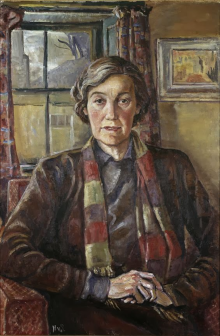
Birth of Evie Hone, Painter & Stained Glass Artist

Eva Sydney Hone RHA, Irish painter and stained glass artist usually known as Evie, is born at Roebuck Grove, County Dublin, on April 22, 1894. She is considered to be an early pioneer of cubism, although her best known works are stained glass. Her most notable pieces are the East Window in the Chapel at Eton College, which depicts the Crucifixion, and My Four Green Fields, which is now in the Government Buildings in Dublin.

Hone is the youngest daughter of Joseph Hone, of the Hone family, and Eva Eleanor (née Robinson), daughter of Sir Henry Robinson and granddaughter of Arthur Annesley, 10th Viscount Valentia. Her mother dies two days after her birth. She is related to artists Nathaniel Hone and Nathaniel Hone the Younger.

Shortly before her twelfth birthday, Hone suffers from polio (infant paralysis), suffering a fall while helping to decorate the Taney parish church for Easter. Her resulting ill health leads to her seeking treatment in Harley Street, Marylebone, Central London. She is educated by a governess, continuing her education in Switzerland, and goes on tours to Spain and Italy before moving to London in 1913. Her three sisters all marry British Army officers, and all are widowed in World War I.

Hone studies at the Byam Shaw School of Art in London and then under Bernard Meninsky at the Central School of Arts and Crafts. She meets Mainie Jellett when both are studying under Walter Sickert at the Westminster Technical Institute. She works under André Lhote and Albert Gleizes in Paris before returning to become influential in the modern movement in Ireland and becoming one of the founders of the Irish Exhibition of Living Art. She is considered an early pioneer of Cubism but in the 1930s turns to stained glass, which she studies with Wilhelmina Geddes.

Hone is extremely devout. She spends time in an Anglican Convent in 1925 at Truro in Cornwall and converts to Catholicism in 1937. This possibly influences her decision to begin working in stained glass. Initially, she works as a member of the An Túr Gloine stained glass co-operative before setting up a studio of her own in Rathfarnham.

Hone’s most important works are probably the East Window, depicting the Crucifixion, for the Chapel at Eton College, Windsor (1949–1952) and My Four Green Fields, now located in Government Buildings, Dublin. This latter work, commissioned for the Irish Government’s Pavilion, wins first prize for stained glass in the 1939 New York World’s Fair. It graces CIÉ‘s Head Office in O’Connell Street from 1960 to about 1983. The East Window of Eton College is commissioned following the destruction of the building after a bomb is dropped in 1940 on the school during World War II. She is commissioned to design the East Window in 1949, and the new window is inserted in 1952. This work is featured on an Irish postage stamp in 1969. From December 2005 to June 2006, an exhibition of her work is on display at the National Gallery of Ireland. Saint Mary’s church in Clonsilla also features her stained glass windows.

Despite ill health, Hone continues to produce a huge number of small stained glass panels as well as oils, watercolours, and gouache landscapes. In 1953, she is represented at the Contemporary Irish Art exhibition at Aberystwyth, Wales, and at the Tate gallery in London, receiving as well an honorary LLD from Trinity College Dublin (TCD). In 1954, she is elected an honorary member of the Royal Hibernian Academy (RHA).

Unmarried, Hone dies on March 13, 1955, while entering her parish church at Rathfarnham. She is survived by two of her sisters. Over 20,000 people visit a memorial exhibition of her work at University College Dublin (UCD), Earlsfort Terrace, Dublin, in 1958.

(Pictured: Portrait of Evie Hone by Hilda van Stockum)


Leave a comment

Death of Opera Singer Margaret Burke Sheridan

Irish opera singer Margaret Burke Sheridan dies in Dublin on April 16, 1958. She is known as Maggie from Mayo and is regarded as Ireland’s second prima donna, after Catherine Hayes (1818–1861).

Sheridan is born in Castlebar, County Mayo, on October 15, 1889. She has her early vocal training while at school at the Dominican Convent in Eccles Street, Dublin, with additional lessons from Vincent O’Brien. In 1908, she wins a gold medal at the Feis Ceoil. From 1909 to 1911 she studies at the Royal Academy of Music in London, during which time she is introduced to the Italian inventor Guglielmo Marconi, who is instrumental in arranging further studies for her in opera in Rome.

With Marconi’s help, Sheridan auditions in 1916 for Alfredo Martino, a prominent singing teacher attached to the Teatro Costanzi, and she makes her début there in January 1918 in Giacomo Puccini‘s La bohème. In July 1919 she appears at the Royal Opera House in Covent Garden in the title role in Iris by Pietro Mascagni.

Sheridan returns to Italy, where her career continues to grow, with performances at the Teatro Dal Verme in Milan and at the Teatro di San Carlo in Naples, primarily in Puccini roles. In 1922 she first sings at La Scala, Milan, in La Wally by Alfredo Catalani under the direction of Arturo Toscanini. For the next few years, she sings at La Scala with great success. Perhaps her greatest role is Madama Butterfly, which she sings extensively in Italy and at Covent Garden. When she plays the part of Madama Butterfly, Puccini is said to be spellbound.

Despite her successes, Sheridan’s career is short. Suffering vocal difficulties, she goes into retirement around 1930 except for a few concerts. Bríd Mahon, in her 1998 book While Green Grass Grows, states that “It was rumoured that an Italian whose overtures she had rejected had blown his brains out in a box in La Scala, Milan, while she was on stage and that after the tragedy, she never sang in public again.”

Margaret Sheridan dies in relative obscurity on April 16, 1958, having lived in Dublin for many years, and her remains are buried in Glasnevin Cemetery, Dublin.

(Pictured: Margaret Burke Sheridan meets Italian conductor Vincenzo Bellezza in London, 1938. Photograph by Erich Salomon)


Leave a comment

Birth of William Brownlow, MP and Landowner

William Brownlow, MP and landowner, is born on April 10, 1726, the son of William Brownlow (1683–1739), landowner and MP for County Armagh (1711–27), and Lady Elizabeth Brownlow of County Armagh, and grandson of Arthur Brownlow. His mother is a daughter of James Hamilton, 6th Earl of Abercorn. He inherits the family estates around Lurgan in 1739 and spends some of his youth in France and Italy with his mother.

Brownlow’s father, grandfather, and great-grandfather had been MPs, and in 1753 he wins a hotly contested by-election in which his opponents accuse him of papist and Jacobite sympathies. The unsuccessful candidate is Francis Caulfeild, brother of James, 1st Earl of Charlemont, his petition to parliament causing a furor and is defeated by only one vote in one of the most celebrated electoral struggles of the day. Brownlow represents the county for over forty years, from 1753 until his death. In 1753, he supports the government on the controversial money bill.

Brownlow marries Judith, daughter of the Rev. Charles Meredyth, Dean of Ardfert, of County Meath, on May 25, 1754. They have two sons. After her death in Lyon, France, in October 1763, he marries Catherine, daughter of Roger Hall of Newry, County Down, on November 25, 1765. They have two sons and five daughters, three who marry into the nobility. In 1758, he is one of the Wide Streets commissioners in Dublin and owns an imposing house in Merrion Square. He is a trustee of the linen board in Ulster, and makes many improvements to his estate, castle, and demesne, the local church, and the town of Lurgan. However, it is alleged that private roads in his demesne were built with public money. He is one of a few landowners in County Armagh who are believed to have misappropriated the unusually high county cess levied by the grand jury, of which he is a member. In 1758, he suggests that salaries be paid to government officials, and one official, Henry Meredyth, his first wife’s uncle, subsequently receives an annual salary of £500.

In June 1763, large numbers of Presbyterian farmers and weavers, calling themselves the Hearts of Oak, in a notable show of dissatisfaction with the privileges of landlords, march on the homes of the gentry to demand redress. Brownlow is in England and avoids a confrontation. Despite the allegations of abuse of public money, he is generally recognised as one of the more independent and reform-minded MPs of the day. He captains a Volunteer troop of dragoons which march from Lurgan to assist Belfast after the French commander François Thurot lands at Carrickfergus in 1760. As one of the supporters of Henry Grattan, he is prominent in the Volunteer movement of the 1780s. He is captain of the Lurgan Volunteer company and lieutenant-colonel of the northern battalion and backs the movement in parliament until displeased by the Volunteer national convention (November 10 – December 2, 1783), which seeks franchise reform and seems to challenge the authority of the existing parliament.

Brownlow subscribes £9,000 to help found the Bank of Ireland in 1783, and in parliament on February 7, 1785, vigorously opposes William Pitt‘s proposals on Ireland’s commercial relations with England, seeing in them the danger that Ireland would become a “tributary nation.” He is appointed a privy councilor in 1765. He organises horse races in his locality and is a talented harpsichord player. After his death on October 28, 1794, the Belfast News Letter prints an unusually long and glowing tribute, expressing admiration for his “incorruptible integrity” and patriotism, as well as two poetic elegies. He is succeeded by his son William Brownlow.

(From: “Brownlow, William” by Linde Lunney, Dictionary of Irish Biography, http://www.dib.ie, October 2009 | Pictured: Portrait of the Right Honorable William Brownlow, oil on canvas by Gilbert Stuart, circa 1790)


Leave a comment

Death of Kathleen Napoli McKenna, Nationalist Activist & Journalist

Kathleen Napoli McKenna, Irish nationalist activist and journalist closely associated with Arthur Griffith, dies in Rome, Italy, on March 22, 1988.

McKenna is born Kathleen Maria Kenna on September 9, 1897, in Oldcastle, County Meath. Her parents are William, a draper and hardware merchant, and Mary Kenna (née Hanley). She is the eldest child of seven, with three sisters and three brothers. She and her siblings add “Mc” to their surname as teenagers. Her maternal grandfather, a Fenian, miller and land agitator, is a strong influence on her. Agnes O’Farrelly is her paternal great aunt. She attends the Oldcastle Endowed School and goes on to pass the National University of Ireland (NUI) matriculation examination. She attends University College Dublin (UCD) briefly, but the family’s circumstances prevent her from completing her course.

McKenna’s father had been an active member of the Irish National Land League and the Meath Labour Union. He is one of the organisers of a short-lived local newspaper, Sinn Féin – Oldcastle Monthly Review, in 1902. Both her parents are members of Conradh na Gaielge. Arthur Griffith and Brian O’Higgins frequently visit the family home. Denounced by the local parish priest, Fr. Robert Barry, her father’s business goes into decline. The family leaves Oldcastle and moves to Dundalk in August 1915, and to Rugby, Warwickshire, England, in March 1916. In Rugby, her father teaches typing and shorthand, and her mother works in an ammunition factory. She works as a secretary for an engineering firm. Members of the family return to Ireland from 1919 to 1922, and by the time of her father’s death in 1939, he is living back in Oldcastle.

McKenna spends some holidays in Ireland and, during a visit to Dublin in the summer of 1919, she presents herself to the Sinn Féin offices in Harcourt Street. She has a letter of introduction from her father to Griffith, which emphasises her willingness to work for Irish independence. For her holidays, she works in the Sinn Féin press bureau and is employed as one of the first “Dáil girls” of the clandestine government. She is informed that if a planned news bulletin comes through, she will be summoned back to Dublin. In October 1919, she receives that summons and, after a typing test on November 11, she joins the Irish Bulletin under Minister for Publicity, Desmond FitzGerald, and director of publicity, Robert Brennan. She also becomes a member of the Conradh na Gaielge Parnell branch.

The Irish Bulletin is published five times a week, circulating the misdeeds of the British government in Ireland. McKenna edits and mimeographs a summary of “acts of aggression” from British forces in Ireland weekly, compiled by Anna Kelly. Frank Gallagher does most of the writing, edited by FitzGerald, and later Erskine Childers. Though she is sometimes described as the Bulletin‘s editor, she is more akin to an editorial assistant. R. M. Smyllie later recalls that she was in regular contact with the media. She types out each issue on a wax stencil in a typewriter which is used to create mimeograph copies, and then circulated to England. In the beginning, about 30 recipients, mostly London journalists, receive the Bulletin but by October 1920 it has grown to 600, and by July 1921 over 1,200. She also keeps the accounts, takes dictation of statements, and at times works up articles from notes given to her by Griffith or others. She also acts as a confidential messenger, couriering between Dáil departments and Irish Republican Army (IRA) leaders such as Michael Collins. Through this, she meets Moya Llewelyn Davies.

The Bulletin becomes a symbol of the underground government and a target for British forces. This necessitates the frequent moving of the operation from one Dublin hideout to another. She fears that if she were captured, she would break under interrogation. When FitzGerald is arrested, he is asked about “the girl wearing a green tam” in reference to McKenna’s tam-o’-shanter hat which prompts her to change her choice of hat. Despite the capture of a number of the Bulletin staff, as well as the capture of the office files and equipment on March 26, 1921, it never misses an issue.

McKenna’s sister Winifred also works as a secretary to the clandestine government. Her brother, Tadhg (Timothy), is a member of Sinn Féin and in Greenore, County Louth, is involved in trade union affairs. He is detained, beaten, and interned in March 1921. He is later an activist with the Irish Labour Party. Her brother William is a messenger for the Irish government during this period and during the Irish Civil War serves in the Free State Army.

After the truce in 1921, McKenna is assigned to the Dáil cabinet secretarial staff at the Mansion House, where she continues to work in the publicity department. She travels as Griffith’s private secretary to London as part of the Irish delegation to the treaty negotiations in October 1921. She is an admirer of both Griffith and Collins and is a firm supporter of the Anglo-Irish Treaty. She works as Griffith’s secretary until just before his death and also does some secretarial work for Collins during the negotiations. One of her sisters is anti-Treaty, and she later recalls that she lost friends due to her support of the treaty.

When the Irish Free State government is established, McKenna becomes a private secretary to a number of Ministers for External Affairs, including FitzGerald, Kevin O’Higgins and W. T. Cosgrave. In 1924, she is a private secretary to the Boundary Commission, as well as one of a pair of secretaries who travels with the Irish delegation to the London Imperial Conference in 1924. From 1927 to 1931 she is James Dolan‘s secretary and parliamentary secretary to the Minister for Industry and Commerce. Before its closure in 1924, she writes a number of articles for the Freeman’s Journal.

McKenna marries Vittorio Napoli in 1931. He is a captain, and later a general, in the Italian royal grenadier guards. They meet when she is on holiday in Italy in 1927. For the first five years of their marriage, they live in the port of Derna in Cyrenaica, Libya, while her husband is stationed there. A son and daughter are born there. From September 1939 to June 1940, the family lives in Albania, but after Italy enters World War II, she and the children move to Viterbo. Her husband is taken prisoner in Greece in September 1943, and is detained in Germany and Poland. He returns to Italy in September 1945. Viterbo had been heavily bombed, and after Allied troops arrive, McKenna works as a translator and gives English language lessons to support her family. Her husband remains in the army, and they remain in Viterbo until 1956, later moving to Rome.

After the war, McKenna writes articles for the Irish Independent and other publications from Ireland, the United States and New Zealand, including The Irish Press, Irish Travel, Standard, Word, and Writer’s Digest. Sometimes she writes under her own name, as well as her pen name Kayn or Kayen MacKay. As the wives of Italian officers do not traditionally work, the money she earns from this is kept for travel and other leisure activities. This money allows her to visit her family in Ireland in 1947 for the first time since 1932. After their retirement, she and her husband visit Ireland regularly, and travel around Italy.

McKenna applies for an Irish military pension in 1950/51 and 1970, receiving references in support of her claim from Gallagher. As she had not served in a military organisation, her claims are rejected. As an Irish War of Independence veteran, she is awarded free travel in 1972, which is later extended to her husband. In her later years, she becomes concerned about the inaccuracies in the history around the Irish War of Independence and the Irish Civil War. She gives two talks to Radio Éireann in 1951, speaking about her time with the Irish Bulletin. Copies of these recordings are now held by the Bureau of Military History. During her lifetime, extracts of her memoir are published in the Capuchin Annual and The Irish Times. She drafted and redrafted these memoirs from the late 1940s to the early 1980s. A version edited by her daughter and niece is published in 2014 as A Dáil girl’s revolutionary recollections.

McKenna dies on March 22, 1988, in Rome. She is buried with an Irish flag which she had kept with her. A large collection of her papers is held in the National Library of Ireland (NLI). In 2010, 2011 and 2016, some of her memorabilia is sold in Dublin.


Leave a comment

Birth of Tom Hales, IRA Volunteer & Fianna Fáil Politician

Thomas Hales, Irish Republican Army (IRA) volunteer and Fianna Fáil politician, is born in Knocknacurra House, Ballinadee, near Bandon, County Cork, on March 5, 1892.

Hales is born on a family farm owned by his father, Robert Hales, an activist in the Irish Land War and a reputed member of the Irish Republican Brotherhood (IRB) and his wife, Margaret (née Fitzgerald). He is the sixth of nine children (five sons and four daughters). He is educated at Ballinadee national school and Warner’s Lane school, Bandon. After leaving school he works at Harte’s timber yard, Bandon.

Hales joins and is involved with the Irish Volunteers movement from its inception in November 1913. Elected a delegate at the Volunteer national convention in the Abbey Theatre in 1915, he is among the majority who vote for the election of the national executive.

Hales is a part of a group of volunteers who are mobilised and plan to rise up in Cork during the 1916 Easter Rising. He sends a number of dispatches to Cork requesting further instructions. However, they receive last minute orders to stand down and there is no uprising in Cork to match that in Dublin. The Volunteers give up their arms and are later arrested.

By May 1916, Hales and his brothers, Seán, Bob, and William, are fighting with the IRA in west Cork during the Irish War of Independence. Terence MacSwiney is arrested in Hales’ home on May 3, 1916, and Hales himself escapes and goes on the run. He states that he was listed as “wanted” in the Hue and Cry police gazette.

In 1918, Hales takes part in a raid on a British gunboat and holds 25 armed Royal Irish Constabulary (RIC) members prisoner at Snugmore Castle. He takes part in a decoy in assisting his elder brother, Seán, to escape after his arrest in connection with the German Plot. He is elected Battalion Commandant of the 1st (Bandon) Battalion (1917–19), and Brigade Commandant of Cork 3rd Brigade, IRA, in January 1919.

In December 1919, Hales takes part in an ambush against the RIC at Kilbrittain and Bandon and is involved in the manufacture of gunpowder for IRA munitions. By this point he is the commander of the Third Cork Brigade of the IRA. In July 1920, he along with Harte is arrested by soldiers from the Essex Regiment.

The pair are taken to a nearby military barracks, where they are severely beaten while being interrogated by officers of the regiment. Hales has his fingernails pulled out, an event that later inspires a scene in the film The Wind That Shakes the Barley. However, neither Hales nor Harte give up any information and are eventually sent to a military hospital to recuperate. Hales is tried and is eventually sentenced to two years’ penal servitude, which he serves in Pentonville and Dartmoor prisons in England. He is commander of the Irish prisoners at Pentonville, but is released following a general amnesty after the Anglo-Irish Treaty in December 1921. According to Tom Barry, Harte suffers brain damage and goes insane before dying in Broadmoor Hospital.

A fifth Hales brother, Donal, settles in Genoa from 1913, and is appointed Irish Consular and Commercial Agent for Italy in February 1919. In this capacity he plays a leading propaganda role. Several letters from Michael Collins to Donal Hales still exist which are used by Hales to promote international awareness of the Irish conflict in Italian publications. Donal oversees a failed attempt to import a substantial number of Austrian weapons and ammunition captured from World War I, from Genoa in the spring of 1921, through the person of Gabriele D’Annunzio.

During the Irish Civil War, Tom and Seán Hales fight on opposite sides, with Hales fighting against the Anglo-Irish Treaty with the Anti-Treaty IRA while Seán joins the newly formed National Army of the Irish Free State. While the bothers end up on opposite sides of the war, they never openly criticise one another for their rival political stances.

Hales is elected to the anti-Treaty IRA executive in March 1922, but resigns in June over a proposal to prevent the Free State’s first general election in June 1922. He resumes his old rank during the Irish Civil War as commander of Cork 3 Brigade.

During the Irish Civil War in July 1922, Hales takes part in the raid and capture of Skibbereen Barracks and Ballineen by anti-Treaty forces. He is also involved in a skirmish with Free State troops at Newcestown. He is arrested in November 1922 and imprisoned first in Cork and then at the Curragh. He is released in December 1923, having taken part in a hunger strike for fourteen days. He mentions in his application for a military pension that he was a member of the Supreme Council of the IRB at this time.

In December 1922, Hales’s brother Seán is assassinated by the anti-Treaty IRA in Dublin, in reprisal for the Free State government’s execution of IRA prisoners. Hales later applies to the Irish government for a service pension under the Military Service Pensions Act, 1934 and is awarded nine years’ service in 1935 at Grade B for his service with the Irish Volunteers and the IRA between April 1, 1917, and September 30, 1923.

Hales is elected to Dáil Éireann as a Fianna Fáil Teachta Dála (TD) for the Cork West constituency at the 1933 Irish general election. He resigns from Fianna Fáil in June 1936 stating he cannot support their policy on interning IRA members. He fails to retain his seat as an independent candidate at the 1937 Irish general election. He also unsuccessfully contests the 1944 Irish general election as an independent candidate and the 1948 Irish general election as a candidate for Clann na Poblachta, receiving 2,287 votes (7.93%).

Hales makes his living as farmer. A member of the Mallow area board of the beet growers’ association from 1934 to 1942, he is also connected with other farming organisations. He marries Ann Lehane from Tirelton, Macroom, on April 30, 1927. They have five children, Seán, Robert, Thomas, Eileen, and Margaret.

Hales dies on April 29, 1966, at St. Finbarr’s Hospital, Cork, and is buried at St. Patrick’s Cemetery, Bandon.


Leave a comment

Birth of Michael McCarthy, Professional Football Player & Manager

Michael Joseph “Mick” McCarthy, professional football manager, pundit and former player, is born on February 7, 1959, in Barnsley, South Yorkshire, England. He is most recently the head coach of Blackpool.

McCarthy makes his league debut for then-Fourth Division Barnsley on August 20, 1977, in a 4–0 win over Rochdale. He spends two years in the basement league, before the club wins promotion. A strong central defender, he is a virtual ever-present for his hometown club, but departs in December 1983 for fellow Division 2 club Manchester City.

Manchester City wins promotion in McCarthy’s first full season, and he finally has the chance to play at the highest level. His first season in the topflight is steady enough as the club reaches mid-table, but relegation strikes the following year. However, he does not face the drop as he signs for Celtic in May 1987 in a surprise £500,000 move.

McCarthy is brought to Parkhead by David Hay but within days of the signing the Celtic boss is sacked. Fortunately for McCarthy, Hay’s replacement is the returning Parkhead legend Billy McNeill, who quickly recognises that McCarthy’s strength and aggression are qualities desperately required by a notoriously leaky Celtic defence. He picks up his first silverware with Celtic as they win the league and cup double in his first season. The following season he again wins a Scottish Cup winners medal, although the club has to settle for third place in the league.

If ever an example is needed to reflect McCarthy’s values, it cannot be bettered than that on the day of the 1998 Scottish Cup Final. Celtic wins 2-1, but to the disgust of many, the unpopular Conservative Prime Minister Margaret Thatcher is in attendance and to present the trophy to the winners. The players are under pressure from the Scottish Football Association (SFA) to meet her, but a few refuse. According to fellow Celtic player Andy Walker, McCarthy refuses point-blank, as he is from Barnsley and the son of a miner. Shaking hands with her is an impossibility for him.

In the summer of 1988, McCarthy joins fellow Celtic players Packie Bonner and Chris Morris in Germany as part of the Republic of Ireland European Championship squad and gives a fine account of himself particularly in the historic 1-0 win over England. He, like Bonner and Morris, also star in the Republic’s 1990 FIFA World Cup squad which makes it to the quarterfinals in Italy.

In terms of his Celtic career, McCarthy never repeats the achievements or level of performance of his debut season.

McCarthy signs for Lyon in the summer of 1989 for £350,000. Afflicted by injuries and mindful of his spot in Ireland’s World Cup team, he finishes that season on loan to Millwall. After a captain’s showing in Italy for the Ireland national side, Millwall signs him full-time and later he becomes manager at The Den in 1992. In February 1996, he follows Jack Charlton into the Ireland manager’s job and experiences various highs and lows over his nearly seven years in charge. He has since managed Sunderland and Wolverhampton Wanderers.

In later years McCarthy becomes a low-key candidate for the Celtic manager’s job after the departures of Martin O’Neill and Gordon Strachan but is never favoured by the board or the general support for the role. Ironically then in 2018, he takes over from Martin O’Neill following his second stint as the Ireland manager. Notably, Roy Keane is Martin O’Neill’s assistant and has to step down also. On April 4, 2020, amid the global coronavirus pandemic, he stands down as manager and is immediately replaced by Stephen Kenny.

McCarthy joins Cypriot First Division club APOEL as manager on November 2, 2020, signing a contract until 2022. He is sacked by the club on January 5, 2021, following a run of 2 wins, 1 draw and 5 defeats in his eight games in charge.

On January 22, 2021, McCarthy is appointed as manager of Cardiff City, following the sacking of Neil Harris. He signs a contract until the end of the season. After making an unbeaten start to his reign at the club, a run that includes a six-game winning streak, he signs a new two-year deal with the club on March 4, 2021. Cardiff finishes the season in 8th place. Despite losing one of their opening six matches at the start of the following season, a run of results follows which sees Cardiff drop as low as 21st in the table. On October 23, 2021, after suffering a club-record eighth successive loss of the season at the hands of Middlesbrough, McCarthy leaves the club by mutual consent.

On January 19, 2023, McCarthy is appointed head coach of the Championship’s second-bottom placed club Blackpool on a short-term contract until the end of the season. On April 8, 2023, he leaves Blackpool by mutual consent, following a 3–1 home defeat to Cardiff the previous day. He achieves two wins in his 14 games in charge, losing nine of them, which leaves the club in 23rd position. “With results on the pitch not improving in recent weeks, the decision has been agreed by both parties that a change is needed,” the club says in a statement.


Leave a comment

“The Siege of Rochelle” First Performed at Drury Lane Theatre

Irish composer Michael William Balfe‘s opera The Siege of Rochelle is first performed at the Drury Lane Theatre in London on October 29, 1835.

The opera is originally prepared for the English Opera House but for some reason the theatrical manager, Samuel James Arnold, does not want it. Instead, Alfred Bunn, the manager of Drury Lane Theatre, seizes the opportunity and begins what is a very fruitful collaboration with Balfe that lasts a decade. Balfe is to become the mainstay of English Opera for almost the next 30 years with a succession of popular operas.

The opera runs for 70 nights on its initial run and is revived in the following three seasons with Balfe singing the role of Michel. Queen Victoria sees the opera on November 15, 1837, her first state visit to a theatre during her reign. In 1836, the opera is reported as staged in Leeds, York, Sheffield, Manchester, Liverpool, Bath and Dublin with Abigail Betts as Clara. John Wilson, who sings in the initial run of the opera, also sings in, at least, some of these. Madame Balfe chooses the opera for her benefit in 1841, and Bunn opens his 1843 season with it on September 30. Emma Romer uses it to open her 1853 season at the Surrey Theatre, although it is being described by then as “somewhat hacknied.”

October 1875 sees a revival of the opera by the Carl Rosa Opera Company at the Princess’s Theatre, and it is then included in the company’s repertoire that tours to Manchester in 1875, Liverpool in 1876, Birmingham in 1877 and Dublin in 1879. The Turner Company tours it in 1893. This is possibly the opera’s last performance until the Wexford Festival Opera performances in 1963. The overture and songs from the opera, such as “When I beheld the anchor weigh’d” continue to retain a place in the concert hall and the home into the 20th century.

In 1838, the opera is performed by the Caradori-Allan troupe at the Park Theatre in New York but fails although it appears to be retained in the repertory. In 1839, it is performed again in Dublin with Balfe as Michel and in Sydney in 1848.

The opera’s production sparks an acrimonious argument between a correspondent in The Examiner accusing Balfe of plagiarism from Luigi Ricci‘s 1832 opera, Chiara di Rosemberg, and, in defence, Frederick Beale, from Balfe’s publishers, and Balfe. The matter seems to be settled in Balfe’s favour when the score of Chiara di Rosemberg is displayed at music publisher Cramer, Beale and Co. so that people can compare the two for themselves. While Edward Fitzball probably uses Ricci’s libretto as the basis for his, it does not seem to have been a straight translation, as some allege, but similarities would help to feed the accusations of plagiarism, bolstered by the Italian training and approach of both composers and the fact that Balfe had sung in Chiara di Rosemberg in Italy in 1834.

Balfe is said to have been paid £5 a night by Bunn and 400 guineas for the score by the publishers Cramer, Beale and Co. In 1871, the Bury and Norwich Post (April 11, 1871) report that the copyright has sold for £156 and just over ten years later the Aberdeen Evening Express (May 8, 1883) notes that the copyright has been sold again for approximately £20, adding “So much for Balfe’s ‘popularity.”