Seán Proinsias Ó Faoláin, short story writer of international repute and one of the most influential figures in 20th-century Irish culture, dies in Dublin on April 20, 1991. He is also a leading commentator and critic.
Ó Faoláin writes his first stories in the 1920s, eventually completing ninety stories over a period of sixty years. From 1929 to 1933 he lectures at the Catholic college, St. Mary’s College, at Strawberry Hill, London, during which period he writes his first two books. His first book, Midsummer Night Madness, is published in 1932. It is a collection of stories partly based on his Civil War experiences. He afterward returns to Ireland. He publishes four novels, seven additional volumes of short stories, six biographies, three travel books, a play, a memoir, a history book, translations and literary criticism, including one of the rare full-length studies of the short story, The Short Story (1948). He also writes a cultural history, The Irish, in 1947. His last short story volume, Foreign Affairs, is published in 1976. His Collected Stories is published in 1983.
Ó Faoláin produces critical studies of the novel and the short-story form, introduces texts of historical and literary merit, and contributes scores of articles, reviews, and uncollected stories to periodicals in Ireland, Britain, and the United States.
Ó Faoláin is a founder member and editor of the Irish literary periodical The Bell from 1940 to 1946. Under his editorship, The Bell participates in many key debates of the day. It also provides a crucial outlet for established and emerging writers during the lean war years. The list of contributors to The Bell include many of Ireland’s foremost writers, among them Patrick Kavanagh, Patrick Swift, Flann O’Brien, Frank O’Connor and Brendan Behan.
A recurring thread in Ó Faoláin’s work is the idea that national identities are historically produced and culturally hybrid; an additional thesis is that Irish history should be conceived in international terms, and that it should be read, in particular, in the context of social and intellectual developments across Europe.
Ó Faoláin marries Eileen Gould, a children’s book writer who publishes several books of Irish folk tales, in 1929. They have two children: Julia (1932–2020), who becomes a Booker-nominated novelist and short story writer, and Stephen (b. 1938).
Ó Faoláin dies in Dublin at the age of 91 on April 20, 1991.
Ó Faoláin is a controversial figure in his own lifetime and two of his books are banned for “indecency” in Ireland — his debut collection of short stories and his second novel, Bird Alone (1936). His legacy has proven divisive. If some consider him a social liberal cosmopolitan who challenges “proscriptive” definitions of Irish culture, others see him as a chauvinistic snob who paradoxically restricts the development of Irish writing. Proto-revisionist or nascent postcolonial, O’Faoláin has been considered both, sometimes within the same critical survey. Either way, his work is central to the evolution of a post–Literary Revival aesthetic, and his voice is one of the most prominent, and eloquent, in the fight against censorship in Ireland.
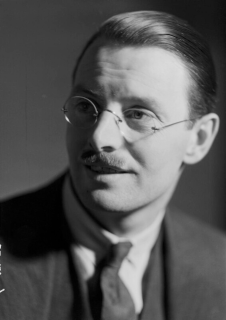
(Pictured: Portrait of Seán Ó Faoláin by Howard Coster, 1930s, National Portrait Gallery)
Sheridan is born in Castlebar, County Mayo, on October 15, 1889. She has her early vocal training while at school at the Dominican Convent in Eccles Street, Dublin, with additional lessons from Vincent O’Brien. In 1908, she wins a gold medal at the Feis Ceoil. From 1909 to 1911 she studies at the Royal Academy of Music in London, during which time she is introduced to the Italian inventor Guglielmo Marconi, who is instrumental in arranging further studies for her in opera in Rome.
Sheridan returns to Italy, where her career continues to grow, with performances at the Teatro Dal Verme in Milan and at the Teatro di San Carlo in Naples, primarily in Puccini roles. In 1922 she first sings at La Scala, Milan, in La Wally by Alfredo Catalani under the direction of Arturo Toscanini. For the next few years, she sings at La Scala with great success. Perhaps her greatest role is Madama Butterfly, which she sings extensively in Italy and at Covent Garden. When she plays the part of Madama Butterfly, Puccini is said to be spellbound.
Despite her successes, Sheridan’s career is short. Suffering vocal difficulties, she goes into retirement around 1930 except for a few concerts. Bríd Mahon, in her 1998 book While Green Grass Grows, states that “It was rumoured that an Italian whose overtures she had rejected had blown his brains out in a box in La Scala, Milan, while she was on stage and that after the tragedy, she never sang in public again.”
Margaret Sheridan dies in relative obscurity on April 16, 1958, having lived in Dublin for many years, and her remains are buried in Glasnevin Cemetery, Dublin.
(Pictured: Margaret Burke Sheridan meets Italian conductor Vincenzo Bellezza in London, 1938. Photograph by Erich Salomon)
Henry is the third of four sons of the Rev. Robert Mitchell Henry, minister of the Reformed Presbyterian Church, and his wife Kate Ann Berry, eldest of four daughters of Thomas Berry, minister of the Baptist church, Athlone. His father becomes a Baptist in 1858 and pastor of Great Victoria Street Baptist Church, Belfast, resigning in 1875 to join the Plymouth Brethren.
Henry marries the painter Emily Grace Mitchell on September 17, 1903, in London at St Peter’s Anglican church, Bayswater. He returns to Ireland in 1910. From then until 1919 he lives on Achill Island, where he learns to capture the peculiar interplay of light and landscape specific to the west of Ireland. In 1919, he moves to Dublin and in 1920 he is one of the founders of the Society of Dublin Painters, originally a group of ten artists. He designs several railway posters, some of which, notably Connemara Landscape, achieves considerable sales. He separates from his wife in 1929. His second wife is the artist Mabel Young.
In the 1920s and 1930s, Henry is Ireland’s best-known artist, one who has a considerable influence on the popular image of the west of Ireland. Although he seems to cease experimenting with his technique after leaving Achill and his range is limited, he creates a large body of fine images whose familiarity is a testament to its influence.
Henry’s use of colour is affected by his red-green colour blindness. He loses his sight in 1945 and does not regain his vision before his death.
A commemorative exhibition of Henry’s work is held at Trinity College, Dublin, in 1973 and the National Gallery of Ireland holds a major exhibition of his work in 2004.
A painting by Henry is featured on an episode of the BBC‘s Antiques Roadshow, broadcast on November 12, 2006. The painting is given a value of approximately £40,000–60,000 by the Roadshow. However, due to the buoyancy of the Irish art market at the time, it sells for €260,000 on December 5, 2006, in James Adams’ and Bonhams’ joint Important Irish Art sale.
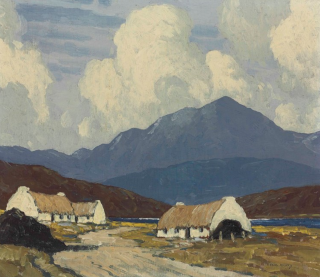
Pictured: “Roadside Cottages, below Mweelrea Mountain” by Paul Henry, RHA, oil on panel, 1940)
Josephine McNeill, Irish diplomat, is born on March 31, 1895, in Fermoy, County Cork. She is the first Irish female diplomat appointed to represent Ireland abroad in a ministerial capacity.
McNeill is born Josephine Ahearne, the daughter of shopkeeper and hotelier, James Ahearne, and his wife Ellen Ahearne (née O’Brien). She attends the Loretto Convent, Fermoy, and goes on to graduate from University College Dublin (UCD) with a BA, H.Dip.Ed. in French and German. With this she begins a teaching career, at St. Louis’ Convent, Kiltimagh, at the Ursuline Convent, Thurles, and at Scoil Íde. Scoil Íde, the female counterpart to St. Enda’s School, had been established by her friend, Louise Gavan Duffy. She is fluent in the Irish language and takes an active part in the cultural elements of the Irish independence movement, such as literature and music. She is a member of Cumann na mBan, serving as a member of the executive committee in 1921.
After the death of her husband in 1938, McNeill becomes the honorary secretary of the council of the Friends of the National Collections, as well as serving as chair of the executive committee of the Irish Countrywomen’s Association until 1950. As a member of the Department of External Affairs advisory committee on cultural relations, she writes on economic, social and cultural issues. She represents Ireland at the UNESCO general assembly in Paris in 1949.
McNeill is an active member of Clann na Poblachta from its foundation in 1946. She is appointed the minister to the Netherlands in 1950 by Seán MacBride, making her the first Irish female diplomat to represent the Republic of Ireland abroad in a ministerial capacity. This appointment is not well received by diplomats in the Department of External Affairs. Her reports from The Hague focus on the issues the Netherlands faces with decolonisation. In 1955, she becomes the minister to Sweden, going on to hold the joint appointment to Austria and Switzerland from 1956 to 1960, after which she retires. While serving in Switzerland she puts aside the resentment she feels towards Éamon de Valera based on how he had treated her husband, to sit with him during a convalescence while de Valera recovers from an eye operation.
McNeill is an amateur pianist and collects paintings and porcelains. In 1933, she publishes the Irish language book, Finnsgéalta ó India.
Boland is born on September 16, 1870, at 135 Capel Street, Dublin, to Patrick Boland, businessman, and Mary Donnelly. Following the death of his mother in 1882, he is placed with his six siblings under the guardianship of his uncle, Nicholas Donnelly, auxiliary bishop of Dublin.
Boland is educated at two private Catholic schools, the Catholic University School, Dublin, and Birmingham Oratory in Birmingham, England, where he becomes head boy. His secondary education at the two schools help give him the foundation and understanding to play an influential role in the politics of Great Britain and Ireland at the beginning of the 20th century, when he is a member of the Irish Parliamentary Party, which pursues constitutional Home Rule.
In 1892, Boland graduates with a BA from London University. He studies for a semester in Bonn, Germany, where he is a member of Bavaria Bonn, a student fraternity that is member of the Cartellverband. He studies law at Christ Church, Oxford, graduating with a BA in 1896 and MA in 1901. Although called to the Bar in 1897, he never practises.
Boland is the first Olympic champion in tennis for Great Britain and Ireland at the first modern Olympics, which take place in Athens in 1896. He visits his friend Thrasyvoulos Manos in Athens during the Olympics, and Manos, a member of the organising committee, enters Boland in the tennis tournament. He promptly wins the singles tournament, defeating Friedrich Traun of Germany in the first round, Evangelos Rallis of Greece in the second, Konstantinos Paspatis of Greece in the semifinals, and Dionysios Kasdaglis of Greece in the final.
Boland then enters the doubles event with Traun, the German runner whom he had defeated in the first round of the singles. Together, they win the doubles event. They defeat Aristidis and Konstantinos Akratopoulos of Greece in the first round, have a bye in the semifinals, and defeat Demetrios Petrokokkinos of Greece and Dimitrios Kasdaglis in the final. When the Union Jack and the German flag are run up the flagpole to honour Boland and Traun’s victory, Boland points out to the man hoisting the flags that he is Irish, adding “It [the Irish flag]’s a gold harp on a green ground, we hope.” The officials agreed to have an Irish flag prepared.
Following a visit to County Kerry, Boland becomes concerned about the lack of literacy among the native population. He also has a keen interest in the Irish Language.
Boland’s patriotic stand is well received in nationalist circles in Ireland. This and a lifelong friendship with John Redmond gain for him an invitation to stand as a candidate for the Irish Parliamentary Party in the safe seat of South Kerry, which he holds from 1900 to 1918. He is unopposed in the general elections of 1900 and 1906, and the first of 1910. In the second election of 1910 he is challenged by a local man, T. B. Cronin, who stands as an independent nationalist in the interest of William O’Brien. Boland stands down at the 1918 United Kingdom general election.
In 1908, Boland is appointed a member of the commission for the foundation of the National University of Ireland (NUI). From 1926 to 1947, he is General Secretary of the Catholic Truth Society. He receives a papal knighthood, becoming a Knight of St. Gregory in recognition for his work in education. In 1950, he is awarded an honorary Doctor of Law by the NUI.
Boland marries Eileen Moloney at SS Peter and Edward, Palace Street, Westminster, on October 22, 1902, the daughter of an Australian Dr. Patrick Moloney. They have one son and five daughters. His daughter Honor Crowley succeeds her husband Frederick Crowley upon his death sitting as Fianna FáilTD for South Kerry from 1945 until her death in 1966. His daughter Bridget Boland is a playwright who notably writes The Prisoner and co-writes the script for Gaslight, and, among other books, co-authors Old Wives’ Lore for Gardeners with her sister, Maureen Boland.
At 6 ft. 3 in. (191 cm) and 194 lbs. (88 kg), Sheridan is the best all-around athlete of the Irish American Athletic Club, and like many of his teammates, serves from 1906 until his death in 1918 with the New York City Police Department. He is so well respected in the NYPD, that he serves as the Governor’s personal bodyguard when the governor is in New York City.
In 1907, Sheridan wins the National Amateur Athletic Union (AAU) discus championship and the Canadian championship, and in 1908 he wins the Metropolitan, National and Canadian championships as well as two gold medals in the discus throw and a bronze medal in the standing long jump at the 1908 Olympic Games.
Two of Sheridan’s gold medals from the 1904 Olympic Games in St. Louis, Missouri, and one of his medals from the 1906 Olympic Games in Athens, are currently located in the USA Track & Field‘s Hall of Fame History Gallery, in Washington Heights, Manhattan.
It is often claimed that Sheridan fueled a controversy in London in 1908, when flagbearer Ralph Rose refused to dip the flag to King Edward VII. Sheridan supposedly supports Rose by explaining, “This flag dips to no earthly king,” and it is claimed that his statement exemplified both Irish and American defiance of the British monarchy. However, careful research has shown that this was first reported in 1952. Sheridan himself makes no mention of it in his published reports on the Games and neither does his obituary.
Sheridan dies in St. Vincent’s Hospital in Manhattan, New York, on March 27, 1918, the day before his 37th birthday, a very early casualty of the 1918 flu pandemic. He is buried in Calvary Cemetery, Queens, New York. The inscription on the granite Celtic Cross monument marking his grave says in part: “Devoted to the Institutions of his Country, and the Ideals and Aspirations of his Race. Athlete. Patriot.”
According to his obituary in The New York Times, Sheridan was “one of the greatest athletes the United States has ever known.”
(Pictured: Martin Sheridan from the historical picture collection of Knut Gulbrandsen)
At the age of 17, McCabe migrates to London and works as a teacher, returning to Ireland after finding success as a writer. He resides in Clones with his artist wife Margot Quinn and two daughters, Katie and Ellen.
McCabe’s books include The Butcher Boy (1992) and Breakfast on Pluto (1998), both shortlisted for the Booker Prize. He has written a children’s book, The Adventures of Shay Mouse (1985), and several of his radio plays have been broadcast by RTÉ and BBC Radio 4. He wrote a collection of linked short stories, Mondo Desperado, published in 1999. The play Frank Pig Says Hello, which he adapts from The Butcher Boy, is first performed at the Dublin Theatre Festival in 1992.
McCabe’s 2001 novel Emerald Germs of Ireland is a black comedy featuring matricide. Winterwood, published in 2006, is the 2007 Hughes & Hughes/Irish Independent Irish Novel of the Year. Three years later, 2009 sees the publication of The Holy City. The Stray Sod Country (2010) is described as “Strangely elegiac, gloriously operatic and driven by (…) wild and savage imagination, (…) an eerie folk tale that chronicles the passing of a generation.”
Zelig Theatre premieres the play Appointment in Limbo, written by McCabe and directed by Cathal Cleary, in Galway‘s Town Hall Theatre in 2008.
McCabe and British film director Kevin Allen are organisers of the Flat Lake Literary & Arts Festival, a music festival held annually since 2007 on the Hilton Park farm estate in Clones, County Monaghan.
Kavanagh’s mother insists that he be brought up and have opportunities like any other child and places him in the care of the doctor Francis Boxwell, who believes that an armless and legless child can live a productive life. Kavanagh learns to ride horses at the age of three by being strapped to a special saddle and managing the horse with the stumps of his arms. With the help of the surgeon Sir Philip Crampton, Lady Harriet has a mechanical wheelchair constructed for her son, and encourages him to ride horses and engage in other outdoor activities. He also goes fishing, hunting, draws pictures and writes stories, using mechanical devices supplementing his physical capacities. His mother teaches him how to write and paint holding pens and brushes in his mouth.
In 1846, Lady Harriet takes three of her children, Thomas, Harriet and Arthur, traveling to the Middle East for two years. Kavanagh nearly drowns in the Nile when he falls in while fishing and is rescued by a local antiquities salesman who dives in to pull him out.
In 1849, Kavanagh’s mother discovers that he has been having affairs with girls on the family estate, so she sends him into exile to Uppsala, and then to Moscow with his brother and a clergyman, whom he comes to hate. He travels extensively in Egypt, Anatolia, Persia, and India between 1846 and 1853. In India, his letter of credit from his mother is cancelled when she discovers that he has spent two weeks in a harem, so he persuades the East India Company to hire him as a despatch rider. Other sources say that this is due to the death of his eldest brother, Charles, of tuberculosis in December 1851, which leaves him with only 30 shillings.
Kavanagh dies of pneumonia in London at the age of 58 on December 25, 1889. He is buried in Ballicopagan cemetery. He is succeeded in the title of The MacMurrough by his son, Walter MacMurrough Kavanagh, who also serves as MP for County Carlow from 1908 to 1910. The 1901 novel The History of Sir Richard Calmady, written by Lucas Malet (pseudonym of Mary St. Leger Kingsley), is based on his life.
Kavanagh marries his cousin, Mary Frances Forde-Leathley, in 1855. Assisted by his wife, he is a philanthropic landlord, active county magistrate, and chairman of the board of guardians. Together, they have seven children.
McKenna is born Kathleen Maria Kenna on September 9, 1897, in Oldcastle, County Meath. Her parents are William, a draper and hardware merchant, and Mary Kenna (née Hanley). She is the eldest child of seven, with three sisters and three brothers. She and her siblings add “Mc” to their surname as teenagers. Her maternal grandfather, a Fenian, miller and land agitator, is a strong influence on her. Agnes O’Farrelly is her paternal great aunt. She attends the Oldcastle Endowed School and goes on to pass the National University of Ireland (NUI) matriculation examination. She attends University College Dublin (UCD) briefly, but the family’s circumstances prevent her from completing her course.
McKenna’s father had been an active member of the Irish National Land League and the Meath Labour Union. He is one of the organisers of a short-lived local newspaper, Sinn Féin – Oldcastle Monthly Review, in 1902. Both her parents are members of Conradh na Gaielge. Arthur Griffith and Brian O’Higgins frequently visit the family home. Denounced by the local parish priest, Fr. Robert Barry, her father’s business goes into decline. The family leaves Oldcastle and moves to Dundalk in August 1915, and to Rugby, Warwickshire, England, in March 1916. In Rugby, her father teaches typing and shorthand, and her mother works in an ammunition factory. She works as a secretary for an engineering firm. Members of the family return to Ireland from 1919 to 1922, and by the time of her father’s death in 1939, he is living back in Oldcastle.
McKenna spends some holidays in Ireland and, during a visit to Dublin in the summer of 1919, she presents herself to the Sinn Féin offices in Harcourt Street. She has a letter of introduction from her father to Griffith, which emphasises her willingness to work for Irish independence. For her holidays, she works in the Sinn Féin press bureau and is employed as one of the first “Dáil girls” of the clandestine government. She is informed that if a planned news bulletin comes through, she will be summoned back to Dublin. In October 1919, she receives that summons and, after a typing test on November 11, she joins the Irish Bulletin under Minister for Publicity, Desmond FitzGerald, and director of publicity, Robert Brennan. She also becomes a member of the Conradh na Gaielge Parnell branch.
The Irish Bulletin is published five times a week, circulating the misdeeds of the British government in Ireland. McKenna edits and mimeographs a summary of “acts of aggression” from British forces in Ireland weekly, compiled by Anna Kelly. Frank Gallagher does most of the writing, edited by FitzGerald, and later Erskine Childers. Though she is sometimes described as the Bulletin‘s editor, she is more akin to an editorial assistant. R. M. Smyllie later recalls that she was in regular contact with the media. She types out each issue on a wax stencil in a typewriter which is used to create mimeograph copies, and then circulated to England. In the beginning, about 30 recipients, mostly London journalists, receive the Bulletin but by October 1920 it has grown to 600, and by July 1921 over 1,200. She also keeps the accounts, takes dictation of statements, and at times works up articles from notes given to her by Griffith or others. She also acts as a confidential messenger, couriering between Dáil departments and Irish Republican Army (IRA) leaders such as Michael Collins. Through this, she meets Moya Llewelyn Davies.
The Bulletin becomes a symbol of the underground government and a target for British forces. This necessitates the frequent moving of the operation from one Dublin hideout to another. She fears that if she were captured, she would break under interrogation. When FitzGerald is arrested, he is asked about “the girl wearing a green tam” in reference to McKenna’s tam-o’-shanter hat which prompts her to change her choice of hat. Despite the capture of a number of the Bulletin staff, as well as the capture of the office files and equipment on March 26, 1921, it never misses an issue.
McKenna’s sister Winifred also works as a secretary to the clandestine government. Her brother, Tadhg (Timothy), is a member of Sinn Féin and in Greenore, County Louth, is involved in trade union affairs. He is detained, beaten, and interned in March 1921. He is later an activist with the Irish Labour Party. Her brother William is a messenger for the Irish government during this period and during the Irish Civil War serves in the Free State Army.
After the truce in 1921, McKenna is assigned to the Dáil cabinet secretarial staff at the Mansion House, where she continues to work in the publicity department. She travels as Griffith’s private secretary to London as part of the Irish delegation to the treaty negotiations in October 1921. She is an admirer of both Griffith and Collins and is a firm supporter of the Anglo-Irish Treaty. She works as Griffith’s secretary until just before his death and also does some secretarial work for Collins during the negotiations. One of her sisters is anti-Treaty, and she later recalls that she lost friends due to her support of the treaty.
McKenna marries Vittorio Napoli in 1931. He is a captain, and later a general, in the Italian royal grenadier guards. They meet when she is on holiday in Italy in 1927. For the first five years of their marriage, they live in the port of Derna in Cyrenaica, Libya, while her husband is stationed there. A son and daughter are born there. From September 1939 to June 1940, the family lives in Albania, but after Italy enters World War II, she and the children move to Viterbo. Her husband is taken prisoner in Greece in September 1943, and is detained in Germany and Poland. He returns to Italy in September 1945. Viterbo had been heavily bombed, and after Allied troops arrive, McKenna works as a translator and gives English language lessons to support her family. Her husband remains in the army, and they remain in Viterbo until 1956, later moving to Rome.
After the war, McKenna writes articles for the Irish Independent and other publications from Ireland, the United States and New Zealand, including The Irish Press, Irish Travel, Standard, Word, and Writer’s Digest. Sometimes she writes under her own name, as well as her pen name Kayn or Kayen MacKay. As the wives of Italian officers do not traditionally work, the money she earns from this is kept for travel and other leisure activities. This money allows her to visit her family in Ireland in 1947 for the first time since 1932. After their retirement, she and her husband visit Ireland regularly, and travel around Italy.
McKenna applies for an Irish military pension in 1950/51 and 1970, receiving references in support of her claim from Gallagher. As she had not served in a military organisation, her claims are rejected. As an Irish War of Independence veteran, she is awarded free travel in 1972, which is later extended to her husband. In her later years, she becomes concerned about the inaccuracies in the history around the Irish War of Independence and the Irish Civil War. She gives two talks to Radio Éireann in 1951, speaking about her time with the Irish Bulletin. Copies of these recordings are now held by the Bureau of Military History. During her lifetime, extracts of her memoir are published in the Capuchin Annual and The Irish Times. She drafted and redrafted these memoirs from the late 1940s to the early 1980s. A version edited by her daughter and niece is published in 2014 as A Dáil girl’s revolutionary recollections.
McKenna dies on March 22, 1988, in Rome. She is buried with an Irish flag which she had kept with her. A large collection of her papers is held in the National Library of Ireland (NLI). In 2010, 2011 and 2016, some of her memorabilia is sold in Dublin.
Tone is born Martha Witherington in Dublin on June 17, 1769. She is the eldest daughter of merchant William Witherington and his wife Catherine (née Fanning). Her father is listed as a woolen draper on Grafton Street, Dublin, from 1768 to 1784, as a wine merchant from 1784 to 1788, and finally as a merchant from 1788 to 1793. It is claimed that he is a lieutenant in the Royal Navy and sits on the merchants’ guild on Dublin’s common council from 1777 to 1783. Her mother is a housekeeper to her father after he is widowed.
Tone receives a good education and maintains an interest in drama and literature throughout her life. Katherine Wilmot visits her in Paris in 1802 and comments on the books she has by French, Italian and English authors. When she is fifteen years old, she gets to know Wolfe Tone through her older brother. He is still a student in Trinity College Dublin, and it is he that renames her Matilda. They marry when she is just sixteen, on July 21, 1785, in St. Ann’s Church, Dublin, honeymooning in Maynooth. Upon their return they live with the Witheringtons, though they are not on good terms, and then with Wolfe Tone’s parents in Bodenstown, County Kildare.
The Tone’s first child, Maria, is born before October 1786. She is followed by a son, Richard, who is named for their neighbour Richard Griffith, who dies in infancy. Tone stays with her husband’s family while he is studying for the bar in London from 1787 to 1788. When he returns, the couple has two more sons: William Theobald Wolfe Tone, born on April 29, 1791, and Francis Rawdon Tone, born on June 23, 1793. Francis is known as Frank and is named after Francis Rawdon-Hastings. William is born in Dublin and Frank is probably born in Bodenstown. By this time, the family has a cottage in Bodenstown which Wolfe Tone had inherited from his uncle Jonathan Tone, which the family jokingly refers to as Château Boue. They live there until May 1795, when they leave for Princeton, New Jersey, due to political reasons.
Tone and her children come back to Europe to join Wolfe Tone in France eighteen months later. The family settles in Paris, at first living with Colonel Henry Shee at Nanterre, later moving to the suburb, Chaillot. She educates her children at home. Very few of her letters survive, but many of her husband’s letters and diaries are addressed or intended for her. From these and her letter to her friend Eliza Fletcher, it is clear she shares her husband’s interest in politics. Following her husband’s death in November 1798, she moves to a small apartment at 51 Rue Saint-Jacques in the Latin Quarter of Paris. This is to be close to her son William, who is attending Lycée Louis-le-Grand. She is awarded a pension of 1,200 francs for herself and 400 for each of her children after the expiration of the Treaty of Amiens on May 1, 1803.
Tone’s daughter Maria dies in April 1803, and then her son Frank dies in 1807, both of tuberculosis. William is displaying symptoms of the disease as well, which prompts her to move to the United States in 1807. From there, they attempt to sort out her husband’s affairs, which had been entrusted to James Reynolds. They retrieve only a few of Wolfe Tone’s pre-1795 diaries, and all of the post-1795 letters and diaries, which they add to the autobiography she already has in her possession. When William enters the Cavalry School at Saint-Germain-en-Laye in November 1810 as a cadet, she moves to be close to him, living at the Hôtel de la Surintendance. By approaching Napoleon in 1811, who knew Wolfe Tone, she ensures that her son receives French citizenship and the privileged status of “élève du gouvernement.” In January 1813, when William begins his service, she returns to Paris to live on the Rue de Lille and later moves to the Latin Quarter.
Following the defeat of Napoleon in June 1815, William is refused entry to Ireland or to visit Britain. This leads to both mother and son returning to the United States. Before she leaves Paris, she marries her old friend Thomas Wilson on August 19, 1816. Wilson is a Scottish businessman and advocate who has taken care of her financial affairs after the death of her husband. The couple visit Scotland, and then move to New York City in 1817, and finally to Georgetown, District of Columbia, around 1820. She lives there until her death and calls herself Matilda Tone-Wilson.
Starting in 1824, The New Monthly Magazine begins the unauthorised publication of extracts from Wolfe Tone’s autobiography. In response, Tone decides to publish all of Wolfe Tone’s papers and writing, including the autobiography, pamphlets and diaries, edited by their son William. What results is two large volumes entitled the Life of Theobald Wolfe Tone, published in May 1826. She adds a memoir of her own life in Paris following his death in 1798. The book is a best-seller, and ensures the legacy of Wolfe Tone, as well as being an important contemporary document of both Irish and French revolutionary politics.
William Tone dies in 1828, after which Tone lives more privately. She dies in Georgetown on March 18, 1849. Thomas Wilson predeceases her in 1824. Just two weeks prior to her death she is interviewed by a Young Irelander, Charles Hart. She is initially buried near William Tone at Marbury burying-ground, Georgetown. After that cemetery is sold, she is reinterred in Green-Wood Cemetery, Brooklyn, New York, on October 31, 1891, by her great-grandchildren. A new monument is dedicated to her, which is later restored in 1996.






 seamus dubhghaill