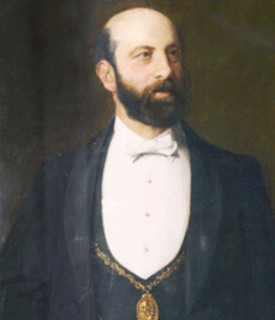
Purser is the son of John Tertius Purser (1809–1893), the general manager of the well known A Guinness, Son & Co. brewery, and Anna Benigna Fridlezius (1803-1881). He is educated in a wealthy family, which includes artists, as his cousin Sarah Purser, or engineers, as his brother-in-law John Purser Griffith. He is the brother of mathematician Frederick Purser. He receives his early education at the private boarding school run by his uncle, Dr. Richard W. Biggs, at Devizes, Wiltshire. He completes his schooling at Devizes and begins his university studies at Trinity College, Dublin, graduating BA in mathematics in 1856. He is the best mathematician of his year at the University and in 1855 he gains the Lloyd Exhibition.
Purser becomes a tutor to the four sons of William Parsons, 3rd Earl of Rosse (1800-1867) in 1857. Lord Rosse’s 72-inch reflecting telescope, built in 1845 and colloquially known of as the “Leviathan of Parsonstown,” is the world’s largest telescope when it is built and continues to hold this distinction until the early 20th century. As well as acting as tutor to the children, Purser does become involved in Lord Rosse’s interest in astronomy but never does any observing.
In 1863, Purser is appointed professor of mathematics at Queen’s College, Belfast, a position he maintains until his retirement in 1901.
Purser never marries. When his father dies on April 5, 1893, Rathmines Castle passes to him. He dies at Rathmines Castle on October 18, 1903, a very wealthy man. In his will he leaves £100,000 to his brother Frederick Purser, £40,000 to his sister Anna Griffith and £5,000 to each of her children. In addition to the money, he owns property in Blessington Street, Essex Street and Eustace Street which he leaves to his brother-in-law John Purser Griffith. Other properties and interests that he owns he divides between his brother Frederick and his sister Anna. After his death, his sister Anna and her husband John Purser Griffith move into Rathmines Castle although, at this time, its ownership has gone to Frederick Purser. After Frederick dies in August 1910, the Castle and his considerable wealth passes to Anna.
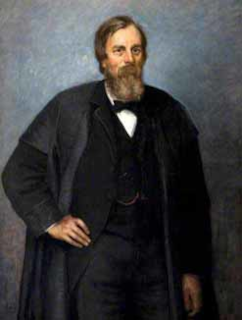
(Pictured: Portrait of John Purser painted by the artist Sarah Purser, daughter of Tertius Purser’s brother Benjamin Purser. The portrait hangs in Queen’s College, Belfast.)
Sir Joseph LarmorFRSFRSE, Irish and British physicist and mathematician who makes breakthroughs in the understanding of electricity, dynamics, thermodynamics, and the electron theory of matter, is born in Magheragall, County Antrim, on July 11, 1857. His most influential work is Aether and Matter, a theoretical physics book published in 1900.
In 1903 Larmor is appointed Lucasian Professor of Mathematics at Cambridge, a post he retains until his retirement in 1932. He never marries. He is knighted by King Edward VII in 1909.
Eames spends his early years in Larne, with the family later moving to Belfast. He is educated at the city’s Belfast Royal Academy and Methodist College Belfast before going on to study at Queen’s University Belfast, graduating LL.B. (Upper Second Class Honours) in 1960 and earning a Ph.D. degree in canon law and history in 1963. During his undergraduate course at Queen’s, one of his philosophy lecturers is his future Roman Catholic counterpart, Cahal Daly.
Turning his back on legal studies for ordination in the Church of Ireland, Eames embarks on a three-year course at the divinity school of Trinity College, Dublin in 1960, but finds the course “intellectually unsatisfying.” In 1963 he is appointed curate assistant at Bangor Parish Church, becoming rector of St. Dorothea’s in Belfast in 1966, the same year he marries Christine Daly.
During his time at St. Dorothea’s, in the Braniel and Tullycarnet area of east Belfast, Eames develops a “coffee bar ministry” among young people but is interrupted by the Troubles. He turns down the opportunity to become dean of Cork and in 1974 is appointed rector of St. Mark’s in Dundela in east Belfast, a church with strong family links to C. S. Lewis.
On May 9, 1975, at the age of 38, Eames is elected bishop of the cross-border Diocese of Derry and Raphoe. Five years later, on May 30, 1980, he is translated to the Diocese of Down and Dromore. He is elected to Down and Dromore on April 23 and that election is confirmed on May 20, 1980. In 1986, he becomes the 14th Archbishop of Armagh and Primate of All Ireland since the Church of Ireland’s break with Rome. It is an appointment that causes some level of astonishment among other church leaders.
Drumcree Church, a rural parish near Portadown, becomes the site of a major political incident in 1996, when the annual Orangemen‘s march is banned by the Chief Constable of the Royal Ulster Constabulary from returning to the centre of Portadown via the nationalist Garvaghy Road after attending worship at Drumcree Church. Public unrest and violence escalate over the next three summers as other parades come under first police and later commission sanction.
Eames, as diocesan bishop and civil leader finds himself immersed in the search for a resolution to the issue. Within the wider Church of Ireland there is unease as it is a broad church in theology and politics including within its congregations nationalists in the south and unionists in the north. Eames, along with the rector of Drumcree, has to navigate this political and social controversy and seeks political assistance to diffuse tension. Some bishops in the Republic of Ireland call for Eames to close the parish church, including Bishop John Neill who later becomes Archbishop of Dublin. He refuses to do so, believing this action could precipitate greater unrest and possible bloodshed.
Eames is, for many years, a significant figure within the general Anglican Communion. In 2003, the self-styled ‘divine optimist’ is appointed Chairman of the Lambeth Commission on Communion, which examines significant challenges to unity in the Anglican Communion. The Commission publishes its report, the Windsor Report, on October 18, 2004.
At the Church of Ireland General Synod in 2006 Eames announces his intention to retire on December 31, 2006. Church law permits him to continue as primate until the age of 75 but he resigns, in good health, at the age of 69. On January 10, 2007, the eleven serving bishops of the Church of Ireland meet at St. Patrick’s Cathedral in Dublin and elect Alan Harper, Bishop of Connor, as Eames’s successor.
Bradley is one of four surviving children of John and Margaret Bradley, Lecky Road, Derry. He leaves school to work as a telegraph boy but returns to education at St. Columb’s College. Following training as a teacher at St. Mary’s Training College, Belfast, he qualifies in 1947. While teaching in a primary school in Derry he studies for a degree in mathematics as an external student at the University of London and is awarded a degree in 1953.
Moving to London where he teaches mathematics in a grammar school, Bradley decides to register for an evening course at Birkbeck College. His first choice is mathematics but as he already has a degree in the subject the admissions staff suggests that he study physics. In 1957, after four years of part-time study, he is awarded a Bachelor of Science degree in physics by Birkbeck, achieving the highest marks in his final exams in the University of London overall. He next joins Royal Holloway College as an assistant lecturer and simultaneously enrolls as a PhD student, working on Fabry–Pérot interferometer etalon-based high-resolution spectroscopy supervised by Samuel Tolansky. He receives a PhD in 1961.
Bradley is a pioneer of laser physics, and his work on the development of ultra-fast pulsed lasers adds a new and vitally important element to the capabilities of this new type of light source. In particular, working on dye lasers, he produces pulses of light as short as one picosecond (one picosecond is to a second as a second is to 31,800 years). His work paves the way for the completely new field of non-linear optical interactions. In addition, he inspires a new generation of laser scientists in Ireland and the UK, many of whom are international leaders in their fields.
Appointed to a lectureship in the physics department at Imperial College London, Bradley sets up a research programme in UV solar spectroscopy using rocket technology to reach high altitudes.
In 1963 Bradley begins work in laser physics but returns to Royal Holloway College as a reader one year later. In 1966 he is appointed professor and head of department at Queen’s University, Belfast. There he quickly establishes a space research group of international standing to do high-resolution solar spectroscopy. He attracts significant funding from a variety of agencies, allowing him to build his department into one of the world’s leading laser research centres, involving a total of 65 scientists. However, he leaves Belfast because of fears for his family’s safety as political violence escalates in the early 1970s amidst The Troubles.
Bradley returns to Imperial College London in 1973 to a chair in laser physics and heads a group in optical physics, laser physics and space optics. He is head of the Physics department from 1976 to 1980 but is frustrated by cutbacks and a rule governing the ratio of senior to junior positions, one consequence of which is that he is unable to maintain a long-established chair in optical design. He is also critical of the college administration’s handling of some departmental grant applications. He resigns in 1980 and moves to Dublin.
Among Bradley’s many lasting contributions to laser research in the UK is the setting up of one of the world’s leading research facilities for laser research, the Central Laser Facility at the Rutherford Appleton Laboratory (RAL).
Arriving at Trinity College, Dublin, Bradley decides the time is ripe to move on from laser research and development into laser applications. In 1982, with Dr. John Kelly, a chemist, and Dr. David McConnell, a geneticist, he forms a team which wins funding for a project using laser techniques to explore the structure of organic molecules like DNA and proteins. Unfortunately, however, his work at Trinity is cut short by ill health and he retires in 1984. His research on semiconductor lasers is carried on and this work on developing widely tuneable lasers for optical communications systems continues.
A member of the Royal Irish Academy, Bradley is Fellow Emeritus of Trinity College Dublin, and holds fellowships of the Royal Society, The Optical Society of America and Institute of Physics. Through time the ravage of his illness restricts his travelling and eventually he is cared for in a residential home in Dublin, where he passes away on February 7, 2010.
Bleakley runs for the Westminster seat of Belfast East in 1970 (gaining 41% of the vote), February 1974 and October 1974 for the Northern Ireland Labour Party each time, but never enough to win the Westminister seat from the Ulster Unionist Party (UUP). In 1971, Brian Faulkner appoints him as his Minister for Community Relations at Stormont, but as Bleakley is not an MP, he can only hold the post for six months. He resigns five days before his term expires in order to highlight his disagreement with government policy, specifically the failure to widen the government to include non-Unionist parties, and the decision to introduce internment. He writes a respectful biography of Faulkner and his own memoir of the period.
After the Parliament is abolished, Bleakley stands for, and is elected to, the Northern Ireland Assembly and its successor, the Northern Ireland Constitutional Convention. He stands again for Belfast East in the February and October UK general elections, but wins only 14% of the vote each time.
Unlike most Protestants in Northern Ireland, Bunting becomes a militant republican. His father, by contrast, was a committed Ulster loyalist. Despite their political differences, they remain close.
Bunting joins the Official Irish Republican Army (OIRA) around 1970 as he is attracted to their left-wing and secular interpretation of Irish republicanism and believes in the necessity of armed revolution. The other wing of the IRA, the Provisional Irish Republican Army, is seen to be more Catholic and nationalist in its outlook. At this time, the communal conflict known as the Troubles is beginning and the Official IRA is involved in shootings and bombings. He is interned in November 1971 and held in Long Kesh until the following April.
In 1974, Bunting follows Seamus Costello and other militants who disagree with the Official IRA’s ceasefire of 1972, into a new grouping, the Irish National Liberation Army (INLA). Immediately, a violent feud breaks out between the Official IRA and the INLA.
In 1975, Bunting survives an assassination attempt when he is shot in a Belfast street. In 1977, Costello is killed by an Official IRA gunman in Dublin. Bunting and his family hide in Wales until 1978, when he returns to Belfast. For the remaining two years of his life, he is the military leader of the INLA. The grouping regularly attacks the British Army and Royal Ulster Constabulary (RUC) in Belfast. He calls in claims of responsibility to the media by the code name “Captain Green.”
At about 4:30 AM on October 15, 1980, several gunmen wearing balaclavas storm Bunting’s home in the Downfine Gardens area of Andersonstown. They shoot Bunting, his wife Suzanne and another Protestant INLA man and ex-member of the Red Republican Party, Noel Lyttle, who has been staying there after his recent release from detention.
Both Bunting and Lyttle are killed. Suzanne Bunting, who is shot in the face, survives her serious injuries. The attack is claimed by the Ulster Defence Association (UDA), but the INLA claims the Special Air Service are involved.
Upon his death, Bunting’s body is kept in a funeral parlour on the Newtownards Road opposite the headquarters of the UDA. On the day of the funeral, as the coffin is being removed, UDA members jeer from their building. The Irish Republican Socialist Party wants a republican paramilitary-style funeral for Bunting but his father refuses and has his son buried in the family plot of a Church of Ireland cemetery near Donaghadee.
Milligan is brought up as a Methodist, the daughter of the writer Seaton Milligan, antiquarian and member of the Royal Irish Academy (RIA). She is one of eleven children, including music collector Charlotte Milligan Fox, and from 1877 to 1887 attends Methodist College Belfast (MCB), after which she completes a teacher-training course. Together with her father she writes a political travelogue of the north of Ireland in 1888, Glimpses of Erin. She writes her first novel, A Royal Democrat, in 1890.
After the death of Charles Stewart Parnell, Milligan becomes an ardent nationalist. In 1894 with Jenny Armour, she founds branches of the Irish Women’s Association in Belfast and other places and becomes its first president. With Ethna Carbery she founds two nationalist publications in the 1890s, The Northern Patriot, and later The Shan Van Vocht, a monthly literary magazine published in Belfast from 1896 to 1899.
Alice Milligan dies in Omagh in April 1953 and is buried in Blackford Municipal Cemetery, County Tyrone. On her headstone is inscribed “She loved no other place than Ireland.”
During 2010/2011 the Ulster History Circle mounts plaques for famous Ulster figures. Charlotte Milligan Fox and Alice Milligan have a plaque mounted on Omagh Library, 1 Spillar’s Place, Omagh, County Tyrone.
Brian Moore, novelist and screenwriter who is acclaimed for the descriptions in his novels of life in Northern Ireland after World War II, is born in Belfast, Northern Ireland on August 25, 1921. He has been described as “one of the few genuine masters of the contemporary novel.”
In 1948 Moore emigrates to Canada to work as a reporter for the Montreal Gazette and becomes a Canadian citizen. While eventually making his primary residence in California, he continues to live part of each year in Canada up to his death.
Moore lives in Canada from 1948 to 1958, where he meets his first wife, Jacqueline (“Jackie”) Sirois, a French Canadian and fellow journalist. They marry in 1952. He moves to New York City in 1959 to take up a Guggenheim Fellowship and remains there until his divorce in October 1967. He then moves to the west coast of the United States, settling in Malibu, California, with his new wife Jean Denney, a former commentator on Canadian TV. There he teaches creative writing at UCLA.
Moore writes his first novels in Canada. His earliest novels are thrillers, published under his own name or using the pseudonyms Bernard Mara or Michael Bryan. His first novel outside the genre, Judith Hearne, remains among his most highly regarded. The book is rejected by ten American publishers before being accepted by a British publisher. It is made into a film, with British actress Maggie Smith playing the lonely spinster who is the book/film’s title character.
Some of Moore’s novels feature staunchly anti-doctrinaire and anti-clerical themes, and in particular he speaks strongly about the effect of the Church on life in Ireland. A recurring theme in his novels is the concept of the Catholic priesthood. On several occasions he explores the idea of a priest losing his faith. At the same time, several of his novels are deeply sympathetic and affirming portrayals of the struggles of faith and religious commitment, Black Robe most prominently.
Moore dies at his Malibu home, which is celebrated in Seamus Heaney‘s poem Remembering Malibu, on January 11, 1999, from pulmonary fibrosis. His widow, Jean, lives on in the house until it is destroyed in 2018 in the Woolsey Fire.
At the time of his death, Moore is working on a novel about the 19th-century French symbolist poet Arthur Rimbaud. His last published work before his death is an essay entitled “Going Home.” It is a reflection inspired by a visit he made to the grave in Connemara of his family friend, the Irish nationalist Bulmer Hobson. The essay is commissioned by Granta and published in The New York Times on February 7, 1999.
In 1996, the Brian Moore Short Story Awards is launched by the Creative Writers Network in Northern Ireland and is open to all authors of Irish descent. Previous judges have included Glenn Patterson, Lionel Shriver, Carlo Gébler and Maeve Binchy.
In 1975 Moore arranges for his literary materials, letters and documents to be deposited in the Special Collections Division of the University of Calgary Library, an inventory of which is published by the University of Calgary Press in 1987. His archives, which include unfilmed screenplays, drafts of various novels, working notes, a 42-volume journal (1957–1998), and his correspondence, are housed at the Harry Ransom Center at the University of Texas at Austin.
Jaffe is born into a Jewish family, one of four boys and five girls born to Daniel Joseph and Frederiké Jaffe. In 1852, his parents bring their family to Belfast. His father, along with his older brothers, Martin, John and Alfred, set up a business exporting linen. He is educated at Mr. Tate’s school in Holywood, County Down, and later in Hamburg and Switzerland.
Jaffe marries Paula Hertz, daughter of Moritz Hertz from Braunschweig, on March 8, 1879. They have two sons, Arthur Daniel and William Edward Berthold Jaffe. Daniel Joseph Jaffé is his nephew, son of his brother Martin.
From 1867 to 1877 Jaffe lives and works in New York. In 1877, his brothers retire so he returns to Belfast to head the family business, The Jaffe Brothers, at Bedford Street. He builds it up to become the largest linen exporter in Ireland. He is a member of the Belfast Harbour Commission and becomes a naturalised citizen in 1888. In 1894, he successfully agitates for the reporting and destruction of shipwrecks in the North Atlantic Ocean.
Jaffe is a Justice of the Peace, a governor of the Royal Hospital, a member of the Irish Technical Education Board and a member of the Senate of Queen’s College, which later becomes Queen’s University Belfast. He is the German consul in Belfast. He is an active member of the committee which gets the Public Libraries Act extended to Belfast, leading to the first free library being established there. In 1910 he erects the Jaffe Spinning Mill on the Newtownards Road, also known as Strand Spinning. This provides work for 350 people, rising to 650 in 1914 when the company expands to make munitions. He is lavishly charitable and contributes to Queen’s College.
Jaffe takes a keen interest in the Jewish community of Belfast. He is life-president of the Belfast Hebrew Congregation, which worships at the Great Victoria Street, Belfast synagogue. His father established it on July 7, 1871. Between 1871 and 1903 the congregation increases from fifty-five to over a thousand. He pays most of the £4,000 cost of building the synagogue in Annesley Street. He opens it in 1904 wearing his mayoral regalia. Three years later with his wife, they set up the Jaffe Public Elementary School on the Cliftonville Road.
The outbreak of war sees anti-German sentiment and when the RMS Lusitania passenger liner is torpedoed by a German U-boat of the coast of County Cork on May 7, 1915, resulting in the death of 1,000 people, anti-German feeling in Britain and Ireland rise to breaking point. Even though he is loyal to the Crown, and his eldest son Arthur and his nephew are serving in the British Army, Jaffe is accused of being a German spy. Society women refuse support for the Children’s Hospital so long as Jaffe and his wife remain on the board. He is “overwhelmed with pain and sorrow.”
After twenty-five years of service, Jaffe resigns his post as Alderman of Windsor Ward for Belfast City Council in June 1916 when he is almost 70 years of age and takes up residence in London, where he dies on April 29, 1929. Lady Jaffe is too ill to attend his funeral, and she dies a few months later, in August 1929.
Trimble has vowed to quit as head of the Stormont Executive, where his party shares power with Sinn Féin, if the Irish Republican Party (IRA) has not started to get rid of its guns by July 1. Paisley, however, has accused Trimble and British Prime MinisterTony Blair of breaking their promises to the people of Northern Ireland by allowing into government a party linked to a terrorist group, without prior arms decommissioning.
While Clinton is no longer the most powerful man in the world, his charisma and his past efforts to keep the peace process moving are still appreciated by many. He receives Northern Ireland political leaders countless times at the White House and gives support and encouragement by phone during difficult periods of the peace talks.
The leader of the Social Democratic and Labour Party (SDLP), John Hume, who welcomes Clinton to Derry, says the former president has done a great deal of good for all the people of Ireland. But the Democratic Unionist Party (DUP) deputy leader, Peter Robinson, claims that Clinton and Blair could have a negative effect on Trimble’s campaign. “As a unionist, I wouldn’t like to be sitting next to either of them just before an election,” he said. “Blair’s name is associated with the now-broken pledges he wrote on a board here just before the [Good Friday agreement] referendum, so for him to come over and moralise now won’t do much good. And Clinton is so disgraced and powerless that, while he might prop up the nationalist SDLP and Sinn Féin vote, he’ll have no impact on unionists voters.”
(Pictured: Bill Clinton and SDLP leader John Hume at public address at Guildhall Square in Derry. Sinn Féin leader Gerry Adams and Chelsea Clinton are in the second row.)