Morris’s twin brother John (Johnny) becomes a photographer and marries Thelma Mansfield. Their elder brother, George Redmond, follows in the footsteps of their father, Lord Killanin, by becoming a film producer. His credits include The Reader. They also have one sister, Monica Deborah.
At the age of fifteen Morris’s formal education ends following his diagnosis with dyslexia. He then begins working at racing stables. He earns the nickname “Mouse” when he is an amateur rider.
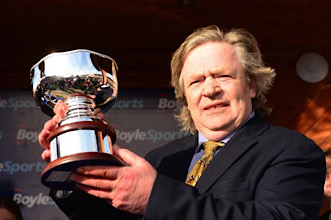
Initially, Morris comes to prominence as an amateur jockey. In 1974 he rides Mr. Midland to victory at Cheltenham Racecourse giving Edward O’Grady his first Festival winner. In 1975 he turns professional. He rides Skymas in his successive victories in the 1976 and 1977 Queen Mother Champion Chase at Cheltenham. He rides Billycan to victory in the 1977 Irish Grand National, a race he is subsequently to win twice as a trainer. His career as a rider ends after a fall in South Carolina‘s Colonial Cup.
Morris is based in Fethard, County Tipperary. In 1981, he takes out a licence and begins his National Hunt training career. Hus first major breakthrough comes when Buck House wins the 1983 Supreme Novices’ Hurdle, giving him his first winner at Cheltenham.
The 1990s start brightly for the “Mouse” Morris yard when Trapper John, ridden by jockey Charlie Swan, wins the Stayers’ Hurdle at the 1990 Cheltenham Festival. The following year, Cahervillahow is beaten by a short head in the Irish Grand National and merely three weeks later in the Whitbread Gold Cup he is controversially judged to have interfered with runner-up Docklands Express in the closing stages. As a result, Docklands Express is awarded the race. He finishes second in the 1993 Grand National which is voided after a false start. He trains His Song who is one of the best novice hurdlers of the period. His Song finishes second behind the J. P. McManus owned Istabraq in the 1998 AIG Irish Champion Hurdle on his fourth race outing before again finishing second in the Supreme Novice Hurdle at Leopardstown Racecourse. One of his most important wins as a trainer comes in 2006 when he sends out the seven-year-old geldingWar Of Attrition to win the 2006 Cheltenham Gold Cup, beating another Irish challenger, Hedgehunter, on Saint Patrick’s Day. In 2008, he trains Hear The Echo to victory in the Irish Grand National. In 2011, he trains the winner of the Grade 1 Neptune Investment Management Novices’ Hurdle at Cheltenham, First Lieutenant, ridden by Davy Russell. In 2016, he wins the Irish Grand National again this time with Rogue Angel. Also in 2016, he wins the Grand National for the first time with Rule The World.
Morris is married to Susanna Felicity Clark. They have two sons, James (Jamie) born in 1983 and Christopher (Tiffer) born in 1985. Tiffer dies at the age of 30 in June 2015 of carbon monoxide poisoning while traveling in Argentina.
Hamilton enters Trinity College Dublin on November 17, 1742, at the age of 13 with Thomas McDonnell as his tutor. He graduates Bachelor of Arts (BA) in 1747 and Trinity Master of Arts (MA Dubl) in 1750. He takes the competitive examination for a vacant fellowship of the college in 1750, but the position is secured instead by his friend Richard Murray, who is a few years older. Two fellowships become vacant the following year and Hamilton is elected to one of them at the age of 22. He is appointed Erasmus Smith’s Professor of Natural and Experimental Philosophy at Trinity College Dublin in 1759 and that same year graduates Bachelor of Divinity (BD). He is elected a Fellow of the Royal Society on February 19, 1761, and graduates Doctor of Divinity (DD) in 1762.
Trinity College presents him to the rectory of Kilmacrennan in the diocese of Raphoe, County Donegal, in 1764. This is a small benefice in the gift of the college, for which he resigns his fellowship. He retains the Erasmus Smith’s chair, however, being succeeded in that by Thomas Wilson in 1769. He resigns from Kilmacrenan in 1767 and becomes vicar of St. Ann’s Church in Dublin.
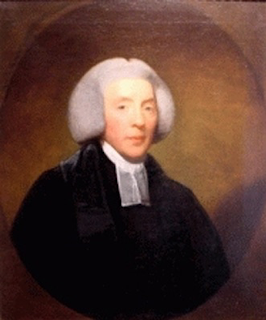
Hamilton then becomes Dean of Armagh, the chief resident cleric of St. Patrick’s Cathedral in Armagh, County Armagh, from April 1768 to 1796. Finding the existing dean’s house inconvenient and poorly situated, he has a new one built in a better location just off Portadown Road, now known as Dean’s Hill. The house, of three stories and a semi-basement, is built in 1772–74. The house is later sold by the church and the present owners provide bed and breakfast accommodation in it. While dean he also acts as treasurer for the infirmary or county hospital, he establishes Sunday schools in the districts of the parish, and he founds a charitable loan for poor tradesmen. He is also instrumental in planning a piped water supply for the town, which is later put into effect. He is one of the 38 original members of the Royal Irish Academy when it is founded in 1785. Gilbert Stuart paints his portrait in about 1790 (pictured above).
Hamilton is promoted to Bishop of Clonfert and Kilmacduagh on January 20, 1796, without seeking it. On January 24, 1799, he is translated to Ossory, where he is bishop until 1805. He dies of a fever at Kilkenny, County Kilkenny, on December 1, 1805. He is buried in the graveyard of St. Canice’s Cathedral at Kilkenny, and there is a memorial to him inside the cathedral.
Hamilton writes a mathematical treatise on conic sections called De Sectionibus Conicis: Tractatus Geometricus, published in 1758. In this book he “was the first to deduce the properties of the conic section from the properties of the cone, by demonstrations which were general, unencumbered by lemmas, and proceeding in a more natural and perspicuous order,” according to writer James Wills in 1847. The work is acclaimed for its lucidity and Leonhard Euler describes it as a perfect book. It is “soon adopted in all the British universities” and is translated from Latin into English as A Geometrical Treatise of the Conic Sections in 1773.
Hamilton also writes Philosophical Essays on Vapours (1767), Four Introductory Lectures on Natural Philosophy (1774), and An Essay on the Existence and Attributes of the Supreme Being (1784). His principal works are collected and republished, with a memoir, as The Works of the Right Rev. Hugh Hamilton by his eldest son, Alexander Hamilton, in two volumes in 1809.
Hamilton marries Isabella, daughter of Hans Widman Wood of Rosmead, County Westmeath, in 1772. Isabella’s mother Frances is the twin sister of Edward King, 1st Earl of Kingston. They have five sons and two daughters. They are Alexander, who was a barrister; Frances; Hans, who is rector of Knocktopher, County Kilkenny, and associated with the Carrickshock incident of 1831; Isabella; Henry; George, who is a biblical scholar; and Hugh, who marries Elizabeth Staples, a daughter of John Staples, a Member of Parliament. The younger Hugh is the great-grandfather of Clive Staples Lewis, better known as C. S. Lewis. Bishop Hugh Hamilton is a great-great-great-grandfather of the mathematicians John Lighton Synge and his brother Edward Hutchinson Synge. Dodgson Hamilton Madden, the High Court judge and noted scholar, is Hamilton’s great-grandson.
(Pictured: “Hugh Hamilton,” oil on canvas by Gilbert Stuart)
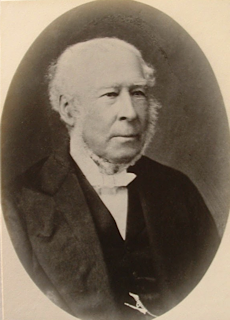
Boycott is the eldest surviving son of William Boycatt (1798–1877), rector of Wheatacrebury, Norfolk, and Elizabeth Georgiana Boycatt (née Beevor). The family name is changed to Boycott by his father in 1862. Educated at a boarding school in Blackheath, London, and the Royal Military Academy, Woolwich, he is commissioned ensign in the 39th (Dorsetshire) Regiment of Foot on February 15, 1850, and serves briefly in Ireland. He sells his commission on December 17, 1852, having attained the rank of captain, marries Annie Dunne of Queen’s County (County Laois) in 1852, and leases a farm in south County Tipperary.
In 1855, Boycott leaves for Achill Island, County Mayo, where he sub-leases 2,000 acres and acts as land agent for a friend, Murray McGregor Blacker, a local magistrate. He settles initially near Keem Strand but after some years builds a fine house near Dooagh overlooking Clew Bay. He clashes with local landowners and agents and is regularly involved in litigation. Twice summonsed unsuccessfully for assault (1856, 1859), he is involved (1859–60) in a bitter dispute with a land agent over salvage rights for shipwrecks, one of the few lucrative activities on the island. Achill’s remoteness and the difficulties of wresting a living from its harsh environment adds a roughness to the island’s social relations and probably aggravates Boycott’s tendency to high-handedness.
In 1873, Boycott inherits money and moves to mainland County Mayo, leasing Lough Mask House near Ballinrobe and its surrounding 300 acres. He also becomes agent for John Crichton, 3rd Earl Erne‘s neighbouring estate of 1,500 acres, home to thirty-eight tenant farmers paying rents of £500 a year, of which he receives 10 per cent as agent. He also serves as a magistrate and is unpopular because of his brusque and authoritarian manner, and for denying locals such traditional indulgences as collecting wood from the Lough Mask estate or taking short cuts across his farm. In April 1879, he purchases the 95-acre Kildarra estate between Claremorris and Ballinlough and an adjoining wood for £1,125, taking out a mortgage of £600 which stretches his finances.
Boycott is no brutal tyrant, but he is aloof, stubborn, and pugnacious, and believes that the Irish peasantry is prone to idleness and require firm handling. Such qualities and beliefs are unremarkable enough, but in the peculiar circumstances of the land war in County Mayo, they are enough to catapult this rather ordinary man to worldwide notoriety.
In autumn 1879, concerted land agitation begins in County Mayo, and on August 1, 1879, Boycott receives a notice threatening his life unless he reduces rents. He ignores it and evicts three tenants, which embitter relations on the estate. Lough Mask House is placed under Royal Irish Constabulary (RIC) surveillance beginning in November 1879. In August 1880, his farm labourers, encouraged by the Irish National Land League, strike successfully for a wage increase from 7s. –11s. to 9s. –15s. Since the harvest is poor, Lord Erne allows a 10 per cent rent abatement. But in September 1880, when Boycott demands the rent, most tenants seek a 25 per cent abatement. Lord Erne refuses, and on September 22, Boycott attempts to serve processes against eleven defaulters. Servers and police are attacked by an angry crowd of local women and forced to take refuge in Boycott’s house. Almost immediately he is subjected to the ostracism against land grabbers advocated by Charles Stewart Parnell in his September 19 speech at Ennis, County Clare. This weapon proves as devastating against an English land agent as an Irish land-grabber. His servants leave him, labourers refuse to work his land, his walls and fences are destroyed, and local traders refuse to do business with him. He is jeered on the roads, is hissed and hustled by hostile crowds in Ballinrobe, and requires police protection.
The campaign against Boycott is largely orchestrated by Fr. John O’Malley, a local parish priest and president of the Neale branch of the Irish National Land League. It is probably O’Malley who coins the term “boycott” as an alternative to the word “ostracise,” which he believes would mean little to the local peasantry. Propagated by O’Malley’s friend, the American journalist, James Redpath, it is adopted by advocates and opponents alike.
On October 22, 1880, before his story breaks on the world, Boycott gives evidence of his treatment to the Bessborough Commission in Galway. He publicises his plight in an October 18, 1880, letter to The Times, and in a long interview with The Daily News on October 24, which is reprinted in Irish unionist newspapers and arouses considerable sympathy for him. Although he rarely uses his former military rank, he becomes universally known as “Captain Boycott,” since it suits both sides to portray him as someone of social standing. Letters of support appear in unionist papers and the Belfast News Letter sets up a “Boycott Relief Fund” and proposes a relief expedition, portraying Boycott as a peaceable English gentleman unjustly subjected to intimidation.
The prospect of hundreds of armed loyalists descending on County Mayo alarms the government, who announce on November 8 that they will provide protection for a small group of labourers to harvest Boycott’s crops. On November 12, fifty-seven loyalists from counties Cavan and Monaghan, “the Boycott Relief Expedition,” arrive at Lough Mask with an escort of almost a thousand troops. After harvesting Boycott’s crops, they leave on November 26. The entire operation costs £10,000 – about thirty times the value of the crops. Although the expedition passes off largely without incident, it focuses international media attention on the affair and establishes the word “boycott” in English and several other languages as a standard term for communal ostracism.
On November 27, Boycott and his wife go to the Hammam Hotel, Dublin, where he receives death threats. On December 1, he travels to London and then to the United States (March–May 1881) to see Murray McGregor Blacker, the friend from his time on Achill Island who has since settled in Virginia. In an interview with the New York Herald, he criticises the liberal government’s weakness toward the Land League and claims that the Irish land question is an intractable problem that can only be solved in the long term by emigration and industrialisation.
Boycott returns to Lough Mask on September 19, 1881, and at an auction in Westport is mobbed and burned in effigy. This, however, is the last outburst of hostility against him, and as the land agitation wanes so does his unpopularity. Although unsuccessful in efforts to win compensation from the government, he receives a public subscription of £2,000. He remains in County Mayo as Lord Erne’s agent until February 1886, when he obtains the post of land agent for Sir Hugh Adair in Flixton, Suffolk, but he keeps the small Kildarra estate, where he continues to holiday. On December 12, 1888, he gives evidence of his treatment to the parliamentary commission on “Parnellism and crime.”
After suffering from ill-health for some years, Boycott dies at Flixton on June 19, 1897, and is buried in the churchyard of Burgh St. Peter. A British-made film, Captain Boycott (1947), stars Cecil Parker in the title role.
Babington is born on September 1, 1804, to the Rev. Richard Babington and his wife Mary Boyle, both members of the Anglo-Irishlanded gentry. His father, the rector of Lower Comber (Diocese of Derry), leads an extravagant lifestyle and leaves debts of £40,000 on his death in 1831, aged 66, equivalent to some £4.1 million as of 2019. His father’s debt is paid off by his two brothers Richard (1795-1870) and Anthony of Creevagh (1800-1869). Another brother is Major GeneralWilliam Babington. He is educated at Trinity College Dublin (TCD).
Babington begins his career as a curate of Lower Cumber, where his father is rector, in 1827. He becomes rector of Moviddy in 1833, at the age of 29. As rector, he carries out improvements worth the equivalent of £166,766 in 2019. As a clergyman he is part of a wave toward secular education in Ireland in the 1800s. In this capacity he is remembered as a “very forward thinking individual.” He is one of the signatories of a progressive booklet titled Declaration in Favour of United Secular Education in Ireland in 1866. The declaration notes, on behalf of the united Church of England and Ireland, “We entirely admit the justice and policy of the rule which protects scholars from interference with their religious principles and thus enables members of different denominations, to receive together in harmony and peace, the benefits of a good education.”
Babington is also, notably, in 1843, an addressee of the “Crookstown letter,” a famous incident at the time covered by The Cork Examiner and Cork Commercial Courier. He publishes, in the Cork Constitution, the contents of a threatening letter he had received in which it threatens him, among others, with murder if he does not become a repealer of the Acts of Union 1800 and with making a bonfire of hay in his farmyard if he does not show the letter to its other addresses. The letter is allegedly to have been written by a Roman Catholic resident of Crookstown, County Cork. The Roman Catholic parish priest, Fr. Daly, and parishioners refute the allegation that the letter had been authored by a Roman Catholic and claim that, conversely, the letter is an invention of a local Protestant who wrote “repeal or die” on the Crookstown Bridge. A local magistrate, J. B. Warren, to whom the letter has also been addressed, pledges to carry out an investigation but Babington does not hand over the original letter, causing the local Roman Catholic population to regard his publication of the letter in the press as “prejudiced, premature and defamatory of the character of the people whose industry he derives his income.” Babington states that he has always been on friendly terms with the Roman Catholic parish priest and his Roman Catholic parishioners and has no intention of offending them but is in fact pushing to publish it by local magistrates. He continues as rector of Moviddy for another 43 years following this incident.
Babington is also involved with the Society for Promoting the Education of the Poor of Ireland.
In 1836, Babington marries Esther, daughter of Richard Nettles, Esq., JP, of Nettleville, County Cork, with whom he has five sons and eight daughters.
Babington dies at the age of 81 on January 23, 1886, at Moviddy Rectory, County Cork. He is buried with his wife, Esther, who died at the age of 70 on August 29, 1878.
Moran’s parents are Patrick and Alicia Cullen Moran. Of his three sisters, two become nuns, one of whom dies nursing cholera patients. His parents die by the time he is 11 years old. In 1842, at the age of twelve, he leaves Ireland in the company of his uncle, Paul Cullen, rector of the Pontifical Irish College in Rome. There he studies for the priesthood, first at the minor seminary and then at the major seminary.
Moran is considered so intellectually bright that he gains his doctorate by acclamation. By The age of 25 he speaks ten languages, ancient and modern. He focuses on finding and editing important documents and manuscripts related to Irish ecclesiastical history. Some editions of his works remain important source materials to this day.
Moran is appointed vice-rector at the Pontifical Irish College and also takes the chair of Hebrew at Congregation for the Evangelization of Peoples (CEP). He is also some-time vice-rector of the Scots College in Rome. In 1866, he is appointed secretary to his mother’s half-brother, Cardinal Paul Cullen of Dublin. He is also appointed professor of scripture at Holy Cross College, Dublin. He founds the Irish Ecclesiastical Record (on which he later models the Australasian Catholic Record).
In 1869, Moran accompanies Cardinal Cullen to the First Vatican Council, a council also attended by Melbourne‘s then-first archbishop, James Alipius Goold. According to Michael Daniel, it is generally agreed that the definition of the Catholic doctrine of papal infallibility is based on Cullen’s proposal, and Ayres suggests that there is strong evidence that Cullen’s proposal is largely drafted by Moran. While in Rome and Ireland he is very active politically in opposing English Benedictine plans for monastic foundations undergirding the Catholic Church in Australia.
Moran is appointed coadjutor bishop of Ossory on December 22, 1871, and is consecrated on March 5, 1872 in Dublin by his uncle, Cardinal Paul Cullen. On the death of Bishop Edward Walsh, he succeeds as Bishop of Ossory on August 11, 1872. He champions Home Rule and is consulted by William Ewart Gladstone prior to the introduction of his Home Rule Bills.
Moran is personally chosen and promoted by Pope Leo XIII to head the Archdiocese of Sydney – a clear policy departure from the previous English Benedictine incumbents, John Bede Polding and Roger Vaughan, who were experiencing tension leading the predominantly Irish Australian Catholics. In the archbishop’s farewell audience with Leo XIII, it is evident that the intrigues of parties, the interference of government agencies and the influence of high ecclesiastics had made the matter almost impossible to decide by Propaganda. In the presence of others, the Pope says clearly: “We took the selection into our own hands. You are our personal appointment.” Moran is appointed to Australia on January 25, 1884, and arrives on September 8, 1884. He is created cardinal-priest on July 27, 1885, with the title of St. Susanna. The new Irish Australian cardinal makes it his business to make his presence and leadership felt.
Moran begins transforming the SydneySaint Patrick’s Day festivities by inaugurating the celebration of a Solemn Mass at St. Mary’s Cathedral on Saint Patrick’s Day 1885. Over time the day’s events change from an Irish nationalist and political day into an occasion “for the demonstration of Irish Catholic power and respectable assimilation” as well as “for the affirmation of Irish Catholic solidarity.”
In 1886, it is estimated that Moran travels 2,500 miles over land and sea, visiting all the dioceses of New Zealand. In 1887, he travels 6,000 miles to consecrate fellow Irishman Matthew Gibney at Perth. He also travels to Ballarat, Bathurst, Bendigo, Hobart, Goulburn, Lismore, Melbourne and Rockhampton for the consecration of their cathedrals. Following the 1891 encyclical Rerum Novarum, he supports the right of labourers to better their conditions.
During his episcopate, Moran consecrates 14 bishops (he is the principal consecrator of William Walsh, Michael Verdon, Patrick Vincent Dwyer, Armand Olier and also assists in consecrating Patrick Clune, among others). He ordains nearly 500 priests, dedicates more than 5,000 churches and professes more than 500 nuns. He makes five journeys to Rome on church business between 1885 and 1903, but does not participate in the papal conclave of 1903 because of the relatively short notice and the distance, making it impossible for him to reach Rome within 10 days of the death of Pope Leo.
Moran is a strong supporter of Federation, and in November 1896 attends the People’s Federal Convention in Bathurst. In March 1897, he stands as a candidate election of ten delegates from New South Wales to the Australasian Federal Convention. Although he states he will not attend the Convention in any official capacity, but in a solely individual one, his candidacy sparks a sectarian reaction. Twenty-nine per cent of voters give one of their ten votes to Moran, but he comes only thirteenth in number of total votes and is not elected.
From 1900 to 1901, Moran’s leadership survives a crisis when his personal secretary, Denis O’Haran, is named as co-respondent in the divorce case of the cricketer Arthur Coningham. Moran vigorously defends O’Haran and a jury finds in his favour.
Moran dies in Manly, Sydney, on August 16, 1911, aged 80. A quarter of a million people, the largest crowd ever to gather in Australia prior to that date, witness his funeral procession through the centre of Sydney. He is buried in St. Mary’s Cathedral, Sydney.
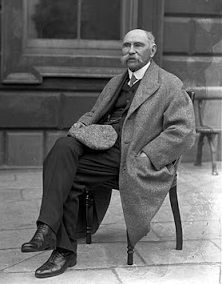
Hyde is born at Longford House in Castlerea, County Roscommon, on January 17, 1860. In 1867, his father is appointed prebendary and rector of Tibohine, and the family moves to neighbouring Frenchpark, in County Roscommon. He is home schooled by his father and his aunt due to a childhood illness. While a young man, he becomes fascinated with hearing the old people in the locality speak the Irish language.
Rejecting family pressure to follow previous generations with a career in the Church, Hyde instead becomes an academic. He enters Trinity College, Dublin (TCD), where he gains a great facility for languages, learning Latin, Greek, Hebrew, French, and German, but his great passion in life is the preservation of the Irish language.
After spending a year teaching modern languages in Canada, Hyde returns to Ireland. For much of the rest of his life he writes and collects hundreds of stories, poems, and folktales in Irish, and translates others. His work in Irish helps to inspire many other literary writers, such as W. B. Yeats and Lady Gregory.
In 1892, Hyde helps establish the Gaelic Journal and in November of that year writes a manifesto called The necessity for de-anglicising the Irish nation, arguing that Ireland should follow her own traditions in language, literature, and even in dress.
In 1893, Hyde founds the Gaelic League (Conradh na Gaeilge) along with Eoin MacNeill and Fr. Eugene O’Growney and serves as its first president. Many of the new generation of Irish leaders who play a central role in the fight for Irish independence in the early twentieth century, including Patrick Pearse, Éamon de Valera, Michael Collins, and Ernest Blythe first become politicised and passionate about Irish independence through their involvement in the Gaelic League. Hyde does not want the Gaelic League to be a political entity, so when the surge of Irish nationalism that the Gaelic League helps to foster begins to take control of many in the League and politicize it in 1915, Hyde resigns as president.
In 1938, Hyde is unanimously elected to the newly created position of President of Ireland, a post he holds until 1945. Hyde is inaugurated on June 26, 1938, in the first inaugural ceremony in the nation’s history. Despite being placed in a position to shape the office of the presidency via precedent, Hyde by and large opts for a quiet, conservative interpretation of the office. In April 1940, he suffers a massive stroke and plans are made for his lying in state and state funeral, but to the surprise of everyone he survives, albeit paralysed and confined to a wheelchair. One of his last presidential acts is a visit to the German ambassador Eduard Hempel on May 3, 1945, to offer his condolences on the death of Adolf Hitler, a visit which remains a secret until 2005.
Hyde leaves office on June 25, 1945, opting not to nominate himself for a second term. He opts not return to his Roscommon home due to his ill-health, but rather moves into the former Secretary to the Lord Lieutenant’s residence in the grounds of Áras an Uachtaráin, where he lived out the remaining four years of his life.
Hyde dies in Dublin on July 12, 1949, at age 89. As a former President of Ireland he is accorded a state funeral which, as a member of the Church of Ireland, takes place in Dublin’s St. Patrick’s Cathedral. Since contemporary rules of the Roman Catholic Church in Ireland at the time prohibit Roman Catholics from attending services in non-Catholic churches, all but one member of the Catholic cabinet remain outside the cathedral grounds while Hyde’s funeral takes place. Hyde is buried in Frenchpark, County Roscommon at Portahard Church.
Drew’s parents are the Rev. Thomas Drew and Isabella (née Dalton) Drew. She is the third of the couple’s eight daughters and four sons, although most of her siblings die young. She spends her childhood in Belfast, where her father is the rector of Christ Church in Durham Street from 1833 to 1859. In 1866, she moves to 60 Upper Sackville Street, Dublin, to live with her brother, the architect Thomas Drew.
From here she appears to begin her journalist career, writing articles for the Irish Builder, going on to eventually become its assistant editor. She goes on to write for Belfast’s News Letter, and following advice from its proprietor James Alexander Henderson, she moves to London in 1871 becoming the paper’s London correspondent. She writes two columns, Metropolitan gossip and Ladies’ letter, which are among some of the earliest regular columns written specifically for women, providing society news for her readers in Belfast. Articles by her also appear in The Literary World, The British Architect and London Society.
Drew is one of the founding members of the Ladies’ Press Association, and campaigns for greater rights for women journalists. She becomes a prominent figure in the Institute of Journalists, representing the Institute at several international congresses. She is serving as the vice-president of the Institute at the time of her death. She also works on its Orphan Fund for many years, an initiative she originally suggests in 1891.
In 1894, Drew is one of the signatories of the Frances Power Cobbe memorial campaigning for greater recognition and rights for women journalists, alongside Millicent Fawcett and Jessie Boucherett. She writes a number of novels, including Harry Chalgraves’s Legacy (1876) and The Lutanistes of St. Jacobi’s (1881). In March 1885, she gives a lecture titled Dress, Economic and Technical at the Loan Exhibition of Women’s Industries in Bristol, which later appears as a pamphlet.
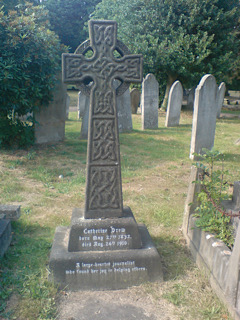
Drew dies at her home in Holland Street, Kensington, on August 26, 1910, and is buried at the Royal Borough of Kensington and Chelsea Cemetery, Hanwell. Lady Drew, her sister-in-law, erects a Celtic cross memorial there in her honour. She bequeaths a jewel-studded gold bracelet to the Institute of Journalists, which had been presented to her by the Institute to mark her retirement in 1908. It is worn by women presidents or the wives of male presidents, and is known as the “Drew Bracelet.”
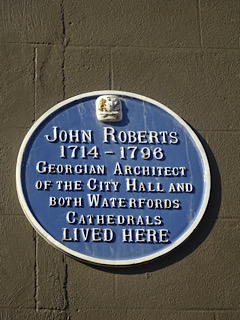
Roberts is born in Waterford in 1712 or 1714, the son of Thomas Roberts, an architect and builder. Little is known of his early life, although he possibly trains in London for a time. At 17, he elopes with Mary Susannah Sautelle, a Huguenot heiress who also lives in Waterford.
In 1785, Roberts builds a house in Waterford for William Morris, now the Harbour Commissioners’ headquarters and the Chamber of Commerce. In 1786, he designs Newtown House, later Newtown School, a Quaker school. In 1787, he designs The Leper Hospital and Church of St. Stephen. He also builds the Assembly Rooms on Waterford’s Mall in 1788, which is now the Theatre Royal and City Hall.
Roberts has between 21 and 24 children with his wife Susannah, of whom eight live to adulthood, including the painters Thomas Roberts and Thomas Sautelle Roberts. They live for many years in the old bishop’s palace, opposite the cathedral, with a country residence at Roberts Mount. He is nicknamed “Honest John” because he pays his workers so reliably, sometimes giving half their pay directly to their wives so that it would not be wasted on alcohol.
Roberts dies on May 23, 1796, after falling asleep on the floor of the Cathedral of the Most Holy Trinity, Waterford, and contracting pneumonia. The main square in Waterford is named John Roberts Square in his honour.
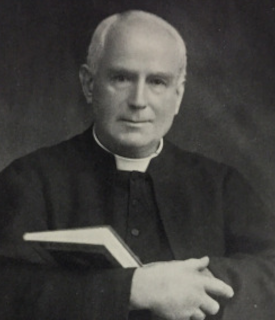
Maturin is born on February 15, 1847, at All Saints’ vicarage, Grangegorman, Dublin, the third of the ten children of the Rev. William Basil Maturin and his wife, Jane Cooke (née Beatty). The Maturins, a prominent Anglo-Irish family of Huguenot ancestry, have produced many influential Church of Ireland clergymen over the generations, the most notable being Maturin’s grandfather, the writer Charles Robert Maturin. His own father, whose tractarian convictions are considered too “high church” for many in Dublin, is a somewhat controversial figure in the church. Religion plays a huge part in the Maturin children’s lives. Two of his brothers enter the church and two sisters become nuns. As a young man, he assists in training the choir and playing the organ at his father’s church. Educated at home and at a Dublin day school, he goes on to attend Trinity College Dublin (TCD), from where he graduates BA in 1870.
Though he initially intends to make a career in the army as an engineer, a severe attack of scarlet fever around 1868, and the death of his brother Arthur, changes his outlook on life, and he decides to become a clergyman. He is ordained a deacon in 1870 and later that year goes as a curate to Peterstow, Herefordshire, England, where his father’s friend Dr. John Jebb is rector. He subsequently joins the Society of St. John the Evangelist, entering the novitiate at Cowley, Oxford, in February 1873. As a Cowley father he is sent in 1876 to establish a mission in Philadelphia, Pennsylvania, where he works as an assistant priest and, from 1881, as rector of Saint Clement’s Church. Though he proves to be an effective clergyman and popular preacher, his growing religious doubts and increasing interest in Catholicism results in his returning to Oxford in 1888. Then follows a six-month visit in 1889–90 to a society house in Cape Town, South Africa. He returns to Britain, where he preaches, and conducts retreats around the country and occasionally on the continent. In 1896 he produces the first in a series of religious publications, Some Principles and Practices of Spiritual Life.
Maturin’s continuing religious anxieties eventually lead to his conversion to Catholicism on March 5, 1897, at the JesuitBeaumont College outside London. He then studies theology at the Canadian College, Rome, and is ordained there in 1898. Following his return to England he lives initially at Archbishop’s House, Westminster, and undertakes missionary work. He then serves at St. Mary’s, Cadogan Street, in 1901. He becomes parish priest of Pimlico and, in 1905, having joined the newly established Society of Westminster Diocesan Missionaries, organises the opening of St. Margaret’s chapel on St. Leonard’s Street, where huge crowds come to hear his sermons. As a Catholic priest, he returns to Ireland on several occasions, and frequently preaches at the Carmelite church, Clarendon Street, Dublin. His attempt, at the age of sixty-three, to enter into monastic life at the Benedictinemonastery at Downside, in 1910, proves unsuccessful. He returns to London and begins working in St. James’s, Spanish Place, while maintaining his preaching commitments. He continues to write, publishing Self-Knowledge and Self-Discipline (1905), Laws of the Spiritual Life (1907) and his autobiographical The Price of Unity (1912), in which he traces his gradual move toward Catholicism. His sermons, like his approach when hearing confessions, are said to have much appeal for their integrity. Despite his influence as a preacher, he seems often feel that his life and vocation lack real purpose and at times he suffers from depression.
After a brief visit to the United States in 1913, Maturin accepts the post of Catholic chaplain at the University of Oxford in 1914. He travels to New York in 1915 and, after preaching there throughout the spring, boards the RMS Lusitania in May to return to England. The liner is torpedoed and sinks on May 7, 1915, off the southern coast of Ireland. He assists his fellow passengers in the last minutes, and it is presumed that he refuses a life jacket, as they are in short supply. His body washes ashore. A service is held for him at Westminster Cathedral.
Maturin’s friend Wilfrid Philip Ward edits a collection of his spiritual writings, Sermons and Sermon Notes, in 1916.
(From: “Maturin, Basil William” by Frances Clarke, Dictionary of Irish Biography, http://www.dib.ie, October 2009)
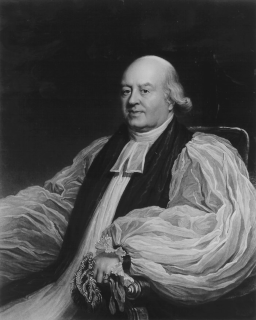
His birth into the politically influential Beresford family affords him a degree of opportunity, and he is made a vice-regal chaplain in 1766. Brother of George de la Poer Beresford, 1st Marquess of Waterford, he marries Elizabeth Fitzgibbon, sister of John FitzGibbon, 1st Earl of Clare, on June 16, 1763. They had three sons and five daughters. These connections, however, do not automatically result in his being promoted to bishop, despite reaching episcopal age in 1773, and he spends several years as a well-beneficed rector of Urney in the Diocese of Derry. The Beresford family complains that he has been overlooked for several episcopal vacancies in the 1770s and it is not until 1780 that he is created Doctor of Divinity and consecrated Bishop of Dromore on April 8, 1780. At Dromore he erects a handsome new episcopal residence. On May 21, 1782, he is transferred to the diocese of Ossory and, as bishop there, takes his seat in the Irish parliament and exercises influence over the ecclesiastical borough of St. Canice.
The death of Primate Richard Robinson in 1794 is the stimulus for a reorganisation within the Church of Ireland hierarchy, and Beresford is one of the candidates rumoured to succeed him. However, his familial ties disadvantage him, because the government does not want to favour one Irish “party” over another. He is instead appointed to the vacant archbishopric of Tuam on October 10, 1794. An influential and senior position within the church, it is worth £5,000 per annum, which is more than Archbishop Charles Agar receives for the archbishopric of Cashel and provides him with extensive patronage.
In the late 1790s Beresford regularly attends parliament, particularly in the crucial session of 1799 as the Acts of Union is debated and shares his brother John’s view that a union is the best means of securing the Protestant interest in Ireland.
In the years following the union Beresford gains a temporal peerage, becoming 1st Baron Decies on December 22, 1812. He is an amiable, kind and loquacious individual, and is patron to artists, including Gilbert Stuart, who produces a portrait of him as Bishop of Ossory. His long years of service within the established church also makes him very wealthy, worth £250,000 at the time of his death.
Beresford dies on September 6, 1819, at Tuam, County Galway, and is succeeded in the barony by his eldest surviving son John on September 8, 1819. His eldest son Marcus had died in 1803. His youngest daughter Louisa, widow of Thomas Hope, marries, by special license, her cousin William Carr Beresford on November 29, 1832. Through Louisa he is a grandfather of British MP and patron of the arts, Henry Thomas Hope.
(From: “Beresford, William” by Martin McElroy, Dictionary of Irish Biography, http://www.dib.ie, October 2009, revised June 2024)



 seamus dubhghaill