Craig is born at Sydenham, Belfast, on January 8, 1871, the seventh of nine children of James Craig (1828–1900), a wealthy whiskey distiller who had entered the firm of Dunville & Co. as a clerk and by age 40 is a millionaire and a partner in the firm. Craig Snr. owns a large house called Craigavon, overlooking Belfast Lough. His mother, Eleanor Gilmore Browne, is the daughter of Robert Browne, a prosperous man who owned property in Belfast and a farm outside Lisburn. Craig is educated at Merchiston Castle School in Edinburgh, Scotland. After school he begins work as a stockbroker, eventually opening his own firm in Belfast.
Craig enlists in the 3rd (Militia) battalion of the Royal Irish Rifles on January 17, 1900, to serve in the Second Boer War. He is seconded to the Imperial Yeomanry, a cavalry force created for service during the war, as a lieutenant in the 13th battalion on February 24, 1900, and leaves Liverpool for South Africa on the SS Cymric in March 1900. After arrival he is soon sent to the front and is taken prisoner in May 1900, but released by the Boers because of a perforated colon. On his recovery he becomes deputy assistant director of the Imperial Military Railways, showing the qualities of organisation that are to mark his involvement in both British and Ulster politics. In June 1901 he is sent home suffering from dysentery, and by the time he is fit for service again the war is over. He is promoted to captain in the 3rd Royal Irish Rifles on September 20, 1902, while still seconded to South Africa.
On June 7, 1921, Craig is appointed the first Prime Minister of Northern Ireland by the Lord Lieutenant of Ireland. The House of Commons of Northern Ireland assembles for the first time later that day.
Craig had made his career in British as well as Northern Irish politics, but his premiership shows little sign of his earlier close acquaintance with the British political world. He becomes intensely parochial and suffers from his loss of intimacy with British politicians in 1938, when the British government concludes agreements with Dublin to end the Anglo-Irish trade war between the two countries. He never tries to persuade Westminster to protect Northern Ireland‘s industries, especially the linen industry, which is central to its economy. He is anxious not to provoke Westminster, given the precarious state of Northern Ireland’s position. In April 1939, and again in May 1940 during World War II, he calls for conscription to be introduced in Northern Ireland (which the British government, fearing a backlash from nationalists, refuses). He also calls for Winston Churchill to invade Ireland using Scottish and Welsh troops in order to seize the valuable ports and install a Governor-General at Dublin.
While still prime minister, Craig dies peacefully at his home at Glencraig, County Down at the age of 69 on November 24, 1940. He is buried on the Stormont Estate on December 5, 1940, and is succeeded as the Prime Minister of Northern Ireland by the Minister of Finance, J. M. Andrews.
(Pictured: James Craig, 1st Viscount Craigavon, bromide print by Olive Edis, National Portrait Gallery, London)
Hickie attends the Royal Military College, Sandhurst, from 1882 to 1885. He is commissioned into his father’s regiment, the Royal Fusiliers at Gibraltar, in 1885 and serves with them for thirteen years in the Mediterranean, Egypt, and India, during which time he is promoted to captain on November 18, 1892. In 1899 he graduates as captain at the Staff College, Camberley, and is selected when the Second Boer War breaks out as a Special Service Officer in which capacity he acts in various positions of authority and command. He leaves Southampton for South Africa on board the SS Canada in early February 1900 and is promoted from captain of mounted infantry to battalion command as major on March 17, 1900. He is subsequently in command of a corps until eventually at the end of 1900 he is given command of an independent column of all arms. He holds this position for eighteen months. He serves with distinction at the Battle of Bothaville in November 1900 and receives the brevet promotion to lieutenant colonel on November 29, 1900. He serves in South Africa throughout the war, which ends with the Treaty of Vereeniging in June 1902. Four months later he leaves Cape Town on the SS Salamis with other officers and men of the 2nd battalion Royal Fusiliers, arriving at Southampton in late October, when the battalion is posted to Aldershot Garrison. In December 1902 he is elected a Fellow of the Royal Geographical Society (FRGS).
After the end of the war in South Africa there follows various staff appointments, the first from December 1902 as deputy-assistant adjutant general for district staff in the Cork district. In 1907 Hickie is back in regimental service in Dublin and Mullingar with the 1st Royal Fusiliers, where he is in command of the regiment for the last two years. From 1909 to 1912 is appointed to the Staff of the 8th Infantry Division in Cork where for four years he is well known in the hunting field and on the polo ground. In May 1912, he is promoted to colonel and becomes Quartermaster General of the Irish Command at Royal Hospital Kilmainham for which he is appointed a Companion of the Order of the Bath.
When war is declared, the Staff of the Irish Command becomes automatically the staff of the II Army Corps and accordingly with the outbreak of World War I in August 1914, Hickie is promoted to brigadier general and, as part of the British Expeditionary Force in France, takes charge of the Adjutant and Quartermaster-General’s Department during the retreat of the II Corps after the Battle of Mons, to Paris, and during the First Battle of the Marne. In mid-September 1914, he relieves one of the brigadiers in the fighting line as commander of the 13th Brigade (5th Infantry Division) and then commands the 53rd Brigade (18th Infantry Division) until December 1915, when he is ordered home to assume command of the 16th (Irish) Division at Blackburn.
Promoted to major general, Hickie takes over from Lieutenant General Sir Lawrence Parsons. It is politically a highly sensitive appointment which requires the professionalism and political awareness he, fortunately, possesses as the division is formed around a core of Irish National Volunteers in response to Edward Carson‘s Ulster Volunteers. He is much more diplomatic and tactful than his predecessors and speaks of the pride which his new command gives him but does not hesitate to make sweeping changes amongst the senior officers of the Irish Division. After putting the division through intensive training, it leaves under Irish command of which each man takes personal pride. It arrives in December 1915.
In the next two years and four months during which Hickie commands the 16th (Irish) Division, it earns a reputation for aggression and élan and wins many memorials and mentions for bravery in the engagements during the 1916 Battle of Guillemont and the capture of Ginchy, both of which form part of the Battle of the Somme, then during the Battle of Messines, the Third Battle of Ypres and in attacks near Bullecourt in the Battle of Cambrai offensive in November 1917.
During this period the Division makes considerable progress in developing its operational techniques but at a price in losses. The growing shortage of Irish replacement recruits, due to nationalist disenchantment with the war and the absence of conscription in Ireland, is successfully met by Hickie by integrating non-Irish soldiers into the division.
In February 1918, Hickie is invalided home on temporary sick leave, but when in the hospital the German spring offensive begins on March 21, with the result that after his division moves under the command of General Hubert Gough it is practically wiped out and ceases to exist as a division. Although promised a new command, this does not happen before the Armistice in November. He typifies the army’s better divisional commanders, is articulate, intelligent and is competent and resourceful during the BEF’s difficult period 1916–17, laying the foundations for its full tactical success in 1918. He is advanced to Knight Commander of the Order of the Bath in 1918.
Hickie retires from the army in 1922, when the six Irish line infantry regiments that have their traditional recruiting grounds in the counties of the new Irish Free State are all disbanded. He identifies himself strongly with the Home Rule Act and says that its scrapping is a disaster and is equally outspoken in condemning the activities of the Black and Tans. In 1925, he is elected as a member of Seanad Éireann, the Irish Free State Senate.
Hickie holds his seat until the Seanad is dissolved in 1936, to be replaced by Seanad Éireann in 1937. He is President of the Area Council (Southern Ireland) of the Royal British Legion from 1925 to 1948. He never marries.
Hickie dies on November 3, 1950, in Dublin and is buried in Terryglass, County Tipperary.
Plunkett’s only grown sibling, a younger brother, from whom he is estranged from about 1916, for reasons not fully clear but connected to his mother’s will, is the noted British naval officer Sir Reginald Drax. Another younger brother dies in infancy.
The title passes to Plunkett at his father’s death in 1899 at a fairly young age. The young Lord Dunsany returns to Dunsany Castle in 1901 after war duty. In that year he is also confirmed as an elector for the Representative Peers for Ireland in the House of Lords.
In 1903, Plunkett meets Lady Beatrice Child Villiers (1880–1970), youngest daughter of Victor Child Villiers, 7th Earl of Jersey, who is then living at Osterley Park. They marry in 1904. Their one child, Randal, is born in 1906. Lady Beatrice is supportive of her husband’s interests and helps him by typing his manuscripts, selecting work for his collections, including the 1954 retrospective short story collection, and overseeing his literary heritage after his death.
The Plunketts are socially active in Dublin and London and travel between homes in Meath, London and Kent, other than during the First and Second World Wars and the Irish War of Independence. He circulates with many literary figures of the time. To many of these in Ireland he is first introduced by his uncle, the co-operative pioneer Sir Horace Plunkett, who also helps to manage his estate and investments for a time. He is friendly, for example, with George William Russell, Oliver St. John Gogarty, and for a time, W. B. Yeats. He also socialises at times with George Bernard Shaw and H. G. Wells and is a friend of Rudyard Kipling.
In 1910 Plunkett commissions a two-story extension to Dunsany Castle, with a billiard room, bedrooms and other facilities. The billiard room includes the crests of all the Lords Dunsany up to the 18th.
Plunkett serves as a second lieutenant in the Coldstream Guards in the Second Boer War. Volunteering in World War I and appointed Captain in the Royal Inniskilling Fusiliers, he is stationed for a time at Ebrington Barracks in Derry, Northern Ireland. Hearing while on leave of disturbances in Dublin during the Easter Rising of 1916, he drives in to offer help and is wounded by a bullet lodged in his skull. After recovery at Jervis Street Hospital and what is then the King George V Hospital (now St. Bricin’s Military Hospital), he returns to duty. His military belt is lost in the episode and later used at the burial of Michael Collins. Having been refused forward positioning in 1916 and listed as valuable as a trainer, he serves in the later war stages in the trenches and in the final period writing propaganda material for the War Office with MI7b. There is a book at Dunsany Castle with wartime photographs, on which lost members of his command are marked.
During the Irish War of Independence, Plunkett is charged with violating the Restoration of Order in Ireland Act 1920, tried by court-martial on February 4, 1921, convicted, and sentenced to pay a fine of 25 pounds or serve three months in prison without labour. The Crown Forces had searched Dunsany Castle and had found two double-barrelled shotguns, two rook rifles, four Very pistols, an automatic pistol and a large quantity of pistol ammunition, along with shotgun and rifle ammunition.
During World War II, Plunkett signs up for the Irish Army Reserve and the British Home Guard, the two countries’ local defence forces, and is especially active in Shoreham, Kent, the English village bombed most during the Battle of Britain.
Plunkett’s fame arises chiefly from his prolific writings. He is involved in the Irish Literary Revival. Supporting the Revival, he is a major donor to the Abbey Theatre, and he moves in Irish literary circles. He is well acquainted with W. B. Yeats, Lady Gregory, Percy French, George “AE” Russell, Oliver St. John Gogarty, Padraic Colum and others. He befriends and supports Francis Ledwidge, to whom he gives the use of his library, and Mary Lavin.
Plunkett makes his first literary tour to the United States in 1919 and further such visits up to the 1950s, in the early years mostly to the eastern seaboard and later, notably, to California. His own work and contribution to the Irish literary heritage are recognised with an honorary degree from Trinity College Dublin.
In 1940, Plunkett is appointed Byron Professor of English in the University of Athens in Greece. Having reached Athens by a circuitous route, he is so successful that he is offered a post as Professor of English in Istanbul. However, he has to be evacuated due to the German invasion of Greece in April 1941, returning home by an even more complex route, his travels forming a basis for a long poem published in book form (A Journey, in 5 cantos: The Battle of Britain, The Battle of Greece, The Battle of the Mediterranean, Battles Long Ago, The Battle of the Atlantic, special edition January 1944). Olivia Manning‘s character Lord Pinkrose in her novel sequence the Fortunes of War is a mocking portrait of Dunsany in that period.
In 1947, Plunkett transfers his Meath estate in trust to his son and heir and settles in Kent at his Shoreham house, Dunstall Priory, not far from the home of Rudyard Kipling. He visits Ireland only occasionally thereafter and engages actively in life in Shoreham and London. He also begins a new series of visits to the United States, notably California, as recounted in Hazel Littlefield-Smith’s biographical Dunsany, King of Dreams.
In 1957, Plunkett becomes ill while dining with the Earl and Countess of Fingall at Dunsany, in what proves to be an attack of appendicitis. He dies in hospital in Dublin, at the age of 79, on October 25, 1957. He is buried in the churchyard of the ancient church of St. Peter and St. Paul, Shoreham, Kent. His funeral is attended by many family members, representatives of his old regiment and various bodies in which he had taken an interest, and figures from Shoreham. A memorial service is held at Kilmessan in County Meath, with a reading of “Crossing the Bar,” which coincides with the passing of a flock of geese.
Beatrice survives Plunkett, living mainly at Shoreham and overseeing his literary legacy until her death in 1970. Their son Randal succeeds to the barony and is in turn succeeded by his grandson, the artist Edward Plunkett. Plunkett’s literary rights pass from Beatrice to Edward.
A major at the outbreak of the Second Boer War in 1899, Hickie serves on the staff of Lieutenant-Colonel P. W. J. Le Gallais, commanding officer of the mounted infantry. On November 6, 1900, he is involved in an attempt to capture General Christiaan De Wet at the Battle of Bothaville, when a force led by Le Gallais and Lieutenant-Colonel Wally Ross storm De Wet’s camp. De Wet escapes, while a rearguard of 100 men engages the British force. In a fierce fight Le Gallais is killed, and Wally Ross is badly wounded. Hickie decides to charge the Boer position and leads his small force forward just as reinforcements under Major-General C. E. Knox arrive. The Boers immediately surrender, and some are found with explosive bullets. He wants to execute them immediately, but Knox insists that they be tried. Exasperated with the whole affair, Hickie gives a highly critical interview after the action which is later published in The TimesHistory of the War in South Africa (7 vols, 1900–09), edited by Leo Amery.
Hickie is promoted to brevetlieutenant colonel in 1901 and appointed deputy-assistant adjutant general of the 8th division (1903–06). In 1906, he is given command of the 1st battalion of the Royal Fusiliers. Promoted to colonel in 1912, he serves as assistant quartermaster general of the Irish command (1912–14) and is appointed a Companion of the Order of the Bath in 1914. On the outbreak of World War I, he is promoted to brigadier general and serves in Belgium and France in command of the adjutant’s and quartermaster-general’s department of II Corps. In this capacity, he is involved in the retreat following the Battle of Mons and during the First Battle of the Marne (September 1914). In December 1915, he is appointed to command the 16th (Irish) Division, with the rank of major general, replacing General Sir Lawrence W. Parsons. The division is based around a core of Redmondite National Volunteers, and Hickie, a Catholic and a home ruler, is an acceptable commander to John Redmond and other Irish nationalists.
Hickie is professional, politically adept, and popular with his men, and under his leadership the 16th is renowned for its aggressive fighting spirit. He commands the division during the Battle of the Somme in 1916 and, while proud of his men’s success in capturing Guillemont and Ginchy (September 1916), is appalled by their losses. When the division is ordered to capture Messines (now Mesen) in June 1917, he gives Major Willie Redmond permission to advance as far as the first objective and, following Redmond’s death, reproaches himself bitterly. After this attack the division is transferred to the fifth army and provides assault troops for future attacks. During the Third Battle of Ypres, and especially during the attack on Langemarck in August 1917, the division suffers horrendous casualties, losing 221 officers and 4,064 men. Among the casualties is Fr. Willie Doyle, who Hickie unsuccessfully recommends for a Victoria Cross. The division’s losses at Langemarck are highlighted by Irish MPs in the House of Commons, and Hickie’s handling of the attack is criticised. By this time, nationalist disillusionment with the war means that few Irish replacements are available, and Hickie is forced to accept increasing numbers of non-Irish conscripts into the division. Worn down by years of command, his health finally breaks, and, in February 1918, he is sent home on sick leave, being replaced by Major-General Sir Richard Amyatt Hull.
In 1918, Hickie is created a Knight Commander of the Order of the Bath (KCB) and is also awarded the French Croix de Guerre. During the Irish War of Independence (1919–21), he is critical of the methods used by Crown forces, denouncing in particular the indiscipline of the Black and Tans. In 1921 he retires from the army and becomes a prominent figure in the Royal British Legion in Ireland, tirelessly campaigning on behalf of ex-servicemen. In the 1920s he is involved with the Irish battlefield memorial committee, which erects memorial crosses at Wytschaete, Guillemont, and Salonika, commemorating the 10th and 16th divisions. He later serves as a senator of the Irish Free State (1925–36). Retiring from public life in 1936 to his residence at Terryglass, County Tipperary, he devotes his last years to gardening and reading.
Hickie dies on November 3, 1950, in Dublin, and is buried at Terryglass. He marries a daughter of the novelist Rev. J. O. Hannay, who predeceases him. There is a small collection of his papers in the National Library of Ireland (NLI).
(From: “Hickie, Sir William Bernard” by David Murphy, Dictionary of Irish Biography, http://www.dib.ie, October 2009)
Godley is the eldest son of Rev. James Godley, rector of Carrigallen, County Leitrim, and Eliza Frances Godley (née La Touche). After attending Tilney Basset’s preparatory school in Dublin, he goes to Harrow College and Balliol College, Oxford, graduating BA in 1878. At Oxford he becomes known for his classical scholarship and wins several prizes, including the Craven scholarship and the Gaisford Prize for Greek Verse. In 1879 he is appointed assistant classical master at Bradfield College. He returns to Oxford in 1883 as tutor and fellow of Magdalen College (1883–1912). Serving as deputy public orator of Oxford (1904–06), he is elected public orator in 1910, a post he holds until his death.
Godley also enjoys renown as a writer of satiric verse and prose, beginning his literary career as a contributor to The Oxford Magazine in 1883. In 1890 he becomes its editor, and two years later publishes his first book of poems, Verses to Order (1892). Later publications include Lyra Frivola (1899), Second Strings (1902) and The Casual Ward (1912). His work is very popular and two volumes, Reliquiae (1926) and Fifty Poems (1927), are published posthumously. He also publishes numerous works of serious scholarship including Socrates and Athenian Society in His Day (1896) and Oxford in the Eighteenth Century (1908). Noted as a translator of Herodotus, Tacitus, and Horace, he serves as joint-editor of The Classical Review (1910–20). He also edits and publishes volumes of the poetry of Thomas Moore and Winthrop Mackworth Praed.
Active in political life, Godley serves as an alderman on Oxford City Council. During the Second Boer War (1899–1901) he organises volunteer forces, commanding a battalion of the 4th Oxfordshire Light Infantry (1900–05). He serves in this capacity again during World War I and is lieutenant-colonel of the Oxfordshire Volunteer Corps (1916–19). A staunch unionist, during the Home Rule Crisis, he supports the formation of the Ulster Volunteer Force (UVF) and writes some political verse, notably The Arrest, which is popular among unionists. A pioneer in the sport of mountaineering, he is a founding member of the Alpine Club and a committee member (1908–11). He is also a member of the governing body of Harrow School. Towards the end of his career he is awarded honorary doctorates from Princeton (1913) and Oxford (1919).
In 1925 Godley goes on a tour of the Levant and contracts a fever which ultimately leads to his death on June 27, 1925, at his Oxford home, 27 Norham Road. He is buried at Wolvercote Cemetery.
Moore is born in Moore Hall, near Lough Carra, County Mayo on February 24, 1852. He comes from a distinguished Catholic family of Irish landholders. When he is 21, he leaves Ireland for Paris to become a painter. His Reminiscences of the Impressionist Painters (1906) vividly describes the Café Nouvelle-Athènes and the circle of Impressionist painters who frequent it. He is particularly friendly with Édouard Manet, who sketches three portraits of him. Another account of the years in Paris, in which he introduces the younger generation in England to his version of fin de siècle decadence, is his first autobiography, Confessions of a Young Man (1888).
Deciding that he has no talent for painting, Moore returns to London in 1882 to write. His first novels, A Modern Lover (1883) and A Mummer’s Wife (1885), introduce a new note of French Naturalism into the English scene, and he later adopts the realistic techniques of Gustave Flaubert and Honoré de Balzac. Esther Waters (1894), his best novel, deals with the plight of a servant girl who has a baby out of wedlock. It is a story of hardship and humiliation illumined by the novelist’s compassion. It is an immediate success, and he follows it with works in a similar vein: Evelyn Innes (1898) and Sister Teresa (1901).
In 1901 Moore moves to Dublin, partly because of his loathing for the South African War and partly because of the Irish Literary Revival spearheaded by his friend, the poet William Butler Yeats. In Dublin he contributes notably to the planning of the Abbey Theatre. He also produces The Untilled Field (1903), a volume of fine short stories reminiscent of Ivan Turgenev’s writing that focuses on the drudgery of Irish rural life, and a short poetic novel, The Lake (1905). The real fruits of his life in Ireland, however, come with the trilogy Hail and Farewell (Ave, 1911; Salve, 1912; Vale, 1914). Discursive, affectionate, and satirical by turns, it reads like a sustained monologue that is both a carefully studied piece of self-revelation and an acute, though not always reliable, portrait gallery of his Irish acquaintance, which included Yeats, George William Russell, and Lady Gregory. Above all it is a perfectly modulated display of the comic spirit.
The increasing narrowness of the Irish mind, politics, and clericalism sends Moore back to England in 1911. After Hail and Farewell, he makes another literary departure. Aiming at epic effect he produces The Brook Kerith (1916), an elaborate and stylish retelling of the Gospel story that is surprisingly effective despite some dull patches. He continues his attempts to find a prose style worthy of epic theme in Héloïse and Abélard (1921). His other works include A Story-Teller’s Holiday (1918), a blend of autobiography, anecdote, Irish legend, and satire, Conversations in Ebury Street (1924), autobiography, The Pastoral Loves of Daphnis and Chloe (1924) and Ulick and Soracha (1926), an Irish legendary romance.
George Moore dies at his home at Ebury Street in the London district of Belgravia on January 21, 1933, leaving a fortune of £70,000. He is cremated in London at a service attended by Ramsay MacDonald among others. An urn containing his ashes is interred on Castle Island in Lough Carra in view of the ruins of Moore Hall, which had been burned by anti-treaty forces in 1923, during the final months of the Irish Civil War.
Patterson is born on November 10, 1867, at Forgney, Ballymahon, County Longford, the son of a Protestant father and a Roman Catholic mother. He joins the British Army at Dublin in 1885 and is posted with the 3rd Dragoon Guards to India. In 1892 he is seconded to the Indian military works department as a supervisor of civil engineering projects. In 1894 he marries Frances Helena Gray, daughter of William Gray of Cork and Belfast, a building surveyor who founded the free library movement in Belfast. She goes on to earn science and law degrees.
In 1898 Patterson is sent to British East Africa to supervise 3,000 Indian and African labourers who are building a railway bridge spanning the Tsavo River as part of the Mombasa to Lake Victoria line. Construction is interrupted when two man-eating lions repeatedly attack the labourers’ camp at night. He embarks on a lion hunt, but by the time he shoots the two lions they have mauled and mutilated between 130 and 140 labourers.
The following year Patterson leads a safari trip in the protectorate accompanied by Audley James Blyth, a son of James Blyth, 1st Baron Blyth, and his wife, Ethel Jane. During the expedition Blyth shoots himself in the head with a revolver and dies. Patterson claims that Blyth was suffering from heat stroke, but there are rumours of a romantic attachment between Patterson and Mrs. Blyth. The colonial secretary Lord Crewe exonerates Patterson in return for his resignation as chief game warden. The incident serves as the plot for Ernest Hemingway‘s short story “The Short Happy Life of Francis Macomber.”
In 1913 Patterson commands the West Belfast division of the Ulster Volunteer Force (UVF) and sees service in Flanders before being sent to Egypt in early 1915. In Alexandria, two Russian Jewish Zionists, the journalistZe’ev Jabotinsky and veteran of the Russo–Japanese WarJoseph Trumpeldor, ask General John Maxwell, commander of the British forces in Egypt, to establish a Jewish legion that will liberate the Holy Land from the Turks. Maxwell refuses, proposing instead that the Jews form a volunteer transport unit to serve in Gallipoli. Patterson, who is imbued with a deep knowledge of the Old Testament and draws spiritual sustenance from biblical heroes such as Joshua and Gideon, is appointed commander of the Assyrian Jewish refugee mule corps, a colonial corps of the Egyptian expeditionary force. He sails with the Zion Mule Corps, as it is popularly known, to Gallipoli in April 1915, where the corps serves with distinction, carrying water and ammunition to the Allied troops on the peninsula. He falls ill in November 1915 and is sent to convalesce in London. The Zion Mule Corps is evacuated from Gallipoli in December and disbanded in March 1916.
When manpower and political considerations persuade the British authorities to create the Jewish Legion in 1917, Patterson is appointed its commander. He marches his 38th Battalion Royal Fusiliers through the City of London and Whitechapel, cheered by a crowd of several thousand Jews. The Jewish Legion participates in General Edmund Allenby‘s sustained attack, which successfully pushes the Turks out of Palestine. His experiences with his Jewish soldiers turn him into a committed Zionist. In 1916 he writes With the Zionists in Gallipoli, and in 1922 With the Judaeans in the Palestine Campaign, which contain a scathing attack on Britain’s policy towards the Jews during and after World War I.
Throughout the 1920s and 1930s, Patterson increasingly allies himself with the revisionist Zionist agenda espoused by Jabotinsky’s New Zionist Organisation. When World War II breaks out, he travels with Jabotinsky to the United States, moving permanently to La Jolla, California, in 1940. With others, including the Irish Jew and later Lord Mayor of DublinRobert Briscoe, he agitates for the formation of a large Jewish army that would fight with the Allies against Nazi Germany. After Jabotinsky’s death in 1940, he works with Benzion Netanyahu, the Palestinian Jewish executive director of the American revisionist Zionists. In 1946 he becomes godfather to Netanyahu’s first son, who is named Yonatan (the closest Hebrew name to John) in Patterson’s honour. Yonatan later leads Operation Entebbe, the successful 1976 Israeli raid on Entebbe Airport to free Israeli hostages.
On June 18, 1947, just a year before the establishment of the Zionist state of Israel, for which he had worked so hard, Patterson dies at Bel Air, California. A week later, the United Zionist Revisionists of Great Britain hold a memorial meeting at the Anglo–Palestinian Club near Piccadilly Circus in Patterson’s memory. His documents and personal effects are held at the Jabotinsky Institute and Museum in Tel Aviv. His uniform and other memorabilia are on display in Beit Hagdudim, the Jewish Legions Museum at Netanya, Israel. His two man-eating lions are on display in Chicago’s Field Museum of Natural History, where his son Bryan Patterson later serves as curator.
(From: “Patterson, John Henry” by Yanky Fachler, Dictionary of Irish Biography, http://www.dib.ie)
Always a keen traveler, during the following years Guinness makes several expeditions in search of biological specimens and archaeological material. He travels twice to New Guinea and also goes to Greenland and the Bay Islands near Honduras. These voyages are vividly described in his books Walkabout (1936) and Atlantic circle (1938). He still maintains a political profile, however, serving in several different capacities including financial commissioner to Kenya (1932) and chairman of the West India Royal Commission (1938–9). At the outbreak of World War II, he works as chairman of the Polish Relief Fund before being appointed as Joint Parliamentary Secretary at the Ministry of Agriculture on the formation of the Churchill government (1940). In 1941 he becomes Secretary of State for the Colonies and Leader of the House of Lords. Appointed Deputy Resident Minister of State in Cairo (August 1942), he becomes Minister-Resident for the Middle East in January 1944. On November 6, 1944, he is assassinated in Cairo by members of the ‘Stern Gang’, the Jewish terrorist group based in Palestine.
Guinness marries (1903) Lady Evelyn Hilda Stuart Erskine, daughter of the 14th Earl of Buchan. They have two sons and one daughter.
(Pictured: Walter Edward Guinness, 1st Baron Moyne of Bury St. Edmunds, bromide print, 1929, by Walter Stoneman, National Portrait Gallery)
Craig is the seventh of nine children of James Craig (1828–1900), a wealthy whiskey distiller who had entered the firm of Dunville & Co. as a clerk and by age 40 is a millionaire and a partner in the firm. Craig Snr. owns a large house called Craigavon, overlooking Belfast Lough. His mother, Eleanor Gilmore Browne, is the daughter of Robert Browne, a prosperous man who owned property in Belfast and a farm outside Lisburn. Craig is educated at Merchiston Castle School in Edinburgh, Scotland. After school he begins work as a stockbroker, eventually opening his own firm in Belfast.
Craig enlists in the 3rd (Militia) battalion of the Royal Irish Rifles on January 17, 1900, to serve in the Second Boer War. He is seconded to the Imperial Yeomanry, a cavalry force created for service during the war, as a lieutenant in the 13th battalion on February 24, 1900, and leaves Liverpool for South Africa on the SS Cymric in March 1900. After arrival he is soon sent to the front and is taken prisoner in May 1900, but released by the Boers because of a perforated colon. On his recovery he becomes deputy assistant director of the Imperial Military Railways, showing the qualities of organisation that are to mark his involvement in both British and Ulster politics. In June 1901 he is sent home suffering from dysentery, and by the time he is fit for service again the war is over. He is promoted to captain in the 3rd Royal Irish Rifles on September 20, 1902, while still seconded to South Africa.
On June 7, 1921, Craig is appointed the first Prime Minister of Northern Ireland by the Lord Lieutenant of Ireland. The House of Commons of Northern Ireland assembles for the first time later that day.
Craig had made his career in British as well as Northern Irish politics, but his premiership shows little sign of his earlier close acquaintance with the British political world. He becomes intensely parochial and suffers from his loss of intimacy with British politicians in 1938, when the British government concludes agreements with Dublin to end the Anglo-Irish trade war between the two countries. He never tries to persuade Westminster to protect Northern Ireland‘s industries, especially the linen industry, which is central to its economy. He is anxious not to provoke Westminster, given the precarious state of Northern Ireland’s position. In April 1939, and again in May 1940 during World War II, he calls for conscription to be introduced in Northern Ireland (which the British government, fearing a backlash from nationalists, refuses). He also calls for Winston Churchill to invade Ireland using Scottish and Welsh troops in order to seize the valuable ports and install a Governor-General at Dublin.
While still prime minister, Craig dies peacefully at his home at Glencraig, County Down at the age of 69 on November 24, 1940. He is buried on the Stormont Estate on December 5, 1940, and is succeeded as the Prime Minister of Northern Ireland by the Minister of Finance, J. M. Andrews.
(Pictured: James Craig, 1st Viscount Craigavon, bromide print by Olive Edis, National Portrait Gallery, London)
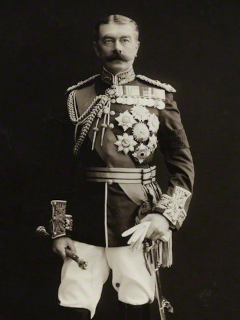
Kitchener is credited in 1898 for winning the Battle of Omdurman and securing control of the Sudan for which he is made Baron Kitchener of Khartoum. As Chief of Staff (1900–1902) in the Second Boer War he plays a key role in Lord Roberts’ conquest of the Boer Republics, then succeeds Roberts as commander-in-chief, by which time Boer forces have taken to guerrilla warfare and British forces imprison Boer civilians in concentration camps. His term as Commander-in-Chief (1902–09) of the Army in India sees him quarrel with another eminent proconsul, the Viceroy Lord Curzon, who eventually resigns. He then returns to Egypt as British Agent and Consul General.
In 1914, at the start of World War I, Kitchener becomes Secretary of State for War, a Cabinet Minister. One of the few to foresee a long war, lasting for at least three years, and with the authority to act effectively on that perception, he organises the largest volunteer army that Britain had ever seen, and oversees a significant expansion of materials production to fight on the Western Front. Despite having warned of the difficulty of provisioning for a long war, he is blamed for the shortage of shells in the spring of 1915, one of the events leading to the formation of a coalition government and is stripped of his control over munitions and strategy.
On June 5, 1916, Kitchener is making his way to Russia on HMS Hampshire to attend negotiations with Tsar Nicholas II. At the last minute, Admiral Sir John Jellicoe changes the HMS Hampshire‘s route on the basis of a misreading of the weather forecast and ignoring (or not being aware of) recent intelligence and sightings of GermanU-boat activity in the vicinity of the amended route. Shortly before 7:30 PM the same day, steaming for the Russian port of Arkhangelsk during a Force 9 gale, HMS Hampshire strikes a mine laid by the newly launched German U-boat U-75 and sinks 1.5 miles west of the Orkney. Only twelve men survive. Amongst the dead are Kitchener and all ten members of his entourage. He is seen standing on the quarterdeck during the approximately twenty minutes that it takes the ship to sink. His body is never recovered.


 seamus dubhghaill