Hone’s most important works are probably the East Window, depicting the Crucifixion, for the Chapel at Eton College, Windsor (1949–1952) and My Four Green Fields, now located in Government Buildings, Dublin. This latter work, commissioned for the Irish Government’s Pavilion, wins first prize for stained glass in the 1939 New York World’s Fair. It graces CIÉ‘s Head Office in O’Connell Street from 1960 to about 1983. The window is then taken into storage by Abbey Glass in Kilmainham, Dublin at the request of the Office of Public Works.
The East Window of Eton College is commissioned following the destruction of the building after a bomb is dropped on the school in 1940 during World War II. She is commissioned to design the East Window in 1949, and the new window is inserted in 1952. This work is featured on an Irish postage stamp in 1969. From December 2005 to June 2006, an exhibition of her work is on display at the National Gallery of Ireland. Saint Mary’s church in Clonsilla also features her stained glass windows.
Hone is extremely devout. She spends time in an Anglican Convent in 1925 at Truro in Cornwall and converts to Catholicism in 1937. This may have influenced her decision to begin working in stained glass. Initially she works as a member of the An Túr Gloine stained glass co-operative before setting up a studio of her own in Rathfarnham.
Unmarried, Hone dies on March 13, 1955, while entering her parish church at Rathfarnham. She is survived by two of her sisters. Over 20,000 people visit a memorial exhibition of her work at University College Dublin (UCD), Earlsfort Terrace, Dublin, in 1958.
(Pictured: “My Four Green Fields” by Evie Hone, which depicts the four provinces of Ireland)
McLachlan is the featured composer in the RTÉ National Symphony Orchestra‘s “Horizons” series in 2003 and 2008. He also represents Ireland at international festivals, including the ISCM World Music Days in Slovenia in 2003 and Croatia in 2005. In 2006, his work Grand Action is commissioned as a test-piece for the AXA Dublin International Piano Competition.
McLachlan’s musical aesthetic is largely shaped by a desire to impart a sense of narrative and expectation to his music without recourse to pastiche rhetorical devices. A critic writes of a recording of McLachlan’s piano piece Nine: “The style of each little piece sends one’s imagination and musical memory reeling, some of them evoking French Impressionism, some jazzy in feel, some reminiscent of the miniatures for piano of Webern, and none of them in any way, shape or form derivative.” Much of his music is structured in contrasting and suddenly changing block-like sections of homogeneous material. The material within these sections is propelled by a rigorous focus on subtle rhythmic and melodic permutations, which result in both surface opacity and gradually increasing tension.
Aidan Higgins, Irish writer of short stories, travel pieces, radio drama and novels, is born on March 3, 1927, in Celbridge, County Kildare. Among his published works are Langrishe, Go Down (1966), Balcony of Europe (1972) and the biographical Dog Days (1998). His writing is characterised by non-conventional foreign settings and a stream of consciousness narrative mode. Most of his early fiction is autobiographical – “like slug trails, all the fiction happened.”
Higgins attends local schools and Clongowes Wood College, a private boarding school. In the early 1950s he works in Dublin as a copywriter for the Domas Advertising Agency. He then moves to London and works in light industry for about two years. He marries Jill Damaris Anders in London on November 25, 1955. From 1960, he sojourns in southern Spain, South Africa, Berlin and Rhodesia. In 1960 and 1961 he works as scriptwriter for Filmlets, an advertising firm in Johannesburg. These journeys provide material for much of his later work, including his three autobiographies, Donkey’s Years (1996), Dog Days (1998) and The Whole Hog (2000).
His upbringing in a landedCatholic family provides material for Higgins first novel, Langrishe, Go Down (1966). The novel is set in the 1930s in a run-down “big house” in County Kildare, inhabited by the last members of the Langrishe family, three spinster sisters, Catholics, living in not-so-genteel poverty in a once-grand setting. One sister, Imogen, has an affair with a German intellectual, Otto Beck, which transgresses the moral code of the time, bringing her a brief experience of happiness. Otto’s intellectual pursuits contrast with the moribund cultural life of mid-20th century Ireland. The book is awarded the James Tait Black Memorial Prize for fiction and is later adapted as a BBC Television film by British playwright Harold Pinter, in association with RTÉ. Langrishe, Go Down also receives the Irish Academy of Letters Award.
Higgins second major novel is Balcony of Europe, taking its name from a feature of the Spanish fishing village, Nerja Andalusia, where it is set. The novel is carefully crafted, and rich in embedded literary references, using Spanish and Irish settings and various languages, including Spanish and some German, in its account of the daily life in the beaches and bars of Nerja of a largely expatriate community. The protagonist, an artist called Dan Ruttle, is obsessed with his friend’s young American wife, Charlotte, and by the contrast between his life among a cosmopolitan artistic community in the Mediterranean, and his Irish origins. The book is re-edited in collaboration with Neil Murphy and published by Dalkey Archive Press in 2010, with the Irish material cut and the affair between Dan Ruttle and Charlotte foregrounded.
Higgins later novels include widely acclaimed Bornholm Night Ferry and Lions of the Grunwald. Various writings have been collected and reprinted by the Dalkey Archive Press, including his three-volume autobiography, A Bestiary, and a collection of fiction, Flotsam and Jetsam, both of which demonstrate his wide erudition and his experience of life and travel in South Africa, Germany and London which gives his writing a largely cosmopolitan feel, utilising a range of European languages in turns of phrase.
Higgins lives in Kinsale, County Cork, from 1986 with the writer and journalist Alannah Hopkin. They are married in Dublin in November 1997. He is a founder member of Irish artists’ association Aosdána. He dies on December 27, 2015, in Kinsale.
Hutchinson’s father, Harry Hutchinson, a Scottish printer whose own father had left Dublin to find work in Scotland, is Sinn Féin treasurer in Glasgow and is interned in Frongoch internment camp in 1919–21. His mother, Cathleen Sara, is born in Cowcaddens, Glasgow, of emigrant parents from County Donegal. She is a friend of Constance Markievicz. In response to a letter from Cathleen, Éamon de Valera finds work in Dublin for Harry as a clerk in the Labour Exchange, and later he holds a post in Stationery Office.
Hutchinson is five years old when the family moves to Dublin and is the last to be enrolled in St. Enda’s School before it closes. He then goes to school at Synge Street CBS where he learns Irish and Latin. One of his close friends there is the poet and literary critic John Jordan. In 1948 he attends University College Dublin (UCD) where he spends a year and a half, learning Spanish and Italian.
Having published some poems in The Bell in 1945, Hutchinson’s poetic development is greatly influenced by a 1950 holiday in Spain and Portugal. A short stop en route at Vigo brings him into contact for the first time with the culture of Galicia. Later, in Andalusia, he is entranced by the landscape and by the works of the Spanish poets Federico García Lorca, Emilio Prados and Luis Cernuda.
In 1951 Hutchinson leaves Ireland again, determined to live in Spain. Unable to get work in Madrid, as he had hoped, he travels instead to Geneva, where he gets a job as a translator with the International Labour Organization, which brings him into contact with Catalan exiles, speaking a language then largely suppressed in Spain. An invitation by a Dutch friend leads to a visit to the Netherlands, in preparation for which he teaches himself the Dutch language.
Hutchinson returns to Ireland in 1953 and becomes interested in the Irish language poetry of writers such as Piaras Feiritéar and Aonghus Fionn Ó Dálaigh and publishes a number of poems in Irish in the magazine Comhar in 1954. The same year he travels again to Spain, this time to Barcelona, where he learns the Catalan and Galician languages, and gets to know Catalan poets such as Salvador Espriu and Carles Riba. With the British poet P. J. Kavanagh, he organises a reading of Catalan poetry in the British Institute.
Hutchinson goes home to Ireland in 1957 but returns to Barcelona in 1961 and continues to support Catalan poets. An invitation by the publisher Joan Gili to translate some poems by Josep Carner leads to the publication of his first book, a collection of thirty of Carner’s poems in Catalan and English, in 1962. A project to publish his translation of Espriu’s La Pell de brau (The Bull-skin), falls through some years later. Some of the poems from this project are included in the collection Done into English.
In 1963, Hutchinson’s first collection of original poems in English, Tongue Without Hands, is published by Dolmen Press in Ireland. In 1967, having spent nearly ten years altogether in Spain, he returns to Ireland, making a living as a poet and journalist writing in both Irish and English. In 1968, a collection of poems in Irish, Faoistin Bhacach (A Lame Confession), is published. Expansions, a collection in English, follows in 1969. Friend Songs (1970) is a new collection of translations, this time of medieval poems originally written in Galician-Portuguese. In 1972 Watching the Morning Grow, a new collection of original poems in English, comes out, followed in 1975 by another, The Frost Is All Over.
In October 1971, Hutchinson takes up the Gregory Fellowship in Poetry at the University of Leeds, on the recommendation of Professor A. Norman Jeffares. There is some controversy around the appointment following accusations, later retracted, that Jeffares had been guilty of bias in the selection because of their joint Irish heritage. He holds tenure at the University for three years, and during that time contributes to the University’s influential poetry magazine Poetry & Audience.
From 1977 to 1978 Hutchinsonn compiles and presents Oró Domhnaigh, a weekly radio programme of Irish poetry, music and folklore for Ireland’s national network, RTÉ. He also contributes a weekly column on the Irish language to the station’s magazine RTÉ Guide for over ten years. A collaboration with Melita Cataldi of Old Irish lyrics into Italian is published in 1981. Another collection in English, Climbing the Light (1985), which also includes translations from Irish, Italian and Galician, is followed in 1989 by his last Irish collection, Le Cead na Gréine (By Leave of the Sun). The Soul that Kissed the Body (1990) is a selection of his Irish poems translated into English. His most recent English collection is Barnsley Main Seam (1995). His Collected Poems is published in 2002 to mark his 75th birthday. This is followed in 2003 by Done into English, a selection of many of the translated works he produced over the years.
A co-editor and founder of the literary journal Cyphers, Hutchinson receives the Butler Award for Irish writing in 1969. He is a member of Aosdána, the state-supported association of artists, from which he receives a cnuas (stipend) to allow him to continue writing. He describes this as “a miracle and a godsend” as he is fifty-four when invited to become a member and is at the end of his tether. A two-day symposium of events is held at Trinity College Dublin, to celebrate his 80th birthday in 2007, with readings from his works by writers including Macdara Woods, Eiléan Ní Chuilleanáin, Paul Durcan and Sujata Bhatt. His most recent collection, At Least for a While (2008), is shortlisted for the Poetry Now Award.
Hutchinson lives in Rathgar, Dublin, and dies of pneumonia in Dublin on January 14, 2012.
Armstrong is the son of a house painter and attends Strandtown Primary School. Later he studies architecture at Queen’s University Belfast, but after two years he moves to study art at Belfast School of Art. The influence of Cubism and the School of Paris can be clearly seen in his work, which takes him to England, France and Spain. He also travels and paints in the west of Ireland and Connemara inspires some of his best work. In 1950 his work is exhibited in the Grafton Gallery in Dublin, and subsequent exhibitions take place in England, Spain and the United States, as well as in Belfast and Dublin. In 1957 he is awarded a travelling scholarship from the Council for the Encouragement of Music and the Arts (CEMA), a forerunner of the Arts Council of Great Britain, and goes to Spain. He eventually settles in Dublin in 1962 and begins showing work at the Royal Hibernian Academy.
In 1968 Armstrong is awarded the Douglas Hyde Gold Medal at the Oireachtas Exhibition. In 1969 he designs sets, with George Campbell and Gerard Dillon, for the Seán O’Casey play, Juno and the Paycock, at the Abbey Theatre in Dublin. He becomes a member of the Royal Hibernian Academy in 1972 and in 1973 he is awarded the Art in Context prize from the Arts Council of Northern Ireland. He becomes a member of Aosdána in 1981, the same year that a retrospective exhibition of his work from 1950 to 1980 is held by the Arts Council of Northern Ireland.
From 1971 Armstrong lives at 28 Chelmsford Avenue, Ranelagh, Dublin, in a house he shares with Gerard Dillon. A bachelor, Armstrong dies in a Dublin hospital on January 13, 1996. The contents of his studio are sold February 3, 1998.
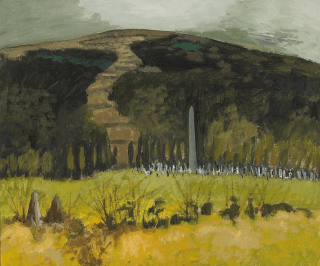
(Pictured: “Glendalough” by Arthur Armstrong, oil on board)
Luis Roberto de Lacy, a Spanish professional soldier of Irish descent who serves in the Spanish and French Imperial armies, is born on January 11, 1775, in San Roque, Cádiz, Spain.
De Lacy is born to Lieutenant-Colonel Patrick de Lacy, an officer in the Ultonia or Ulster Regiment, a foreign unit or Infantería de línea extranjera of the Spanish army. Patrick dies sometime before 1785 and his wife, Antonia, remarries Jean Gautier, another Ultonia officer. His grandfather, General Patrick de Lacy y Gould, came from Limerick. Along with many relatives, he was part of the post-1691 Irish diaspora known as the Flight of the Wild Geese.
De Lacy is commissioned into the Ultonia regiment when he is ten, although his age is recorded as thirteen to satisfy minimum requirements. Issuing commissions to children is not unusual, as they are considered private investments and often used to provide pensions for orphans. Although by now the Ultonia is no longer “Irish,” many of the officers are Spanish-born descendants of the original Irish emigrants, including his uncle Francis and various cousins.
In 1789, de Lacy joins an expedition to Puerto Rico, accompanied by his stepfather. They apparently quarrel and, on their return, de Lacy walks to Porto, in Portugal, intending to take ship to the Maluku Islands, before his stepfather brings him home.
Promoted captain, de Lacy takes part in the War of the Pyrenees against France, which ends with the April 1795 Peace of Basel. He is posted to the Canary Islands in 1799, where he fights a duel with the local Capitán-General. Despite being transferred to El Hierro, he continues their feud. He is court-martialed as a result and sentenced to one year in the Royal Prison at the Concepción Arsenal at Cádiz.
De Lacy’s jailers allegedly consider him mentally unbalanced. As a result, he is stripped of his commission and barred from re-enlisting in the Spanish army. He moves to France in order to continue his career and is appointed captain in the Irish Legion, a French army unit formed in Brittany and intended to support an Irish rising. Although many of its officers are Irish exiles or of Irish descent, the rank and file are mostly Polish.
De Lacy arrives in Madrid shortly before the May 1808 revolt known as the Dos de Mayo. He deserts and is reinstated in the Spanish army as colonel of the Burgos regiment.
In July 1809, de Lacy is given command of the Isla de León, an important defensive position in Cádiz, home of the Regency Council that rules Spain in Ferdinand’s absence. He leads the 1st Division at the Battle of Ocaña on November 19, 1809. The collapse of the Spanish cavalry under Manuel Freire de Andrade exposes him to a flank attack that practically annihilates his division. A second defeat at Alba de Tormes on November 29 leaves the Spanish unable to confront the French in open battle and they resort to guerrilla tactics.
Although Cádiz is besieged by the French from February 1810 to August 1812, support from the Royal Navy allows the Council to send small amphibious expeditions intended to bolster resistance elsewhere. De Lacy leads landings in Algeciras, Ronda, Marbella and Huelva and although unable to hold them, this absorbs French resources. In March 1811, his troops support an Anglo-Spanish attempt to break the siege of Cádiz. The resulting Battle of Barrosa is a significant victory, although command failures mean the siege continues.
After the loss of Tarragona in June 1811, de Lacy replaces the Marquess of Campoverde as Capitán-General of Catalonia, a position held by his uncle Francis from 1789 to 1792. French efforts to capture Valencia weaken them elsewhere and provide the Spanish opportunities for partisan warfare. He leads a series of incursions into the French departments of Haute-Garonne and Ariège. These restore local morale and force the French to send reinforcements.
Most major towns, including Barcelona, Tarragona and Lleida, remain in French hands and in early 1812, Napoleon makes Catalonia part of France. The focus on guerrilla tactics lead to an increasingly bitter war of reprisals and executions by both sides, which severely impact the civilian population. Many of the partisan bands are beyond central control and their operations often indistinguishable from simple brigandage. This leads to conflict between de Lacy and local Catalan leaders and in January 1813, he moves to Santiago de Compostela as Captain General of the Kingdom of Galicia. He assumes command of the Reserva de Galicia, which he focuses on disciplining and reorganising. Following Allied victory at Vitoria in June 1813, the French withdraw from Spain and Ferdinand returns to Madrid in April 1814.
Ferdinand rejects a previous commitment to accept the Spanish Constitution of 1812 and establishes an absolutist regime. Spain also faces colonial wars in the Americas, which begin in 1810 and continue until 1833. This destabilises the regime and leads to a series of attempted coups, by military officers like de Lacy backed by progressive civilian elements, often linked by Freemasonry.
Following failed attempts in 1815 and 1816, de Lacy returns to Barcelona and assisted by a former subordinate, Francisco Milans del Bosch, plan another. This begins on April 5, 1817, but quickly collapses. De Lacy is captured, court-martialed, and sentenced to death. Following public protests against the sentence, he is secretly taken to Palma de Mallorca, held at Bellver Castle and executed there by firing squad on July 5, 1817.
In 1820, a revolt led by Colonel Rafael del Riego forces Ferdinand to restore the 1812 Constitution. This begins the Trienio Liberal, a period of liberalisation that ends in 1823, when a French army allows Ferdinand to re-assert control. However, in 1820 the reconstituted Cortes Generales declares de Lacy a martyr. Along with others including Riego, he is commemorated on a plaque in the Palacio de las Cortes, Madrid, which can still be seen today. De Lacy is buried at the Cementiri de Sant Andreu, in Barcelona.
Lynch is born in Dublin on March 25, 1859. Her father, who is a committed, non-violent Fenian, dies when she is young. Her mother, Anna Theresa Calderwood, is married twice. She grows up in a very female house with her mother and ten sisters and half-sisters. Her stepfather is James Cantwell, also a Fenian, who runs the Star and Garter Hotel. After finishing school, she works as a sub-editor for a provincial paper and as a governess in Europe.
A nationalist like her father and stepfather, Lynch is an executive member of the Ladies’ Land League and as a result closely associates with Fanny Parnell. She writes extensively, producing short stories and satirical sketches, as well as Land War fiction, travel writing, translations and literary criticism. Her satirical pieces include “A Dublin Literary Coterie Sketched by a Non-Pretentious Observer” (1888) and “My Friend Arcanieva” (1895). She publishes William O’Brien‘s paper United Ireland from France, after it is suppressed in Ireland. She disagrees with William Butler Yeats on the literary merit of Emily Lawless, calling her work “highly polished literary stories.”
Lynch also writes fiction on the subject of political and cultural affairs in Ireland, sometimes meeting controversy. Her first novel, Through Troubled Waters (1885), is a fictionalised version of a real-life incident in Galway in which the daughters of a prosperous landowning family are murdered to make way for the sons to inherit the land. The novel also depicts the rural clergy as complicit, by denouncing the victims from the pulpit. The newspaper United Ireland strongly criticises the novel, claiming it peddles in anti-Irish stereotypes for a British audience. She responds by stating that she had intended the book for an Irish publisher and audience, and that she should not be asked “to prove my patriotism at the expense of truth.”
Lynch publishes across Ireland, the United Kingdom and from Paris. By 1896, she has settled in Paris, having also lived in both Spain and Greece. She speaks Greek and French. She then returns to lecture in Ireland and is a part of the salons of Paris in the Belle Époque as well as the Irish Literary Revival in Dublin. She is friends with the historian, biographer and literary critic Arvède Barine (pseudonym of Louise-Cécile Vincens), the writers Mabel and Mary Robinson, and the medievalist Gaston Paris. Her work however does not bring significant income, and she is forced to apply to the Royal Literary Fund for help on multiple occasions. Eventually it takes a toll on her health. She spends time in hospital in Margate, England in 1903.
Wynne-Jones is born to landowner Charles Llewellyn Wynne-Jones and Sybil Mary Gella Scott. The family spends half the year in Wales and half the year in Thornhill, Stalbridge, Dorset, England. She has two brothers, Andrew and Ronald (“Polly”), both of whom die in Africa during World War II.
Wynne-Jones is educated at home. Her skill in art leads to her getting lessons in Sherborne from a children’s book illustrator. Her music is encouraged by the family doctor, and she begins to compose and study the violin, receiving lessons in Bournemouth with the first violinist of the symphony orchestra and continues in Aberystwyth after the start of World War II. She goes on to study the violin and composition at the Royal Academy of Music, London (1940–43). While in London she also serves as a Voluntary Aid Detachment nurse until 1943 and later as a draughtswoman at the Ordnance Survey.
After the war Wynne-Jones purchases and manages a bookshop on the King’s Road in Chelsea, but it is not a financial success. She returns to painting, studying at the Heatherley School of Fine Art, London (1951-52) and the Chelsea School of Art (1952–55). She travels extensively through Portugal and Italy painting landscapes. An interest in completing landscapes in an abstract manner leads her to study with Peter Lanyon in St. Ives, Cornwall.
Wynne-Jones begins study in Cornwall in 1957 and remains there for fifteen years. Her first public exhibition is in a group show (1957) at the Pasmore Edwards Gallery, Newlyn. Other group shows are Jefferson Place Gallery, Washington, D.C., (1959), and in Falmouth, Cornwall (1960). Her solo exhibitions are at the New Vision Centre, London (1962 and 1965), Florence (1963) and Dolgellau (1964). From the 1960s through the 1990s she exhibits in Great Britain, Italy, Belgium, Germany, Ireland, Spain, Holland, South Africa, and the United States.
In 1962 Wynne-Jones purchases Trevaylor House near Penzance and provides accommodation for other artists including renowned Irish painter Tony O’Malley, sculptor Conor Fallon, and English poet and writer W. S. ‘Sydney’ Graham. In the 1970s she exhibits in Ireland at the Project Arts Centre, Dublin (1970) and at the Emmet Gallery, Dublin (1975 and 1977). During the 1980s she exhibits at the Lincoln and Hendricks galleries in Dublin before joining the Taylor Galleries, run by John and Patrick Taylor. She is elected honorary member of the Royal Hibernian Academy (RHA) in 1994 and becomes a member of Aosdána in 1996. Originally an abstract artist, her contact with the Irish countryside slowly transforms her work to that of a landscape artist, albeit with an influence of abstraction attached to it. She becomes well known in Irish art circles as an eminent Irish landscape artist.
Wynne-Jones is involved with artist Derek Middleton before moving to Cornwall. There she becomes romantically involved with Graham who is in an open marriage, however it is the death of her mentor Peter Lanyon that devastates her. She meets the sculptor Conor Fallon through their mutual friend Tony O’Malley. Fallon had arrived in Cornwall ostensibly to meet Lanyon. They marry in 1966. Their honeymoon in Provence is immortalised in expressionist paintings done by Wynne-Jones. The couple adopts a boy and a girl, siblings, John and Bridget. In 1972 she moves with her family to Kinsale, County Cork. It is in this area that a number of her paintings are created. She moves to Ballard House, near Rathdrum, County Wicklow in 1987. There she paints the mountain visible from her home.
Wynne-Jones dies at the age of 83 on November 9, 2006. She is buried in Ballinatone (Church of Ireland), Rathdrum.
(Pictured: “Klein Constantia with Table Mountain” by Nancy Wynne-Jones, acrylic on paper, 16 1/2″ x 23″)
Ó Maolchonaire is born in the townland of Figh, civil parish of Tibohine, barony of Frenchpark, County Roscommon. His father and mother are Fíthil and Onóra Ó Maolchonaire. Two other sons survive to adulthood, Maoilechlainn and Firbisigh. They belong to a well-known family of historians and poets. He is brought up in the family profession.
Ó Maolchonaire studies for the priesthood at Salamanca, entering the Irish college founded in 1592. He first studies the liberal arts and philosophy. In 1593 he translates into Irish a short Castilian catechism by Jerónimo de Ripalda SJ. The original is a simple catechetical work written in Aristotelian master-pupil dialogue. According to Mícheál Mac Craith, Ó Maolchonaire’s translation pointedly refers to the Irish as Eirinnach rather than Gaedheal.
After five years at the Salamanca Irish college, Ó Maolchonaire leaves to join the Franciscan province of Santiago. Aodh Mac Cathmhaoil is among his classmates in the Salamanca Franciscan friary. They and nine of their peers in the Santiago province are later raised to the episcopacy, an unprecedented development in the history of the order.
At the height of the Nine Years’ War, Ó Maolchonaire sails to Ireland where he serves as a confessor and preacher to troops under the command of Hugh O’Neill and Hugh Roe O’Donnell. In 1601, they request a bishopric for Ó Maolchonaire “in recognition of his diligence, commending his sound judgment on Irish affairs.” After the disaster of Kinsale in 1601, he accompanies O’Donnell to Spain as his confessor and adviser, hoping to see a renewal of Spanish military intervention in Ireland.
In 1602, Ó Maolchonaire attempts to get approval for O’Donnell to meet Philip III in person, but they are kept at arm’s length by the Spanish court. During this time, they also drafted an official complaint against the Jesuit superiors of the Irish college at Salamanca over presumed discrimination in favour of Old English students at the expense of students from Connacht and Ulster.
While waiting for a response to his repeated calls for military support in Ireland, O’Donnell becomes seriously ill and dies at Simancas, being assisted on his deathbed by Ó Maolconaire. In keeping with his patronage of the order of friars minor in Donegal, O’Donnell is buried in the Franciscan habit. Ó Maolchonaire accompanies the remains to their last resting place in the Franciscan church at Valladolid. He continues to press for military support after O’Donnell’s death. He participates in an abandoned maritime expedition which reaches Achill Sound in 1603 but never lands in Ireland. He subsequently assists the Spanish councils of state and war to stem the flow of Irish military migrants and their dependents in Spain.
As adviser to Puñonrostro, the king’s appointee as protector of Irish exiles in Spain, Ó Maolchonaire helps to secure funds for widows, orphans and clerics. Trained as a chronicler and genealogist, he sponsors the entry of Irish soldiers into Spanish military orders and successfully calls for the promotion of Henry O’Neill, second eldest son of the earl of Tyrone, as colonel of Irish infantry units in Flanders, the O’Neill tercio in 1604.
In 1606, the Franciscan general chapter is held in Toledo where Ó Maolchonaire is selected as minister-provincial of the Irish friars minor. The most notable act of his tenure as provincial is the founding of a new Irish Franciscan college at Leuven in the Habsburg Netherlands. A year before his appointment, he begins his efforts in earnest with an appeal to the Spanish king. The loss of five Franciscan houses during the Nine Years’ War makes a new foundation essential. In response, Philip III instructs Albert VII, Archduke of Austria, to provide a perpetual grant for a new college in the university town of Leuven. Ó Maolchonaire’s part in founding the college clearly influences the Catholic pastoral mission to Ireland during the seventeenth century. The first and most active Irish printing press on the continent is long in operation at Leuven.
After Hugh O’Neill and Rory O’Donnell leave Ireland in 1607, Ó Maolconaire accompanies them from Douai to Rome as interpreter and advisor. Christopher St. Laurence, baron of Howth, implicates him in a plot to seize Dublin Castle and raises a new rebellion just before the Flight of the Earls. In recognition of his losses, Philip III and Paul V offer O’Neill the concession of Ó Maolchonaire’s promotion to the archbishopric of Tuam. On Sunday, May 3, 1609, he is consecrated archbishop by CardinalMaffeo Barberini in the centre of Rome at the Chiesa Santo Spirito in Sassia. He remains in Rome until his appointment as archbishop of Tuam before returning to Madrid on behalf of Hugh O’Neill.
In response to the 1613–15 Parliament of Ireland, Ó Maolchonaire writes from Valladolid a remonstrance to the Catholic members of the parliament, rebuking them for assenting to the bill of attainder that confiscated the estates of O’Neill, O’Donnell and their adherents. As Archbishop of Tuam, he never takes possession of his episcopal see, governing through vicars general. He continues to live in Madrid and Leuven, as is the case with many Irish clergy at the time. Like his fellow-Franciscan, Luke Wadding, and Peter Lombard, Archbishop of Armagh, he serves as a key intermediary and his influence in Irish matters is considerable. In 1626, a year after Charles I declared war on Spain, he makes the case for an invasion of Ireland under the joint leadership of the earls of Tyrone and Tyrconnell.
Ó Maolconaire dies at the Franciscan friary of San Francisco el Grande in Madrid on November 18, 1629. In 1654, two Irish friars bring his remains back to St. Anthony’s College in Leuven where he is buried near the high altar in the collegiate chapel.
Lord enlists in the Royal Air Force on August 6, 1936. After reaching the rank of corporal in August 1938, he applies to undertake pilot training, which he begins in October 1938. Successfully gaining his pilot’s wings, he becomes a sergeant pilot in April 1939, and is posted to No. 31 Squadron RAF, based in Lahore, India. He later flies the Vickers Type 264 Valentia biplane transport. In 1941, No. 31 Squadron is the first unit to receive the Douglas DC-2 which is followed by both the Douglas DC-3 and Dakota C-47 Skytrain transports. That year he is promoted to flight sergeant and then warrant officer. He flies in North Africa, supporting troops in Libya and Egypt for four months, before being posted back to India. Commissioned as a pilot officer in May 1942, he flies supply missions over Burma, for which he is mentioned in despatches.
The Battle of Arnhem is part of Operation Market Garden, an attempt to secure a string of bridges through the Netherlands. At Arnhem, the British 1st Airborne Division and Polish 1st Independent Parachute Brigade are tasked with securing bridges across the Lower Rhine, the final objectives of the operation. However, the airborne forces that drop on September 17 are not aware that the 9th SS and 10th SS Panzer divisions are also near Arnhem for rest and refit. Their presence adds a substantial number of Panzergrenadiers, tanks and self-propelled guns to the German defences and the Allies suffer heavily in the ensuing battle. Only a small force manages to hold one end of the Arnhem road bridge before being overrun on September 21. The rest of the division becomes trapped in a small pocket west of the bridge and has to be evacuated on September 25. The Allies fail to cross the Rhine, which remains under German control until Allied offensives in March 1945.
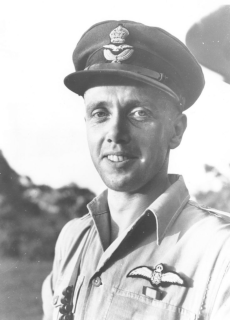
Lord is 30 years old, and a flight lieutenant serving with No. 271 Squadron, Royal Air Force during World War II when he is awarded the Victoria Cross. On September 19, 1944, during the Battle of Arnhem in the Netherlands, the British 1st Airborne Division is in desperate need of supplies. His Dakota III “KG374” encounters intense enemy anti-aircraft fire and is hit twice, with one engine burning. He manages to drop his supplies, but at the end of the run finds that there are two containers remaining. Although he knows that one of his wings might collapse at any moment, he nevertheless makes a second run to drop the last supplies, then orders his crew to bail out. A few seconds later, the Dakota crashes in flames with its pilot and six crew members.
Only the navigator, Flying Officer Harold King, survives, becoming a prisoner of war. It is only on his release in mid-1945, as well as the release of several paratroops from the 10th Parachute Battalion, that the story of Lord’s action becomes known. He is awarded a posthumous Victoria Cross.
Several aircraft have carried tributes to Lord. Between 1993 and 1998, the RAF Battle of Britain Memorial Flight‘s Dakota, serial “ZA947”, is painted in the colours of Lord’s aircraft during the Arnhem battle and bears the same code letters: YS-DM. Between 1973 and 2005, the Dakota displayed at RAF Museum Cosford is similarly painted and coded to represent Lord’s aircraft. From 1966 until its disbandment in 2005, No. 10 Squadron RAF is equipped with Vickers VC-10s, each of which is named after a Royal Air Force or Royal Flying Corps VC recipient. Aircraft serial number ‘XR810’ is named David Lord VC.
Lord’s Victoria Cross is presented to his parents at Buckingham Palace in December 1945. In 1997, his Victoria Cross, along with his other decorations and medals, are sold at auction by Spinks to Lord Ashcroft. As of 2014, the medal group is on display at the Imperial War Museum.




 seamus dubhghaill