The Irish general election is that part of the 1918 United Kingdom general election which takes place in Ireland. The election is now seen as a key moment in modern Irish history because it sees the overwhelming defeat of the moderate nationalistIrish Parliamentary Party (IPP), which had dominated the Irish political landscape since the 1880s, and a landslide victory for the radical Sinn Féin party. The party had never stood in a general election but had won six seats in by-elections in 1917–1918. Sinn Féin vows in its manifesto to establish an independent Irish Republic. In Ulster, however, the Unionist Party is the most successful party.
The election is held in the aftermath of World War I, the Easter Rising and the Conscription Crisis. It is the first general election to be held after the Representation of the People Act 1918. It is thus the first election in which women over the age of 30, and all men over the age of 21, can vote. Previously, all women and most working-class men had been excluded from voting.
In the aftermath of the elections, Sinn Féin’s elected members refuse to attend the British Parliament in Westminster. Instead, they form a parliament in Dublin, the First Dáil Éireann, which declares Irish independence as a republic. The Irish War of Independence is conducted under this revolutionary government which seeks international recognition and sets about the process of state-building.
The British monarch and the Republic of Ireland‘s head of state chat and pose together at Hillsborough Castle, outside Belfast, for an occasion that would have provoked hostility within Northern Ireland’s Protestant majority just a few years earlier. But their trouble-free meeting becomes inevitable once Ireland dropped its territorial claim to Northern Ireland as part of the landmark Good Friday Agreement peace accord of 1998. The visit also fuels speculation the queen could soon make her first official visit to the neighboring Republic of Ireland, where the Irish Republican Army assassinated Lord Louis Mountbatten, the uncle of her husband, Prince Philip, Duke of Edinburgh.
No British monarch has visited the territory of the modern-day Republic of Ireland since George V visited Dublin in 1911, a decade before the island’s partition into a mostly Protestant north that remains within the United Kingdom, and a predominantly Catholic rest of Ireland that gradually gains full independence from Britain.
Camera crews are allowed to film the moment, but not record the sound, when McAleese shakes the queen’s hand at the start of a 20-minute meeting, their fourth since 1998. Previous meetings occurred at Buckingham Palace and on a World War I battlefield site. McAleese later calls it “a very special day for Anglo-Irish relationships” that brings forward the day when the queen will visit the Irish Republic.
McAleese, a Belfast-born Catholic, had made scores of visits to Northern Ireland since being elected to the Irish Republic’s largely symbolic presidency in 1997. As part of her presidential theme of “building bridges,” she regularly invites Protestant groups to her official Dublin mansion and has built impressive diplomatic contacts with northern Protestants.
Before McAleese’s arrival, visits north by an Irish president were rare events that drew public protests from Protestants, who demanded that Ireland remove its territorial claim from its 1937 constitution. The republic’s voters overwhelmingly supported this in a May 1998 referendum, an action completed in December 1999.
The queen has avoided traveling to the Irish Republic, in part, because of security fears following the IRA assassination of Mountbatten in August 1979. He, his daughter-in-law and two teenage boys are killed when the IRA blows up his private boat near his castle in County Sligo. However, Prince Philip and their son, Prince Charles, make several visits to the Irish Republic in the decade following the IRA’s 1994 cease-fire.
Trench is educated at Haileybury and Keble College, Oxford, and is elected a fellow of All Souls College, Oxford. In 1891, after some years spent in traveling, he is appointed an examiner in the Board of Education. He gives up this appointment in 1908 in order to devote himself to literary work.
From his school days Trench has been a writer of verse, and his first volume of poems, Deirdre Wed and other Poems, appears in 1901. It is followed by further poems, notably Apollo and the Seaman, included in New Poems (1907), and Lyrics and Narrative Poems (1911). Among his later publications are an Ode from Italy in time of War (1915), Poems with Fables in Prose (1917) and a poetic play Napoleon (1919), which is produced in London by the Stage Society in 1919. Some of his poems are set to music by Arnold Bax.
In June 1912, after a meeting of a number of women’s organisations, Hanna Sheehy-Skeffington and Margaret Cousins with six other members of the IWFL smash government windows in the General Post Office (GPO) and other government buildings. They are arrested, charged, and jailed. The following month Asquith makes a visit to Dublin to address a meeting in the Theatre Royal. Frank Sheehy-Skeffington manages to gain entrance and demands votes for women before being thrown out. Meanwhile Asquith’s carriage is attacked by British suffragists Mary Leigh and Gladys Evans. In that attack John Redmond is injured. Leigh and Evans go on hunger strike in Mountjoy Gaol, and are joined by the imprisoned Irish IWFL members in solidarity.
In March 1913 a bust of John Redmond in the Royal Hibernian Academy (RHA) is defaced by a suffragist protesting against the failure of the Irish Parliamentary Party to support a Women’s Franchise Bill in the House of Commons. In contrast, as a mark of solidarity with the women, James Connolly travels from Belfast to Dublin to speak at one of the IWFL’s weekly meetings which is held in the Phoenix Park, and members of the Irish Transport and General Workers’ Union (ITGWU) provide protection and offer escorts to women as they leave the meetings.
Hanna Sheehy-Skeffington loses her teaching job in 1913 when she is arrested and put in prison for three months after throwing stones at Dublin Castle. While in jail she starts a hunger strike but is released under the Prisoners (Temporary Discharge of Ill Health) Act 1913 and is soon rearrested.
The league keeps a neutral stance on Home Rule, but is opposed to World War I. After the killing of Francis Sheehy-Skeffington by a British officer in 1916, it supports Sinn Féin.
The Irish Women’s Franchise League publishes a paper, The Irish Citizen, from 1912 to 1920. The paper is edited originally by James H. Cousins.
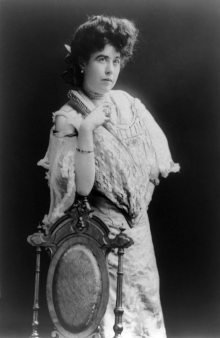
Margaret Brown (née Tobin), an American socialite and philanthropist posthumously known as “The Unsinkable Molly Brown”, dies in New York City on October 26, 1932. She is best remembered for unsuccessfully encouraging the crew in Lifeboat No. 6 to return to the debris field of the 1912 sinking of RMS Titanic to look for survivors. During her lifetime, her friends called her “Maggie”, but even by her death, obituaries refer to her as the “Unsinkable Mrs. Brown.” The reference is further reinforced by a 1960 Broadway musical based on her life and its 1964 film adaptation which are both entitled The Unsinkable Molly Brown.
Tobin is born in a hospital near the Mississippi River in Hannibal, Missouri, on what is now known as Denkler’s alley. Her parents are Irish Catholic immigrants. At age 18, she relocates to Leadville, Colorado, with her siblings Daniel Tobin, Mary Ann Collins Landrigan and Mary Ann’s husband John Landrigan. Margaret and her brother Daniel share a two-room log cabin and she finds a job in a department store.
In Leadville, she meets and marries James Joseph “J.J.” Brown (1854–1922), an enterprising, self-educated man, in Leadville’s Annunciation Church on September 1, 1886. They have two children.
The Brown family acquires great wealth when in 1893 J.J.’s mining engineering efforts prove instrumental in the production of a substantial ore seam at the Little Jonny Mine of his employers, Ibex Mining Company, and he is awarded 12,500 shares of stock and a seat on the board. In Leadville, Margaret helps by working in soup kitchens to assist miners’ families.
In 1894, the Browns purchase a $30,000 Victorian mansion in Denver and in 1897 they build a summer house, Avoca Lodge in Southwest Denver near Bear Creek, which gives the family more social opportunities. Margaret becomes a charter member of the Denver Woman’s Club, whose mission is the improvement of women’s lives by continuing education and philanthropy. After 23 years of marriage, Margaret and J.J. privately sign a separation agreement in 1909. Although they never reconcile, they continue to communicate and care for each other throughout their lives.
Brown spends the first months of 1912 traveling in Egypt as part of the John Jacob Astor IV party, until she receives word from Denver that her eldest grandchild, Lawrence Palmer Brown Jr., is seriously ill. She immediately books passage on the first available liner leaving for New York, the RMS Titanic. Originally her daughter Helen is supposed to accompany her, but she decides to stay on in Paris, where she is studying at the Sorbonne.
The RMS Titanic sinks in the early morning hours of April 15, 1912, after striking an iceberg. Brown helps others board the lifeboats but is finally persuaded to leave the ship in Lifeboat No. 6. Brown is later called “The Unsinkable Molly Brown” by authors because she helps in the ship’s evacuation, taking an oar herself in her lifeboat and urging that the lifeboat go back and save more people. After several attempts to urge QuartermasterRobert Hichens to turn back, she threatens to throw him overboard. Sources vary as to whether the boat goes back and if they find anyone alive. Brown’s efforts seal her place in history, regardless.
Upon being rescued by the RMS Carpathia, Brown proceeds to organize a survivors’ committee with other first-class survivors. The committee works to secure basic necessities for the second- and third-class survivors and even provides informal counseling.
During the last years of her life, Brown is an actress. She dies in her sleep on October 26, 1932, at the Barbizon Hotel in New York City, New York. Subsequent autopsy reveals a brain tumor. She is buried on October 31 alongside her husband in the Cemetery of the Holy Rood in Westbury, New York, following a small ceremony attended only by family members. There is no eulogy.
O’Brien shares his primary education with a townsman with whom he is later to have a close political connection, CanonPatrick Augustine Sheehan of Doneraile. He enjoys his secondary education at the Cloyne diocesan college, which results in his being brought up in an environment noted for its religious tolerance. He greatly values having had this experience from an early age, which strongly influences his later views for the need of such tolerance in Irish national life.
A journalist from 1869, O’Brien is appointed editor of the Irish Land League’s weekly United Ireland by Parnell in 1881. In October of that year the British authorities suppress the paper and put O’Brien in Kilmainham Gaol in Dublin, along with Parnell and others. There he draws up a No Rent Manifesto, which, when read at a Land League meeting, results in the outlawing of the League. Released from prison in 1882, he resumes the editorship of United Ireland, and in 1883 he is elected to the British House of Commons, remaining there until 1895. His “plan of campaign” is disavowed by Parnell but nonetheless stirs up fierce agitation. To suppress the movement, the British government passes the Criminal Law and Procedure (Ireland) Act 1887, under which O’Brien is jailed again.
For some time following the O’Shea divorce case (1889–90), in which Parnell is corespondent, O’Brien attempts to mediate between the Parnellites and their opponents, although he sides with the majority in rejecting Parnell’s continued leadership of the Irish Home Rule struggle. In 1902 he supports the Land Conference, which secures agreement between landlords and tenants’ representatives and results in George Wyndham‘s Land Purchase Act (1903), which is designed to turn Irish tenant farmers into occupying owners.
Retiring from political life, O’Brien contents himself with writing and declines Éamon de Valera‘s offer to stand for Fianna Fáil in the 1927 general election. He dies suddenly at the age of 75 on February 25, 1928, while on a visit to London with his wife. His remains rest in Mallow, and one of the principal streets in the town bears his name to this day. His head-bust overlooks the town Council’s Chamber Room and one of his finest portraits hangs in University College Cork.
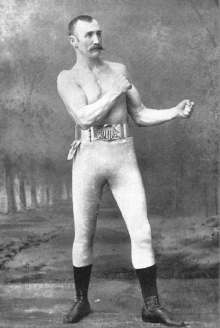
Mike Donovan, middleweight boxer of the bare-knuckle era also known as Professor Mike Donovan and Mike O’Donovan, is born in Chicago, Illinois on September 27, 1847, to Irish-born parents. He later becomes one of the foremost teachers of the sport.
The first of many memorable events in Donovan’s life comes when he fights for the Union Army in the American Civil War, serving in William Tecumseh Sherman‘s army in its march through Georgia. After the war, he begins a boxing career that associates him with some of the best-known people of his age, in and out of the ring.
In 1868, Donovan defeats John Shanssey in a bout in Cheyenne, Wyoming, refereed by famous Western lawman Wyatt Earp. He wins the middleweight title in 1887 in San Francisco. He also fights the most famous Irish boxing champion in history, John L. Sullivan, fighting two four-round fights with him in 1880 and 1881.
After his active boxing career ends, Donovan becomes a boxing instructor at the New York Athletic Club and works with several famous Irish fighters. He is in Jake Kilrain‘s corner when he loses to John L. Sullivan in the last bare-knuckle heavyweight championship fight, and also helps James Corbett when he defeats Sullivan for the title in 1892.
Donovan spars with PresidentTheodore Roosevelt, who loves boxing, on several occasions. He earns the sobriquet “Professor” for his scientific approach to his own career and in his later teaching of the sport. The “Professor” leaves a legacy, as well. His son Arthur is a famous boxing referee in the 1930s and 1940s and is enshrined in the International Boxing Hall of Fame along with the “Professor,” the only father-son combination so honored. His grandson, also Art, plays for the Baltimore Colts in the National Football League and is enshrined in the Pro Football Hall of Fame in Canton, Ohio.
Donovan dies on March 24, 1918, at St. Francis Hospital in the Bronx, New York from complications from a bout with pneumonia he develops while teaching a boxing class. He is survived by his wife, Cecilia, and eight children, all who are at his bedside when he dies. After his death, his will indicates that his last name is actually O’Donovan.
The Volunteers in County Clare have been active since 1917 and by late 1920 have forced the Royal Irish Constabulary (RIC) to abandon most of its small rural barracks in the county. This gives the IRA greater freedom to move in the countryside. In August 1920, the RIC are reinforced by the British deployment of Black and Tans and Auxiliaries to the county. Five RIC men, eleven IRA volunteers and four civilians have been killed in County Clare during the two years before the ambush.
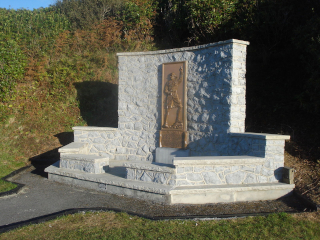
The Rineen Ambush is ordered by the leadership of the IRA’s Mid-Clare Brigade, who had noticed that a RIC lorry travels every week on the Ennistymon to Milltown Malbay road. John Joe Neylon, leader of the local IRA battalion, is put in charge, although the actual attack is led by Ignatius O’Neill, the Officer Commanding. He is a veteran of World War I who had formerly fought with the Irish Guards. The ambush party has only nine rifles and some grenades, the remainder being armed with shotguns or handguns. They prepare to attack the lorry from a railway bridge that overlooks the road at Rineen.
As the IRA party is lying in wait, Alan Lendrum, the local resident magistrate, drives unwittingly into a roadblock of the IRA’s West Clare Brigade, in an unrelated action. He is stopped at a railway crossing at Caherfeenick near Doonbeg. When the IRA demand he surrender his car, he draws an automatic pistol and the IRA men shoot him twice in the head, fatally wounding him. The IRA weights his body with stones and dumps it in a nearby lake. Even though the British Military inquest establishes that Lendrum had died of gunshot wounds, members of the RIC in Clare spread a false version of events and claim that Lendrum had died of drowning.
Although in strict military sense not related to the ambush, it has serious consequences for the ambush. It is quite quickly noticed that the magistrate is missing and the military in Ennistymon decide to send out a search party of ten lorries of soldiers.
The RIC lorry passes safely through the ambush position, travelling from Ennistymon to Milltown Malbay, due to some confusion among the IRA over the numbers they face. However, when they learn that there is only one lorry, it is attacked on its return journey from Milltown Malbay. The lorry is hit by a grenade and blasted at close range by rifle and shotgun fire. The shooting is over in seconds, with five out of the six RIC men being killed outright. The sixth man manages to run about 300 yards before being shot dead. Five of the dead are Irish RIC officers and one is an English Black and Tan. The IRA take their weapons and burn the lorry.
Not long after the lorry has been set ablaze, the ten-lorry search party arrives on the scene. A running fight develops, as four IRA riflemen keep the troops at bay while the other volunteers make their escape. Two IRA volunteers and several British soldiers are wounded in the firing. Padraic O’Farrell lists the casualties as three British soldiers killed, but this is not confirmed by the other sources.
The British forces, enraged by the ambush and the escape of the IRA force, take out reprisals on civilians in the surrounding area. Immediately after the action ends, they burn the house and farm of the O’Gorman family and shoot a local farmer, Sean Keane, who later dies of his wounds.
That night, a mixed force of police and soldiers raid the Lahinch home of Dan Lehane, whose two sons had taken part in the ambush. They shoot him dead and burn his house. Patrick Lehane, who is hiding in the attic, perishes in the blaze. Several other houses are burned in Lahinch and a further eight are razed in Milltown Malbay. A separate RIC raid takes place in Ennistymon, in which several homes and businesses are burned.
In what may have been a belated reprisal for the ambush, four IRA men are arrested by the Auxiliaries at Killaloe on November 16, beaten, interrogated and then shot dead. Another two are summarily executed in the same manner on December 22 at Kilkee.
The reprisals are condemned in the British, Irish and international press. In the House of Commons, the British Labour Party tables a resolution condemning the reprisals and calling for an investigation. This is defeated by 346 votes to 79. Hamar Greenwood, the Chief Secretary for Ireland, defends the State Forces’ actions, saying that the houses destroyed were those of “notorious Sinn Féiners…I am convinced that the people of those two villages knew of this ambush.”
In Clare itself, according to IRA man Anthony Malone, the ambush has two effects. One is that the RIC becomes careful to travel in convoys of no less than three lorries. The other is that, as a result of the reprisals, the civilian population becomes embittered against the British and adopt a more defiant attitude to the British military and Black and Tans.
The death of Resident Magistrate Alan Lendrum, however, according to pro-republican Catholic priest Sean Gaynor, “was not to our credit.” On October 1, the local IRA remove Lendrum’s body from the lake, put it in a roughly constructed coffin and leave it on the railway tracks at Craggaknock railway station for British forces to find.
(Pictured: Monument for the attack at Rineen during the Irish War of Independence, designed by Walter Kiernan)
Luce is the fourth son of the Reverend John James Luce and Alice Luce (née Stubbs). He is educated at Lindley Lodge School and Eastbourne College. He enters Trinity College, Dublin in 1901. He obtains his BA in 1905, BD in 1908 and MA in 1911.
Luce’s earlier work focuses largely on theological matters within Christianity. His academic career is interrupted by World War I, in which he serves with the 12th Royal Irish Rifles. He is awarded the Military Cross in 1917. After the war, he publishes “Monophysitism Past and Present” (1921) which deals with the nature of Jesus and his relationship to the world. The following year, he publishes his Donnellan Lectures on Henri Bergson where he examines issues in psychology and evolution as well as religion.
From the 1930s, Luce becomes interested in the Irish philosopher George Berkeley. He feels many of the previous studies of Berkeley are in many ways inadequate and sometimes wrong. His unearthing of new sources on Berkeley as well as better ways of interpreting existing sources guide his work in this direction. He stresses the role of the French monk Nicolas Malebranche on influencing the thought of the young Berkeley. Prior to his Berkeley and Malebranche (1934), Berkeley had been seen almost solely in the patrimony of John Locke and empiricism.
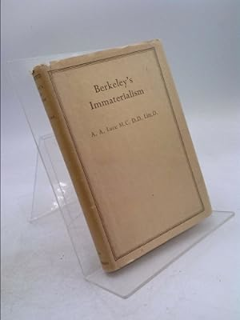
Berkeley’s mature philosophy is given lucid exposition by Luce in his 1945 work “Berkeley’s Immaterialism”. Along with Thomas Edmund Jessop, he edits The Works of George Berkeley (in nine volumes, 1948–1957).
Luce is not only a Berkeley scholar but comes to be a believer in Berkelianism itself. In “Sense without Matter” (1954) he attempts to bring Berkeley up to date by modernising the philosopher’s vocabulary and putting the issues Berkeley faced in today’s terms.
Berkeley’s personal reputation among historians and the public is also an area which Luce feels needs correcting and updating. Some studies of Berkeley had contributed to his reputation as a dreamer or a loner who often hid his real views. Luce’s “Life of George Berkeley, Bishop of Cloyne” (1949) takes aim at this picture of Berkeley and, by careful use of often new sources, paints a more grounded picture of the man.
In 1918, Luce marries Lilian Mary Thomson, with whom he has three children. Tragically, his wife and young daughter drown in 1940. His elder son, Professor John Victor Luce (1920–2011), is also an academic at Trinity and also serves as vice-provost.
Luce dies in Dublin on June 28, 1977, shortly after an assault by a man who has an antipathy towards clergymen.
Alfred Charles William Harmsworth, Viscount Northcliffe, one of the most successful newspaper publishers in the history of the British press and a founder of popular modern journalism, is born on July 15, 1865 in Chapelizod, near Dublin.
After an impoverished childhood and a few attempts at making a quick fortune, young Harmsworth embarks on freelance journalism as a contributor to popular papers, rises to editorial positions, and starts a paper called Answers to Correspondents. After some difficulty in securing financial backing, he begins publication, soon shortening the name to Answers. As the paper gains public favour, he is joined by his brother Harold, whose financial ability and capacity for attracting advertising, combined with Alfred’s genius for sensing the public taste, make it a success. Answers is followed by many other inexpensive popular periodicals, chief among them Comic Cuts and Forget-Me-Not, for the new reading public of women. These form the basis for what becomes Amalgamated Press, the largest periodical-publishing empire in the world.
In 1894 Harmsworth enters the newspaper field, purchasing the nearly bankrupt London Evening News and transforming it into a popular newspaper with brief news reports, a daily story, and a column for women. Within a year circulation grows to 160,000 copies, and profits are substantial. Conceiving the idea of a chain of halfpenny morning papers in the provinces, he purchases two papers in Glasgow, Scotland, and merges them into the Glasgow Daily Record. He then decides to experiment with a popular national daily in London. The Daily Mail, first published on May 4, 1896, is a sensational success. Announced as “the penny newspaper for one halfpenny” and “the busy man’s daily journal,” it is exactly suited to the new reading public. All news stories and feature articles are kept short, and articles of interest to women, political and social gossip, and a serial story are made regular features. With its first issue, the Daily Mail establishes a world record in daily newspaper circulation, a lead it never loses during Harmsworth’s lifetime.
Next Harmsworth purchases the Weekly Dispatch when it is nearly bankrupt and transforms it into the Sunday Dispatch, the biggest-selling Sunday newspaper in the country. In 1903 he founds the Daily Mirror, which successfully exploits a new market as a picture paper, with a circulation rivaling that of the Daily Mail. He saves The Observer from extinction in 1905, the year in which he is made Baron Northcliffe. In 1908 he reaches the pinnacle of his career by securing control of The Times, which he transforms from a 19th-century relic into a modern newspaper.
Northcliffe’s contributions to the British effort in World War I begin with his early exposure in the Daily Mail of the British army’s shell shortage. His criticisms of Lord Kitchener arouse intense resentment in some quarters, but he also presses for the creation of a separate Ministry of Munitions and for the formation in 1915 of a wartime coalition government. For his service as head of the British war mission in the United States in 1917, he is created a viscount. He acts as the British government’s director of propaganda aimed at Germany and other enemy countries in 1918. By this time Northcliffe’s press empire appears to hold such power over public opinion that he tries unsuccessfully to influence the composition of Prime MinisterDavid Lloyd George’s cabinet. Always unpredictable, he becomes the victim of a megalomania that damages his judgment and leads to the breakdown that precedes his death.
Harmsworth’s health declines during 1921 due mainly to a streptococcal infection. He goes on a world tour to revive himself, but it fails to do so. He dies of endocarditis in a hut on the roof of his London house on August 14, 1922, leaving three months’ pay to each of his six thousand employees. The viscountcy, barony, and baronetcy of Northcliffe become extinct upon his death. His body is buried at East Finchley Cemetery in North London.
Northcliffe’s success as a publisher rests on his instinctive understanding of the new reading public that had been created by compulsory education. Though he wants political power, the effect of his newspapers upon public affairs is generally considered to have been smaller than he believed. His influence lay rather in changing the direction of much of the press away from its traditional informative and interpretative role to that of the commercial exploiter and entertainer of mass publics.