Shanahan joins the Holy Ghost Order in France in 1886, where his uncle Pat Walsh (Brother Adelm) had also joined the Holy Ghost Fathers. In 1889, he is transferred to the French Juniorate of the Congregation in Cellule in the Auvergne. He makes his profession on Easter Sunday 1898 and his ordination takes place on April 22, 1900 in the Blackrock College chapel.
By mid-July 1902, Shanahan has received his appointment for Nigeria to help Fr. Léon Lejeune make bricks to build the first proper mission house in Onitsha.
Shanahan is instrumental in the setting up of the Saint Patrick’s Society for the Foreign Missions, sometimes known as the Kiltegan Fathers, when in 1920, following his ordination in Maynooth as Bishop for Southern Nigeria (then a British protectorate), he appeals to students in Maynooth College for missionaries to Nigeria and Africa.
In 1924 Bishop Shanahan founds a missionary society for women, the Missionary Sisters of the Holy Rosary, in Killeshandra, County Cavan.
Always revered as a saint by those in close contact with him, Shanahan’s cause for Beatification is introduced officially on November 15, 1997 in Onitsha cathedral.
In the 1890s Stopford Green becomes interested in Irish history and the nationalist movement as a result of her friendship with John Francis Taylor. She is vocal in her opposition to English colonial policy in South Africa during the Boer Wars and supports Roger Casement‘s Congo Reform movement. Her 1908 book The Making of Ireland and its Undoing argues for the sophistication and richness of the native Irish civilisation. She is active in efforts to make the prospect of Home Rule more palatable to Ulster Unionists. She is closely involved in the Howth gunrunning.
Stopford Green moves to Dublin in 1918 where her house at 90 St. Stephen’s Green becomes an intellectual centre. She supports the pro-Treaty side in the Irish Civil War and is among the first nominees to the newly formed Seanad Éireann in 1922, where she serves as an independent member until her death in Dublin on May 28, 1929, two days shy of her 82nd birthday. She is one of four women elected or appointed to the first Seanad in 1922.
Born to a family of Irish landed gentry, he lives on his father’s plantation in Ceylon until the age of five, when they return to the family home in Nenagh, County Tipperary. Following prep school at Mourne Grange, he goes on to Shrewsbury School, where he wins the Public Schools 402 metres, and at Gonville and Caius College, Cambridge, where he wins a record four events – 402 metres and 110 metres hurdles, long jump and shot put – in the annual match against Oxford. This record is only equaled nearly 60 years later.
Tisdall sets South African and Canadian records in the 201 metres low hurdles in 1929, a year later setting Greek records in the same event. While at Cambridge in March 1932, he decides to try for a place on the Irish Olympic squad and, after he runs a record 54.2 seconds for the Irish Championship 402 metres hurdles in June that year, the authorities agree to let him run in his new event at the Los Angeles Olympic Games.
Tisdall had run only six 400 metres hurdles when he wins the gold medal at the 1932 Olympic Games in a world record time of 51.7 seconds, which is not recognised under the rules of the time because he had a hit a hurdle. Later, because of the notoriety of this incident, the rules are changed and the President of the International Olympic Committee, Juan Antonio Samaranch, presents Tisdall with a Waterford Crystal rose bowl with the image of him knocking over the last hurdle etched into the glass. Though the International Amateur Athletic Federation (IAAF) did not recognise the record at the time, they now recognise the mark, giving Tisdall credit for setting the milestone of being the first man under 52 seconds.
Following his victory, Tisdall is invited to a dinner in Los Angeles where he is seated next to Amelia Earhart on one side and Douglas Fairbanks, Jr. on the other.
Later in life, Tisdall lives in South Africa, where he runs a gymnasium during the day, which he converts to a night club after dark. He grows coffee in Tanzania, but moves to Nambour, Queensland in 1969 with his wife Peggy, where he farms fruit crops and cattle. He admits to running his last race at the age of 80, though he runs in the Sydney Olympics torch relay at age 93. At that point he is the oldest living recipient of an individual track and field Olympic medal。
At the age of 96 Tisdall falls down a steep set of rock stairs and breaks his shoulder, ribs and ruptures his spleen. He never completely recovers and dies on July 27, 2004. At that time, he is the world’s oldest track and field Olympic Gold medalist. He does not want a funeral because “they are altogether too sad.” His wake is attended by family and a few friends.
In 2002, three statues honouring Olympic champions with links to Nenagh, Matt McGrath, Johnny Hayes and Bob Tisdall, are unveiled in front of the Nenagh Courthouse.
Balfe’s musical gifts become apparent at an early age. He receives instruction from his father, a dancing master and violinist, and the composer William Rooke. His family moves to Wexford when he is a child.
In 1817, Balfe appears as a violinist in public, and in this year composes a ballad, first called “Young Fanny” and afterwards, when sung in Paul Pry by Lucia Elizabeth Vestris, “The Lovers’ Mistake”. In 1823, upon the death of his father, he moves to London and is engaged as a violinist in the orchestra of the Theatre Royal, Drury Lane. He eventually becomes the leader of that orchestra. While there, he studies violin with Charles Edward Horn and composition with Charles Frederick Horn.
While still playing the violin, Balfe pursues a career as an opera singer. He debuts unsuccessfully at Norwich in Carl Maria von Weber‘s Der Freischütz. In 1825, Count Mazzara takes him to Rome for vocal and musical studies and introduces him to Luigi Cherubini. In Italy, he also pursues composing, writing his first dramatic work, a ballet, La Perouse. He becomes a protégée of Gioachino Rossini‘s, and at the close of 1827, he appears as Figaro in The Barber of Seville at the Italian opera in Paris.
Balfe soon returns to Italy, where he is based for the next eight years, singing and composing several operas. In 1829 in Bologna, he composes his first cantata for the soprano Giulia Grisi, then 18 years old. He produces his first complete opera, I rivali di se stessi, at Palermo in the carnival season of 1829—1830.
Balfe returned to London in May 1835. His initial success takes place some months later with the premiere of The Siege of Rochelle on October 29, 1835, at Drury Lane. Encouraged by his success, he produces The Maid of Artois in 1836, which is followed by more operas in English. In July 1838, Balfe composes a new opera, Falstaff, for The Italian Opera House, based on The Merry Wives of Windsor, with an Italian libretto by S. Manfredo Maggione.
In 1841, Balfe founds the National Opera at the Lyceum Theatre, but the venture is a failure. The same year, he premieres his opera, Keolanthe. He then moves to Paris, presenting Le Puits d’amour in early 1843, followed by his opera based on Les quatre fils Aymon for the Opéra-Comique and L’étoile de Seville for the Paris Opera. Meanwhile, in 1843, he returns to London where he produces his most successful work, The Bohemian Girl, on November 27, 1843, at the Theatre Royal, Drury Lane. The piece runs for over 100 nights, and productions are soon mounted in New York, Dublin, Philadelphia, Vienna, Sydney, and throughout Europe and elsewhere.
From 1846 to 1852, Balfe is appointed musical director and principal conductor for the Italian Opera at Her Majesty’s Theatre. There he first produces several of Giuseppe Verdi‘s operas for London audiences. He conducts for Jenny Lind at her opera debut and on many occasions thereafter.
In 1851, in anticipation of The Great Exhibition in London, Balfe composes an innovative cantata, Inno Delle Nazioni, sung by nine female singers, each representing a country. He continues to compose new operas in English, including The Armourer of Nantes (1863), and writes hundreds of songs. His last opera, nearly completed when he dies, is The Knight of the Leopard and achieves considerable success in Italian as Il Talismano.
In all, Balfe composes at least 29 operas. He also writes several cantatas and a symphony. His only large-scale piece that is still performed regularly today is The Bohemian Girl.
Brady is a member of the Irish National Invincibles, usually known as the Invincibles, a splinter group of the Irish Republican Brotherhood. This group of assassins is active in Dublin between late 1881 and 1883, with an intent to kill the authorities in Dublin Castle.
The first assassination in the park is committed by Brady, who attacks Burke with a 12-inch knife, followed in short order by Tim Kelly, who knifes Cavendish. Both men use surgical knives. The British press expresses outrage and demands that the “Phoenix Park Murderers” be brought to justice.
A large number of suspects are arrested. By playing one suspect against another, Superintendent Mallon of G Division of the Dublin Metropolitan Police gets several of them to reveal what they know. The Invincibles’ leader, James Carey, and Michael Kavanagh agree to testify against the others. Carey is ultimately given passage to South Africa but is shot on board the Melrose Castle by Patrick O’Donnell. O’Donnell is brought back to England and hanged in December 1883.
Brady, Michael Fagan, Thomas Caffrey, Dan Curley and Tim Kelly are hanged by William Marwood in Kilmainham Gaol in Dublin beginning with Brady’s execution on May 14 and and continuing until June 4. Others are sentenced to long prison terms.
No member of the founding executive, however, is ever brought to trial by the British government. John Walsh, Patrick Egan, John Sheridan, Frank Byrne, and Patrick Tynan are welcomed in the United States, where sentiment toward the murders is less severe, although not celebratory.
Brady by all accounts was a mountain of a man. The Times writes following his execution: “He was brought up as a stonemason of herculean strength, his occupation developing the muscular power of his arms, which told with such terrible effect when he drove the knives into the bodies of Lord Cavendish and his secretary T. H. Burke.”
Kilmainham Gaol contains the graves of the Invincibles convicted and executed for the Phoenix park stabbings.
The first production of the Irish Literary Theatre, The Countess Cathleen, is performed on May 8, 1899. Like many of William Butler Yeats’ plays, it is inspired by Irish folklore. In a time of famine, demons sent by Satan come to Ireland to buy the souls of the starving people. The saintly Cathleen disposes of her vast estates and wealth in order to feed the peasants, yet the demons thwart her at every turn. At last, she sacrifices her own soul to save those of the poor.
Yeats, Lady Gregory and Edward Martyn publish a “Manifesto for Irish Literary Theatre” in 1897, in which they proclaim their intention of establishing a national theatre for Ireland. The Irish Literary Theatre is founded by Yeats, Lady Gregory, Martyn and George Moore in Dublin in 1899. It proposes to give performances in Dublin of Irish plays by Irish authors.
In 1899 Lady Gregory secures a temporary licence for a play to be given at the Antient Concert Rooms in Great Brunswick Street (now Pearse Street) in Dublin and so enables the Irish Literary Theatre to give its first production. The play chosen is The Countess Cathleen by Yeats. It is done by a very efficient London company that includes May Whitty (Dame May Webster) and Ben Webster. The next production given is Martyn’s play The Heather Field.
In the following year the Irish Literary Theatre produces three plays at the Gaiety Theatre in Dublin: Maeve by Edward Martyn, The Last Feast of Fianna by Alice Milligan and The Bending of the Bough by George Moore. The Bending of the Bough is staged during the Second Boer War which begins on October 11, 1899.
The Irish Literary Theatre project lasts until 1901, when it collapses due to lack of funding.
The use of non-Irish actors in these productions is perceived to be a failure, and a new group of Irish players is put together by the brothers William and Frank Fay, among others. These go on to form the Irish National Theatre Society, which leads to the founding of the Abbey Theatre in Dublin in 1904.
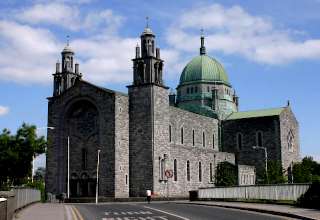
The Diocese of Galway is created on April 23, 1831. The diocese has its origins in the ancient Kilmacduagh monastery and the Wardenship of Galway (1484–1831). Following the abolition of the Wardenship by the Holy See in 1831, the first Bishop of the new Diocese of Galway is appointed in the same year.
The bishopric of Kilmacduagh had been a separate title until 1750 when Pope Benedict XIV decrees that it is to be united with the bishopric of Kilfenora. Since Kilmacduagh is in the Ecclesiastical province of Tuam while Kilfenora is in the Province of Cashel, it is arranged that the ordinary of the united dioceses is to be alternately bishop of one diocese and apostolic administrator of the other. The first holder of this unusual arrangement is Peter Kilkelly, who had been Bishop of Kilmacduagh since 1744. He becomes Apostolic Administrator of Kilfenora in September 1750. Since that date, Kilfenora has been administered by that united diocese as an apostolic vicariate. Since the territory of an apostolic vicariate comes directly under the pope as “universal bishop”, the pope exercises his authority in Kilfenora through a “vicar.”
Around 1880, O’Shea’s wife, Katharine O’Shea, enters into a relationship with the Irish nationalist leader Charles Stewart Parnell, with whom she has three children. O’Shea, who is already separated from his wife, is aware of the relationship.
In 1882 when the Liberal Government is secretly negotiating with Parnell for the terms of his release from Kilmainham Gaol where he is being held on suspicion of “treasonable practices”, the President of the Board of TradeJoseph Chamberlain chooses O’Shea as its intermediary, unaware of Parnell’s affair with Mrs. O’Shea or of the fact that the newly born first child of their liaison is dying. O’Shea spends six hours negotiating with Parnell in the prison, extracting the surprising concession that Parnell would tacitly support the Government after his release. It has been suggested that O’Shea won this concession, which reflected well on him, by threatening Parnell with public exposure of his affair with Mrs O’Shea.
In 1886, following insinuations of the Parnell affair and O’Shea’s complicity in it appearing in The Pall Mall Gazette, O’Shea abstains from voting on the Irish Home Rule bill and resigns his parliamentary seat the following day. However, he only files for divorce in 1890 after his wife’s aunt, from whom he is expecting a large inheritance, dies in 1889 leaving her estate in trust for his wife, thus allegedly violating the terms of O’Shea’s marriage contract. However, that will is overturned upon appeal, and the aunt’s legacy is shared among Katharine O’Shea’s siblings.
After the divorce the two surviving children of Parnell and Katharine O’Shea are given into Captain O’Shea’s custody.
Born Kathleen Annie Josephine Madden, she is the only daughter of banker Paul J. Madden, who is Mayor of Cork in 1885–1886 and a friend of Charles Stewart Parnell, and Eliza Madden (née Dwyer). She is educated privately at her family home, Wood’s Gift, Blackrock Road.
On February 16, 1901, five weeks after her father’s death, she marries the writer Ernest Temple Thurston. They separate in 1907 and are divorced in 1910 on grounds of his adultery and desertion. The suit goes undefended. Thurston “complained that she was making more money by her books than he was, that her personality dominated his, and had said that he wanted to leave her.”
Thurston’s novels achieve success in Britain and the United States. Her best-known work is a political thriller entitled John Chilcote, M.P. (as The Masquerader in the United States), published in 1904 and on The New York Times bestseller list for two years, ranking as third best-selling book for 1904 and seventh best in 1905. Her next book, The Gambler, comes out in 1905 and it too makes the U.S. best-selling lists for that year. This is the first time The New York Times had recorded any author, female or male, as having two top ten books in a single year. In 1910, she is back on the same list at No. 4 with her novel Max, the story of a young Russian princess, who flees disguised as a boy to the Montmartre Quarter of Paris, on the night before her arranged marriage.
John Chilcote, M.P. is adapted for the stage by John Hunter Booth and opens on Broadway in 1917. It is filmed four times, the first silent film by American Pathé in 1912 under the title The Compact and starring Crane Wilbur. The second film is a 1920 Russian/French co-production entitled Chlen parlamenta. Two more films are made using the American book title The Masquerader, in 1922 and then by The Samuel Goldwyn Company in 1933 as a “talkie” starring Ronald Colman.
An epileptic, Thurston’s blossoming career is cut short at the age of 36 when she is found dead in her hotel room in Cork on September 5, 1911. The official enquiry the following day gives the cause of death as asphyxia as result of a seizure. She had been due to remarry later in the month to Dr. A. T. Bulkeley Gavin. She is buried in St. Joseph’s Cemetery, Cork. The story of her final years and her relations with Bulkeley Gavin are the subject of a published thesis by C. M. Copeland, written while studying at the Napier University, Edinburgh.
Noonan is the illegitimate son of Samuel Croker, a senior member of the Royal Irish Constabulary. He is baptised and raised a Roman Catholic by his mother Mary Noonan. His father, who is not Catholic, has his own family, but attempts to provide for Robert until his death in 1875.
By 1875 Noonan is living in London. When he is sixteen, he shows signs of a radical political consciousness. He leaves his family declaring he “would not live on the family income derived largely from absentee landlordism.” It is around this time he changes his surname to his mother’s maiden name.
In 1890, Noonan is a sign writer living in Queen’s Road, Everton, Liverpool. On June 10, 1890, he appears at Liverpool County Intermediate Sessions court at County Sessions House, Islington, Liverpool on charges of housebreaking and larceny. He is found guilty and given a six-month prison sentence.
By 1891, Noonan has moved to Cape Town, South Africa, where he is a painter and decorator. He marries in 1891, but the marriage is an unhappy one, with his wife having numerous affairs after the birth of their daughter, Kathleen. They divorce in 1895, and Noonan acquires all the property, including their house in an affluent suburb of Cape Town.
Noonan and his daughter move to Johannesburg, where he secures a well-paying job with a construction company. It is here that he learns the ways of the industry he would later write about in his novel, although Noonan’s actual circumstances vary greatly from the proletarian characters of the book. After becoming Secretary of the Transvaal Federated Building Trades Council, he is able to send his daughter to an exclusive convent school and also to employ a black manservant called Sixpence.
In 1897, Noonan leads a successful protest against the employment of black skilled labour. During 1898, he becomes a member of the Transvaal Executive Committee of the Centennial of 1798 Association, which commemorates the revolutionary nationalistSociety of United Irishmen. As a 1798 Association member, he helps form the Irish Brigades, an anti-British force that fights alongside the Boers in the Second Boer War. At this point, accounts of his life differ. Some assert he takes up arms and is interned by the British until the end of the war, when he returns to Britain. Others say he leaves South Africa just before hostilities began in October 1899.
In any event, around the turn of the century, Noonan ends up in Hastings, Sussex. Here, he finds work as a sign writer, but at much lower wages and in far poorer conditions than he had experienced in South Africa. He has to take part-time jobs in addition to his full-time position.
Influenced by the Marxist-influenced ideas of designer and socialist William Morris, he joins the Social Democratic Federation in 1906. The next year, after a dispute with his employer, he loses his job. Despite the demand for his skills, his health begins to deteriorate, and he eventually develops tuberculosis. Unemployed and unable to remain politically active, he starts writing, something he hopes will earn enough money to keep him from the workhouse.
He writes under the pen name Robert Tressell as he fears the socialist views expressed in the book will have him blacklisted. He completes The Ragged-Trousered Philanthropists in 1910, but the 1,600-page hand-written manuscript is rejected by three publishing houses. The rejections severely depress him, and his daughter has to save the manuscript from being burned.
Unhappy with his life in Britain, Noonan decides that he and Kathleen should emigrate to Canada. However, he only reaches Liverpool when he is admitted to the Royal Liverpool Infirmary, where he dies of pulmonary tuberculosis on February 3, 1911, at the age of 40. He is buried in a pauper’s grave at Liverpool Parochial Cemetery, later known as Walton Park Cemetery. The location of the grave is not rediscovered until 1970. Twelve other people are buried in the same plot. The plot is now marked although the land is no longer used as a cemetery and is now used by Rice Lane City Farm.
Kathleen mentions her father’s novel to a friend, writer Jessie Pope, who recommends it to her publisher. In April 1914, the publisher purchases the rights to the book for £25, and it appears in Britain, Canada and the United States later that year, in the Soviet Union in 1920, and in Germany in 1925. The version as originally published is heavily abridged by Pope, with much of the socialist ideology removed.
The original manuscript is subsequently located by F. C. Ball and, after he raises funds to acquire and reassemble the original version, an unabridged edition is published in 1955.